.svg)
 Healthcare
 Finance
 Retail
 SaaS & Digital
 eCommerce
 Education
 Salesforce
  HubSpot
 Pipedrive
 Mailchimp
 Klaviyo
 Zendesk
  Intercom
 Freshdesk
 HelpScout
  Front
Front Jira
Jira Slack
Slack  MS Teams
 Zoom
Zoom Google Sheets
  Zapier
  Integrately
 Make
Make  Webhooks




 MS Teams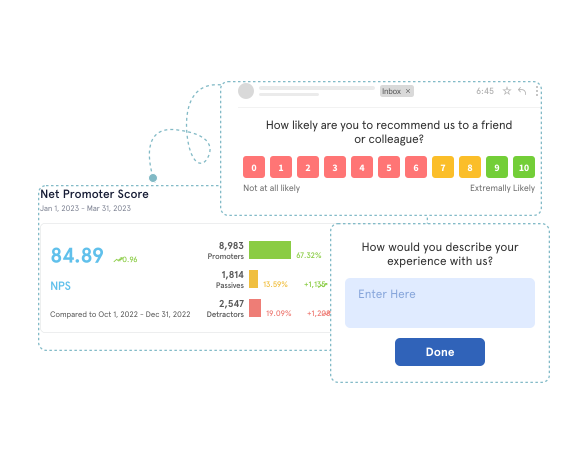


Chapter 1
Introduction to Net Promoter Score
Customer satisfaction doesn't guarantee loyalty. You can have satisfied customers who leave tomorrow for a better offer, a smoother experience, or no reason at all. You can also have customers so emotionally invested in your brand that they bring you referrals, defend you in public, and forgive the occasional mistake.
The difference between those two groups determines whether you grow or plateau.
Net Promoter Score (NPS) gives you a clear, data-driven way to measure that difference. It doesn't just track happiness in the moment. It reveals whether customers are emotionally committed enough to recommend you, which is the strongest predictor of retention and organic growth.
What is Net Promoter Score?
NPS is built around one question:
"How likely are you to recommend us to your friends or colleagues?"
Customers respond on a 0-10 scale, and their answer places them into one of three categories: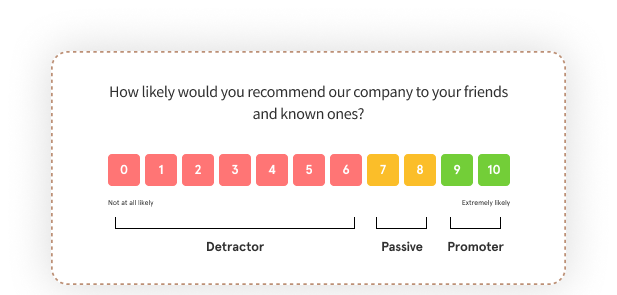
- Promoters (9-10): Loyal, enthusiastic customers who fuel word-of-mouth growth.
- Passives (7-8): Satisfied but uncommitted customers who won't advocate for you.
- Detractors (0-6): Unhappy customers who could actively damage your brand through negative feedback.
Your NPS score reflects the balance between Promoters and Detractors, ranging from -100 to 100. For more on what is net promoter score and how the scoring categories work in practice, see our complete definition guide.
The Origin of NPS: A Metric that Changed the Game
In 2003, Fred Reichheld of Bain & Company introduced NPS in his book, The Ultimate Question: Driving Good Profits and True Growth. His research revealed that customer loyalty was the single most accurate predictor of long-term business success.
The premise was simple: companies that create loyal customers grow faster than those that don't. And the easiest way to gauge loyalty? Ask if customers are willing to recommend you.
This insight changed how businesses measured success. Customer satisfaction was no longer enough. The real goal became turning customers into advocates.
Since then, over two-thirds of Fortune 1000 companies have adopted NPS, embedding it into their growth strategies. Companies like Apple, Amazon, Tesla, and American Express use NPS not just as a feedback tool, but as a strategic growth driver.
Measure Customer Loyalty with NPS ❤️
Create NPS surveys, measure loyalty, and close the feedback loop with Zonka Feedback.

Chapter 2
Why Does NPS Matter for Your Business?
In a world where 83% of consumers trust recommendations from friends and family, customer loyalty is no longer a soft metric. It's a direct revenue driver.
NPS tells you not just how customers feel about your brand, but how likely they are to stay, spend more, and bring others into your ecosystem. That makes it a leading indicator of business success.
Traditional vs. Modern NPS: The Shift from Static Scores to Real-Time Action
For years, businesses treated NPS as a static measurement tool. They collected feedback at set intervals, analyzed scores after the fact, and reacted too late. In today's fast-moving market, this outdated approach no longer drives meaningful change.
Traditional NPS (NPS 1.0 & 2.0): A Reactive Approach
A SaaS company sends out an NPS survey once a quarter to all customers. The results come in, and they notice a drop in scores from enterprise clients. By the time they analyze the responses, key accounts have already churned. Their team scrambles to reach out, but the damage is done. NPS was measured, but action came too late.
This was the problem with traditional NPS:
- Score-centric, not action-oriented: The focus was on collecting data rather than preventing churn.
- Delayed insights: By the time low scores were identified, customers had already disengaged.
- Siloed feedback: The CX team handled NPS, but insights weren't shared in real-time with product, sales, or customer success teams.
The Evolution: NPS 3.0 (Intelligent, Predictive, and Proactive)
The same SaaS company takes a real-time, predictive approach to customer loyalty. Instead of waiting for quarterly surveys, they embed transactional NPS at critical touchpoints: after onboarding, feature adoption, and support interactions.
- AI-driven sentiment analysis flags a decline in NPS from enterprise customers.
- An automated workflow alerts the account management team to engage at-risk accounts.
- Customer feedback is integrated across teams, allowing product managers to fix reported issues while sales strategizes retention efforts.
- Within hours, key clients receive personalized outreach, showing that their concerns are heard and addressed.
The difference? NPS becomes an active growth strategy. Traditional NPS was a lagging indicator, capturing customer sentiment too late. Modern NPS (NPS 3.0) is a proactive system that predicts churn, triggers immediate action, and drives continuous improvement.
This shift from passive measurement to real-time intervention is why today's most successful businesses don't just track NPS. They use it as a strategic engine for customer retention and revenue growth.
Chapter 3
How to Calculate NPS?
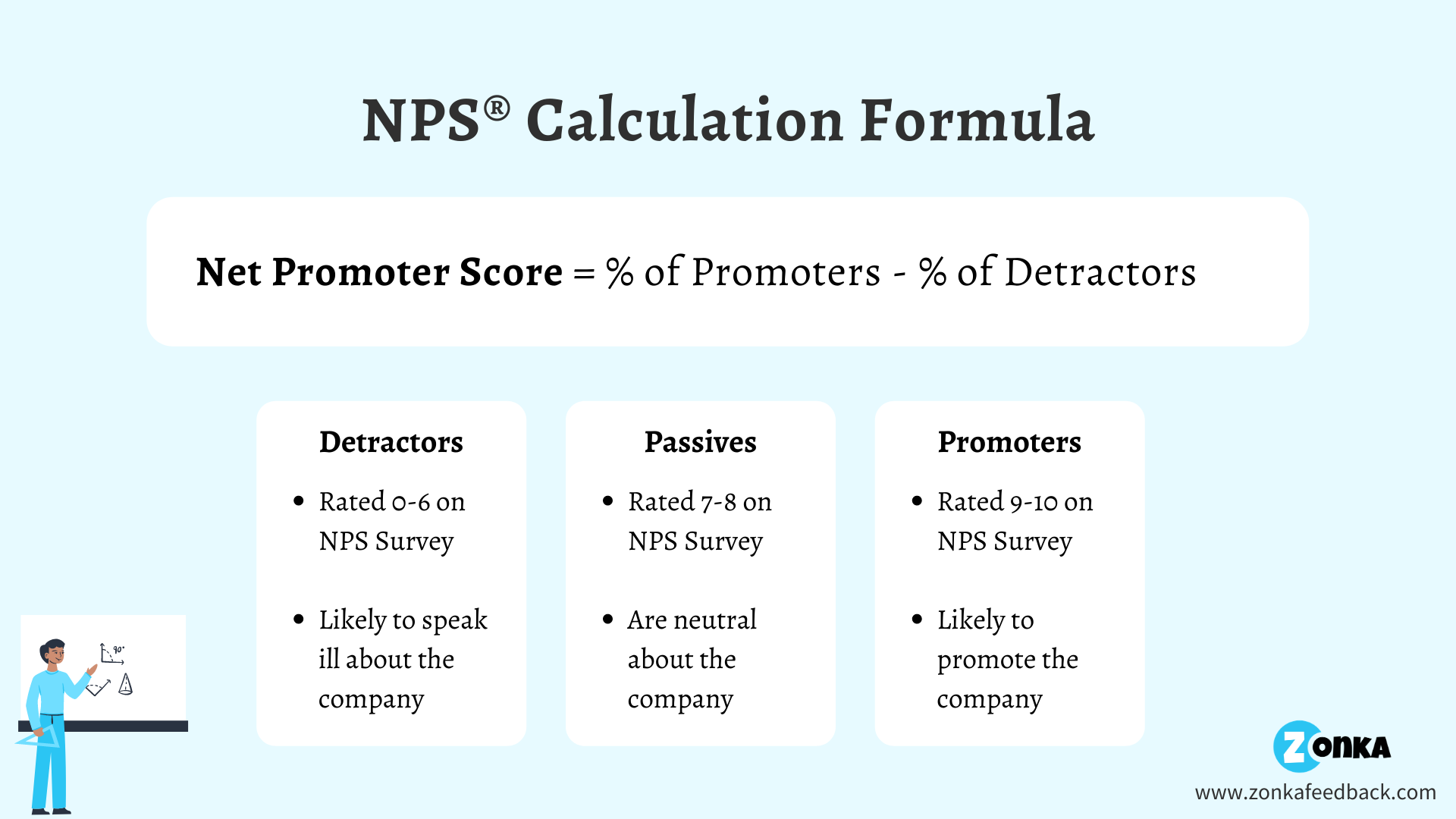
To calculate your NPS, subtract the percentage of Detractors from the percentage of Promoters. NPS can range from -100 to 100.
If you have more Detractors than Promoters, your NPS will be negative. If you have more Promoters, your score will be positive. The goal is to have significantly more Promoters than Detractors to drive sustainable growth and fuel word-of-mouth advocacy.
For a complete walkthrough of how to calculate net promoter score using Excel, Google Sheets, or automated software, see our calculation guide. You can also use our free NPS calculator for instant results.

What Is a Good Net Promoter Score?
There's no universal "passing" NPS score. Your benchmark should be based on industry standards and customer expectations.
General ranges:
- Above 50: Exceptional. Your business is likely growing through referrals and repeat business.
- 30 to 50: Strong. Your customers are loyal, but there's room for improvement.
- 0 to 30: Average, but vulnerable. You're not losing customers in droves, but you also aren't creating enough brand advocates to fuel growth.
- Below 0: Red flag. More customers are unhappy than happy.
A good NPS in one industry may not be satisfactory in another. Tech and SaaS companies typically aim for 35-50. Retail and e-commerce brands target 30-45. Financial services average 25-40. Healthcare and insurance often sit at 15-30 due to industry complexities.
For complete industry-by-industry benchmarks and guidance on what is a good net promoter score, see our benchmarks guide. For nps for b2b vs b2c breakdowns, see our comparison analysis.
Chapter 4
The Psychology Behind NPS: Why Customers Promote or Detract
Many businesses assume customers make decisions logically, comparing prices, features, and benefits. In reality, loyalty is driven by emotions, expectations, and perceived value.
A customer doesn't recommend your brand just because they had a smooth transaction. They promote your business because they feel something deeper: trust, excitement, or even a sense of belonging.
Conversely, a detractor isn't just unhappy with a product. They feel let down, frustrated, or even betrayed. Understanding these emotional and cognitive triggers is the key to engineering a high NPS and turning customers into long-term advocates.
The Science of Promoters
Promoters (NPS 9-10) are more than just satisfied customers. They are emotionally invested in your brand. They don't just buy from you. They believe in you. This belief leads them to refer others, defend your brand, and spend more over time.
To understand what goes on in a Promoter's mind, you should take into account these key psychological drivers:
a. Surprise & Delight Effect
Customers don't just want their expectations met. They want them exceeded. Apple has mastered this by making even the unboxing experience a moment of joy. Similarly, Ritz-Carlton's legendary customer service empowers employees to spend up to $2,000 per guest to solve problems, turning what could have been a Detractor moment into lifelong advocacy.
b. Identity and Brand Affiliation
Some brands create such a strong emotional connection that customers feel like they are part of a tribe. Tesla owners, for example, don't just buy cars. They buy into a mission of sustainability and cutting-edge innovation. Harley-Davidson riders wear the brand like a badge of honor, turning ownership into a lifestyle.
c. Effortless Experience
When a brand makes life easier, customers feel a strong sense of relief. Amazon Prime's one-click checkout removes friction, making it simple to keep buying. Slack eliminates communication headaches, turning workplaces into seamless collaboration hubs. When something is effortless, customers subconsciously associate the brand with ease and convenience, making them more likely to recommend it.
d. Social Currency
People love to share experiences that make them look good. Early iPhone adopters weren't just enthusiastic about the product. They loved being ahead of the curve. Luxury brands like Rolex thrive because owning one signals prestige. Promoters recommend brands that elevate their own status, whether that's being associated with innovation, exclusivity, or superior taste.
The Psychology of Detractors
Detractors (NPS 0-6) don't just leave quietly. They actively warn others to stay away. Unlike Passives, who are indifferent, Detractors feel an emotional grievance that compels them to voice their dissatisfaction.
Some major psychological reasons for low NPS scores given by Detractors include:
a. Expectations vs. Reality Gap
When a business overpromises and underdelivers, it creates a sense of betrayal. A hotel advertising "ocean views" but delivering a parking lot view instantly erodes trust. A SaaS company claiming "seamless integration" that actually requires hours of setup creates frustration. This psychological dissonance leads to negative word-of-mouth and lost trust that is difficult to rebuild.
b. High Effort and Friction
When a customer has to jump through hoops to solve a problem, make a purchase, or get support, they associate the brand with stress. Complicated return policies, long wait times, and poor service all contribute to cognitive overload, making the customer feel drained rather than satisfied.
c. Perceived Indifference
People don't expect perfection, but they do expect acknowledgment. A delayed response to a complaint, a lack of follow-up, or inconsistent service sends a clear message: "We don't really care about you." When customers feel ignored, they don't just leave. They actively work against you, telling others not to make the same mistake.
The Psychological Drivers of Referrals & Repeat Purchases
Loyalty isn't just about satisfaction. It's about emotional momentum. Customers who feel a strong connection to a brand continue buying and actively refer others. What goes on in their mind is a mix of psychological triggers that make them feel invested, valued, or compelled to take action.
- The Endowment Effect: Customers feel more attached to brands when they've invested time or effort into them. This is why customization and loyalty programs work so well. When a Starbucks Gold Member receives a personalized free drink on their birthday, it reinforces their emotional connection to the brand.
- Reciprocity: When a brand goes above and beyond, customers feel compelled to "repay" that generosity through repeat purchases or referrals. Zappos is famous for this. When a customer experiences an unexpected upgrade to free overnight shipping, they don't just return. They tell their friends.
- Fear of Missing Out (FOMO): Scarcity and exclusivity create desirability. Think about invite-only platforms like Clubhouse at its peak, or limited-edition sneaker drops. Customers feel a sense of pride and urgency in sharing exclusive opportunities with their network.
Chapter 5
Using NPS as a Growth Metric
Net Promoter Score is a predictive indicator of future revenue, retention, and brand strength. A company with a high NPS isn't just delivering a great experience. It's creating an army of loyal customers who will drive expansion through repeat purchases, higher lifetime value, and powerful word-of-mouth marketing.
The best businesses don't just track their NPS. They operationalize it, using it as a growth lever that influences strategy, product development, and long-term financial success.
The Direct Link Between NPS & Revenue Growth
If you want to know where your company is headed financially, look at your NPS trends before you look at your revenue reports. High-NPS companies consistently outperform their competitors in three key areas:
- Higher Retention Rates: Loyal customers stay longer, reducing churn and increasing predictable revenue.
- Increased Customer Lifetime Value (CLV): Promoters spend more over time and are less price-sensitive.
- Stronger Organic Growth: Satisfied customers bring in new business through referrals, reducing acquisition costs.
Take Costco, for example. Its NPS routinely outpaces competitors like Walmart and Target. Why? Because Costco doesn't rely on aggressive marketing. It relies on exceptional member experiences, unbeatable value, and trust. Its Promoters keep renewing memberships, spend more per visit, and actively encourage friends and family to join.
Now contrast that with industries where low NPS scores correlate with shrinking market share. The cable industry, for example, consistently ranks among the lowest NPS performers due to poor customer service and high friction. This is why companies like Comcast and AT&T face constant churn, high acquisition costs, and a negative reputation that stifles growth.
NPS is the early warning system that revenue reports don't show until it's too late. For more on the direct financial nps impact on revenue, see our revenue guide.
Beyond NPS: Introducing Earned Growth as the Ultimate Revenue Signal
High NPS isn't just a sign of customer satisfaction. It's a financial growth indicator. Earned Growth, a core concept in NPS 3.0, takes this one step further by directly measuring how much of a company's revenue comes from returning customers and referrals instead of paid acquisition.
Why does this matter? Because while NPS tells you how loyal customers feel, Earned Growth proves the financial impact of that loyalty.
- Higher Earned Growth = More revenue from existing customers and referrals, lower dependency on paid acquisition.
- Lower Earned Growth = High NPS with low financial impact, meaning customers may be happy but not driving actual business growth.
For example, Amazon Prime's growth isn't just about high NPS. It's backed by Earned Growth. Prime members not only renew at high rates but also increase their spending year over year, creating a sustainable, low-acquisition-cost growth loop.
Earned Growth gives you a true financial metric to validate that NPS is not just a survey score. It's a real driver of revenue expansion.
For a complete breakdown of how NPS correlates with nps and customer lifetime value, see our CLV guide. For strategies on using NPS to prevent churn, see our nps for customer success playbook.
Chapter 6
NPS Across the Customer Journey
To truly leverage NPS potential, you must measure both individual customer interactions and overall brand sentiment. A single bad experience doesn't always mean a customer will leave, just as a smooth transaction doesn't guarantee long-term loyalty.
This is why you need two complementary NPS approaches:
- Transactional NPS (tNPS): Captures feedback at key touchpoints, helping you identify and fix experience-level pain points in real time.
- Relational NPS (rNPS): Provides a broader view of customer sentiment over time, allowing you to gauge brand health and loyalty trends.
Companies that fail to track both are flying blind. If you only measure rNPS, you risk missing crucial pain points that could drive customers away. If you only track tNPS, you won't know if individual positive experiences are translating into long-term advocacy and revenue growth.
For a complete breakdown of when to use each approach, how to design surveys for both, and how to interpret the results, see our guides on relationship transactional nps, transactional net promoter score surveys tnps, and relationship surveys rnps.
Chapter 7
Turning NPS Into Growth
NPS isn't just about measuring customer sentiment. It's a growth engine when used strategically. Your highest-value Promoters (NPS 9-10) are your most powerful marketing asset. They spend more, stay longer, and bring in new business through referrals.
However, many businesses fail to activate their Promoters effectively. Simply knowing who your advocates are isn't enough. You need a structured plan to engage them, amplify their voices, and turn their enthusiasm into measurable revenue growth.
The best businesses treat Promoters, Passives, and Detractors differently:
- Promoters: Invite them into referral programs, ask for testimonials, and give them early access to new features.
- Passives: Engage them with personalized offers, educational content, or additional product value to shift them into Promoters.
- Detractors: Route feedback to customer success teams for proactive issue resolution before they churn or damage your brand.
For complete playbooks on how to work with each segment, see our guides on nps promoters, nps passives, and nps detractors.
For structured strategies on building referral programs, see our using nps for referrals guide. For tactics on converting customer feedback into reviews and testimonials, see our nps surveys for customer reviews recommendations guide.
Chapter 8
Implementing Your NPS System
Turning NPS into a growth engine requires a structured system that captures insights, drives action, and scales with your business. Making the most with NPS requires a well-designed system that goes beyond just asking, "How likely are you to recommend us?"
To ensure that NPS insights lead to meaningful impact, whether it's reducing churn, increasing referrals, or driving higher customer lifetime value, you need an integrated approach that connects survey execution, feedback analysis, and action workflows.
The most successful NPS programs follow this high-level framework:
- Define Clear Objectives: Are you measuring long-term loyalty (rNPS) or experience at key touchpoints (tNPS)? Is your goal to reduce churn, improve customer experience, or increase referrals?
- Identify Key Touchpoints: Where in the customer journey should you measure NPS? Onboarding, post-purchase, after support interactions, at renewal, or periodic loyalty check-ins?
- Select Scalable Software: Manual surveys don't scale. You need multi-channel distribution, AI-powered analysis, workflow automation, and real-time reporting.
- Design Contextual Surveys: Personalize questions based on customer journey stage. Use conditional logic for dynamic follow-ups. Time surveys strategically.
- Distribute Strategically: Match survey distribution to customer behavior: email for relational NPS, website/in-app for transactional NPS, SMS for high-intent feedback, WhatsApp for global audiences.
- Analyze for Action: Monitor NPS trends over time, segment responses for deeper understanding, link NPS to business metrics like churn and CLV, and use AI-powered sentiment analysis to extract insights from open-ended feedback.
- Close the Loop: Build automated workflows that route Detractors to support teams, engage Passives with personalized offers, and invite Promoters into referral programs.
- Continuously Optimize: A/B test survey timing and formats, benchmark against industry standards, integrate NPS data across departments, and measure the impact of NPS-driven changes.
For a complete step-by-step implementation framework, see our dedicated NPS Program Setup guide.
For tactical execution across specific areas, see our guides on how to create an nps survey, nps survey email, how to collect nps on your website, nps surveys on whatsapp sms in app, nps data analysis and reporting, and closing the feedback loop with nps surveys.
For guidance on selecting the right tools, see our best nps tools comparison or industry-specific guides like nps tools for saas.
Chapter 9
Top Books & Resources to Master NPS & Growth
Now that you have a deep understanding of NPS, how to measure it, analyze it, and turn insights into action, it's time to take it a step further. The best business leaders don't just track NPS. They immerse themselves in the strategies that fuel customer loyalty and sustainable growth.
To truly master NPS, continuous learning is key. Whether you're a CX leader, product manager, or executive, these insights will ensure your NPS program evolves with your business and customer expectations.
Must-Read Books on NPS & Customer Loyalty
Our recommendations for some must-reads include:
1. The Ultimate Question 2.0 by Fred Reichheld & Rob Markey
If you want to understand the foundation of NPS and how it evolved into a system for driving growth, this is the book to start with. It breaks down how companies like Apple and Enterprise Rent-A-Car use NPS to build customer loyalty, improve operations, and fuel business expansion. This book is a must-read for leaders looking to embed NPS into their company culture and strategy.
2. Winning on Purpose: The Unbeatable Strategy of Loving Customers by Fred Reichheld
This book goes beyond the mechanics of NPS and dives into the philosophy of customer-first businesses. Reichheld explains why companies that prioritize customer happiness over short-term profits consistently outperform competitors. If you're looking for inspiration and real-world examples on how NPS can become your company's North Star, this book is for you.
3. The Effortless Experience by Matthew Dixon, Nick Toman, & Rick DeLisi
While it doesn't focus on NPS specifically, this book is invaluable for understanding what actually drives customer loyalty. Spoiler alert: It's not just about wowing customers. It's about making their experience seamless and hassle-free. A great read for anyone looking to reduce Detractors by eliminating pain points in their customer journey.
4. Customer Experience 3.0 by John A. Goodman
If you're looking for a data-driven approach, this book is packed with real-world case studies and analytics on how businesses can use customer feedback to drive measurable improvements. It helps you connect the dots between NPS, operational improvements, and revenue growth. Ideal for executives and managers looking to turn CX into a competitive advantage.
5. Hug Your Haters by Jay Baer
This book teaches you how to turn unhappy customers into brand advocates by responding to complaints the right way. Given that Detractors often provide the most valuable feedback, this book helps NPS practitioners leverage negative reviews and complaints as opportunities to build trust and win back customers.
Online Resources & Communities for NPS & Customer Growth
Our recommendations don't stop at books. Mastering NPS isn't just about reading. It's about staying connected to real-time insights, industry benchmarks, and expert conversations. Here are some of the best podcasts, reports, and online communities that will keep your NPS program sharp and effective.
- Net Promoter System Podcast (Bain & Company): Hosted by Rob Markey, this podcast features in-depth conversations with business leaders who have successfully implemented NPS as a core growth strategy.
- NPS Benchmarks & Industry Reports (CustomerGauge, NICE Satmetrix, Bain & Company): Keep your NPS program competitive by tracking industry benchmarks, identifying trends, and understanding what sets high-NPS companies apart.
- CX & NPS Certification Programs (Forrester, CXPA, Bain & Company): Gain formal training in customer experience and NPS implementation to drive measurable impact in your organization. These programs help CX leaders optimize NPS strategies and integrate them into business operations.
- Harvard Business Review (HBR) on Customer Loyalty & Retention: HBR regularly publishes research-backed insights on NPS, loyalty economics, and customer experience best practices, making it an essential resource for executives and decision-makers.
- LinkedIn Groups & CX Communities: Engage with NPS practitioners, CX professionals, and industry experts in communities like Customer Experience Professionals Association (CXPA) and CustomerGauge's NPS LinkedIn Group to exchange strategies and real-world use cases.
Chapter 10
Conclusion
Over the course of this guide, you've explored everything about Net Promoter Score (NPS), from its foundations to using it as a powerful growth metric. We've covered how to measure NPS, decode customer sentiment, and transform feedback into actionable strategies that drive retention, advocacy, and revenue.
But here's the real takeaway: NPS isn't just a score. It's a strategy.
A great NPS program does more than collect data. It builds customer loyalty. It's not about measuring once. It's about continuously optimizing, engaging customers, and closing the loop. The best companies don't just track NPS. They use it to drive smarter business decisions, create better experiences, and grow faster.
By applying these insights and continuously refining your approach, you'll be well on your way to turning customer feedback into a competitive advantage.
At the end of the day, NPS is only as powerful as what you do with it. It's not just a reflection of past performance. It's a roadmap for future success. Listen carefully to the voice of your customers, act on feedback, adapt to customer needs, and turn insights into meaningful improvements.
Don't just measure NPS. Leverage it as an engine for growth.