


.svg)
 Healthcare
 Finance
 Retail
 SaaS & Digital
 eCommerce
 Education
 Salesforce
  HubSpot
 Pipedrive
 Mailchimp
 Klaviyo
 Zendesk
  Intercom
 Freshdesk
 HelpScout
  Front
Front Jira
Jira Slack
Slack  MS Teams
 Zoom
Zoom Google Sheets
  Zapier
  Integrately
 Make
Make  Webhooks



 Sign In
 MS Teams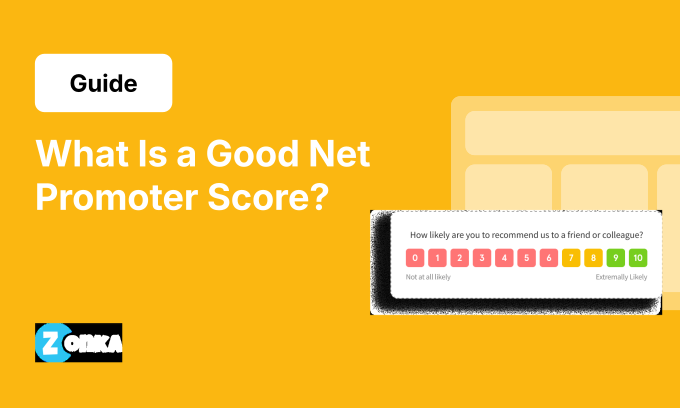


TL;DR
- A good NPS score depends on your industry, not just the absolute number
- This guide covers 2026 average net promoter score data for 20+ B2B and B2C industries, regional breakdowns, and how to benchmark your NPS the right way
- In absolute terms: above 0 is positive, above 30 is a good score, above 50 is excellent, above 70 is world-class
- The average net promoter score across all industries is 32, median NPS is 44
- B2C companies average 49, B2B companies average 38, an 11-point structural gap
- 10 out of 14 tracked industries showed an upward trend in 2025
- Insurance leads B2B at 80; Consumer Electronics leads B2C at 54
- Regional scoring culture matters as much as industry, a UK NPS of 28 vs US NPS of 45 may reflect cultural differences, not a CX gap
The number itself tells you almost nothing. An NPS of 35 can be the best score in telecom or a mediocre one in e-commerce. Context is everything — and that's precisely where most companies operating in competitive markets go wrong when they look up "good net promoter score" and get back a single number.
The Net Promoter Score measures customer satisfaction and loyalty by asking one question: how likely are you to recommend this company to a friend or colleague, on a scale of 0 to 10. NPS surveys categorize responses into three groups — Promoters (9–10), Passives (7–8), and Detractors (0–6). The formula subtracts the percentage of Detractors from the percentage of Promoters, producing a score on the NPS scale from -100 to +100.
In absolute terms, here's how average NPS scores sit on that scale:
Any NPS above 0 means you have more promoters than detractors — that's fundamentally a good score. Scores above 30 indicate strong customer loyalty in most industries. Above 50 is excellent and puts you in the top tier of most sectors. Above 70 is world class, achieved by only a handful of market leaders globally. These are the average scores the net promoter system uses as reference points across all industries.
But the more actionable question isn't where you fall on an absolute scale. It's how you compare to direct competitors in your specific industry, using a comparable survey methodology. A telecom company with NPS 35 that leads its sector delivers more business value than a retail brand at NPS 50 that's sitting in third place in a high-NPS industry.
New to NPS? Before benchmarking, make sure you're working from an accurate score. Start with our complete guide to what Net Promoter Score is and how it works, or use our free NPS calculator to compute yours.
NPS Score Ranges at a Glance
| Score Range | What It Signals |
| Below 0 | More unhappy customers than happy customers. Needs urgent investigation. |
| 0–30 | Positive territory. Common in early CX maturity stages. Room to grow. |
| 30–50 | Strong. Promoters significantly outnumber detractors. |
| 50–70 | Excellent. Top-quartile performance in most industries. |
| 70+ | World class. Achieved by only a handful of global brands. |
Why Absolute Scores Are Misleading: The Case for Relative Benchmarking
Here's the thing: most companies benchmark their NPS against a generic scale and declare victory or defeat without ever looking at their competitive landscape. That's like judging your marathon time without knowing the course conditions.
-
Absolute NPS tells you where your absolute NPS score sits on the -100 to +100 scale, regardless of industry. Useful for a general health check.
-
Relative NPS tells you how you compare performance against direct competitors in your specific market. That's where the actionable insights live.
Bain & Company's research found that companies with NPS scores roughly twice their industry average grow at more than twice the rate of competitors. High NPS relative to industry peers is a leading indicator of organic revenue growth and higher customer lifetime value. What matters isn't the raw number — it's the gap between you and the companies your customers could choose instead.
Benchmarks are also shaped by cultural scoring tendencies, survey methodology, and whether you're measuring B2B or B2C customers — business model differences that affect NPS in ways most teams underestimate. B2C companies average 49 while B2B companies average 38, an 11-point structural gap driven by how these business models operate, not CX quality differences.
NPS Benchmarks by Industry: Updated for 2026
The industry NPS benchmarks below are aggregated from Retently, CustomerGauge, and Qualtrics XM Institute. They represent industry averages, not individual company scores. Use them to compare performance within your own sector and to set informed decisions about realistic improvement targets.
Methodology note: These figures reflect relationship NPS from standardized survey approaches. Individual scores vary based on customer mix, survey channel, and timing. Use them as directional context, not absolute targets. Your most reliable benchmark is your own historical performance when measuring NPS regularly.
B2B NPS Industry Benchmarks
| Industry | Avg NPS | YoY Change | Range (Low–High) |
| Insurance (B2B) | 80 | +9 | 57–80 |
| Financial Services | 75 | +8 | 44–75 |
| Consulting | 69 | +1 | 64–69 |
| Technology & Services | 66 | +5 | 55–66 |
| Ecommerce (B2B) | 59 | +6 | 45–59 |
| Healthcare (B2B) | 58 | +7 | 34–58 |
| Property Management | 52 | — | — |
| Manufacturing | 49 | -1 | 44–49 |
| B2B Software & SaaS | 42 | +1 | 29–42 |
| Logistics & Transportation | 40 | -2 | 3–40 |
| Construction | 34 | -3 | 34–37 |
| Internet Software & Services | 16 | -2 | 14–18 |
Source: Retently 2025 NPS Benchmark Report. YoY change vs. 2024. Range reflects 5-year low to current average.
-
Insurance and Financial Services lead B2B benchmarks, driven by long-term relationship models and high switching costs that keep loyal customers in the fold even when minor friction arises.
-
Consulting firms typically enjoy above-average NPS scores due to their personalized service and ongoing client relationships — reflected in the consistent 64–69 range.
-
Construction and Internet Software lag, reflecting fragmented markets and continued pricing pressure.
-
Healthcare crossed the 50-point threshold for the first time in 2025 — a significant milestone for a sector that has historically struggled to deliver consistent CX at scale. For context, average NPS scores in healthcare ran as low as 34 just a few years ago. The upward trend signals that companies systematically collecting customer feedback and acting on negative feedback are pulling ahead.
Going deeper by industry? See our NPS for SaaS guide for strategies specific to that 29–42 range, and our healthcare NPS guide for patient satisfaction and medical services measurement.
B2C Industry Benchmarks
| Industry | Avg NPS | YoY Change | Range (Low–High) |
| Consumer Electronics | 54 | — | — |
| Hospitality & Hotels | 44 | +3 | 23–65 |
| Banking & Credit Unions | 41 | +1 | 23–41 |
| Automotive | 41 | — | — |
| Retail | 37 | +2 | 30–37 |
| Airlines | 37 | +4 | 27–50 |
| Grocery | 34 | — | — |
| Consumer Payments | 32 | — | — |
| Telecom (consumer) | 19 | +5 | -7–19 |
| Car Rental | 16 | -1 | 16–34 |
Sources: Retently 2025, QuestionPro Q1 2025 CX Benchmark. YoY change vs. 2024.
-
Consumer Electronics and Hospitality lead B2C — both sectors where customers love their experience enough to actively recommend it.
-
The hospitality industry's average NPS of 44 reflects strong overall customer satisfaction and brand loyalty built through repeat business and positive word of mouth.
-
Telecom and Car Rental trail significantly. Telecom improved 5 points year-over-year but remains structurally low — negative feedback around billing complexity, service reliability, and cancellation friction keeps it anchored near the bottom.
-
Airlines showed the strongest recovery trajectory (+4 YoY), reflecting post-pandemic service investments finally showing up in customer sentiment.
-
TV services remain a similarly challenging category for client satisfaction globally, structurally close to telecom.
You can also read our hotel NPS survey guide for hospitality, and NPS tools for banking for financial services to get better perspective about NPS.
Year-over-Year Shifts: What's Moving and Why?
The trajectory matters as much as the snapshot. In 2025, 10 out of 14 tracked industries either improved or maintained their NPS — keeping the upward trend consistent for the second consecutive year (Retently 2025). The improvement is real, but it's concentrated in specific sectors.
These NPS results reflect a broader shift: companies that use customer data and NPS feedback systematically to identify trends and drive CX improvements are pulling ahead of those that collect scores but don't act on them.
Gaining ground:
- Insurance: +9 points (71→80) — digital claims processing and AI-powered underwriting reducing customer effort
- Financial Services: +8 points — personalized advisory and mobile banking adoption improving everyday touchpoints
- Healthcare: +7 points — crossed 50 for the first time; virtual care and streamlined scheduling removing longstanding friction
- Ecommerce (B2B): +6 points — recovery from a 2023 low of 50
- Technology & Services: +5 points — AI and automation improving support speed and resolution quality
Still under pressure:
- Construction: -3 points (37→34) — supply chain pressure and inflationary friction haven't eased
- Internet Software & Services: -2 points (18→16) — oversaturation and weak differentiation in a crowded market
- Car Rental: holding at 16 — approximately 46% of pre-2019 levels despite modest recent gains
The pattern across sectors is consistent. Growth concentrates in industries where companies are measuring NPS regularly, using customer data to understand what customers rate them on, and acting on negative feedback before it compounds. Sectors with fragmented physical service delivery or commodity-level differentiation continued to lag.
NPS Benchmarks by Region
If you operate across multiple markets, industry NPS benchmarks alone won't tell you what you need to know. Where you measure NPS matters as much as what industry you're in — and most global teams find out too late that they've been comparing NPS data across regions without accounting for how differently survey respondents in those regions use the rating scale.
Regional NPS Ranges and Scoring Characteristics
| Region | Avg NPS Range | Key Characteristics |
| North America | 35–40 | High customer expectations. Generous scoring culture — 9s and 10s come more freely. Forrester 2025 notes a 4th consecutive year of CX quality decline in the US, even as NPS figures stay relatively stable. |
| Europe | 25–35 | Conservative scoring. Cultural tendency to rate in the 6–8 range even when satisfied. An NPS of +30 is often market-leading. Stricter data privacy norms also affect survey response rates. |
| Asia-Pacific | 15–50+ | Wide variance. Digital-first sectors outperform globally. India and SE Asia trend 40–55. Japan and South Korea score lower due to cultural scoring restraint — not dissatisfaction. |
| Latin America | 45–55 | Highest average enthusiasm globally. Mexico and Brazil lead. Cultural tendency toward expressive, positive scoring. |
| Middle East & Africa | 20–70+ | Extreme variance by sector. Aviation and telecom leaders reach 70+. Utilities lag near 20. |
Source: Qualtrics XM Institute 18-country study and Retently aggregated benchmark data. Cultural scoring patterns are directionally stable over time but should not be interpreted as satisfaction differences.
💡The practical implication for global teams: If your UK NPS is 28 and your US NPS is 45, you may not have a UK problem at all. You may have a cultural scoring difference. Set region-specific benchmarks rather than applying a single global target. The same customer experience genuinely produces different numbers in different countries and data driven decisions require accounting for that gap.
How to Benchmark Your NPS the Right Way?
Most teams treat NPS benchmarking as a one-time exercise — look up the industry average, compare, move on. That's how you end up making decisions based on misleading comparisons. Benchmarking well requires understanding both what the external NPS data actually measures and what your own trend data is telling you about your customer base.
Internal Trending vs External Comparison
Your most reliable benchmark is your own previous score. External data provides market context, but your quarterly or annual trajectory tells you whether your CX investments are actually working. Regularly measuring NPS — and comparing those results over time — is how companies identify trends that single-snapshot data misses entirely.
A three-step internal approach:
- Establish your baseline with your first NPS measurement — this is your reference point for everything that follows
- Track consistently — quarterly for relationship NPS, continuously for transactional NPS. Compare year-over-year, not month-to-month; NPS fluctuates seasonally and monthly noise will mislead you
- Segment for signal — enterprise vs SMB, new vs tenured customers, by product line or geography. Top-line NPS hides problems across customer segments that segmented customer data reveals
External industry benchmarks tell you where you stand. Internal trends tell you where you're headed. Use both — but when they conflict, your internal trend is the more honest signal. Regularly canvassing customer feedback this way creates an ongoing benchmark against which you can measure progress across your entire customer journey.
For deeper analysis beyond the top-line score, see our NPS data analysis article.
Factors That Skew Benchmark Comparisons
Before you declare yourself above or below average, check whether you're comparing the same thing. Six factors consistently affect NPS benchmarks and skew comparisons:
-
Survey timing. Post-purchase surveys capture transaction-level sentiment, which typically runs higher. Periodic relationship surveys capture overall brand perception, which typically runs lower. Comparing transactional NPS against a relationship benchmark produces misleading conclusions about your overall customer satisfaction.
-
Survey channel. In-app surveys yield higher response rates and often higher scores than email surveys. The channel affects both who responds and how they respond — actively engaged users who open an in-app prompt score differently from the broader customer base reached by email. An NPS of 45 from in-app data isn't directly comparable to an NPS of 45 from email.
-
Sample size and response rate. A benchmark built on 50 survey responses isn't comparable to one built on 5,000. Low response rates introduce non-response bias — the most dissatisfied and most enthusiastic customers tend to respond, skewing scores in unpredictable directions.
-
Cultural scoring tendencies. In Japan and Northern Europe, survey respondents rarely give 9s or 10s even when genuinely satisfied. This structurally suppresses NPS regardless of actual loyalty. Scoring lower in these markets doesn't mean customers like you less — it means they categorize responses differently by cultural habit.
-
Customer mix. If your customer base skews enterprise vs SMB, or new customers vs long-tenured ones, your NPS reflects that composition as much as your CX quality. A new customer cohort almost always scores differently from customers in their third year who have experienced your full customer success motion.
-
Question wording and context. Small variations in how the NPS question is framed — product vs company vs service — produce measurably different scores. Compare like with like.
What to Do If Your NPS Is Below Your Industry Average?
A below-average NPS isn't a verdict. It's a diagnostic signal. The companies that improve customer service fastest are usually the ones that resist the urge to fix things before they understand what's actually broken.
-
Diagnose before acting. Don't assume you know why the score is low. Collect feedback at a more granular level — segment by customer type, touchpoint, and journey stage across different customer journeys to find where the friction actually lives. Unhappy customers rarely tell you directly; the qualitative NPS feedback attached to low scores is often where the most valuable insights hide. See our guide to identifying root causes behind a bad NPS score before you spend a dollar on fixes.
-
Close the feedback loop first. The highest-ROI action for most companies with a low NPS is responding to negative feedback from detractors within 24–48 hours. Customers who feel heard often shift from detractor to passive through the response alone — without any product or process change. Closing the feedback loop with unhappy customers, informing them of CX improvements made based on their feedback, can turn them into loyal customers over time. Closing the feedback loop is where most real improvement starts.
-
Focus on passives, not just detractors. Detractors get all the attention, but passives are the swing segment. They're already conditionally satisfied — customers love the product well enough to stay but not yet enough to recommend it. Converting them to promoters who spread positive word of mouth is where your customer success team can have the most impact. Handling NPS detractors and converting passives are two different motions that need different tactics to build brand loyalty.
The Bottom Line
NPS benchmarks give you context. They tell you whether you're in the right league, falling behind, or quietly outperforming a market that doesn't know it yet. But the companies that consistently sit above industry standards don't get there by watching the scoreboard. They get there by using NPS feedback to make data-driven decisions, closing the loop with unhappy customers before they churn, and treating every survey response as an input to a real action.
Your industry average is public knowledge. What you do about the gap between that number and yours — that's what your competitors can't copy!
Start with 15 proven strategies to improve your NPS.
Sources:
- Retently. "What is a Good Net Promoter Score? (2025 NPS Benchmark)." March 30, 2025. — Primary B2B and B2C industry benchmark data, YoY changes
- Sybill. "NPS Scores of Companies: 2026 Benchmarks." January 2026. — B2B vs. B2C gap data (B2C avg 49, B2B avg 38)
- SurveyMonkey. "Net Promoter Score Benchmarks." 150,000+ organizations. — Average NPS 32, median 44, top quartile 72+
- Qualtrics XM Institute. "NPS Industry Benchmarks." 18-country study. — Regional benchmark data and cultural scoring patterns
- Bain & Company. "Measuring Your Net Promoter Score." — Growth correlation: 2x industry NPS leaders grow 2x faster
- QuestionPro. "NPS Benchmarks." Q1 2025 CX Benchmark. — B2C supplementary industry data
- Forrester. "CX Index™ Global Benchmarks 2025." — North America 4th consecutive year of CX quality decline
- CustomerGauge. "B2B NPS & CX Benchmarks Report." 2025. — B2B supplementary data
- Survicate. "NPS Benchmarks 2025." 599 companies, 5.4M responses. — Median NPS 42, B2B vs B2C performance gap


.png)
.png)


.png)
.png)