


.svg)
 Healthcare
 Finance
 Retail
 SaaS & Digital
 eCommerce
 Education
 Salesforce
  HubSpot
 Pipedrive
 Mailchimp
 Klaviyo
 Zendesk
  Intercom
 Freshdesk
 HelpScout
  Front
Front Jira
Jira Slack
Slack  MS Teams
 Zoom
Zoom Google Sheets
  Zapier
  Integrately
 Make
Make  Webhooks




 MS Teams
.svg)


TL;DR
- Google reviews build trust and drive purchase decisions. 82% of customers read reviews before buying.
- NPS finds your most satisfied customers (Promoters). They're the ones most likely to leave positive Google reviews.
- The process: Survey → Identify Promoters → Send direct Google review link → Follow up → Respond to reviews.
- Automation matters. Tools like Zonka Feedback can trigger review requests immediately after a 9 or 10 score.
- Case studies: Akumin redirects Promoters to location-specific Google review pages. Futurehome improved from 2.9 to 4.0+ stars using NPS-driven review requests.
Imagine this: Your product receives glowing NPS feedback, with a segment of customers rating you a 9 or 10. These are your Promoters—the most loyal and enthusiastic advocates for your brand. But here's the question: Do you stop there, or do you leverage this invaluable bucket of advocates to drive real business impact?
Most businesses collect NPS scores and then do nothing with them. They measure loyalty but don't convert it into anything tangible. That's where Google reviews come in.
Your Promoters already think you're great. They've told you that in the survey. Now you need them to tell everyone else. Google reviews turn private satisfaction into public proof. They're the bridge between "I like this company" and "other people should buy from this company."
This guide shows you how to build that bridge. You'll learn how to identify the right promoters, ask for reviews without being pushy, automate the entire process, and handle the customers who aren't quite ready to review yet. Let's get started.
Why Google Reviews Matter for Your Business
Google reviews aren't just feedback. They're a trust signal that influences every decision a prospect makes about your business.
Your brand is what people say about you when you're not in the room.
Jeff Bezos said that. And in 2026, what people say about you happens on Google. Here's why it matters:
-
Customers trust reviews more than your marketing: 63% of consumers say they're more likely to make a purchase from a business with positive reviews. They don't trust your homepage copy. They trust what your customers say.
-
Volume matters as much as ratings: A business with 50 reviews and a 4.5 star rating will outperform a business with 10 reviews and a 5 star rating. Why? Because more reviews mean more data points. Customers assume businesses with more reviews are more established, more reliable, and more worth their money.
-
Reviews drive conversions across industries: In e-commerce, customers compare sellers based on review counts before adding items to cart. In hospitality, travelers won't book a hotel without reading recent reviews. In healthcare, patients choose providers based on what other patients say about their experience. The pattern holds everywhere.
-
Google reviews are the first filter: When someone searches for a business like yours, they see your star rating and review count before they even click through to your website. If your rating is low or your review count is single digits, they'll skip you entirely. You don't even get a chance to make your case.
How NPS Connects to Google Reviews
NPS measures how likely customers are to recommend you. Google reviews let them actually do it. That's the entire connection.
Here's the problem most businesses run into: They send NPS surveys, get a bunch of 9s and 10s, and then... nothing. They assume Promoters will go leave reviews on their own. They won't.
Customers are busy. Even happy customers. They gave you a 10 in the survey because it took five seconds. Leaving a Google review requires opening a browser, searching for your business, finding the review section, and writing something coherent. That's friction. Most people won't do it unless you make it incredibly easy.
That's where the NPS to Google review process comes in. You use the survey to find people who are already satisfied, then you give them a direct path to leave a review. One click. No searching required.
What is Net Promoter Score?
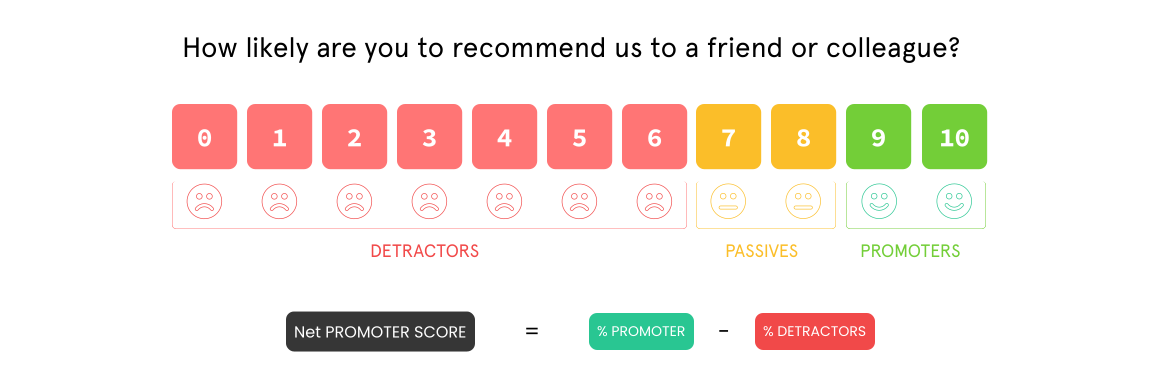
If you're new to NPS, here's the short version: It's a survey that asks one question.
On a scale of 0 to 10, how likely are you to recommend our product/service to a friend or colleague?
Customers who answer 9 or 10 are Promoters. They love you. Customers who answer 7 or 8 are Passives. They're fine with you but not enthusiastic. Customers who answer 0 to 6 are Detractors. They're unhappy.
For a detailed breakdown of how NPS works, check out our guide on what is Net Promoter Score.
Why Promoters Are Worth Targeting
Promoters are the only segment you should be asking for Google reviews. Here's why:
-
They've already committed publicly to recommending you: A 9 or 10 score isn't just satisfaction. It's a willingness to put their reputation on the line by telling others to use you. Asking them to formalize that in a Google review isn't a big ask. It's a natural next step.
-
They convert at higher rates: When you ask a Promoter for a review, your conversion rate will be somewhere between 30% and 50% depending on your industry and how you ask. That's significantly higher than cold outreach or generic review requests.
-
They write better reviews: Promoters don't just say "good service." They mention specifics. They talk about the feature they love, the person who helped them, the problem you solved. Those details make their reviews more credible and more useful to prospects.
If you want to understand the full power of this customer segment, read our deep dive on NPS Promoters.
Step-by-Step: How to Turn NPS Promoters into Google Reviewers
Here's the process. Five steps. Follow them in order.
1. Set Up NPS Surveys
You can't generate Google reviews from NPS if you're not running NPS surveys. Start here.
-
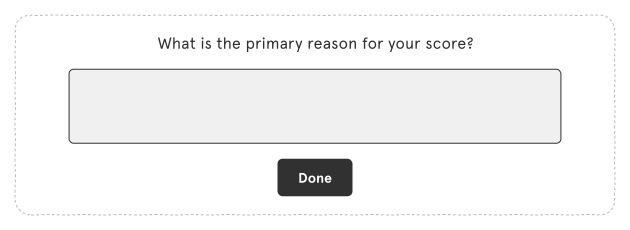
Ask the right question. Use the standard NPS question: "How likely are you to recommend us to a friend or colleague?" Don't rewrite it. The consistency matters for benchmarking. Follow it with an open-ended question: "What's the main reason for your score?" This gives you context.
-
Send surveys at the right moments. Post-purchase works for e-commerce. Post-resolution works for support teams. Post-onboarding works for SaaS. The goal is to catch customers when they've just had a positive experience and that experience is still fresh. For timing guidance, see our article on how when and where to collect Net Promoter Score surveys.
-
Use multiple channels. Email works, but response rates are higher with SMS and in-app surveys. WhatsApp works well for customer support teams. The channel matters less than the timing. For channel-specific strategies, check out NPS surveys on WhatsApp SMS in app.
2. Identify Promoters with High ROI Potential
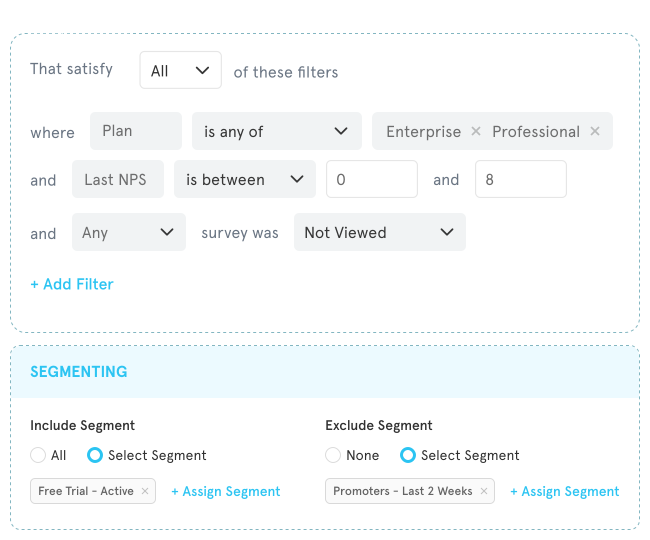
Not all Promoters are created equal. Some will leave detailed, glowing reviews. Others won't bother. Your job is to figure out which ones to prioritize.
-
Look for passionate language in their open-ended responses. A Promoter who writes "Great!" isn't as valuable as a Promoter who writes "Your team went above and beyond to solve my issue. I've never experienced customer service this good." The second person is more likely to write a review with similar detail.
-
Prioritize high-value customers. Customers who've been with you longer, spent more money, or engage more frequently are worth targeting first. Their reviews carry more weight because they demonstrate sustained satisfaction, not just a one-time positive interaction.
-
Segment by location if you're multi-location. A customer who visits your downtown location shouldn't be directed to leave a review on your suburban location's Google page. Match the review request to the specific location they interacted with.
-
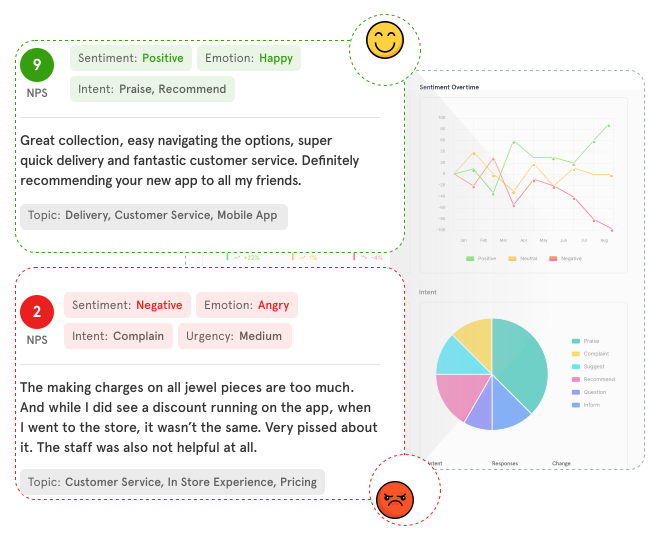
Use AI to identify themes. Tools like Zonka Feedback can analyze open-ended responses and group Promoters by the reasons they gave high scores. Customers who mention "fast shipping" can be directed to mention that in their Google review. Customers who mention "helpful support team" can be directed to do the same. This creates review clusters that reinforce specific strengths.
3. Send Personalized Google Review Requests
This is where most businesses screw it up. They send a generic "please leave us a review" email and wonder why nobody responds.
Here's what works:
-
Thank them first. Acknowledge their positive score before asking for anything. "Thanks for rating us a 10! We're glad you had a great experience."
-
Reference their specific feedback. If they mentioned fast delivery in their open-ended response, say "We're thrilled you appreciated our fast delivery." Personalization increases conversion rates.
-
Provide a direct Google review link. Don't make them search for you. Give them a link that takes them straight to the review form. The format is:
https://g.page/r/[YOUR_PLACE_ID]/review. Replace [YOUR_PLACE_ID] with your actual Google Place ID. You can find this by searching for your business on Google Maps and extracting it from the URL. -
Keep the ask short. One sentence. "If you have a moment, we'd love if you could share your experience on Google." That's it. Don't write a paragraph explaining why reviews matter. They don't care. Make it easy, make it quick.
Example email:
Hi [Name],
Thanks for rating us a 10! We're thrilled you had such a positive experience with our [specific feature/service they mentioned].
If you have a moment, we'd love if you could share your thoughts on Google: [direct review link]
Thanks again,
[Your Name]
Example SMS:
Hi [Name], thanks for your feedback! We'd love if you could leave a quick review on Google: [short link]
For more review request templates and email strategies, see NPS survey email.
4. Automate the Entire Process
Manual review requests don't scale. You need automation.
-
Set up triggers based on NPS score. When someone submits a 9 or 10, automatically send them a Google review request within 30 minutes. Don't wait a day. Don't wait a week. Immediate follow-up gets the highest conversion rates.
-
Build multi-step sequences. If they don't leave a review after the first request, send a gentle reminder 48 hours later. "Hey [Name], just following up on our last message. If you have a moment, we'd really appreciate a Google review: [link]." Stop after two attempts. More than that feels pushy.
-
Use different sequences for different scores. Promoters get immediate review requests. Passives get a follow-up asking what would make their experience better. Detractors get routed to your support team for immediate resolution. Don't ask Detractors for reviews.
Example workflow:
- NPS survey sent
- Customer scores 9 or 10
- Automated email with Google review link sent within 30 minutes
- If no review submitted within 48 hours, send reminder
- If still no review, stop outreach
For detailed automation strategies, read our guide on NPS automation.
5. Respond to Reviews and Close the Loop
Getting reviews is half the job. Responding to them is the other half.
-
Respond to every review. Even the short ones. A simple "Thanks for your review, [Name]! We're glad you had a great experience" is enough. It shows you're paying attention.
-
Reference specifics when you can. If they mentioned a specific team member or feature, call it out in your response. "We're so glad [Team Member] was able to help you with [specific issue]."
-
Use keywords naturally. If they mention "fast delivery," use that phrase in your response. "We're committed to fast delivery and appreciate you noticing." This helps with search visibility without being spammy.
-
Handle negative reviews carefully. If a Detractor leaves a negative review despite your best efforts, respond publicly with empathy and a path to resolution. "We're sorry to hear about your experience. We'd like to make this right. Please contact us at [email/phone] so we can resolve this for you." Then take the conversation offline.
For strategies on handling different customer segments, see closing the feedback loop with NPS surveys.
.svg)
Advanced Tactics: Turning Promoters into Advocates
Once you've mastered the basics, here are some advanced strategies to get more mileage out of your Promoters.
1. Create Review Clusters Around Specific Strengths
Instead of asking every Promoter for a generic review, guide them toward mentioning specific aspects of your business.
Example: If you run a SaaS company and a customer mentions "easy onboarding" in their NPS feedback, your review request might say: "We're glad our onboarding process made it easy to get started! If you share your experience on Google, mentioning the onboarding would really help others understand what to expect."
This creates thematic consistency across your reviews. When prospects see multiple reviews mentioning "easy onboarding" or "responsive support," it reinforces those strengths more effectively than generic praise.
2. Offer Non-Monetary Incentives
You can't pay for positive reviews. That violates Google's policies. But you can offer incentives for leaving a review regardless of what they say.
Options:
- Early access to new features (for SaaS companies)
- Exclusive content or webinars
- Recognition in a customer spotlight series
- Entry into a prize drawing (as long as it's not contingent on a positive review)
Be transparent. "Leave us a review on Google (positive or negative) and we'll give you early access to our upcoming feature release." This keeps you compliant while still incentivizing action.
3. Build a Promoter Community
Some of your Promoters will want to do more than leave a review. They'll want to advocate for you in bigger ways.
Create a space for them:
- Launch a customer advisory board where they can give product feedback
- Start a referral program where they get rewards for bringing in new customers
- Feature them in case studies or testimonials
- Invite them to exclusive events or product previews
Companies like Salesforce (Trailblazer Community) and LEGO (LEGO Ideas) have done this successfully. Your Promoters become co-creators, not just reviewers.
4. Leverage Social Proof
Once you've built up a solid base of Google reviews, use them everywhere.
- Feature your top reviews on your homepage
- Include review snippets in email campaigns
- Create social media posts highlighting recent reviews
- Add your star rating and review count to your email signature
This creates a flywheel. More reviews make you more credible, which drives more conversions, which generates more customers who can become Promoters, which leads to more reviews.

What Works: Real Examples from Real Companies
Here's how other businesses are using NPS to drive Google reviews.
a. Akumin: Location-Based Review Routing
Akumin runs outpatient diagnostic imaging centers across multiple locations. They needed a way to get more Google reviews for each individual location without manual work.
Their solution: When a customer scores 9 or 10 on an NPS survey, they're automatically redirected to that specific location's Google review page. No manual routing. No confusion about which location to review. The customer just went to the downtown clinic, so they get the downtown clinic's review link.
Result: More reviews per location, better distribution across their network, and less manual effort from their team.
b. Futurehome: From 2.9 to 4.0+ Stars
Futurehome's app ratings were stuck at 2.9 on the App Store and 3.2 on Google Play. The product was good, but the ratings didn't reflect that.
They implemented automated NPS surveys and started redirecting Promoters to leave reviews on both platforms. Within months, their ratings jumped to over 4.0 on both App Store and Google Play.
The lesson: Your satisfied customers exist. You just need to ask them to go public.
c. Apple: Detractor Recovery First, Reviews Second
Apple doesn't just focus on Promoters. They prioritize Detractors.
When someone leaves a low NPS score, an Apple Store manager calls them within 24 hours. They resolve the issue, often by replacing a product or offering a full refund. Once the customer is satisfied, they're far more likely to update their opinion.
Sometimes those recovered Detractors become Promoters. And Promoters leave reviews.
The takeaway: Don't ignore your Detractors. Fix their problems first. Reviews come second.
d. Baremetrics: Make It Frictionless
Baremetrics, a SaaS analytics company, made leaving a review as easy as copying and pasting.
After a Promoter submitted their NPS score, Baremetrics sent them a pre-written tweet template: "Just had a great experience with @Baremetrics! [Your thoughts here]." Customers could copy it, customize it, and post it immediately.
This worked for Google reviews too. They provided review templates that customers could use as-is or modify.
The principle: Reduce friction. Make it so easy that saying yes is easier than saying no.
Common Problems and How to Fix Them
Here's what usually goes wrong and how to fix it.
1. Low Response Rates
You're sending review requests but nobody's responding.
Fix:
- Send requests immediately after the NPS score. Not tomorrow. Not next week. Within 30 minutes.
- Use multiple channels. If email doesn't work, try SMS or in-app notifications.
- Make the link direct. One click should take them straight to the review form.
- Keep the message short. One paragraph max.
2. Promoters Aren't Following Through
They say they'll leave a review but never do.
Fix:
- Send a reminder 48 hours later. "Hey [Name], just following up. If you have a moment, we'd love a Google review: [link]"
- Explain why it matters. "Your review helps others find us and decide if we're the right fit."
- Offer a template. "Not sure what to write? Here's a template you can customize: [template]"
3. Customers Confuse NPS Surveys with Reviews
They think submitting the NPS survey is the same as leaving a review.
Fix:
- Clarify in your review request. "Thanks for your NPS feedback! That helps us internally. If you have a moment, we'd love if you could also share your experience on Google so others can see it: [link]"
- Make the transition seamless. After they submit their NPS score, show a button that says "Share your experience on Google." One click, direct redirect.
4. Detractors Are Leaving Negative Google Reviews
You're trying to prevent this but it keeps happening.
Fix:
- Route Detractors to support immediately. Don't wait. When someone scores 0-6, your support team should reach out within an hour.
- Resolve their issue before they have time to leave a review. Speed matters.
- Once resolved, ask if they're satisfied. "Has your issue been resolved to your satisfaction?" If yes, you can softly ask if they'd update their review or share their improved experience.
For more on handling unhappy customers, see bad NPS score how to improve.
5. You're Not Tracking Conversion Rates
You're sending review requests but you don't know if they're working.
Fix:
- Track NPS survey response rate (baseline)
- Track Promoter to Google review conversion rate (primary metric)
- Track time from NPS score to Google review (speed)
- Track review volume month over month (growth)
Example dashboard:
January:
NPS surveys sent: 500
Promoters (9-10): 200
Google reviews submitted: 80
Conversion rate: 40%Goal for February: 50% conversion
For more on analyzing your NPS data, check out NPS data analysis and reporting and NPS dashboards reports.
Conclusion: Turn Satisfaction Into Proof
NPS tells you who loves your business. Google reviews let them tell everyone else.
The process isn't complicated. Survey your customers. Find your Promoters. Send them a direct link to your Google review page. Follow up once if they don't respond. Respond to every review they leave.
Do this consistently and your Google review count will grow. More reviews mean more trust. More trust means more conversions. More conversions mean more customers. More customers mean more Promoters. And the cycle repeats.
Start with your next NPS survey. Add a review request to your Promoter follow-up sequence. Track the conversion rate. Optimize from there.
The reviews are already out there. You just need to ask for them.



.svg)
.png)