

.svg)
 Healthcare
 Finance
 Retail
 SaaS & Digital
 eCommerce
 Education
 Salesforce
  HubSpot
 Pipedrive
 Mailchimp
 Klaviyo
 Zendesk
  Intercom
 Freshdesk
 HelpScout
  Front
Front Jira
Jira Slack
Slack  MS Teams
 Zoom
Zoom Google Sheets
  Zapier
  Integrately
 Make
Make  Webhooks




 MS Teams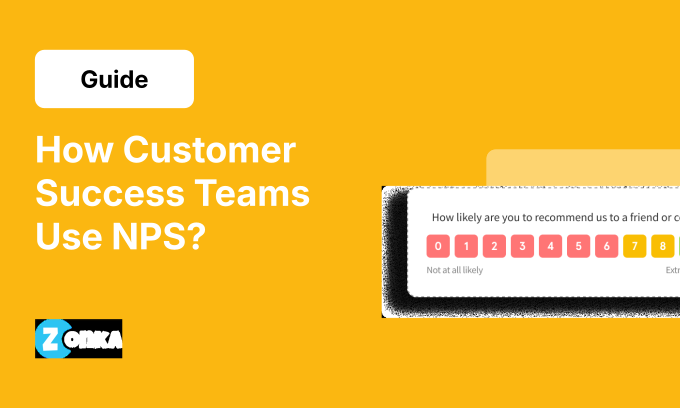


TL;DR
- Most CS teams have NPS data but don't operationalize it. It sits in dashboards, gets reported quarterly, and rarely changes what a CSM does on Monday morning.
- NPS works best as part of your health score model alongside usage data, support tickets, and engagement signals. A customer can have high usage but low NPS. That's a retention risk.
- The churn signal is NPS decline + usage decline happening in the same quarter. Either signal alone is soft. Both together trigger immediate CSM intervention.
- CS teams should send transactional NPS early in the renewal cycle, giving enough runway to fix what's broken before the renewal conversation happens.
- The litmus test: Can you see which accounts have declining NPS + declining usage right now? If not, your NPS program is reporting, not operations.
Most Customer Success teams have NPS data. Very few actually use it.
The scores go into a dashboard. Leadership reviews them quarterly. Someone mentions the trend in an all-hands. And on Monday morning, the CSM opens the same account list they always do, in the same priority order, with no idea which customers are quietly slipping.
The problem is not the metric. The problem is that CS platforms like Gainsight and ChurnZero include NPS tracking, but most teams treat it as reporting infrastructure, not operational infrastructure. The data exists. The workflows don't.
This guide is built for CS professionals who want to turn NPS from a number they report to a signal they act on. It covers how to weight NPS in health scores, how to use it in QBRs, how to combine it with usage data to predict churn, and what to do with each score band before renewal conversations happen.
Why NPS Is the CS Team's Most Underused Tool?
The gap is not awareness. Every CS team knows what NPS is. The gap is integration.
NPS lives in one system. Health scores live in another. Usage data lives somewhere else. QBR decks get built manually. And nobody has connected the dots in a way that changes what a CSM does when they log in.
The teams that get value from NPS treat it like a health score input, a QBR agenda-setter, and a churn predictor. They don't just track the number. They route it, weight it, and combine it with other signals to figure out which accounts need intervention this week.
That is the version of NPS this page covers. Not the passive version. The operational one.
NPS as a Health Score Component
Health scores tell you which accounts need attention. But most health score models miss the one signal that matters most at renewal: whether the customer would actually recommend you. NPS fills that gap. Here is how to weight it alongside the metrics you are already tracking.
How to Weight NPS in Your Health Score Model
Most health scores weight four inputs: product usage (40%), support tickets (20%), NPS (20%), and engagement signals (20%). The exact percentages shift by business, but the structure holds.
The reason NPS matters is that it captures something usage data misses. A customer can log in every day, hit all their workflows, and still hate the product. High usage with low NPS is a retention risk that usage metrics alone would never flag.
NPS catches the subjective experience. Product usage measures behavior. Support tickets measure friction. Engagement signals measure how responsive the customer is to outreach. Together, you get a fuller picture than any single metric provides.
The mistake is treating NPS as the only input. It is not. It is one of four. But it is the one that tells you whether the customer would actually recommend you, which matters more at renewal than whether they clicked around your product this month.
NPS Trend vs Point-in-Time Score
A single low NPS score is a data point. A declining NPS trend is a warning.
A customer who went from 8 to 6 to 4 over three quarters is at higher churn risk than a customer who has consistently scored 5. The trajectory matters more than the number. Stability at 5 means they are passively satisfied but not thrilled. Decline from 8 to 4 means something broke, and they have not told you what.
Build a simple alert: if NPS drops more than 10 points quarter over quarter, flag the account for CSM review. Do not wait for the score to hit zero. By the time it does, the customer has already made the decision to leave. You are just waiting for them to tell you.
Track the trajectory. That is where the signal is.
Using NPS in Quarterly Business Reviews (QBRs)
Most QBRs are one-sided. You talk about what you built. The customer sits through it. NPS flips that dynamic by making the customer's voice the center of the conversation. When you show up with their feedback and what you did about it, the QBR stops being a status update and starts being a partnership check-in.
1. Presenting NPS to Customers
Most QBRs are product update presentations disguised as business reviews. The customer sits through a deck about features they are not using while their actual problems go unaddressed.
NPS changes that dynamic. When you present the account's NPS trend over the last four quarters, compare it to their industry benchmark from what is a good net promoter score, and show what you have done based on their feedback, the QBR becomes customer-centric instead of vendor-centric.
The goal is not to celebrate a high score or apologize for a low one. The goal is to show that you are listening. The score is a conversation starter, not a report card.
2. The "You Said, We Did" Framework for QBRs
This is the format that makes NPS data useful in a QBR.
You Said: "Your team mentioned [specific feedback from the last NPS survey]."
We Did: "Here is what we built, changed, or fixed as a result."
Outcome: "Here is the impact: improved workflow, reduced support tickets, faster onboarding."
This turns feedback into evidence of partnership. It proves you are not just collecting scores. You are acting on them.
A simple slide template works well here: Column 1 is customer feedback (verbatim quote from the NPS comment), Column 2 is the action you took, Column 3 is the measurable outcome. Three rows is enough. The point is not to fill a slide. The point is to show that feedback has consequences.
When customers see this, they give you better feedback next time. They know it will not disappear into a spreadsheet.
3. Using NPS to Set QBR Agendas
The score shapes the conversation before you walk into the meeting.
Low NPS (0 to 6): QBR agenda is problem resolution. What is broken? What can we fix? What support do you need? You are not pitching expansion. You are showing up to repair what is damaged.
Mid NPS (7 to 8): QBR agenda is optimization. Where can we add more value? What features are you not using yet? What workflows could be smoother? You are moving from fixing problems to unlocking more of what already works.
High NPS (9 to 10): QBR agenda is expansion and advocacy. What is working? Can we expand usage to other teams? Who else in your organization should we be talking to? You are not defending the relationship. You are growing it.
The NPS score does not determine the entire meeting. But it does determine where you start. And that is half the conversation.
NPS-Based Churn Prediction
A single metric never tells the full story. NPS alone is not a churn predictor. Usage alone is not a churn predictor. But when both decline in the same quarter, you have a retention problem that is visible months before the customer tells you they are leaving. This is how CS teams spot it early enough to fix it.
a. The Churn Signal: NPS + Usage Decline
NPS decline alone is a soft signal. Usage decline alone is also a soft signal. NPS decline plus usage decline happening in the same quarter is a strong churn predictor.
Here is a simple model: If NPS drops more than 10 points AND usage drops more than 20% in the same quarter, flag the account for immediate CSM intervention. If NPS drops more than 10 points AND support tickets increase more than 30%, flag the account for product or support escalation.
The combined signal gives CS teams a 60 to 90 day runway to intervene before renewal. That is enough time to diagnose the root cause, fix what is fixable, and rebuild trust. It is not enough time if you wait until both metrics are in freefall.
This is not advanced analytics. It is two IF statements in a spreadsheet. Most CS teams already have the data. They just have not connected it yet.
b. Pre-Renewal NPS Timing
Send transactional NPS early in the renewal cycle, well before the contract end date. This gives CS teams enough runway to intervene if scores reveal risk.
A three-checkpoint framework works well here.
First checkpoint: NPS survey sent and reviewed. Score determines next steps.
Second checkpoint: If score indicates risk (below 7), escalate to CS leadership and activate recovery strategies. If score is healthy (8 or above), shift focus to expansion opportunities.
Final checkpoint: If account is still at risk despite intervention, bring in executive sponsors. Options include expanded support coverage, product roadmap alignment, or contract restructuring.
The key is starting early enough that you have time to fix what is broken before the renewal conversation happens. If you send NPS two weeks before renewal, you are not collecting feedback. You are collecting a post-mortem.
When CS Should Escalate NPS Signals to Product and Support
Not every NPS issue is a CS problem. Some signals need to be routed cross-functionally, and the handoff is part of the workflow.
Escalate to Product when: Detractor feedback mentions missing features, product limitations, or UX friction. When multiple accounts in the same vertical mention the same product gap. When promoter feedback highlights a feature driving loyalty, and product should double down on it.
For how product teams should receive and act on CS-escalated NPS data, see NPS for product teams.
Escalate to Support when: Detractor feedback mentions response time, resolution quality, or support SLA misses. When support ticket volume correlates with low NPS scores across multiple accounts.
CS owns the relationship. Product and Support own the fixes. The handoff matters because it prevents NPS feedback from dying in the CS inbox when the root cause lives somewhere else.
A simple escalation rule: If the same issue appears in NPS feedback from three or more accounts in the same quarter, route it to the team that can fix it. Do not wait for it to become a pattern across ten accounts. Three is the threshold.
What CS Teams Should Do with Each NPS Score
The score tells you where the customer stands. Your response tells them whether you are paying attention. A promoter at 9 needs a different conversation than a passive at 7, and both need something completely different from a detractor at 4. Here is what to do with each score band before renewal conversations happen.
1. Promoter (9 to 10): Expansion Focus
This is where upsell and cross-sell conversations happen. Promoters are already telling you they would recommend you. The next question is whether they would recommend you to other teams inside their own company.
Ask for referrals. Request testimonials or case study participation. Invite them into advocacy programs. For the full framework on activating promoters, see NPS promoters.
The mistake here is doing nothing because the score is already high. High scores are expansion signals, not maintenance signals.
2. High Passive (8): Nudge Strategy
An 8 is one point away from a promoter. The question is: what would make us a 9?
Proactive outreach works here. Personalized value delivery works here. Highlighting features they are not using yet works here. The QBR should focus on optimization, not problem-solving.
These customers are satisfied but not thrilled. The gap between satisfied and thrilled is where retention risk lives in B2B vs B2C contexts. Close the gap.
3. Low Passive (7): Watch and Monitor
A 7 is stable neutrality. They are not unhappy. They are also not committed. If something better comes along, they will consider it.
Monitor usage trends closely. Prepare an intervention plan if the score declines further. Increase check-in cadence without being intrusive. The goal is not to flood them with outreach. The goal is to surface issues before they become deal-breakers.
These accounts do not need emergency intervention. They need attention.
4. Detractor (0 to 6): Recovery Mode
Immediate outreach within 24 to 48 hours. Root cause diagnosis before you propose a solution. Escalation path if the CSM cannot resolve it alone: CSM to CS lead to executive sponsor.
For the full detractor recovery framework, see NPS detractors. For the full closed-loop process that applies across all score bands, see closing the feedback loop with NPS surveys.
The principle is the same across all four bands: the score determines the response. If you treat every NPS response the same way, you are wasting the signal.
Conclusion
Open your CS platform right now. Can you see which accounts have declining NPS and declining usage in the same view? If not, your NPS program is a reporting exercise, not an operational tool.
The CS teams that prevent churn do not just collect NPS scores. They weight NPS in health scores. They surface NPS trends in QBRs. They combine NPS with usage data to predict churn. They trigger interventions early in the renewal cycle, not after the customer has already made the decision to leave.
NPS works for customer success when it changes what a CSM does on Monday morning. Everything else is just a dashboard.
For the full framework on building an NPS program that drives retention and connects to revenue outcomes, see NPS and customer lifetime value. For the methodology behind analyzing NPS data at scale, see NPS data analysis and reporting. And for the complete guide that covers NPS end to end, see our Net Promoter Score guide.

.svg)

.png)