

.svg)
 Healthcare
 Finance
 Retail
 SaaS & Digital
 eCommerce
 Education
 Salesforce
  HubSpot
 Pipedrive
 Mailchimp
 Klaviyo
 Zendesk
  Intercom
 Freshdesk
 HelpScout
  Front
Front Jira
Jira Slack
Slack  MS Teams
 Zoom
Zoom Google Sheets
  Zapier
  Integrately
 Make
Make  Webhooks



 Sign In
 MS Teams
.svg)


TL;DR
- VoC tools for SaaS help product teams, customer success, and growth teams collect customer feedback across the subscription lifecycle: onboarding, activation, adoption, support, renewal.
- Modern SaaS VoC combines in-app surveys, direct feedback, behavioral data, and AI analysis to catch churn before renewal conversations begin.
- Top 8 VoC tools for SaaS in 2026: Zonka Feedback (in-app + AI churn signals), CleverX (Interview Based VoC), SurveyMonkey (basic surveys), Hotjar (UX friction), Mopinion (digital experience), SentiSum (support sentiment), Chattermill (unified VoC), Brandwatch (social listening).
- Most SaaS programs combine two or three of these tools rather than relying on one.
- This guide includes a comparison table, evaluation criteria, individual tool reviews, best practices, and a decision framework for matching tools to your SaaS motion (PLG, sales-led, multi-product, B2C).
Voice of Customer (VoC) tools have become a core part of the modern SaaS stack. Product teams use them to validate feature decisions. Customer Success uses them to flag churn risk. Support uses them to spot recurring issues. Marketing uses them to sharpen positioning. The category has grown from "send a survey" to "unify every signal a customer leaves behind."
This guide covers the seven VoC tools doing that best for SaaS in 2026. We'll walk through what each tool is built for, where it fits in a SaaS lifecycle (onboarding, activation, adoption, support, renewal), pricing tiers, G2 ratings, and which combinations work for different SaaS motions: PLG, sales-led, multi-product, and B2C.
If you're evaluating VoC tools for the first time, the framework matters as much as the tool list. Both are below.
Why most SaaS VoC programs catch the wrong signals
Most SaaS teams think churn is a pricing problem. Or a competitor problem. Or a market problem.
It's almost never any of those.
Churn is what silent friction looks like six months later. The integration that broke during onboarding. The feature that confused a power user in week 3. The support reply that took 36 hours when the answer was sitting in a help doc nobody linked.
According to ProfitWell, 40–60% of SaaS churn is preventable when product teams have the right customer insight. But here's the catch: most VoC programs collect feedback at the wrong moments. Quarterly NPS blasts. Post-support surveys. End-of-year health checks.
Meanwhile the real signals hide somewhere else entirely. Inside feature usage patterns, rage clicks, support ticket sentiment, abandoned setup flows, cancellation reasons no one ever tagged.
The shift is already happening. SaaS VoC in 2026 isn't "asking customers what they think." It's catching what they're trying to tell you, in the moment they're trying to tell you.
That's what this guide is about.
What is VoC in SaaS?
VoC in SaaS is a continuous system for collecting customer feedback across the entire customer journey. It combines direct feedback from customer surveys and customer interviews, qualitative feedback from support interactions, and raw feedback from behavioral signals. The goal is turning customer feedback into product and CS decisions before friction compounds into churn.
Voice of Customer in SaaS started as a survey discipline. Quarterly NPS, annual CSAT, the occasional post-purchase form.
That definition stopped working roughly the moment SaaS became product-led.
In a SaaS business, customers don't talk to you in scheduled moments. They talk constantly: through clicks, hesitations, abandoned wizards, support tickets, in-app comments, cancellation reasons, public reviews on G2, threads on Reddit. VoC in SaaS is the system that catches all of that and makes sense of it.
For SaaS teams specifically, VoC includes:
- In-app feedback when users hit friction
- Onboarding micro-surveys at activation milestones
- Support sentiment from tickets and chats
- Behavioral signals like rage clicks and abandoned flows
- Open-text feedback in NPS comments, churn surveys, and exit interviews
- Public sentiment from reviews, social, and community channels
The point isn't to collect more data. The point is to catch friction before it shows up as a churn email.
Why is VoC Important for SaaS Companies in 2026?
SaaS revenue stopped depending on acquisition years ago.
With CAC up 70% in the last 5 years (ProfitWell) and 40–60% of new users dropping off after their first session, the math has shifted. Net retention is the new growth number. Activation is the new conversion. The teams that win are the ones who see friction before it shows up in MRR loss.
VoC matters in SaaS because it catches what product analytics can't:
- Why a user abandoned setup, not just that they did
- Why an enterprise customer is suddenly opening fewer support tickets, often a worse signal than opening more
- Why a power user stopped recommending you to peers
- Why trial-to-paid conversion dipped 8% last quarter
- Why the new pricing page is confusing the wrong segment
A modern SaaS VoC program does five things product analytics alone can't do:
- Surfaces churn intent 60–90 days before renewal risk shows up in usage data
- Tags open-text qualitative feedback and raw feedback from customer conversations into specific themes ("integration error," "billing confusion," "missing API endpoint") so roadmaps reflect real customer expectations
- Connects customer sentiment shifts to specific accounts, not just aggregate scores
- Triggers real-time alerts when a high-LTV customer hits friction across any digital channel
- Identifies power users who'd happily share product feedback with the roadmap team
Tracking the right voice of customer metrics, including NPS trend, CSAT by product area, and support sentiment scores, shows whether the program is generating real retention impact.
The cost of not having this is rarely visible. It shows up as flat NRR, growing churn cohorts, and roadmap decisions made from gut instead of evidence.
If you're building your first program, our voice of customer overview covers the foundational concepts before you evaluate tools.
For the full business case before you commit budget, the benefits of a Voice of Customer program are worth reading alongside this tools guide.
What Should the Best VoC Tools for SaaS Offer?
The best VoC tools for SaaS need to do more than collect responses. They need to catch how users actually feel inside the product, then make that signal usable for the teams that can fix things.
A high-impact SaaS VoC tool should offer:
- In-app feedback at key friction points (onboarding drop-offs, integration errors, feature confusion)
- Natural language processing (NLP) to tag unstructured customer input into SaaS-specific themes like "setup difficulty," "billing confusion," and "missing feature"
- Sentiment analysis that scores tone at the comment level, not just the survey level
- Real-time alerts when high-risk sentiment appears in a tracked account
- Integration depth with the modern SaaS stack: HubSpot, Salesforce, Zendesk, Intercom, Mixpanel, Amplitude
- Closed-loop workflows so detractor follow-up, issue resolution, and recovery are trackable
- Journey mapping that ties feedback to lifecycle stages: onboarding, activation, adoption, support, renewal, expansion
- Role-based views so Product, CS, and Support each see what's relevant to them
- Feedback forms and in-app surveys built for digital channels, from mobile apps to web widgets and email triggers
- Feedback data sync with customer data platforms so low scores and flagged themes flow directly into CRM workflows
If a tool sits in the "great surveys, weak intelligence" camp, it's a survey tool. Not a VoC platform.
VoC Tools vs. Feedback Tools vs. Survey Tools: What's the Difference?
These three categories overlap so often that buyers default to using them interchangeably. They shouldn't.
- Survey tools (SurveyMonkey, Typeform): Build and send customer surveys. Collect survey responses and surface basic customer data. Stop at data collection.
- Feedback management tools (Survicate, GetFeedback, parts of Zonka): Survey + multi-channel collection + ticketing + closed-loop workflows.
- VoC platforms (Zonka, Chattermill, Medallia, Qualtrics): Feedback management with AI theme tagging and natural language processing, sentiment analysis, journey mapping, and churn signals across digital channels. This is customer experience management at the platform level.
For SaaS specifically: a pure survey tool gets you NPS scores. A feedback tool gets you NPS plus ticketing plus closing the loop. A VoC platform gets you NPS plus behavior signals plus support sentiment plus churn prediction tied to lifecycle stages.
Most SaaS teams running modern programs need the third. If your stack already covers feedback management well, you might be looking for a SaaS customer feedback tool instead. That's a different evaluation.
A voice of customer framework clarifies where each tier fits in your program's overall architecture before you decide which tools to buy.
If you're also weighing VoC against structured voice of customer vs market research methodologies, that comparison is worth reading before you finalise your research stack.
Best SaaS VoC Software Compared
Quick comparison of the seven tools covered below.
| VoC Tool | Best For | Key Strengths | Ideal SaaS Use Cases | Pricing | G2 Rating |
| Zonka Feedback | In-app product insights, AI feedback intelligence & churn prediction | AI Feedback Intelligence, event-based in-app surveys, journey mapping, real-time alerts, modern SaaS stack integrations | Onboarding friction detection, activation feedback, feature-level insights, churn risk detection, renewal blockers, CS health scoring | Custom | 4.7 |
| CleverX | AI-moderated customer interviews & panel-based qualitative research | Verified panel, AI Interview Agent, live + AI moderation, built-in post-session theme analysis | Win-loss interviews, churn root-cause research, power-user renewal research | From $99/mo | 4.4 |
| SurveyMonkey | Quick SaaS surveys & basic VoC programs | Easy survey setup, NPS/CSAT templates, large-scale distribution, basic analytics | Onboarding surveys, NPS programs, churn exit surveys, feature validation, persona-level feedback | From $39/mo | 4.4 |
| Hotjar | UX friction detection & product experience insights | Heatmaps, session recordings, rage-click detection, funnels, in-app feedback widgets | Onboarding flow optimization, UX issue diagnosis, feature usability analysis, activation drop-off insights | From $49/mo | 4.3 |
| Mopinion | In-app & web feedback for digital experience optimization | Customizable feedback widgets, trigger logic, mobile SDKs, multilingual support | Sign-up friction, trial conversion drop-offs, billing confusion, feature adoption | From $229/mo | 4.4 |
| SentiSum | Support ticket intelligence & AI-driven churn signals | AI tagging of unstructured tickets, churn-risk detection, escalation alerts, multi-language analysis | Support sentiment analysis, churn prediction from ticket trends, root-cause discovery for product bugs | From ~$1,000/mo | 4.8 |
| Chattermill | Unified customer intelligence across channels | Multi-channel aggregation, AI theme detection, journey-stage analysis, NPS driver analysis | Cross-channel feedback unification, NPS driver analysis, lifecycle stage analysis, executive reporting | Custom | 4.5 |
| Brandwatch | Reputation monitoring & social sentiment | Social listening, review monitoring, competitor benchmarking, crisis alerts | Brand sentiment tracking, public review analysis, competitive intelligence, PR crisis detection | Custom | 4.4 |
How We Evaluated These VoC Tools
We ranked these seven platforms on five criteria that matter specifically for SaaS teams:
- SaaS-specific trigger capability: Can the tool fire surveys on product events (onboarding completed, integration failed, feature first-use), or is it limited to scheduled email blasts and manual sends?
- AI sentiment and theme-tagging accuracy: Does it auto-categorize open-text feedback into SaaS-relevant themes (integration error, billing confusion, feature gap), or does it stop at generic positive/negative scoring?
- Integration depth with the modern SaaS stack: How well does it connect to HubSpot, Salesforce, Zendesk, Intercom, Mixpanel, Amplitude, Slack, and the workflow tools SaaS teams actually use?
- G2 ratings and verified user reviews: What do real users say about reliability, support, and value at the team sizes they operate at?
- Suitability across SaaS motions: Does the tool fit PLG (high-volume, self-serve), sales-led enterprise, multi-product portfolios, and B2C-style SaaS, or is it built for only one of these?
We did not rank purely on G2 score or feature count. A tool that scores 4.7 but doesn't trigger on product events isn't a SaaS VoC tool - it's a survey tool with good marketing. Fit matters more than absolute capability.
Disclosure: Zonka Feedback is our product. We've evaluated it on the same five criteria as every other tool on this list. Where Zonka has known limits relative to competitors (for example, Brandwatch outranks it on social listening depth, Hotjar outranks it on session recording), we've said so.
What are the Best Voice of Customer Tools in 2026?
The seven tools below are the ones SaaS teams actually keep on their stack. Picked across different categories so you can mix and match. Most modern SaaS VoC programs end up combining two or three of these.
If you want to see how real SaaS programs are structured before comparing tools, our voice of customer examples page shows programs across different team sizes and motions.
1. Zonka Feedback: Best for In-App Product Insights, AI Feedback Intelligence & Churn Prediction in SaaS
Category: AI-Driven VoC + In-App Feedback
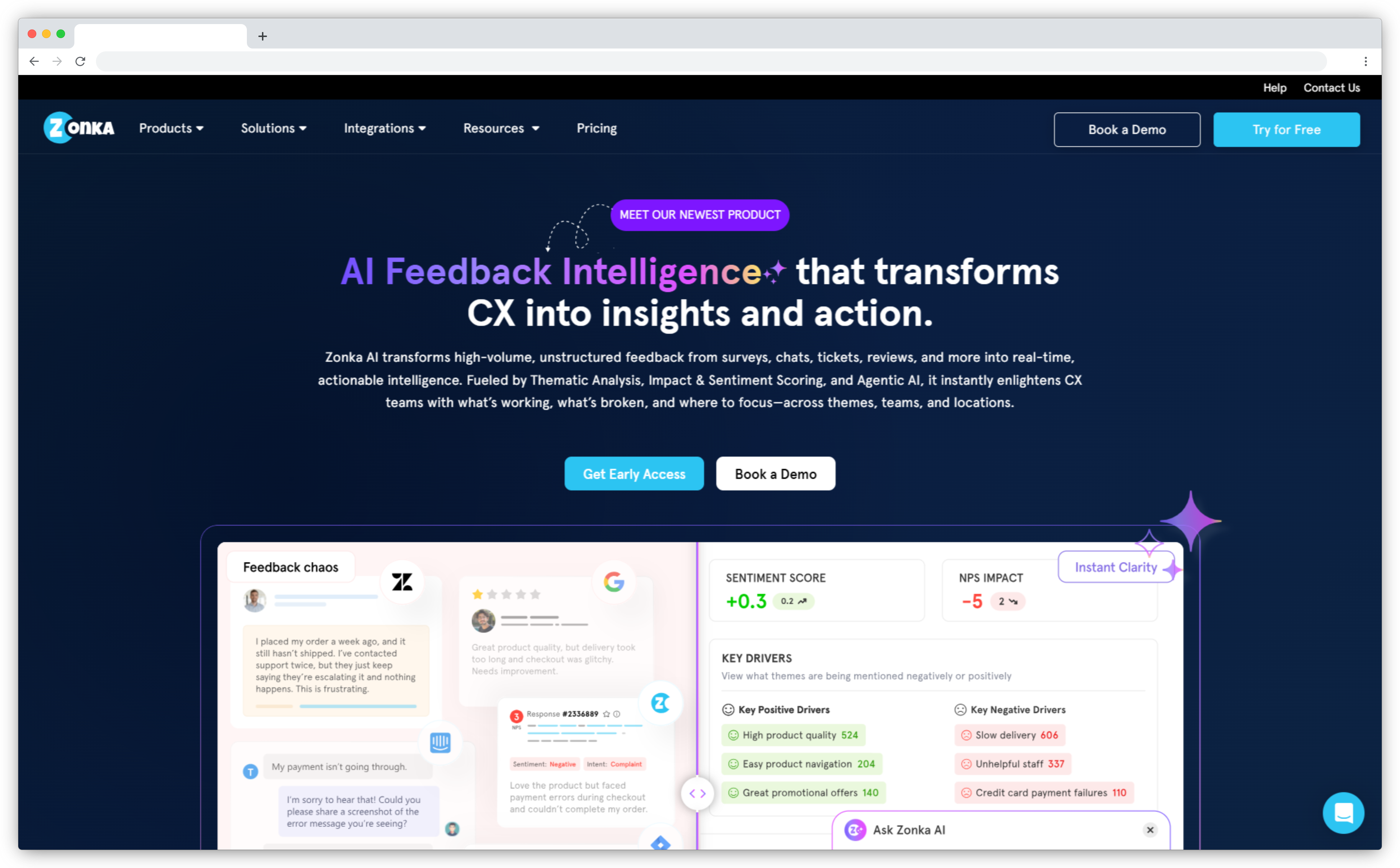
Zonka Feedback is built for SaaS teams running in-app feedback at volume. It fires surveys on specific product events: onboarding completed, trial day 7, integration setup attempted, feature first-use. Then it uses AI to tag open-text comments into SaaS-specific themes the moment responses come in. Categories like "integration error," "onboarding confusion," "billing question," or "missing API endpoint" surface automatically.
Where it earns its place on this list: most VoC tools either collect well or analyze well. Zonka does both in one platform without the enterprise price tag. AI agents surface signals across surveys, in-app feedback, support sentiment, and reviews, then route those signals to the team that can fix the underlying issue.
A 200-seat PLG SaaS can use Zonka's event-based triggers to fire a one-question CSAT the moment a user fails an integration setup. That surfaces churn risk in week 2 instead of finding it in a cancellation email at month 4.
Why Zonka Feedback works for SaaS
Every SaaS journey (trial activation, onboarding, integration, feature adoption, renewal) has micro-friction moments that traditional surveys miss, because the user has already moved on by the time the next quarterly NPS arrives. Zonka's event-based in-app surveys catch those moments live.
The AI Feedback Intelligence layer tags responses into structured themes specific to SaaS, then surfaces them as connected signals across role-based dashboards. Customer Success sees churn intent in week 2 of onboarding, not week 50. Product gets roadmap prioritization grounded in real friction. Support sees recurring issues become a feedback loop, not a ticket queue.
Top features of Zonka Feedback for SaaS
- AI Feedback Intelligence with SaaS-specific categories and churn indicators
- In-app surveys triggered during onboarding, feature usage, and friction points
- NPS, CSAT, CES tied to product events and customer journeys
- Real-time alerts when high-risk sentiment appears in a tracked account
- Support ticket sentiment analysis for Zendesk, Intercom, Freshdesk
- Journey-based feedback mapping (onboarding → activation → adoption → renewal)
- Customer health scoring inputs for CS teams
- Comparative dashboards for segments, cohorts, and personas
- Integrations with HubSpot, Salesforce, Mixpanel, Amplitude, Slack
- Live in under a week. No implementation team required.
G2 Rating: 4.7/5
Zonka Feedback Pros
- Extremely strong for SaaS onboarding, activation, and in-app UX feedback
- AI Feedback Intelligence reveals why users churn or fail to activate
- Flexible in-app, email, and multi-channel surveys for the entire SaaS journey
- Ideal for CS teams managing renewals and at-risk accounts
- Helps Product teams prioritize roadmap using real user themes
- Live in under a week; no implementation team required
- Works equally well for PLG and sales-led SaaS models
Zonka Feedback Cons
- Advanced event-based automation requires initial journey mapping
- Works best for SaaS teams ready to operationalize feedback insights
Zonka Feedback Pricing
- Custom pricing based on business requirements
- Free trial available upon request
2. CleverX: Best for AI-Moderated Customer Interviews & Panel-Based Research in SaaS VoC Programs
Category: Interview Based VoC
CleverX gives SaaS teams verified access to a global panel of 8 million+ B2B and B2C participants across 150+ countries, paired with research infrastructure for live moderated sessions, AI-moderated interviews, and structured studies. Where every other tool on this list analyzes feedback customers already left behind, CleverX goes upstream: it recruits and interviews the customers, prospects, or churned users you don't have sitting in a ticket queue or NPS comment field. The AI Interview Agent scales qualitative depth across 50+ participants in the time a manual study would cover 8.
A SaaS team running quarterly win-loss research can use CleverX to recruit and AI-interview 40 churned accounts in the time it would take a CS manager to manually schedule 8 exit calls, surfacing the actual reasons behind cancellations instead of guessing from exit-survey checkboxes.
.png?width=1366&height=611&name=Screenshot%20(88).png)
Where CleverX fits best in SaaS VoC Stack
CleverX exists for the signal that never shows up in any of those — the churned customer who never answers the exit survey, the prospect who chose a competitor and never told you why, the power user whose praise never gets typed into an NPS comment box. That's structured, moderated conversation, and it doesn't scale through a survey tool.
For SaaS teams, that makes CleverX a companion to the rest of the stack rather than a replacement for any of it. Pair it with Zonka or SurveyMonkey for the continuous signal, and reach for CleverX when a specific question needs a real conversation: why did this cohort churn, why did this segment choose a competitor, what would make this power user renew at a higher tier.
Top features of CleverX for SaaS
- Verified panel of B2B and B2C participants, useful for both enterprise win-loss interviews and B2C churn research
- AI Interview Agent for autonomous, adaptive AI-moderated sessions at 6x the pace of manual scheduling
- Live moderated sessions with Krisp AI noise cancellation and hidden observer mode for stakeholder sit-ins
- Methods beyond interviews: diary studies, usability testing, card sorting, tree testing, first-click analysis
- AI-assisted screening with behavioral consistency checks before participants reach sessions
- Post-session AI analysis: theme extraction, sentiment, automated transcript tagging
- BYOA (Bring Your Own Audience) for teams that want to interview their own churned or existing customer list instead of the panel
- Native integrations with Prolific and Respondent.io
- Searchable research repository so past interview findings don't get lost between quarters
G2 Rating: 4.4/5
CleverX Pros
- Combines B2B and B2C panel access in one platform, most competitors specialize in one or the other
- AI moderation and human moderation under one roof
- AI analysis built in, no need to export transcripts to a separate tool
- Transparent credit-based pricing
CleverX Cons
- Not built for continuous, always-on feedback the way survey or in-app VoC tools are; it's structured research sprints, not a real-time signal engine
- Doesn't sit inside the product like Zonka or Hotjar, so it complements in-app VoC rather than replacing it
- Credit-based pricing suits teams running ongoing research programs better than a single one-off study
CleverX Pricing
- Starter at $99/month (1 seat, 99 credits/month)
- Pro at $149/seat/month (unlimited seats, 149 credits/seat/month)
- Managed Services with custom pricing
- Additional credits at $1/credit
3. SurveyMonkey: Best for Quick SaaS Surveys, Customer Feedback Basics & Simple VoC Programs
Category: Survey-First VoC
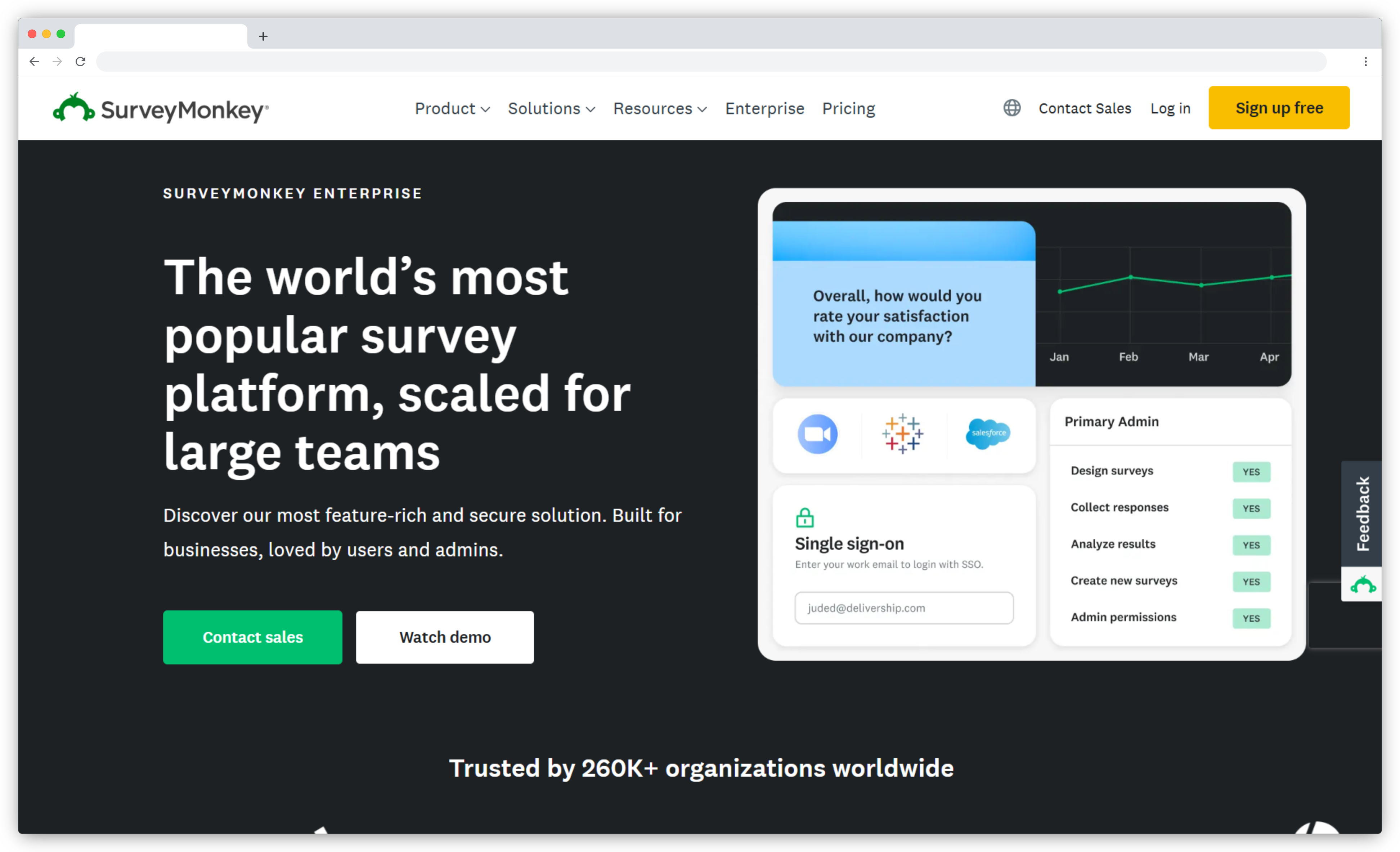
SurveyMonkey is the right pick for SaaS teams that need to get a survey out the door this afternoon. Onboarding survey, NPS, feature satisfaction, churn exit. The templates are built and the distribution is easy. It's not deeply embedded in the product the way Zonka or Hotjar are, but for broad outreach surveys to large customer segments, it's hard to beat.
SurveyMonkey works best in SaaS organizations where the goal is structured feedback at scale rather than in-app real-time signals. Series A startups validating product roadmap with their first 500 trial users. PLG companies running quarterly NPS to a 50,000-customer base. Enterprise SaaS teams running annual customer research projects.
A 30-person SaaS startup can spin up an exit survey for churned trial users in under an hour, push it via email to last quarter's drop-offs, and have categorized "why I didn't convert" data on the founders' Slack by the end of the day.
Where SurveyMonkey fits best in SaaS
SurveyMonkey is widely used in SaaS because it lets teams collect feedback fast and at volume, especially when launching new features or validating roadmap decisions. Instead of setting up in-app triggers or AI tagging, SaaS teams use SurveyMonkey for broad outreach surveys: trial users who didn't convert, long-term customers nominated for advisory boards, churned accounts asked for honest exit reasons.
The trade-off is depth. SurveyMonkey gives you the survey results, not the signal underneath them. If you want AI to tag open-text into "integration error" vs. "pricing concern" vs. "competitor switch," you'll need to pair it with another tool or do that work manually.
Top features of SurveyMonkey for SaaS
- Simple NPS, CSAT, and onboarding survey templates
- Quick survey distribution via email, link, or website
- Persona-based segmentation for SaaS audiences
- Easy churn exit survey setup
- Prebuilt question banks for product feedback
- Basic analytics for sentiment and satisfaction trends
- Team collaboration and shared dashboards
- Integrations with Slack, HubSpot, Zapier, and CRM tools
- Survey logic and branching for different user segments
- Best for broad surveys and large customer outreach
G2 Rating: 4.4/5
SurveyMonkey Pros
- Extremely easy for SaaS teams to set up and deploy
- Best for broad surveys and large customer outreach
- Ideal for quick feedback, onboarding surveys, and NPS programs
- No technical or engineering support required
- Great for early-stage or scaling SaaS companies
SurveyMonkey Cons
- Not built for in-app SaaS feedback or real-time product insights
- Limited AI analysis compared to advanced VoC platforms
- Not ideal for churn prediction, CS workflows, or PLG feedback loops
- Dashboards are basic compared to modern VoC systems
SurveyMonkey Pricing
- Individual plans start around $39/month
- Team plans from ~$25/user/month (billed annually); Enterprise custom
- Free Basic plan available
4. Hotjar: Best for In-App UX Insights, Heatmaps & Product Experience Feedback
Category: Behavioral / Product Analytics VoC
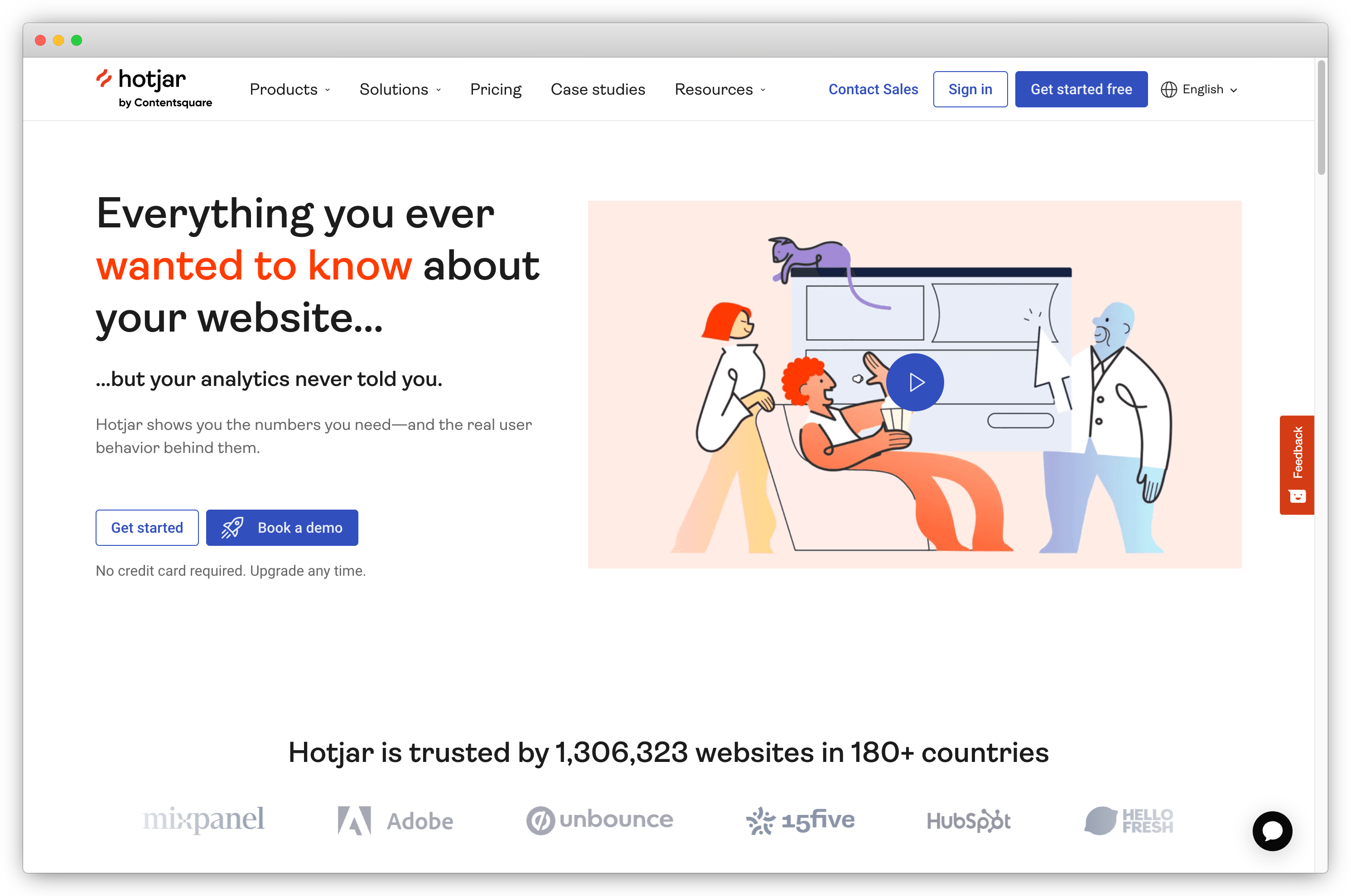
Hotjar belongs on every SaaS VoC stack that cares about activation. It captures the implicit feedback users never give you in surveys: where they hesitated, what they rage-clicked, which UI element confused them, what onboarding step they abandoned. Behavioral data from heatmaps, session recordings, funnels, and frustration detection sits alongside lightweight in-app feedback widgets.
For PLG SaaS especially, Hotjar is non-negotiable. It tells you what users do, not just what they say. Most users won't fill out a survey to tell you the integration wizard is broken. They'll just leave. Hotjar shows you they left, where, and why.
A PLG SaaS company can use Hotjar to identify the exact onboarding step where trial users abandon the integration wizard. Typically a 30–40% activation killer that shows up nowhere in NPS data because the users who abandon never get sent the survey.
Hotjar's edge for SaaS Product teams
Hotjar stands out because it captures the signals users don't articulate. SaaS companies rely on it to see real user behavior: where users hesitate, which UI elements confuse them, what workflows they abandon. Product and UX teams use this to fix onboarding flows, simplify navigation, and rework complex features.
The in-app widgets also let SaaS teams ask for feedback at the exact moment users hit friction, right after a failed action or a cancelled form. Pair Hotjar with a survey-first tool (SurveyMonkey, Zonka) and you've got both the "what did they do" and the "why did they do it" sides of the story.
Top features of Hotjar for SaaS
- Heatmaps showing where users click, tap, scroll, and ignore
- Session recordings to watch real user interactions
- Funnel analysis to detect onboarding or feature drop-offs
- Rage-click and frustration behavior detection
- In-app feedback widgets ("How was this page?" or "Did this help?")
- User segmentation by device, role, or behavior
- Product discovery and navigation analytics
- Visual reports for Product, Design, and Engineering teams
- Integrations with Segment, Slack, HubSpot, and product analytics tools
- Strongest for understanding why users struggle with onboarding
G2 Rating: 4.3/5
Hotjar Pros
- Excellent for understanding why users struggle with onboarding or features
- Visual insights that product teams can act on instantly
- Great for diagnosing UI/UX issues that surveys won't uncover
- Fast setup; no engineering required
- Captures implicit feedback users never give in surveys
Hotjar Cons
- Not a full VoC system (limited NPS/CSAT capabilities)
- Not ideal for support sentiment, account-level insights, or churn prediction
- Behavior recordings can be heavy on data for large SaaS products
Hotjar Pricing
- Free tier available
- Growth plan starts at $49/month (billed annually)
- Pro and Enterprise plans custom-priced
5. Mopinion: Best for Web & App Feedback Collection and Digital Experience Optimization in SaaS
Category: Digital Experience / Embedded Feedback VoC
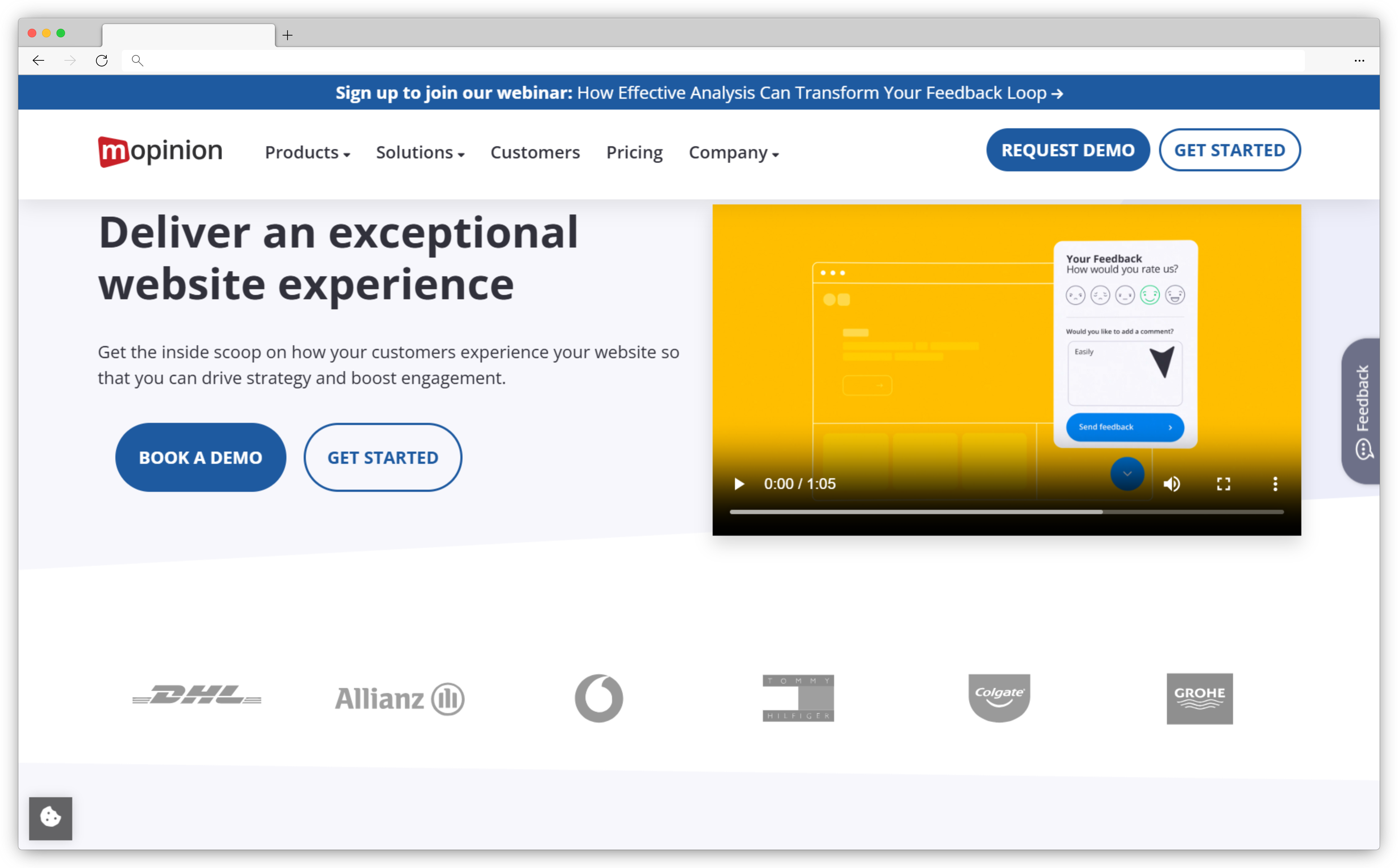
Mopinion is built for SaaS teams that depend on digital experience quality across onboarding flows, self-serve touchpoints, and in-app journeys. The flexible feedback widgets and form logic let teams capture contextual, real-time input from users as they interact with the product, website, or mobile app.
Where it differs from a generic survey tool: Mopinion specializes in embedded feedback. Forms appear when users hit a specific signal: a failed signup, a confusing configuration step, a stalled onboarding task. The mobile SDK extends this into iOS and Android apps, which matters for SaaS products with significant mobile usage.
A self-serve SaaS billing platform can use Mopinion to display a one-line feedback prompt the moment a user repeatedly hovers over a blocked element on the upgrade page. That catches friction in the exact micro-moment that costs them the upgrade.
Why Mopinion stands out for digital SaaS experiences
Mopinion's biggest value for SaaS is contextual feedback at the right micro-moment. Intelligent form logic lets you display specific prompts only when users take certain actions: abandoning a setup screen, hovering over a blocked element, failing a billing check. That level of context helps SaaS teams understand not just macro trends but the exact micro-frictions that derail activation and conversion.
The strong mobile SDK and multilingual support also make Mopinion a fit for global SaaS products with significant mobile traffic, the segment where most VoC tools start to weaken.
Top features of Mopinion for SaaS
- Customizable in-app and web feedback widgets
- Trigger logic for specific user actions (e.g., form abandonment)
- Mobile app feedback with SDK support
- Feedback categories for UX, bugs, billing, onboarding confusion
- Sentiment and text analysis for user comments
- Dashboard views for Product, CX, and growth teams
- Strong funnels and goal-based reporting
- Multilingual support for global SaaS user bases
- Integrations with Mixpanel, Google Analytics, CRMs, and support tools
- Strong for capturing in-context feedback tied to digital touchpoints
G2 Rating: 4.4/5
Mopinion Pros
- Excellent for capturing in-context feedback tied to specific user actions
- Strong for onboarding and conversion optimization in SaaS funnels
- Flexible form logic provides precise targeting
- Great for both mobile and web app experiences
- Ideal for SaaS teams focused on continuous digital UX improvement
Mopinion Cons
- Not built for support ticket sentiment or deep AI-driven analysis
- Less suited for account-level health scoring than dedicated CS platforms
- Requires thoughtful setup to avoid over-surveying users
Mopinion Pricing
- Growth plan starts around $229/month
- Enterprise custom pricing
- 14-day free trial available
6. SentiSum: Best for Support Ticket Intelligence, AI-Driven Churn Signals & Unstructured Feedback Analysis in SaaS
Category: AI-Driven Support Sentiment VoC
SentiSum is the right pick for SaaS companies where support interactions are the richest source of customer signal. Instead of relying on surveys alone, SentiSum analyzes every unstructured customer conversation: Zendesk tickets, Intercom chats, emails, NPS comments, long-form feedback. It then converts them into SaaS-specific insights using AI.
For SaaS platforms where support trends usually reveal deeper product issues (bugs, integration failures, onboarding confusion, feature gaps), SentiSum sits in the middle of the data flow. It tags issues like "setup confusion," "broken workflow," "billing error," or "need for feature X" automatically, then highlights escalation patterns and sentiment shifts in real time.
A B2B SaaS Customer Success team can use SentiSum to flag the 40-account cohort that suddenly increased their tickets about API rate limiting in the past two weeks. That's a churn risk pattern that would have shown up in renewal data three months later.
Where SentiSum wins for support-heavy SaaS
SentiSum works best in SaaS environments because support conversations reveal more friction than surveys ever capture. When users struggle with integrations, billing, configuration, or new features, they almost always contact support before they churn. SentiSum taps into that high-frequency data and applies AI to extract themes that map directly to product and onboarding issues.
The value is strongest for Customer Success and Support leaders. SentiSum highlights escalation patterns, detects sentiment shifts in real time, and flags accounts where ticket sentiment is degrading. That's the leading indicator most renewal forecasts miss until it's too late.
Top features of SentiSum for SaaS
- AI-powered sentiment analysis for tickets, chats, and email conversations
- Automatic categorization of SaaS-specific issues (bugs, onboarding, billing, integrations)
- Churn-risk detection based on tone, keywords, and complaint patterns
- Trend analysis for product issues and recurring user frustrations
- AI tagging that eliminates manual ticket categorization
- Escalation alerts for CSMs and support leaders
- Multi-language analysis for global SaaS products
- Integration with Zendesk, Intercom, Freshdesk, Salesforce, HubSpot
- Insights dashboards for Support, CS, and Product teams
- Root-cause reporting for product development teams
G2 Rating: 4.8/5
SentiSum Pros
- Excellent for SaaS products with high support volume
- AI uncovers issues that surveys or analytics may miss
- Strong for churn prediction using sentiment and escalation patterns
- Reduces manual tagging workload for support teams
- Helps Product teams pinpoint recurring feature and UX problems
SentiSum Cons
- Limited for in-app surveys or journey-based VoC
- Best suited for SaaS companies with substantial ticket or chat volume
- Not ideal for multi-channel VoC unless paired with a survey tool
SentiSum Pricing
- Starts at approximately $1,000/month
- Custom enterprise pricing based on ticket volume and data sources
- Free trial not available
7. Chattermill: Best for Unified Customer Intelligence, Multi-Channel Feedback & Scalable SaaS VoC Insights
Category: Unified Multi-Channel VoC Intelligence
Chattermill is built for SaaS companies dealing with feedback scattered across product, support, marketing, reviews, and community channels. The strength is aggregating data from multiple touchpoints (NPS comments, in-app feedback, tickets, reviews, surveys, call transcripts) and using AI to surface themes that affect product experience, adoption, and retention.
For SaaS companies where feedback lives in 8–12 different tools, Chattermill acts as the central intelligence layer. It connects responses across systems and identifies the underlying drivers of delight or frustration: specific product features, onboarding blockers, UI complexity, support issues, pricing concerns, or missing functionality.
A multi-product SaaS platform with NPS in one tool, support tickets in Zendesk, app reviews in Apptentive, and in-app feedback via a homegrown widget can use Chattermill to merge all four streams into one set of themes. That can surface the fact that 60% of detractor comments across all channels share a single root cause: the new pricing tiers introduced last quarter.
Chattermill's strength: unified feedback at scale
Chattermill is a fit for SaaS teams whose feedback is fragmented across systems. Rather than analyzing each type separately, the AI builds a connected view of feedback across the entire customer lifecycle. Machine learning models identify the drivers behind sentiment: specific features, onboarding blockers, UI complexity, support issues, pricing concerns, or missing capability.
For Product and CX leadership at multi-product SaaS, Chattermill reduces the noise. Instead of three teams reporting three contradictory NPS narratives, you get one set of themes ranked by impact, with the underlying responses one click away.
Top features of Chattermill for SaaS
- Unified VoC intelligence across surveys, reviews, tickets, and product feedback
- AI theme detection for product, support, onboarding, and UX issues
- Sentiment analysis across every SaaS customer touchpoint
- Customer journey analysis by lifecycle stage (trial → activation → renewal)
- Segment-based insights for personas, account tiers, and feature cohorts
- NPS driver analysis to identify conversion, retention, and churn patterns
- Role-based dashboards for CS, CX, Product, and Leadership
- Integration with Intercom, Zendesk, HubSpot, Salesforce, and analytics tools
- Trend reporting for roadmap planning and customer strategy
- Built for scale; works for high-volume multi-product SaaS
G2 Rating: 4.5/5
Chattermill Pros
- Excellent for SaaS companies with multiple feedback channels
- AI unifies surveys, tickets, and reviews into one insight engine
- Very strong for NPS driver analysis and product prioritization
- Great for identifying churn drivers across different user segments
- Enterprise-level dashboards ideal for cross-functional SaaS teams
Chattermill Cons
- Requires initial taxonomy setup for optimal accuracy
- Not focused on in-app surveys or real-time triggers (needs pairing with another tool)
Chattermill Pricing
- Custom enterprise pricing based on channels, feedback volume, and features
- Free trial not available
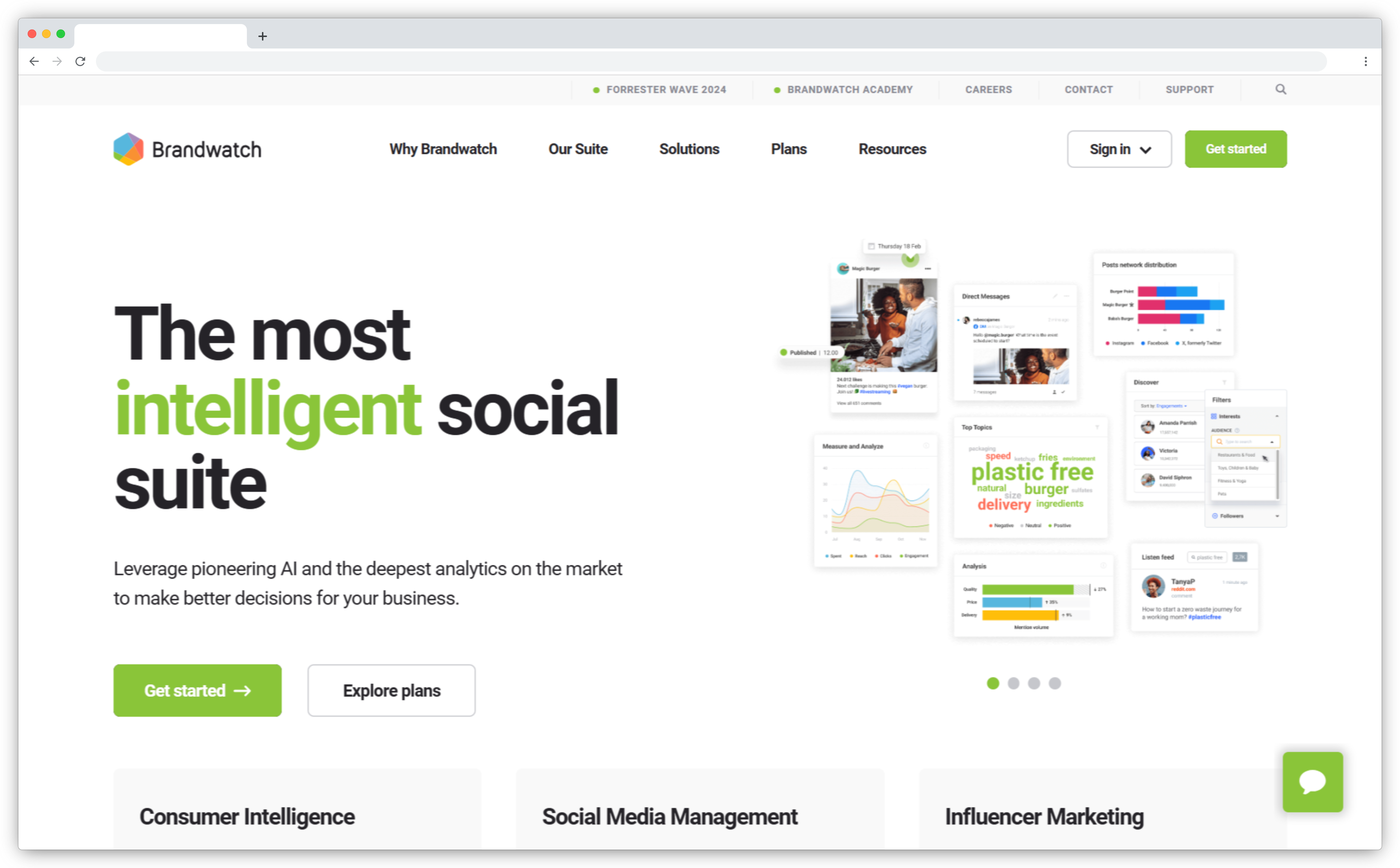
8. Brandwatch: Best for Reputation Monitoring, Social Sentiment & Market Intelligence for SaaS
Category: Social Listening / External VoC
Brandwatch is the right pick for SaaS companies that need to understand the external Voice of Customer: the conversations happening on social channels, communities, forums, review sites, and public digital spaces. While Hotjar and Mopinion focus on in-product feedback, Brandwatch shows SaaS teams how customers and prospects talk about the product, competitors, pricing, performance, and category trends outside the product.
That makes it a strong VoC companion for SaaS brands focused on reputation, competitive positioning, and capturing early signals of dissatisfaction. Many of the most important customer opinions never make it into surveys or tickets. They appear publicly on Reddit, X, G2, Capterra, and community Slacks.
A B2C-style SaaS launching a major pricing change can use Brandwatch to track sentiment across Reddit, Twitter, and review sites in the 48 hours after launch. That catches the social media backlash early enough to issue a clarification before the cancellation flood hits support.
Why Brandwatch matters for SaaS brand reputation
Brandwatch is essential for SaaS companies because many customer opinions never make it into surveys or tickets. They appear publicly: on social media, review sites, Reddit threads, community discussions. These conversations often reveal early patterns: onboarding dissatisfaction, pricing complaints, praise for features, bugs found after product updates, frustrations with competitors.
Brandwatch's AI sentiment analysis shows how those conversations evolve across regions, audience segments, and market categories. For Product Marketing and Brand teams at SaaS companies with strong public visibility, that intelligence shapes positioning, messaging, and crisis response.
Top features of Brandwatch for SaaS
- Social listening across millions of public digital sources
- AI sentiment analysis for product, brand, and competitor mentions
- Review monitoring for G2, Capterra, Trustpilot, and app stores
- Trend detection for emerging product issues or feature demands
- Competitor benchmarking for positioning and experience gaps
- Audience insights for product marketing and messaging refinement
- Crisis detection and alerts for negative sentiment spikes
- Dashboards for CX, Product Marketing, and Leadership
- Influencer and advocacy tracking for PLG environments
- Strongest external visibility into how SaaS brands are perceived
G2 Rating: 4.4/5
Brandwatch Pros
- Unmatched visibility into public SaaS sentiment and competitive perception
- Excellent for identifying macro-level patterns outside in-product feedback
- Powerful for strategic decisions across Product Marketing, CX, and Brand teams
- Strong review intelligence for SaaS marketplaces (G2, Capterra, etc.)
- Early detection of negative trends that may affect reputation or retention
Brandwatch Cons
- Not designed for in-product feedback or onboarding insights
- Lacks journey-based VoC features for SaaS workflows
- Enterprise-level pricing may not fit early-stage SaaS companies
Brandwatch Pricing
- Custom enterprise pricing
- Typically the most expensive tool on this list
What are the Most Effective VoC Best Practices for SaaS?
A successful VoC program in SaaS needs more than tools and surveys. SaaS journeys are nonlinear and product-led, so the highest-impact VoC strategies focus on capturing in-product friction, scoring sentiment at scale, and using real-time signals to influence onboarding, activation, adoption, and renewal.
For the program design layer behind these practices, our VoC strategy and best practices guide covers how to build the system before selecting the tools.
Seven practices, ranked by impact for modern SaaS CX, CS, and PX teams.
1. Capture feedback at the exact moments where SaaS users experience friction
SaaS users hit product friction during onboarding flows, setup tasks, and mid-feature actions. Not after. The teams that catch it embed VoC directly into the product to flag pain points in the moment.
The best moments to trigger feedback:
- After a failed workflow or integration setup
- When users abandon an onboarding step
- When they hesitate on a complex screen
- Right after completing (or failing) a key activation milestone
A SaaS onboarding survey template can give you a starting point for the first three of these.
Supplement in-product triggers with customer interviews for a complete view of customer expectations. Direct feedback from one-on-one conversations often surfaces customer input that feedback forms miss.
2. Use AI to turn unstructured SaaS feedback into churn prediction signals
SaaS users leave rich evidence inside NPS comments, support tickets, chat conversations, and open-text surveys, assuming you're collecting it in the first place through net promoter score software and the rest of your feedback stack. AI can detect early warnings months before renewal risk shows up in usage data.
Modern VoC software applies natural language processing to raw feedback from all sources, including tickets, reviews, and interview notes, and converts it into structured themes rather than leaving teams with piles of untagged qualitative feedback.
The signals AI should flag:
- Themes like "confusing setup," "missing feature," "billing issues," "integration error"
- Escalation patterns that signal rising frustration
- Negative intent keywords: switching tools, looking for alternatives, canceling soon
That's the difference between catching a churn signal in week 8 and finding it in a cancellation email in month 9.
3. Map VoC insights to the SaaS customer journey (not just channels)
Most companies organize VoC by channel: surveys here, tickets there, reviews somewhere else. SaaS doesn't reward that.
SaaS success depends on progression through value stages. The best VoC systems connect feedback directly to lifecycle milestones:
- Onboarding: where time-to-value is at risk
- Activation: when users first experience real product ROI
- Adoption: behavior patterns that show feature fit
- Support: signals around frustration and recurring issues
- Renewal: perceived value, outcomes, relationship health
- Expansion: feedback from power users
This shows CX, CS, and Product teams which stage is hurting growth, not just which channel had a bad week.
4. Combine behavioral analytics with direct customer feedback for true insights
Surveys tell you what users say. Behavior tells you what they do. Pair them and the picture changes.
If users complain about complexity, check session recordings to validate. If a feature has low satisfaction scores, compare sentiment with activation rates. If churn feedback mentions slow performance, correlate with time-in-app metrics.
That combination is how you separate real friction from anecdote.
5. Set up real-time alerts for at-risk SaaS accounts
Timing is everything in SaaS. When a customer expresses frustration, signals intent to leave, or shows declining usage, the window to intervene is small.
Real-time alerts should fire for:
- NPS detractors mentioning specific product frustration
- Support tickets with urgent or repeated issues from a single account
- Drops in activation paths or feature engagement
- Negative AI themes like "can't complete task," "bug," "slow," "switching tools"
That window between the first signal and the cancellation form is where retention is won.
6. Democratize VoC insights across Product, CS, Support & Leadership
VoC fails in SaaS when only one team sees the feedback. Growth happens when VoC becomes a shared operating layer.
Different teams use VoC differently:
- Product: prioritize roadmap, fix UX friction
- Customer Success: identify expansion opportunities and renewal risks
- Support: reduce recurring issues and improve deflection
- Leadership: measure customer health and strategic risk
Aligning everyone to the same customer signals accelerates product improvement and retention. Misaligned VoC is just expensive dashboards.
7. Close the loop fast: SaaS users expect response and resolution
In SaaS, delayed follow-up increases churn risk because switching costs are low. Respond fast to detractors and frustrated users to rebuild trust. Fast recovery means higher retention and lower negative reviews.
What "fast" looks like:
- Follow up within 24–48 hours
- Provide a fix, workaround, or clear next step
- Document resolution patterns to reduce future friction
- Ask for post-resolution sentiment
Log the customer input behind each complaint as structured feedback data in your CRM. Patterns in that feedback data, whether about billing, onboarding, or API limits, become evidence for the next sprint.
Before selecting tools, see our guide on how to build a Voice of Customer program for the program foundation that makes these practices work.
For more on operationalizing this, our guide on how to close the customer feedback loop walks through the playbook.
Which VoC tool is right for your SaaS team?
There's no universal answer. The right VoC stack depends on your SaaS motion, your team size, and where your highest-friction stages live.
If you're also sorting out where voice of customer vs customer experience programs split at your company, that question affects which team owns these tools.
A practical decision framework:
- PLG / self-serve SaaS with high trial volume: Zonka Feedback + Hotjar. Catch in-app friction during onboarding and validate it with behavioral data from rage clicks and abandoned flows.
- Sales-led enterprise SaaS with heavy support load: Zonka Feedback + SentiSum. Pair survey signals with support ticket sentiment to predict churn 60–90 days before renewal.
- Multi-product SaaS with fragmented feedback: Chattermill + Zonka. Unify feedback across surveys, tickets, reviews, and in-app channels into one intelligence layer.
- B2C-style SaaS with strong public brand presence: Brandwatch + SurveyMonkey. Combine social listening with quick survey deployment to catch sentiment shifts the moment they happen publicly.
- Budget-conscious SaaS starting their first VoC program: Zonka Feedback as the all-in-one starter. In-app feedback, AI sentiment, and journey mapping in one platform without the enterprise price tag.
Whichever stack you pick, the principle is the same. Capture feedback at friction moments. Tag it with AI. Map it to lifecycle stages. Close the loop fast.
Modern SaaS is built on retention, and retention is built on signals. The teams that catch them early build the kind of customer relationships that compound. The teams that don't keep finding out about churn from a cancellation email.
Ready to see what an integrated SaaS VoC stack looks like? Explore Zonka's Voice of Customer platform for SaaS teams or schedule a demo to see how AI agents surface signals across your customer lifecycle.

.png)
.svg)
.png)