What Questions Are in This In-Store Experience Survey Template?
This in-store experience survey template includes 4 questions across 5 screens, combining an overall satisfaction rating with parameter-level breakdowns and a loyalty measure. Here's each question and what it tells you:
- "How would you rate your overall in-store experience?" (5-point emoji scale) — The headline number. Track this weekly per store to spot trends before they become problems. Stores that dip below 3.5 for two consecutive weeks almost always have an operational issue — staffing, stock-outs, or a cleanliness problem — that hasn't surfaced in manager reports yet.
- "Please rate the following aspects of your in-store experience" (radio rating matrix) — This is where the real diagnostic value lives. The matrix breaks the experience into four parameters:
- Store Cleanliness — The silent dealbreaker. Customers rarely complain about a dirty store to staff; they just don't come back. A cleanliness score below 3 on a 5-point scale correlates with a 15-20% drop in repeat visits within 60 days.
- Product Availability — Stock-outs are the #1 reason for lost in-store sales. This rating catches the problem at the customer level before your inventory system flags it. A shopper who wanted something and didn't find it rates this low — even if they bought something else.
- Staff Helpfulness — The differentiator between a store visit and an online order. If customers can't get help or find staff disengaged, your physical store loses its only advantage over ecommerce.
- Checkout Process — Long lines, slow payment processing, and confusing self-checkout kill the entire experience at the last moment. This is the parameter that most directly predicts whether someone will shop in-store or switch to online next time.
- "Based on your experience shopping today, how likely are you to recommend this store?" (0-10 NPS) — Store-level NPS tells you which locations are building word-of-mouth and which are quietly losing reputation. In retail, NPS above 40 is strong. Below 20, you're losing more customers through negative word-of-mouth than you're gaining through marketing.
- "Please provide any additional feedback or suggestions" (open-ended) — The unstructured gold. Customers mention the broken shopping cart, the rude security guard, the confusing store layout — things no rating scale captures. Feed these into AI-powered feedback analytics to auto-tag themes across thousands of responses per month.
How to Customize This In-Store Experience Survey for Your Retail Format
This template works for department stores, grocery chains, specialty retail, and convenience stores — but each format needs different tweaks. The mistake is deploying it unchanged across formats and wondering why the data feels generic.
- Grocery and supermarkets: Replace "Product Availability" with "Freshness and Quality of Produce." Add a parameter for "Aisle Organization." Grocery shoppers care more about finding items quickly than about staff interaction — swap the weight of your follow-up actions accordingly.
- Apparel and fashion retail: Add "Fitting Room Experience" as a matrix parameter. In fashion retail, the fitting room is where purchase decisions happen — a dirty or understaffed fitting room area kills conversion rates that your floor associates worked to build.
- Electronics and specialty: Swap "Staff Helpfulness" for "Staff Product Knowledge." A friendly but uninformed associate in an electronics store is worse than no associate at all — customers came in specifically because they wanted expert guidance they can't get online.
- Convenience stores: Drop the matrix entirely. A 3-question version (overall rating, NPS, open-ended) works better for a 90-second transaction. Use the Smiley Terminal Survey Template instead if your average visit is under 5 minutes.
Customize the template in Zonka's survey builder — edit questions, add parameters, change scales, and set up skip logic so the survey adapts based on the customer's initial rating.
What's a Good In-Store Experience Score? Retail Benchmarks That Actually Matter
Benchmarks without context are useless. A 4.1 overall score means nothing until you know what top-performing retailers in your segment score. Here's where the numbers land in practice:
- Overall in-store experience (5-point scale): Median retail score sits around 3.6-3.8. Stores above 4.2 are in the top quartile. Stores below 3.3 are losing customers to competitors and ecommerce faster than they realize.
- Store Cleanliness: This is the parameter with the narrowest acceptable range. Below 3.5, customers start mentioning it in open-ended comments. Below 3.0, it's actively driving people away. Target 4.0+ and treat anything below 3.5 as urgent.
- Staff Helpfulness: The most variable parameter across shifts. Morning staff at one store might score 4.5 while evening staff scores 3.2. Use location and frontline analytics to break scores down by time of day, not just by store.
- Checkout Process: The threshold here is binary. Scores above 3.5 mean "acceptable." Below 3.5, you're losing impulse purchases and building resentment. The fix is almost always operational — more registers open during peak hours, faster POS systems, or better self-checkout UX.
- Retail NPS: The category average hovers around 25-35. Grocery trends higher (35-45) because of habitual loyalty. Fashion trends lower (15-30) because of higher expectations. Don't compare your grocery store NPS to a luxury retailer's — compare it to other grocery stores.
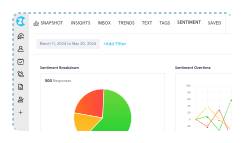
Track these on a centralized survey dashboard with store-level breakdowns. The dashboard isn't for reading individual responses — it's for spotting which stores are drifting and which parameters are driving the drift.
When to Trigger an In-Store Experience Survey
Timing is the variable most retail teams get wrong. The same in-store experience survey template will produce different data depending on when the customer encounters it.
- At the point of exit (kiosk or tablet): Captures emotional reactions while they're fresh. Best for measuring overall experience and checkout satisfaction. Drawback: customers who had a bad experience tend to walk past the kiosk — your data skews positive.
- At the checkout counter (embedded in receipt process): High capture rate (everyone checks out) but responses are rushed. Works for a 2-3 question quick pulse, not for the full 8-question template. Save this for the microsurvey version.
- Post-visit email (within 1-2 hours): Best for honest, detailed feedback. Customers have had time to reflect and will give longer open-ended answers. Use receipt email data or loyalty program info to trigger the survey automatically. Response rates: 8-15% but with richer data per response.
- Post-visit SMS (within 30 minutes): Higher open rates than email but shorter responses. Good for the NPS question and a quick parameter check. Send the link with a one-line ask: "How was your visit to [Store Name] today?"
The best approach: kiosk for daily pulse (overall + NPS) and email for weekly deep-dive (full template). Don't deploy both to the same customer on the same visit.
Integrating In-Store Survey Data With Your Retail Stack
Survey data locked inside a feedback tool is only half useful. The real value comes when you connect in-store experience scores to the systems where your retail team already works.
- CRM integration (HubSpot, Salesforce): Push NPS scores and open-ended feedback into customer records. When a loyalty program member scores below 6 on NPS, your CRM can trigger a retention workflow — discount offer, personal outreach from the store manager, or a service recovery email — without anyone manually reading the survey.
- POS data correlation: Match survey responses to transaction data via timestamps and store location. This tells you whether dissatisfied customers are spending less (they usually are) and lets you calculate the revenue impact of each NPS point. Use Zapier to connect Zonka with POS systems that don't have native integrations.
- Staff scheduling tools: When staff helpfulness scores drop consistently during certain shifts, feed that data into your scheduling system. The problem isn't "staff aren't helpful" — it's "you're understaffed on Tuesday evenings and the associates are overwhelmed."
- Inventory management: Low "Product Availability" scores at specific stores are a leading indicator of stock-out patterns. If three customers at the same location mention missing items in open-ended feedback, your inventory system probably hasn't flagged it yet because the SKU hasn't hit zero — it just hit "too low for shelf visibility."
Running an In-Store Feedback Program Day-to-Day
An in-store experience survey is not a one-time project. It's a recurring operational system that needs daily attention from store managers and weekly attention from regional leadership.
- Daily check (store manager, 5 minutes): Review the previous day's scores. Flag any detractor responses (NPS 0-6) for same-day follow-up. Check which parameter dipped — if checkout process dropped, look at yesterday's staffing log. Use CX automation to get detractor alerts pushed to your phone.
- Weekly review (regional manager, 30 minutes): Compare store-level scorecards. Identify the top and bottom performers on each parameter. Look at the thematic analysis of open-ended responses to spot emerging patterns — a new competitor opening nearby, a seasonal staffing crunch, or a supply chain issue affecting product availability.
- Monthly deep-dive (VP retail/CX team, 1 hour): Review trend data across the entire retail network. Which parameters are improving, which are declining? Cross-reference with sales data. Present findings to the operations team with specific, location-level action items — not abstract "improve customer experience" goals.
Pro tip: publish the weekly scorecard to all store managers, not just each store's own scores. Friendly competition between locations drives improvement faster than top-down directives. The store manager who sees their checkout score is the lowest across 15 locations will fix it before you have to ask.
Related Templates for Retail and In-Store Feedback
This in-store experience survey template covers the core visit experience. Depending on your retail operation, you may need complementary surveys for specific touchpoints:


.svg)
 Healthcare
 Finance
 Retail
 SaaS & Digital
 eCommerce
 Education
 Salesforce
  HubSpot
 Pipedrive
 Mailchimp
 Klaviyo
 Zendesk
  Intercom
 Freshdesk
 HelpScout
  Front
Front Jira
Jira Slack
Slack  MS Teams
 Zoom
Zoom Google Sheets
  Zapier
  Integrately
 Make
Make  Webhooks




 MS Teams