Subscription Cancellation Survey Template
Every cancelled subscription has a reason behind it. This subscription cancellation survey template captures that reason at the exact moment the customer leaves — before they’ve moved on and stopped caring enough to tell you.
- Try 14 days for Free
- Lightening fast setup
This subscription cancellation survey template fires at the point of exit — the moment a customer cancels. Two questions, two screens, 30 seconds. It captures the cancellation reason from a predefined list (missing features, cost, project over, usability, other) plus an open-ended detail field. The goal isn’t to stop the cancellation in real time. It’s to build a dataset of churn reasons that tells you exactly what to fix to prevent the next hundred.
What Questions Are in This Subscription Cancellation Survey Template?
This template includes 2 questions across 2 screens. Deliberately short — a customer who just clicked "cancel" has minimal patience for a long survey. Every second of friction between the cancel button and the exit increases the chance they close the tab without answering. Two questions gets you the critical data point without testing that patience.
- "We're sorry to see you go. Could you please let us know why you cancelled your subscription?" (MCQ: Missing features I need, The software is expensive, The project is over, Not sure how to use the tool, Other reasons) — This is your churn categorization engine. The five options aren't random — they map to the most common SaaS churn drivers. "Missing features" = product gap. "Expensive" = pricing/value mismatch. "Project is over" = natural lifecycle end (not fixable, but good to quantify). "Not sure how to use" = onboarding/adoption failure. "Other" catches the long tail. Track the distribution monthly — if "expensive" jumps from 15% to 30%, you have a pricing perception problem that product improvements alone won't fix.
- "Any other feedback you'd like to share with us?" (Open-ended, optional) — Optional by design. Requiring this field tanks completion rates — a customer mid-cancellation will skip rather than type. But the 30-40% who do write something provide the qualitative detail that the MCQ can't capture. "Missing features" becomes "I needed Jira integration and you didn't have it." "Expensive" becomes "I'm a solo founder — $99/month doesn't work for a team of one." Feed these into AI-powered feedback analytics to auto-tag sub-themes within each churn category.
How to Customize This Subscription Cancellation Survey Template
The default reasons work for general SaaS, but customizing them to your product dramatically improves data quality. Here's how:
- Replace generic options with product-specific churn reasons — If you know from support tickets that "slow performance" is a common complaint, add it as an explicit option. Generic categories like "other" are a signal that your options don't match your reality. Each "other" response is a category you missed.
- Add a competitor question — "Did you switch to a competitor? If yes, which one?" is uncomfortable to ask but invaluable to know. If 40% of churned users name the same competitor, you have a positioning problem, not just a product problem. Make this optional to avoid feeling interrogative.
- Add a win-back trigger question — "Under what circumstances would you consider re-subscribing?" with options like "lower pricing," "improved features," "better support." This turns the exit survey into a win-back segmentation tool — you know exactly what offer to put in front of each churned customer.
- Consider adding a rating of the cancellation process itself — "How easy was it to cancel?" (5-point scale). A difficult cancellation process creates resentment that poisons any future win-back attempt. And yes, making cancellation easy is good business — dark patterns save subscriptions this month and destroy brand trust permanently.
Customize all options, branding, and logic in the survey builder — no code needed.
Analyzing Churn Data — What to Do With Cancellation Survey Results
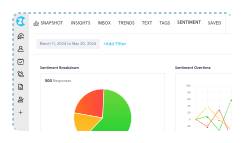
A pie chart of churn reasons is a starting point, not a strategy. Here's how to turn this subscription cancellation survey template's data into decisions:
- Track churn reason distribution monthly, not just overall. If "missing features" was 20% last month and is 35% this month, something changed — maybe a competitor launched a feature, or your product roadmap fell behind. Trend analysis on churn categories is more valuable than the snapshot. Use Zonka's reporting tools to visualize these trends.
- Cross-reference churn reasons with customer metadata. "Expensive" from a startup customer means something different than "expensive" from an enterprise customer. Segment churn data by plan type, company size, tenure, and usage level. The pattern that emerges tells you which segments need pricing adjustments and which need product changes.
- Build a churn prediction model from survey data. Customers who cite "not sure how to use" probably showed low adoption metrics before cancellation. Map churn reasons to behavioral signals — then use those signals to identify at-risk customers before they hit the cancel button. That's proactive retention, not reactive data collection.
- Mine the open-ended responses for competitive intelligence. Customers who write "I switched to [Competitor] because..." are giving you free market research. Use thematic analysis to cluster competitor mentions and feature comparisons. These responses shape your competitive positioning and product roadmap more honestly than any analyst report.
Common Churn Survey Mistakes That Waste the Exit Moment
The cancellation moment is a narrow window — mess it up and you lose the data permanently. Three mistakes to avoid:
- Making the survey longer than 3 questions — Every additional question at the cancellation moment drops completion rates by 15-20%. A customer who just decided to leave has zero loyalty left to your brand. Don't test it. Two questions gets you the "what" and the "why" — that's enough. Save the deep-dive for a follow-up email to churned users who opt in.
- Using the survey as a retention tool instead of a data tool — Some teams add a discount offer or "are you sure?" prompt to the cancellation survey. This conflates two different objectives and degrades both. The survey should be neutral and fast. Retention offers belong in a separate flow before the cancel button, not embedded in the exit survey.
- Collecting data but never closing the loop — If "missing features" is your #1 churn reason for six months and the product roadmap doesn't reflect it, the survey is decoration. Present churn reason trends to your product and leadership team monthly. Assign ownership of each churn category to a specific team. Read more about reducing customer churn with feedback data.
Where to Deploy This Subscription Cancellation Survey Template
The cancellation moment dictates the channel. Wherever the customer cancels, that's where the survey should live:
- In-app/in-product (primary channel) — Embed the survey directly in the cancellation flow. After the customer clicks "cancel subscription," the next screen is this 2-question survey. No email, no redirect, no delay. The response rate for in-flow surveys is 2-3x higher than post-cancellation emails because the customer is already in the "I'm explaining my decision" mindset. Use website survey widgets or in-app SDK to embed.
- Post-cancellation email (secondary channel) — Send within 1 hour of cancellation via email for customers who skipped the in-app survey. The email subject line matters: "We'd love to know why — 30 seconds" outperforms "Please take our survey." Keep it short and direct.
- SMS (for mobile-first products) — For apps and mobile-first services, SMS outperforms email for post-cancellation feedback. Send within 30 minutes of cancellation with a direct link to the 2-question survey.
Set up CX automation to trigger the survey automatically when a subscription status changes to "cancelled" in your billing system. Connect with HubSpot or Salesforce to tag churned contacts with their cancellation reason for future win-back campaigns.
Turning Cancellation Data Into a Win-Back System
The subscription cancellation survey template doesn't just explain churn — it creates the foundation for a win-back program. Here's how to close the feedback loop with churned customers:
- Segment churned customers by reason — "Missing features" customers go into a win-back campaign that triggers when you ship the requested feature. "Expensive" customers get notified about pricing changes or new plans. "Project is over" customers get a re-engagement nudge 6 months later when new projects start. Each segment gets a different message because each left for a different reason.
- Build a "feature request from churned users" tracker — When someone cancels because of a missing feature, log it alongside existing feature requests. If a feature is requested by 50 active users AND is the churn reason for 30 cancelled users, it jumps to the top of the roadmap. Churn data gives feature requests urgency that active user requests alone don't.
- "Not sure how to use" = immediate onboarding problem — This churn reason is the most fixable. Set up a real-time alert when someone selects this option, and have your CS team reach out within 24 hours with a rescue offer — a dedicated onboarding session, a walkthrough call, or extended trial. Some of these customers can be saved on the spot.
- Track win-back conversion rates by churn reason — "Expensive" customers who come back after a pricing change are validating your pricing decision. "Missing features" customers who return after a feature launch confirm your roadmap priorities. The win-back conversion rate by category tells you which churn categories are truly fixable and which are natural lifecycle exits.
Related Templates
Churn prevention requires data from before, during, and after cancellation. These templates cover the full lifecycle:
- Customer Loyalty Survey Template — Captures repurchase intent and improvement priorities before customers reach the cancellation point. The pre-churn early warning system.
- Customer Feedback Template — Multi-metric feedback (CSAT + NPS) for ongoing relationship monitoring between loyalty surveys.
- Product Churn Template — Focused on product-specific churn drivers. Use alongside this subscription cancellation survey for products where feature gaps are the primary churn driver.
- Customer Success Survey Template — Evaluates CS program effectiveness. Deploy pre-renewal to catch CS-driven churn risk before it reaches the cancellation stage.
Subscription Cancellation Survey Template FAQ
-
What is a subscription cancellation survey template?
A subscription cancellation survey template captures the reason a customer cancels their subscription at the point of exit. This template uses 2 questions — a multiple-choice reason selector (missing features, cost, project over, usability, other) and an optional open-ended feedback field. It takes about 30 seconds and deploys in-app or via email immediately after cancellation.
-
When should a cancellation survey trigger?
Immediately at the point of cancellation — as the next screen after the "confirm cancel" button, not as a follow-up email days later. In-flow surveys get 2-3x higher response rates than post-cancellation outreach. If the customer skips the in-app survey, send a follow-up email within 1 hour as a backup.
-
How many questions should a cancellation survey have?
Two, maximum three. Every additional question at the cancellation moment drops completion rates by 15-20%. The customer has already decided to leave — their patience for your brand is at its lowest point. Capture the "what" (reason category) and the "why" (open-ended detail). Save deeper questions for a follow-up email to respondents who opted in.
-
How do I use cancellation data to reduce churn?
Track churn reason distribution monthly and segment by customer metadata (plan type, tenure, usage level). Build win-back campaigns segmented by reason — feature-gap churners get notified when you ship what they asked for, price-sensitive churners hear about new plans. Present the top 3 churn reasons to your product and leadership team monthly with specific action assignments.
-
Should I include a retention offer in the cancellation survey?
No. Keep the survey neutral and fast. Embedding a discount offer or "are you sure?" prompt conflates data collection with retention and degrades both. Retention offers belong in a separate flow before the cancel button — not in the exit survey itself. The survey's job is to produce clean, honest data about why people leave.
-
Can I customize the cancellation reason options?
Yes, and you should. Replace generic options with product-specific churn reasons from your support tickets and CS conversations. If "slow performance" is a common complaint, add it explicitly. Every "other" response represents a category you missed. Add a competitor switch question and a win-back trigger question for maximum data value.
-
How do I analyze open-ended cancellation feedback at scale?
Use AI-powered thematic analysis to auto-tag sub-themes within each churn category. "Missing features" splits into specific feature requests; "expensive" splits into pricing structure complaints vs. ROI perception issues. The sub-themes are where the product and pricing decisions live — the top-level category alone isn't specific enough to act on.
Create and Send This Subscription Cancellation Survey with Zonka Feedback
Book a Demo


.svg)
 Healthcare
 Finance
 Retail
 SaaS & Digital
 eCommerce
 Education
 Salesforce
  HubSpot
 Pipedrive
 Mailchimp
 Klaviyo
 Zendesk
  Intercom
 Freshdesk
 HelpScout
  Front
Front Jira
Jira Slack
Slack  MS Teams
 Zoom
Zoom Google Sheets
  Zapier
  Integrately
 Make
Make  Webhooks




 MS Teams