This employee pulse survey template includes 3 questions: a mood rating, an open feedback prompt, and a suggestions field. Completion takes under 30 seconds, which is the entire point — pulse surveys work because they're fast enough to run frequently without burning out your team. Deploy weekly, biweekly, or monthly to build a continuous sentiment trendline that shows you what's changing between your full engagement surveys.
What Questions Are in This Employee Pulse Survey Template?
Three questions. No fluff. Each one earns its place because it produces a different type of signal — a trackable metric, qualitative context, and forward-looking input. Here's what you're getting and why this combination works better than a single "how are you?" emoji poll.
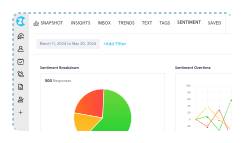
- "How was your day?" (mood rating / smiley scale) — The headline pulse metric. A smiley-face or 1-5 mood scale gives you a number you can trend over time. One data point means nothing. Fifty data points over 3 months show you whether morale is stable, climbing, or quietly eroding. Track this by team and week — a sudden dip in one team's average while others stay flat usually points to a team-specific trigger (new project, management change, workload spike) rather than an organizational issue. Feed these into sentiment analysis dashboards to visualize trend lines without manual spreadsheet work.
- "Is there anything else on your mind?" (open-ended) — The catch-all. This question surfaces whatever the employee is actually thinking about — which is often something you wouldn't have known to ask. Workload concerns, team friction, a great win that deserves recognition, frustration with a new tool rollout. The responses are messy and varied, and that's the value. Run them through thematic analysis weekly to auto-tag recurring themes. If "workload" appears in 30% of responses for two consecutive weeks, that's a signal worth escalating — even if the mood ratings haven't dropped yet.
- "Please leave us your feedback and suggestions" (open-ended) — This question is forward-looking where the previous one is observational. "What's on your mind?" captures current state. "Feedback and suggestions" invites ideas for improvement. The distinction matters — employees who feel heard on their current concerns are more likely to invest effort in suggesting improvements. Track suggestion quality over time: teams that give detailed, constructive suggestions tend to be more engaged than teams that leave this blank or write one-word answers.
Pro tip: The two open-ended questions look redundant but serve different purposes. Merging them into one "anything to share?" field produces lower-quality responses because people default to either venting or suggesting — not both. Keeping them separate gives you cleaner data categorization. If you still want to reduce, keep the mood rating and one open-ended ("Is there anything on your mind?"). Never cut below 2 questions — a single mood rating with no context is a metric without meaning.
What Does Good Pulse Survey Data Look Like — Benchmarks and Red Flags
Pulse survey benchmarks are different from engagement survey benchmarks because you're measuring frequency and trend, not depth.
- Response rate target: 70%+. Below 60% means people have stopped caring about the survey — usually because they've given feedback before and nothing changed. Response rate decline is itself a signal: if your pulse response rate drops from 80% to 55% over 8 weeks, the survey isn't the problem. The lack of visible action on previous feedback is the problem.
- Mood stability: A healthy team's average mood rating shouldn't swing more than 0.3 points on a 5-point scale week to week. Swings larger than 0.5 points indicate something happened — a major deadline, a layoff announcement, a leadership change. Investigate any single-week swing above 0.5 before waiting for the next data point.
- Open-ended response rate: If fewer than 30% of respondents write anything in the open-ended fields, the survey is being rushed through without thought. That's still better than no data, but the qualitative value drops. Shorten the survey window (24 hours instead of a week) to create urgency, and share examples of how previous feedback led to changes — visible impact drives future participation.
- Theme concentration: When one theme dominates more than 40% of open-ended responses for 3+ consecutive weeks, it's no longer a blip — it's a structural issue demanding attention. Track with location and team analytics to see whether the theme is org-wide or isolated to specific teams.
The benchmark that matters most: trend direction over 8-12 weeks. A team averaging 3.2/5 mood that's been climbing 0.1 per week for 6 weeks is healthier than a team at 4.0 that's been declining 0.1 per week for the same period. Absolute scores vary by team personality; trajectories tell you what's actually happening.
Pulse Surveys vs. Annual Engagement Surveys — Why You Need Both, Not Either
The biggest misconception about employee pulse survey templates: that they replace engagement surveys. They don't. They serve fundamentally different purposes.
- Pulse surveys (this template): High frequency, low depth. 30 seconds, weekly or monthly. You get a mood trend line and qualitative signals. The data tells you when something changed and gives you clues about what — but it won't tell you the full why. That's by design. Pulse surveys are a monitoring system, not a diagnostic tool.
- Engagement surveys (like the employee engagement survey template): Low frequency, high depth. 5-8 minutes, biannually. You get dimension-level data across growth, compensation, autonomy, relationships, and culture. The data tells you why engagement is high or low — but by the time you run it, the situation might have already changed.
The right cadence: Run pulse surveys weekly or monthly as your continuous monitoring layer. Run full engagement surveys biannually as your deep diagnostic. When pulse data shows a decline, the engagement survey tells you which dimension is driving it. When engagement data identifies a problem area, pulse surveys track whether your interventions are working in real time.
Teams that run only engagement surveys are flying with delayed instruments — they see where they were 6 months ago. Teams that run only pulse surveys have real-time sentiment but no understanding of root causes. You need both layers.
Mistakes That Turn Pulse Surveys Into Background Noise
Pulse surveys fail more often from execution mistakes than from bad questions. The template is simple — the process around it determines whether it produces actionable data or becomes another notification people ignore.
- Over-surveying without acting on results. This is the #1 pulse survey killer. If employees share feedback every week and nothing visibly changes, they stop participating. Before launching a weekly pulse, define your response process: who reads the data, when they read it, and what triggers an intervention. A pulse survey without a response system is just surveillance that employees eventually tune out.
- Sending at inconsistent times. If your pulse goes out Monday at 9am one week, Thursday at 4pm the next, and Tuesday at noon after that, you're introducing timing bias into your data. Monday mood differs from Friday mood. Pick a consistent day and time — most teams find Tuesday or Wednesday morning gives the most representative responses. Use recurring survey scheduling to lock in the cadence.
- Making it too long. A "pulse survey" with 10 questions isn't a pulse — it's a short engagement survey. The moment your pulse takes more than 60 seconds, you've crossed from "quick check-in" to "another thing on my to-do list." Three questions is the ceiling. Two is often better.
- Not segmenting results. Company-wide pulse data hides the story. Team A at 4.5/5 and Team B at 2.0/5 average to 3.25 — which looks "fine." Cut pulse data by team, department, location, and manager. That's where the signals live. Teams running creative employee surveys at the team level surface issues that aggregated data misses entirely.
- Ignoring low response rates. A pulse survey with 40% response rate isn't giving you a representative picture — it's giving you feedback from the most engaged or most frustrated employees (the middle stays quiet). If response rates drop below 60%, pause the survey and investigate why. Usually: either nothing changed from previous feedback, or the survey feels pointless.
Where to Deploy Your Employee Pulse Survey — Channel Selection by Workforce Type
A 30-second survey needs to reach people where they already are. Making someone open their email, find the survey, click a link, and load a page adds friction that kills response rates for something this short.
- Slack/Teams — for desk-based knowledge workers. Send the pulse as a direct message through Slack or MS Teams. The mood question can render as an interactive poll inside the message. No link to click, no page to load. Response rates for in-app pulse surveys consistently run 15-20% higher than email-based pulses for teams that live in these tools.
- SMS — for deskless, frontline, and field workers. Warehouse staff, retail associates, healthcare workers, and field technicians don't sit at desks checking email. Reach them via SMS surveys. A 3-question pulse via text takes 20 seconds to complete. Send at shift start or shift end — not mid-shift when they're working.
- Email — for mixed workforces or formal environments. Email surveys work when the pulse is part of a formal cadence (e.g., every Monday morning). Embed the first question directly in the email body so the employee can start responding without clicking through. Email pulse surveys work better on a weekly cadence than daily — daily email surveys get filtered and ignored.
- In-app — for product and engineering teams. If your team uses an internal tool daily (HRIS, intranet, project management platform), embed the pulse there. In-app SDK surveys load inside the tool employees already have open. Zero context switching means maximum completion rates.
Pro tip: Don't use the same channel for pulse surveys and full engagement surveys. If your engagement survey goes out via email, send pulse surveys via Slack. Channel variety prevents the "oh, another survey" reflex.
Automating Your Pulse Survey Program So It Runs Itself
A pulse survey that depends on someone remembering to send it every week will last about 6 weeks before someone forgets, the cadence breaks, and the program dies quietly. Automation is non-negotiable for sustained pulse programs.
- Recurring schedule: Set the pulse to deploy automatically every week or every two weeks using recurring survey scheduling. Pick the day (Tuesday or Wednesday), the time (morning in the employee's timezone), and the close window (24-48 hours). Lock it in once and never touch it again.
- Auto-close and report: Close the survey window automatically after 48 hours. Generate a summary report — mood average, theme tags from open-ended responses, response rate — and route it to managers and HR partners within 24 hours of close. Use survey reporting dashboards with week-over-week comparison views.
- Threshold alerts: Configure automated workflow alerts for two conditions: (1) any team's mood average drops below a defined threshold (e.g., 2.5/5), and (2) a specific theme appears in more than 30% of open-ended responses for two consecutive weeks. These are your escalation triggers. Without them, you're collecting data that nobody reviews until the quarterly report.
- Response rate monitoring: If response rate drops below 60% for two consecutive weeks, trigger a notification to the survey owner. Declining response rates are feedback about your feedback program — something needs to change (communication, visible action on results, cadence adjustment).
Related Employee Feedback Templates
Pulse surveys are the fast, frequent layer of your employee feedback ecosystem. These templates provide the depth and specificity that pulse data alone can't deliver.
- Employee Net Promoter Score (eNPS) Survey Template — A single loyalty metric that pairs naturally with pulse surveys. Run eNPS monthly and pulse surveys weekly for two complementary data streams: eNPS tells you if people would recommend your company; pulse tells you how they're feeling day to day.
- Employee Engagement Survey Template — The deep diagnostic that pulse surveys are NOT. When pulse data shows declining mood, the engagement survey tells you which specific dimension (growth, compensation, management, culture) is driving the decline. Run biannually as the complement to weekly/monthly pulses.
- Employee Exit Survey Template — Retroactively compare departing employees' pulse survey trends to their exit reasons. Employees whose pulse scores declined steadily for 8+ weeks before resigning? That's a pattern you could have caught — and that's exactly why pulse data exists.
- Employee Wellness Survey Template — When pulse mood scores drop but engagement dimensions look stable, the issue might be wellness — burnout, stress, work-life balance — rather than organizational engagement. A wellness survey provides the diagnostic layer that pulse mood data can't.


.svg)
 Healthcare
 Finance
 Retail
 SaaS & Digital
 eCommerce
 Education
 Salesforce
  HubSpot
 Pipedrive
 Mailchimp
 Klaviyo
 Zendesk
  Intercom
 Freshdesk
 HelpScout
  Front
Front Jira
Jira Slack
Slack  MS Teams
 Zoom
Zoom Google Sheets
  Zapier
  Integrately
 Make
Make  Webhooks



 Sign In
 MS Teams