

.svg)
 Healthcare
 Finance
 Retail
 SaaS & Digital
 eCommerce
 Education
 Salesforce
  HubSpot
 Pipedrive
 Mailchimp
 Klaviyo
 Zendesk
  Intercom
 Freshdesk
 HelpScout
  Front
Front Jira
Jira Slack
Slack  MS Teams
 Zoom
Zoom Google Sheets
  Zapier
  Integrately
 Make
Make  Webhooks




 MS Teams



Quick answer: The best customer intelligence platforms for CX leaders are Zonka Feedback, Medallia, Qualtrics, InMoment, Chattermill, Thematic, Clootrack and Unwrap. Each one reads the open-ended feedback behind NPS, CSAT and CES scores and ties the themes it finds to the customers, locations, agents or accounts behind the number.
The eight platforms, with full-loop platforms first and intelligence layers after:
- Zonka Feedback: best for AI feedback analysis and signals by location and agent
- Medallia: best for multi-location enterprises capturing signal at every touchpoint
- Qualtrics: best for enterprise programs spanning locations, digital and the contact center
- InMoment: best for CX programs that want software plus in-house experts
- Chattermill: best for unifying high-volume multichannel feedback into one theme model
- Thematic: best for adding traceable themes on top of an existing CX suite
- Clootrack: best for consumer brands analyzing reviews and calls across markets
- Unwrap: best for tying themes to accounts and revenue in B2B programs
What Is a Customer Intelligence Platform for CX Leaders?
A customer intelligence platform for CX leaders is software that reads the open-ended feedback behind NPS, CSAT and CES scores and connects each theme to the customers, locations and agents it affects. The score tells a CX team that something changed. The comments under it explain why, and a customer intelligence platform turns thousands of them into feedback categories, customer sentiment and signals a named owner can act on. It brings customer feedback from surveys, support tickets, chats and online reviews into one model, so the same complaint counts once whether it arrived in a survey or a ticket. The strongest platforms then answer the question every CX leader hears in a quarterly review: which pain points moved the number, where they're concentrated, and whether the fix worked.
Customer intelligence platforms handle four jobs:
- Unify: bring survey data, support data and reviews into one place and break down the data silos between teams.
- Explain: find themes, sentiment and intent in unstructured feedback without manual tagging.
- Locate: break every theme down by location, agent, segment or account.
- Act: route each finding to its owner and track whether the score moved after the fix.
A tool that stops after the second job is text analytics. CX leaders need all four, because a theme without an owner or a location rarely gets fixed.
Customer Intelligence Platforms Compared
The table compares the eight customer intelligence platforms on the sources they read, how they break down a score, what happens after a theme surfaces, and how each one prices.
| Tool | Type | Sources It Reads | How It Breaks Down a Score | Routing and Action | Pricing Model | G2 Rating |
| Zonka Feedback | Full-loop platform | Surveys on eight channels, tickets, chats, Google reviews | Locations, agents, departments, custom entities | Auto-routing by entity, alerts, case inbox | Custom pricing based on usage and needs | 4.7/5 (80 reviews) |
| Medallia | Full-loop platform | Surveys, speech, social, digital, video | Any org structure, insights for every role | Smart Response replies, Frontline-Ready AI | Experience Data Record model, contact sales | 4.5/5 (210 reviews) |
| Qualtrics | Full-loop platform | Surveys, calls, chat, social, digital behavior | Location, digital and contact center views | Automated workflows, Experience Agents | Priced on interactions, request pricing | 4.3/5 (751 reviews) |
| InMoment | Full-loop platform | Surveys, reviews, social, calls, chats, tickets | Customer journey view, shaped by InMoment experts | Intelligent alerts, case management | Not published | 4.7/5 (319 reviews) |
| Chattermill | Intelligence layer | Surveys, reviews, tickets, social, calls | Customer ID, channel, location, CRM segments | Anomaly alerts to Slack, email and Jira | Not published | 4.4/5 (238 reviews) |
| Thematic | Intelligence layer | Surveys, tickets, calls, reviews, social | Segments, themes scored by business impact | Predictive Actions: tickets, alerts, dashboards | Not published | 4.8/5 (43 reviews) |
| Clootrack | Intelligence layer | Reviews, calls, survey text via 1,000+ connectors | Country, region, category, SKU, competitor | Goal-based AI agents, decision digests | Not published | 4.6/5 (44 reviews) |
| Unwrap | Intelligence layer | Surveys, tickets, reviews, sales and support calls | Accounts and revenue | Slack and email alerts, Responder, team dashboards | From $24,000 per year | 4.8/5 (26 reviews) |
Zonka Feedback, Medallia, Qualtrics and InMoment collect feedback and analyze it in one product. Chattermill, Thematic, Clootrack and Unwrap are intelligence layers that analyze feedback your survey tools, helpdesk and review sites already hold. Within each group, the biggest difference is the breakdown, since location and agent views suit multi-location operators and account and revenue views suit B2B teams.
How This List Was Built
A platform earned a place on this list only if it reads open-ended customer feedback, finds themes and sentiment automatically, and connects them to the scores and customers behind them. Customer data platforms, BI tools and helpdesks were left out because they work on structured data or treat feedback analysis as a side feature. Each platform's capabilities were confirmed on the vendor's own product pages, customer stories and pricing pages.
The platforms were compared on five criteria:
- Sources: which feedback channels the platform reads, from surveys to tickets, reviews and calls
- Explanation: how it finds themes, sentiment and intent in unstructured feedback
- Breakdown: whether themes break down by location, agent, segment or account
- Routing and action: how a finding reaches an owner and what happens next
- Proof of impact: whether the platform shows a score moving after a fix
The list runs full-loop platforms first, then intelligence layers, and orders each group by fit for CX leaders who own NPS, CSAT and CES programs across locations and agents. Ratings come from each platform's G2 profile and pricing from each vendor's own website, both checked in September 2026. Where a vendor doesn't publish a price, the entry says so, and readers can contact sales for a quote.
InMoment and Qualtrics appear as separate entries because both are still sold as separate platforms, even though Qualtrics now owns InMoment's parent company. Forsta, a third product under the same parent, was left out because its strength is research-grade survey work.
Zonka Feedback publishes this guide and is one of the eight platforms reviewed. Its entry follows the same criteria, fields and length as the other seven, cons included.
What Are the Best Customer Intelligence Platforms for CX Leaders?
For CX leaders, the best full-loop customer intelligence platforms are Zonka Feedback, Medallia, Qualtrics and InMoment, and the best intelligence layers are Chattermill, Thematic, Clootrack and Unwrap. Every entry uses the same fields, from the sources a platform reads to the programs it doesn't suit.
1. Zonka Feedback: Best for AI Feedback Analysis & Signals by Location and Agent
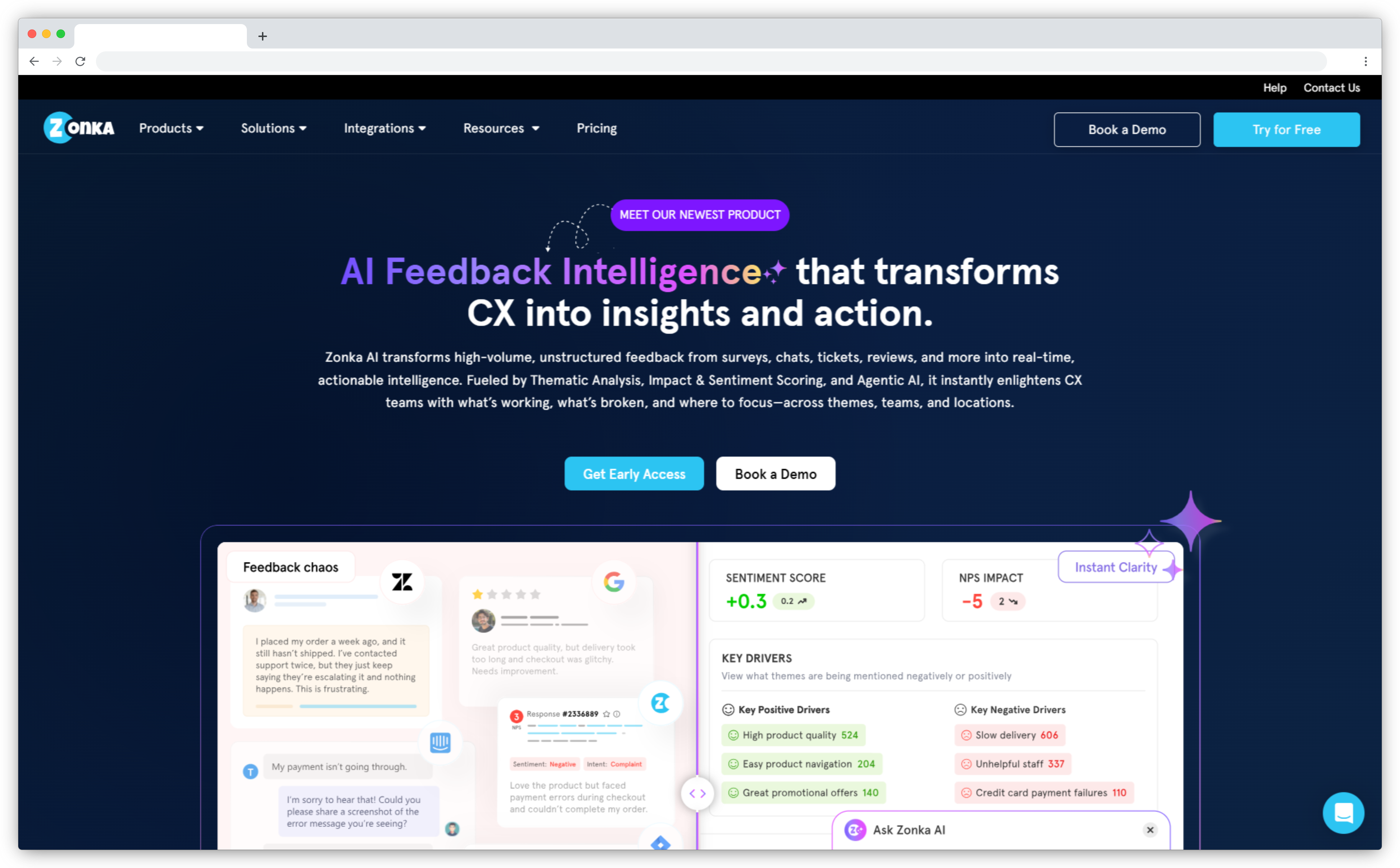
Zonka Feedback collects feedback on eight channels, from email and WhatsApp to kiosks, and unifies it with support tickets, chats and Google reviews in a single platform. Its feedback intelligence tags every response with themes, sentiment and entities, and frontline analytics compare locations, teams and agents side by side. Zonka's team handles setup and migration, and the platform is ISO 27001 certified, GDPR and HIPAA compliant.
At a Glance
- Sources it reads: Surveys, plus tickets, chats and emails from Zendesk, Intercom and Freshdesk, and Google reviews synced by location.
- How it explains the score: AI analysis finds themes and sub-themes and scores sentiment, emotion, intent and urgency for every response and theme.
- Breakdown: Standard and custom entities such as locations, agents and departments, with leaderboards for agent performance and location scores.
- Routing and action: Workflow automation routes tagged feedback to its owner, with real-time reporting, alerts and cases in one response inbox.
- Proof of impact: Impact analysis scores each theme's effect on NPS, CSAT and churn and tracks how initiatives move those scores.
- Best for: CX leaders who want to collect feedback and analyze it in one platform, with scores broken down by location and agent.
- Not the right fit if: You're keeping another survey suite for collection and only want an analysis layer on top.
Zonka Feedback Pros
- Surveys and workflows are quick to customize.
- The support team is responsive.
- The Salesforce integration is strong.
Zonka Feedback Cons
- The breadth of features can take new users some time to learn.
- Custom pricing means teams need a quote before comparing costs.
2. Medallia: Best for Multi-Location Enterprises Capturing Signal at Every Touchpoint
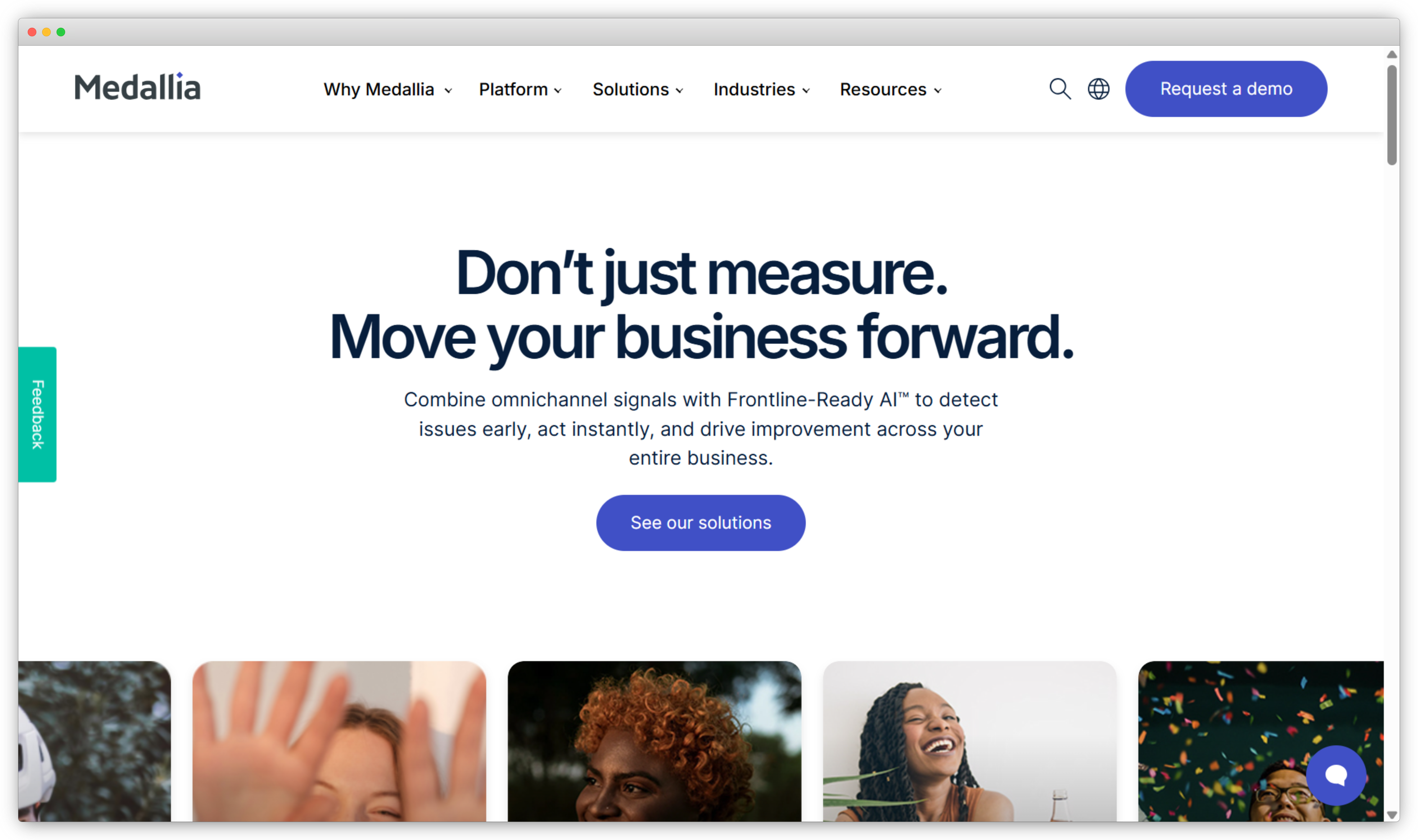
Medallia Experience Cloud is an experience management platform built for enterprise scale and complex org structures. One pricing metric, the Experience Data Record, covers signal capture from surveys, speech, social, digital and video feedback, along with text, speech and acoustic analytics. Frontline-Ready AI is designed so employees can act on insights without training.
 At a Glance
- Sources it reads: Surveys, speech, social signals, digital feedback and video feedback, all counted under one Experience Data Record.
- How it explains the score: Medallia AI Text Analytics and speech analytics, Themes with GenAI for emerging issues, and Root Cause Assist, which runs root cause analysis without an analyst.
- Breakdown: Adapts to any org structure and delivers insights to every role, from frontline employees to executives.
- Routing and action: Smart Response drafts personalized, branded replies so frontline teams can close the loop with customers in seconds.
- Proof of impact: Medallia frames its reporting around cost reduction and revenue growth across the enterprise.
- Best for: Large enterprises with many locations and business units that need signal from every channel, including the contact center.
- Not the right fit if: You need a fast, self-serve rollout, since G2 reviewers mention a steep learning curve.
Medallia Pros
- Strong feedback management across touchpoints.
- Insights generation that reviewers rate highly.
- Helpful customer support.
Medallia Cons
- The learning curve is steep for new users.
- Reporting can be difficult to set up.
Medallia Pricing
- Priced per Experience Data Record, a single metric that includes the platform's features.
- Contact sales for a quote.
G2 Rating: 4.5/5 (210 reviews)
3. Qualtrics: Best for Enterprise Programs Spanning Locations, Digital and the Contact Center
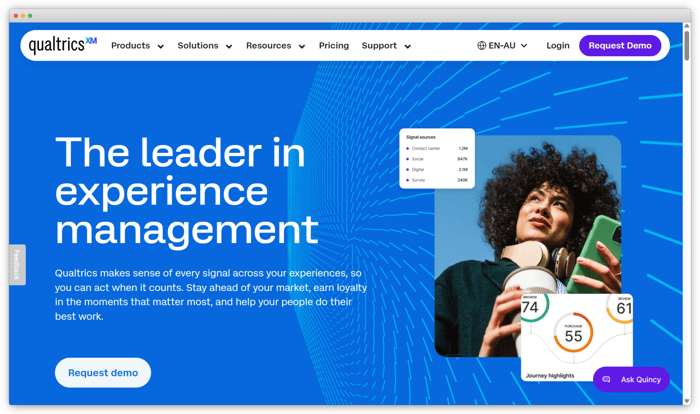
Qualtrics XM for Customer Experience is customer experience software that captures feedback across surveys, calls, chat, social and digital channels. It extends into dedicated products for locations, digital experience analytics and the contact center, so one vendor can cover the whole program. Experience Agents are AI agents that act on customer context to prevent churn as customer expectations shift.
At a Glance
- Sources it reads: Surveys, calls, chat, social and digital behavior, plus conversation intelligence across every call, email and chat in the contact center.
- How it explains the score: Text and conversation analytics across channels, though a G2 reviewer notes that sentiment analysis isn't included in basic licenses.
- Breakdown: Location Experience Management recommends actions for every location, with a plan built for location-based industries such as hospitals, hotels and retail.
- Routing and action: Automated workflows trigger recovery efforts, route feedback to the right experience owner and close the loop with customers.
- Proof of impact: Predictive modeling flags customers at risk of churning and ties experience data to revenue at risk.
- Best for: Enterprise CX programs that want one vendor across locations, digital channels and the contact center.
- Not the right fit if: Your team wants a light setup for basic surveys, which G2 reviewers say can feel complex.
Qualtrics Pros
- Deep insights that support customer satisfaction and retention work.
- Strong analytics and reporting.
- Flexible dashboard building.
Qualtrics Cons
- Complexity can slow down new users.
- Sentiment analysis sits outside basic licenses.
Qualtrics Pricing
- CX plans are priced on interactions.
- Request pricing from sales.
G2 Rating: 4.3/5 (751 reviews)
4. InMoment: Best for CX Programs That Want Software Plus In-House Experts
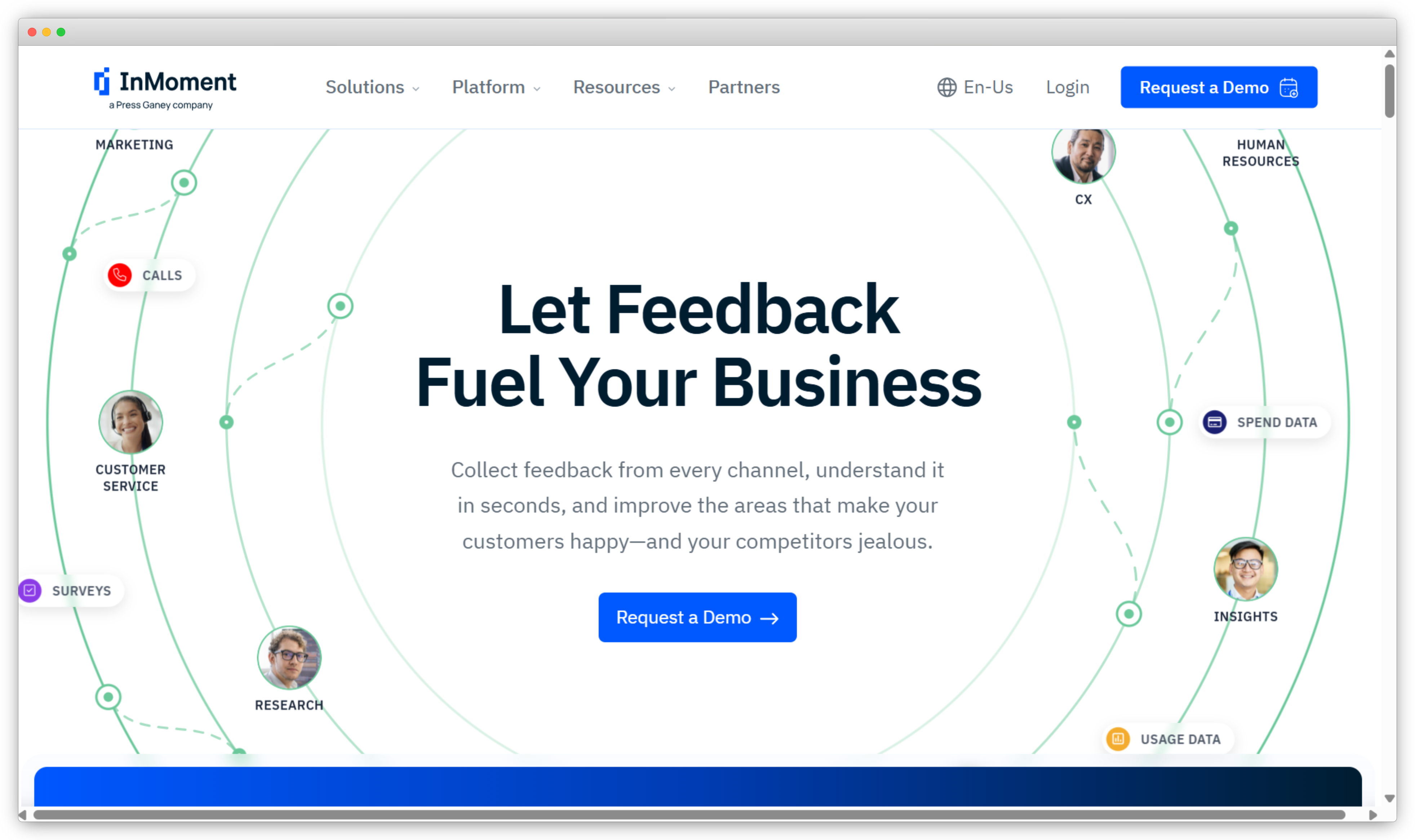
InMoment is still sold as its own platform, even though its parent company, Press Ganey Forsta, is now owned by Qualtrics. The Experience Improvement (XI) Platform brings surveys, conversations, ratings and reviews into one view of the customer journey, and its conversational surveys ask follow-up questions in real time. A team of CX experts works alongside the software, and reputation management and conversational intelligence modules extend it into reviews and the contact center.
At a Glance
- Sources it reads: Surveys, ratings and reviews, social media, calls, chats, support tickets and emails, plus spend and usage data.
- How it explains the score: AI and NLP across every channel, plus Smart Summaries that condense long comments.
- Breakdown: Journey analytics across touchpoints, with program structure and reporting shaped by InMoment's experts.
- Routing and action: Intelligent alerts feed case management, and cases are assigned, tracked and prioritized in the XI Platform or your CRM.
- Proof of impact: InMoment's experts guide the program toward documented ROI and keep improving it over time.
- Best for: Enterprise CX programs that want strategists and analysts working alongside the platform.
- Not the right fit if: You want a self-serve rollout without a services relationship.
InMoment Pros
- Easy to use, with an intuitive dashboard.
- Responsive, supportive staff.
- Collects tens of thousands of survey responses without manual deployment.
InMoment Cons
- It can be expensive, according to G2 reviewers.
- Customization can need technical expertise for complex needs.
5. Chattermill: Best for Unifying High-Volume Multichannel Feedback Into One Theme Model
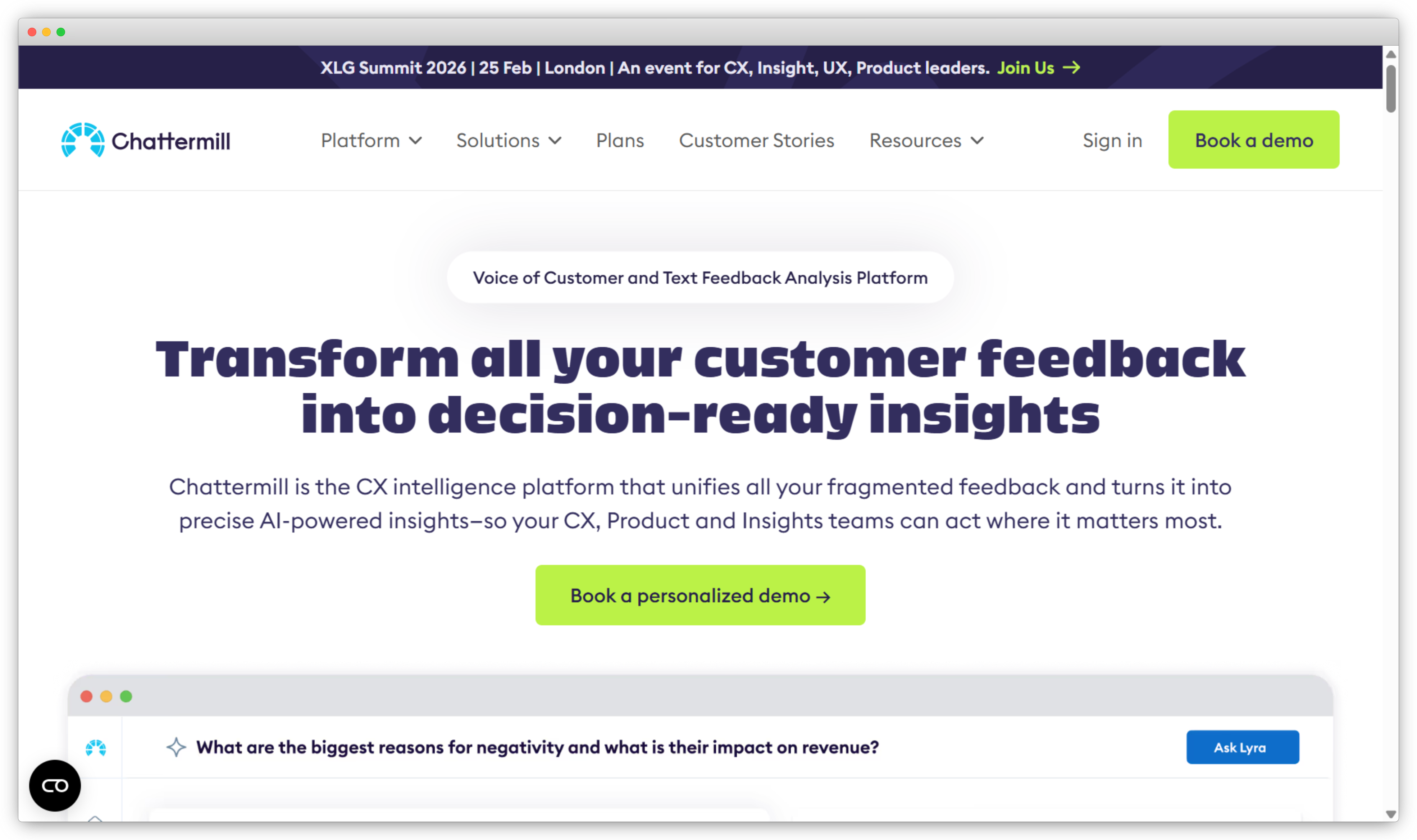
Chattermill has the largest G2 review base of the four intelligence layers here, at 238 reviews, and real-time feedback management is the strength reviewers mention most. Chattermill describes itself as an AI-native voice of customer platform that unifies fragmented feedback for teams and AI agents. Its Lyra Agent monitors feedback continuously and answers questions about what's moving NPS and CSAT.
At a Glance
- Sources it reads: Surveys, product reviews, support tickets, social media and call transcripts, including data from Zendesk, Intercom, Qualtrics and Trustpilot.
- How it explains the score: Theme detection that finds several concepts and sentiments in one comment, plus Lyra Agent for diagnosing NPS or CSAT shifts and churn signals.
- Breakdown: Each signal carries context such as customer ID, channel and location, and CRM data adds account, deal and segment context.
- Routing and action: Anomaly alerts deliver real-time insights to Slack, email and Jira, and top issues become Jira tickets with customer quotes attached.
- Proof of impact: Impact analysis tracks the effect of CX on customer retention, churn and revenue, with a team of experts to link signals to outcomes.
- Best for: B2C CX and VoC teams with high feedback volume across many channels.
- Not the right fit if: You need a light setup, since G2 reviewers mention a steep learning curve.
Chattermill Pros
- Real-time feedback management.
- Clear customer insights that support decisions.
- Responsive support.
Chattermill Cons
- The learning curve is steep, with limited guidance.
- Dashboards aren't always intuitive to build.
Chattermill Pricing
- Not published.
- Chattermill's pricing page routes to a demo request.
G2 Rating: 4.4/5 (238 reviews)
6. Thematic: Best for Adding Traceable Themes on Top of an Existing CX Suite
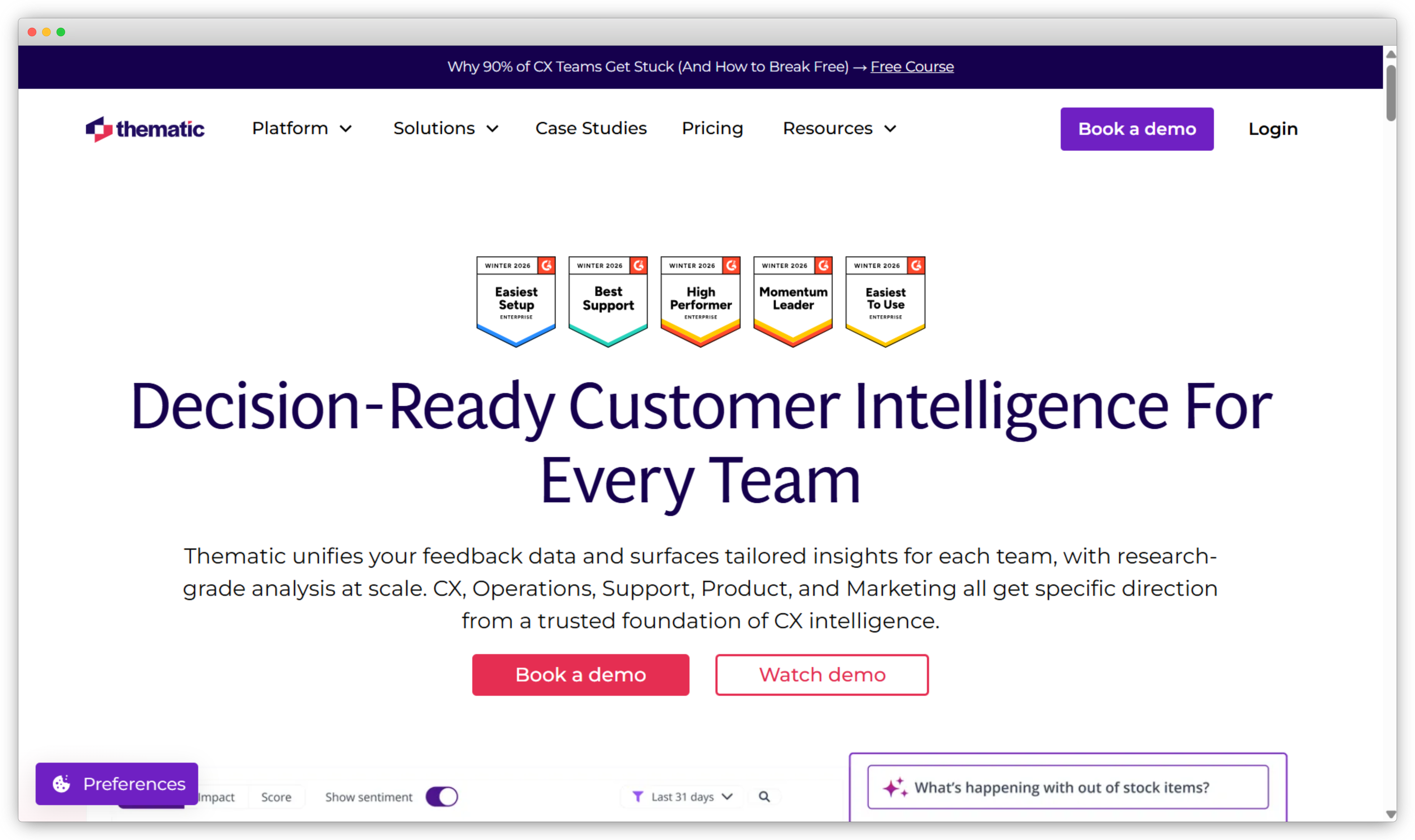
Thematic calls itself the customer intelligence layer for enterprise CX, and its pitch is aimed at teams whose feedback already sits in a CX suite without clear answers. It unifies surveys, tickets, calls, reviews and social into one model, and every theme traces back to the raw comments behind it. That traceability makes the output easier to defend in an executive review.
At a Glance
- Sources it reads: Surveys, support tickets, calls, app reviews and social, including survey data from an existing CX suite.
- How it explains the score: Themes scored by business impact, and a Scoring Agent that uses predictive analytics to estimate NPS, churn propensity and effort from unstructured feedback.
- Breakdown: Responses filter by segment, and themes trend over time against KPIs such as NPS, according to G2 reviewers.
- Routing and action: Predictive Actions route insights to the right team in the tools they already use, creating tickets, alerts and dashboard updates.
- Proof of impact: Thematic cites a Forrester Total Economic Impact study that measured a 543% three-year ROI.
- Best for: Enterprise CX and insights teams that keep their survey platform and need defensible themes on top of it.
- Not the right fit if: You want one vendor to handle both collection and analysis.
Thematic Pros
- An intuitive interface.
- Granular themes and sentiment that give a deeper understanding of what drives NPS.
- Fast onboarding and strong customer support.
Thematic Cons
- Collection depends on the survey tools and CX suite you already run.
- There's no public pricing page.
Thematic Pricing
- Not published on Thematic's website.
- Contact sales for a quote.
G2 Rating: 4.8/5 (43 reviews)
7. Clootrack: Best for Consumer Brands Analyzing Reviews and Calls Across Markets
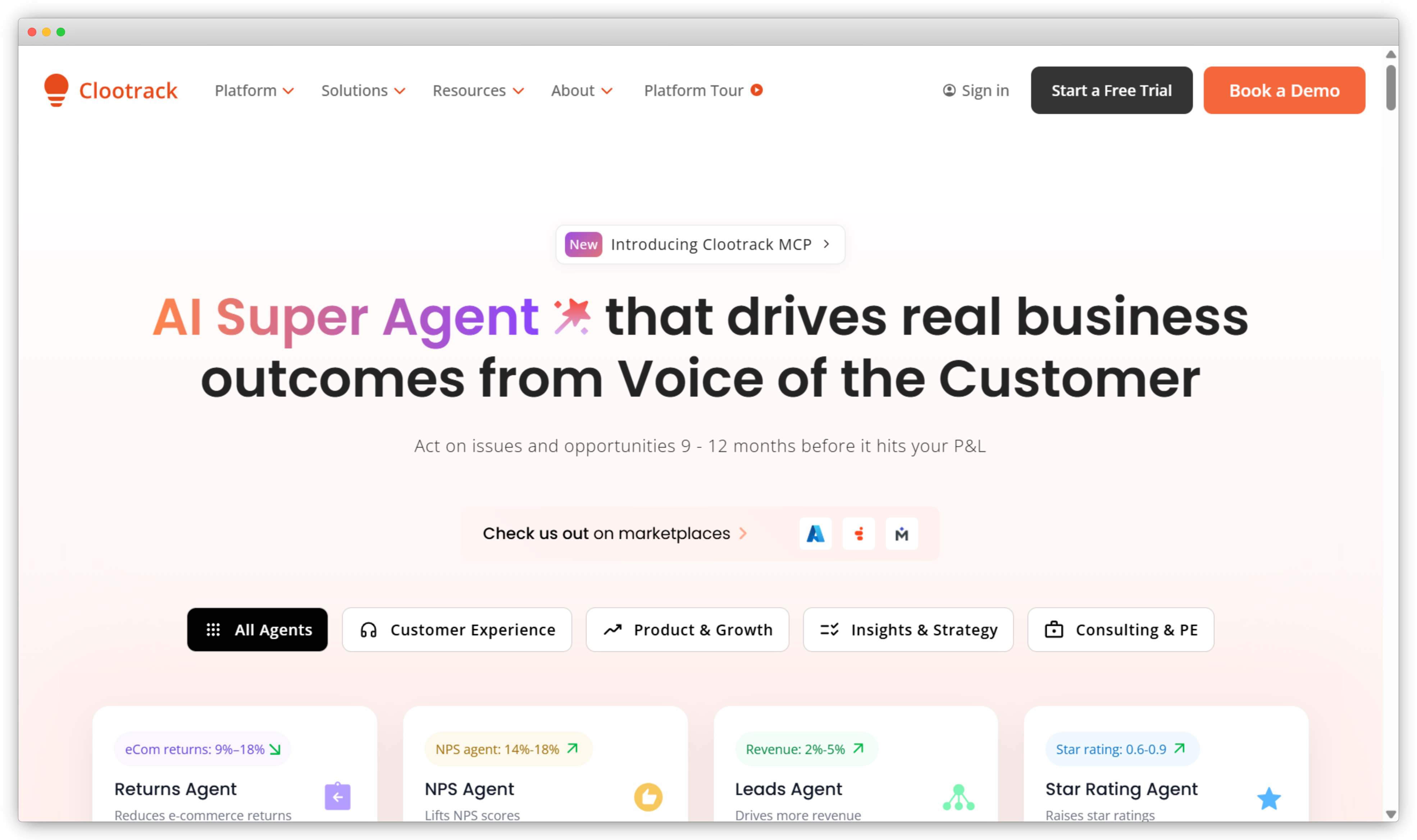
If most of your feedback lives in public reviews and contact center calls, Clootrack is built for that mix. Clootrack Neo is an AI agent platform for voice of the customer that pulls data through 1,000+ connectors, and its unsupervised theme analysis finds patterns without a fixed taxonomy. It supports 95+ languages, and it's GDPR compliant and ISO 27001 certified, with a self-hosted Azure option.
At a Glance
- Sources it reads: Online ratings and reviews, contact center calls and open-ended survey responses, plus cloud storage endpoints such as Amazon S3.
- How it explains the score: Unsupervised theme analysis that catches every topic in a conversation, even when one comment raises several.
- Breakdown: Review data filters by country, region, category, SKU and competitor, per a customer quoted on Clootrack's site, which supports competitive benchmarking.
- Routing and action: Goal-based AI agents, such as an NPS Agent and a Star Rating Agent, deliver AI Decision Digests to teams.
- Proof of impact: Clootrack publishes outcome ranges for each agent, such as a 14% to 18% NPS lift for its NPS Agent.
- Best for: Retail, e-commerce and consumer brands with heavy review and call volume across markets.
- Not the right fit if: You need survey collection and case management in the same platform, which Clootrack's product pages don't cover.
Clootrack Pros
- Breaks down departmental data silos.
- Themes, sub-themes and sentiment by theme.
- A team that's open to feedback and custom requests.
Clootrack Cons
- Some visualization dashboards could be clearer.
- There's no public pricing.
Clootrack Pricing
- Not published.
- A SaaS free trial is offered, and self-hosted access is by request.
G2 Rating: 4.6/5 (44 reviews)
8. Unwrap: Best for Tying Themes to Accounts and Revenue in B2B Programs
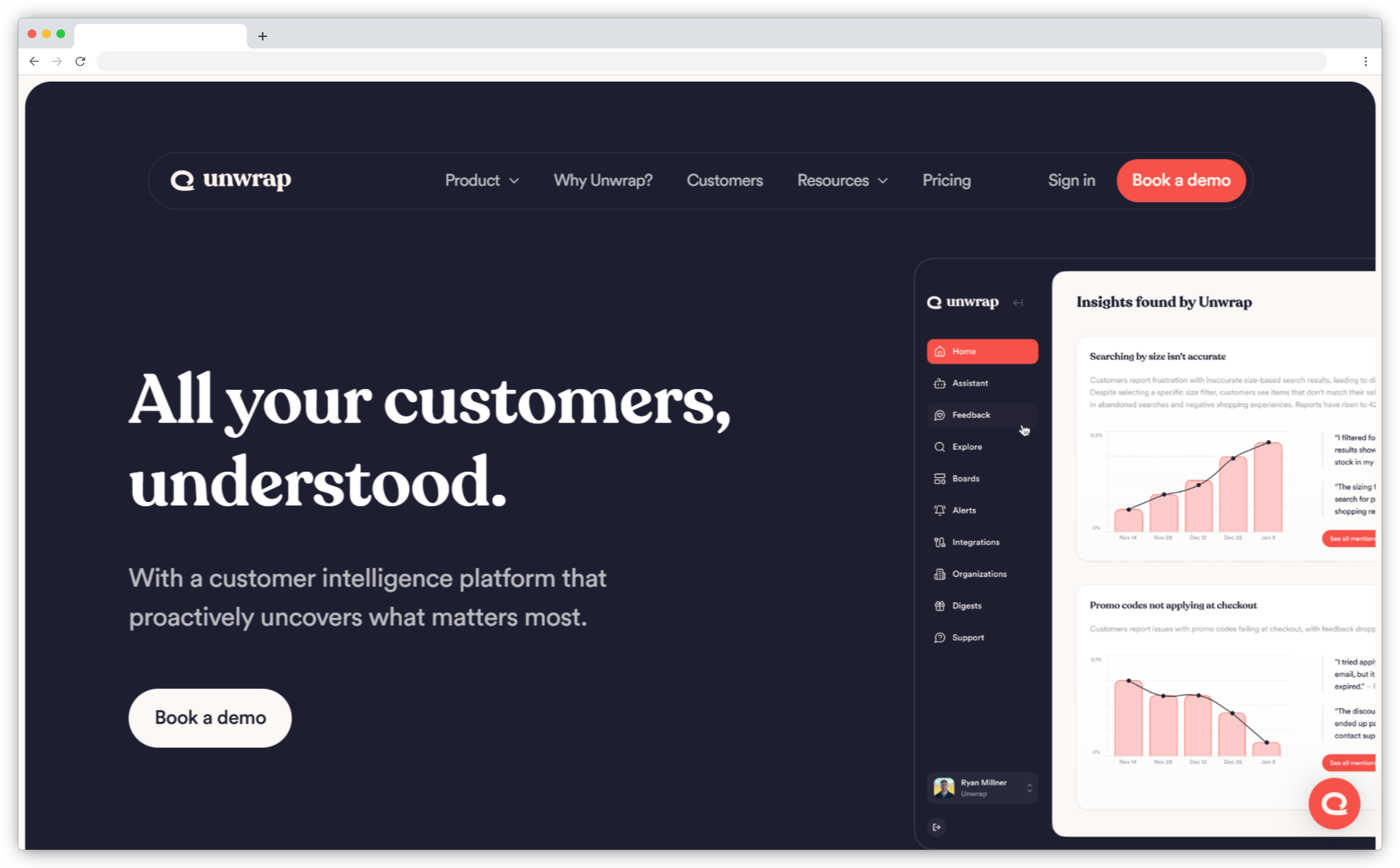
For a B2B CX team where every complaint matters because of the account behind it, Unwrap is the most direct fit on this list. Unwrap groups feedback from surveys, tickets, reviews and calls into themes without a hand-built taxonomy and ties each theme to the accounts and revenue it affects. It's SOC 2 Type II and GDPR compliant, with SSO and automatic PII redaction.
At a Glance
- Sources it reads: Surveys, support tickets, app-store and product reviews, and sales calls or support calls, from thousands of integrations.
- How it explains the score: Auto Tagger categorizes all feedback, and the Assistant answers natural language questions with customer anecdotes and dynamic charts.
- Breakdown: By account and revenue, so each spike in complaints shows its dollar weight alongside its volume.
- Routing and action: Slack and email alerts fire when an anomaly appears, Responder keeps customer conversations going, and custom dashboards serve each team.
- Proof of impact: Unwrap tracks whether sentiment on a theme moved after a fix shipped.
- Best for: B2B CX and customer success teams that prioritize by account value and revenue at risk.
- Not the right fit if: Your program collects only a handful of responses a month, since Unwrap says its model needs volume to cluster.
Unwrap Pros
- Saves hours when pulling insights.
- Intuitive design that surfaces trends quickly.
- Responsive support, including over Slack.
Unwrap Cons
- Overlapping groups can create information overload.
- Integrations have room to grow.
Unwrap Pricing
- Starts at $24,000 per year.
- Teams can begin with a 30-day trial on their own data.
G2 Rating: 4.8/5 (26 reviews)
How Do You Tie a Feedback Theme to the NPS or CSAT Change It Caused?
You tie a theme to a score by comparing the ratings of customers who mention it with the ratings of those who don't, then tracking that gap by location or agent before and after a fix. Most teams skip the second half. That's why a quarterly deck can say what customers care about and still can't say which complaint cost the points.
- Theme every comment across sources. Merge survey verbatims, support tickets and reviews into one set of feedback categories, so a billing error in a ticket and a double charge in a survey count as the same theme.
- Measure each theme's pull on the score. Compare the average NPS or CSAT of customer responses that mention the theme with responses that don't. That gap, weighted by how often the theme appears, is the theme's impact.
- Cut the impact by entity. Break it down by location, agent, product or segment. A theme that drags the score at three branches is a local fix, and one that shows up everywhere is a process fix.
- Assign an owner and re-measure. Route the theme to the team member who owns that location or process, then track its volume, sentiment and score gap for the weeks after the fix ships.
Example: a retail bank's CSAT drops two points in a quarter. Wait-time complaints appear in 18% of detractor comments, and four branches with the same staffing model account for most of them. The theme goes to those four branch managers, and the CX team watches its share and score gap over the next six weeks. If the gap closes, the CX leader has measurable outcomes to show, and a clear read on how customers feel about the change.
Spreadsheets can handle this for a few hundred comments. Past that, the math has to run continuously, which is what impact analysis features in customer intelligence platforms automate.
Is a Customer Intelligence Platform the Same as a Customer Data Platform?
No. A customer data platform organizes who your customers are and how they behave, while a customer intelligence platform for CX explains why they rate you the way they do and ties that reason back to the customer. Customer data platforms (CDPs) serve marketing teams building segments and journeys from customer interactions such as purchases, product usage and CRM data. BI tools and analytics platforms help data analysts report on structured metrics like revenue and churn. Neither reads what customers write in a survey comment or a support ticket.
Customer intelligence has two halves, and CX programs need both. The who, meaning customer data and customer behavior, lives in the CRM or CDP. The why lives in customer feedback, and feedback intelligence finds the themes, sentiment and intent inside it. A customer intelligence platform for CX leaders joins the two, so CRM data flows into the analysis and every theme carries the accounts, locations or segments behind it.
How Do You Choose the Right Customer Intelligence Platform?
Choose by answering three questions in order: whether you need a full-loop platform or an intelligence layer, where your score breaks down, and whether the platform can prove a fix worked. Feature lists look alike, so these three questions narrow the search for the right CX software faster than a demo does.
| If your program... | Look for... | Platforms to shortlist |
| Is consolidating survey tools and analysis into one system | A full-loop platform that collects and analyzes | Zonka Feedback, Medallia, Qualtrics, InMoment |
| Keeps an existing CX suite for surveys | An intelligence layer that reads the suite's data | Thematic, Chattermill |
| Runs many locations, branches or teams of support agents | Breakdowns and leaderboards by location and agent | Zonka Feedback, Medallia, Qualtrics |
| Sells to named B2B accounts | Themes tied to accounts and revenue | Unwrap, Chattermill |
| Depends on reviews and calls more than surveys | Review and call connectors in many languages | Clootrack, InMoment |
Check channel coverage against the sources you actually have. Support tickets and chats in customer service software like Zendesk or Intercom often carry the most specific complaints, which is why customer service analytics matters as much as survey analysis for customer service teams. If call recordings are a major source, shortlist platforms that list speech or call analytics on their product pages.
Test the routing and the AI capabilities on your own feedback before you sign. Ask each vendor to show one theme reaching a named owner, with an alert, an escalation path and a record of what happened next. If routing and case follow-up are the main gap in your program, compare closed loop feedback software as its own category.
Regulated industries should confirm enterprise-grade security early, including ISO 27001, SOC 2, GDPR and HIPAA where they apply, plus data residency. And price the total cost, since an intelligence layer adds a second contract on top of the CX platform it reads from.
Which Customer Intelligence Platform Fits Your CX Program?
The right customer intelligence platform depends on where your feedback comes from and who owns the fix.
- To collect and analyze feedback in one platform and break every score down by location and agent: Zonka Feedback
- To capture signal from every channel at enterprise scale, including speech and video: Medallia
- To run location, digital and contact center programs with one vendor: Qualtrics
- To pair the platform with in-house CX strategists: InMoment
- To unify high-volume B2C feedback into one theme model: Chattermill
- To add traceable, defensible themes on top of a CX suite you're keeping: Thematic
- To analyze reviews and calls across global markets and languages: Clootrack
- To rank themes by account value and revenue in B2B: Unwrap
- To analyze support tickets on their own: ticket analysis tools, a narrower category built for support teams
- To turn product feedback into roadmap work: product feedback tools, a separate category built for product teams
For CX leaders running NPS, CSAT and CES across locations or agent teams, start with a full-loop platform. Zonka Feedback fits mid-size to large programs that want to be live in weeks, with setup and migration handled by the vendor. Medallia and Qualtrics fit global enterprises that need the widest channel coverage and can absorb the learning curve G2 reviewers describe. If your survey suite is staying, put Thematic or Chattermill on top of it. B2B teams selling to named accounts should look at Unwrap first.
For a wider list that includes collection-first platforms and simpler survey tools, see these voice of customer tools.
Conclusion
Every NPS, CSAT and CES score has a reason, and every reason needs an owner. All eight platforms here find those reasons. What separates them is how quickly a theme travels from a customer comment to the person who can fix it, so pick the one that matches how your CX program runs today.

.png)