

.svg)
 Healthcare
 Finance
 Retail
 SaaS & Digital
 eCommerce
 Education
 Salesforce
  HubSpot
 Pipedrive
 Mailchimp
 Klaviyo
 Zendesk
  Intercom
 Freshdesk
 HelpScout
  Front
Front Jira
Jira Slack
Slack  MS Teams
 Zoom
Zoom Google Sheets
  Zapier
  Integrately
 Make
Make  Webhooks




 MS Teams

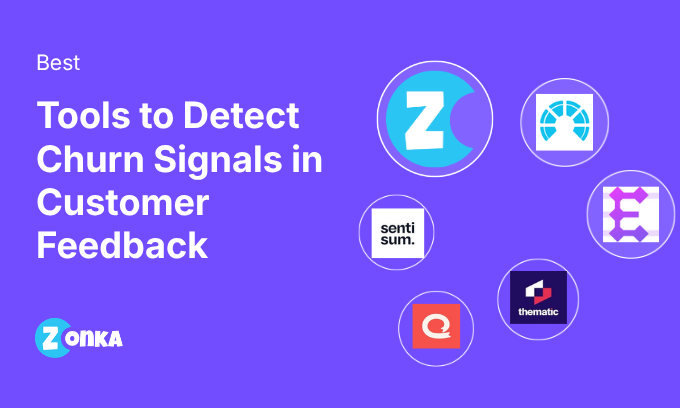


The best tools to detect churn signals in customer feedback are Zonka Feedback, Chattermill, Enterpret, Thematic, Unwrap.ai, and SentiSum. Each one reads the language sitting in your surveys, support interactions, reviews, and NPS comments, then flags the churn risk hiding in it, usually before a usage metric or a health score catches up.
TL;DR
- Six tools worth shortlisting: Zonka Feedback, Chattermill, Enterpret, Thematic, Unwrap.ai, and SentiSum.
- What they do: read customer feedback for churn signals like rising effort, unresolved complaints, and mentions of evaluating alternatives, across every channel rather than one.
- The distinction that matters: behavioral tools tell you an account went quiet; feedback tools tell you why, earlier.
- Zonka Feedback collects and analyzes in one system; Enterpret, Chattermill, Thematic, and Unwrap analyze feedback you feed them; SentiSum is strongest on support interactions.
- This guide is about voluntary churn, the kind customers signal in words. Involuntary churn from failed payments is a billing problem for dunning tools to handle.
Most churn gets called too late. The signal was usually there; teams were watching the wrong place for it. Customer health scores are built from customer behavior that already happened: login frequency, product usage, a renewal date creeping closer. By the time one turns red, the customer decided a while ago.
The earlier signal was in what they wrote. A support ticket that took three follow-ups. A review that named a competitor. An NPS comment that the product used to be simpler. Those are churn signals, and they show up in customer feedback weeks before customer behavior confirms them. The tools below exist to read that language at a scale no team can manage by hand, and to point you at the at-risk customers while there's still time to act.
What Counts as a Churn Signal in Customer Feedback?
A churn signal is language that predicts a customer is heading for the door. Rising customer effort, like the same issue raised again and again without resolution. A complaint that never got closed out. Unmet expectations stated plainly. A promoter sliding to passive on your next survey. It is one of the experience signals that AI reads out of open-ended feedback, sitting alongside sentiment, effort, and urgency.
It beats a risk score on timing. A score tells you an account is disengaging. It rarely tells you why, because the why lives in customer sentiment, and a usage log cannot hold it. Two things make churn language hard to catch manually: it is spread across many data sources, and there is too much of it to read. In Zonka Feedback's analysis of more than a million open-ended responses across eight languages, 23% carried an intent or behavioral signal and 29% held mixed sentiment rather than a clean positive or negative. That is the pile these tools read for you. For the method itself, our guide to churn analysis covers how to run it.
The Six Tools at a Glance
| Tool | Best for | Reads churn from | Collects feedback? | Pricing model |
| Zonka Feedback | Collection + AI in one system | Five signals, per response and per theme | Yes | Custom |
| Chattermill | Enterprise omnichannel | Aspect sentiment across many channels | No | Custom |
| Enterpret | An existing feedback stack | Adaptive taxonomy + account link | No | Usage-based |
| Thematic | Themes tied to score movement | Theme-to-metric linkage | No | Annual, on request |
| Unwrap.ai | Fast product-team trends | Auto-tagged trend spikes | No | Annual, on request |
| SentiSum | Support-heavy CX teams | Real-time support and survey sentiment | No | From ~$3,000/mo |
How We Evaluated These Tools
We build Zonka Feedback, so weigh our own entry with that in mind. We have listed it first because it is one of the few tools here that both collects feedback and detects churn signals in one system, which is the exact job this guide is about. Every tool then got the same five checks: how many feedback channels it reads, whether churn surfaces as a real signal, how much manual tagging it needs, whether a signal links back to the account behind it, and honest pricing. Each rating below links to that tool's G2 profile so you can check it yourself, and where a vendor does not publish pricing publicly we have marked it as available on request rather than guess.
Zonka Feedback: Best for Collection and Churn Detection in One Platform
Zonka Feedback collects feedback and reads it for churn in one system, with no export step in between. Its AI reads five signals, including churn risk, at both the response and theme level, maps each to the product, agent, or location behind it, and routes it to an owner with context. It fits teams that want omnichannel collection and churn detection in one place. The trade-off is that the AI sits in a higher tier, so a low-volume team may not need it yet. It holds 4.7/5 on G2 across 80 reviews, on custom pricing set by volume and needs.
Chattermill: Best for Enterprise Omnichannel Feedback
Chattermill is a customer experience intelligence platform that unifies feedback from many channels, including surveys, reviews, support tickets, and social media, and classifies each piece with its own AI model. For churn work, its strength is aspect-based sentiment: it identifies which part of the experience a customer is unhappy about, theme by theme. It fits enterprise B2C teams running high-volume, multilingual feedback. The trade-off is onboarding, since the feature depth means a slower start for a small team. It holds 4.4/5 on G2 across 238 reviews, on custom pricing set by channels and volume and available on request.
Enterpret: Best for Teams Whose Feedback Already Lands Everywhere
Enterpret is an analysis layer for teams whose feedback already flows into many systems with nothing tying it together. It uses NLP and machine learning to categorize qualitative data like tickets, reviews, and survey responses, and its taxonomy adapts as churn reasons change instead of asking you to pre-list them. It also links a theme to the accounts and revenue behind it, which turns a churn theme into a prioritized retention effort. The catch is that there is no native survey builder, so you need feedback arriving from elsewhere first. It holds 4.6/5 on G2 across 110 reviews, on usage-based pricing available on request.
Thematic: Best for Tying Churn Themes to Score Movement
Thematic takes an analyst-controlled approach to themes. Its useful trait for churn is that it connects a theme to what it is doing to your metric, linking themes to score movement, so you can see which rising complaint is dragging your number down. That makes it a fit for teams that care less about raw volume and more about proving a theme moved NPS or CSAT. It tends to suit mid-market to enterprise teams and is often used alongside a broader experience suite. It holds 4.8/5 on G2 across 41 reviews, on annual pricing available on request.
Unwrap.ai: Best for Fast Product-Team Trend Visibility
Unwrap is built for speed. It is dashboard-first, quick to set up, and lets teams respond to customers from inside the analytics view, so a spiking complaint shows up in days. Its auto-tagging groups incoming feedback into trends without much configuration, which is where churn themes surface early. It suits product teams that want fast trend visibility and a light footprint, and it is a weaker fit for enterprise omnichannel programs that need deep governance and many connectors. It holds 4.7/5 on G2 across 25 reviews, on annual pricing available on request.
SentiSum: Best for Churn Signals in Support Conversations
SentiSum is an AI platform built for support-heavy teams, reading tickets, chats, emails, and survey responses to tag sentiment and surface churn drivers in real time. It connects to helpdesks like Zendesk, Freshdesk, and Help Scout and builds a custom model of the issues customers raise, so triage runs on sentiment and urgency rather than manual tags. It suits mid-market support and CX teams whose churn signal shows up first in service conversations. Its honest limitation is a thin third-party footprint, sitting on an unclaimed, low-volume review profile. It holds 4.8/5 on G2 across 14 reviews, with Pro plans starting around $3,000/month.
How to Choose the Right One
Start with where your churn signal actually lives. If it is buried in support interactions, SentiSum reads that directly. If it is scattered across channels you already own, Enterpret or Chattermill unify it. If you do not have a collection layer yet and you are still exporting survey files, Zonka handles both ends. If you want themes tied straight to score movement, Thematic. If speed matters more than depth, Unwrap.
Then decide how much you need the signal tied to money. A churn theme hitting ten small accounts and one threatening your three biggest deals deserve different responses, and you cannot tell them apart without the revenue link. If prioritizing by business impact is the goal, a feedback prioritization matrix is worth setting up next to whichever tool you choose.
Two categories sit outside this list on purpose. Product analytics and health-score tools read customer behavior, login frequency, and product usage. They tell you an account is disengaging, which is useful, though it is a lagging indicator that never explains the reason. And customer success platforms are worth pairing with any tool above: they help customer success teams act on the who, once a feedback tool has surfaced the why. Together they cover two halves of the same job, and the feedback loop only closes when both run.

.png)