


.svg)
 Healthcare
 Finance
 Retail
 SaaS & Digital
 eCommerce
 Education
 Salesforce
  HubSpot
 Pipedrive
 Mailchimp
 Klaviyo
 Zendesk
  Intercom
 Freshdesk
 HelpScout
  Front
Front Jira
Jira Slack
Slack  MS Teams
 Zoom
Zoom Google Sheets
  Zapier
  Integrately
 Make
Make  Webhooks




 MS Teams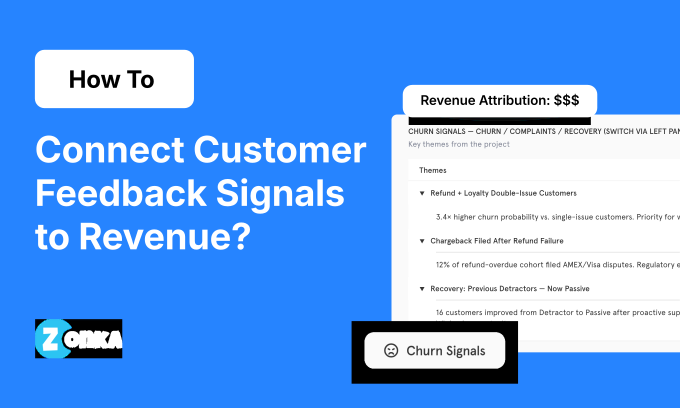


TL;DR
- Revenue attribution from customer feedback is the process of connecting detected experience signals (churn, effort, intent, sentiment) to CRM financial data (contract value, renewal date, deal stage) so every feedback signal carries a dollar value.
- Zonka Feedback's AI in Feedback Analytics 2025 report (based on structured conversations with 100+ CX, Product, and Support leaders across Finance, Retail, SaaS, and Healthcare in North America, EMEA, and APAC) found that 57% say insights lack business context and 42% want ROI visibility from feedback tools.
- A churn signal on a $200K enterprise account renewing in 45 days is a different priority than the same signal on a $5K starter account. Without CRM data, both get equal attention. With it, the $200K account gets a same-day intervention.
- You don't need a technology integration to start. A manual cross-reference of your top 20 churn signals against CRM account values takes 30 minutes and reveals the revenue concentration that justifies automated attribution.
- The shift: CX moves from "churn language increased 22%" to "$480K in enterprise revenue is at risk from integration reliability, 4 accounts renewing in 90 days, $22K intervention protects 75% of it."
CX teams have gotten good at detecting signals. Thematic analysis surfaces the themes. Experience signals catch the effort, urgency, churn risk, and emotion. Entity recognition maps feedback to locations, agents, and products. Intent classification routes it to the right team. The analysis pipeline works.
What doesn't work, for most organizations, is connecting those signals to money. A CX leader walks into a quarterly review and says "churn language increased 22% in the enterprise segment." The CFO's response: "What does that mean in dollars?" The CX leader doesn't have an answer, because the feedback system and the revenue system don't talk to each other.
Revenue attribution from customer feedback is the practice of connecting experience signals detected in feedback (churn risk, effort, intent, advocacy, sentiment trends) to CRM financial data (annual contract value, renewal date, customer lifetime value, deal stage) so that every signal carries a dollar value, every prioritization decision is financially weighted, and every intervention can be measured by its revenue impact.
Zonka Feedback's AI in Feedback Analytics 2025 report found this gap in hard numbers: 57% of CX leaders say their insights lack business context, and 42% specifically want ROI visibility from their AI feedback tools. The research was based on structured conversations with 100+ CX, Product, and Support leaders across Finance, Retail/eCommerce, SaaS, and Healthcare in North America, EMEA, and APAC between April and June 2025. One senior CX manager in financial services put it directly: "It's not enough to know what the customer said. You need to track what action was taken."
Why CX Teams Can't Prove Financial Impact
Feedback data lives in survey platforms and text analysis tools. Revenue data lives in Salesforce, HubSpot, or the finance team's ERP. The two datasets reference the same customers, but they're not connected. A churn signal on Account X doesn't automatically pull Account X's annual contract value, renewal date, and expansion pipeline. The signal exists without financial context, and the revenue data exists without the customer voice behind it.
This disconnect creates three problems:
CX competes for budget on feeling, not evidence. Product points to feature adoption metrics. Sales points to pipeline numbers. CX points to NPS survey trends and satisfaction scores. Leadership funds what they can measure. When CX improvements can't be linked to retained revenue, every budget request is a qualitative argument.
Prioritization lacks financial weighting. A churn signal from a $5K annual account and a churn signal from a $500K enterprise account get the same priority in the feedback system. The experience signals are identical. The financial impact is 100x different.
Post-action impact is invisible. A CX team identifies checkout friction, routes it to operations, the team fixes the process. Effort signals drop. But did the fix affect retention? Did revenue improve? Without the CRM connection, the answer is always "we think so, but we can't prove it." (The full research report covers all five findings in detail.)
How Revenue Attribution from Feedback Signals Works
Revenue attribution connects two data streams that already exist separately: the signals your feedback intelligence platform detects and the financial data your CRM tracks. In simple terms, the architecture isn't new analysis. It's a connection layer that gives every signal a dollar value.
The process has four stages:
1. Signal detection. The Feedback Intelligence Framework produces structured signals: themes, experience quality (sentiment, effort, urgency, churn, emotion), intent classification, and entity recognition. Each signal is mapped to an account, contact, or entity.
2. CRM enrichment. When the feedback platform connects to Salesforce or HubSpot, each signal inherits financial context: annual contract value (ACV), deal stage, renewal date, customer lifetime value (CLV), product tier, segment. CLV matters here because it captures the full revenue relationship, not just the current contract: a $50K ACV account with 3 years of history and an expansion trajectory represents more at stake than a new $50K account.
3. Financial prioritization. The Impact x Trend matrix gains a revenue dimension. "Fix Now" isn't just high-impact and worsening. It's high-impact, worsening, and concentrated on accounts representing $1.2M in annual revenue.
4. Post-action measurement. After an intervention, the system tracks whether affected accounts renewed, expanded, or churned. This is where closing the feedback loop gets a financial dimension: did the accounts that received churn-signal recovery outreach renew at a higher rate than those that didn't?
Revenue Attribution in Action: A Worked Example
A B2B SaaS company has 400 accounts generating $8M in annual recurring revenue. Their feedback intelligence platform detects churn signals across 28 accounts in Q1.
Without revenue context, the CX team sees: "28 accounts with churn language. Themes: onboarding friction (12), billing confusion (9), feature gaps (7)." Onboarding friction gets prioritized because it has the highest count.
With CRM data connected, the same 28 accounts reveal a completely different priority:
| Tier | Accounts with Churn Signals | ACV Range | Total Revenue at Risk | Primary Churn Theme | Renewing in 90 Days |
| Enterprise | 6 | $50K-$120K | $480K | Integration reliability (4 of 6) | 4 accounts |
| Pro | 14 | $8K-$25K | $210K | Onboarding (8), Billing (6) | 6 accounts |
| Starter | 8 | $2K-$5K | $28K | Feature gaps (all 8) | 3 accounts |
| Total | 28 | $718K | 13 accounts |
The revenue-weighted priority is the 4 Enterprise accounts renewing in 90 days ($480K at risk), and the theme driving churn in that segment isn't onboarding: it's integration reliability. The intervention: an engineering sprint to stabilize the integration ($20K) plus personal CS outreach to each account ($2K). If 3 of 4 renew, the team protects $360K-$400K for a $22K investment.
In simple terms, signal count says "fix onboarding." Revenue weighting says "fix the integration for 4 enterprise accounts first." The difference is $480K in retention vs a diffuse improvement that might not move the revenue needle at all.
Which Feedback Signals Predict Revenue Impact?
Not all signals carry equal revenue weight. Here's how each framework signal type connects to financial outcomes.
Churn signals → retention revenue. Conditional language ("if it happens again, we'll switch") and explicit language ("we're evaluating alternatives") map directly to renewal risk. Weighted by ACV, the math is straightforward: at-risk accounts that received recovery intervention vs those that didn't, measured by renewal rate.
Effort signals → support cost + downstream churn. Every repeat contact, channel switch, and extended resolution drives cost to serve. CEB research published in the Harvard Business Review found that 96% of high-effort customers become disloyal. When effort signals are mapped to accounts with known support costs, reducing effort on a specific theme saves measurable support hours and reduces churn velocity. The retained-revenue upside compounds on top of the cost savings.
NPS score movement → revenue correlation. NPS alone doesn't predict revenue. But NPS movement at the account level, combined with feedback signals, does. An account whose NPS dropped from 9 to 6 over two quarters, accompanied by effort signals and a competitor mention, is a different risk profile than an account whose NPS dropped from 9 to 7 with no accompanying signals. Revenue attribution weights the NPS movement by the account's financial value, turning a score change into a dollar figure: "$1.2M in accounts moved from Promoter to Detractor this quarter, with integration reliability as the primary theme."
Advocacy intent → expansion and referral revenue. Customers expressing advocacy ("I've told all my friends") are expansion candidates. When advocacy signals map to accounts with upsell potential in the CRM, marketing gets a list of warm leads they didn't generate: customers who've declared intent to promote.
Feature request intent + competitor entity → competitive retention. When feature requests mention competitor capabilities, they're early indicators of switching risk. Weighted by revenue, these signals tell the product team which feature gaps carry the highest financial risk.
Connecting NPS and CSAT Scores to Revenue Outcomes
Structured CX metrics (NPS, CSAT, CES) are the most widely tracked feedback data. But on their own, they're disconnected from revenue. Revenue attribution changes what these scores can prove.
NPS by revenue segment
Company NPS is +32. But segmented by account tier: Enterprise NPS is +45, Mid-Market is +28, and SMB is +18. The accounts most at risk (lowest NPS) are SMB, but the accounts where a 5-point NPS decline costs the most are Enterprise. Revenue attribution tells you where to invest in NPS improvement based on financial impact, not just score movement.
CSAT at renewal windows
CSAT scores for accounts renewing in the next 90 days are a leading indicator of retention. An account with average CSAT of 3.2 (below your company's 4.1 average) renewing next month at $85K ACV is a specific, actionable risk. Without revenue context, it's just a low score in a dashboard.
CES as a churn cost predictor
Effort scores predict both support cost and churn velocity. Wondering how to translate CES into revenue language? Accounts with CES above your threshold (high effort) churn at a measurably higher rate. If high-effort accounts represent $2M in ACV and your high-effort churn rate is 35% vs 12% for low-effort, the cost of effort is $460K in annual churn differential. That's the number that gets an effort-reduction initiative funded.
What CRM Integration Requires
Revenue attribution depends on a data connection between your feedback platform and your CRM. Here's what that connection needs to work.
Required CRM fields:
- Account or Contact identifier (the shared key that links a feedback response to a CRM record)
- Annual contract value or monthly recurring revenue (the revenue figure each signal gets weighted against)
- Renewal or contract end date (for time-sensitive prioritization)
- Account tier or segment (Enterprise, Mid-Market, SMB, or your custom classification)
- Account owner (for routing recovery actions to the right person)
Optional but high-value fields:
- Customer lifetime value (captures the full revenue relationship, not just current contract)
- Open opportunities or expansion pipeline (identifies accounts where churn signals would block upsell)
- Deal stage for open opportunities (signals on accounts mid-negotiation carry different urgency)
- Product or plan tier (for segmenting signals by revenue contribution)
Permissions and access: The integration needs read access to Account, Contact, and Opportunity objects (Salesforce) or Company, Contact, and Deal objects (HubSpot). Write access is needed if you want the feedback platform to create Tasks or update custom fields on the CRM record when signals are detected. Most implementations use OAuth-based authentication through the native AppExchange (Salesforce) or App Marketplace (HubSpot) connector.
Data model consideration: Feedback signals should map to the Account level for B2B (where revenue lives) and to the Contact level for B2C (where individual CLV lives). If your CRM tracks revenue at the Opportunity level, the integration needs to roll up Opportunity values to the Account for accurate revenue weighting. Misalignment here is the most common implementation issue: signals mapped to Contacts in a B2B context miss the Account-level revenue data that makes attribution work.
The 30-Minute Revenue Attribution Exercise
Full automated attribution requires CRM integration. But this manual exercise proves the concept, changes how you present CX data, and takes less than an hour.
Step 1: Pull your churn and effort signals. Export feedback responses from the last quarter containing churn language ("considering alternatives," "if this happens again") or high-effort signals ("called three times," "still waiting"). A keyword search gets you 80% of the way if signals aren't pre-classified.
Step 2: Cross-reference with CRM account values. For each signal, find the account in Salesforce or HubSpot and note the ACV, renewal date, and tier. Use this template:
| Account | Signal | Theme | ACV | Renewal | Action | Outcome |
| Acme Corp | Churn (conditional) | Integration reliability | $85,000 | Jun 2026 | ||
| TechStart Inc | Effort (repetition) | Billing confusion | $12,000 | Aug 2026 | ||
| GlobalRetail | Churn (explicit) | Feature gap + competitor | $120,000 | May 2026 |
Step 3: Calculate revenue concentration. Total the ACV of all accounts with churn signals. You'll find that 60-70% of at-risk revenue concentrates in 10-15% of accounts. That pattern is the insight.
Step 4: Act on the top 5. For the 5 accounts with highest ACV and nearest renewal dates, assign a recovery owner. Record the intervention. Check back at renewal and fill in the outcome column.
Step 5: Present the ROI. "12 enterprise accounts with churn signals representing $2.8M in annual revenue, 5 renewing in the next 90 days. Recovery outreach on 5 accounts cost $8K in CS hours. 4 of 5 renewed, protecting $1.9M." That's a CX budget justification that gets approved because it's denominated in dollars, not scores.
How to Prove CX Value to the CFO: Before and After Revenue Attribution
The shift isn't technical. It's political. Most CX teams present NPS trends and satisfaction scores. Leadership nods, asks "but what does that mean for revenue?", and funds the teams that can answer with numbers. Revenue attribution is what lets CX answer it.
Before (how most CX teams present today): "Churn language increased 22% in the enterprise segment this quarter. We recommend a recovery program." Leadership: "What would that cost, and what would it save?"
After (with revenue attribution): "Churn signals appeared on 14 enterprise accounts representing $3.4M in annual revenue. Seven renew in the next 90 days. A targeted recovery program for those seven costs approximately $15K. Based on last quarter's recovery rate, we'd retain 4-5, protecting $1.4M-$1.7M."
The second version gets funded because it speaks the language the CFO uses: dollars at risk, cost of intervention, expected return.
Measuring CX ROI with Feedback Signals
Revenue attribution also changes how CX teams measure their own ROI. Instead of tracking NPS trends and hoping leadership sees the connection to retention, CX teams can report a concrete formula: "Feedback-driven interventions protected $X in revenue this quarter, at a cost of $Y, for a CX ROI of Z%."
Here's what that calculation looks like in practice:
- Revenue protected: total ACV of at-risk accounts that renewed after intervention ($1.9M in our exercise example)
- Intervention cost: CS hours + engineering time + any escalation cost ($8K-$22K in our examples)
- CX ROI: (Revenue protected / Intervention cost) x 100. In the worked example: ($400K / $22K) = 18x return.
That's a CX budget justification denominated in the same language finance uses for every other investment decision. A senior VP of customer experience, interviewed for our research report, captured the vision: "We want to tie actions to financial outcomes: what investments are driving retention, revenue lift, or avoided loss."
Don't believe us that this changes the budget conversation? Consider that 42% of CX leaders in our research specifically asked for ROI visibility from their feedback tools. The demand exists. Revenue attribution is the mechanism that delivers it.
From Signals to Dollars: Making Revenue Attribution Work
The question has never been whether feedback signals affect revenue. The question is whether your organization can prove it.
If you want to see the gap in your own data, try this: pull your last quarter's churn signals, cross-reference them with account revenue in your CRM, and calculate the total ACV at risk. Then ask two questions: how much of that at-risk revenue is concentrated in your top 10% of accounts? And how many of those accounts received a proactive intervention because of the feedback signal? For most organizations, the concentration is high and the intervention rate is low. That gap is the ROI case for revenue attribution.
The teams that connect feedback signals to CRM deal data are the ones that turn CX from a reporting function into a revenue-protection function. And the dollar math in this guide isn't theoretical: it's the same math that gets CX programs funded, because it speaks in the language leadership uses to allocate resources.
Zonka Feedback is building revenue attribution into the AI Feedback Intelligence platform through Salesforce and HubSpot CRM integration: every signal, theme, and entity weighted by its associated revenue context. Book a walkthrough →