

.svg)
 Healthcare
 Finance
 Retail
 SaaS & Digital
 eCommerce
 Education
 Salesforce
  HubSpot
 Pipedrive
 Mailchimp
 Klaviyo
 Zendesk
  Intercom
 Freshdesk
 HelpScout
  Front
Front Jira
Jira Slack
Slack  MS Teams
 Zoom
Zoom Google Sheets
  Zapier
  Integrately
 Make
Make  Webhooks



 Sign In
 MS Teams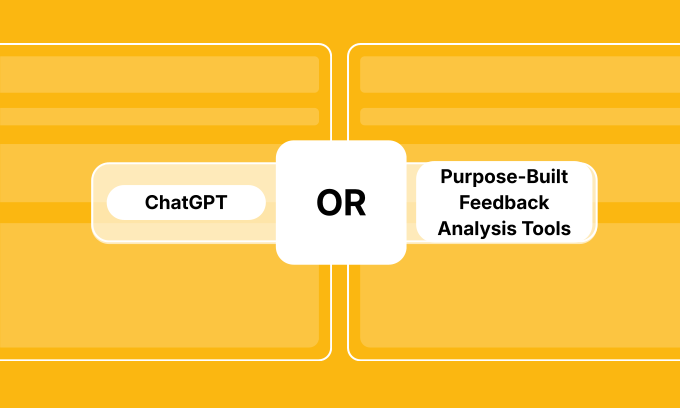


TL;DR
- 46% of CX professionals currently use ChatGPT, Claude, or Gemini for feedback analysis. With structured prompts, these tools produce genuinely useful results for batches of 20-50 responses.
- The framework matters more than the tool. Structured prompts specifying themes, sentiment, intent, and entities make ChatGPT dramatically better and even cause different AI tools to converge on similar output.
- Seven gaps appear at scale: no persistent taxonomy, no trend detection, sentiment drift, per-session entity linking, manual routing, no closed-loop automation, and a ~50 response ceiling per session.
- Purpose-built platforms solve these through continuous processing, persistent taxonomies, time-series tracking, automated routing, and loop closure.
- The transition from ChatGPT to a platform is a maturity step, not a failure: spreadsheets → ChatGPT → purpose-built. Each stage builds analytical literacy.
There's a widespread assumption that ChatGPT can't do serious feedback analysis. That's wrong. The more accurate statement: ChatGPT can do impressive single-session analysis. What it can't do is turn that analysis into a system your team runs on week after week.
The distinction matters because most teams evaluating their options frame it as "ChatGPT or a platform." The better frame is "ChatGPT for getting started, platform for making it operational." These aren't competing choices. They're sequential stages on the same maturity curve.
We tested both approaches during a live webinar in March 2026: identical feedback data, identical framework prompts, run on ChatGPT, Claude, and a purpose-built platform. The results were illuminating. With structured prompts, ChatGPT and Claude produced impressively similar output to each other and to the platform's single-session results. The differentiation appeared when we tried to make that output operational: tracking trends, routing signals, closing loops, maintaining consistency over time.
This article walks through exactly where ChatGPT works, where it hits the wall, and how to know when the wall matters for your team.
What ChatGPT Does Well for Feedback Analysis
Dismissing ChatGPT as inadequate for feedback analysis would be dishonest. With the right prompt structure, it's a genuinely capable qualitative analysis tool.
Pattern recognition. LLMs catch themes human readers miss, especially after fatigue sets in around the 50th response. The Stanford HAI AI Index 2025 found that NLP performance on sentiment classification now exceeds human baseline on several benchmarks. In simple terms, the technology behind ChatGPT is genuinely good at understanding what customers mean beyond what they literally say.
Zero barrier to entry. No API key, no deployment, no budget approval. Copy, paste, prompt, result. For a CX team without engineering support, this is a legitimate path to structured feedback analysis that didn't exist three years ago.
Framework prompting transforms output quality. A generic prompt ("analyze this feedback") produces vague, inconsistent results. A structured prompt specifying: extract themes and sub-themes, score sentiment per topic, classify intent (advocacy, complaint, feature request, escalation, question), and identify entities (staff, competitors, products, locations) produces dramatically better output. During the webinar demo, framework prompts caused ChatGPT and Claude to converge on similar structured results. The framework is what matters, not the tool.
Key finding from the webinar test: General prompts produced different output every time, even on the same data. Framework prompts produced consistent, structured output across different AI tools. If you're using ChatGPT for feedback analysis, applying a structured prompt is the single highest-impact improvement you can make. For a detailed walkthrough, see our survey analysis with ChatGPT guide.
The 7 Capability Gaps at Scale
So ChatGPT can analyze feedback well in a single session. But what happens when you try to do it every week, with the same consistency, across thousands of responses? Wondering where the ceiling hits? Let's find out.
These gaps don't appear in your first session. They appear when you try to build a repeatable process around session-based analysis. Each one compounds the others.
1. No persistent taxonomy. Every session starts fresh. The theme names from last month don't carry over. You can't track whether "checkout friction" is trending up if the system called it "payment issues" last month and "purchase flow problems" the month before. Purpose-built platforms maintain a persistent, auto-evolving taxonomy that applies consistently across every analysis period.
2. No trend detection. ChatGPT tells you what themes exist in a dataset. It can't tell you whether themes are increasing or decreasing relative to previous periods. Trend detection requires memory across sessions. ChatGPT has none. Starbucks tracks customer feedback trends week over week across thousands of locations, comparing theme frequency and sentiment shifts month over month. That kind of continuous tracking is structurally impossible in session-based analysis.
3. Sentiment drift between sessions. Ask ChatGPT to score sentiment on the same comment in two different sessions and you may get different results. For exploration, this is fine. For a program tracking whether negative sentiment around a specific theme improved quarter over quarter, this drift introduces noise that makes trend data unreliable.
4. Per-session entity linking only. ChatGPT can identify that a comment mentions "Sarah" or "Marriott" within a single session. It can't maintain an entity database across sessions. You can't ask "show me all feedback mentioning Competitor X over the past six months" because there's no persistent entity record.
5. Manual intent routing. ChatGPT classifies intent: complaints, feature requests, advocacy. But the classification lives in text output. Someone reads it, decides who needs what, and manually forwards. Purpose-built intent routing connects classifications directly to workflows: complaints auto-create tickets, feature requests go to the product backlog.
6. No closed-loop automation. When ChatGPT identifies a detractor with a churn signal, what happens? Nothing, unless a person reads the output and takes action. A platform creates a task, assigns an owner, sends a Slack alert, and tracks resolution. The closed feedback loop is what turns analysis into outcomes. ChatGPT outputs text. Platforms output workflows.
7. Scale ceiling. Token limits cap each session at roughly 50 responses. Processing 2,000 monthly items requires 40 separate sessions, each producing its own theme structure. Purpose-built platforms process unlimited volumes continuously.
The Head-to-Head: Same Data, Same Framework, Both Approaches
During the March 2026 webinar, we ran identical analysis on ChatGPT, Claude, and a purpose-built platform using the same framework prompts. The comparison clarified where the approaches converge and diverge.
| ChatGPT + Framework Prompt | Purpose-Built Platform | |
| Sentiment | Strong per-topic, but drifts between sessions | Consistent, real-time, zero drift |
| Taxonomy | Re-paste every session | Persistent, auto-evolving |
| Trends | Impossible: no memory | Time-series with alerts |
| Entity linking | Per-session only | Persistent across all data |
| Intent routing | Classification only, routing manual | Auto-routed to right team |
| Closed loop | Text output, manual follow-up | Auto-routed tasks with context |
| Scale | ~50 responses per session | Unlimited, continuous |
The critical finding: ChatGPT's single-session quality was strong. Themes were relevant, sentiment accurate, intent classification useful. The gap wasn't in analysis quality. It was in everything around the analysis: persistence, trends, routing, follow-through. Single-session accuracy tells you what's in the data. Operational infrastructure tells you what to do about it.
When to Stay with ChatGPT (and When to Move On)
How do you know whether ChatGPT is enough for your team's current needs?
Stay with ChatGPT when: you're analyzing fewer than 200 responses per cycle, analysis is periodic (monthly or quarterly), one person owns the process, you don't need trend tracking, and PII compliance isn't a constraint.
Move to a purpose-built platform when: you need to track themes over time, multiple teams need access to signals (support, product, CX, leadership), signals need to auto-route through Slack, Jira, or your CRM, you're above 500 responses per cycle, feedback comes from multiple channels, PII compliance matters, or role-based dashboards are required.
The real cost calculation: ChatGPT costs near-zero in software fees. The hidden cost is labor: exporting data, running sessions, comparing outputs manually, routing insights by hand, following up without a system. Count those hours per month. If they exceed 10-15, a platform pays for itself in time savings alone. If the bigger decision is whether to build your own stack, the build vs buy comparison covers that in detail.
The transition isn't a failure. It's a maturity step. Spreadsheets, then ChatGPT, then purpose-built: each stage builds the analytical literacy that makes the next stage more effective. Teams that skip straight to a platform without the ChatGPT stage often underuse it, because they never developed the intuition for what good analysis looks like.
Making the Transition Practical
Most teams run both in parallel for the first month: continue the ChatGPT workflow while the platform ingests the same data. Compare outputs. When the platform's theme discovery and sentiment scoring meet or exceed your best prompt, retire the manual workflow.
Three things carry forward from your ChatGPT stage:
Your framework prompt becomes your taxonomy seed. The theme categories your structured prompt specified become the starting taxonomy for the platform. The AI evolves it as new themes emerge, but your prompt work provides a grounded starting point.
Your manual routing rules become automated workflows. If you've been forwarding product feedback to the product team every time ChatGPT flags it, that rule translates directly into automated routing.
Your questions become dashboard views. "What are the top themes among detractors?" and "Is billing friction getting worse?" become saved filters and alerts. You already know what you need to see. The platform makes it visible without running a session each time.
What a Purpose-Built Platform Actually Adds
The platform doesn't replace what ChatGPT does. It adds what ChatGPT can't.
Continuous ingestion: feedback flows in from surveys, Zendesk, Intercom, Freshdesk, Google Reviews, G2, App Store, and more. No export, no paste, no batch processing.
Persistent analysis: themes, entities, and sentiment scores accumulate in a consistent taxonomy. You compare "checkout friction" this quarter to the same theme last quarter because the system maintains the label.
Experience signal depth: beyond basic sentiment, the platform detects effort, urgency, churn risk, and emotion at both response and theme level. Sentiment analysis that works per-theme means a comment praising your product but criticizing your billing produces two distinct signals, not one averaged label.
Operational integration: analysis connects to action. Churn signals create Slack alerts. Complaints create support tickets. Feature requests hit the product backlog. The analysis ends when someone acts and the outcome is tracked.
Compliance and PII: configurable PII stripping (choose what goes to AI and what doesn't), regional processing (US, EU, India, Australia), and compliance certifications designed for customer data. ChatGPT's data handling may not align with GDPR, HIPAA, or internal governance.
In simple terms, ChatGPT gives you a snapshot. A platform gives you a system. Snapshots are useful for exploration. Systems are what feedback programs run on.
How Zonka Feedback Compares
Zonka Feedback is built for the transition from ChatGPT analysis to operational feedback intelligence. The platform delivers the analysis quality ChatGPT provides plus the persistence, automation, and routing ChatGPT can't.
- AI thematic analysis with persistent, auto-evolving taxonomy across all sources
- Per-theme sentiment at response and theme level, consistent across periods
- Entity recognition for staff, competitors, products, locations: persistent across all historical data
- Intent classification and routing: auto-routed to the right team
- Signals reporting: churn signals, recovery opportunities, emerging and trending themes
- Multi-source ingestion: surveys, Zendesk, Intercom, Freshdesk, Google Reviews, G2, App Store
- Closed-loop workflows: Slack, email, ticketing integrations
- Multilingual: 8+ languages unified in one framework
Schedule a demo to compare what your ChatGPT workflow produces against what Zonka's continuous analysis surfaces from the same data.
The question was never whether ChatGPT can analyze feedback. It can, and it does it well for the right use case. The real question is whether session-based analysis matches the speed and scale at which your feedback actually arrives. For teams that have outgrown the session, the platform is the natural next step: same analytical depth, with the persistence and automation that makes it sustainable.