


.svg)
 Healthcare
 Finance
 Retail
 SaaS & Digital
 eCommerce
 Education
 Salesforce
  HubSpot
 Pipedrive
 Mailchimp
 Klaviyo
 Zendesk
  Intercom
 Freshdesk
 HelpScout
  Front
Front Jira
Jira Slack
Slack  MS Teams
 Zoom
Zoom Google Sheets
  Zapier
  Integrately
 Make
Make  Webhooks



 Sign In
 MS Teams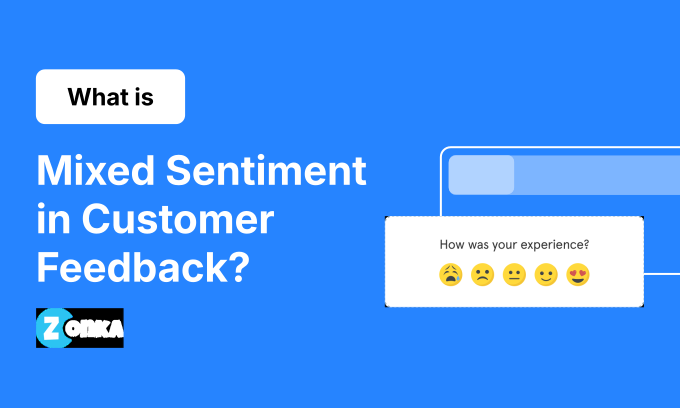


TL;DR
- In an analysis of 1M+ open-ended feedback responses, 29% contained mixed sentiment: praise and criticism in the same comment.
- Standard sentiment scoring flattens these into a single "neutral" label, losing the signals product, support, and CX teams each need.
- Per-theme sentiment analysis scores each topic within a response separately: positive about staff, negative about billing, frustrated about wait time. All from one comment.
- Mixed-sentiment responses are often the most valuable for improvement because they tell you what's working and what's broken, side by side.
- Aspect-based sentiment analysis (ABSA) is the technique that makes per-theme scoring possible at scale.
Most teams think of sentiment analysis as a sorting exercise: positive goes in one bucket, negative in another, and the work is done. That framing misses the most interesting part of customer feedback entirely.
"Sarah at the front desk was amazing, but the WiFi was terrible and checkout took forever. If it happens again, we'll just book the Marriott next time."
That's one comment. One customer. Three themes (staff experience, amenities, checkout process), three different sentiment signals (positive, negative, negative), a competitor mention (Marriott), a churn signal, and an effort indicator. A standard sentiment tool labels this "neutral" or "mixed" and moves on. The detail that makes it useful disappears into a single label.
In Zonka Feedback's analysis of 1M+ open-ended feedback responses across industries and 8 languages, 29% carried mixed sentiment. In simple terms, nearly a third of all customer feedback contains praise and criticism sitting side by side. If your analysis treats each response as a single unit with a single label, you're discarding the most operationally useful part of almost a third of your data.
What Single-Score Sentiment Analysis Actually Misses
Most sentiment analysis works at the document level: read the entire comment, assign one label, move on. "Great product, love it" is positive. "Terrible experience, never coming back" is negative. Simple feedback gets simple labels.
But customer feedback isn't usually that clean. The average open-ended response contains 4.2 distinct topics. When a single comment addresses multiple aspects of the experience, each with its own emotional valence, forcing it into one bucket loses information your team needs.
Consider what happens to these three comments under document-level scoring:
"The product is fantastic but your support team took three days to respond." Document-level: neutral. What's lost: product team should hear the praise, support team needs to see the criticism. Neither gets the right signal.
"Onboarding was smooth, pricing is fair, but the reporting dashboard is completely unusable." Document-level: slightly positive (two positives outvote one negative). What's lost: the dashboard issue is critical for the product team, but it's outvoted in the aggregate score.
"I love working with your team. The invoicing system, not so much." Document-level: neutral. What's lost: the relationship is strong (retain this customer), but there's a specific operational problem that's invisible in the average.
In each case, the document-level score is technically correct and operationally useless.
Why Nearly a Third of Feedback Contains Contradictory Signals
The 29% figure isn't surprising when you consider how customers actually experience a product or service. Rarely is everything perfect or everything terrible. Real experiences are layered.
A hotel guest can love the room but hate the parking. A SaaS user can praise the core product but struggle with onboarding. A patient can feel well cared for by the doctor but frustrated by the billing department. These aren't inconsistencies. They're accurate reflections of multi-dimensional experiences.
Three factors make mixed sentiment especially common:
1. Multi-touchpoint experiences. Most customer journeys involve several distinct touchpoints: sales, onboarding, support, billing, product usage, renewal. Each touchpoint operates somewhat independently. Amazon's own customer experience research has shown that a customer can rate delivery speed as excellent and packaging quality as poor in the same review: different supply chain touchpoints, different evaluations, both valid.
2. Emotional complexity. Customer emotions aren't binary. A customer who's been loyal for three years and encounters a frustrating bug feels something more complex than "negative." They feel frustrated AND loyal AND concerned AND hopeful it'll get fixed. Emotion detection that goes beyond positive/negative captures these layers, but only if the analysis system is designed to hold multiple emotions from the same response.
3. Feedback as relationship signal. Customers who write detailed mixed feedback are usually more invested than those who write "it's fine" or nothing at all. The criticism comes with context because they want you to fix it. The praise comes because they want to stay. Mixed sentiment is often a relationship strength indicator, not a weakness.
Why this matters for retention: A customer who writes "everything is terrible, I'm leaving" is already gone. A customer who writes "love the product, but if billing doesn't improve I'll have to look at alternatives" is telling you exactly what to fix to keep them. Mixed-sentiment responses are your highest-value recovery opportunities. Flattening them into "neutral" hides that signal entirely.
What Breaks When You Flatten Mixed Signals
The consequences show up in reporting, routing, and your team's ability to act. They're not abstract.
Reporting loses accuracy. If 29% of responses are scored "neutral" when they contain both positive and negative signals, your sentiment trend reports are noisy. A quarter where you fixed a real problem might not show improvement because the fix is masked by mixed comments still labeled neutral. You did the work. Your data can't prove it.
Routing breaks down. When a comment contains a product compliment and a support complaint, where does it go? With document-level sentiment, it goes into a "neutral" bucket nobody owns. The support issue never reaches the support team. The product praise never reaches product.
Prioritization becomes unreliable. If your feedback prioritization relies on sentiment scores per theme, and 29% of the data feeding those scores is averaged into meaningless labels, your prioritization matrix works with corrupted inputs. Negative themes inside mixed-sentiment comments get underweighted because the positive signal dilutes them.
Recovery opportunities get missed. Mixed-sentiment comments often wrap churn signals in loyalty signals: "I've been a customer for five years, but this billing issue is making me reconsider." A system that labels this "mixed" and files it misses the recovery. A system that detects churn within the billing theme and routes it to the retention team saves the customer.
The aggregate impact: if your organization processes 5,000 feedback responses per quarter and 29% contain mixed sentiment, that's 1,450 responses where operational signal is degraded or lost. Those responses contain both what you're doing right and what you're doing wrong, side by side. That combination is more valuable for improvement planning than a purely positive or negative comment, because it gives you both sides of the equation in a single data point.
Per-Theme Sentiment: How AI Separates the Signal
The solution is aspect-based sentiment analysis (ABSA): instead of one sentiment label per response, the system assigns sentiment to each theme mentioned within the response. Research published in the Harvard Business Review has shown that reducing negative customer effort predicts loyalty more strongly than delighting customers. In simple terms, finding which specific themes carry friction signals and which carry delight is more valuable than knowing the overall mood. Per-theme sentiment is what makes that distinction possible.
Here's how it works in practice. Take the hotel comment from the opening:
"Sarah at the front desk was amazing, but the WiFi was terrible and checkout took forever."
Per-theme sentiment analysis produces:
| Theme | Sub-Theme | Sentiment | Signal |
| Staff Experience | Front desk service | Positive | Recognition opportunity |
| Amenities | WiFi quality | Negative | Operational issue |
| Checkout Process | Checkout speed | Negative | High effort signal |
Three themes. Three separate sentiment scores. Three different teams see what's relevant to them without reading the original comment. Staff praise goes to HR for recognition. WiFi goes to facilities. Checkout speed goes to operations. And the response-level AND theme-level detection matters: at the response level, this customer is at risk (churn signal, competitor mention). At the theme level, specific problems are identifiable and addressable.
What Per-Theme Sentiment Changes for Each Team
For support leaders: filter all feedback where "support" or "agent" themes carry negative sentiment, even when the overall response is positive. This surfaces support-specific issues that document-level sentiment hides inside otherwise-positive comments.
For product teams: track sentiment on a specific feature across all feedback, regardless of what else the customer mentioned. If "reporting dashboard" carries negative sentiment in 47% of mentions, that's a product signal. It doesn't matter that 30% of those responses also praised onboarding.
For CX leadership: see which themes drive positive sentiment and which drive negative, across the entire customer base. Mixed-sentiment responses stop being a blind spot and become a data source revealing exactly where the experience succeeds and where it fails.
3 Ways to Use Mixed Sentiment Analysis in Practice
Knowing the problem exists is the first step. Putting per-theme sentiment into your workflows is the second.
1. Recovery workflows triggered by mixed signals. When AI detects a response with positive loyalty signals AND negative theme-level sentiment with churn risk, route it to retention with full context. The retention conversation starts from existing goodwill, which dramatically improves recovery rates. Ritz-Carlton built their legendary service recovery on a similar principle: identify the specific thing that went wrong, acknowledge what went right, and fix the gap. Per-theme sentiment gives your team the same precision at scale.
2. Staff recognition from mixed-sentiment responses. Positive staff mentions often appear inside otherwise-critical feedback. "Everyone else dropped the ball, but Lisa in support actually fixed it." Entity recognition identifies Lisa. Per-theme sentiment confirms the positive signal. That recognition data is invisible with document-level scoring because the overall comment is negative.
3. Segment-level sentiment by theme. Enterprise accounts might have positive product sentiment but negative billing sentiment. SMB accounts might show the reverse. Per-theme sentiment lets you build segment-specific improvement plans instead of averaging everyone. The enterprise billing roadmap is different from the SMB product usability roadmap, and per-theme sentiment reveals that distinction.
Starting point: Filter for responses your current system labels "neutral" or "mixed." These are the ones most likely to contain hidden positive and negative signals. Analyze them with per-theme sentiment and compare: how much signal was invisible under the old label? That delta is the business case for the upgrade.
How Zonka Feedback Handles Mixed Sentiment
Zonka Feedback's AI analyzes sentiment at two levels simultaneously: the response level and the individual theme level. This dual-level detection is specifically designed for the 29% of feedback carrying contradictory signals.
- Per-theme sentiment scoring: every theme and sub-theme gets its own label (positive, negative, mixed, neutral). One response can produce multiple sentiment scores, each tied to a specific aspect of the experience.
- Experience signal detection goes beyond sentiment: effort, urgency, churn risk, and emotion are detected per theme. A negative theme with churn risk is higher-priority than a negative theme without it.
- Mixed-signal alerts: responses containing both positive loyalty indicators and negative theme-level signals are flagged as recovery opportunities in the signals dashboard.
- Entity-level sentiment: when a customer mentions a specific staff member, product, location, or competitor, the sentiment for that entity is tracked separately from the overall response.
Schedule a demo to see how per-theme sentiment analysis surfaces the signals that single-score systems miss.
Customer feedback has never been binary. Customers don't experience your product or service as a single, uniform interaction. They experience touchpoints, each with its own quality. The analysis that matches how they experience should match how they express it: multi-dimensional, specific, and honest about what works and what doesn't. Per-theme sentiment analysis is that match, and the 29% of your feedback currently lost to averaged labels is where the most valuable improvement signals are hiding.