

.svg)
 Healthcare
 Finance
 Retail
 SaaS & Digital
 eCommerce
 Education
 Salesforce
  HubSpot
 Pipedrive
 Mailchimp
 Klaviyo
 Zendesk
  Intercom
 Freshdesk
 HelpScout
  Front
Front Jira
Jira Slack
Slack  MS Teams
 Zoom
Zoom Google Sheets
  Zapier
  Integrately
 Make
Make  Webhooks




 MS Teams
.svg)


TL;DR
- Entity recognition in customer feedback identifies the specific WHO and WHAT behind every comment: staff members, competitors, products, features, and locations. It's the third pillar of the Feedback Intelligence Framework.
- Zonka Feedback's analysis of 1M+ responses found that 32% mention identifiable entities. Each entity type generates a different business action: staff names become coaching or recognition data, competitor names become switching triggers, and product names become roadmap intelligence.
- Custom entities vary by industry: airlines track flight numbers and cabin classes, SaaS companies track feature names and plan tiers, and hospitality tracks room types and amenities. AI auto-detects and auto-tags these entities at scale.
- Entity-level metrics (NPS, CSAT, sentiment per entity) let teams monitor performance at the agent, location, product, or service level, not just at the company average.
- Entity-based dashboards let teams view all feedback analysis filtered by a specific entity. A branch manager sees their location. A product owner sees their feature. Each role gets the view that matches their accountability.
- Without entity recognition, feedback analysis answers "what happened." With it, the analysis answers "what happened, to whom, involving what, and who in the organization is responsible."
When customers mention specific names in their feedback, something different is happening than when they describe a general experience. "The service was slow" is a theme. "Sarah at the front desk was amazing, but the WiFi was terrible, and checkout took forever" is a theme with three entities: a staff member (Sarah), a facility (WiFi), and a process (checkout). The difference matters because themes tell you what to investigate. Entities tell you who's accountable.
That's what entity recognition does in customer feedback analysis: it identifies and classifies the specific people, competitors, products, features, and locations customers mention, then connects those entities to the rest of the analysis. When we built entity recognition as the third pillar of the Feedback Intelligence Framework, we designed it as the connective tissue: entities are what link themes and signals to your organizational structure. A negative sentiment signal becomes more useful when you know it's about your Chicago location. A churn signal becomes urgent when it mentions a named competitor. A positive experience signal becomes actionable when it names a specific agent.
Zonka Feedback's analysis of over one million feedback responses found that 32% mention at least one identifiable entity. Nearly one-third of all feedback is telling you how the experience felt AND exactly who and what was involved. This guide covers the four standard entity types, how custom entities work across industries, what entity-level metrics reveal that company averages hide, and what changes when teams can filter their entire feedback view by entity.
What Is Entity Recognition in Customer Feedback?
Entity recognition in customer feedback is the process of identifying and classifying specific names, references, and identifiers mentioned in open-text responses. In technical terms, it's an application of named entity recognition (NER), a natural language processing capability that locates and categorizes references to real-world objects in text.
But for CX teams, the value isn't technical. It's operational. In simple terms, entity recognition answers two questions that thematic analysis and sentiment analysis can't: WHO specifically is being discussed? And WHAT specifically is being referenced? When your sentiment analysis tells you that billing is a negative theme, entity recognition tells you that billing complaints spike at your Denver location and frequently mention a competing service by name. Sprout Social's research found that 44% of business leaders rank real-time sentiment analysis powered by entity recognition among their most important AI applications: the ability to know how customers feel, about what specifically, and about whom.
.svg)
Entity recognition sits within the Feedback Intelligence Framework as the third pillar, operating alongside thematic analysis (what customers are talking about) and experience signals (how the experience felt and why the customer is communicating). All three fire simultaneously on every incoming response. In simple terms, entities are what connect the other two pillars to your organizational structure: they map themes and signals to specific people, places, and things in your business.
The key capability that makes entity recognition operational at scale is auto-detection and auto-tagging. AI doesn't wait for someone to manually tag a response with "Location: Denver" or "Agent: Sarah." It reads the text, identifies the entity, classifies its type, and tags it automatically. Every response. Every channel. Every language. That's what turns entity recognition from a research technique into an operational layer that teams can build workflows around.
4 Standard Entity Types and What They Reveal
Customer feedback entities cluster into four standard categories. Each one generates a different type of business intelligence and routes to a different stakeholder. In the Feedback Intelligence Framework, entity recognition works alongside experience signals and thematic analysis to produce a fully structured view of every response. Sentiment tells you the feeling. Themes tell you the topic. Entities tell you the specific who and what. Wondering what these look like in real feedback and what your team should do with each one?
1. Staff Entities: Coaching and Recognition
"Sarah at the front desk was amazing." "The technician, I think his name was James, was incredibly patient." "Agent #4521 kept putting me on hold."
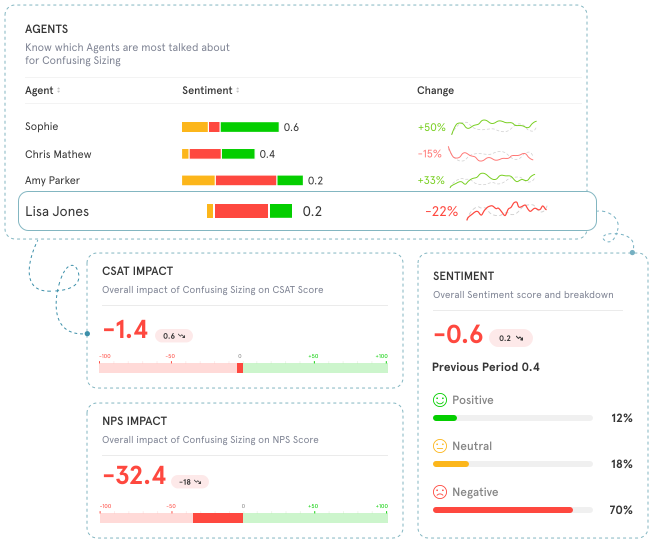
Staff entities are names, roles, or identifiers that connect feedback to specific employees. When AI extracts a staff entity and pairs it with the experience quality signals on that theme, the result is individual-level performance data derived from customer language: which staff members generate delight, which ones generate effort signals, and which ones appear in complaint or escalation contexts.
This is coaching data that doesn't exist anywhere else in most organizations. Quality assurance reviews cover a sample. CES scores cover interactions. But staff entity recognition in feedback provides the customer's perspective attached to a name, and it does so across every feedback channel: surveys, tickets, reviews, and social mentions.
The recognition side is equally important. When a customer names an employee positively, that's an opportunity to reinforce the behavior: share it with the team, log it in performance reviews, use it as a training example. Most positive staff mentions disappear into satisfaction scores. Entity recognition surfaces them.
What to do when AI flags a staff entity:
- Positive mention + delight signal: share with the employee's manager and HR. Add to the recognition pipeline. Use the customer's own language in coaching materials.
- Negative mention + effort or complaint signal: route to the team lead for review. Compare against the agent's other mentions to determine whether it's a one-off or a pattern.
- Repeated negative mentions for the same agent: flag for coaching intervention. The data isn't one supervisor's opinion. It's the customer-perspective record across all channels.
- Staff entity appearing alongside competitor mention: this combination signals that the interaction may have influenced a switching decision. Route to customer success for follow-up.
For multi-location service businesses, staff entity recognition across locations creates a performance comparison that traditional QA programs can't replicate. A hotel chain can see which front desk staff generate delight signals consistently and which ones appear alongside effort or complaint language. When combined with NPS survey data at the agent level, entity recognition turns a relationship metric into a coaching tool.
2. Competitor Entities: Switching Triggers
"Considering the Marriott next time." "Your competitor offers this feature." "We switched to [Competitor] and it was easier." "Saw that [Competitor] has better pricing."
Competitor entities are brand names or product names that identify alternative providers the customer is aware of, considering, or has already used. These are switching triggers: direct signals that the customer's decision space includes someone other than you.
When competitor entities combine with churn signals ("if it happens again, we'll book the Marriott"), the picture becomes specific: this customer is at risk of churning, the trigger is checkout effort, and the alternative is named. That's three signals (churn risk + effort + competitor) from a single comment, each pointing to a different action: fix the checkout process (operations), monitor the account (customer success), and track competitive positioning on checkout experience (strategy). Combine this with intent classification and you can also see that the response carries complaint intent routed to operations and conditional churn intent routed to the account manager.
What to do when AI flags a competitor entity:
- Competitor mentioned alongside churn language: route to the account manager immediately. This customer is actively considering switching, and the alternative is named.
- Competitor mentioned alongside feature request: route to the product team. The customer is telling you which capability gap is driving their comparison shopping.
- Same competitor appearing in 20+ responses over a month: this isn't a one-off. It's a competitive trend. Route a summary to strategy or product leadership with the associated themes and signals.
- Competitor mentioned in positive context ("we switched from X to you"): this is a win signal. Route to marketing for potential case study outreach.
Don't believe us? One CX director in retail, interviewed for Zonka Feedback's AI in Feedback Analytics 2025 report, described the challenge: "In large organizations, teams operate in silos, each with their own tools, priorities, and systems. The result? The data doesn't talk, and neither do the teams." Competitor entity recognition breaks that silo because the same entity (a competitor name) is visible to sales, product, support, and strategy simultaneously.
3. Product and Feature Entities: Roadmap Intelligence
"The mobile app crashes every time I try to export." "Love the new dashboard." "The API integration was straightforward." "Your reporting tool is confusing."
Product entities connect feedback to specific features, modules, or components of your offering. When combined with sentiment and emotion signals, they give the product team feature-level intelligence: which features generate delight, which ones generate confusion, and which ones appear alongside churn or competitor language.
This is roadmap data that surveys alone can't generate because surveys ask about predefined topics. Entity recognition surfaces what customers choose to mention, including features or issues the product team hadn't considered asking about.
What to do when AI flags a product or feature entity:
- Feature entity + confusion signals: this is a UX problem, not a feature gap. Route to the product design team with the specific language customers are using.
- Feature entity + positive sentiment + advocacy intent: this feature is a differentiator. Route to marketing for positioning content. Let sales know what customers love most.
- Feature entity + effort signals post-release: something changed for the worse. Compare effort signals before and after the release date to see if the new version introduced friction.
- Feature entity trending upward with negative sentiment: it's becoming a bigger problem. Feed this into the prioritization matrix where Impact x Trend scoring will determine whether it's a "Fix Now" or "Watch" item.
Product entity recognition also resolves a common product management challenge: distinguishing between "loud" requests and frequent ones. A feature request from one influential customer might dominate a Slack channel. But entity recognition across all feedback sources shows whether 5 customers mentioned it or 500, what sentiment and effort signals co-occur with the mentions, and whether the trend is growing or stable.
4. Location Entities: Regional Routing and Comparison
"The downtown branch." "London office experience was much better than the one in Manchester." "Store #127 on Main Street." "The airport lounge."
Location entities connect feedback to specific physical or organizational units. For multi-location businesses (retail chains, hospitality groups, healthcare networks, financial services with branches), location entities are what make feedback comparison possible without building separate surveys for each site.
When Gartner reported that 93% of customer feedback goes unanalyzed, much of that unanalyzed data sits in reviews, tickets, and social comments that mention locations by name. Entity recognition turns those mentions into structured, comparable data: sentiment by location, effort by location, churn signals by location, all without requiring location-specific survey programs.
What to do when AI flags a location entity:
- Location entity + negative sentiment trending worse: route to the site manager with full context (which themes, which effort types, which time period). This is their accountability signal.
- Location entity + positive signals across multiple themes: this location is doing something right. Flag it for the regional manager as a model site. Extract the specific practices that drive the positive signals and share with underperforming locations.
- Same issue appearing across multiple location entities: this isn't a local problem. It's systemic. Route to operations leadership, not individual site managers.
- Location entity + competitor mention: a local competitive threat. One branch's customers comparing you to a nearby alternative is different from a company-wide competitive trend. Route to the local team for a targeted response.
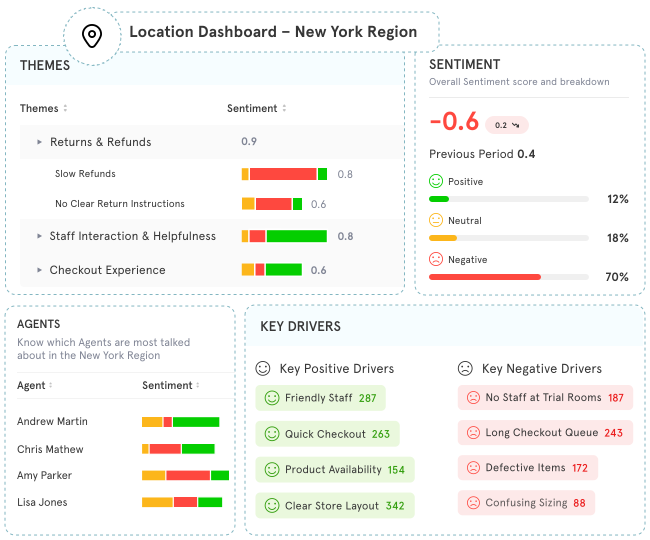
Location entities also enable frontline accountability. Entity-based filtering lets a branch manager view all feedback, themes, and signals filtered to their location, and location and frontline analytics turn those filtered views into operational dashboards for every site manager.
Zonka Feedback's AI in Feedback Analytics 2025 report found that 46% of frontline teams don't receive feedback fast enough to act on it. Location entity recognition directly addresses this. For a deeper look at how this works in multi-location operations, see our guide on transforming location-based operations with AI feedback signals.
Custom Entities by Industry
Standard entities (staff, competitors, products, locations) cover the basics. But every industry has domain-specific entities that standard NLP models miss. Custom entity configuration lets organizations define and extract the identifiers that match your operations, and AI auto-tags every response for faster, more specific analysis.
| Industry | Custom Entity Examples | What They Enable |
| Airline | Flight number, route, cabin class, loyalty tier | Route-level experience analysis, cabin-class comparison |
| Retail | Product category, brand name, store format, department | Category-level sentiment, brand performance, department comparison |
| SaaS | Feature name, plan tier, integration name, API endpoint | Feature-level feedback, tier-specific friction, integration health |
| Healthcare | Department, treatment type, physician name, ward | Department-level patient experience, physician performance |
| Hospitality | Room type, amenity, booking channel, meal period | Amenity-level satisfaction, channel effectiveness, F&B tracking |
| Financial Services | Product type, advisor name, transaction type, branch format | Product-level NPS, advisor performance, process friction |
Custom entities matter because they determine the granularity of your analysis. A hospitality company using only standard entities sees "negative sentiment at Location X." One using custom entities sees "negative sentiment about WiFi (amenity entity) in Superior rooms (room type entity) booked through the mobile app (booking channel entity)." The second view tells the general manager exactly what to fix.
Here's a SaaS example. A B2B software company receives 800 support tickets monthly. Standard entity recognition tags agent names and product mentions. Custom entity recognition also tags plan tiers (Free, Pro, Enterprise) and integration names (Salesforce, HubSpot, Slack). The result: effort signals cluster on the "Salesforce integration" entity specifically for Enterprise-tier customers. The fix isn't a general integration improvement. It's a Salesforce-specific fix prioritized for the tier that generates the most revenue. Without custom entities, the team would see "integration issues trending upward." With them, they see exactly which integration, for which tier, with what revenue at stake.
Here's a hospitality example. A hotel chain operates 25 properties. Custom entities include room type (Standard, Superior, Suite), amenity (pool, spa, WiFi, parking), and booking channel (direct, OTA, corporate). A quarterly review filtered by the "WiFi" amenity entity shows that WiFi complaints dropped 60% at properties that upgraded their infrastructure but remain high at 8 properties that didn't. The entity-filtered view makes the case for the remaining upgrades with specific data, not a general request. Filter further by booking channel and you see that WiFi complaints concentrate among OTA guests who booked based on listing photos that didn't mention the WiFi issue. That's a marketing fix, not an infrastructure fix, at those 8 properties.
Entity-Level Metrics: What Company Averages Hide
Most CX dashboards show company-wide NPS, CSAT, and sentiment scores. Those averages are useful for board reports. They're not useful for the branch manager whose location is underperforming, or the product owner whose feature is generating confusion signals, or the support lead whose team has rising effort scores.
Entity-level metrics break the average into the components that actually drive it. Instead of "company NPS is +32," you see:
- NPS by location: Downtown is +45, Airport is +12, Suburban is +38. The company average hides a 33-point gap between your best and worst sites.
- CSAT by agent: Agent A averages 4.6, Agent B averages 3.2, Agent C averages 4.4. The team average of 4.1 masks that one agent is consistently driving dissatisfaction.
- Sentiment by product feature: Dashboard sentiment is 78% positive, Reporting is 42% positive, Onboarding is 65% positive. The overall product satisfaction score hides that one module is generating most of the friction.
- Effort by service type: Claims processing shows high effort. Account inquiries show low effort. Policy renewals show medium. The aggregate "support effort" metric doesn't tell operations which process to redesign first.
In simple terms, entity-level metrics turn CX measurement from a reporting function into a diagnostic one. The company average tells you the temperature. Entity-level metrics tell you where the fever is and who's responsible for treating it.
But entity-level metrics alone still don't answer: which of these entity-specific themes actually matters most? That's where impact analysis completes the picture. Not all feedback is equal. A theme appearing 50 times for Location X might have minimal impact on NPS. Another theme appearing 20 times might be the primary driver of detractor scores at that location. Impact analysis scores each theme's effect on your performance metrics (NPS, CSAT, CES, sentiment) per entity, so teams know which entity-level issue to fix first. The combination works like this:
- Entity recognition identifies that Location X, Agent Y, and Feature Z all appear in this month's feedback.
- Entity-level metrics show that Location X's NPS dropped 12 points, Agent Y's CSAT is the lowest on the team, and Feature Z's sentiment is 42% positive (down from 68% last quarter).
- Impact analysis reveals that at Location X, "checkout speed" is the theme with the highest negative impact on NPS. Not "staff friendliness" (which also scores low but has minimal correlation with detractor scores). The fix is checkout speed, not a general staff training program.
That three-layer view: entity recognition + entity-level metrics + impact analysis, is what turns feedback data into prioritized, entity-specific action. Benchmarking sentiment, CSAT, and experience themes across agents, stores, cohorts, or even competitors uncovers gaps and improvement opportunities that aggregate views hide completely.
Here's a financial services example. A wealth management firm tracks advisor-level NPS across its 200 advisors. Company NPS is +28. Entity-level analysis reveals that the top 30 advisors average +62 while the bottom 30 average -8. The firm's retention problem isn't company-wide. It's concentrated in 15% of the advisor base. Impact analysis then shows that for the bottom 30, the primary NPS driver is "response time to portfolio questions," not "investment performance" (which is actually rated similarly to the top performers). Entity recognition attached the feedback to specific advisor entities, impact analysis identified the specific theme dragging their scores, and the coaching intervention became targeted: improve response time for 30 advisors, not a company-wide initiative.
Entity-Based Dashboards: Seeing Feedback Through Your Business Structure
The traditional feedback dashboard shows themes, scores, and trends for the entire organization. Entity-based dashboards change the perspective: instead of "what are all our customers saying?", the question becomes "what are customers saying about this specific entity?"
Here's the difference in practice. A retail chain with 40 locations collects 3,000 feedback responses per month:
Without entity filtering: The dashboard shows "checkout experience" is the #1 negative theme with 420 mentions. The effort signal is high. Sentiment is dropping. Leadership sees the number and assigns a company-wide checkout improvement initiative. Every location gets the same directive.
With entity filtering: The same 420 mentions, filtered by location entity, reveal that 280 of them come from 6 locations. The other 34 locations have normal or positive checkout sentiment. Two of the 6 problem locations share the same POS system that was updated last month. The fix isn't company-wide retraining. It's a POS rollback at 6 sites. Entity filtering turned a vague problem into a specific one with a named cause and a targeted fix.
.svg)
Three entity-based views that change how teams work:
"Show me everything about Location X." All themes, all sentiment data, all effort signals, all churn language, all competitor mentions, filtered to one location. A branch manager opens this view and sees their location's performance: what's working, what's generating friction, and how it compares to the company average.
"Show me all feedback mentioning Competitor Y." Every switching trigger, every feature comparison, every "your competitor does this better" comment, aggregated and trended over time. This is competitive intelligence derived from customer voice, not from market research or sales call notes.
"Show me Agent Z's feedback." Every mention, every associated sentiment signal, every effort pattern, every recognition moment. This is the coaching view: not a QA sample, but the complete customer-perspective record for a specific team member.
Wondering how this scales across large organizations? With role-based dashboards, each team sees only the entities and feedback relevant to them. A product owner sees their features. A regional manager sees their locations. A support lead sees their agents. Each stakeholder gets visibility into sentiment, feedback themes, and areas needing improvement without digging through spreadsheets. And when entity views connect to the feedback prioritization matrix, each team also sees which of their entity-specific themes are in the "Fix Now" quadrant.
How Entity Recognition Connects to the Full Framework
Entity recognition is Pillar 3 of the Feedback Intelligence Framework, but it's not an independent analysis. It's the connective tissue that makes the other two pillars operationally useful.
Without entity recognition, thematic analysis tells you "billing is a negative theme." With it, the analysis tells you "billing is a negative theme at the Chicago location, driven by confusion signals around the new invoice format, and three responses mention Competitor Z as an alternative."
Without entity recognition, experience quality signals tell you "effort is increasing." With it, the signals tell you "effort is increasing for Agent X, specifically on the account cancellation workflow, and the effort type is primarily repetition: customers are having to call back."
Without entity recognition, intent classification tells you "12 escalation signals this week." With it, the analysis tells you "12 escalation signals, 8 of which mention the Denver branch, 6 of which name the same billing process, and 3 of which reference a competitor as an alternative."
Entities add the "who" and "what" to every theme and every signal. That specificity is what transforms analysis from a reporting function into an accountability function: when a signal is mapped to an entity, there's a person in the organization whose job it is to act on it. And when that action feeds into a closed-loop feedback process, the entity mapping ensures the right person closes the loop, not a generic queue.
The Feedback Intelligence Framework analyzes all three pillars simultaneously, not sequentially. Entity recognition doesn't wait for thematic analysis to finish. They process together, producing a fully structured output where every theme, every signal, and every entity is connected from the moment the feedback is ingested. Once feedback is tagged, the system automatically routes it to the right owner, triggers follow-ups, and sends real-time alerts so teams stay proactive and accountable.
Entity Recognition and PII: Drawing the Line
Entity recognition creates a natural tension with data privacy: the same capability that identifies "Sarah at the front desk" for recognition purposes also identifies a named individual in customer feedback. For organizations operating under GDPR, the AI Act, or CCPA, the question is where to draw the line between useful entity extraction and personal data protection.
The practical approach most CX teams adopt is configurable control: you define which entity types go to the AI processing layer and which stay as metadata. Staff names, for example, might be sent as metadata (tagged in the system for filtering and dashboards) but not sent to external LLMs for processing. This metadata approach means entity-based dashboards work, coaching signals are visible, but the personal data never leaves the organization's infrastructure.
What should always be stripped before AI analysis:
- Customer names and contact details (email addresses, phone numbers)
- Financial identifiers (credit card numbers, account numbers, SSNs)
- Health information (diagnoses, treatment details in regulated contexts)
What's typically safe to process as entities:
- Staff first names or agent IDs (configurable per your compliance requirements)
- Competitor brand names (no PII involved)
- Product and feature names (your own product data)
- Location names and identifiers (public information)
For organizations with strict compliance requirements, regional processing (data stays in the customer's region) and ML-based PII stripping (runs on the feedback platform's infrastructure, not on external models) are standard capabilities. The entity extraction happens after PII controls are applied, ensuring that the analysis is both operationally useful and compliant.
From Names to Accountability: What Entity Recognition Makes Possible
Customer feedback without entity recognition is a picture missing its subjects. You can see what the picture is about (themes) and how it feels (signals), but you can't see who's in it and what specifically is being referenced. When every theme and every signal maps to an entity, feedback analysis stops being a general observation and starts being something a specific person in your organization can act on this week.
If you want to see what's hiding in your own data, try this: take your last 30 feedback responses and tag every mention of a person, a competitor, a product feature, or a location. Then map each one to the team in your organization that's responsible for it. That map is your entity routing blueprint, built from data you already have, with no tool required. For most teams, the exercise reveals that 30-40% of their feedback carries specific entity mentions that never reach the person accountable.
The teams building their feedback programs around entity-level analysis are the ones that turn "service quality is declining" into "service quality is declining at Location X, driven by Agent Y's effort signals on the billing workflow, and three customers mentioned Competitor Z as an alternative." That's the shift from reporting to accountability. And it's what entity recognition makes possible.
Zonka Feedback's AI Feedback Intelligence platform extracts standard and custom entities from every response, auto-tags them at scale, maps them to your organizational structure, and provides entity-based dashboards where every role sees the feedback that matches their accountability. Book a walkthrough to see entity recognition in action.