

.svg)
 Healthcare
 Finance
 Retail
 SaaS & Digital
 eCommerce
 Education
 Salesforce
  HubSpot
 Pipedrive
 Mailchimp
 Klaviyo
 Zendesk
  Intercom
 Freshdesk
 HelpScout
  Front
Front Jira
Jira Slack
Slack  MS Teams
 Zoom
Zoom Google Sheets
  Zapier
  Integrately
 Make
Make  Webhooks




 MS Teams


TL;DR
- Product feedback survey templates are pre-built questionnaires designed to capture customer input at specific moments in the product lifecycle.
- The three core metrics most templates measure:
- NPS (Net Promoter Score): customer loyalty and relationship health
- CSAT (Customer Satisfaction Score): satisfaction with specific interactions
- CES (Customer Effort Score): how easy it was to accomplish a task
- Match the template to the lifecycle stage: PMF surveys at launch, NPS quarterly, CSAT post-interaction, churn surveys at cancellation.
- Most teams start with one template per stage and expand as their feedback program matures.
Product feedback survey templates are pre-built questionnaires that capture customer input at defined moments in the product lifecycle. They measure specific metrics (NPS, CSAT, CES, product-market fit) that map directly to business outcomes like retention, expansion, and churn prevention.
The challenge isn't finding templates. It's knowing which one to deploy when.
A bug report template sent after onboarding wastes a touchpoint. An NPS survey triggered mid-crisis measures the wrong thing at the wrong moment. A churn survey that fires after someone's already gone misses the window to save the account.
This guide maps 10 product feedback survey templates to the lifecycle stages where they actually work, with sample questions, deployment triggers, and the metrics each one feeds. The goal is simple: right template, right moment, right signal.
10 Product Feedback Survey Templates
- Product-Market Fit (PMF) Survey
- Beta Testing Survey
- Product NPS Survey
- Product CSAT Survey
- Customer Effort Score (CES) Survey
- Feature Feedback Survey
- Feature Request Survey
- Churn Survey
- Bug Report Survey
- Marketing Attribution Survey
What Are Product Feedback Surveys?
Product feedback surveys are structured questionnaires that capture customer input at defined moments in the product lifecycle, from first use to potential churn. They measure specific metrics (NPS, CSAT, CES, PMF) that map to business outcomes like retention, expansion, and product-market fit.
The distinction that matters: product feedback surveys focus on the product itself. Features, usability, value perception, fit. Customer feedback surveys are broader. They cover support interactions, brand sentiment, overall experience. There's overlap, but the focus differs.
Three metric families do most of the work:
NPS (Net Promoter Score) measures relationship loyalty. "How likely are you to recommend this product?" It's a quarterly or milestone-based check on overall sentiment. Not something you send after every interaction.
CSAT (Customer Satisfaction Score) measures satisfaction with a specific moment. "How satisfied were you with this feature?" or "How would you rate your onboarding experience?" It's transactional, tied to a particular touchpoint.
CES (Customer Effort Score) measures how hard something was. "How easy was it to accomplish your goal?" Research from CEB (now Gartner) found that reducing effort predicts loyalty better than delighting customers. CES catches friction that CSAT misses.
For the fundamentals of building a product feedback, the pillar guide covers the strategy layer. This article is about the tactical execution: which template, which trigger, which questions.
Which Template Should You Use When?
This is where most teams get stuck. They pick a template because it looks good, not because it fits the moment.
The decision framework is simpler than it seems: match the template to the lifecycle stage. (For the strategic layer that sits above template selection, including audience design, prioritization frameworks, and decision routing, see the complete guide to product feedback strategy.)
Pre-Launch Stage
You're validating assumptions. Does the product solve a real problem? Would users miss it if it disappeared?
Templates: Product-Market Fit (PMF) Survey, Beta Testing Survey
Trigger: After early adopters have used the product for 2-4 weeks. Long enough to form an opinion, early enough to change direction if needed.
Metric: PMF percentage (the Sean Ellis 40% threshold), feature completeness feedback, likelihood to use at launch.
Active Use Stage
The product is live. Users are in it daily or weekly. You need ongoing signals about relationship health and interaction quality.
Templates: NPS, CSAT, CES, Feature Feedback, Feature Request
Triggers vary by template:
- NPS: Quarterly cadence, post-milestone (e.g., 90 days after onboarding), or at relationship moments (renewal window)
- CSAT/CES: Within 24 hours of a specific interaction (support ticket closed, feature used, onboarding completed)
- Feature Feedback: After significant usage of a specific feature, or post-release for new features
- Feature Request: Ongoing collection via in-app widget or during roadmap planning cycles
Churn Prevention Stage
Something's wrong. Usage dropped, a cancellation was initiated, or a bug derailed the experience. These templates diagnose what happened and whether recovery is possible.
Templates: Churn Survey, Bug Report Survey
Triggers:
- Churn Survey: Cancellation flow (before they leave) or post-churn (within 24-48 hours, for win-back context)
- Bug Report: Bug submission flow, in-app widget, or post-issue-resolution follow-up
| Lifecycle Stage | Templates | Primary Metric | When to Trigger |
| Pre-Launch | PMF, Beta Testing | PMF %, feature completeness | 2-4 weeks after early access |
| Active Use | NPS, CSAT, CES, Feature Feedback/Request | NPS, CSAT, CES scores | Quarterly (NPS), post-interaction (CSAT/CES) |
| Churn Prevention | Churn Survey, Bug Report | Churn reasons, bug severity | Cancellation flow, bug submission |
Not every stage needs every template. Start with one per stage where you currently have the least visibility. Expand as your program matures.
What Questions Should Product Feedback Surveys Include?
The specific questions depend on the template. But across all product feedback surveys, a few question types consistently deliver useful signal:
Rating questions (1-5 scale, 0-10 NPS scale) give you quantifiable data. Easy to trend, easy to segment, easy to report.
Open-ended follow-ups ("What's the main reason for your score?") give you the why behind the number. Without these, a 6 NPS is just a number. With them, it's a roadmap.
Multiple choice ("Which features do you use most often?") helps with segmentation and prioritization. Useful for feature feedback and churn surveys.
Here are 10 questions that work across most product feedback contexts:
- How often do you use our product?
- Which features are most valuable to you?
- How would you compare our product to alternatives you've tried?
- What important features are we missing?
- What problem were you trying to solve when you started using this product?
- What other types of people or teams could find this product useful?
- How easy is it to use our product? (1-5 scale)
- How would you rate the value for the price?
- How likely are you to recommend this product to a colleague? (0-10 NPS)
- What's one thing we could change to better meet your needs?
For a deeper question bank organized by survey type, see the complete product feedback questions guide.
10 Product Feedback Survey Templates
| Template | Primary Metric | Lifecycle Stage | Best For |
| Product-Market Fit | PMF % (40% threshold) | Pre-Launch | Validating fit before scaling |
| Beta Testing | Feature completeness, launch readiness | Pre-Launch | Identifying gaps before GA |
| Product NPS | NPS score + trend | Active Use | Relationship health over time |
| Product CSAT | CSAT score per touchpoint | Active Use | Satisfaction with specific interactions |
| CES | Effort score | Active Use | Friction point identification |
| Feature Feedback | Feature usefulness rating | Active Use | Post-launch feature evaluation |
| Feature Request | Request priority + frequency | Active Use | Roadmap input from users |
| Churn Survey | Churn reasons | Churn Prevention | Understanding why customers leave |
| Bug Report | Bug severity + reproduction | Churn Prevention | Structured bug reporting |
| Marketing Attribution | Channel source | Supporting | Understanding acquisition channels |
Pre-Launch Templates
These templates validate whether you're building something people actually want before you commit to scaling. Deploy them during beta, early adopter phases, or before major product pivots.
1. Product-Market Fit (PMF) Survey Template
Use when: Post-early-adopter phase, before scaling. You need to know if the product solves a real problem for a defined audience.
Best for: Validating product-market fit before committing to growth investment.
The PMF survey is built around one question: "How would you feel if you could no longer use this product?" The benchmark comes from Sean Ellis, who found that companies with 40% or more respondents saying "very disappointed" consistently achieved strong traction. Below that threshold, growth stalls.
This isn't a vanity metric. It predicts whether you've built something people actually need or something they'd shrug off if it disappeared.
When to deploy it: after early adopters have used the product long enough to form a real opinion (usually 2-4 weeks of active use), but before you've committed significant resources to scaling. If you're worried about growth speed, introducing major product changes, or starting a new vertical, run this survey first.
Sample questions:
- How would you feel if you could no longer use [Product Name]? (Very disappointed / Somewhat disappointed / Not disappointed)
- What is the primary benefit you've received from [Product Name]?
- What type of person do you think would benefit most from this product?
- How can we improve [Product Name] to better meet your needs?
- How did you discover [Product Name]?
For the methodology behind this survey and how to interpret results, see the product-market fit survey guide.
2. Beta Testing Survey Template
Use when: Beta program, pre-launch validation. You need structured feedback on feature completeness, bugs, and likelihood to use at launch.
Best for: Identifying gaps and blockers before general availability.
Beta testers aren't typical users. They're early adopters who signed up knowing the product isn't finished. That willingness to tolerate rough edges is valuable, but it also means their feedback skews optimistic. The survey needs to push past "this is cool" to "would you actually use this at launch?"
Timing matters here. Send it too early and they haven't formed real opinions. Send it too late and you've missed the window to act on feedback before launch. Two to three weeks into the beta, after they've hit the core workflows at least a few times, is usually the right moment.
Sample questions:
- How likely are you to use this product when it launches? (1-5 scale)
- Which features worked well for you?
- Which features felt incomplete or confusing?
- Did you encounter any bugs? If so, describe them.
- What's missing that would make this product useful for your daily work?
- Would you recommend this product to a colleague at launch? Why or why not?
For question design and beta program structure, see the beta testing survey guide.
Active Use Templates
Once customers are using your product regularly, these templates measure relationship health, satisfaction with specific interactions, and capture feature feedback while context is fresh.
3. Product NPS Survey Template
Use when: Quarterly cadence, post-milestone (90 days after onboarding), or at relationship moments like renewal windows.
Best for: Measuring overall relationship health and loyalty over time.
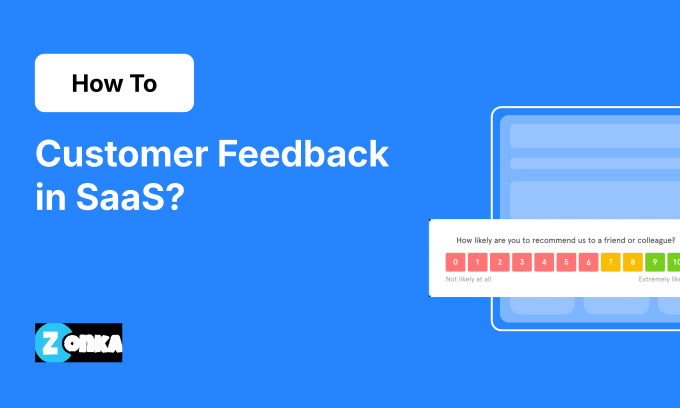
NPS measures whether customers would recommend your product. The 0-10 scale splits respondents into promoters (9-10), passives (7-8), and detractors (0-6). Your NPS is the percentage of promoters minus the percentage of detractors.
The number matters less than the trend. An NPS of 45 that's been climbing for three quarters tells a different story than a 45 that dropped from 60. And the open-ended follow-up ("What's the main reason for your score?") is where the real signal lives.
Veeam Software, which develops backup and disaster recovery software, runs NPS as a core part of their product feedback program. They improved their NPS by 11 points while achieving 27% year-over-year revenue growth. The connection isn't coincidental. They drill into the reasons behind scores and act on what they find.
Don't send NPS after a single support interaction. That's not what NPS measures. Use it for relationship moments, not transactions.
Sample questions:
- How likely are you to recommend [Product Name] to a friend or colleague? (0-10)
- What's the main reason for your score?
- Which features of our product have impressed you the most?
- What's one thing we could change to improve your experience?
For the full methodology, see the Net Promoter Score fundamentals guide.
4. Product CSAT Survey Template
Use when: Immediately after specific interactions: feature use, support resolution, onboarding completion, purchase.
Best for: Measuring satisfaction with individual touchpoints, not overall relationship.
CSAT asks a simple question: "How satisfied were you with [specific thing]?" The 1-5 scale (or sometimes 1-7) gives you a number you can track by feature, by team, by time period.
The key difference from NPS: CSAT is transactional. It measures how a specific moment went, not how the customer feels about your company overall. That's its strength. You can tie scores to particular features, releases, or support agents. If your new checkout flow launched last week and CSAT dropped 15%, you know exactly where to look.
Asana uses CSAT surveys to evaluate specific product experiences, including their homepage. The surveys identified how customers actually use the platform versus how Asana assumed they'd use it. That's the real value: CSAT catches gaps between intention and experience.
Sample questions:
- How satisfied were you with [specific feature/experience]? (1-5 scale)
- What worked well about this experience?
- What could we improve?
- Compared to alternatives you've used, how would you rate this experience?
- Would you use this feature again?
For setup and deployment patterns, see the CSAT survey guide.
5. Customer Effort Score (CES) Survey Template
Use when: Post-support resolution, post-self-service, post-onboarding. Any moment where the customer had to accomplish something.
Best for: Identifying friction points that CSAT misses.
CES measures effort: "How easy was it to [accomplish X]?" The insight behind it comes from research published in the Harvard Business Review, which found that reducing customer effort is a stronger predictor of loyalty than delighting customers.
That's counterintuitive. Most teams focus on making experiences great. CES says: focus on making them easy. A 4/5 satisfaction score with high effort is a warning sign. The customer got what they needed, but they won't come back if they have alternatives.
CES works best on flows where effort varies: onboarding, support resolution, self-service tasks, complex feature adoption. It catches the friction that a "How satisfied were you?" question doesn't surface.
Sample questions:
- How easy was it to [accomplish your goal]? (1-5 scale, where 5 is very easy)
- What made this easier or harder than expected?
- Did you need to contact support to complete this task?
- How could we make this process easier?
6. Feature Feedback Survey Template
Use when: After a new feature launches, or after significant usage of a specific feature you want to evaluate.
Best for: Understanding whether features deliver value and where they need refinement.
Feature feedback surveys close the loop on product development. You built something, shipped it, and now you need to know: did it work?
Zoom did this well during their rapid growth period. When COVID-19 drove a surge in demand, they added features fast: infrastructure improvements, security enhancements, new collaboration tools. But they didn't ship and forget. The team listened to feature-level feedback and used it to fine-tune releases, fix rough edges, and prioritize what came next.
The timing matters. Too early (day one after launch) and users haven't formed real opinions. Too late (three months out) and you've missed the window to iterate quickly. One to two weeks of active usage is usually the sweet spot.
Sample questions:
- Have you used [feature name] in [product name]?
- How useful was this feature for your workflow? (1-5 scale)
- How does this feature compare to similar features in other products you've used?
- What would make this feature more useful for you?
- Would you recommend this feature to a colleague?
7. Feature Request Survey Template
Use when: Ongoing collection via in-app widget, during roadmap planning cycles, or when you need structured input on what to build next.
Best for: Capturing and prioritizing customer ideas for product development.
Feature requests come in constantly. Through support tickets, sales calls, social media, casual conversations. The problem isn't volume. It's structure. Without a consistent format, product teams spend more time deciphering requests than evaluating them.
A feature request template standardizes the input. Instead of "it would be cool if you added X," you get: what problem does this solve, how often do you encounter it, what's your workaround today, how important is this relative to other requests.
The survey isn't just for customers. Internal teams submit feature ideas too. The same template works for both. It forces clarity on the "why" behind the request, which is what product teams actually need to prioritize.
Sample questions:
- What feature or improvement would you like to see?
- What problem would this feature solve for you?
- How often do you encounter this problem?
- What's your current workaround?
- How important is this feature relative to other improvements you'd like to see?
- Any screenshots, mockups, or examples to share?
Churn Prevention Templates
When customers show signs of leaving or have already churned, these templates help you understand why and whether recovery is possible. The data feeds both retention efforts and product roadmap decisions.
8. Churn Survey Template
Use when: Cancellation flow (before they leave) or post-churn (within 24-48 hours, for diagnosis and potential win-back).
Best for: Understanding why customers leave and whether recovery is possible.
The average monthly churn rate for SaaS companies sits between 3-8%. That's a lot of customers walking out the door. The churn survey asks them why. And sometimes, that's enough to save the account.
Groove, a shared inbox tool for small businesses, reduced churn by 71% by asking one thing: why are you leaving? The act of asking, combined with acting on the answers, changed their retention curve.
Timing is everything here. In the cancellation flow, before the customer has fully committed to leaving, you have the best chance to intervene. A discount, a feature they didn't know about, a call with customer success. Post-churn surveys are still valuable (they feed your product roadmap), but they're diagnostic, not preventive.
Keep it short. Someone canceling isn't in the mood for a 10-question survey. Three to four questions, mostly multiple choice, with one open-ended "anything else?"
Sample questions:
- What's the main reason you're canceling? (Multiple choice: too expensive, missing features, switched to competitor, no longer need it, other)
- Is there anything we could do to change your mind?
- How would you rate your overall experience with [product name]? (1-5 scale)
- Any additional feedback before you go?
For churn survey best practices and question design, see the product churn survey guide.
9. Bug Report Survey Template
Use when: Bug submission flow, in-app widget, or post-issue-resolution follow-up.
Best for: Collecting structured bug reports that developers can actually act on.
Bugs happen. The question is whether you find out about them from customers or from a spike in churn. A bug report template makes it easy for users to tell you what broke, where, and how to reproduce it.
The template matters because unstructured bug reports are nearly useless. "It doesn't work" gives developers nothing. "On the checkout page, when I click 'Apply Coupon' with a code that includes numbers, the page freezes" gives them everything they need.
Deploy bug report forms at every stage: internal testing, beta, production. The format stays consistent, which means developers see the same fields whether the report comes from QA or a paying customer.
Sample questions:
- On which page or screen did you encounter the bug?
- What were you trying to do when it happened?
- Describe what went wrong.
- Were you able to complete the task another way?
- Upload a screenshot or screen recording (optional)
- What browser/device are you using?
For question design and bug tracking workflow integration, see thebug report form questions guide.
Supporting Templates
These templates don't fit neatly into a lifecycle stage but fill critical gaps in your feedback program, from marketing attribution to understanding how customers discovered you.
10. Marketing Attribution Survey Template
Use when: Post-conversion (signup, purchase, demo request). You need to know which marketing channels are actually converting.
Best for: Understanding where customers first heard about you, beyond what analytics can track.
Marketing attribution tools track clicks. They don't track the podcast someone listened to on their commute, the conference booth they walked by, or the colleague who mentioned your product over lunch. For that, you need to ask.
The survey is simple. Often just one question: "How did you first hear about us?" Multiple choice with the usual suspects (Google search, social media, referral, podcast, event, other) plus an open-ended option for channels you haven't thought of.
Insert it at key conversion points: after signup, after demo request, after purchase. The data fills the gaps that analytics can't reach and helps you understand which channels deserve more investment.
Sample questions:
- Where did you first hear about [product name]? (Multiple choice)
- If "other," please describe.
- What made you decide to try [product name] today?
How Do You Choose the Right Template for Your Stage?
Not every stage needs every template. Teams that try to run all 10 from day one end up with survey fatigue, low response rates, and data nobody acts on.
Start with one template per lifecycle stage where you currently have the least visibility:
- If you're pre-launch and unsure about product-market fit, run the PMF survey.
- If you're in active use but don't know how customers feel about you overall, start with quarterly NPS.
- If you're losing customers and don't know why, deploy a churn survey in your cancellation flow.
Expand from there. Once NPS is running smoothly, add CSAT for specific touchpoints. Once churn surveys are feeding your roadmap, add feature request collection.
The goal isn't coverage for its own sake. It's building a feedback program that tells you what's working, what's broken, and what to fix next. Without overwhelming customers or your team.
Zonka Feedback's template library includes all 10 templates covered here, mapped to lifecycle stages and ready to deploy across email, in-app, SMS, and web channels. If you're building a multi-stage feedback program, it's designed for exactly this use case.
Start With One Template, Then Expand
The 10 templates in this guide cover every stage of the product lifecycle, from validating market fit before launch to understanding why customers leave. But trying to deploy all of them at once is a mistake.
Pick one lifecycle stage where you have the least visibility right now. Deploy one template there. Read every response for the first two weeks. That's enough to know whether you're measuring the right thing at the right moment, and what to add next.
Once you've got one template running smoothly and generating insights you act on, add a second. NPS running quarterly? Layer in CSAT for support interactions. Churn surveys feeding your roadmap? Add feature request collection to hear from customers before they leave.
The goal isn't survey coverage for its own sake. It's building a feedback program that tells you what's working, what's broken, and what to fix next. Without overwhelming customers or your team.