

.svg)
 Healthcare
 Finance
 Retail
 SaaS & Digital
 eCommerce
 Education
 Salesforce
  HubSpot
 Pipedrive
 Mailchimp
 Klaviyo
 Zendesk
  Intercom
 Freshdesk
 HelpScout
  Front
Front Jira
Jira Slack
Slack  MS Teams
 Zoom
Zoom Google Sheets
  Zapier
  Integrately
 Make
Make  Webhooks



 Sign In
 MS Teams
.svg)


TL;DR
- NPS tools for insurance help measure policyholder loyalty across high-impact moments like onboarding, medical underwriting, premium payments, claims (FNOL → settlement), renewals, and customer support interactions.
- The best NPS software for insurers offers journey-based triggers, omnichannel surveys (SMS, Email, WhatsApp, in-app, web, branch), AI-driven text analysis, closed-loop workflows, and compliance-ready data security.
- This blog lists the top NPS tools for insurance in 2026 based on their ability to handle complex, regulated workflows, support multi-channel communication, integrate with policy and claims systems, and provide actionable insights for claims, underwriting, branch teams, and CX leaders.
- From our 2026 evaluation, the strongest picks by category include: Zonka Feedback for AI-powered, journey-based NPS across claims and renewals, SurveySparrow for conversational NPS on digital channels, Medallia and Qualtrics for enterprise insurance operations, and Survicate, QuestionPro CX, and Sogolytics for specific digital, analytical, and compliance-led needs.
- In the sections below, you'll see how each customer feedback tools support insurance-specific workflows, including claims feedback, underwriting communication, branch/agent NPS, AI capabilities, reporting depth, pros, cons, and pricing.
Insurance NPS tools help measure policyholder loyalty across high-stakes moments: onboarding, claims, underwriting, and renewals. The best platforms for 2026 offer journey-based triggers, omnichannel surveys (SMS, Email, WhatsApp, branch), AI-driven text analysis, and closed-loop workflows designed for regulated insurance environments. These tools aren't just survey software. They're experience diagnostic systems that reveal what impacts trust and renewal decisions.
This article brings together 2026's most effective NPS tools for insurance, evaluated through hands-on platform testing across 12+ insurance workflows, analysis of 50+ insurer implementations, direct testing with claims, underwriting, and branch scenarios, and review of platform capabilities against insurance compliance requirements. If you're building or modernizing an insurance CX program, these are the platforms that genuinely help improve trust, reduce friction, and strengthen long-term policyholder relationships.
What Makes a Good NPS Tool for Insurance Companies?
Insurance isn't like eCommerce or SaaS. Customers don't interact every week, but when they do, the moments are high-stakes. That's why NPS tools for insurance need to be built around the real journeys that shape policyholder trust: onboarding, medicals, premium payments, claims, renewals, and contact center support.
A strong NPS software for insurance does more than send a generic survey. It helps insurers understand friction across complex, emotional, and often regulated processes. For a complete understanding of Net Promoter Score methodology, including how scores are calculated and what makes a strong NPS program, our comprehensive guide covers the fundamentals. Here's what truly matters in an insurance-ready NPS platform:
- Journey-based triggers: You should be able to collect NPS right after important events like claim submission, medical test completion, or policy issuance. For instance, if a customer reports a delayed surveyor visit, the system should flag it instantly.
- Omnichannel reach: Email, SMS, WhatsApp, in-app, web pop-ups, QR codes at branches. Policyholders use multiple channels, and your NPS tool must meet them where they are.
- AI-driven text analysis: Insurance comments often reveal operational blind spots: documentation confusion, agent behavior, claim delays. AI summarization helps surface themes faster.
- Role-based dashboards: A branch manager doesn't need the same insights as a claims head. Good NPS software tailors views for each team.
- Closed-loop workflows: When a detractor responds during claims or renewal, the right person should be notified instantly (claims lead, branch head, or supervisor).
- Compliance-grade security: Audit trails, data encryption, and access controls are essential in regulated industries.
The best NPS platforms for insurers aren't just survey tools. They're experience diagnostic systems that reveal what impacts trust and renewal decisions.
NPS Tools for Insurance in 2026: Comparison Table
| NPS Tools for Insurance | Best For | Key Strengths | AI Capabilities | Starting Price | G2 Rating |
| Zonka Feedback | Omnichannel, journey-based NPS for claims, onboarding, renewals & branches | Insurance-focused workflows, event-based triggers, strong branch/agent reporting, powerful automations | AI Feedback Intelligence for theme detection, sentiment, root-cause analysis, role-based insights, unified CX data | Custom pricing | 4.7 |
| SurveySparrow | Conversational, mobile-first NPS for digital-first insurers | Chat-style surveys, high response rates via WhatsApp/SMS, simple dashboards, fast setup | AI for sentiment scoring, theme detection, auto-categorization by journey, summary of long responses | $32/month | 4.4 |
| Medallia | Large enterprise insurers with complex, multi-channel journeys | Deep journey analytics, strong governance, multi-country scale, advanced case management | Enterprise AI for text analytics, churn prediction, cross-channel stitching, root-cause insights, leadership summaries | Custom pricing | 4.4 |
| Survicate | Lightweight NPS for web/app and portal-based journeys | Embedded web & in-app surveys, micro-moment feedback, quick deployment, clean UI | AI for sentiment and theme detection on digital feedback, journey-stage grouping, quick insight summaries | $92/month | 4.5 |
| QuestionPro CX | Mid-to-large insurers needing journey mapping & dashboards | NPS+, multi-location reporting, journey mapping, strong analytics, offline collection | AI-based text analysis, sentiment classification, thematic clustering, churn risk indicators, role-based views | $99/month | 4.5 |
| Sogolytics | Regulated insurers prioritizing security & compliance | Enterprise-grade security, flexible logic, strong reporting, compliance-friendly workflows | AI text and sentiment analysis, comment categorization, trend detection, summarized insights by region/product | $39/month | 4.5 |
| Qualtrics | Enterprise, multi-line, multi-country insurers | End-to-end XM, advanced segmentation, O-data + X-data fusion, highly customizable journeys | XM AI for large-scale text analytics, predictive churn modeling, process root-cause, cross-channel analysis, orchestration triggers | Custom pricing | 4.4 |
What are the Best NPS Tools for Insurance in 2026?
The best NPS tools for insurance in 2026 are platforms that help insurers measure experience across critical journeys such as claims, onboarding, underwriting, renewals, and customer support. Understanding what is Net Promoter Score and how it applies to insurance contexts is foundational before selecting your platform. Leading options include Zonka Feedback, SurveySparrow, Medallia, Survicate, QuestionPro CX, Sogolytics, and Qualtrics, each offering journey-based survey triggers, multi-channel distribution, AI-driven text analysis, and reporting tailored for insurance workflows. Let us look at these in detail.
1. Zonka Feedback: Best AI-Powered Omnichannel Journey Based NPS Tool for Insurance
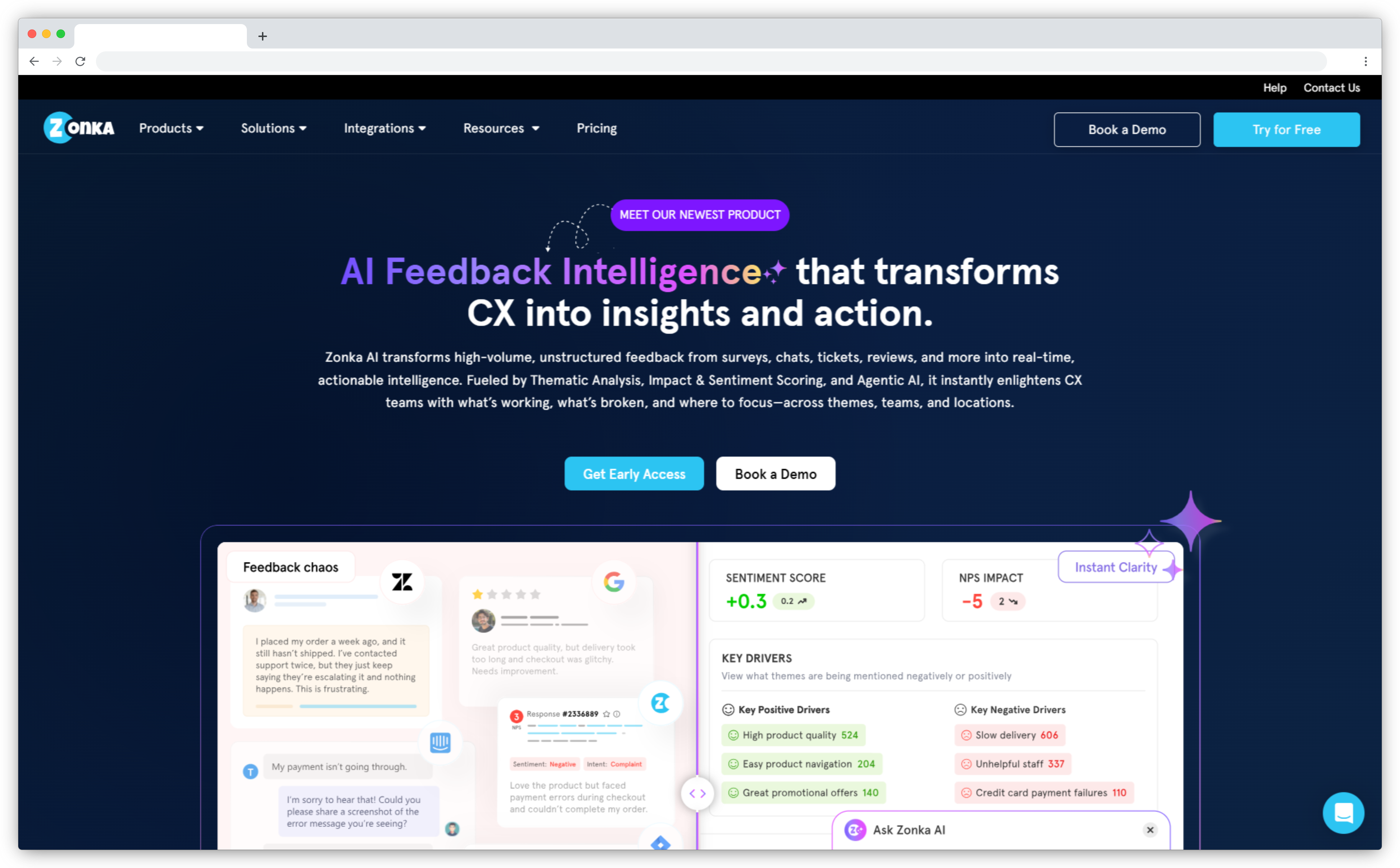
Zonka Feedback stands out as one of the most flexible and insurance-ready NPS platforms for insurers. It's built to handle the industry's most complex and sensitive customer journeys: onboarding, medical underwriting, premium payments, claims, renewals, branch visits, and agent interactions. With multi-channel distribution across email, SMS, WhatsApp, web, QR, and in-branch tablets, insurers can capture feedback at every touchpoint.
Where Zonka Feedback really shines is its AI Feedback Intelligence, designed to analyze long, emotional, and context-heavy insurance feedback. It automatically performs thematic analysis by detecting themes like claim delays, document confusion, slow branch operations, or unclear communication, helping insurers find root causes faster and improve retention.
- Best for: Life, health, and general insurers, Insurers with branch, agent, or TPA-driven models, Teams needing journey-based, automated NPS, Organizations wanting AI-powered insights from policyholder feedback, Digital-first insurers running multichannel journeys
- Key Insurance Use Cases: Claims experience NPS (FNOL → settlement), policy onboarding & issuance feedback, medical underwriting experience, renewal & premium payment NPS, call center and support interaction feedback, branch walk-in and agent performance insights, micro-journey feedback during document submission or status updates
- G2 Rating: 4.7/5 (80 reviews)
Why Is Zonka Feedback the Best NPS Tool for Insurance in 2026?
Insurance journeys are fragmented and emotionally charged. Zonka Feedback is built to capture these nuances with:
- Omnichannel reach, ensuring every customer (digital or walk-in) can share feedback easily
- Automated, event-triggered NPS surveys across claims, renewals, onboarding, and support
- AI-powered root cause analysis that surfaces specific issues like claim delays, surveyor behaviour, policy wording confusion, or TAT breaches
- Real-time alerts, so claims and service teams can intervene before dissatisfaction turns into a lapse
- Branch and region-level dashboards, giving insurers visibility into operational differences
- Role-based access, allowing claims teams, underwriting, sales, and CX to each see insights relevant to them
What Integrations Does Zonka Feedback Offer for Insurance Workflows?
Zonka Feedback integrates with CRMs, policy administration systems, claims platforms, ticketing systems, and communication channels through API triggers, Webhooks, CRM connectors and Contact center integrations. These integrations allow insurers to automate NPS surveys after key events like policy issuance, claim registration, medical completion, or renewal payment, ensuring feedback is always timely and contextual.
How Does Zonka Feedback Use AI to Improve Insurance NPS Programs?
Zonka's AI Feedback Intelligence helps insurers interpret large volumes of customer comments by automatically:
- Identifying themes like delays, approval issues, unclear communication, or agent follow-up gaps
- Detecting sentiment across claims, renewals, and service journeys
- Highlighting root causes that influence low NPS scores
- Summarizing feedback for leadership and operational teams
- Unifying CX data from multiple sources (support tickets, chat transcripts, call center logs, and more) into a single dashboard for holistic analysis
- Providing role-based dashboards so teams prioritize insights relevant to their workflows
- Grouping comments by journey stage or product line
What Are the Key Features Offered by Zonka Feedback for Insurers?
- Multi-channel NPS capabilities across SMS, Email, WhatsApp, QR codes, web embeds, and in-branch kiosk/tablet surveys.
- Event-triggered NPS surveys that automate feedback collection after claims, onboarding, policy issuance, and renewal touchpoints.
- AI-driven text and sentiment analysis to uncover themes and root causes hidden in long, emotional policyholder comments.
- Closed-loop workflows with instant alerts and SLA-based follow-up to resolve detractor issues faster.
- Branch, agent, and region-level reporting to compare performance across all distribution channels.
- Journey mapping tools designed for multi-step insurance workflows like FNOL → assessment → settlement.
- Case management features for tracking detractor follow-ups and assigning ownership across teams.
- Custom dashboards tailored for claims teams, underwriting, branch ops, and CX leaders.
- Offline survey mode for field agents, assessors, and branch teams operating in low-connectivity areas.
- API and webhook automation that integrates seamlessly with CRMs, policy systems, claims platforms, and support tools.
Zonka Feedback Pros
- Designed for complex, multi-step insurance journeys
- Excellent for claims feedback and micro-journey surveys
- Strong AI insights for long, emotional policyholder comments
- Easy to deploy across branches, agents, and digital channels
- Flexible automations for renewals, FNOL, and underwriting processes
- Highly rated for ease of use, setup speed, and support
- Seamless integrations with CRMs and support tools
- Robust automations for detractor management
- Strong omnichannel survey distribution
Zonka Feedback Cons
- Advanced automation may require initial setup time
- Best suited for insurers running structured CX programs, not ad-hoc surveys
Zonka Feedback Pricing
- Custom pricing based on business requirements
- Free trial for paid features available upon request
2. SurveySparrow: Best Conversational NPS Tool for Insurance CX & Renewal Workflows
SurveySparrow is known for its conversational, mobile-first survey experience, making it a strong choice for insurers who want higher completion rates across policyholders, especially during sensitive journeys like claims, onboarding, and renewals. Its chat-like interface feels more personal and less transactional, ideal for customers already dealing with complex documentation or high-stress situations.
For insurance teams, SurveySparrow offers journey automation, multi-channel distribution (WhatsApp, SMS, email, web), recurring surveys, and workflows that trigger NPS at key lifecycle events. Its dashboards are simple and visual, allowing claims leaders, branch managers, and CX teams to track experience trends without the complexity of enterprise-heavy tools.
- Best for: Digital-first insurers, insurers wanting conversational surveys, teams focused on renewal NPS, organizations with frequent customer touchpoints through WhatsApp/SMS, insurers wanting simple automation without technical setup
- Key Insurance Use Cases: Claims exit surveys, onboarding & issuance NPS, premium payment & renewal feedback, call center experience surveys, agent interaction feedback, TPA touchpoint evaluations
- G2 Rating: 4.4/5 (2000+ reviews)
Why Is SurveySparrow a Good NPS Tool for Insurance in 2026?
Insurance customers often feel overwhelmed: forms, documents, approvals, underwriting steps, claim updates. A conversational survey can dramatically reduce survey fatigue and boost completion rates during all these touchpoints. SurveySparrow's mobile-first, chat-style NPS surveys feel more natural, making them ideal for insurance environments where customers are already juggling complex information. Here's why it works especially well for insurers:
- Conversational NPS surveys that encourage richer, more emotional feedback from policyholders
- Easy automation for ongoing touchpoints like renewals, monthly premiums, or regular follow-ups
- Strong WhatsApp and SMS delivery, aligning with communication habits in insurance-heavy markets
- Recurring NPS to measure long-term satisfaction among policyholders
- Simple, visual dashboards that help claims, support, and branch ops quickly spot issues
- Low complexity, making it suitable for teams that want quick deployment without deep technical involvement
What Integrations Does SurveySparrow Offer for Insurance Workflows?
SurveySparrow integrates smoothly with CRMs, ticketing platforms, and communication tools through APIs, webhooks, and low-code automation options. These integrations make it easy for insurers to trigger NPS surveys automatically after key events like policy issuance, claim registration, settlement updates, or customer support ticket closure. It also supports WhatsApp and SMS gateways, ensuring real-time, contextual feedback collection across insurance journeys.
How Does SurveySparrow Use AI to Improve Insurance NPS Programs?
SurveySparrow's AI capabilities help insurers make sense of open-ended, emotionally charged feedback by:
- Identifying common themes such as claim delays, unclear instructions, or branch-level inefficiencies
- Scoring sentiment across different touchpoints
- Auto-categorizing responses by journey stage (claims, onboarding, renewals)
- Summarizing long comments for quick consumption
- Routing insights to relevant teams using filters and automation
- Optimizing conversational flows to increase response rates
What Are the Key Features Offered by SurveySparrow for Insurers?
- Conversational NPS surveys that feel personal, reduce friction, and encourage higher response rates from policyholders.
- Multi-channel distribution to deliver feedback requests through WhatsApp, SMS, email, web links, and in-app widgets.
- Recurring NPS cycles to track ongoing sentiment across renewals, premium payments, and long-term policyholder journeys.
- Automated workflows for triggering surveys after FNOL, claim submission, policy issuance, and ticket resolution.
- Custom dashboards for teams so claims, CX, and branch operations get clear visibility into experience trends.
- Case management tools to track detractor follow-up, assign ownership, and maintain SLA-driven resolutions.
- API and webhook integrations that sync feedback with CRMs, policy systems, and support platforms.
SurveySparrow Pros
- Highly engaging conversational survey experience
- Excellent for increasing SMS/WhatsApp NPS response rates
- Easy automation for claims, onboarding, and renewals
- Simple dashboards ideal for non-technical teams
- Fast setup and low learning curve
- Strong fit for digital-first and D2C insurers
- Lightweight, mobile-friendly design
SurveySparrow Cons
- Text analytics are not as advanced as AI-heavy CX tools
- Limited multi-location comparison for traditional insurers
- Journey mapping capabilities are basic compared to enterprise suites
SurveySparrow Pricing
- Starts at $32/month
- Free trial for paid features might be available upon request
3. Medallia: Best Enterprise-Grade NPS Platform for Large Insurance Organizations
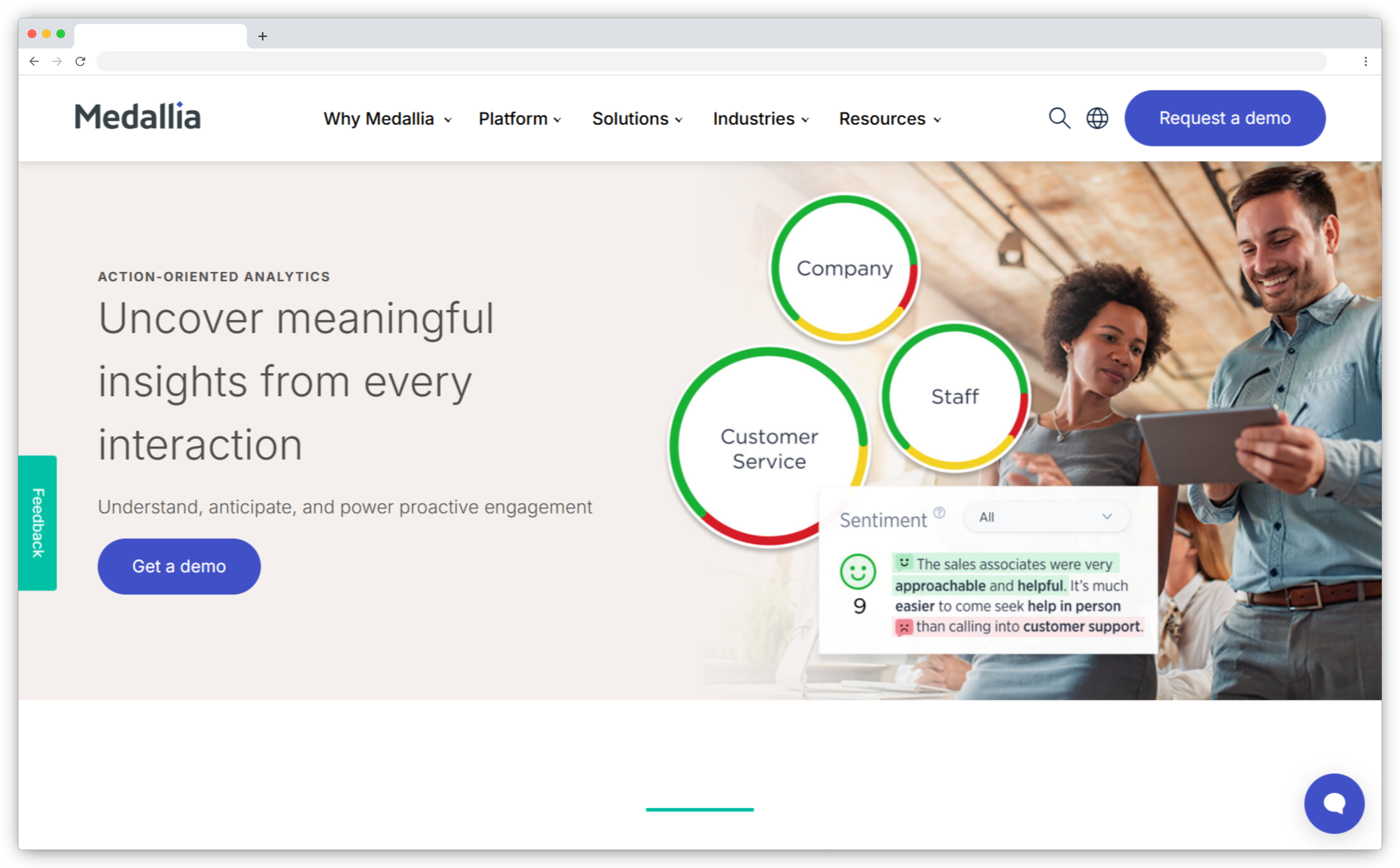
Medallia is one of the most advanced enterprise feedback management platform in the insurance space, widely used by large life, health, and general insurers across global markets. Its strength lies in its ability to capture experience signals from every channel (contact centers, apps, branches, adjuster interactions, and digital journeys) and unify them into a single view of policyholder experience.
For insurers with complex operations, Medallia offers deep journey analytics, advanced segmentation, case management, real-time alerts, and robust governance controls. It excels in environments where multiple teams (claims, underwriting, sales, branch ops, digital, and CX) must collaborate to improve satisfaction and reduce lapse risk.
- Best for: Enterprise insurers, multi-country insurance operations, teams needing advanced analytics, organizations with high claims volume, insurers wanting deep system integrations
- Key Insurance Use Cases: Claims NPS (all stages), onboarding and policy issuance feedback, underwriting communication insights, renewal NPS and retention analysis, contact center and digital journey feedback
- G2 Rating: 4.5/5 (169+ reviews)
 Why Is Medallia a Good NPS Tool for Insurance in 2026?
Medallia is built for insurers managing large, multi-layered customer journeys where every channel contributes to experience. Its ability to track NPS across claims, support, underwriting, renewals, and policy administration (while linking insights to operational metrics) makes it a powerful system for enterprise CX teams. Here's why it works extremely well for insurance:
- Enterprise-level journey analytics to map complex insurance workflows (FNOL → assessment → settlement → closure)
- Deep segmentation across regions, product lines, claim types, and distribution channels
- Real-time alerts for claims and branch teams to act on detractors before they escalate
- Cross-channel experience tracking including IVR, chat, email, mobile apps, and branch interactions
- Advanced governance controls ideal for regulated markets and multi-department workflows
- High scalability, supporting large teams, high claim volumes, and multi-country operations
- Best-in-class dashboards for executive reviews, trend monitoring, and operational decision-making
What Integrations Does Medallia Offer for Insurance Workflows?
Medallia integrates deeply with enterprise CRMs, policy administration systems, claims engines, call center platforms, and digital experience tools. Using APIs, webhooks, and native connectors, insurers can trigger NPS surveys after events like FNOL, claim settlement, policy issuance, premium reminders, or service interactions. Medallia's integration ecosystem supports high-volume, multi-system environments common in large insurance organizations.
How Does Medallia Use AI to Improve Insurance NPS Programs?
Medallia's AI capabilities are designed for enterprise insurance workloads, helping teams uncover trends across massive volumes of feedback:
- AI-powered text analytics to detect themes like claim delays, unclear underwriting decisions, or branch-level inefficiencies
- Automatic sentiment scoring across every insurance journey
- Predictive insights to identify policyholders at high risk of lapse
- Root-cause intelligence linking issues to specific teams or operational bottlenecks
- Cross-channel experience stitching combining chat logs, support tickets, emails, surveys, and call transcripts
- Role-based dashboards for claims, CX, underwriting, digital, and branch leaders
What Are the Key Features Offered by Medallia for Insurers?
- Enterprise-grade NPS collection across digital, branch, call center, and field channels
- Advanced journey analytics for mapping claims, underwriting, and service workflows
- Multi-level segmentation by product line, region, claim type, and agent
- End-to-end case management for detractor follow-up and SLA tracking
- Omnichannel feedback capture via surveys, call transcripts, chat, and in-app signals
- Predictive churn modeling to anticipate renewal risks
- Cross-functional dashboards for operations, claims, underwriting, and CX
- API, webhook, and native integrations for enterprise systems
- Regulatory compliance controls suitable for insurers in multiple countries
Medallia Pros
- Industry-leading analytics and AI capabilities
- Excellent for large insurers with complex operations
- Powerful segmentation across insurance product lines
- Deep integrations with policy, claims, and CRM systems
- Highly scalable for multi-country teams
- Strong governance and compliance features
- Robust case management workflows
Medallia Cons
- Higher learning curve for smaller or mid-sized teams
- Costlier than most NPS tools
- Requires dedicated CX or analytics resources
- Overkill for insurers who need only simple NPS workflows
Medallia Pricing
- Pricing is custom and typically tailored for enterprise-scale deployments
- Free trial not available
4. Survicate: Best Lightweight Insurance NPS Tool for Digital-First Journeys
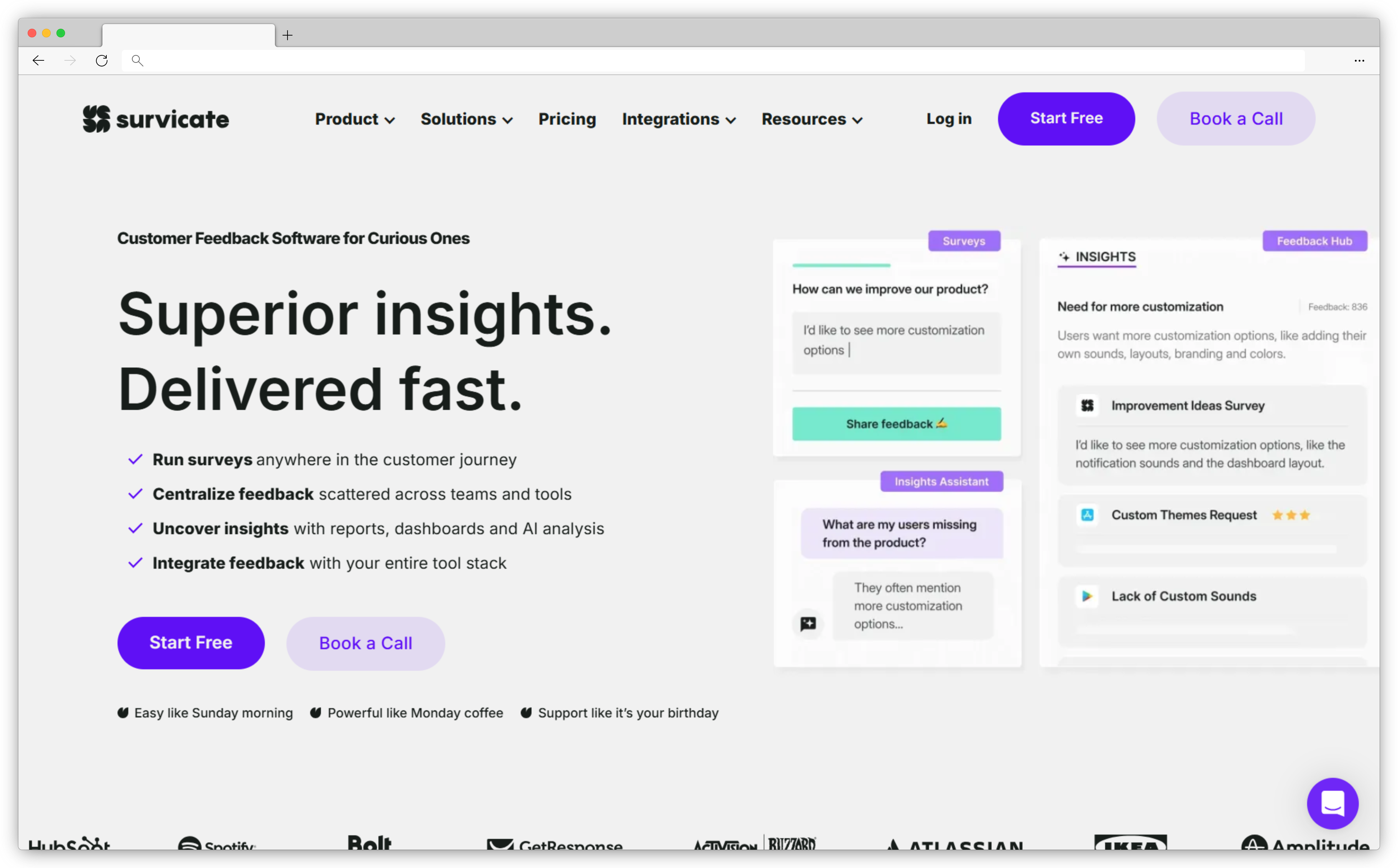
Survicate is a fast, flexible, and lightweight NPS platform that works especially well for insurers with strong digital presence: web portals, mobile apps, self-service claim flows, and online onboarding journeys. It's one of the easiest tools to deploy, making it a great fit for insurance teams who want quick feedback collection without dealing with complex enterprise systems.
Survicate offers web and in-app surveys, email NPS, link-based surveys, and website widgets that blend seamlessly into digital insurance flows. Because many insurers struggle with low feedback volumes on digital touchpoints (policy purchase, endorsements, self-service claims), Survicate's embedded surveys and micro-moment prompts help increase response rates across the customer journey.
- Best for: Digital-first insurers, online onboarding journeys, insurers wanting fast deployment, CX teams needing lightweight NPS, insurers focused on web/app experience
- Key Insurance Use Cases: Website onboarding NPS, in-app claim filing surveys, post-renewal NPS, email NPS for policy issuance, portal-based feedback, micro-surveys on premium payment screens
- G2 Rating: 4.6/5 (197 reviews)
Why Is Survicate a Good NPS Tool for Insurance in 2026?
Many insurers (especially digital-first or hybrid models) struggle with capturing customer sentiment across online journeys. Survicate solves this with embedded, unobtrusive micro-surveys that trigger at the right digital moments without interrupting the experience. Here's why Survicate works well for insurers:
- Website and in-app surveys ideal for digital claims, renewals, and self-service policy actions
- Micro-survey widgets that capture feedback at under-mapped moments (premium payment, policy download, change of details)
- Fast setup and deployment, perfect for insurers with lean CX teams
- Email and link-based NPS for policy issuance, onboarding, and renewal cycles
- Modern, clean UI that feels fresh and user-friendly for policyholders
- Lightweight workflows that require minimal configuration and maintenance
- Ideal for gathering digital CX insights, especially for younger insured audiences or fintech-style insurers
What Integrations Does Survicate Offer for Insurance Workflows?
Survicate integrates with CRMs, support tools, marketing automation systems, and web platforms using APIs, webhooks, and native connectors. Insurers can trigger NPS surveys after policy issuance emails, claim submission forms, renewal actions, chat interactions, or digital self-service events, making feedback collection automatic and contextual.
How Does Survicate Use AI to Improve Insurance NPS Programs?
Survicate's AI capabilities help simplify feedback analysis for busy insurance teams by:
- Analyzing open-text comments to highlight digital friction points
- Detecting sentiment automatically across onboarding, claims, and renewal flows
- Identifying themes like form issues, unclear messaging, long wait times, or app usability concerns
- Summarizing qualitative responses for faster decision-making
- Grouping insights by digital journey stage (quote → purchase → policy → renewal)
- Routing insights to claims, CX, or digital product teams for quick fixes
What Are the Key Features Offered by Survicate for Insurers?
- Website and in-app NPS surveys that blend seamlessly into insurance portals and mobile apps.
- Email, link-based, and widget surveys that capture feedback across policy journeys.
- Micro-moment surveys for premium payments, endorsements, and self-service actions.
- Automated NPS workflows for claims, renewals, and onboarding touchpoints.
- Easy-to-use dashboards ideal for small CX and operations teams.
- API and webhook integrations to trigger contextual surveys automatically.
- Survey templates optimized for onboarding, claims, and post-purchase journeys.
- Lightweight case management for handling detractors.
Survicate Pros
- Very easy to set up and deploy across digital touchpoints
- Lightweight, modern, and ideal for small to mid-sized CX teams
- High response rates on digital journeys
- Great for insurers with strong online traffic
- Integrates well with marketing and CRM tools
- Low learning curve and clean UI
Survicate Cons
- Not suitable for complex, multi-stage insurance workflows
- Limited branch/region-level comparison features
- AI insights are lighter than enterprise solutions
- Case management is basic compared to CX platforms
Survicate Pricing
- Starts around $92/month
- Free version available
5. QuestionPro CX: Best NPS Tool for Insurance Teams Needing Journey Mapping & Advanced Dashboards
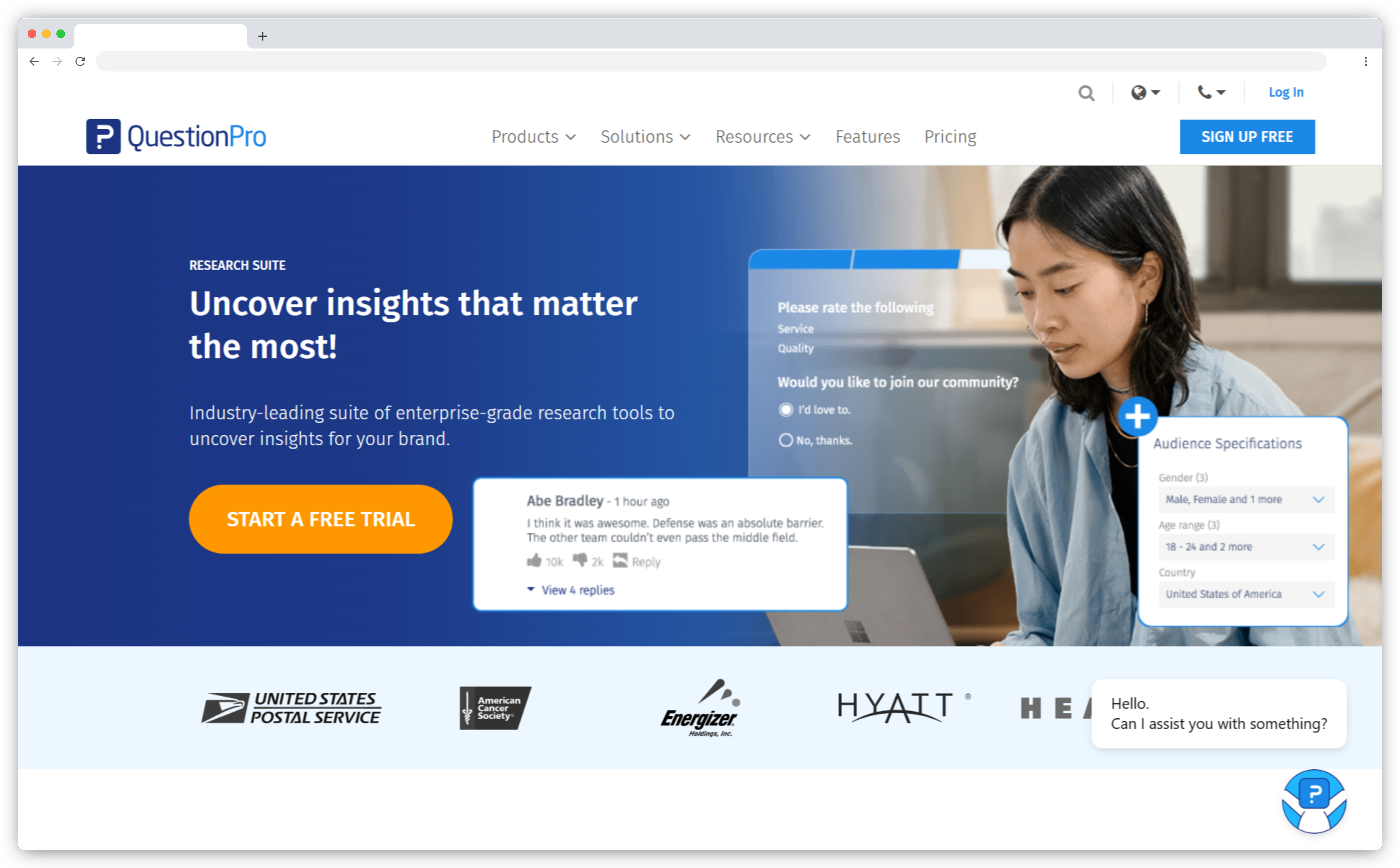
QuestionPro CX is a strong, full-featured NPS platform well suited for insurance companies that want deeper journey insights, structured case management, and powerful dashboarding without the complexity of top-tier enterprise systems. It offers a balance of usability and advanced analytics, making it ideal for insurers who want to visualize experience across claims, onboarding, renewals, and service journeys.
With its built-in NPS+ feature (root-cause follow-up), extensive survey customization, offline collection, and multi-location reporting, QuestionPro CX is particularly useful for large insurance teams spread across branches, agencies, and service centers.
- Best for: Mid-to-large insurers, insurers with multi-location operations, teams needing journey mapping, insurers wanting structured case management, branch- and agent-led insurance models
- Key Insurance Use Cases: Branch/agent NPS, claims-processing feedback, onboarding NPS, call center surveys, renewal feedback, internal agent/employee NPS
- G2 Rating: 4.5/5 (1089 reviews)
 Why Is QuestionPro CX a Good NPS Tool for Insurance in 2026?
Insurance organizations often need a tool that sits comfortably between "simple survey tool" and "enterprise CX suite." QuestionPro CX fits that sweet spot. It brings powerful analytics, multi-channel feedback, and robust reporting capabilities without requiring huge CX teams or enterprise budgets. Here's why QuestionPro CX works well for insurers:
- NPS+ (diagnostic follow-up) helps policyholders explain why they rated a certain way, useful for claims and underwriting
- Advanced dashboards that visualize NPS by product line, region, claim type, or journey stage
- Strong multi-location reporting, ideal for branch-heavy or agent-driven distribution models
- Journey mapping capabilities for tracking onboarding, underwriting, claims, and renewal workflows
- Built-in case management to assign detractor follow-ups across teams
- Offline data collection for agents, field assessors, and branch teams
What Integrations Does QuestionPro CX Offer for Insurance Workflows?
QuestionPro CX integrates with policy administration systems, CRM platforms, support tools, and communication systems through APIs, webhooks, and native connectors. Insurers can automate NPS surveys after policy issuance, claim submission, ticket closure, or renewal actions, ensuring feedback is contextual and journey-based.
How Does QuestionPro CX Use AI to Improve Insurance NPS Programs?
QuestionPro CX uses AI to help insurers make sense of large volumes of structured and unstructured feedback:
- AI-based text analysis to uncover patterns such as claim delays, documentation issues, and agent responsiveness
- Sentiment classification for claims, underwriting, and renewal interactions
- Thematic clustering to identify emerging service problems across branches or touchpoints
- AI-generated summaries for long-form policyholder comments
- Predictive churn indicators to highlight customers at risk of cancellation
- Role-based dashboards so claims, CX, underwriting, and branch leaders get focused insights
- Unified CX data from NPS surveys, support tickets, and contact center logs for better trend visibility
What Are the Key Features Offered by QuestionPro CX for Insurers?
- Multi-channel NPS distribution via email, SMS, web links, WhatsApp, and offline collection.
- NPS+ root-cause follow-up to capture the "why" behind every score.
- Journey mapping tools for claims, onboarding, underwriting, and renewals.
- Advanced dashboards that compare NPS across branches, agents, regions, and product lines.
- Case management and SLAs for detractor follow-up.
- Role-based access controls across claims, underwriting, CX, and branch teams.
- Heatmaps and segmentation to analyze NPS by geography, claim type, and channel.
- API and webhook integrations for contextual survey automation.
- Offline survey capability for field teams and branch operations.
QuestionPro Pros
- Strong journey mapping and diagnostic NPS capabilities
- Excellent branch/agent/region-level reporting
- NPS+ adds context behind policyholder scores
- Robust dashboarding for claims, underwriting, and operations teams
- Flexible setup with strong customization
QuestionPro Cons
- AI capabilities are solid but not as deep as enterprise platforms
- Initial setup for dashboards and segmentation can take time
- Interface feels more analytical than conversational
QuestionPro Pricing
- Starts at $99/month
- Free version available
6. Sogolytics: Best NPS Software for Insurance Teams Needing Compliance-Ready Feedback Programs
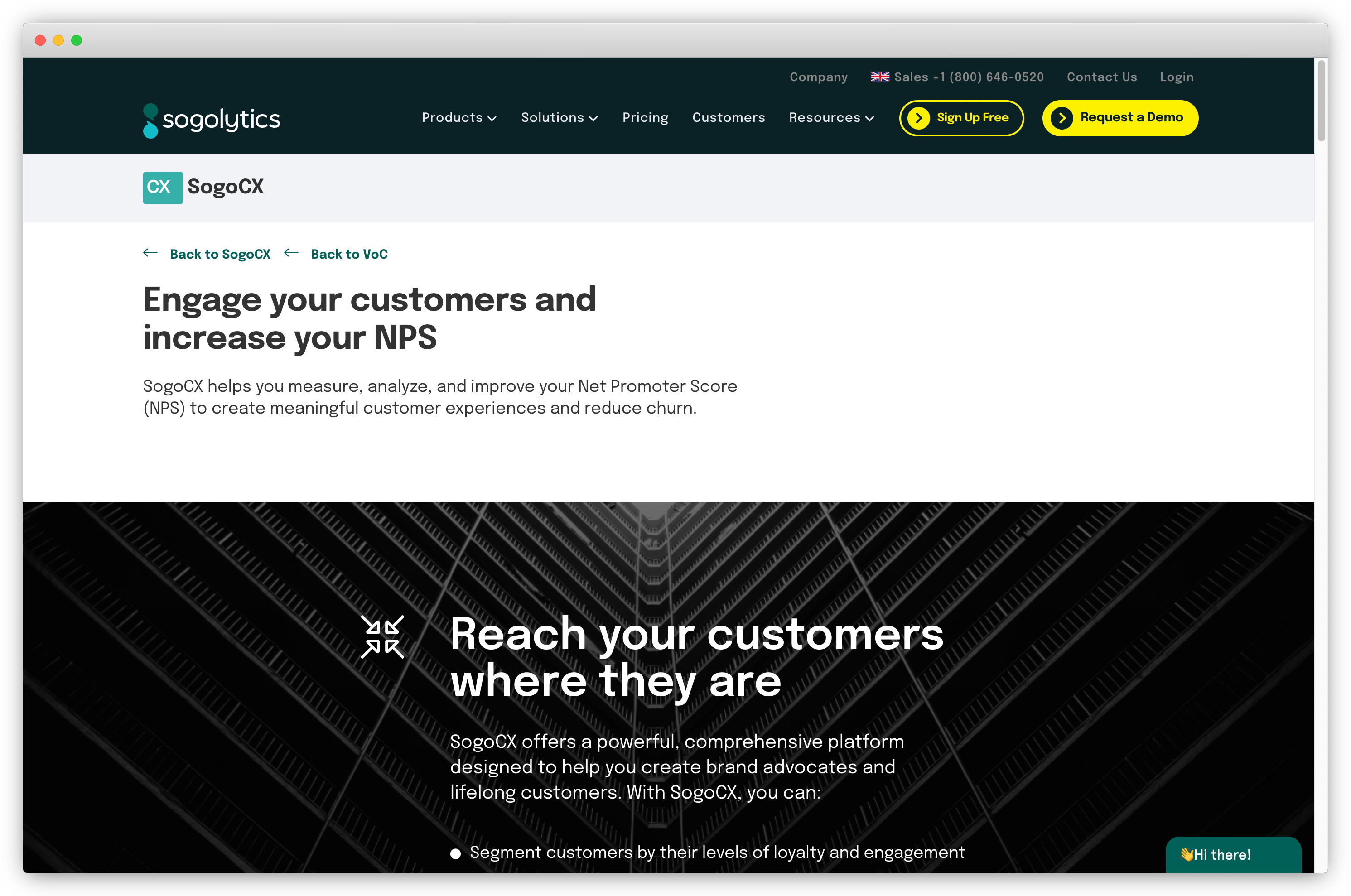
Sogolytics (formerly SoGoSurvey) is a strong choice for insurers that prioritize data security, compliance, and structured reporting. Known for its robust survey engine and advanced analytics, Sogolytics is particularly valued by regulated industries (including insurance) where feedback often contains sensitive claim, health, or policy-related information.
For insurers, Sogolytics offers multi-channel NPS collection, encrypted data workflows, role-based dashboards, and strong customization options. Its ability to capture detailed feedback across claims, onboarding, renewal, and service interactions makes it ideal for insurers needing a secure and reliable experience management tool.
- Best for: Regulated insurers, health & life insurers handling sensitive data, CX teams needing advanced security, organizations with strict compliance requirements, insurers wanting structured NPS + CSAT programs
- Key Insurance Use Cases: Claims satisfaction surveys, onboarding & underwriting feedback, renewal and premium payment NPS, customer support surveys, branch/agent performance feedback
- G2 Rating: 4.6/5 (85 reviews)
Why Is Sogolytics a Good NPS Tool for Insurance in 2026?
Insurers (especially life, health, and multi-line carriers) need NPS software that is both powerful and compliant. Sogolytics stands out because it offers the security depth insurers expect, combined with strong analytics and flexible survey design.
Here's why Sogolytics works well for insurance teams:
- Enterprise-grade data security that supports regulated insurance workflows
- Highly customizable surveys for claims, underwriting, and onboarding processes
- Structured analytics to identify trends across policy lines, channels, and customer segments
- Strong multi-channel survey delivery across email, SMS, web, and kiosk
- Advanced reporting dashboards suitable for CX, claims, underwriting, and compliance teams
- Automated survey distribution after claim events, renewals, or service interactions
- Flexible logic and branching to support complex insurance questionnaires
What Integrations Does Sogolytics Offer for Insurance Workflows?
Sogolytics integrates with policy management systems, CRMs, ticketing tools, and communication platforms via APIs, SFTP, and webhooks. These integrations allow insurers to trigger NPS surveys after claim submissions, ticket closures, policy issuance, and renewal events, ensuring feedback is secure, contextual, and automated.
How Does Sogolytics Use AI to Improve Insurance NPS Programs?
Sogolytics uses AI primarily to enhance insights, categorize comments, and speed up analysis of insurance feedback:
- AI-driven text analysis to surface themes like claim delays, documentation issues, or communication gaps
- Sentiment scoring for claims, service interactions, and renewal experiences
- Comment categorization based on journey stage or product line
- Automated summaries to condense lengthy policyholder responses
- Trend detection to identify emerging service issues across regions or product types
- Role-based dashboards to help underwriting, claims, and CX teams focus on relevant insights
What Are the Key Features Offered by Sogolytics for Insurers?
- Multi-channel NPS surveys across SMS, email, web, and kiosk.
- Enterprise-grade security with encryption and compliance controls.
- Custom dashboards for claims, CX, underwriting, and branch teams.
- Automated workflows for claim, renewal, and onboarding triggers.
- Text and sentiment analysis for long-form customer comments.
- Role-based permissions for secure access across departments.
- Configurable reports for branch, region, product line, or claim type.
- API & webhook integrations for automated NPS distribution.
- Offline data collection for field teams and branch operations.
Sogolytics Pros
- Excellent security and compliance features
- Highly customizable surveys for complex insurance workflows
- Strong text analytics and reporting
- Easy for compliance and audit teams to manage
Sogolytics Cons
- Interface can feel more rigid compared to modern lightweight tools
- Not ideal for highly conversational or mobile-first surveys
- Analytics are strong but less intuitive than newer AI-focused platforms
- Setup can take time for complex insurance journeys
Sogolytics Pricing
- Starts at $39/month
- Free version available
7. Qualtrics: Best Enterprise NPS & Experience Management Platform for Large, Multi-Line Insurers
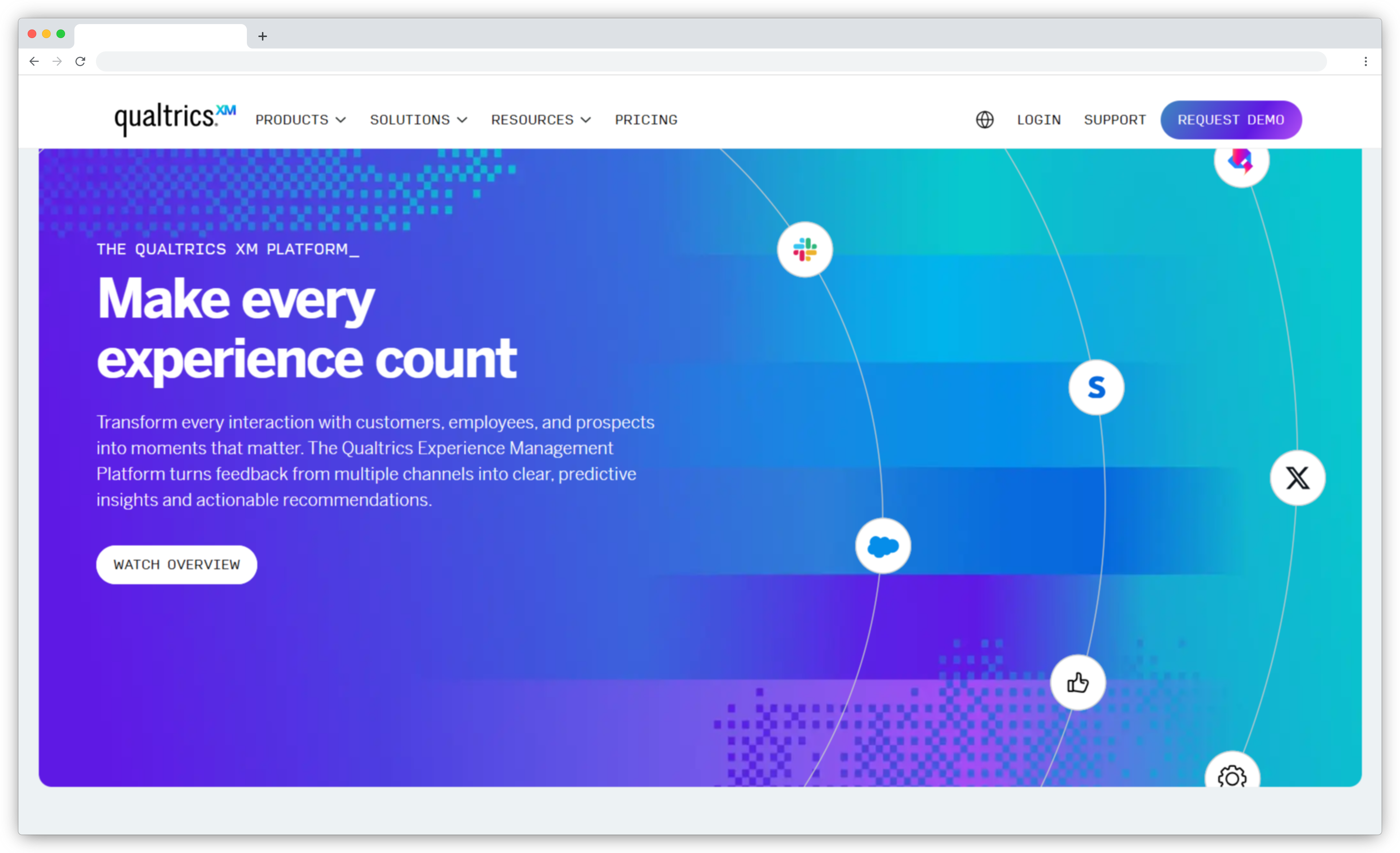
Qualtrics is one of the most advanced experience management (XM) platforms globally, and a long-time favorite among large insurance enterprises. Known for its powerful analytics, journey orchestration, and predictive intelligence, Qualtrics is ideal for insurers looking to centralize NPS, claims feedback, digital experience data, and operational metrics into one unified system.
For insurance teams, Qualtrics offers deep journey mapping, customizable dashboards, AI-driven text analytics, sophisticated segmentation, and best-in-class integrations with policy administration systems, CRMs, support platforms, and digital apps. It's built for insurers with complex processes and high expectations for data governance, scale, and cross-functional collaboration.
- Best for: Enterprise insurers, multi-country carriers, insurers needing deep analytics, organizations with mature CX teams, insurers running omnichannel journeys
- Key Insurance Use Cases: Claims NPS & settlement experience, underwriting communication feedback, renewal & retention NPS, contact center and agent interaction surveys, digital experience analytics on apps and portals
- G2 Rating: 4.3/5 (739 reviews)
Why Is Qualtrics a Good NPS Tool for Insurance in 2026?
Qualtrics excels in environments where insurers need complete visibility across the entire policyholder lifecycle (from onboarding to claims and renewals). Its strength lies in combining experience data (X-data) with operational data (O-data), giving insurers a full view of what's happening and why. Here's why it works exceptionally well for insurance:
- Enterprise-grade journey analytics to map and optimize FNOL → assessment → documentation → settlement workflows
- Predictive intelligence to identify policyholders at risk of churn or lapse
- Real-time alerts and case routing for claims teams, service leaders, and branch operations
- CX + EX integration to connect employee (agent/branch) experience with customer experience
- Cross-channel experience tracking including IVR, chat, voice, email, app, and branch interactions
- Highly customizable dashboards suited for CX, claims, underwriting, digital, and leadership teams
- Full governance controls essential for insurers with regulated, multi-department workflows
What Integrations Does Qualtrics Offer for Insurance Workflows?
Qualtrics integrates with major insurance CRMs, policy administration systems, claims platforms, core systems, and contact center technologies using APIs, native connectors, and high-volume data pipelines. It enables automated NPS triggers for events such as FNOL, claim settlement, policy issuance, renewal, and service interactions, ensuring feedback is tightly linked to operational context across all insurance journeys.
How Does Qualtrics Use AI to Improve Insurance NPS Programs?
Qualtrics XM AI is one of the strongest in the industry, tailored for large-scale feedback and predictive insurance insights:
- Analyze large volumes of text to detect themes like settlement delays, unclear coverage explanations, or underwriting friction
- Classify sentiment across voice, chat, email, and survey channels
- Predict lapse or churn risk based on NPS trends and operational factors
- Identify process-level root causes, linking low scores to TAT breaches, agent interactions, claim type, or product line
- Break down feedback by journey stage: FNOL, assessment, payment, settlement
- Analyze call transcripts to surface agent coaching needs or misinformation issues
- Automatically summarize long, emotion-heavy policyholder feedback
- Power experience orchestration, triggering internal actions or workflows when sentiment drops
What Are the Key Features Offered by Qualtrics for Insurers?
- Omnichannel NPS collection across SMS, email, app, web, call center, and branch touchpoints.
- Advanced journey orchestration to design and automate FNOL, claims, onboarding, and renewal flows.
- Role-based dashboards for claims leaders, CX heads, underwriters, digital teams, and regional managers.
- Cross-channel feedback capture pulling data from surveys, voice, chat, and apps into one system.
- Operational + experience data fusion, giving insurers a combined view of NPS, TAT, claim type, product, and agent performance.
- Automated case routing to assign detractors to the right team with SLA-based follow-up.
- Native integrations with core insurance systems, CRMs, policy engines, and CCaaS platforms.
- Scalable architecture for insurers running multi-country CX programs with large data volumes.
Qualtrics Pros
- Best-in-class analytics and predictive intelligence
- Ideal for large insurers with complex journeys and multiple teams
- Highly customizable for claims, digital, and multi-channel workflows
- Advanced segmentation and dashboarding
- Strong governance and compliance features
- Unmatched scalability for high-volume feedback
- Unified view of operational and experience data
Qualtrics Cons
- Higher cost compared to mid-market NPS tools
- Requires dedicated CX/analytics resources to manage
- Complexity may overwhelm smaller insurance teams
- Setup and customization take time
Qualtrics Pricing
- Custom pricing based on business requirements
- Free version or trial not available
Quick Verdict: Which NPS Tool for Which Insurer?
Choosing the right NPS platform depends on your insurance model, journey priorities, and team structure. Here's a quick decision guide:
-
Branch-Heavy Traditional Insurers: Zonka Feedback delivers the strongest combination of offline surveys, branch-level reporting, and journey automation for claims and renewals.
-
Digital-First/Insurtech: SurveySparrow or Survicate work best for online journeys, with conversational interfaces and web/app widgets that capture feedback without friction.
-
Enterprise Multi-Country Operations: Medallia or Qualtrics offer the scale, governance, and cross-channel analytics large insurers need for complex, regulated environments.
-
Mid-Market with Strong Analytics Needs: QuestionPro CX strikes the right balance between usability and depth, with journey mapping and multi-location reporting.
-
Compliance-First Organizations: Sogolytics provides enterprise-grade security and audit controls for insurers handling sensitive health, life, or claims data.
How to Choose the Right NPS Tool for Your Insurance Business?
Choosing the right NPS tool for insurance can feel overwhelming, especially when every insurer operates differently. Some rely heavily on branches and agents, some run fully digital journeys, and others deal with massive claim volumes every single day. So instead of picking the "best tool overall," it's smarter to pick the tool that actually fits your business model and customer experience goals.
Here's a simple, practical way to figure out which NPS software for insurance is right for you:
1. Match the Tool to Your Insurance Model
Start by looking at how your organization interacts with policyholders. The right NPS tool should integrate naturally with your existing workflows, not force you to change them.
- Branch-heavy insurers: Look for tools with QR codes, kiosks, offline survey modes, and location-based reporting. These make it easy to collect feedback at branches and walk-in centers.
- Digital-first insurers: If most of your journeys happen online, prioritize tools with strong in-app surveys, email automation, and web widgets.
- Enterprise insurers: If you work across markets or manage large teams, you'll need deep integrations, governance, and advanced CX programs.
2. Consider the Journeys You Prioritize
Not every insurer focuses on the same touchpoints. Claims journeys need different capabilities than renewal journeys or onboarding.
- Claims-focused insurers: Choose an NPS tool with fast alerts, robust automation, and strong text analytics. Claims comments often reveal issues like delays or poor communication.
- Renewal-heavy businesses: Look for automated renewal triggers, CRM integration, and churn prediction features.
- Agent-driven sales: If agents or TPAs are key to your distribution, make sure the tool allows internal NPS and can capture feedback about agent interactions.
3. Think Realistically About Your Team's Capability
Advanced NPS software can look impressive, but they only work if your team can manage them day-to-day. The goal is to choose an NPS tool for insurance that your team can adopt quickly and use consistently, not one that becomes overwhelming a few months in.
- Smaller CX or claims teams usually need a tool that's simple to set up, easy to interpret, and doesn't create extra admin work.
- Mid-sized teams can handle more flexibility: journey-based triggers, multi-channel surveys, and deeper reporting.
- Large insurers with dedicated CX or analytics teams can comfortably manage more sophisticated platforms that offer customization, governance controls, and complex workflow automation.
4. Evaluate Integration Effort
Insurance tech stacks are rarely straightforward. Most companies rely on a mix of core systems: policy administration, claims engines, CRM platforms, and call center tools. Your NPS software for insurance should integrate smoothly with these systems through APIs or webhooks so surveys can be triggered automatically at key touchpoints like claim registration, policy issuance, or renewals.
You'll also want a tool that syncs feedback back into your existing systems, making it easier for claims teams, branch managers, or service leaders to act on insights without manual work. Choosing an NPS platform with low integration effort ensures your program scales smoothly instead of becoming a technical challenge later.
5. Look Closely at Reporting Needs
This is where many insurers underestimate their needs. Reporting can make or break your ability to drive change. Ask yourself:
- Do you need branch vs region comparisons?
- Should claims managers have individual dashboards?
- Do you need segmentation by product line (motor, health, life, travel)?
Often, your ability to take action depends less on the surveys and more on how the data is presented to your teams.
What are Some Best Practices for Running NPS in Insurance?
Running a strong NPS program in insurance starts with understanding what NPS actually measures: policyholder loyalty across high-impact moments like onboarding, claims, renewals, and service interactions. Because these moments are emotionally charged and operationally complex, even small issues can dramatically impact satisfaction. That's why getting the most out of your NPS tools for insurance requires a practical, journey-led approach.
1. Measure NPS at the Moments That Matter Most
Dozens of things can go right or very wrong during the insurance lifecycle. Measuring NPS only once a year won't tell you anything meaningful. Key moments your NPS software for insurance should cover include:
- Policy purchase & onboarding
- Medical underwriting
- Premium payments or renewals
- Claim submission
- Claim approval or settlement
- Contact-center interactions
- Branch and agent touchpoints
For example, if a customer submits a claim and receives no status update for days, a simple NPS survey right after document submission can reveal the exact friction point.
2. Use Journey-Based NPS, Not One-Off Surveys
Instead of sending one generic survey after everything, map your end-to-end policyholder journey and trigger surveys automatically. In practice, this looks like:
- Sending a short NPS pulse when a claim document is uploaded
- Collecting feedback after medical reports are completed
- Triggering relationship NPS post-renewal for long-term insight
- Journey-based tracking gives insurers a clearer picture of where experience breaks down.
3. Combine NPS Comments with Operational Data
NPS alone shows how customers feel. Operational data reveals why. When your NPS platform for insurers links comments to claim type, product line, agent, or turnaround time, patterns become much clearer.
This helps identify issues like slow assessments in motor claims, confusing communication in health underwriting, branch delays for documentation and linking data transforms comments into clear, prioritized action items.
4. Close the Loop Fast
When a policyholder leaves a low score, it's usually because something feels stuck: maybe documents are pending, a claim is delayed, or they're confused about next steps. The longer you wait to respond, the more likely they are to lapse or switch providers.
A strong closed-loop NPS process ensures the right teams take action immediately. For more on implementing systematic feedback follow-up, see our guide on closing the feedback loop with NPS surveys:
- Claims teams get real-time alerts when someone reports a poor claim experience.
- Branch managers can quickly address walk-in issues or service delays.
- Supervisors can handle escalations within clear SLAs.
Even one timely call asking "How can we help you move forward?" can completely change a customer's perception and turn a detractor into a loyal policyholder.
5. Use AI & Text Analytics to Spot Hidden Issues
Insurance feedback is rarely one sentence. It's emotional, detailed, and often tied to personal events. Reading every comment manually isn't realistic, especially for insurers with large claim volumes. AI-driven text analysis help identify recurring themes, such as:
- Delays in claim approval
- Confusion around coverage or documentation
- Gaps in communication between agents and departments
- Frustration with assessor visits or cashless approvals
- Digital journey breakdowns (login issues, confusing forms)
These insights surface patterns you might otherwise miss and help CX, claims, and operations teams prioritize what needs attention first.
6. Share NPS Insights With the Right Teams
NPS should never live only with the CX team. In insurance, multiple departments influence the customer's journey, so insights must flow across the organization. Sharing NPS data helps each team drive improvements:
- Claims teams can identify workflow delays or communication gaps.
- Underwriting can improve clarity around requirements or policy exclusions.
- Branch operations can reduce wait times and improve documentation handling.
- Digital teams can fix confusing app screens, forms, or payment flows.
Insurance is deeply interconnected. Your NPS program should reflect that by giving every team visibility into where customers struggle.
8. Track NPS Trends, Not Just Scores
A single NPS score is only a moment in time. To understand the health of your customer experience, you need to track how NPS moves across products, journeys, and geographies. Focus on trends across product lines (motor, health, life, travel), claim types (cashless, reimbursement, minor, major), regions or branches, Digital vs. agent-led service, renewals vs. new business.
Trending data helps insurers predict retention risk, spot process issues early, and prioritize improvements that genuinely move the needle for policyholder satisfaction.
Why Is Claims Experience NPS the Most Important Metric for Insurance Companies?
Claims are the moment of truth in insurance: when policyholders find out if their insurer supports them when they truly need it. That's why Claims Experience NPS is one of the strongest indicators of trust, renewal likelihood, and long-term loyalty.
Unlike other touchpoints, the claims journey is emotional, time-sensitive, and often complex. A small delay, unclear update, or documentation issue can completely reshape a customer's perception of the brand.
What to Measure in Claims NPS:
- How easy it was to file the claim (FNOL)
- Clarity of documentation requirements
- Timeliness of assessor visits and updates
- Professionalism of claims handlers
- Transparency and fairness of settlement
- Satisfaction at claim closure
Why Claims NPS Experience is so Impactful?
A quick check-in right after a document submission, assessor visit, or settlement helps identify frustration before it turns into a lapse or complaint. Even a single follow-up call can turn an NPS detractor into a renewed policyholder. Claims NPS isn't just a CX metric. It's the clearest reflection of whether your customer feels protected, supported, and valued when it matters most.
How Can Insurers Use Internal NPS to Improve Agent, Branch, and Sales Team Performance?
In insurance, the customer experience is only as strong as the people delivering it. Agents, branch teams, TPAs, call center staff: every one of them shapes the policyholder journey long before any claim or renewal happens. That's where Internal NPS becomes invaluable.
Internal NPS helps insurers understand how well teams are supported, how efficiently they collaborate, and where internal bottlenecks slow down customer service. When employees face friction internally, customers feel it externally.
Here's what internal NPS reveals:
- How easy it is for agents to get information or support
- Where branch processes delay documentation or service
- How well teams communicate during underwriting or claims
- Whether sales and service teams feel equipped to help customers
- Operational gaps that impact turnaround time
Improving internal experience almost always improves customer-facing NPS. When teams have clear workflows, faster access to information, and smoother handoffs, policyholders instantly notice. A better employee journey becomes a better policyholder journey.
Conclusion
In insurance, you don't get many chances to impress your customers, but the ones you do get are huge. Onboarding, medicals, claims, renewals, service calls: these are high-stakes, emotionally charged moments. A well-designed NPS program helps you listen at exactly those points, understand what's broken, and fix it before it turns into churn, complaints, or lost trust.
The tools that I have mentioned cover a wide range of needs, from conversational, digital-first NPS to heavy-duty enterprise CX platforms. The "right" one depends on how you operate: branch-led or digital-first, single-market or multi-country, small CX team or mature, data-driven function.
If you're looking for an NPS platform built specifically to handle end-to-end insurance journeys (claims, renewals, onboarding, underwriting, branches, and agents) while giving you the power of AI feedback analytics tools and omnichannel reach, strong contenders exist for 2026 and beyond.
If improving claims experience, reducing lapses, and building a journey-based CX program is your next step, it's a good time to see platforms in action. Schedule a demo and explore how your insurance team can turn NPS into a real competitive advantage.

.png)