

.svg)
 Healthcare
 Finance
 Retail
 SaaS & Digital
 eCommerce
 Education
 Salesforce
  HubSpot
 Pipedrive
 Mailchimp
 Klaviyo
 Zendesk
  Intercom
 Freshdesk
 HelpScout
  Front
Front Jira
Jira Slack
Slack  MS Teams
 Zoom
Zoom Google Sheets
  Zapier
  Integrately
 Make
Make  Webhooks




 MS Teams


If you're reading this, you've likely already seen the Qualtrics XM Discover demo. The analytics are impressive. The cross-channel intelligence, the NLU-based emotion and effort scoring, the custom taxonomy builder — it's genuinely powerful. Then the pricing conversation happens. Discover XM is not included in your Qualtrics contract. It's a separate module, priced at $300,000–$400,000 per year on top of a base platform that itself starts from $25,000/year for meaningful deployments. Most teams never get executive sign-off. Most never move forward.
Others are already inside Qualtrics and using Text iQ or the base analytics — and finding that turning what the platform surfaces into day-to-day action requires more manual effort than expected. Configuration is slow. Insights are centralized but not operationalized. The teams who need to act on feedback don't have easy access to what the analytics produce.
This guide covers both situations. It maps the best Qualtrics XM Discover alternatives for 2026 — from enterprise conversational intelligence platforms to more action-oriented feedback analytics built for faster adoption and lower total cost. Each tool is assessed on text analytics depth, multi-source ingestion, time to insight, closed-loop capability, and what it actually costs. For a broader view of the full Qualtrics competitive landscape, the qualtrics alternatives and competitors guide covers 18 platforms across CX, EX, and research categories.
TL;DR
- Qualtrics XM Discover is a robust enterprise text and conversational analytics platform — formerly Clarabridge. It is priced separately from the base Qualtrics contract at $300,000–$400,000/year additional. Most teams that evaluate it never get budget approval.
- Teams seek alternatives for three main reasons: the Discover XM price barrier, the setup and taxonomy configuration overhead in both Discover XM and Text iQ, and the insight-to-action gap — analytics that surface findings but don't connect directly to team-level workflows.
- This guide covers 7 leading alternatives: Zonka Feedback, Medallia, Sprinklr, InMoment, Chattermill, Thematic, and Forsta (Confirmit) — assessed on text analytics depth, multi-source ingestion, implementation complexity, actionability, and pricing model.
- Zonka Feedback stands out for teams that need Gen AI feedback intelligence, closed-loop automation, and CRM integration at a price point that doesn't require enterprise procurement approval. Schedule a demo to see the platform in practice.
What Is Qualtrics XM Discover?
Understanding what XM Discover actually is — and how it differs from the rest of the Qualtrics platform — is essential context before evaluating alternatives. The two products are frequently confused, and that confusion shapes how teams approach the evaluation.
Qualtrics XM Discover (formerly Clarabridge, acquired by Qualtrics in 2021) is an enterprise conversational intelligence platform. It is not the same as Qualtrics Text iQ, which is the text analytics feature built into standard Qualtrics survey plans. XM Discover is a separate, standalone product built to analyze unstructured feedback at scale across multiple sources: contact center call transcripts, chat logs, emails, social media, online reviews, and survey open-text. It uses natural language understanding (NLU) to detect not just positive/negative sentiment, but emotion, customer effort, intent, and themes — at the phrase level, across all connected data sources.
The platform has three core components: Connectors (which ingest data from external systems), Designer (where teams build and train topic models and taxonomies), and Studio (custom dashboards and reporting). That architecture is what makes XM Discover powerful — and what makes it operationally demanding. Meaningful deployments require taxonomy configuration, model training, specialist involvement, and ongoing maintenance. It is built for centralized enterprise CX programs with dedicated analytics teams, not for lean CX teams that need insights quickly. For teams that specifically need alternatives to Qualtrics' text analytics layer — but not necessarily the full Discover XM stack — the qualtrics text iq alternatives competitors guide covers that more focused comparison.
How Much Does Qualtrics XM Discover Cost?
XM Discover is not included in a standard Qualtrics contract. It is priced separately, and its cost is the primary reason most teams that evaluate it don't proceed.
Based on verified buyer data and direct accounts from organizations that went through the evaluation: XM Discover is priced at $300,000–$400,000 per year as a standalone module, on top of a base Qualtrics platform contract that typically runs $25,000–$180,000/year for mid-market deployments. One senior VoC leader who used Qualtrics at two large healthcare and insurance organizations described the dynamic directly: at each organization, she ran the Discover XM evaluation and built the business case — and at each one, the cross-channel analytics package never got executive sign-off once the price was clear. "We did not move very far at all once they saw the price point," she said. That experience — seeing the capability in a demo, building genuine interest, and then losing the budget conversation — is the most common reason teams begin looking at Qualtrics XM Discover alternatives. For context on how Qualtrics' broader pricing compares to SurveyMonkey at the enterprise tier, the surveymonkey vs qualtrics comparison is useful framing.
Why Teams Look for Qualtrics XM Discover Alternatives
The reasons teams seek Qualtrics XM Discover alternatives fall into three patterns, drawn from both user research and direct conversations with organizations that have been through the evaluation.
The price barrier. At $300,000–$400,000/year as an add-on to an already significant base contract, XM Discover is beyond the budget horizon for most mid-market CX teams. Even at enterprise organizations, the analytics capability is genuinely compelling but the business case is hard to close. Teams end up staying on Text iQ (the base analytics layer) or building workarounds — exporting data to spreadsheets, running manual LLM-based analysis — rather than getting the cross-channel intelligence they actually need.
Setup and taxonomy complexity. The configuration overhead in both XM Discover and Text iQ is a recurring friction point. One retail CX manager described Text iQ as "very fiddly" — where an incorrect category setup would silently route feedback into the wrong buckets, and the errors only surfaced when someone manually reviewed the reporting. Designer, XM Discover's taxonomy modeling tool, gives organizations significant analytical control — but requires specialist involvement to configure well, and ongoing maintenance to stay accurate as product and service language evolves. For lean teams without a dedicated CX analyst, this overhead is operationally unsustainable.
The insight-to-action gap. XM Discover produces sophisticated analysis. What it doesn't do natively is connect those insights to team-level workflows: routing a negative theme to the relevant product manager, triggering a follow-up for a detractor, writing back to a CRM contact record, or sending a digest to a regional manager. That execution layer sits outside the platform — which means teams that need both analysis and action end up with a stack of tools rather than a single integrated workflow. A VP of Customer Experience at a large aesthetics services company described watching his survey response rate drop from 22% to under 12% over two years on Qualtrics, seeking guidance from their account team, and receiving none. The support gap at premier pricing was what ultimately drove the decision to evaluate alternatives.
Across these patterns, the common thread is not that XM Discover lacks analytical strength — it doesn't. The issue is that the strength is priced and architected for a specific organizational profile that many teams don't match.
Quick Comparison: Top Qualtrics XM Discover Alternatives
The table below maps all seven alternatives across the dimensions that matter most when replacing XM Discover functionality. Criteria are specific to what XM Discover is evaluated on: text analytics depth, multi-source ingestion, implementation time, closed-loop capability, and pricing model.
| Tool | Best For | Text Analytics Depth | Multi-Source Ingestion | Time to First Insight | Closed-Loop Workflows | Pricing | G2 |
| Zonka Feedback | CX and support teams needing fast insight-to-action | Phrase-level sentiment, thematic analysis, entity detection, impact scoring | Surveys, support tickets, reviews, digital touchpoints, offline | Same day — no configuration required | Strong — alerts, routing, CRM sync, follow-ups | Custom; typically $2K–$20K/yr for mid-market | 4.7/5 |
| Medallia | Large enterprise CX programs with governance needs | Advanced text analytics, sentiment, predictive AI | Surveys, digital, contact center, in-person | Weeks to months — enterprise implementation | Moderate — structured case management | Custom enterprise pricing | 4.5/5 |
| Sprinklr | Digital and social CX teams | NLP for social and digital conversation channels | Social media, messaging, digital support | Moderate — initial channel configuration needed | Moderate — digital-channel workflows | Custom enterprise pricing | 4.2/5 |
| InMoment | Survey-led enterprise experience measurement | Text analytics on survey open-text responses | Surveys, transactional feedback, employee | Weeks — program setup required | Moderate — program-driven action management | Custom enterprise pricing | 4.7/5 |
| Chattermill | CX and product insight teams needing deep qualitative analysis | Strong AI theme and sentiment detection across sources | Surveys, reviews, support tickets, social | Days — integration setup required | Limited — insight-focused, not execution-focused | Pro, Team, Enterprise (custom pricing) | 4.5/5 |
| Thematic | Research and insight teams needing explainable AI | Advanced qualitative analysis, driver detection | Surveys, reviews, support conversations | Days — theme model review recommended | Limited — analytics-first, minimal workflows | From $25K/yr; Enterprise custom | 4.8/5 |
| Forsta (Confirmit) | Market research and survey-heavy CX programs | Text analytics within survey-based research datasets | Survey data, market research panels | Weeks — research program setup required | Limited — research workflow focus | Custom research-based pricing | 4.3/5 |
| Blix | Survey open ends analysis | LLM based thematic analysis and automated coding, API | - | - | Text Analysis UI and UPI | Pay as you go and annual subscriptions | 4.7/5 |
What Are the Best Qualtrics XM Discover Alternatives in 2026?
The tools below represent the strongest alternatives to Qualtrics XM Discover across different organizational profiles and use cases. Each is assessed on the capabilities that matter for replacing or supplementing what XM Discover provides — not on general survey functionality.
1. Zonka Feedback — Best for Gen AI Feedback Intelligence with Closed-Loop Action
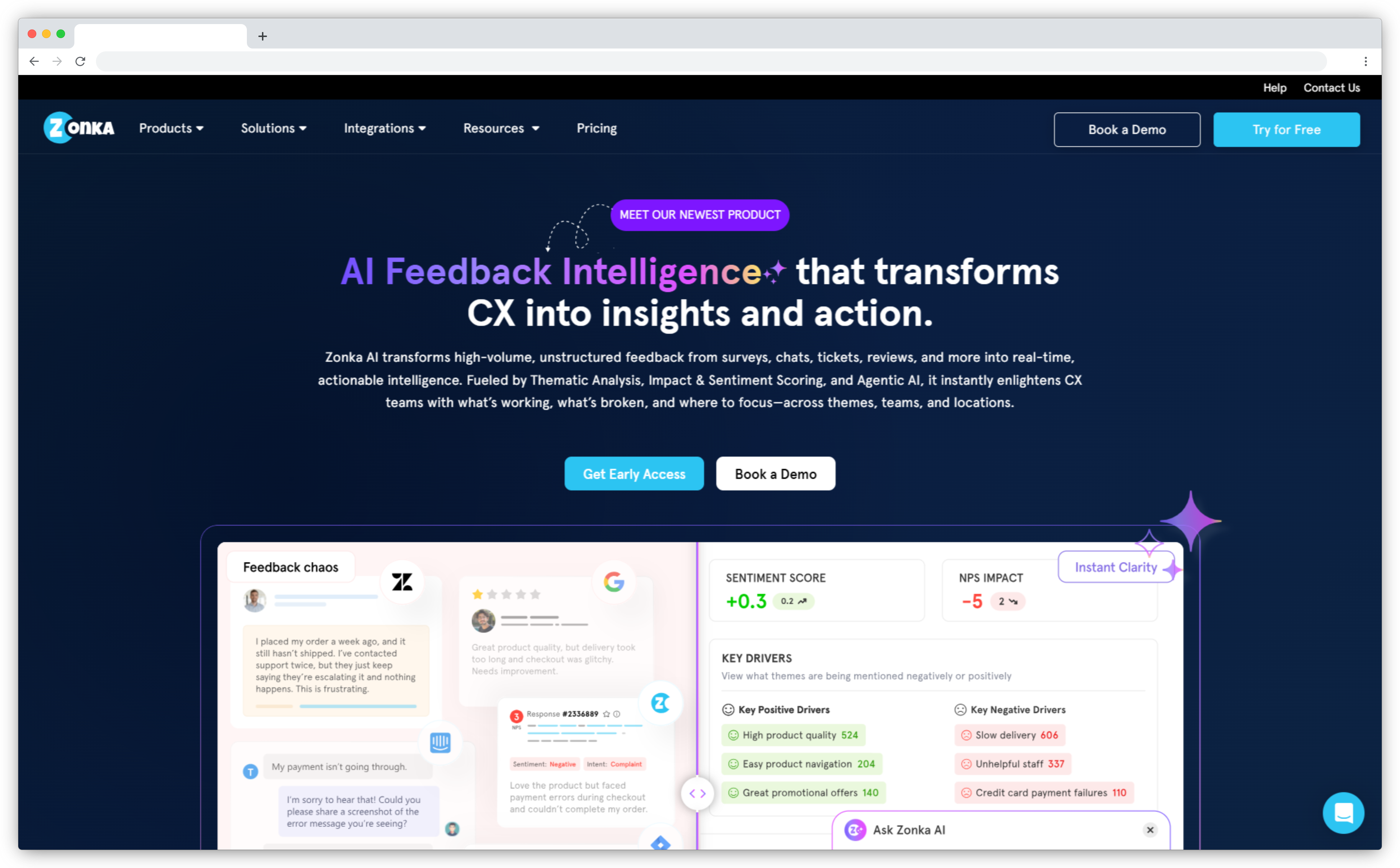
For teams that need the analytical depth XM Discover offers but can't absorb the cost or implementation overhead, Zonka Feedback is the most direct alternative. It replaces both the text analytics layer and the action workflow layer in a single platform — without requiring taxonomy configuration, specialist implementation, or a separate budget line for the AI module.
Zonka Feedback's AI Feedback Intelligence runs automatically on every open-text response from day one. It operates at the phrase level rather than the comment level — a response like "the onboarding team was excellent but the billing process is confusing" gets broken into component phrases, each scored for sentiment, entity (onboarding team, billing process), and impact independently. This matters because mixed-sentiment responses are the norm in customer feedback, and comment-level classification obscures the real signal. Thematic analysis detects patterns without requiring manual category setup. Impact scoring links which themes correlate most strongly with NPS or CSAT movement. Ask AI lets any team member query the full dataset in natural language.
The difference from XM Discover's architecture is operational: Zonka Feedback connects insight directly to execution. Negative themes route to the relevant team. Detractors trigger follow-up workflows. CRM records are updated automatically. Regional managers receive role-based digests without someone manually building a report. This closed-loop layer is what most analytics-first platforms — including XM Discover — require separate tools or custom integrations to replicate.
Key Features
- Gen AI Feedback Intelligence — Phrase-level sentiment, thematic analysis, entity detection, impact scoring, and Ask AI natural language queries. Runs automatically on every response. No configuration required.
- Multi-channel feedback collection — Surveys via email, SMS, WhatsApp, web intercepts, in-app (mobile SDK), kiosk/offline, and QR codes. Feedback from support tickets, reviews, and digital touchpoints also ingested.
- Closed-loop automation — Real-time alerts, ownership assignment, CRM field sync, Slack/Teams notifications, and case management workflows. Insight connects directly to action without external tools.
- Contact profiles — Every response maps to a customer record, building a longitudinal view of feedback across all surveys, channels, and time periods. Account-level trend analysis available without manual data joins.
- Role-based dashboards — CX leads, regional managers, support teams, and product managers each see insights relevant to their scope without separate report builds.
- CRM integration — Bidirectional Salesforce sync including custom object mapping, merge fields in the survey body, and event-trigger field writeback. Native Pipedrive integration also available.
Pros
- Gen AI analytics included in base pricing — no add-on module required
- Self-service setup — operational within days, no implementation partner needed
- Closed-loop execution built into the platform, not bolted on
- Phrase-level sentiment delivers more accurate analysis than comment-level classification
- Responsive support included in plan pricing
Cons
- Voice/speech analytics not yet available (roadmap item)
- Custom dashboarding at enterprise scale is less mature than Qualtrics or Medallia
Pricing
- Custom pricing based on business requirements. Typically $2,000–$20,000/year for mid-market CX programs — approximately 70–80% savings versus a comparable Qualtrics deployment with Discover XM
- 14-day free trial available on request
"Zonka Feedback has been a game changer for us. We've managed to increase our NPS by 30%."
— SmartBuyGlasses, Zonka Feedback customer story
2. Medallia — Best for Large Enterprise CX Programs with Governance Requirements
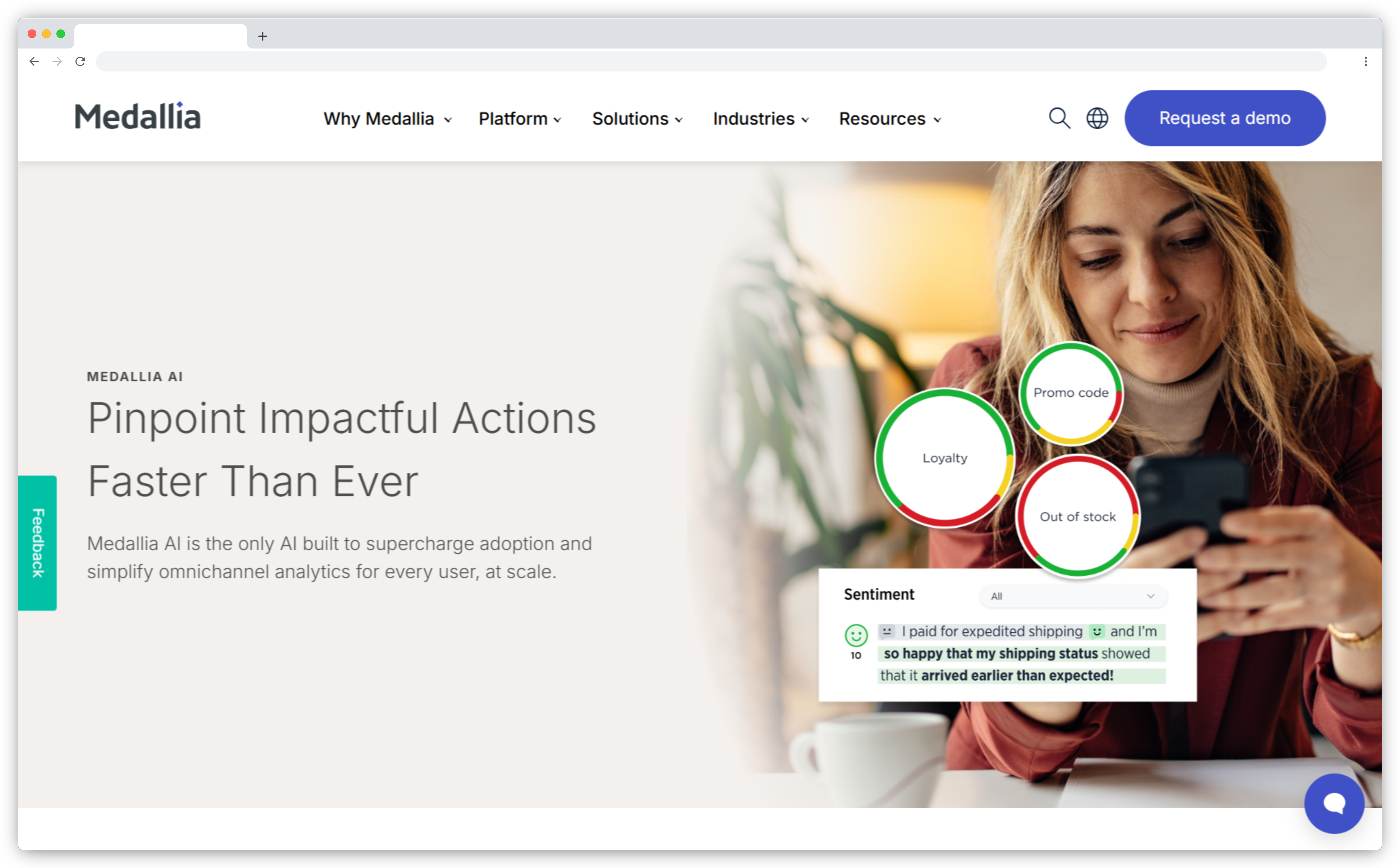
Medallia is the closest enterprise-tier alternative to Qualtrics XM Discover for organizations that genuinely need the scale and governance depth both platforms offer. It handles large feedback volumes across complex multi-touchpoint operations, with text analytics, predictive AI, and centralized reporting designed for global programs.
Where Medallia earns its position is in programs that need formal governance — role-based access across regions, standardized reporting across business units, and structured case management workflows for controlled follow-ups. Its Intelligent Summaries and Root Cause Assist features (added in 2025) have meaningfully reduced the analysis time that used to require dedicated analyst resources. Implementation is complex and requires significant setup time, but for organizations with the resources and scale to justify it, Medallia is a genuine XM Discover alternative that doesn't require leaving the enterprise tier.
Key Features
- Enterprise-wide feedback ingestion — Surveys, digital, contact center, and in-person interactions at scale across large customer bases and regions.
- Text analytics and Athena AI — Pattern detection, anomaly identification, predictive behavior modeling, and sentiment analysis across feedback sources.
- Intelligent Summaries and Root Cause Assist — AI features (added 2025) that reduce time-to-analysis for large result sets.
- Centralized reporting for executive oversight — Role-based views, regional benchmarking, and long-term trend tracking built for governance-focused programs.
- Structured case management — Formal follow-up workflows designed for process-driven CX programs rather than real-time operational response.
Pros
- Enterprise-scale analytics with strong governance and compliance controls
- Handles high feedback volumes across complex global programs
- AI features meaningfully reduce manual analysis time
- Widely adopted — deep implementation ecosystem and partner network
Cons
- Complex implementation requiring dedicated resources and significant setup time
- Not suited for lean teams or organizations needing fast deployment
- Pricing is custom enterprise and requires procurement engagement
Pricing
- Custom enterprise pricing. Contact Medallia for a quote.
"What I like best about Medallia Customer Experience is that it lets you discern patterns in customer feedback that aren't immediately apparent. Text Analytics, Push Reports and Admin Suite — these features have completely altered my time to analyze results."
3. Sprinklr — Best for Social, Digital, and Conversational Experience Intelligence
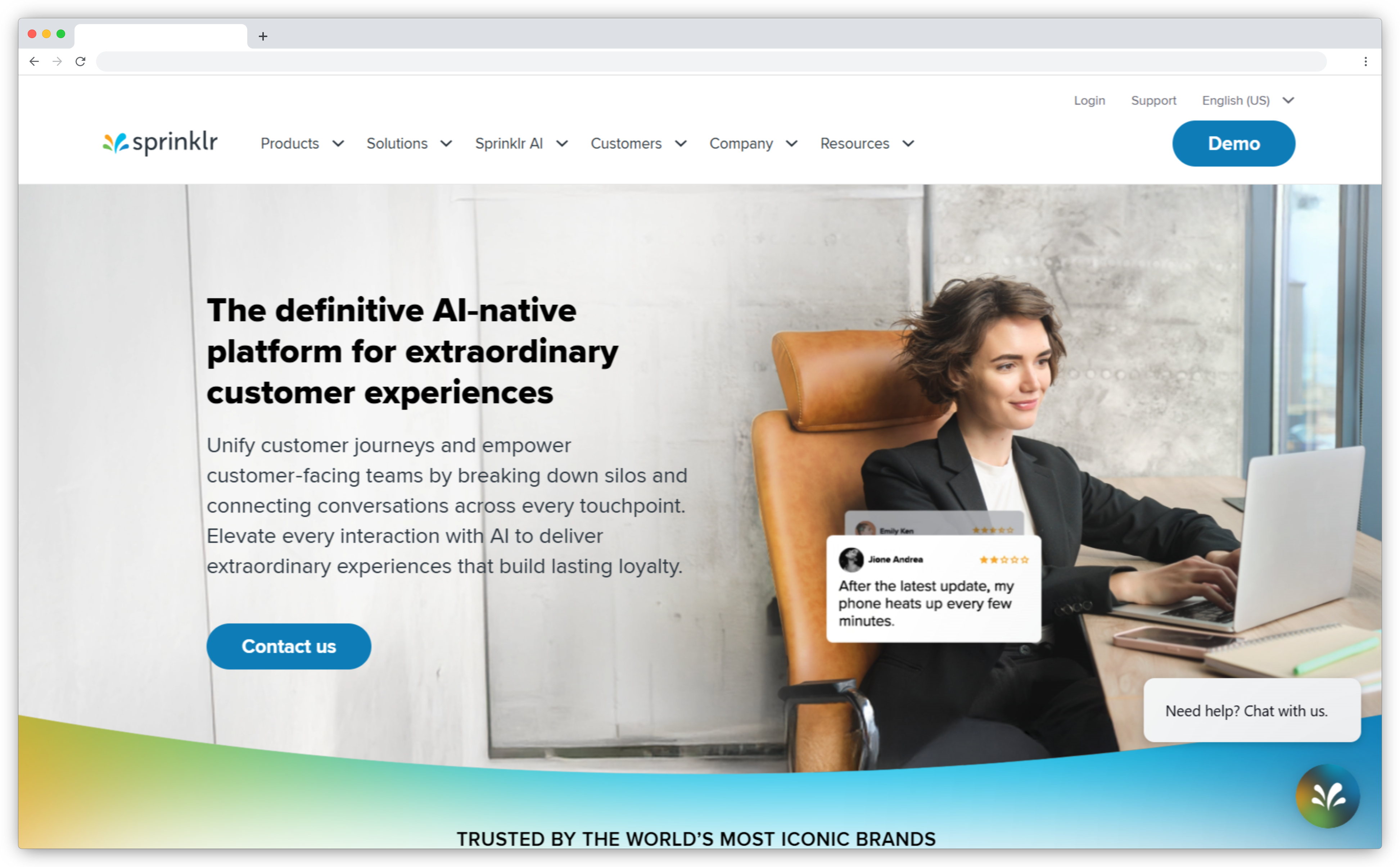
Sprinklr is the strongest alternative for organizations where XM Discover's conversational intelligence use case is primarily social and digital — brand monitoring, public conversation analysis, and social media sentiment — rather than survey-based or contact center-driven. It's built for enterprise teams where the customer experience is shaped through ongoing digital interactions rather than structured survey programs.
If a significant portion of your unstructured feedback comes from social media, messaging platforms, online communities, and digital support channels, Sprinklr covers that landscape more natively than most alternatives. It doesn't replace XM Discover for contact center analytics or deep survey text analysis — but for teams where digital and social listening is the primary driver of the XM Discover evaluation, it's worth serious consideration.
Key Features
- Social listening and brand monitoring — Real-time tracking of customer conversations, brand mentions, and public sentiment across social platforms.
- Conversational analytics for digital channels — NLP analysis of messaging apps, live chat, and digital support interactions at scale.
- Unified digital experience management — Connected view of customer interactions across social, messaging, and digital support touchpoints.
- Workflow management for digital CX teams — Conversation routing, ownership assignment, and response management for time-sensitive social issues.
- Enterprise governance and reporting — Role-based access, regional reporting, and compliance controls for global digital CX teams.
Pros
- Industry-leading social and digital conversation analytics
- Handles high volumes of public customer conversations across platforms
- Strong digital workflow management for real-time issue response
Cons
- Less suited for traditional survey programs or contact center analytics
- Complex for teams seeking straightforward feedback collection workflows
Pricing
- Custom enterprise pricing. Contact Sprinklr for a quote.
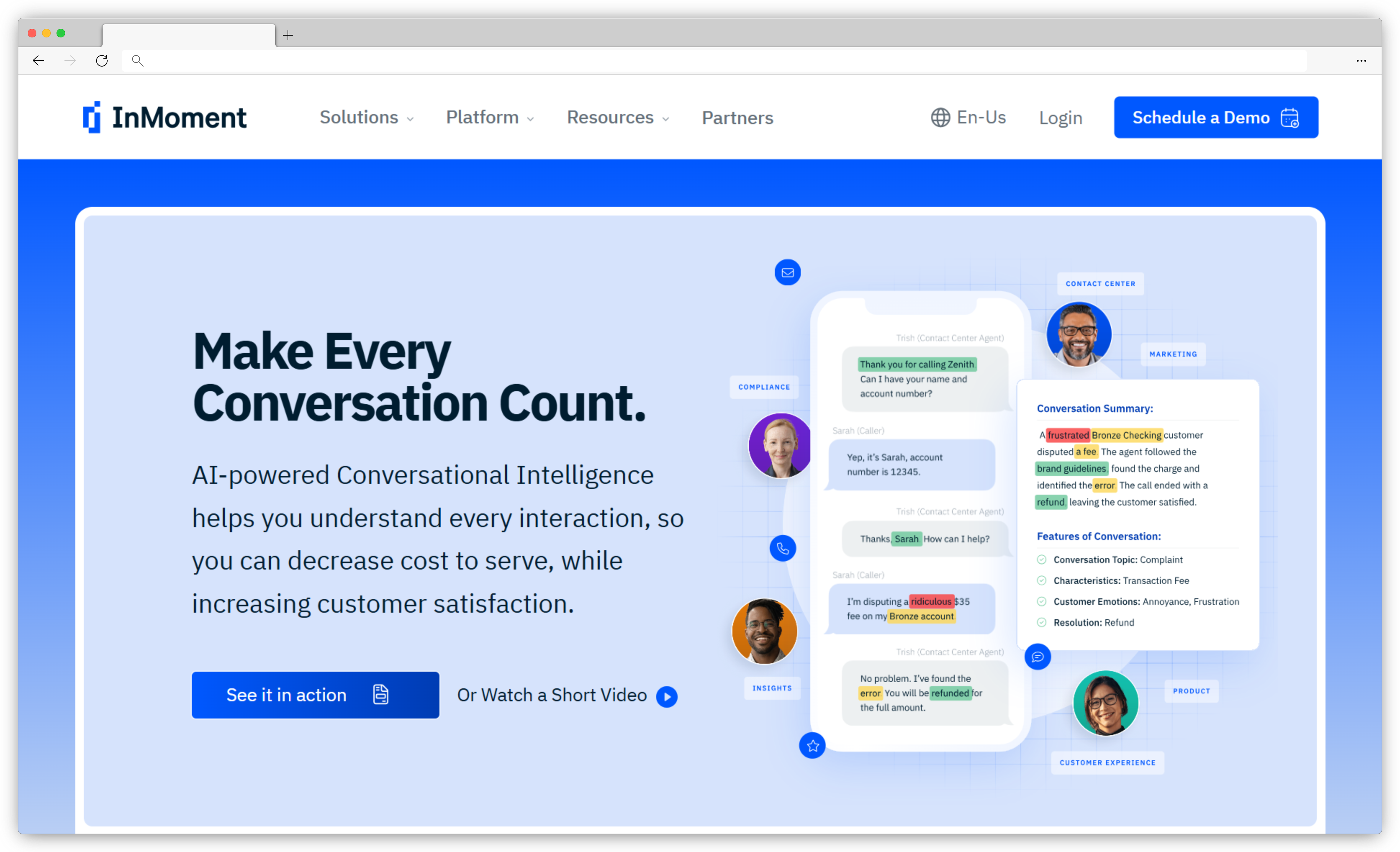
4. InMoment — Best for Survey-Led Enterprise Experience Measurement
InMoment occupies the space between a traditional survey platform and a full conversational intelligence product. It's built for organizations that run structured CX programs anchored in survey-based measurement — NPS, CSAT, CES at defined touchpoints — and need text analytics layered on top of that structured data rather than across multi-source conversational feeds. It's a better fit for organizations with formal CX measurement frameworks than for teams looking to replace XM Discover's multi-source conversational analytics specifically.
Key Features
- Survey-first feedback collection at defined journey touchpoints — Post-transaction, post-support, and lifecycle surveys at specific customer interaction points.
- Text analytics on survey open-text responses — NLP and machine learning applied to structured survey datasets for theme and sentiment detection.
- Long-term CX performance tracking — Dashboards and reporting designed for periodic program review, benchmarking, and leadership visibility.
- Formal action management within CX programs — Planned, program-driven follow-up workflows rather than real-time operational response.
- Employee feedback alongside CX measurement — Combined CX and EX measurement in structured programs.
Pros
- Strong for structured enterprise CX and EX measurement programs
- Combines customer and employee feedback in a single platform
- Well-suited for governance-focused, long-term CX initiatives
Cons
- Primarily survey-led — limited multi-source conversational analytics
- Implementation for complex enterprise setups requires significant time
Pricing
- Custom enterprise pricing available on request.
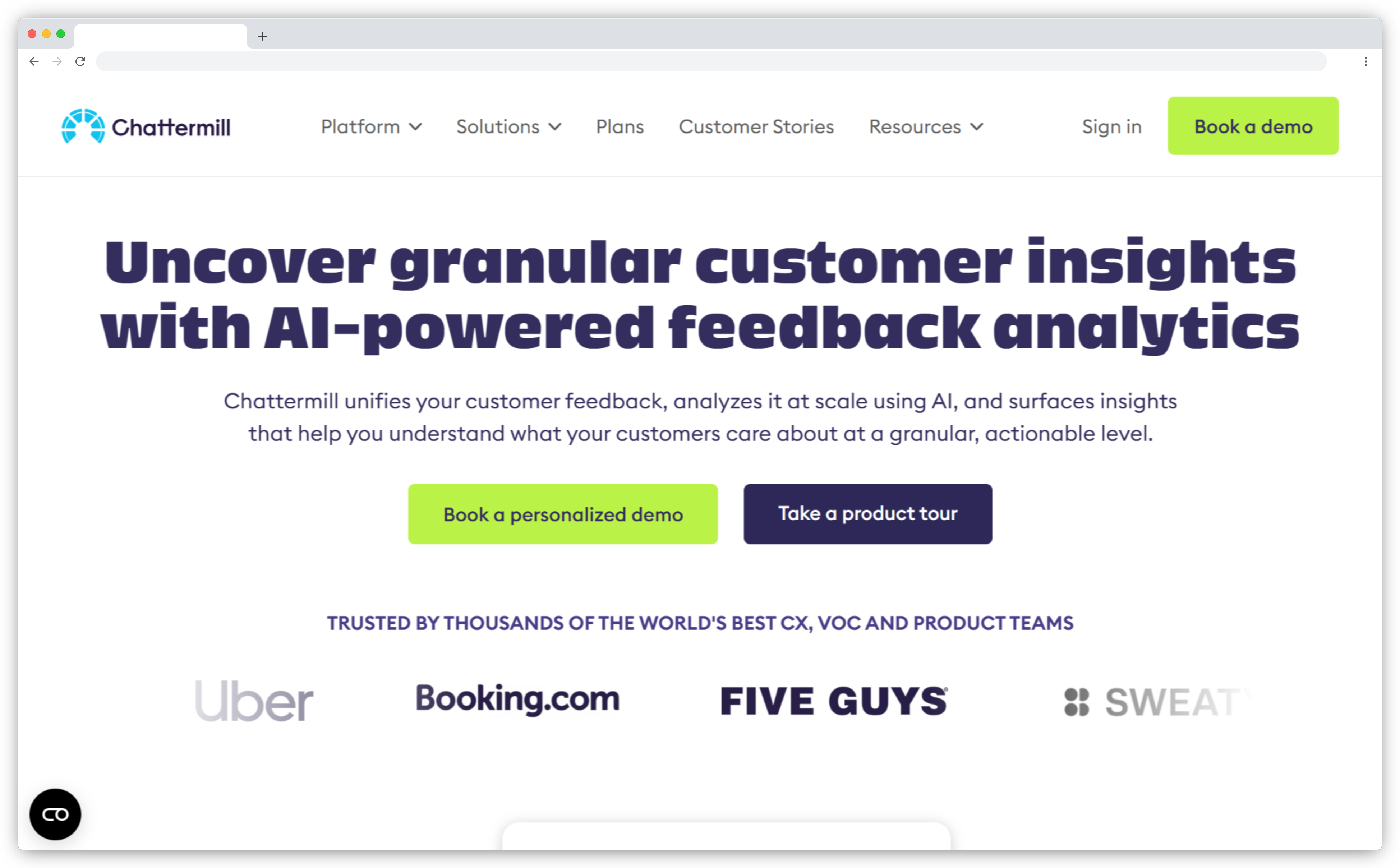
5. Chattermill — Best for Deep Qualitative Feedback Analysis and Driver Discovery
Chattermill is an AI-powered customer feedback analytics platform that unifies open-text feedback from surveys, reviews, support conversations, and other text-based sources. It's built for CX, product, and insight teams that need deep qualitative analysis — understanding why satisfaction scores move, which themes drive churn, and what customers care about most — rather than operational feedback management or closed-loop workflows.
Where Chattermill excels versus XM Discover is in approachability and time to insight. It doesn't require the taxonomy configuration overhead that XM Discover's Designer demands. Themes are detected automatically, teams can begin exploring their data quickly, and the integration setup with common survey tools and support platforms is relatively straightforward. The trade-off is that Chattermill is insight-focused rather than execution-focused — it surfaces what customers are saying, but doesn't natively route that insight into operational team workflows.
Key Features
- Unified feedback analytics across sources — Surveys, online reviews, app store feedback, and support interactions centralized for cross-source pattern analysis.
- AI theme detection and sentiment analysis — Automatic identification of themes, topics, and sentiment without manual tagging or rules.
- Driver analysis for CX and product teams — Surfaces which themes impact NPS or CSAT most strongly, enabling prioritization decisions based on measurable impact.
- Dashboards for cross-team visibility — Trend tracking, theme comparison, and stakeholder-facing reporting across CX, product, and support.
- Integrations with survey and support tools — Connects to common platforms to consolidate data without custom pipeline work.
Pros
- Deep AI-driven text analytics with strong theme detection
- Faster time to insight than XM Discover — less configuration overhead
- Used by high-profile brands including Uber, Booking.com, HelloFresh, and H&M
- Strong for qualitative insight discovery and driver analysis
Cons
- Limited closed-loop execution — insights don't natively connect to action workflows
- Custom bespoke themes require higher-tier plans
Pricing
- Pro, Team, and Enterprise tiers. Custom pricing based on data sources and volume.
"Chattermill saves us so much time and money — it enables us to dig into what our customers are saying and quickly find out what the biggest issues impacting our NPS and satisfaction scores are."
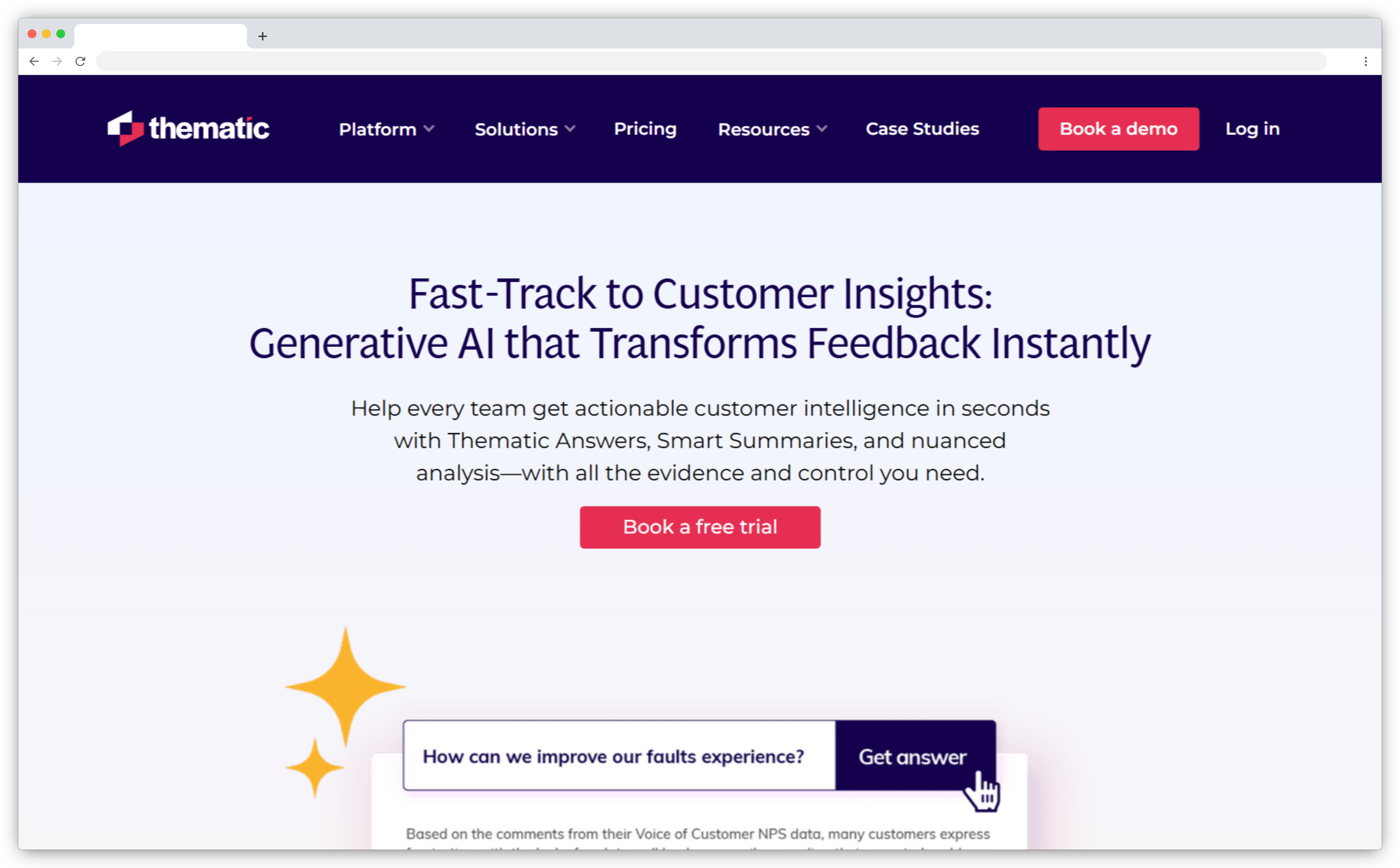
6. Thematic — Best for Explainable AI Text Analytics and Research-Led Insight
Thematic is a customer feedback analytics platform built specifically for teams that prioritize analytical rigor and explainability. It uses machine learning to detect themes from large volumes of open-text feedback — survey responses, online reviews, support conversations — without requiring manual taxonomy setup. Unlike XM Discover's Boolean-based Designer, Thematic's models are transparent: teams can see why themes were detected and validate them before acting on them. That explainability is what makes Thematic valuable for research-led CX and insight teams where analytical credibility matters.
Where Thematic differs from XM Discover is in scope and operational depth. It doesn't ingest contact center calls or voice transcripts. It doesn't include workflow automation, CRM writeback, or real-time alerting. It's an analytics platform, not a feedback management platform — which makes it the right choice for teams where insight quality is the primary criterion and operational workflows sit outside the tool.
Key Features
- AI theme detection with human-in-the-loop validation — Models surface themes automatically; teams can review, validate, and refine before acting on findings.
- Advanced text analytics for unstructured feedback — Open-text survey responses, online reviews, and support conversations analyzed at scale.
- Sentiment analysis and trend tracking — Customer sentiment tracked across time periods with emerging issue detection.
- Impact scoring linked to experience metrics — Themes connected to NPS or CSAT to quantify which issues have the strongest effect on scores.
- Designed for research and insight teams — Depth, rigor, and explainability over operational speed.
Pros
- Explainable AI — teams understand why themes are detected, not just what they are
- Strong for research-led qualitative analysis at scale
- Human-in-the-loop model validation builds analytical confidence
- Rated 4.8/5 on G2 — highest satisfaction score among tools in this comparison
Cons
- Does not include feedback collection, survey distribution, or closed-loop workflows
- Better for insight teams than operational CX programs needing real-time action
Pricing
- Foundation plan from $25,000/year. Enterprise pricing available on request.
7. Forsta (Confirmit) — Best for Market Research and Survey-Heavy CX Programs
Forsta, formerly known as Confirmit, is an enterprise experience and market research platform built for organizations running large-scale survey and research programs. Its text analytics capabilities are strongest when applied within structured survey data rather than across multi-source conversational feeds. For organizations that evaluate XM Discover primarily as an analytics layer on top of structured survey programs — rather than for contact center or social data — Forsta is a viable research-grade alternative.
Key Features
- Advanced survey design and research data collection — Complex survey logic, sampling, and questionnaire control for large research programs.
- Text analytics within survey research datasets — Open-ended response analysis with theme detection and sentiment in combination with quantitative data.
- Research-focused analytics and reporting — Deep segmentation, weighting, and statistical comparison across large datasets.
- Multi-study support across CX, market research, and employee engagement — Unified platform for organizations running multiple research disciplines.
- Enterprise governance and compliance — Role-based access and data compliance controls for global research programs.
Pros
- Research-grade survey capabilities with strong data quality controls
- Well-suited for organizations running complex multi-market studies
- Handles both CX and market research from a single platform
Cons
- Primarily research-driven — limited real-time feedback or operational workflow capabilities
- Text analytics depth is strongest on structured survey data, not conversational feeds
Pricing
- Custom pricing based on research scope and business requirements.
8. Blix — Best for Text Analysis of Survey Open-Ends in Research
Blix is an AI-powered text analysis platform designed to help research and insights teams analyze open-ended survey responses quickly and accurately. It is built for teams that want high-quality coding and theme detection without the manual work, complexity, or long setup
often associated with traditional text analytics tools. It is especially relevant for market research agencies, consumer insights teams, and CX teams that already collect open-ended feedback and need a faster, more intuitive way to turn qualitative responses into structured, quantified insights.
.png?width=1366&height=598&name=Screenshot%20(34).png)
Key Features
- AI-powered open-ended response coding - Blix automatically codes open-ended survey responses using AI, helping teams turn large volumes of qualitative feedback into structured data. This reduces the need for manual coding while still supporting high-quality, consistent analysis.
- High-quality text analysis with human-like understanding - The platform is designed to understand meaning, context, nuance, and intent in open-ended responses. This makes it useful for analyzing customer feedback where simple keyword matching is not enough.
- Intuitive and easy-to-use workflow - Blix is built to be simple and researcher-friendly. Teams can upload data, generate a codebook, review results, and export outputs without needing a technical setup or heavy onboarding.
- Brand awareness coding - Blix supports unaided brand awareness coding, helping teams identify and standardize brand mentions in open-ended responses. It can detect misspellings, abbreviations, naming variations, and mentions across languages, then organize them into a clean brand taxonomy for analysis.
- Text analysis API for automated workflows - Blix offers a text analysis API for teams that want to embed open-ended response coding directly into existing workflows, dashboards, trackers, or research platforms. This makes it possible to automate text analysis at scale without relying only on the web app
Pros
- High-quality AI coding for open-ended survey responses
- Very intuitive and easy to use
- Designed specifically for research and insights workflows
- Helps reduce manual coding time and effort
- Supports fast analysis without requiring complex setup
Cons
- Less focused on full customer experience management or case management workflows
- Best suited for teams that already collect feedback and need to analyze it, rather than teams looking for an all-in-one survey distribution platform
Pricing
- Blix offers flexible pricing based on usage and business needs. Pay-as-you-go and annual plans are available.
What to Look for in a Qualtrics XM Discover Alternative
The right alternative depends on which aspect of XM Discover your team actually needs to replace. Most organizations don't need all of what XM Discover offers — they need a specific subset, and the right platform matches that scope without adding the overhead of the rest.
- Text analytics depth and analytical layer: Does the platform analyze at the phrase level or the comment level? Does it detect emotion, effort, and intent — or only positive/negative sentiment? Is taxonomy configuration required, or does the AI detect themes automatically?
- Multi-source ingestion: Which data sources does the platform ingest natively — surveys, contact center calls, chats, emails, social, reviews? The answer determines whether the platform replaces XM Discover's cross-channel capability or only covers part of it.
- Time to first insight: How long from contract signature to seeing meaningful analysis? XM Discover commonly takes months to configure. Faster alternatives exist, but the trade-off is often analytical depth or taxonomy flexibility.
- Closed-loop workflows: Does the platform connect insight to execution — routing alerts, triggering follow-ups, writing back to CRM — or does it stop at the analytics dashboard? This is the gap most XM Discover users experience.
- Implementation and ongoing management: Does the platform require specialist involvement to maintain, or is it self-service? For lean teams, this is often the deciding criterion.
- Total cost of ownership: License fee plus implementation plus ongoing management. Many teams find that a platform with a lower license fee but significant implementation and maintenance overhead costs more than a self-service alternative over a 3-year horizon.
Which Qualtrics XM Discover Alternative Is Right for Your Team?
There is no single best alternative — the right choice depends on what your program actually needs. The decision framework below maps use cases to the platforms that serve them best.
| If your primary need is… | Best-fit alternative | Why |
| Gen AI text analytics at mid-market pricing, with closed-loop action built in | Zonka Feedback | AI included in base pricing, self-service setup, closed-loop workflows, CRM sync |
| Enterprise conversational analytics with full governance, scale, and AI maturity | Medallia | Enterprise-grade analytics, predictive AI, governance controls, global program support |
| Social, digital, and public conversation intelligence at enterprise scale | Sprinklr | Native social and messaging channel analytics, built for digital-first CX teams |
| Deep qualitative insight and driver analysis across surveys and reviews | Chattermill or Thematic | Strong AI theme detection, insight-first focus, no taxonomy configuration required |
| Structured survey-led CX measurement with text analytics on top | InMoment or Forsta | Survey-first architecture, formal CX program structure, research-grade analytics |
Why Zonka Feedback Stands Out as the Best Qualtrics XM Discover Alternative for Mid-Market Teams
The pattern that emerges from teams evaluating XM Discover alternatives is consistent: they need the AI analytical depth, but not the price tag, not the implementation timeline, and not the separate budget line for the analytics module. Zonka Feedback is built for exactly that profile.
Its Gen AI Feedback Intelligence — phrase-level sentiment, thematic analysis, entity detection, impact scoring, Ask AI queries — is included in base pricing, not separated into a $300,000+ add-on. Setup is self-service: teams are typically operational within days, without implementation partners or IT coordination. And the closed-loop layer — alerts, CRM writeback, follow-up routing, role-based reporting — is built into the same platform rather than requiring a separate execution stack.
For organizations in the Qualtrics ecosystem that are evaluating whether Discover XM is the right next step, or for teams that have outgrown basic text analytics and need more than keyword matching, Zonka Feedback offers a practical path that doesn't require enterprise procurement approval to access enterprise-grade AI.
Frequently Asked Questions About Qualtrics XM Discover Alternatives
What is Qualtrics XM Discover?
Qualtrics XM Discover (formerly Clarabridge) is an enterprise conversational intelligence platform that analyzes unstructured feedback from calls, chats, emails, social media, reviews, and surveys using natural language understanding. It detects sentiment, emotion, effort, and intent at the phrase level and includes Designer (taxonomy modeling), Connectors (data ingestion), and Studio (custom dashboards). It is a separate product from Qualtrics Text iQ and is priced as an add-on module.
Is Qualtrics XM Discover included in a standard Qualtrics contract?
No. XM Discover is not included in a standard Qualtrics contract. It is priced separately as an add-on module at approximately $300,000–$400,000/year, on top of the base platform cost. Most Qualtrics customers use Text iQ — the text analytics feature built into standard plans — rather than XM Discover, because the price barrier makes Discover XM inaccessible at most organizational budget levels.
What is the difference between Qualtrics Text iQ and Qualtrics XM Discover?
Text iQ is the text analytics feature included in standard Qualtrics survey plans. It offers keyword-based theme detection and comment-level sentiment classification on survey open-text responses. XM Discover is a separate, enterprise-grade conversational intelligence platform that ingests data from calls, chats, emails, social, and reviews — not just surveys — and uses NLU-based analysis to detect emotion, effort, intent, and themes at the phrase level. They are fundamentally different products at different price points.
How much does Qualtrics XM Discover cost?
XM Discover is priced at approximately $300,000–$400,000/year as a separate add-on module. This is on top of the base Qualtrics platform contract, which runs $25,000–$180,000/year for mid-market deployments and higher for enterprise. The combined cost of a full Qualtrics deployment with XM Discover commonly exceeds $400,000–$500,000/year for large enterprises.
Can I replace XM Discover without leaving Qualtrics entirely?
Yes. If you use Qualtrics for survey creation and distribution but need a better text analytics layer, you can integrate a third-party analytics platform alongside your existing Qualtrics setup. Platforms like Chattermill, Thematic, and Zonka Feedback can ingest data from Qualtrics surveys via API or export, providing deeper text analytics without requiring a full platform migration. For teams that want to move entirely away from Qualtrics' survey layer as well, that's also a viable path — but it's not a prerequisite for accessing better analytics.
What are the main limitations of Qualtrics XM Discover?
Three limitations come up consistently: price ($300,000–$400,000/year as an add-on makes it inaccessible for most teams), setup complexity (Designer's taxonomy configuration requires specialist involvement and ongoing maintenance), and the insight-to-action gap (XM Discover surfaces analysis but doesn't natively connect it to operational team workflows, CRM writeback, or automated follow-ups). For organizations that need all three of those problems addressed, a more integrated platform is typically a better fit.
Which Qualtrics XM Discover alternative is best for mid-market CX teams?
Zonka Feedback is the strongest alternative for mid-market CX teams that need Gen AI text analytics, CRM integration, and closed-loop automation without enterprise pricing or implementation overhead. Gen AI analysis is included in base pricing, setup is self-service, and the closed-loop workflows — alerts, routing, CRM sync — are built into the same platform. For teams where the primary need is deeper qualitative insight without operational workflows, Chattermill and Thematic are strong options. For enterprise-scale programs needing Medallia-level governance, Medallia remains the most viable XM Discover alternative at that tier.
How long does it take to implement a Qualtrics XM Discover alternative?
It depends on the platform. XM Discover itself typically requires 3–6 months from contract to operational deployment. Medallia has a comparable timeline. Chattermill and Thematic typically run days to a few weeks for integration setup. Zonka Feedback is self-service — most teams are operational within a few days, with no implementation partner required. The implementation timeline is one of the most practically consequential factors when choosing an alternative, particularly for teams that have an active feedback program and need to maintain continuity without a gap.
Conclusion
Qualtrics XM Discover is a genuinely powerful conversational intelligence platform. The question for most teams evaluating it is not whether it's capable — it is — but whether the price, implementation complexity, and organizational commitment required to realize that capability are the right trade-offs for their program's actual needs.
For teams where the answer is no, the alternatives in this guide serve different parts of that gap. Enterprise-scale governance and multi-source analytics: Medallia. Social and digital conversation intelligence: Sprinklr. Deep qualitative insight without taxonomy overhead: Chattermill or Thematic. Structured research-grade survey analytics: InMoment or Forsta. Gen AI feedback intelligence at mid-market pricing, with closed-loop execution built in: Zonka Feedback.
The best Qualtrics XM Discover alternative is the one that matches what your program actually needs to do — not the one that matches XM Discover's full scope. Start with the use case, not the feature list. Want to see how Zonka Feedback handles the specific parts of your program that XM Discover would address? Schedule a demo and we'll walk through your specific requirements.

.png)

.svg)