


.svg)
 Healthcare
 Finance
 Retail
 SaaS & Digital
 eCommerce
 Education
 Salesforce
  HubSpot
 Pipedrive
 Mailchimp
 Klaviyo
 Zendesk
  Intercom
 Freshdesk
 HelpScout
  Front
Front Jira
Jira Slack
Slack  MS Teams
 Zoom
Zoom Google Sheets
  Zapier
  Integrately
 Make
Make  Webhooks




 MS Teams
_%20Benefits%2c%20Use%20Cases%2c%20Examples%20%26%20More.svg)


TL;DR
- Voice of Customer (VoC) is the process of collecting, unifying, and analyzing customer feedback to guide business decisions.
- VoC data comes from three signal types: solicited feedback like surveys and interviews, unsolicited feedback like reviews and support tickets, and behavioral data like product usage.
- The programs that work run as a loop, Collect, Unify, Understand, Fix, and most of them break in the same place: between Understand and Fix.
- The number that proves a program is working is loop closure rate, the share of flagged issues that get resolved rather than only recorded.
- The core VoC metrics are NPS, CSAT, and CES, tracked over time and tied to customer retention and customer lifetime value.
- AI now does the heavy lifting, using text analytics, sentiment analysis, and natural language processing to turn thousands of open-text responses into ranked themes.
Here is a scene that plays out in more organizations than anyone admits.
The quarterly NPS report arrives Monday morning. Scores are down three points from last quarter. Someone flags it in a meeting. The meeting produces a slide deck summarizing the themes, pricing friction, slow support response times, a confusing feature in the product. The deck gets shared with leadership. The feedback gets acknowledged. And then the next survey cycle begins, and the same themes appear again.
The scores were accurate. The customer feedback was real. Customers had been telling the business exactly what was broken, in specific enough terms to act on.
The problem was not the survey. It was never the survey.
The problem was that no one had built a system around what came after it. Feedback without a structure to act on it is just noise with better documentation.
That is the gap a Voice of Customer program is designed to close. Not collecting more customer data. Doing something with it.
We've run Voice of Customer programs with teams across healthcare, banking, retail, and SaaS, from Akumin's 700-plus imaging centers to Bank of Maldives, Adani One's airport network, and eyewear retailer Eyewa. The programs that move metrics share one pattern. The ones that stall share one gap.
This guide walks through both: what VoC is, where its data comes from, the operating loop that turns feedback into action, the metrics that prove it works, and how to run it in your industry.
What Is Voice of Customer (VoC)?
Voice of Customer (VoC) is the process of collecting, unifying, and analyzing customer feedback to guide business decisions. It spans solicited feedback like surveys, unsolicited feedback like reviews, and behavioral signals like product usage. A VoC program turns all of it into decisions teams can act on.
The term covers everything from structured customer surveys and customer interviews to unsolicited online reviews, support transcripts, and behavioral patterns. VoC data is not only what customers say when you ask them. It's everything customers express about your product, service, and brand, whether or not you prompted it.
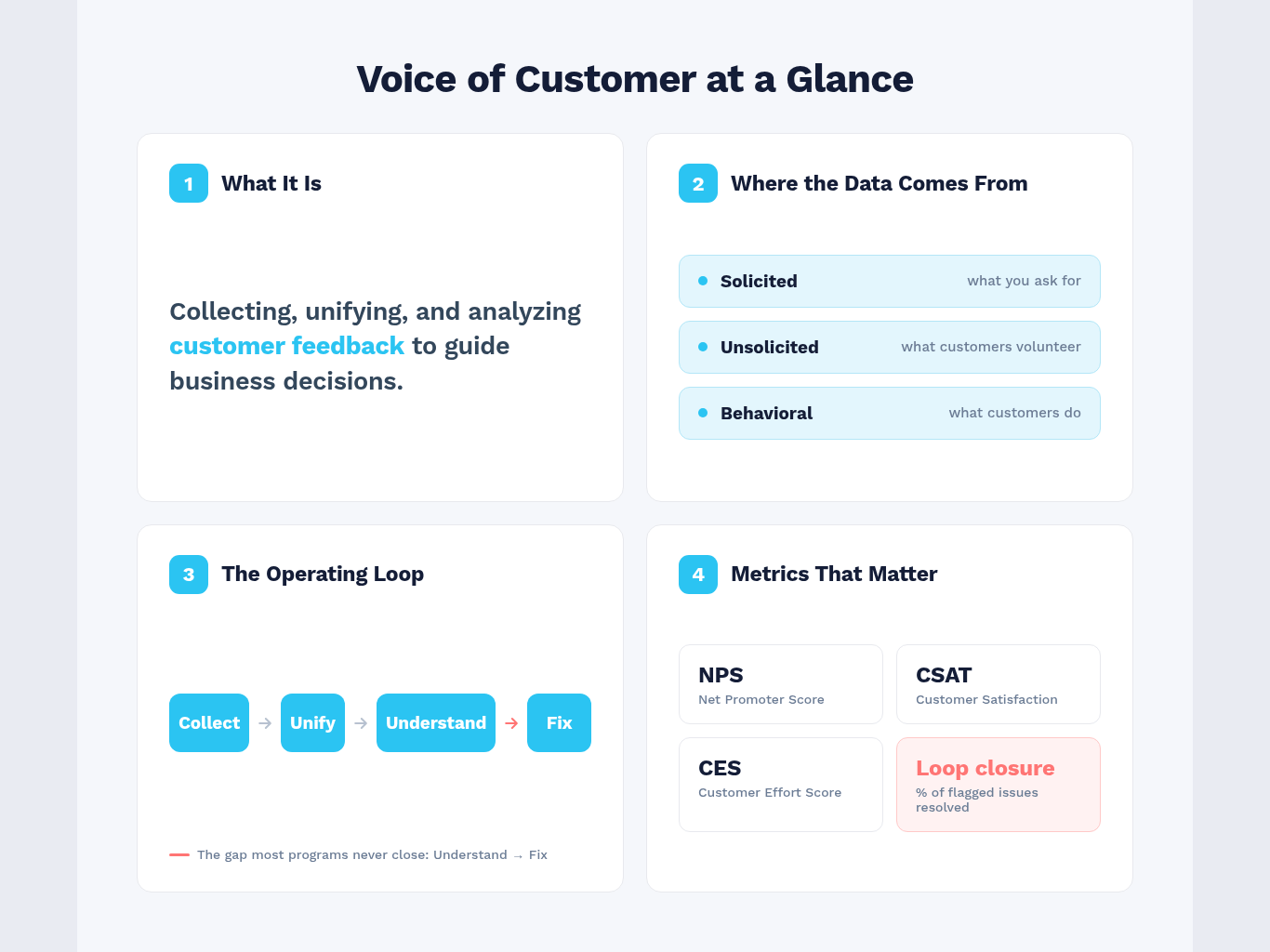
Customer feedback and Voice of Customer are not the same thing, and the difference is the whole point.
| Customer Feedback | Voice of Customer | |
| What it is | A single input from one customer | The program that collects and analyzes every input together |
| Scope | One survey, ticket, or review | Surveys, reviews, support, calls, and behavior, unified |
| Structure | Ad hoc, scattered across tools | A repeatable system with defined stages |
| Output | A data point | A decision a team can act on |
| Example | A 4-star Google review | A monthly theme explaining why ratings are slipping, routed to an owner |
Most organizations have customer feedback. Fewer have a VoC program. The difference is structure, and what that structure makes possible downstream.
Voice of the customer means the same thing as voice of customer. Both describe the full picture of what customers expect, prefer, and struggle with, organized into a system for continuous improvement.
Voice of Customer vs Customer Experience vs Market Research
These three terms get used interchangeably, and they shouldn't be. They answer different questions, on different timelines, about different people.
| Voice of Customer | Customer Experience | Market Research | |
| Question it answers | What are our customers telling us across every channel? | How does it feel to be our customer, end to end? | What does the broader market want, and how big is it? |
| Who it studies | Your existing customers | Everyone who interacts with you | Customers and non-customers alike |
| Timing | Continuous | Continuous, across the journey | Point-in-time studies |
| Primary use | Fix specific issues and guide decisions | Design and improve the customer journey | Validate strategy and size opportunities |
Voice of Customer is the listening engine inside a wider customer experience practice, and it draws on some of the same techniques as market research without being limited to a study window. For a fuller side-by-side on the first, see voice of customer vs customer experience. We break down the second in voice of customer vs market research.
The VoC Operating Loop: Collect, Unify, Understand, Fix
Most companies treat VoC as a periodic activity. Run a survey. Read the results. File the report. Repeat next quarter. It's a reasonable-sounding approach that produces very little change, because it treats a continuous process as a scheduled task.
.png?width=700&height=597&name=The%20VoC%20Operating%20Loop%20(1).png)
The programs that actually shift metrics run it as a loop we call the VoC Operating Loop. It's the framework we use to run VoC programs across every industry we work in, and it has four stages, where each one feeds the next, and where the loop closes only when the customer's problem is resolved, not when the report is filed.
| Stage | What Happens | Where it Breaks |
| Collect | Feedback is pulled from every channel at once: surveys, reviews, support tickets, call and chat transcripts, and behavioral data. | Relying on a single channel, which leaves blind spots in the picture. |
| Unify | Every source is merged into one view, so a survey score sits next to a support ticket and a review about the same issue. | Data stays trapped in separate tools and never gets connected. |
| Understand | Themes, sentiment, entities, and business impact are identified across the combined data, usually with text analytics and NLP. | Analysis stops at a dashboard, with no ranking of what to fix first. |
| Fix | The right owner acts on the signal, and the loop closes when the issue is resolved. | The gap where most programs stall: the themes are documented, and then nothing happens. |
Collect
One channel rarely gives the full picture. Effective VoC programs pull customer feedback from surveys, reviews, support tickets, call recordings, and behavioral data at the same time, across every customer touchpoint in the journey. The wider the net, the fewer the blind spots.
Unify
This is the stage most programs skip, and skipping it is why their feedback stays fragmented. Unifying means bringing every source into one place, so the survey score, the support ticket, and the public review about the same problem are read together instead of sitting in separate tools owned by separate teams.
Understand
With the data in one place, analysis can find what matters: recurring themes, customer sentiment by theme and touchpoint, the specific locations or products a complaint attaches to, and the business impact behind each pattern. Text analytics and natural language processing do at scale what no team can do by hand across thousands of open-text responses.
Fix
A signal that no one acts on is not a program. The loop closes only when the issue reaches the person who can resolve it and the resolution actually happens. This is also where the one number most programs never track lives: the customer loyalty index moves when you get this right, but the operational number to watch is loop closure rate, the share of flagged issues that were resolved rather than only recorded.
Most VoC programs break in the same place, between Understand and Fix. The data exists. The themes are documented. And then the next survey cycle begins, and the same themes appear again. Everything earlier in this guide is what feeds the loop. Everything after it is what keeps the loop closing.
Where Voice of Customer Data Comes From
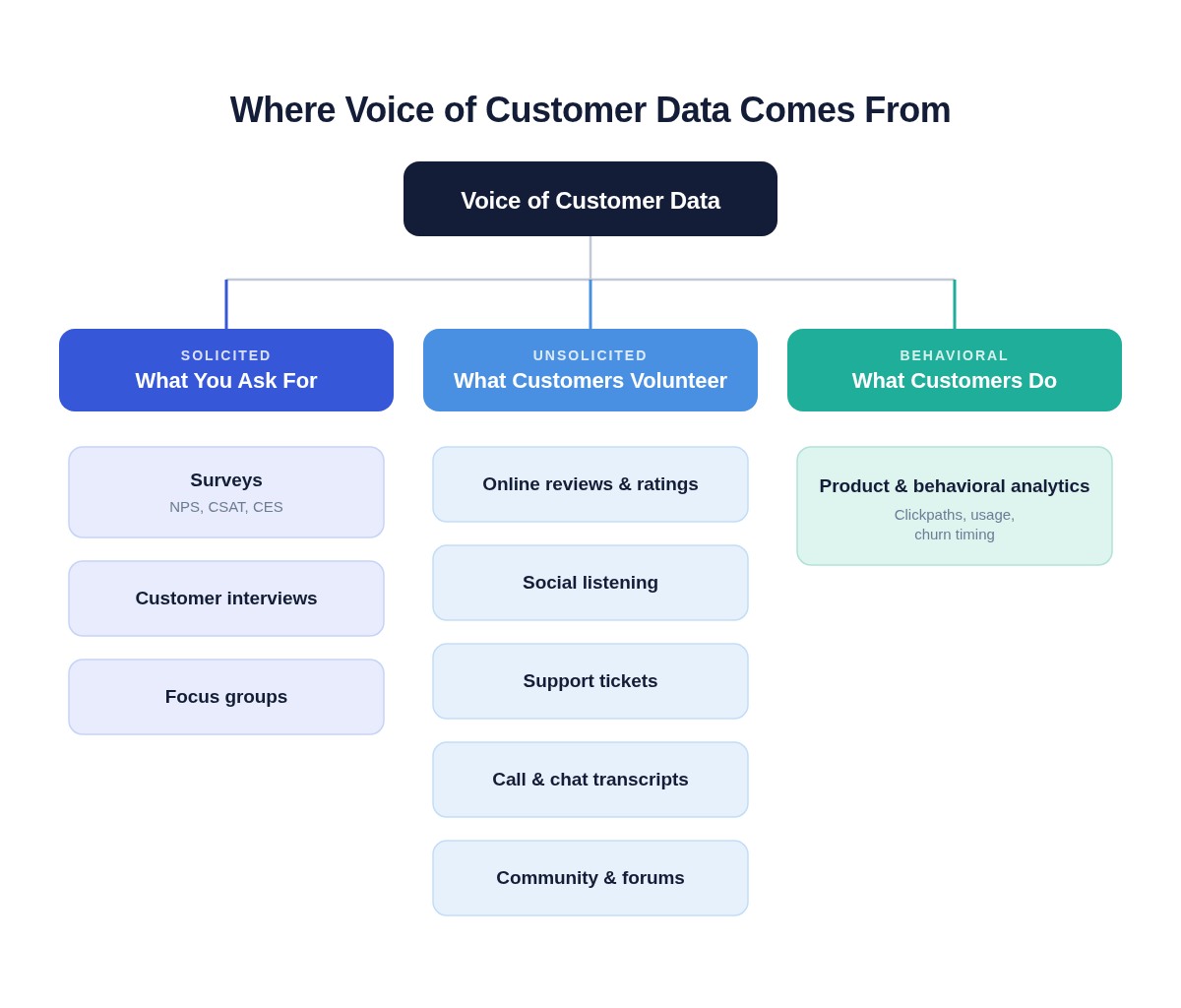
VoC data does not come from one place. A complete program draws from three distinct types of customer signal, and each captures something the others miss. Solicited feedback is what you ask for. Unsolicited feedback is what customers volunteer. Behavioral data is what customers do.
VoC Data Sources at a Glance
| Source | Signal Type | What it Captures | Best For |
| Surveys (NPS, CSAT, CES) | Solicited | Structured scores plus open-text on a defined question | Tracking loyalty, satisfaction, and effort over time |
| Customer interviews | Solicited | Deep, qualitative reasoning behind a behavior | Understanding the "why" a survey can't reach |
| Focus groups | Solicited | Group reactions to a concept, product, or message | Testing ideas before launch |
| Online reviews and ratings | Unsolicited | Unprompted public opinion on your product and brand | Spotting issues customers won't put in a survey |
| Social listening | Unsolicited | Mentions, sentiment, and trends across social channels | Catching emerging problems in real time |
| Support tickets | Unsolicited | Problems customers reported through service | Finding friction that already cost the customer effort |
| Call and chat transcripts | Unsolicited | The full conversation behind an interaction | Root-cause detail behind a score or complaint |
| Community and forums | Unsolicited | Peer-to-peer discussion and feature requests | Reading demand and advocacy in customers' own words |
| Product and behavioral analytics | Behavioral | What customers do: clickpaths, usage, churn timing | Seeing friction before a customer ever says a word |
Solicited feedback: what you ask for
Solicited feedback is what you request directly. You control the timing, the questions, and the sample, which gives you precision and limits you to what you already knew to ask.
Surveys (NPS, CSAT, CES). Structured customer surveys are the backbone of most programs. Net Promoter Score measures loyalty, the customer satisfaction score measures satisfaction with a specific interaction, and the customer effort score measures how much effort a task took. The open-text follow-up is where the real signal sits. Use them to track the same metric over time and to trigger action when a score drops. Example: a post-support CSAT that routes any rating below three to a manager the same day.
Customer interviews. A one-to-one conversation reaches the reasoning a survey scale can't. Use interviews when a metric moved and you don't know why, or before you commit to a roadmap bet. Example: ten churned-customer interviews that surface a single onboarding step everyone got stuck on.
Focus groups. A moderated group reacts to a concept, message, or prototype in real time. Use them early, before launch, while an idea is still cheap to change. Example: reactions to two pricing-page layouts before either one ships.
Unsolicited feedback: what customers volunteer
Unsolicited feedback is what customers say when you're not asking. You didn't prompt it, which is exactly why it's candid. Reviews, social posts, tickets, transcripts, and community threads all sit here, and text analytics and sentiment analysis are what make them usable at volume.
Online reviews and ratings. Public reviews on Google, G2, app stores, and your own site are candid because customers write them for other customers, not for you. Monitor them continuously and read the text, not only the star rating. Example: a run of reviews naming the same checkout error days before support tickets spiked.
Social listening. Mentions and conversations across social channels surface problems and praise you were never sent directly. Use social listening to catch emerging issues while they're still small. Example: a jump in negative feedback after a release, flagged before it reached the contact center.
Support tickets. Every ticket is feedback that already cost the customer effort. Mined together with text analytics, tickets show which problems recur and how much they cost to resolve. Example: a monthly theme showing that one integration drives a fifth of all customer support interactions.
Call and chat transcripts. The full transcript behind a call or chat holds the root-cause detail a score never captures. Analyzed at scale, transcripts explain the "why" behind a CSAT dip. Example: transcripts revealing that customers rate support low because they had to repeat themselves across channels.
Community and forums. Community threads are where customers talk to each other and ask for what they want next. Read them for demand signals and advocacy. Example: a feature-request thread with hundreds of upvotes that reshapes the roadmap.
Behavioral data: what customers do
Behavioral data is what customers do, not what they say. Clickpaths, session recordings, feature adoption, and churn timing reveal friction and disengagement before anyone fills out a survey.
Product and behavioral analytics. Behavior is the signal customers never articulate. Tie it to survey and support data by touchpoint so a drop-off carries context. Example: a checkout step where session recordings show repeated failed attempts that no survey ever captured.
A program that relies only on surveys misses the second and third categories entirely. A program that only watches reviews misses the structured, targeted signal surveys provide. The strongest programs read all three together.
VoC Methods and Techniques
Sources tell you where feedback comes from. Methods are how you gather it deliberately and turn it into something you can act on. A working program leans on a handful of them, and it helps to know what each one does before you pick a tool to run it.
Customer journey mapping. Before you collect anything, you decide where to listen. Customer journey mapping lays out every stage a customer moves through, from first touch to renewal, and marks the moments that carry the most weight. It stops a program from over-surveying one step while ignoring the ones that actually shape the relationship.
Thematic analysis. Most VoC data is open text, and open text is hard to use until it's grouped. Thematic analysis clusters thousands of comments into a short list of recurring themes, so "the checkout is confusing" and "I couldn't find the pay button" land in the same bucket. It's the technique that turns a pile of responses into a ranked set of problems.
Sentiment analysis. Knowing a theme exists is only half the picture. You also need to know how customers feel about it. Sentiment analysis scores each response, and each theme, as positive, negative, or neutral, so you can tell a minor gripe from a real driver of churn. Read alongside theme frequency, it shows which issues are both common and painful.
Text analytics and NLP. Underneath thematic and sentiment analysis sits natural language processing. Text analytics is what makes both techniques possible at scale, reading every response, ticket, and transcript at once instead of the small sample a human team could hand-code. This is the shift that moved VoC from reading a few hundred responses to reading all of them.
Driver and impact analysis. The last step is deciding what to act on first. Driver analysis links themes back to the metrics they move, so you can see which issue is actually pulling NPS down. Prioritization frameworks then rank those themes by business impact rather than by how loud they are, so the loop spends its effort where it counts.
Each of these deserves its own treatment. For the full set, including how to run thematic analysis and where each method fits, see the guide to voice of customer methodologies. For the structured models behind them, such as Kano and jobs-to-be-done, see the voice of customer framework.
VoC Surveys and Survey Questions
Surveys are the most controllable VoC source, which is why most programs start here. You decide the moment, the audience, and the wording, so a well-built survey gives you a clean, comparable signal over time. The tradeoff is that you only learn about what you thought to ask, which is why surveys work best alongside the unsolicited and behavioral sources covered earlier.
The survey you send depends on what you're trying to learn. A few types carry most programs:
- NPS asks how likely someone is to recommend you, on a 0 to 10 scale. Use it to track loyalty over time, usually quarterly or after a full cycle of use.
- CSAT asks how satisfied someone was with a specific interaction. Fire it right after that interaction, like a resolved support ticket or a completed purchase.
- CES asks how much effort a task took. Send it straight after the task, such as an onboarding step or a self-service action, to find friction while it's fresh.
- Product-market fit and churn surveys ask how disappointed a user would be to lose the product, and why a customer is leaving. Both catch signals a score alone misses.
Good survey questions follow a few rules that decide whether the data is usable. Ask one idea per question; "Was our support fast and helpful?" is two questions wearing one, so split it. Avoid leading wording, because "How great was your experience?" tells the customer what to say. And pair a closed metric question with a single open-ended follow-up, since the number tells you what happened and the open text tells you why. That open-text answer is what feeds thematic analysis later.
Timing and channel matter as much as wording. The same question lands differently in an email a week later than in an in-app prompt at the moment of use, and a survey sent at the wrong moment mostly measures who ignores surveys.
The right questions also change by industry. A post-purchase question is not a churn question, and a healthcare intake survey is not a SaaS onboarding survey. Start from the voice of customer surveys guide to see how the survey types fit together. When you're ready to build, the voice of customer survey template gives you a starting point so you can gather feedback without building from scratch.
Voice of Customer Metrics to Track
Metrics turn feedback into something you can trend and defend to the rest of the business. Three form the core of almost every program, and they answer different questions, so most programs run more than one.
| Metric | What it Measures | Scale | Best Used For |
| Net Promoter Score (NPS) | Loyalty and likelihood to recommend | 0 to 10, grouped into promoters, passives, detractors | Tracking long-term customer loyalty |
| Customer Satisfaction Score (CSAT) | Satisfaction with a specific interaction | 1 to 5, or percentage satisfied | Judging the quality of a single touchpoint |
| Customer Effort Score (CES) | How much effort a task took | 1 to 5 or 1 to 7 | Removing friction from key journeys |
Each measures a different thing, so read them together rather than in isolation. NPS tells you about the relationship, CSAT about a single moment, and CES about the ease of a task. A high CSAT on one support ticket can sit next to a falling NPS if the overall product is frustrating, and that gap is itself a signal worth chasing. Treat the score as the headline and the open-text comment behind it as the story, because the comment is what tells you what to fix.
Be careful with benchmarks. A "good" NPS varies widely by industry, so the number that matters most is your own trend over time, not a comparison to a figure from a different market. Watch the direction and the drivers, not a single snapshot.
Beyond the core three, mature programs watch a customer loyalty index that blends several signals into one view, theme frequency to see which issues are growing, and loop closure rate to prove the program acts on what it hears. The point of any of them is the same: connect movement in the metric to customer retention and customer lifetime value, so the program reports business outcomes and key performance indicators the whole company cares about, not only scores.
For the full metric set and how to build reporting around it, see voice of customer metrics. For live tracking, use the voice of customer dashboard guide.
Why Voice of Customer Matters
A VoC program earns its place by changing decisions, yet most teams are not set up to let it. Zonka's State of AI Feedback Analytics 2025, based on conversations with more than 100 CX, product, and marketing leaders, put numbers on the problem.
- Feedback is scattered. 93% of leaders said their feedback is spread across tools and teams with no central intelligence, the exact fragmentation the Unify stage exists to solve.
- Few trust their analysis. Only 17% felt confident in their maturity with AI-driven feedback analytics, so the distance between collecting feedback and understanding it is still wide.
That gap is the opportunity, because a working program pays back in four concrete ways.
It makes better decisions, so instead of the loudest voice in the room setting the roadmap, teams prioritize what customers actually struggle with, ranked by impact. It protects retention, because catching a frustrated customer while they are still a customer and resolving the issue is far cheaper than winning them back after they leave. It improves the product and the experience, since recurring themes point directly at what to fix and effort goes where it moves the numbers. And it lowers cost to serve, because fixing the root cause of a complaint removes the tickets, calls, and churn that came from it.
The cost of getting it wrong is just as measurable. In PwC's customer experience research, 32% of consumers said they would stop doing business with a brand they love after a single bad experience.
The through-line is simple. When feedback is unified and acted on, satisfied customers stay longer, cost less to serve, and recommend you to others, which is how a strong program connects to customer retention and customer lifetime value over time. Done well, a VoC program stops being a reporting exercise and becomes both a competitive advantage and the backbone of a customer-centric culture, precisely because so few teams run one well.
For the full benefit breakdown, see the benefits of a voice of customer program. To model the return, see voice of customer ROI.
How to Build a Voice of Customer Program
A VoC program comes together in a repeatable sequence. Each phase below is a summary; the step-by-step lives on the dedicated guides.
1. Set goals and choose metrics
Decide what the program is for before you send a single survey. Tie each goal to a metric and a decision it will inform, so you're measuring customer satisfaction against something specific rather than in the abstract. A goal like "reduce onboarding drop-off" points to CES on the onboarding flow; "improve loyalty" points to NPS. Without that link, you collect numbers no one uses.
2. Map touchpoints and pick sources
Map the customer journey, mark the touchpoints that matter most, and choose the sources that cover them. A program that only listens at one moment learns about one moment. If renewals are where you lose people, that stage needs a listening post of its own, not only the post-purchase survey everyone remembers to send.
3. Collect and unify
Turn on collection across multiple channels, then, critically, unify it into one view. This is the step that separates a real program from a folder of disconnected reports. When a survey score, a support ticket, and a review about the same problem sit together, the pattern is obvious; when they live in three tools, no one ever sees it.
4. Analyze and prioritize
Cluster the feedback into themes, score sentiment, and rank by business impact. The output is a short list of what to fix first, not a dashboard nobody reads. Prioritizing by impact rather than by volume keeps a few loud complaints from outweighing a quieter issue that costs far more.
5. Close the loop
Route each priority to a named owner, resolve it, and tell the customer what changed. The loop closes here or it doesn't close at all. Closing it with the customer, a quick "you asked, we fixed it," is also what turns a detractor into someone willing to give feedback again.
6. Measure and iterate
Report loop closure rate and the movement in your core metrics, then feed what you learn back into the next cycle for continuous improvement. A program is not a launch, it's a habit, and each cycle should sharpen the next.
For the full build, see how to build a voice of customer program. For the governance and best practices around it, see the VoC strategy and best practices guide.
How to Analyze Voice of Customer Data and Act on It
Analysis is where feedback becomes a decision, and action is where the decision becomes a result. A reliable way to run the second half of the loop is a four-step closed loop: detect the signal, route it to an owner, recover the customer, and measure whether the fix held.
Use this scorecard to see whether your loop is actually closing. Count how many are true of your program:
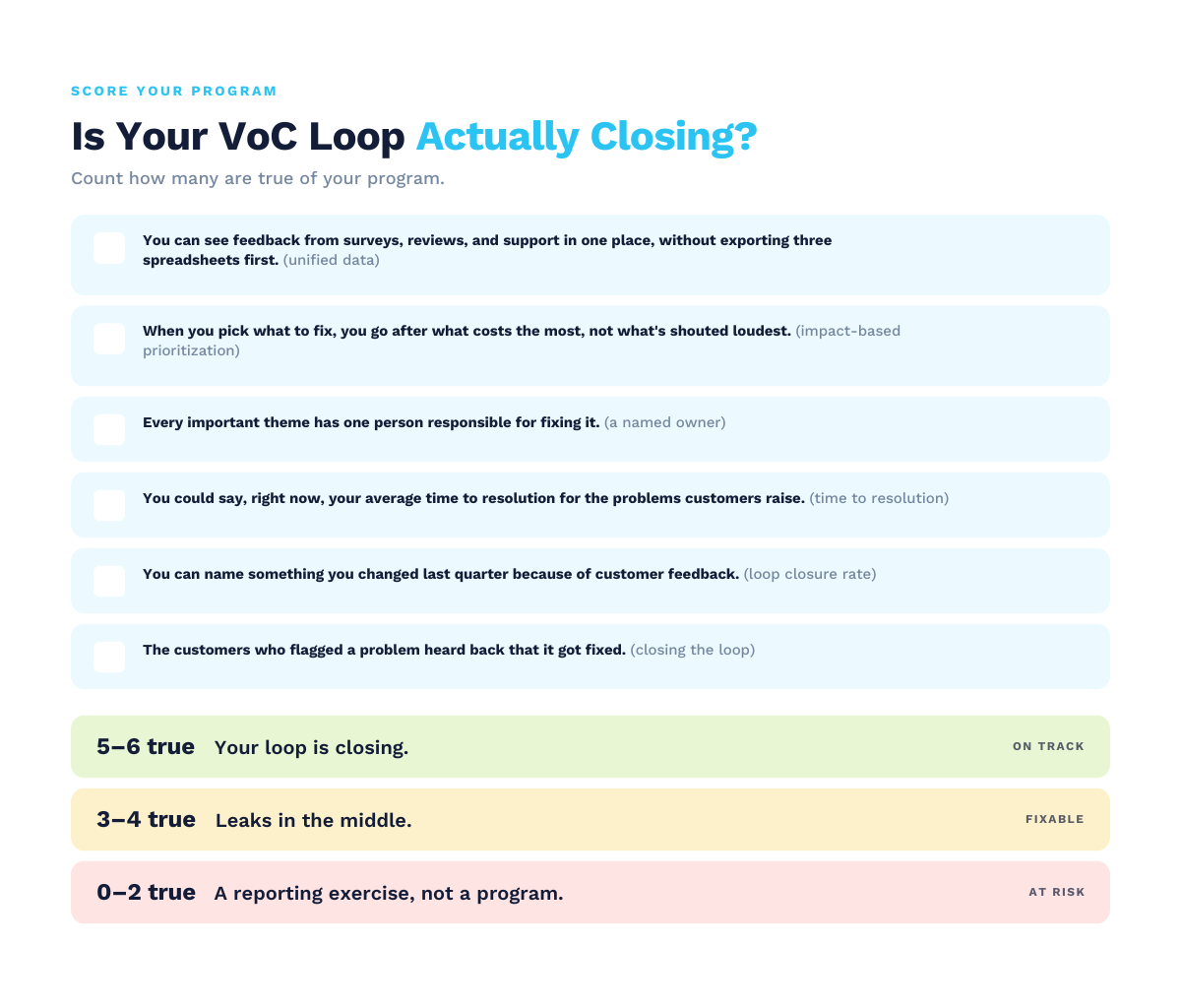
- You can see feedback from surveys, reviews, and support in one place, without exporting three spreadsheets first. That's unified data.
- When you pick what to fix, you go after what costs the most, not what's shouted loudest. That's impact-based prioritization.
- Every important theme has one person responsible for fixing it. A named owner.
- You could say, right now, your average time to resolution for the problems customers raise.
- You can name something you changed last quarter because of customer feedback. That's your loop closure rate.
- The customers who flagged a problem heard back that it got fixed. That's closing the loop.
Five or six true and your loop is closing. Three or four and it's leaking in the middle. Two or fewer and it's a reporting exercise, not a program.
The analytical depth behind this, from theme discovery to predictive analytics, sits in the voice of customer analytics guide. The mechanics of the action half are covered in closing the customer feedback loop.
How AI Changes Voice of Customer
AI has moved VoC from sampling to reading everything. Where teams once hand-coded a few hundred responses and hoped the sample was representative, natural language processing now analyzes every open-text answer, ticket, and transcript at once. That change is what makes a modern program possible at volume.
Four capabilities do most of the work:
- Thematic analysis clusters open text into recurring themes automatically, so thousands of comments become a ranked list of issues in minutes instead of weeks.
- Sentiment analysis scores the emotion behind each response and each theme, separating a mild annoyance from a real driver of churn.
- Entity mapping attaches every comment to the specific product, location, service, or agent it's about, so a complaint about "the Mumbai branch" or "the export feature" routes to the right owner.
- Impact scoring ranks themes by what they cost the business rather than by how often they come up, so effort goes to the issue that matters most.
Two capabilities push further. Ask-AI style tools let anyone query the feedback in plain language, so a manager can ask "what are the top complaints from enterprise accounts this month?" and get an answer without building a report. And predictive analytics uses today's customer feedback to flag churn risk and emerging issues before they show up in the numbers. A rising cluster of billing complaints among top accounts, for instance, can surface as a churn-risk alert weeks before anyone cancels.
That shift, from reacting to anticipating, is the difference AI makes. It's also where a general-purpose chatbot and a purpose-built platform diverge, because reading feedback accurately at scale depends on models tuned for exactly that.
For how this works in practice, see AI customer feedback analytics. To stand one up, see the guide to building your VoC AI program.
VoC Data Privacy and Ethics
Listening at scale comes with responsibility. A VoC program handles personal data, and in regulated industries it handles sensitive data, so privacy is part of the design, not an afterthought. Collect only what you need, tell customers how their feedback will be used, secure and anonymize personal information where you can, and honor regional rules such as GDPR and, in healthcare, HIPAA. There's an ethical line too: don't over-survey, don't ask what you won't act on, and don't use feedback in ways a customer wouldn't expect. Trust is the thing that keeps customers willing to talk to you, and it's easy to spend and hard to earn back.
Voice of Customer by Industry
The loop is the same everywhere. What changes is the touchpoints that matter, the compliance load, and the signal each industry watches most.
Healthcare. Patient feedback is often a compliance requirement, not a choice, and it carries the heaviest privacy obligations of any sector. Programs collect post-discharge and department by department, so a dialysis unit and an outpatient clinic are measured separately, and a low score can trigger a follow-up the same day. See voice of customer best practices in healthcare.
Banking and financial services. Feedback runs branch by branch and advisor by advisor, and trust and effort are the signals that matter most, because a single mishandled transaction can end a long relationship. Transaction-level CSAT and branch-level NPS are the usual backbone. See VoC survey questions for banking.
Insurance. The relationship is defined by two moments: the claim and the renewal. Feedback concentrates there, because a claim handled badly is the fastest way to lose a policyholder, and the renewal is where that experience gets cashed in. See voice of customer best practices in insurance.
Retail and ecommerce. Post-purchase and delivery moments drive the score, often captured on WhatsApp and at high volume across thousands of orders. Store-level and agent-level breakdowns show which location or rep needs attention. See voice of customer best practices in retail. For ecommerce specifically, see voice of customer survey questions for ecommerce.
SaaS. Feedback tracks the product lifecycle from onboarding to renewal, through in-app NPS, feature feedback, and churn surveys tied to what the user was doing at the time. Because the product is the touchpoint, most collection happens in-app and in context. See voice of customer best practices in SaaS.
Voice of Customer Examples
The pattern is easiest to see in real programs. Two of the examples below are teams we've worked with, shown with their real numbers. The rest are common approaches you'll recognize from products you use every day.
SmartBuyGlasses (retail, 30-plus countries). The eyewear retailer runs NPS and CSAT through website popups and side tabs. Because it sells across dozens of markets, it uses one survey that translates automatically instead of maintaining a separate version per country, which keeps the program unified rather than scattered across regions. Acting on what came back, it raised NPS by 30%, on more than 84,000 responses.
Adani One (travel and airports). Adani One collects in-app feedback across major Indian airport touchpoints, from duty free to food and beverage to car parking, so each part of the journey is measured on its own. With more than 38,000 responses, the program can point to the specific touchpoint dragging the experience down instead of reading one blended score.
Beyond any single company, a few patterns show up across industries:
- Subscription and SaaS products fire a short churn survey the moment someone clicks cancel, asking the one reason they're leaving, then route pricing answers to a save offer and missing-feature answers to the roadmap.
- Large ecommerce retailers send a post-delivery CSAT within hours of an order arriving and watch public review sites in parallel, so the same complaint gets caught whether the customer answered the survey or posted it publicly.
- Ride-hailing and on-demand apps ask for a rating at the end of every trip and tie each score to a specific driver, route, and time, so a dip in the number points at something specific rather than a vague sense that service slipped.
These are the same four stages, Collect, Unify, Understand, and Fix, applied in different industries. For the full case studies, see voice of customer examples.
Why Voice of Customer Programs Fail
Most failures trace back to a break in the loop, and three show up again and again.
The data stays fragmented. Feedback lives in separate tools, surveys in one, tickets in another, reviews somewhere else, so no one ever sees the full picture and the Unify stage never happens. The same complaint shows up in three systems and gets treated as three small issues instead of one big one. The fix is to bring every source into a single view before you try to analyze anything.
Analysis stops at reporting. Themes get documented in a monthly deck, but they're never ranked by impact or assigned to anyone, so the program produces slides instead of fixes. Reporting feels like progress, which is what makes this failure so easy to miss. The fix is to end every analysis with a short, ranked list of what to act on, not a summary of everything heard.
No one owns the action. Without a named owner and a closed loop, feedback is acknowledged and then forgotten, which is exactly where this guide began. The score dips, everyone nods, and the next cycle repeats the same themes. The fix is to give each priority an owner, a due date, and a loop that closes only when the customer's issue is resolved.
For the fixes to each in depth, see why your voice of customer program is failing.
Voice of Customer Tools and Platforms
The tool question usually comes down to one distinction: a survey tool collects feedback, and a VoC platform runs the whole loop.
| Survey Tool | VoC Platform | |
| Collects | Mostly one channel, surveys | Every channel and source |
| Unifies | No, data stays per-tool | Yes, one view across sources |
| Analyzes | Charts and scores | Themes, sentiment, entities, and impact with AI |
| Acts | Manual export | Routing, alerts, and loop closure |
When you evaluate options, judge them on how far around the loop they can take you: how many channels they collect, whether they truly unify sources, how well their AI analyzes open text, and what they automate on the action side.
This is the category Zonka Feedback is built for. It's an AI customer feedback and intelligence platform that collects across every channel, unifies surveys, tickets, reviews, and conversations into one view, analyzes them with AI, and closes the loop by routing signals to the right owner, which maps directly to the four stages above.
For the wider landscape, see voice of customer tools. For SaaS teams, see voice of customer tools for SaaS. In insurance, see VoC tools for insurance. And for banking, see best voice of customer tools for banking.
Conclusion
A Voice of Customer program is not a survey, a dashboard, or a quarterly report. It's a loop that only earns its keep when it closes. Get the four stages working, watch loop closure rate the way you watch revenue, and the same customer feedback that used to pile up unread starts moving the numbers that matter.
See what a closed-loop VoC program looks like in practice. Zonka Feedback helps teams collect, unify, understand, and act on customer feedback in one platform. Schedule a demo for a walkthrough.

.png)