

.svg)
 Healthcare
 Finance
 Retail
 SaaS & Digital
 eCommerce
 Education
 Salesforce
  HubSpot
 Pipedrive
 Mailchimp
 Klaviyo
 Zendesk
  Intercom
 Freshdesk
 HelpScout
  Front
Front Jira
Jira Slack
Slack  MS Teams
 Zoom
Zoom Google Sheets
  Zapier
  Integrately
 Make
Make  Webhooks




 MS Teams


TL;DR
- Customer feedback questions are the prompts you put in a survey or feedback form to learn how customers feel about your product, service, and overall experience. This guide groups 100+ of them by CX metric, business goal, and channel.
- A good question is short, specific, tied to one goal, and unbiased. Most weak survey data traces back to a question that broke one of those four rules.
- Match the question type to what you're measuring: NPS for loyalty, CSAT for a specific interaction, CES for effort. Send relational surveys on a schedule and transactional ones right after the moment.
- Open-ended questions tell you the "why" behind a score. They're harder to read at scale, which is where AI feedback analysis earns its place.
- Every set below includes the right field type and the moment to ask, so you can drop questions straight into your next survey.
Most feedback programs don't fail at collection. They fail at the question.
A team sends an NPS survey after a single support ticket. A checkout survey asks five things when it needed one. A form opens with "How satisfied are you with our amazing new features?" and then someone wonders why the data looks so rosy. The survey went out. The responses came back. And none of it told anyone what to actually fix.
That's the gap this list closes. You get 100+ questions to copy, yes, but you also get which question belongs at which moment, what field type it needs, and what the answers are good for. Lift any of them straight into a survey. You'll get more out of them if you also know why they work.
The questions are organized three ways: by the CX metric you're measuring, by the business goal behind the survey, and by the channel or touchpoint where you ask. Skip to whichever section matches what you're building.
What Makes a Good Customer Feedback Question?
A good customer feedback question is short, specific, tied to a single goal, and free of bias. Those four traits separate questions that produce usable data from questions that produce noise.
Run every question you write through this check:
- Short. One idea, plain words. If a respondent has to read it twice, rewrite it.
- Specific. Anchor it to a page, an interaction, or a moment. "Was this page easy to use?" beats "Are you satisfied with our company?" every time.
- Single-goal. One question, one thing measured. "How helpful and fast was our support?" is two questions wearing one coat, so split it.
- Unbiased. Drop the adjectives that steer the answer. "How was your experience with our excellent support team?" is a leading question; "How would you rate the support you received?" isn't.
- Actionable. Before you add a question, know what you'll do with each possible answer. If a response wouldn't change a decision, cut the question.
One rule saves more surveys than any other: ask as few questions as you can get away with. Response rates drop sharply past the first handful, so every question has to earn its slot.
The Best Customer Feedback Questions at a Glance
Short on time? These ten cover the most ground across a typical customer relationship. Pull the rest from the sections below when you need depth on a specific goal or channel.
- On a scale of 0–10, how likely are you to recommend us to a friend or colleague?
- How satisfied were you with your most recent experience with us?
- How easy was it to get your issue resolved?
- What were you trying to do today?
- Did you find what you were looking for?
- What's the one thing we could do to improve your experience?
- What almost stopped you from buying?
- Which features do you use most?
- What nearly made you leave?
- Is there anything you'd like to add?
Everything below breaks these down by purpose, with phrasing variants, the right field type, and the moment to ask.
Customer Feedback Questions by CX Metric (NPS, CSAT, CES)
The three core CX metrics each answer a different question about the customer relationship. NPS measures loyalty, CSAT measures satisfaction with a specific interaction, and CES measures how much effort a task took. Running all three gives you a fuller read than any one alone, but only if you send each at the right moment.
Get the relational-versus-transactional split right before you pick a metric. Relational surveys (NPS) go out on a schedule and measure the whole relationship. Transactional surveys (CSAT, CES) fire right after a specific event, while the experience is fresh. Sending a relational metric after a single transaction is the most common way to collect noisy data.
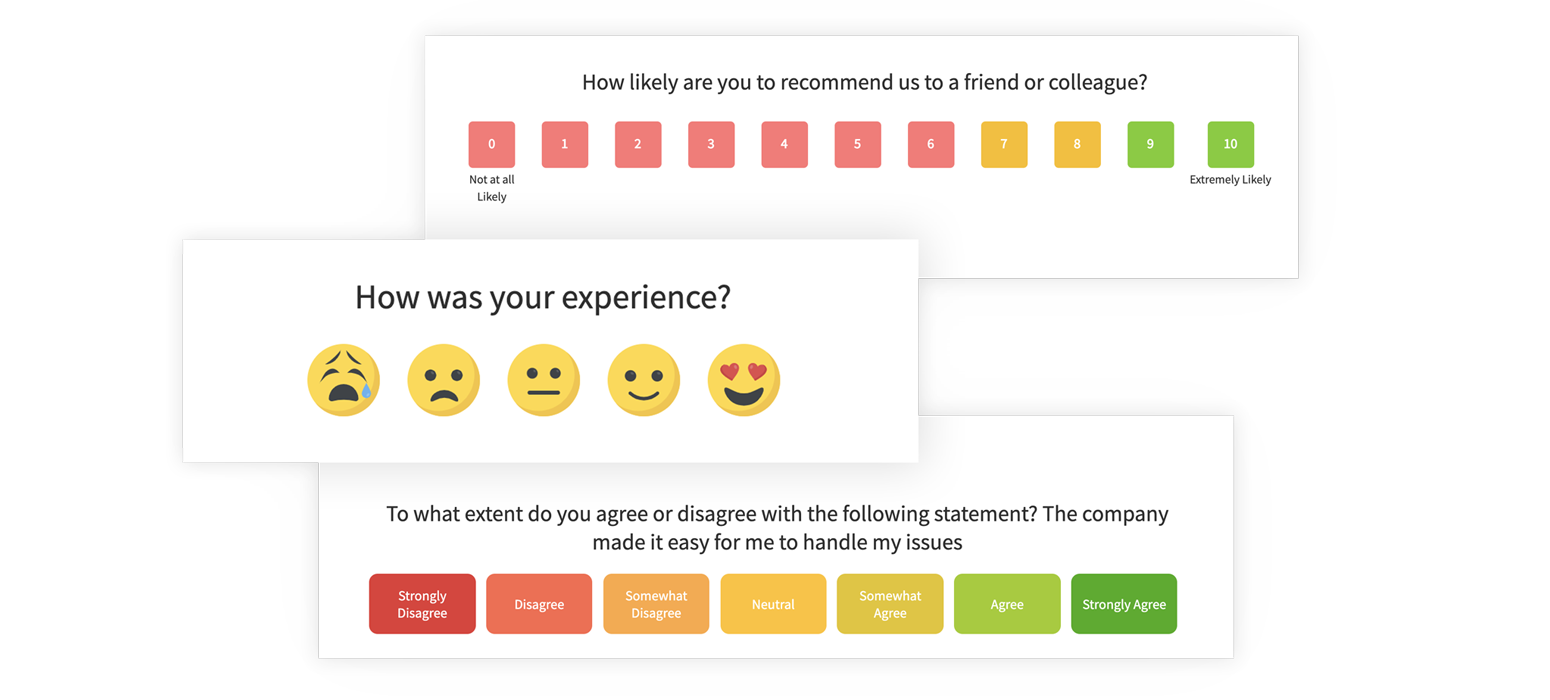
Net Promoter Score (NPS) Questions
The Net Promoter Score question measures loyalty by asking how likely someone is to recommend you. NPS, developed by Fred Reichheld at Bain & Company, works best at relationship moments like post-onboarding, quarterly check-ins, and renewal windows, not after a single support ticket. Field type: a 0–10 rating scale, followed by one open-ended "why."
1. On a scale of 0–10, how likely are you to recommend us to a friend or colleague?
2. How likely are you to recommend [product/service] to someone in your industry?
3. Based on your experience so far, how likely are you to recommend us?
4. How likely are you to recommend us based on your recent purchase?
5. How likely are you to recommend us based on your recent support experience?
6. How likely are you to recommend our support team to a friend or colleague?
7. How likely are you to recommend [company] as a place to work? (for eNPS)
8. What's the primary reason for your score? (open-ended follow-up)
9. What would it take to move your score closer to a 10? (open-ended follow-up)
10. What do we do better than anyone else? (open-ended follow-up for promoters)
For phrasing variants and setup, see our full guide to the NPS survey question.
Customer Satisfaction (CSAT) Questions
The Customer Satisfaction Score question measures how a specific interaction, product, or experience landed. Customer satisfaction score is transactional by design. You ask it right after the moment you want to measure, on a simple 1–5 or 1–7 scale, and you can tie each score to an agent, a case type, or a touchpoint.
11. How satisfied were you with your most recent experience with us?
12. How satisfied are you with [product/service]?
13. How satisfied were you with the support you received today?
14. How would you rate the quality of the product you received?
15. How would you rate your experience with our delivery service?
16. How well did [product/service] meet your expectations?
17. How satisfied are you with the value you get for the price?
18. Did this experience meet your expectations? (Yes/No, with optional comment)
19. What's the main reason for your rating? (open-ended follow-up)
Customer Effort Score (CES) Questions
The Customer Effort Score question measures how hard a customer had to work to get something done. CES is the metric most support teams underuse. Research from CEB (now Gartner) found that reducing effort predicts loyalty more reliably than delighting customers. Ask it right after a resolution, usually as an agree/disagree statement from strongly disagree to strongly agree.
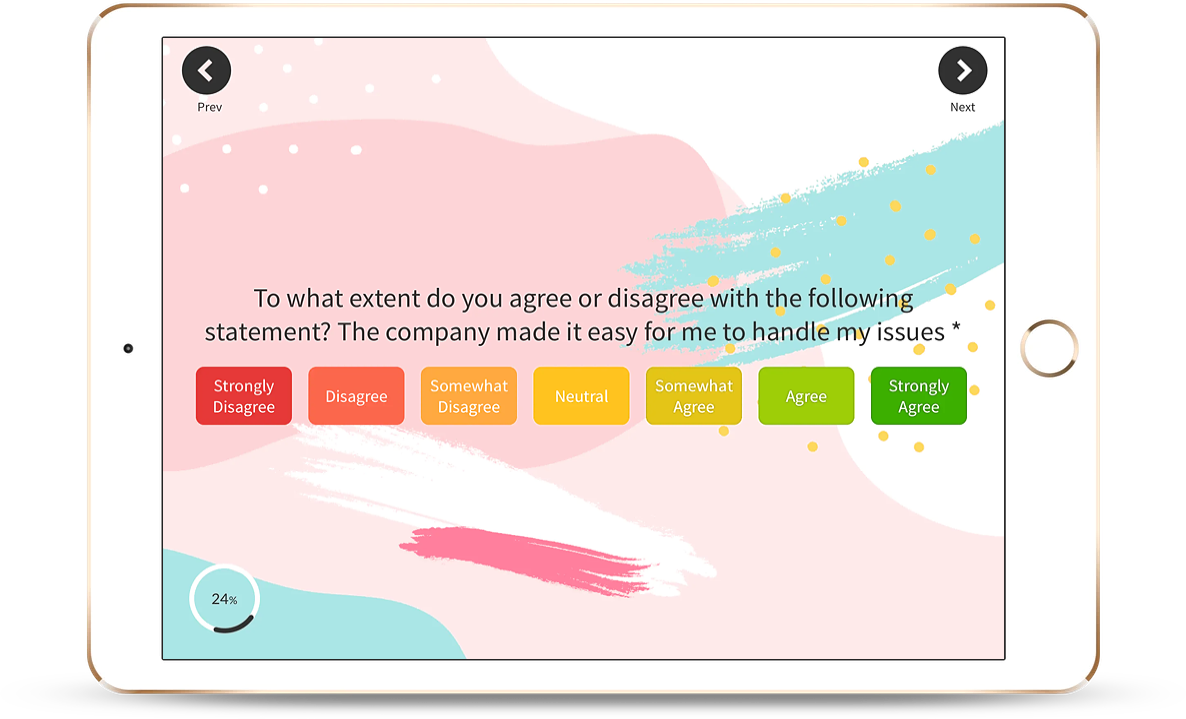
20. How easy was it to get your issue resolved today?
21. [Company] made it easy for me to handle my issue. (Strongly disagree → Strongly agree)
22. How much effort did you have to put in to get your question answered?
23. How easy was it to complete your purchase?
24. How easy was it to find the information you needed?
25. How easy was it to get started with [product/service]?
26. What made this harder than it needed to be? (open-ended follow-up)
For the mechanics of scoring and setup, see how to measure customer effort score.
Customer Feedback Questions by Business Goal
Metrics tell you the score. Goal-based questions tell you why the score is what it is, and what to do next. Group your questions around the decision you're trying to make, whether that's improving service, fixing a product, or pricing something new.
To Improve Customer Service
These questions evaluate how your customer service team handles interactions, and they surface signals like first-contact resolution and response time that a bare CSAT score misses.
27. Did our team resolve your issue?
28. Was our support team quick to respond to your query?
29. Did you find our staff helpful and courteous?
30. Did a customer service representative answer all of your questions?
31. How many times did you have to contact us before your issue was resolved?
32. How would you rate the knowledge of the agent who helped you?
33. Was it easy to reach a real person when you needed one?
34. How can we make your support experience better? (open-ended)
To Improve Your Product or Service
When customer expectations get met or beaten, loyalty follows. These questions tell product teams which features to double down on and which to rethink.
35. Which features do you use most?
36. Which features aren't useful to you?
37. Which feature do you wish we had?
38. What's the one thing you'd change about [product/service]?
39. How well does [product/service] solve the problem you bought it for?
40. Is [product/service] priced fairly for the value you get?
41. What would make you use [product/service] more often?
42. What nearly stopped you from choosing us over a competitor? (open-ended)
To Test a New Product, Feature, or Price
Launching something new carries risk. Asking existing customers before you ship lets your product team make the call on real signal instead of a guess.
43. Would you find [new feature] useful?
44. Would you buy [new product]? Why or why not?
45. How much would you expect to pay for [new feature]?
46. If we offered [discount/rewards program], would you use it?
47. How does [new feature] compare to how you solve this today?
48. What would make this a must-have for you? (open-ended)
To Understand the Relationship and Churn Risk
These questions read the health of the relationship and flag customers drifting toward the exit before they go. Pair them with churn survey questions when you're specifically diagnosing cancellations.
49. Were your expectations met, unmet, or exceeded?
50. What nearly made you leave?
51. How would you feel if you could no longer use [product/service]?
52. What's missing that would make you a long-term customer?
53. How likely are you to renew or purchase again?
54. How has [product/service] changed the way you work? (open-ended)
Customer Feedback Questions by Channel and Touchpoint
Where you ask shapes what you should ask. A one-question website poll and a post-purchase email survey serve different customer touchpoints, and the phrasing shifts with the channel.
Website and Digital Experience Questions
Website questions work best as short, in-context prompts, a single pop-up or slide-in poll tied to the page a visitor is on. For a full set organized by usability dimension, see our website usability survey questions.
55. Was this page easy to use?
56. What were you looking for on this page? Did you find it?
57. What's the one thing this page is missing?
58. What's stopping you from [taking action] today?
59. How would you rate the information available on our website?
60. How can we make this page better? (open-ended)
61. What almost made you leave without finishing? (exit-intent, open-ended)
Post-Purchase and Checkout Questions
Fire these right after the transaction, while the experience is fresh. Response rates fall off fast once the memory fades. See more post-purchase surveys examples for the full flow.
62. How easy or difficult was it to complete your purchase?
63. Were you able to check out quickly?
64. What would you improve about the checkout process?
65. What convinced you to buy today?
66. How did you first hear about us?
Retail and In-Store Questions
In-store questions capture the physical experience, including staff, layout, stock, and speed. For the full bank, see our retail survey questions.
67. How would you rate your shopping experience today?
68. How would you rate the helpfulness of our store staff?
69. How would you rate the cleanliness and layout of the store?
70. Did you find everything you were looking for?
71. How would you rate the speed of checkout?
72. Were the products priced fairly?
73. How likely are you to shop with us again?
74. How would you rate the variety of products available? (open-ended optional)
Support and Service Interaction Questions
Send these immediately after a support ticket closes, mapped to the specific case so you can report by agent and case type. These pair naturally with the customer service surveys you're already running.
75. Was your issue resolved to your satisfaction?
76. How satisfied were you with the support agent who helped you?
77. How easy was it to get the help you needed?
78. How long did it take to resolve your issue?
79. Did our self-service resources help before you reached out?
80. Would you contact our support team again if you had another issue?
81. What could we have done better? (open-ended)
Customer Interaction and General Questions
Some questions belong in almost any survey. They give you a quick read on how customers perceive your business overall and open the door to the details a metric alone won't surface.
82. How did you hear about us?
83. What made you choose us in the first place?
84. What problem were you trying to solve when you found us?
85. How often do you use our product or service?
86. How long have you been a customer?
87. What do you like most about us?
88. What do you dislike about us?
89. Is there anything you'd like to add? (always-include closing question)
Questions to Collect Customer Data
A short set of profile questions helps you segment responses and connect feedback to the right customer group. Keep these optional and offer a "prefer not to say" choice where it fits.
90. Which best describes your role or job title?
91. What industry are you in?
92. What size is your team or company?
93. Which of our products or plans do you use?
94. Which device do you use us on most: desktop, mobile, or tablet?
95. How did you first discover our product?
Questions for Competitor Analysis
These questions surface why customers picked you, what nearly kept them with someone else, and where a competitor still does something better. That's some of the most useful data you can collect for positioning and retention.
96. Did you use a competitor before us?
97. What were you using before you found us?
98. What made you switch to us?
99. What did that previous product do better?
100. What does our product do better than the alternatives?
101. What would tempt you to switch away from us? (open-ended)
Open-Ended vs Closed Feedback Questions: When to Use Which
Closed questions give you numbers you can track. Open-ended questions give you the reasons behind them. A strong survey uses both: a rating scale to measure, then one open-ended follow-up to explain the rating.
Closed questions (rating scales, multiple choice questions, yes/no, Likert) are fast to answer and easy to benchmark over time, which is why every CX metric uses one. The trade-off is that a number alone never tells you why. A 3/5 CSAT could mean "fine" or "quietly furious," and you can't tell which.
Open-ended questions capture qualitative data in the customer's own words, including the friction points, unmet needs, and ideas no multiple-choice list would have predicted. The catch is volume: 600 open-text responses are only useful if someone can read them, and most teams can't at scale. That's the exact problem AI feedback analysis solves, which we'll get to. For a deeper split, see when to use open-ended vs closed-ended questions.
Here's a quick reference for matching question type to the job:
| Question type | Best for | Example | Watch out for |
| Open-ended | The "why" behind a score | "What could we do better?" | Hard to analyze at scale |
| Rating scale | Tracking a metric over time | "Rate your satisfaction 1–5" | No context on its own |
| Multiple choice | Segmenting responses | "How did you hear about us?" | Misses answers you didn't list |
| Yes/No | Quick screening | "Did you find what you needed?" | Binary; no depth |
| Likert | Measuring agreement | "This was easy. (Disagree to Agree)" | Repetitive if overused |
Whatever mix you choose, keep the wording neutral. A leading question that nudges people toward a positive answer quietly poisons both formats.
The move that beats most surveys: pair a rating scale with an open-ended follow-up. You get the number to track and the reason to act on, in two questions instead of ten.
How Many Questions Should You Ask (and When)?
Ask as few questions as your goal allows. Completion rates drop sharply after the first handful, and a shorter survey almost always returns more usable data than a longer one. For transactional surveys like CSAT or CES, one to three questions is plenty. For relational surveys like NPS with a follow-up, three to five.
Timing matters as much as length. Transactional surveys should fire within a couple of hours of the moment you're measuring, while it's fresh. Relational surveys go out on a schedule, whether that's quarterly, at onboarding milestones, or at renewal, independent of any single interaction. And a 30-day suppression window keeps you from hitting the same customer with three surveys in a week, which tanks response rates across all of them.
If people aren't finishing your surveys, the length is usually the culprit before the questions are. Our guide on how to get people to take a survey covers the rest.
Turning Feedback Answers Into Insight
Collecting answers is the easy half. The half that separates programs that improve things from programs that generate unread reports is what happens to the responses next, especially the open-ended ones.
Scores point you in a direction. Open-text answers tell you why, but only if you can read them at scale, and a team fielding a few thousand responses a month can't review every comment by hand. So the comments pile up, the patterns stay buried, and the richest part of your feedback quietly goes to waste.
This is where a thematic analysis tool and sentiment analysis do the work manual review can't. Instead of 600 individual comments, you get them grouped into themes, for example a chunk about wait time, another about resolution quality, and a cluster of "4/5 but…" responses carrying frustration the score alone hides. That's the difference between knowing your CSAT dropped and knowing why.
Purpose-built AI customer feedback analytics reads open-ended responses the way a human would, just across all of them at once, turning the answers these questions generate into something your product, support, and CX teams can act on.
Put These Questions to Work
The questions above are a starting bank, not a script. Pull the ones that match your goal, cut them to the fewest that answer your actual question, and match each to the right moment and channel. Then commit to the part most programs skip: reading the answers and doing something with them.
When you're ready to build, our customer feedback template gives you a ready-to-edit starting point, and the customer feedback pillar guide covers the full lifecycle from collection to closing the loop.
When you're comparing where to run and analyze your surveys, our guide to customer feedback tools breaks down the options.
For questions tuned to a specific context, see these sets:
- SaaS customer feedback questions
- B2B customer satisfaction survey questions
- product survey questions
- retail survey questions

.png)
.png)