

.svg)
 Healthcare
 Finance
 Retail
 SaaS & Digital
 eCommerce
 Education
 Salesforce
  HubSpot
 Pipedrive
 Mailchimp
 Klaviyo
 Zendesk
  Intercom
 Freshdesk
 HelpScout
  Front
Front Jira
Jira Slack
Slack  MS Teams
 Zoom
Zoom Google Sheets
  Zapier
  Integrately
 Make
Make  Webhooks




 MS Teams


Birdeye built its name on review management. And it delivers — the review generation engine works, the multi-location dashboard handles real complexity, and for businesses whose primary need is collecting and responding to public reviews, the value is there.
The problem shows up when the platform is asked to do more than that. Or when the per-location pricing model starts compounding faster than the value justifies.
Teams running structured NPS or CSAT programs find that Birdeye's survey tools are secondary features inside a reputation platform — not a feedback intelligence system. Teams managing multiple locations find that per-location pricing compounds quickly as the footprint grows, and the value calculation starts to shift. Teams that decide to leave encounter a 90-day cancellation requirement that catches a lot of people off guard. And teams that just need solid review generation often find themselves paying for social media tools, messaging, and AI features they never touch.
If you're at that point — or trying to avoid getting there — this guide is for the decision ahead. Nine Birdeye alternatives, each evaluated for what it actually does well, matched to the specific gap it closes.
Which Birdeye Alternative Should You Pick?
- For structured CX feedback programs (NPS, CSAT, AI analysis): Zonka Feedback
- For SMS-first review generation, local businesses: Podium
- For enterprise reputation management at scale: Reputation.com
- For multi-location review monitoring and analytics: ReviewTrackers
- For lightweight review automation for SMBs: NiceJob
- For listings management and local search presence: Yext
- For multi-location social media + reputation management: SOCi
- For capturing negative feedback privately before it goes public: GatherUp
- For local SEO bundled with review management: BrightLocal
Not sure which fits your situation? Jump to the how to choose section.
How We Evaluated These Birdeye Alternatives
These tools were assessed against four criteria: review generation and management depth, structured feedback capability (NPS/CSAT/CES programs with proper analytics), post-collection intelligence (AI analysis, sentiment, thematic grouping), and integration pipeline. Every tool was reviewed using verified user data from G2 and Capterra, published documentation, and conversations with teams actively evaluating alternatives.
Full disclosure: Zonka Feedback is our platform. It's listed first because it directly addresses the feedback intelligence gap that Birdeye's survey module leaves but every tool here is evaluated on its own merits for its specific use case.
Why Teams Look for Birdeye Alternatives
Birdeye's core business has always been reputation management: review generation, listings, multi-location monitoring. It does that well. But as the platform expanded into surveys, social media, AI tools, and messaging, it became more expensive without always becoming more useful for what a given team actually needed.
Here's where the friction shows up most often.
- Per-location pricing compounds quickly. Birdeye's pricing is not publicly listed and requires a demo to get a quote — but verified user reports consistently place it at the higher end of the market. As location count grows, costs scale per location, and key capabilities like social media management are gated to higher tiers. For many teams, the bill grows faster than the value.
- Survey and feedback tools are shallow. Birdeye can send NPS surveys and collect ratings. What it can't do is analyze open-ended responses at scale — no native thematic grouping, no AI on text, no structured closed-loop workflows tied to survey outcomes. For teams that need a real feedback program, this is the ceiling.
- Contract terms create real lock-in. Birdeye requires a 90-day cancellation notice with auto-renewal built in. Multiple customers have reported being charged thousands of dollars for missing that window. One Trustpilot reviewer described being billed $7,000 after missing the deadline by a week.
- Social media features don't match dedicated tools. Verified users note the social module feels bolted on. One G2 reviewer put it plainly: "The social module feels like they added it to justify the price increase. It works, but barely."
- Support reliability is inconsistent. Birdeye has accumulated 113 Better Business Bureau complaints in three years — most tied to billing disputes and contract enforcement — which is a notable figure for a software platform.
What to Look for in a Birdeye Alternative
The right alternative depends on which problem you're actually solving. These tools don't all do the same thing, and the gap between them matters.
- Review generation and monitoring — Does it automate review requests via SMS or email? Does it aggregate reviews from 80–200+ platforms into a single dashboard with response management?
- Structured feedback programs — Beyond review collection, does it support NPS, CSAT, and CES surveys with proper targeting, AI analysis, and closed-loop automation?
- Post-collection analytics — Does it analyze what customers said in open-ended responses, or does it just surface star ratings? Sentiment analysis, thematic grouping, and driver analysis are the differentiators.
- Listings and local SEO — Does it manage your business information across directories and support Google Business Profile optimization?
- Multi-location management — Can you manage reviews, responses, and reporting across dozens or hundreds of locations with role-based access?
- Pricing model — Is pricing per location, per response, per user, or flat rate? The model that fits your growth trajectory matters as much as the starting price.
Quick Comparison: Birdeye Alternatives at a Glance
| Tool | Best For | Key Capabilities | Starting Price | Free/Trial | G2 Rating |
| Zonka Feedback | AI feedback intelligence + structured CX surveys | NPS/CSAT/CES, AI thematic analysis, omnichannel collection | On request | Trial on request | 4.7 |
| Podium | SMS-first review generation, local businesses | SMS review requests, unified messaging inbox, webchat | On request | No | 4.6 |
| Reputation.com | Enterprise reputation management at scale | Multi-location reviews, surveys, BI integration, analytics | From $80/location/month | Demo only | 4.3 |
| ReviewTrackers | Multi-location review monitoring + analytics | 100+ platform aggregation, sentiment analysis, competitive benchmarking | From $89/location/month | Demo only | 4.6 |
| NiceJob | Review automation for SMBs | Automated review requests, referral campaigns, social proof | From $75/month | 14-day trial | 4.9 |
| Yext | Listings management, local search presence | 200+ directories, review monitoring, AI search visibility | On request | No | 3.9 |
| SOCi | Multi-location social + reputation management | Social content calendar, review responses, listings, competitor tracking | On request | Demo only | 4.3 |
| GatherUp | Private feedback before public review routing | NPS-gated review funnel, internal resolution routing, review monitoring | From $99/month | 14-day trial | 4.7 |
| BrightLocal | Local SEO bundled with review management | Citation building, local rank tracking, GBP audits, review monitoring | From $39/month | 14-day trial | 4.5 |
9 Best Birdeye Alternatives Worth Evaluating in 2026
The 9 best Birdeye alternatives include Zonka Feedback, Podium, Reputation.com, ReviewTrackers, NiceJob, Yext, SOCi, GatherUp, and BrightLocal.
1. Zonka Feedback — Best for Structured CX Feedback Programs and AI Feedback Intelligence
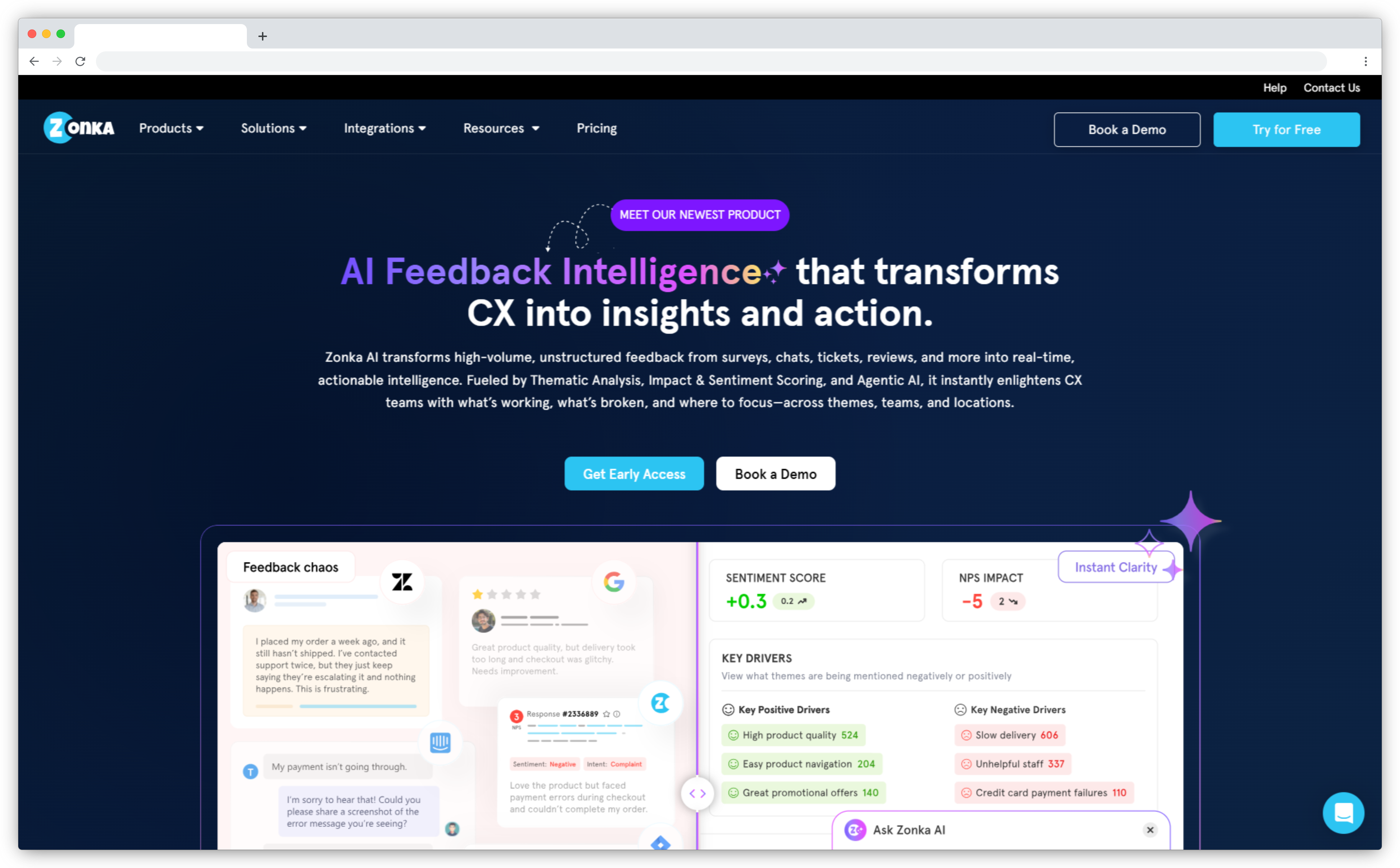
- Where it stands out vs. Birdeye: Purpose-built for structured feedback programs — NPS, CSAT, CES surveys with AI-powered thematic and sentiment analysis on open-ended responses, closed-loop workflows, and omnichannel collection across website, in-app, email, SMS, and WhatsApp. Birdeye's survey tools are a secondary feature; this is the core product.
- Use case: Teams running customer feedback programs where understanding sentiment — not just collecting ratings — is the actual goal. Post-purchase CSAT, product NPS, support CES, AI analysis on what customers wrote in open-ended fields.
- Best for: Mid-market and enterprise CX, product, and customer success teams that need a dedicated feedback intelligence platform, not a survey module inside a reputation tool.
- G2 rating: 4.7/5
The gap Birdeye leaves isn't on the review side. Most teams don't switch because of review management — that part works. The gap shows up when teams need structured feedback programs: NPS surveys triggered after specific customer interactions, CSAT collected at multiple touchpoints, AI analysis on what people actually wrote in the open-ended fields.
Birdeye can send a survey. What it can't do is tell you that 34% of low NPS scores mention "response time" as the underlying theme, or route those responses automatically to the right team, or close the loop with a triggered follow-up tied to survey outcomes. That analysis still falls on whoever's managing the dashboard.
That's the specific problem Zonka Feedback solves.
The AI Feedback Intelligence layer groups open-ended responses into themes automatically, detects sentiment at sentence level, tracks entity mentions, and surfaces what's actually moving NPS and CSAT scores. Targeting goes well beyond basic rules — surveys fire based on lifecycle stage, plan type, custom events, and user attributes across website feedback, in-product surveys, and a native in-app SDK for iOS and Android.
The closed-loop automation means detractor alerts route automatically to the right team, feedback lands in your CRM without manual exports, and follow-up triggers fire based on response content — not manual tagging.
One Capterra reviewer described the reporting as "absolutely kickass — I get too many detailed reports in one click and really love the way the entire analytics system is designed." Another on SoftwareAdvice called it "the most robust tool for measuring a wide variety of CX activities" — with Qualtrics-level depth at a fraction of the cost.
For teams that have been using Birdeye's survey module and wondering why they can't get the analysis they need: this is why. Survey collection inside a reputation tool and a dedicated feedback intelligence platform are built for different jobs.
Zonka Feedback Features
- NPS, CSAT, and CES surveys with multi-channel delivery (website, in-app, email, SMS, WhatsApp)
- AI Feedback Intelligence: thematic analysis, sentiment analysis, entity mapping
- Website feedback surveys with behavioral triggers and exit-intent targeting
- In-app feedback SDK for iOS and Android
- 200+ survey templates with advanced logic and branching
- Customizable dashboards with role-based access and drill-down reporting
- Closed-loop automation: detractor alerts, case routing, follow-up triggers
- 50+ integrations: Salesforce, HubSpot, Zendesk, Intercom, Freshdesk, Slack, Jira
Zonka Feedback Pros
- Dedicated feedback intelligence platform — surveys and AI analysis are the core product, not add-ons
- AI thematic and sentiment analysis removes the manual tagging burden on CX teams
- Full omnichannel collection: website, in-product, in-app SDK, email, SMS, WhatsApp, offline/kiosk
- Closed-loop workflows built in, not dependent on external automation tools
- Scales for mid-market to enterprise CX programs
Zonka Feedback Cons
- Not designed for review generation or directory listings management
- Advanced AI features require onboarding time for teams new to structured feedback programs
Zonka Feedback Pricing
- Custom pricing based on business requirements
- Free trial available on request
2. Podium — Best for SMS-First Review Generation for Local Businesses
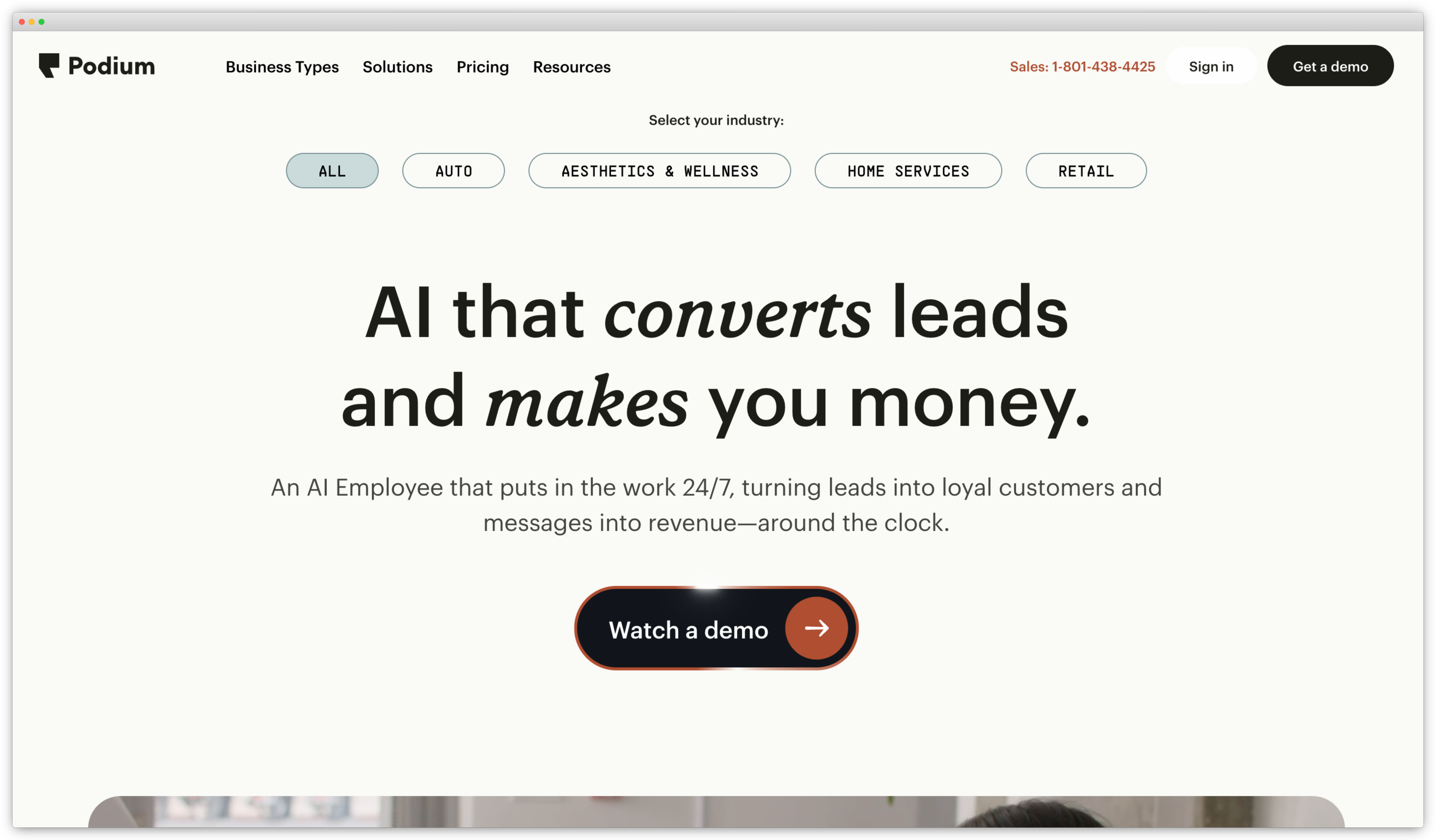
- Where it stands out vs. Birdeye: SMS-first architecture that consistently outperforms email-based review requests for local service businesses. Messaging is the core product here — review management is built around it, not bolted on top of it.
- Use case: Local businesses in home services, automotive, dental, and healthcare that want more Google reviews and a unified channel for customer communication via text.
- Best for: Local service businesses and SMBs where SMS is the primary customer communication channel and review volume on Google and Facebook is the main KPI.
- G2 rating: 4.6/5
Podium and Birdeye serve similar markets — local and multi-location businesses focused on online reputation. But they start from different premises.
Birdeye is a platform that added messaging. Podium built messaging first and reputation tools around it. The practical difference: Podium's SMS review requests tend to see higher open and completion rates than email-based alternatives. A text two hours after a service appointment with a direct link to leave a Google review removes almost all friction from the process.
The unified inbox pulls together text messages, webchat, and Facebook messages in one view — so the team managing reviews is also handling inbound inquiries. Payments via SMS streamlines billing for service businesses that historically sent invoices separately. It's genuinely one platform doing three jobs that previously required separate tools.
Where Podium falls short vs. Birdeye: less multi-location analytics depth, thinner coverage on platforms beyond Google and Facebook, and a narrower footprint for enterprise-scale programs. Pricing is also undisclosed and has a reputation for being high relative to what smaller businesses need.
For local businesses where the primary goal is more Google reviews and better customer communication — and you've been paying Birdeye prices for features you don't use — Podium is the more focused alternative.
Podium Features
- Automated SMS review request campaigns after transactions or service appointments
- Unified inbox: text, webchat, and Facebook messages in one place
- Payments via text messaging — request and collect payment through the same channel
- Webchat widget with automatic routing to team inbox
- Review monitoring across Google and Facebook
- Analytics: review volume, response rates, messaging performance
- Integrations: Google My Business, Facebook, Salesforce, HubSpot, ServiceTitan, Zendesk, Shopify
Podium Pros
- SMS-first approach drives higher review completion rates than email-based alternatives
- Unified messaging inbox reduces channel-switching for customer-facing teams
- Payment collection via text simplifies billing for service businesses
- Clean, intuitive interface — faster to get running than Birdeye
Podium Cons
- Limited review monitoring coverage beyond Google and Facebook
- Multi-location analytics are less robust than Birdeye or Reputation.com
- Pricing upon request — reported costs vary significantly and are higher than many alternatives
Podium Pricing
- Pricing upon request — demo required
- No free plan available
3. Reputation.com — Best for Enterprise Reputation Management at Multi-Location Scale
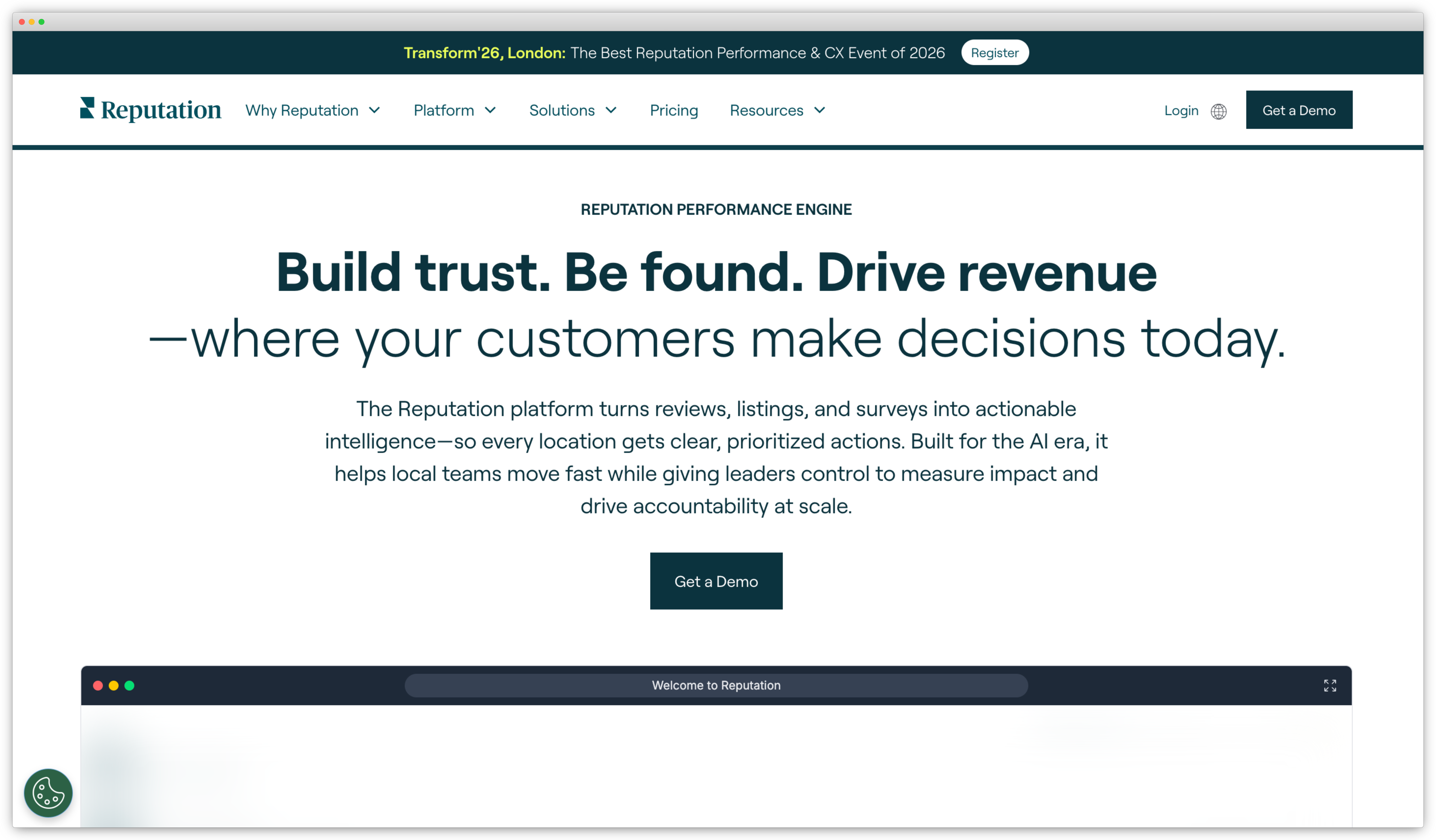
- Where it stands out vs. Birdeye: Stronger enterprise governance, deeper analytics dashboards, and specific vertical depth in healthcare — a market where Birdeye has less specialized tooling. Built for organizations that need reputation data connected to business intelligence systems.
- Use case: Large multi-location organizations — healthcare networks, automotive groups, financial services — where reputation data needs to flow into BI and CRM platforms, and where governance across 50–500 locations is a real operational need.
- Best for: Enterprise CX, marketing, and operations teams at organizations with 50+ locations that need cross-location analytics, enterprise security controls, and API-based integration with existing data infrastructure.
- G2 rating: 4.3/5
Where Birdeye targets businesses from SMB to enterprise, Reputation.com focuses on the enterprise end specifically — and the analytics layer is where you feel the difference.
The dashboards are built for stakeholder reporting across locations, regions, and business units. You get customizable views, sentiment trend analysis, and the ability to pipe reputation data directly into existing BI tools via API and data connectors. This is the level of integration that enterprise operations teams actually need, and it's not something Birdeye's standard analytics deliver.
The survey tools go beyond review generation. You can build and deploy custom feedback surveys alongside reputation monitoring, so internal and external customer signals sit in the same platform — giving a fuller picture of customer experience than reviews alone.
Healthcare is where Reputation.com has a genuine vertical advantage: patient experience tooling, HIPAA-aware data handling, and native monitoring for platforms that matter in that space (Healthgrades, Zocdoc, Vitals) that Birdeye doesn't cover as thoroughly.
The tradeoff is complexity. Setup and onboarding are an investment. The platform isn't designed for fast deployment, and teams that need to be running in days — not weeks — should weigh that honestly. The G2 rating of 4.3/5 reflects both the depth and the steeper learning curve.
Reputation.com Features
- Review monitoring across 100+ platforms with centralized response management
- Custom survey creation and distribution for internal and external feedback
- Location-level analytics with cross-location benchmarking and trend analysis
- BI integration via API and data connectors
- Social media publishing and monitoring
- Healthcare-specific templates and HIPAA-aware data handling
- Role-based access for enterprise governance across departments and locations
Reputation.com Pros
- Purpose-built for enterprise scale — 50 to 500+ location management
- Connects reputation data to existing BI systems via API
- Healthcare vertical expertise with HIPAA-aware data handling
- Custom survey tools integrate alongside review management in one platform
Reputation.com Cons
- Complex onboarding — not suited for teams that need fast time-to-value
- Yelp integration is absent, which creates gaps for consumer-facing businesses
- Overkill for mid-market teams without dedicated analytics resources
Reputation.com Pricing
- From $80/location/month (enterprise pricing varies significantly)
- Demo required for a quote
4. ReviewTrackers — Best for Multi-Location Review Monitoring and Analytics
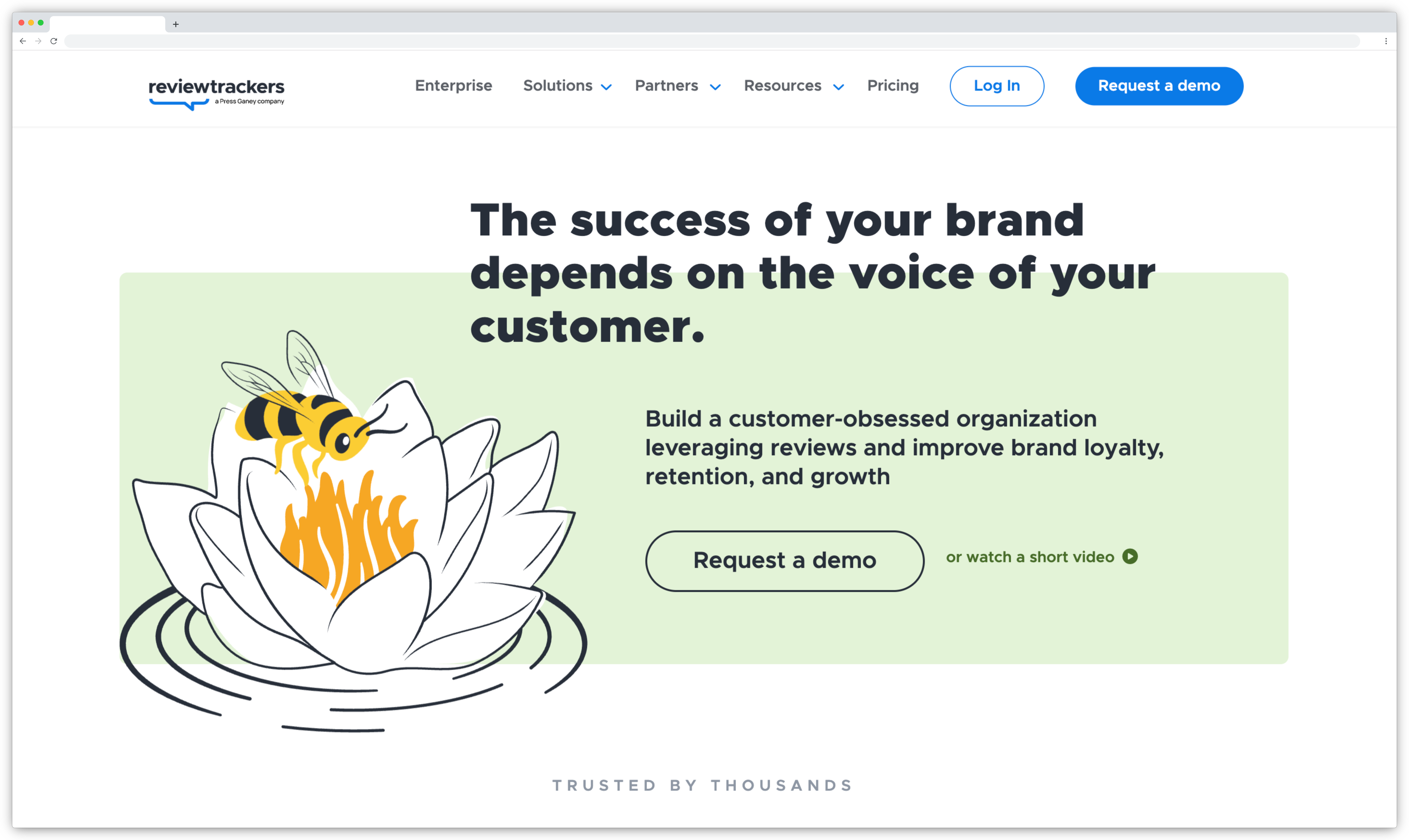
- Where it stands out vs. Birdeye: More focused on monitoring and analytics — aggregating reviews from 100+ platforms and surfacing performance trends — without the social media, messaging, and AI tools that inflate Birdeye's cost for teams that don't use them.
- Use case: Multi-location brands, franchise systems, and CX analytics teams that need deep review intelligence and competitive benchmarking without paying for a full-suite platform.
- Best for: CX and marketing analytics teams at mid-market to enterprise companies that need to understand review performance trends at location level and benchmark against competitors.
- G2 rating: 4.6/5
ReviewTrackers occupies a specific position: review monitoring and analytics, done well, without the feature sprawl that makes platforms like Birdeye expensive for teams who only need part of what they offer.
If the primary reason you're reconsidering Birdeye is that you're paying for social media tools, listings management, and messaging you don't use — and you just need excellent review intelligence — ReviewTrackers is purpose-built for that job.
The platform aggregates reviews from 100+ sources, surfaces sentiment trends, enables competitive benchmarking against local competitors, and provides the granular location-level reporting that CX and operations teams need for stakeholder presentations. Integrations with Slack, HubSpot, and Hootsuite make it easy to route review data into existing workflows without additional configuration.
The competitive analysis tools are a genuine differentiator. You can benchmark your ratings and sentiment against direct competitors by market — something most teams currently do manually in spreadsheets or not at all.
Where ReviewTrackers falls short: it's focused on monitoring and analysis, not review generation. If you need a replacement for the full Birdeye suite including review requests and listings management, you'd be filling gaps with other tools. But if the analytics layer is specifically what you need to improve — this is where the investment pays off.
ReviewTrackers Features
- Review aggregation from 100+ platforms including Google, Yelp, TripAdvisor, Facebook, and industry-specific sites
- Sentiment analysis and trend tracking across locations
- Competitive benchmarking against local competitors
- Location-level reporting and cross-location analytics dashboards
- Review response management from a centralized interface
- Integrations with Slack, HubSpot, Hootsuite, and 20+ tools
- Local listing management available as an add-on
ReviewTrackers Pros
- Strong analytics focus without the extra feature overhead that inflates Birdeye's cost
- Competitive benchmarking built into the core product
- Per-location pricing is transparent at $89/month for single-location entry
- Clean integrations with marketing and CX workflows
ReviewTrackers Cons
- Analytics and monitoring focused — not built for review generation volume
- No native social media management or listings management in core platform
- Per-location pricing can still compound significantly for large enterprise footprints
ReviewTrackers Pricing
- From $89/location/month (single location)
- Volume discounts for 10+ locations
- Demo required for custom enterprise quotes
5. NiceJob — Best for Automated Review Generation for SMBs and Service Businesses
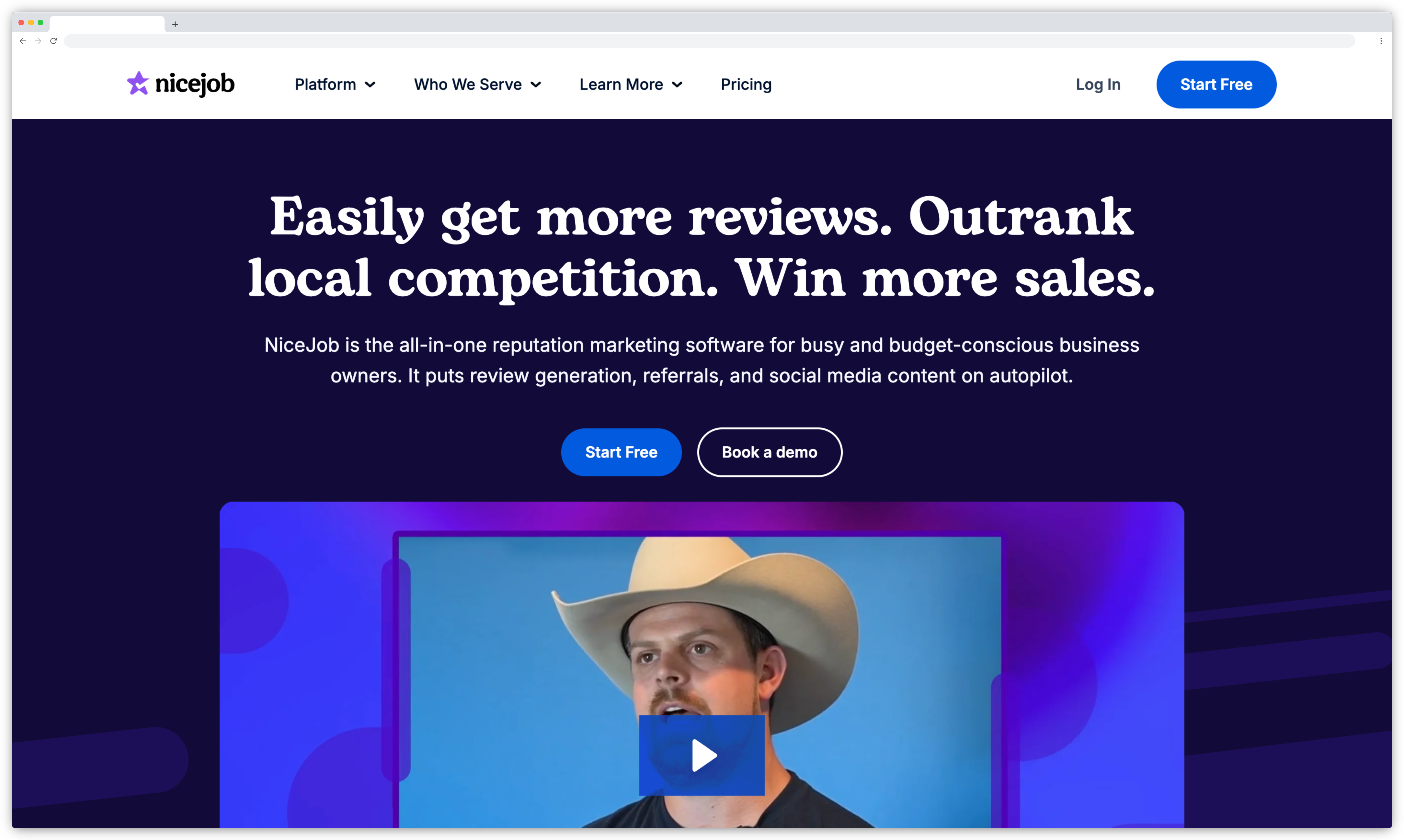
- Where it stands out vs. Birdeye: Significantly more affordable, faster to deploy, and purpose-built for service businesses that need to generate reviews and referrals without enterprise complexity. Does the core job Birdeye is most often used for at SMB scale — at roughly one-quarter of the price.
- Use case: Home services, contractors, cleaners, HVAC, dental practices, and local service businesses that want to automate review requests and build word-of-mouth referral systems.
- Best for: Small and mid-size service businesses for whom generating more Google and Facebook reviews is the primary goal, and enterprise features are unnecessary overhead.
- G2 rating: 4.9/5 — highest user satisfaction rating on this list.
NiceJob is the focused alternative for the segment Birdeye arguably oversells to most consistently.
A significant portion of Birdeye's customers are small service businesses — contractors, cleaners, HVAC companies, dental practices — that pay $299+/month primarily to generate reviews and show up better in local search. NiceJob does exactly that, for $75–$125/month, with a simpler interface and a model specifically built for this workflow.
Connect your job management software (Jobber, ServiceTitan, HouseCall Pro), and NiceJob automatically sends review requests after each completed job. No manual triggering, no separate workflows, no training required. It just runs.
The referral system is the real differentiator against Birdeye. Once a customer leaves a positive review, NiceJob automatically invites them to refer friends and family — turning each satisfied customer into a potential growth channel that Birdeye's standard plans don't touch.
One G2 reviewer described it directly: "Before NiceJob, our online reviews were uniformly positive but we didn't have very many. After connecting it with our job management tool, our reviews skyrocketed and our online reputation finally matched our actual word-of-mouth reputation."
What NiceJob doesn't do: multi-platform review monitoring at scale, enterprise analytics, listings management, or social media. For teams that need any of those, the gap is real. But for service businesses that want a tool purpose-built to generate reviews and referrals at a fraction of Birdeye's price, the comparison isn't close.
NiceJob Features
- Automated review requests via email and SMS after job completion
- Referral campaigns: automated invitations for satisfied customers to refer new business
- Review monitoring for Google and Facebook
- Social proof widgets: display latest reviews on your website automatically
- Website builder with review-rich landing pages (Grow+Sites plan)
- Integrations: Jobber, HouseCall Pro, ServiceTitan, QuickBooks, HubSpot, Salesforce, Mailchimp
NiceJob Pros
- Purpose-built for SMB service businesses — does one job extremely well
- Referral campaign feature drives organic customer growth beyond review collection
- Significantly more affordable than Birdeye for single-location or small multi-location businesses
- Minimal setup — connects to job management software and runs automatically
- 4.9/5 on G2 — highest user satisfaction on this list
NiceJob Cons
- Not built for multi-location enterprise management or governance
- Review analytics are basic — volume and star ratings, not deep sentiment or trend analysis
- Industry-specific and niche review platforms not supported
NiceJob Pricing
- Grow plan: $75/month
- Grow+Sites (includes website builder): $125/month + $399 setup fee
- 14-day free trial available
6. Yext — Best for Listings Management and Local Search Presence
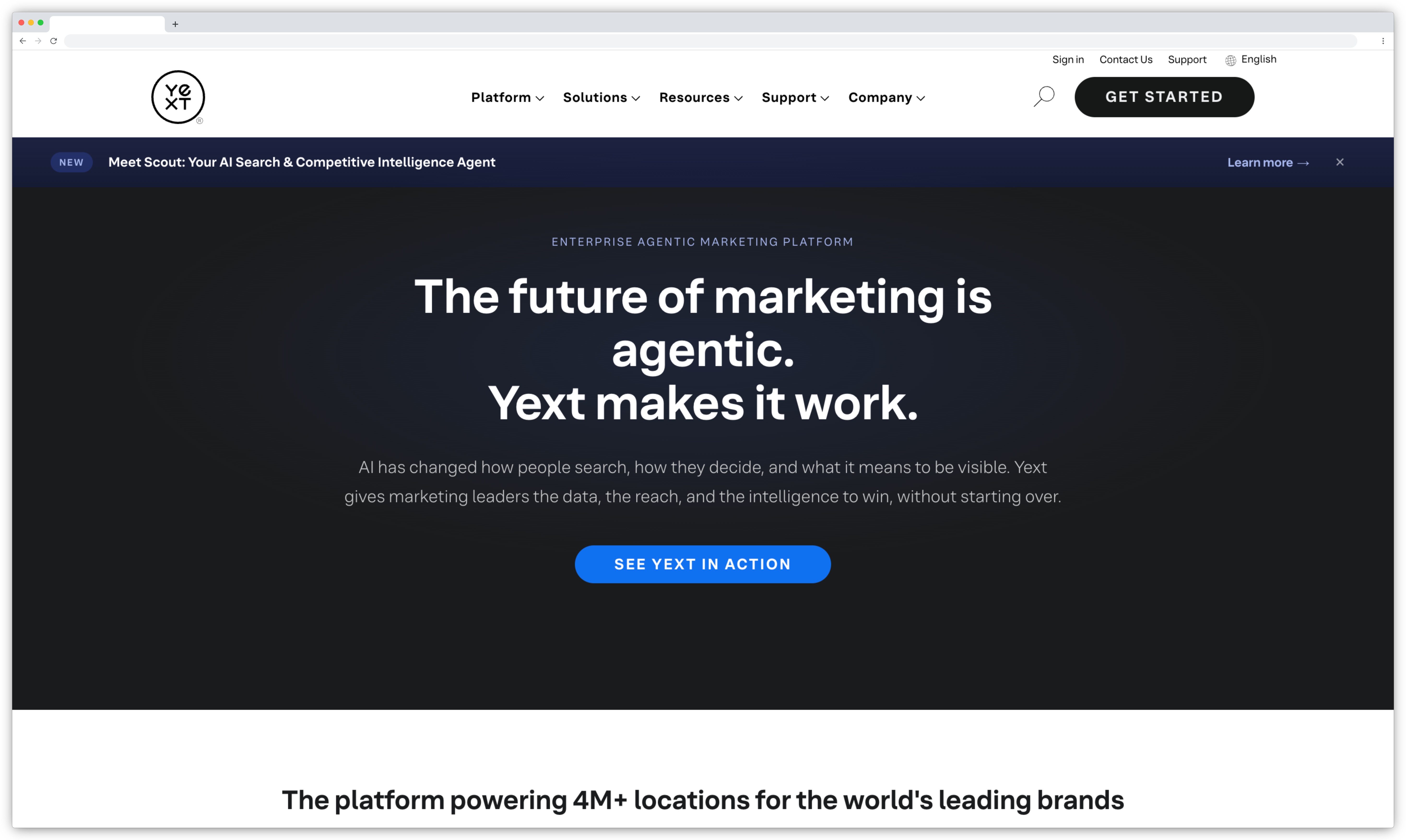
- Where it stands out vs. Birdeye: Significantly deeper listings infrastructure — managing presence across 200+ directories including Apple Maps, Bing, Alexa, and vertical-specific platforms. Purpose-built for businesses where being found accurately across search and voice is the primary problem.
- Use case: Multi-location brands and franchise systems where listing accuracy, duplicate suppression, and local search visibility across 200+ directories are strategic priorities — not just Google and Facebook management.
- Best for: Large multi-location brands for whom consistent local search presence and structured data management across directories are more critical than review generation volume.
- G2 rating: 3.9/5
Yext and Birdeye both touch reputation management but from opposite starting points. Birdeye starts with reviews. Yext starts with listings.
The Yext platform manages business information — name, address, phone number, hours, photos — across 200+ directories simultaneously. When a location changes hours or moves, one update in Yext propagates across every connected directory automatically. For brands where inconsistent listings are costing local search visibility or directing customers to wrong locations, that infrastructure delivers real value.
The review monitoring tools are included, but they're not the core product and don't reach the depth of dedicated review platforms.
Two things to factor in before committing: Yext's G2 rating of 3.9/5 reflects consistent complaints about interface complexity and pricing relative to perceived value. And the annual subscription model includes proprietary directory relationships — if you leave, you lose the presence Yext managed on directories that don't accept direct edits.
In 2025, Yext also moved into AI search visibility — helping brands position their content for generative AI answers in Google AI Mode, ChatGPT, and Perplexity. For brands that want to be referenced in AI-generated responses, that's a capability most reputation tools don't address yet.
For businesses where listings accuracy is the primary problem, Yext is the market leader. For businesses primarily focused on review generation and sentiment analysis, it's an expensive choice for a partial solution.
Yext Features
- Listings management across 200+ directories (Google, Apple Maps, Bing, Yelp, TripAdvisor, Alexa, and more)
- Review monitoring and response management
- AI search visibility — structured content for generative AI answer engines
- Location-specific landing pages with schema markup
- Analytics: local search impressions, clicks, and listing accuracy by location
- Brand consistency controls for multi-location and franchise brands
Yext Pros
- Unmatched directory coverage — 200+ platforms in one update
- AI search visibility capabilities that most reputation tools don't offer
- Strong structured data management for local SEO programs
- Multi-location brand consistency controls at scale
Yext Cons
- Lowest G2 rating on this list (3.9/5) — interface complexity is a consistent complaint
- Listing lock-in: leaving Yext means rebuilding presence on proprietary directories
- Review analytics are functional, not deep — not suited as a primary review intelligence tool
- High annual cost relative to feature set for businesses primarily needing review management
Yext Pricing
- Custom pricing — annual subscription, upon request
- Per-location pricing with enterprise volume discounts
- Demo required for a quote
7. SOCi — Best for Multi-Location Social Media Combined with Reputation Management
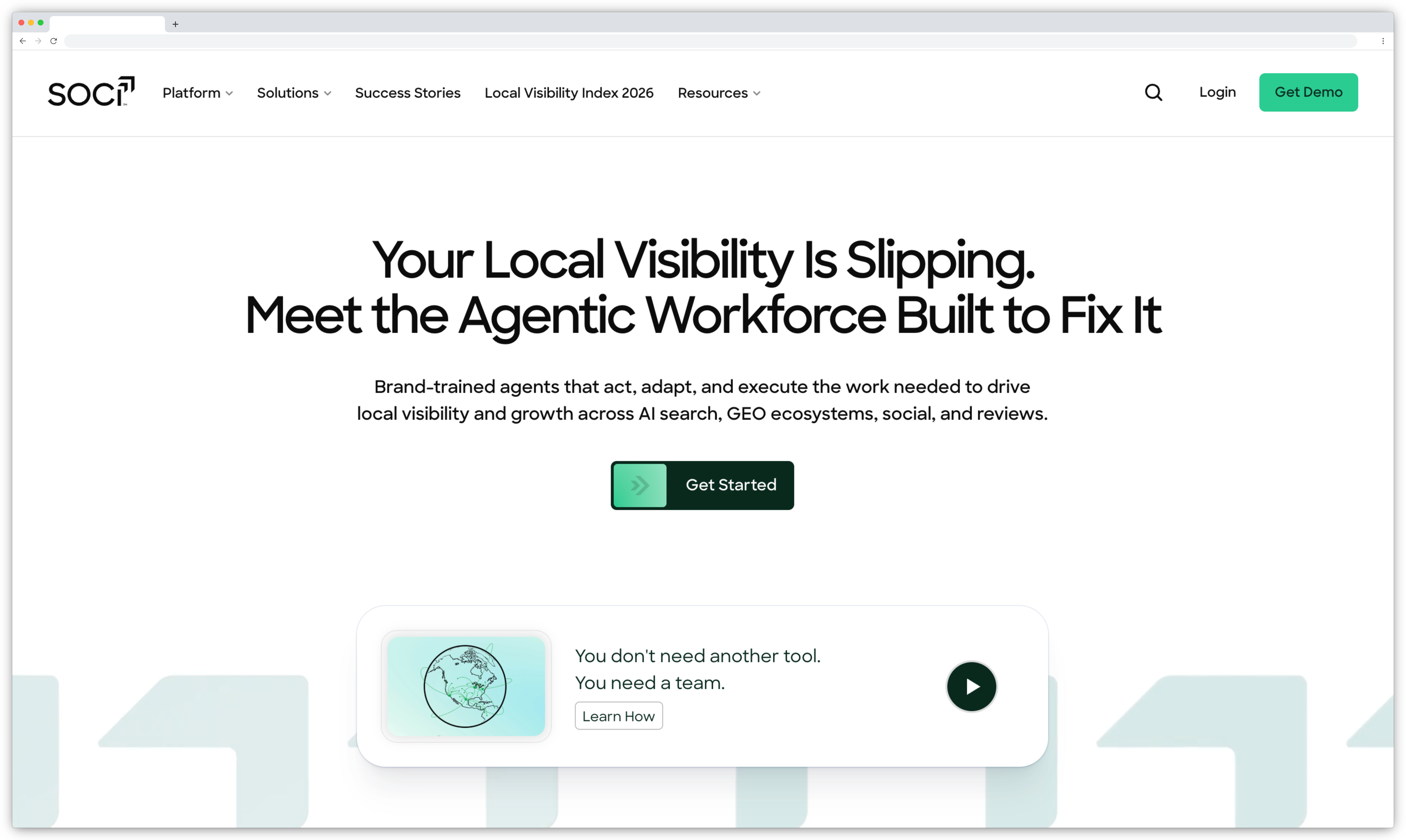
- Where it stands out vs. Birdeye: Social media management is built as a primary product, not a tier-gated feature. Purpose-built for multi-location brands that need social content management, community management, and reputation management coordinated across dozens to hundreds of locations from one platform.
- Use case: Franchise systems, retail chains, and property management groups where local social media presence and reputation management need to work in sync — with local team access and corporate brand governance controls.
- Best for: Multi-location brands with 20+ locations where both social media and reputation management need to be managed from a single platform, with role-based controls that let local teams act within corporate guardrails.
- G2 rating: 4.3/5
SOCi solves the specific problem Birdeye's social tools never fully addressed. For multi-location brands that need both reputation management and social media management from one platform — with proper controls for local team access and corporate oversight — SOCi was purpose-built for this use case.
The social content calendar, review response templates, and listing management tools work in concert. Local teams can post and respond within approved parameters while corporate maintains brand consistency and reporting visibility across all locations.
The competitive tracking feature is a real differentiator: you can monitor competitor reviews and social engagement by market and location, giving operations and marketing teams benchmarking data that's otherwise difficult to compile without manual work.
Where SOCi falls short: it's not built for teams primarily focused on generating reviews or running structured survey programs. The enterprise pricing puts it out of reach for most SMBs. And compared to dedicated social media tools like Sprout Social or Hootsuite, the depth of social analytics is limited.
But for franchise systems and large multi-location brands where social and reputation need to be one coordinated program — with governance controls that Birdeye can't replicate — SOCi is the right category of tool.
SOCi Features
- Social content calendar: plan, schedule, and publish across all locations simultaneously
- Review monitoring and response management from a central dashboard
- Automated review response templates with brand voice controls
- Local listings management across major directories
- Competitor review and social monitoring by market
- Location-level permissions with corporate oversight controls
- Analytics: review performance, social engagement, local search metrics by location
SOCi Pros
- Social media management built as a primary product — not an add-on feature
- Location-level permissions let local teams operate within corporate guardrails
- Competitive monitoring built in for market-level benchmarking
- Purpose-built for franchise and multi-location brand complexity
SOCi Cons
- Enterprise pricing — not suited for SMBs or smaller multi-location brands
- Steeper setup and onboarding than simpler alternatives
- Social analytics depth is limited compared to dedicated social media platforms
SOCi Pricing
- Custom pricing upon request — enterprise tier
- Demo required
8. GatherUp — Best for Capturing Customer Feedback Privately Before It Goes Public
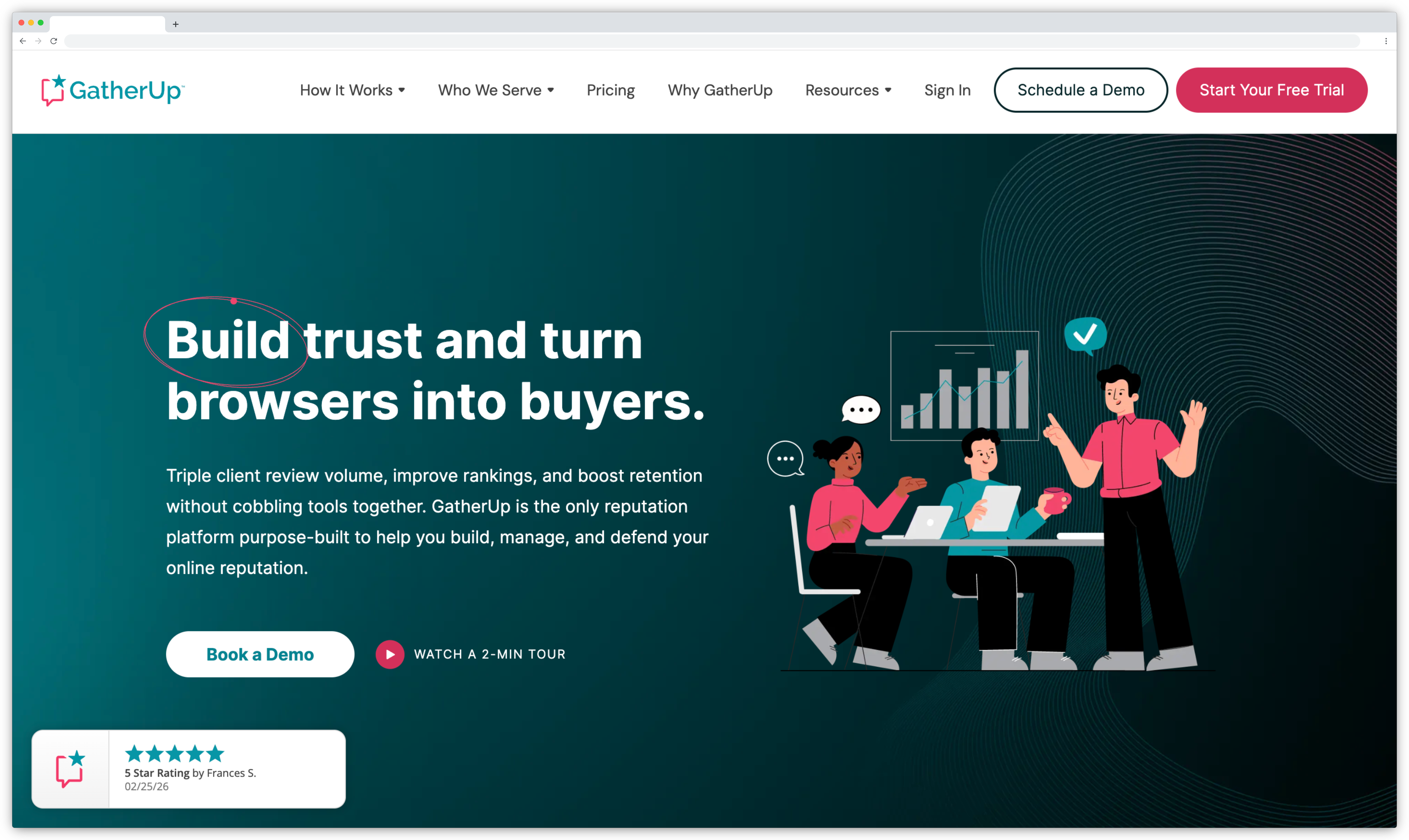
- Where it stands out vs. Birdeye: Inverts the review funnel — surveys dissatisfied customers privately before routing them to public review platforms, so negative experiences are addressed internally rather than becoming 1-star posts. Birdeye pushes everyone toward public reviews immediately; GatherUp adds a triage step first.
- Use case: Service businesses and healthcare practices that want to use structured feedback as a quality improvement tool — catching negative experiences before they escalate publicly — while still generating positive reviews at volume.
- Best for: Local businesses, healthcare practices, and professional service firms where protecting public reputation matters as much as generating positive review volume.
- G2 rating: 4.7/5
GatherUp's model is fundamentally different from Birdeye's — and the difference is in the funnel logic.
Most review management platforms work like this: customer has an interaction, platform sends a review request, customer leaves a public review. GatherUp adds a triage step: survey the customer first, route dissatisfied responses to an internal resolution workflow, and only invite satisfied customers to post publicly.
The NPS survey at the top of the funnel is what makes this work. High scores get invited to leave a Google or Facebook review. Low scores get routed to a team member who can resolve the issue — and potentially convert a detractor before the 1-star review ever gets written.
For healthcare practices, home services companies, and any business where one bad public review carries outsized weight, this proactive model addresses a problem that standard review generation tools ignore entirely.
GatherUp holds a 4.7/5 on G2, with users consistently citing support quality and ease of setup as standouts. The limitation is scope — it's focused on this specific workflow. It's not a multi-channel social tool, not a listings manager, and not an AI feedback intelligence platform.
GatherUp Features
- Private feedback collection with NPS-gated routing before public review requests
- Automated review requests with sentiment-based routing to public platforms
- Internal resolution workflow for negative feedback before public posting
- Review monitoring for Google, Facebook, and industry-specific platforms
- Reporting: review performance, sentiment trends, response tracking
- Integrations with field service software and CRM platforms
GatherUp Pros
- Private-first funnel model reduces 1-star review risk before issues go public
- Simple, intuitive interface — minimal setup and learning curve
- Purpose-built for the specific workflow: internal feedback → public reviews
- Consistently strong support ratings on G2
GatherUp Cons
- Not built for social media management or directory listings
- Less suited for large enterprise multi-location programs
- Analytics are functional but not as deep as ReviewTrackers or Reputation.com
GatherUp Pricing
- From $99/month (billed annually)
- 14-day free trial available
9. BrightLocal — Best for Local SEO Bundled with Review Management
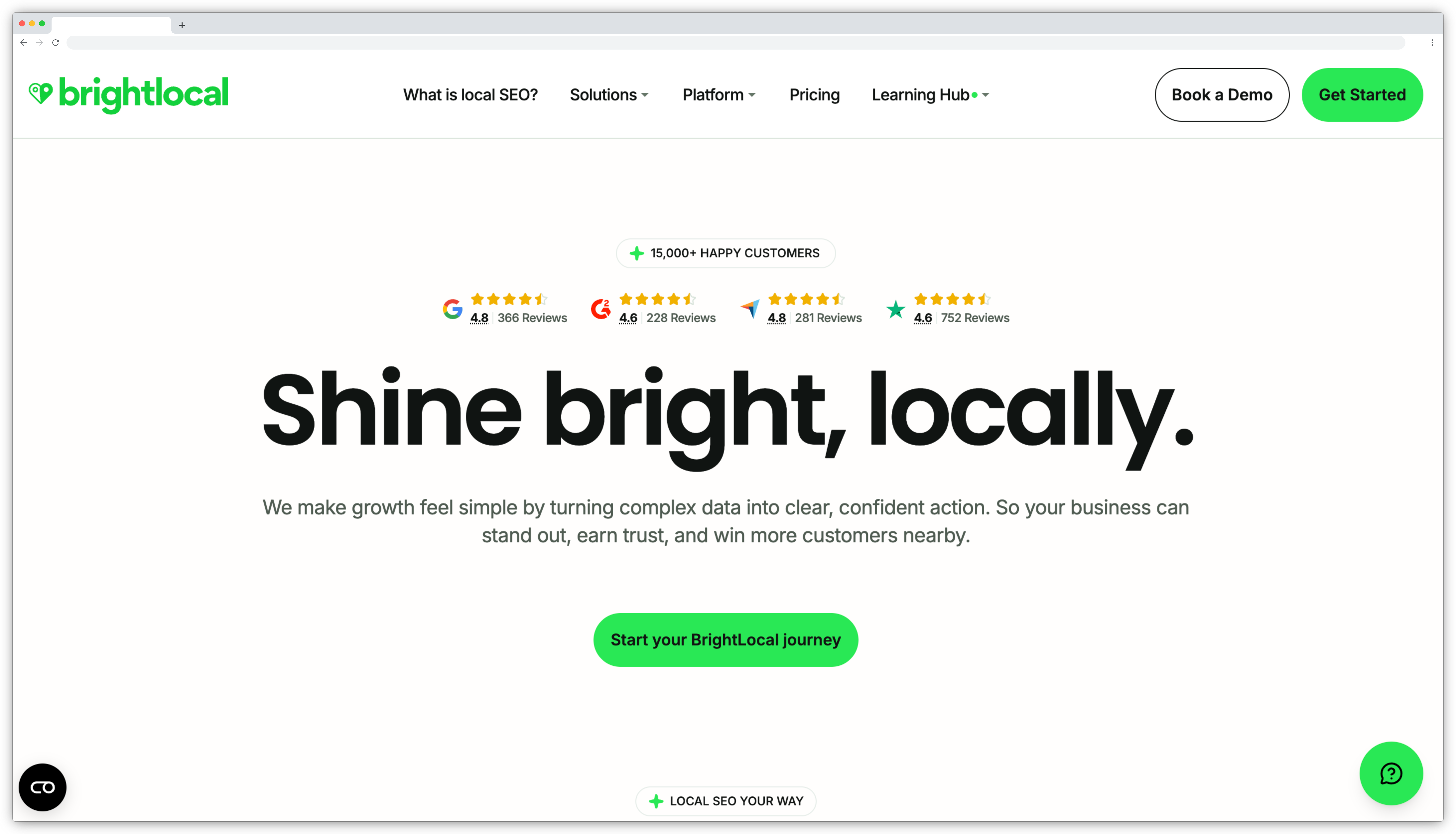
- Where it stands out vs. Birdeye: Built as a local SEO platform first, with review management included — not the other way around. Covers citation building, local rank tracking, and Google Business Profile audits alongside review monitoring and generation, at a price point that makes sense for marketing agencies and SMBs.
- Use case: Marketing agencies managing local SEO for clients, and multi-location businesses that need local search performance tracking and review management in one tool without Birdeye-level pricing.
- Best for: Marketing agencies, local SEO practitioners, and multi-location businesses for whom local search visibility and review management are equally important parts of the same program.
- G2 rating: 4.5/5
BrightLocal is the alternative for teams where "reputation management" and "local SEO" aren't two separate workflows.
The platform handles citation management (consistent NAP data across directories), local rank tracking by keyword and location, Google Business Profile audits, and review monitoring and generation — all from one dashboard. For marketing agencies especially, the white-label reporting makes it practical to manage multiple client accounts without building a custom reporting layer on top.
The pricing is where BrightLocal has a clear structural advantage over Birdeye. Plans start at $39/month and top out at $59/month for most use cases. For the agency managing 10–20 local business clients or the single-location business that needs review and SEO tools without enterprise pricing, this is a meaningful difference.
The review generation tools — automated email and SMS request campaigns, review funnel pages — are functional, though less sophisticated than dedicated platforms like Podium or NiceJob for businesses where review volume is the primary KPI.
Where BrightLocal falls short vs. Birdeye: no social media management, messaging tools, or AI-powered response generation. Review platform coverage is solid at 80+ sources but doesn't reach Birdeye's 150+ platform footprint. For enterprise multi-location brands with complex needs, the depth isn't there. But for the agency and local business segment, the combination of local SEO + review management at an accessible price point is hard to beat.
BrightLocal Features
- Citation building and management across 80+ directories
- Local rank tracking by keyword, location, and device type
- Google Business Profile (GBP) audits and optimization reports
- Review monitoring across 80+ platforms
- Automated review request campaigns via email and SMS
- White-label reporting for marketing agencies
- Competitive local SEO benchmarking by market
BrightLocal Pros
- Local SEO + review management in one tool at a fraction of Birdeye's price
- Best-in-class citation management for local and multi-location businesses
- White-label reporting makes it practical for agencies managing multiple clients
- Transparent, predictable pricing — no per-location compounding at base tiers
BrightLocal Cons
- No social media management or customer messaging tools
- Review platform coverage (80+) is less extensive than Birdeye's 150+ platforms
- Review generation tools are functional but lighter than dedicated alternatives like Podium or NiceJob
BrightLocal Pricing
- Track plan: from $39/month
- Manage plan: from $49/month (most popular for SMBs and agencies)
- Grow plan: from $59/month
- 14-day free trial available
How to Choose the Right Birdeye Alternative
The tools above cover a wide range. The right choice depends almost entirely on which gap you're actually trying to close — and being honest about which part of Birdeye wasn't working for you.
-
If you're leaving because surveys and feedback intelligence are too shallow: Zonka Feedback is the tool built specifically for this gap. NPS, CSAT, and CES programs with AI thematic analysis, sentiment detection, and closed-loop automation — where surveys and post-collection intelligence are the primary product, not the secondary feature.
-
If your primary need is more reviews and faster review generation: NiceJob if you're a service business at SMB scale — simpler, more affordable, and purpose-built for this exact workflow. Podium if you want SMS-first review generation with a unified messaging inbox for customer communication in the same platform.
-
If you need enterprise-level reputation management across many locations: Reputation.com for large multi-location organizations that need deep analytics, BI integration, and healthcare vertical expertise. SOCi if social media management needs to be coordinated alongside reputation at scale, with location-level governance controls. You can also choose Zonka Feedback for the same.
-
If review analytics and competitive benchmarking are the gap: ReviewTrackers — focused almost exclusively on monitoring, analysis, and performance benchmarking without the social and messaging overhead that inflates platform costs.
-
If listings management and local search visibility are the core problem: Yext for directory coverage breadth across 200+ platforms, especially if AI search visibility (generative engine optimization) matters to your program. BrightLocal if local SEO — citation building, rank tracking, GBP audits — needs to sit alongside review management, especially for agencies.
-
If protecting public reputation while improving internally is the priority: GatherUp's private-first model intercepts dissatisfied customers before public posting — a fundamentally different approach from standard review generation that most platforms don't offer.
Wrapping Up
Birdeye works well for what it was built for. The question is whether it still fits what your program actually needs.
If the gap is reviews — there are lighter, more affordable tools that do this better at your scale. If the gap is feedback intelligence — you need a platform where surveys and AI analysis are the core product, not the add-on. If the gap is local SEO — Birdeye isn't the strongest option there either.
The mistake worth avoiding is switching tools without being specific about which problem you're solving. Match the tool to the constraint, and the switch will justify itself.
If you want to see what a feedback intelligence program looks like when NPS, CSAT, and AI analysis are the primary capabilities — not features inside a reputation tool — schedule a demo with Zonka Feedback and see it against your specific use case.

.png)