

.svg)
 Healthcare
 Finance
 Retail
 SaaS & Digital
 eCommerce
 Education
 Salesforce
  HubSpot
 Pipedrive
 Mailchimp
 Klaviyo
 Zendesk
  Intercom
 Freshdesk
 HelpScout
  Front
Front Jira
Jira Slack
Slack  MS Teams
 Zoom
Zoom Google Sheets
  Zapier
  Integrately
 Make
Make  Webhooks




 MS Teams


TL;DR
- Different business scenarios need different NPS templates. Relationship templates measure long-term loyalty. Transactional templates capture feedback right after an interaction.
- Choose templates based on your measurement goal: baseline loyalty, post-purchase feedback, competitive positioning, or driver analysis.
- Template selection impacts response rates. Shorter templates work for transactional surveys. More detailed templates work for periodic relationship check-ins.
- Match the template to the channel. SMS surveys need ultra-short formats. Email surveys can handle 3-4 questions. Website surveys work best as single-screen experiences.
- All templates include the core 0-10 recommendation question. What changes is the follow-up structure and when you deploy it.
The relationship between businesses and their customers has evolved with time.
Today, it doesn't end with the customer buying products/services from the business. That's just the beginning of a relationship where the customer becomes a recurring buyer and recommends the brand to their friends, family, and colleagues.
But how do you know if customers will actually promote your brand?
You ask.
Businesses run Net Promoter Score (NPS) surveys on their websites, via email, or through SMS to measure the likelihood of getting recommended. The structure is simple: a 0-10 rating question plus a follow-up asking why.
That's NPS at its most basic. But picking the right template for your specific scenario matters more than most teams realize. Send a relationship survey right after a purchase and you'll get noisy data. Send a five-question template via SMS and nobody will finish it. Use a generic template when you need competitive positioning data and you'll miss the insights you're actually looking for.
This guide helps you choose the right NPS template for your business scenario. We'll cover 10 template types, when to use each one, and how to match templates to your measurement goals and distribution channels.
How to Choose the Right NPS Survey Template
Before diving into specific templates, you need to answer three questions:
1. What are you measuring? Overall relationship loyalty? Satisfaction with a specific interaction? Competitive positioning? The drivers behind your score?
2. When are you asking? Right after an interaction (transactional)? On a quarterly schedule (relationship)? At specific lifecycle moments?
3. Where will customers take the survey? Email? SMS? Website? In-app? The channel determines how long your template can be.
Once you know those three things, picking the template becomes straightforward. Different NPS surveys serve different purposes. Here's how to match template to goal.
Template Selection Framework: Relationship vs Transactional
The first decision: are you measuring the overall relationship or a specific interaction?
-
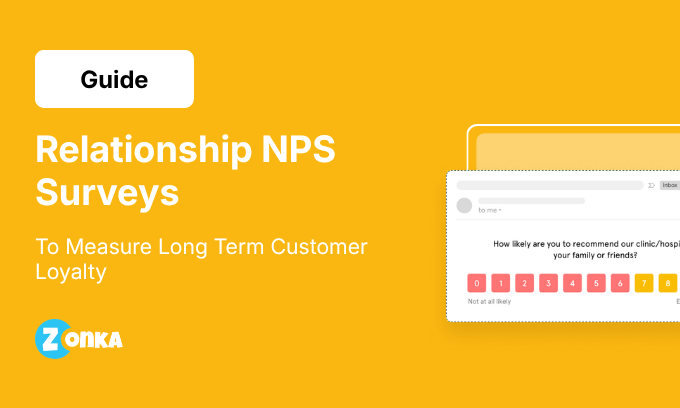
Relationship templates measure long-term loyalty. They ask customers to think about their entire experience with your brand. Send these quarterly, annually, or at major lifecycle moments like renewal or onboarding completion. They give you a baseline loyalty score you can track over time. For more on this approach, see our guide to relationship NPS surveys.
-
Transactional templates measure moment-specific satisfaction. They fire immediately after a purchase, support case, delivery, or feature use. They tell you what's working or breaking at specific touchpoints. The feedback is concrete and actionable because it's tied to something that just happened. Learn more about transactional NPS surveys.
Most businesses need both. Relationship surveys tell you where the account stands. Transactional surveys tell you what's driving it. For a detailed comparison, see relationship vs transactional NPS.
Template Types by Measurement Goal
Here are the 10 most common NPS template types. Each serves a specific measurement goal. For actual question wording and examples, see our complete guide to NPS survey questions.
1. Standard NPS Survey Template
Use this when: You need a clean baseline of customer loyalty without adding complexity.
Template structure: Two questions. Core 0-10 recommendation rating plus an open-ended follow-up asking why.
Best for: First-time NPS deployment, quarterly relationship check-ins, annual loyalty benchmarking.
Channel fit: Works across all channels. Email, SMS, website, in-app, kiosk.
This is the foundation. Start here if you're running your first NPS program. The standard NPS Survey template gives you the core score plus qualitative context without overwhelming respondents. Once you have baseline data, you can layer in more detailed templates for specific use cases.
2. Post-Purchase NPS Survey Template
Use this when: You want feedback on the buying experience specifically, not the overall relationship.
Template structure: Four to five questions. Core NPS rating framed around the purchase, plus follow-ups on what worked, what didn't, and open comments.
Best for: eCommerce stores, retail businesses, any company where the purchase moment is a critical touchpoint.
Channel fit: Email surveys 24-48 hours post-purchase, SMS surveys immediately after delivery, website surveys on order confirmation pages, kiosk surveys at checkout in physical stores.
Timing matters: Send this while the experience is fresh. Within 24-48 hours of purchase or delivery. Wait longer and recall fades. For more on timing, see when and where to collect NPS surveys.
The post-purchase template is transactional by design. It measures satisfaction with a specific moment, not loyalty to the brand. Use this to optimize checkout, delivery, packaging, or first-use experience.
Try The Post Purchase NPS Survey Template
3. Relationship NPS Survey Template
Use this when: You want to track overall brand loyalty over time, independent of any single interaction.
Template structure: Two questions. Core NPS rating about the overall relationship plus an open-ended follow-up.
Best for: Quarterly or annual loyalty tracking, customer health monitoring, churn prediction, account-level scoring.
Channel fit: Email works best. Relationship surveys need more thought than transactional surveys, so give customers time and space to respond.
Frequency: Send this on a schedule, not triggered by events. Quarterly works for most B2B businesses. Annually works for low-touch B2C. For subscription businesses, send it 30 days before renewal.
This template measures the entire experience, not a moment. Customers think about every interaction they've had with you: onboarding, support, product, billing, all of it. The score reflects cumulative satisfaction. For implementation guidance, see how to implement NPS programs.
Try The Relationship NPS Survey Template
4. NPS Survey Template With Comments
Use this when: You need deeper qualitative feedback and the score alone isn't enough.
Template structure: Two questions. Core NPS rating plus a large text box for open-ended comments.
Best for: Early-stage businesses learning what drives satisfaction, companies with small customer bases where every comment matters, programs with strong feedback loop processes.
Channel fit: Email surveys where customers have time to write. Avoid this on SMS or website pop-ups where typing is friction.
What you get: Rich qualitative data you can feed into sentiment analysis or thematic tagging. The comments tell you what's behind the score. For analyzing this data, see our guide to NPS data analysis and reporting.
This template prioritizes depth over structure. You'll get detailed feedback, but it requires manual analysis unless you're using AI to categorize responses.
Try The NPS Survey Template With Comments
5. NPS Survey Template With Customer Information
Use this when: You need to segment responses by customer demographics, usage patterns, or account characteristics.
Template structure: Three or more questions. Core NPS rating, follow-up question, plus data capture fields for name, email, company size, role, industry, etc.
Best for: B2B companies segmenting by company size or industry, SaaS businesses segmenting by usage tier or feature adoption, any business that needs to connect NPS to customer attributes.
Channel fit: Email surveys where form-filling feels less intrusive. Avoid adding too many fields to SMS or in-app surveys.
Why it matters: Aggregate NPS hides important patterns. A score of 40 could mean half your Enterprise customers are promoters while SMB customers are detractors, or vice versa. Customer information fields let you spot those patterns. For industry-specific insights, see guides like SaaS NPS surveys or NPS for B2B vs B2C.
Try The NPS Survey Template With Customer Information
6. NPS Survey Template With Follow-up Question
Use this when: You want structured follow-up data that's easier to analyze than open text.
Template structure: Three questions. Core NPS rating plus two multiple-choice follow-ups asking what worked and what didn't.
Best for: High-volume programs where manual comment analysis isn't scalable, businesses tracking improvement over time on specific attributes, teams using NPS dashboards to surface trends.
Channel fit: Works across all channels. Multiple choice is faster than typing, so this works even on mobile.
What you gain: Structured data you can track over time. If 40% of detractors cite customer service in Q1 and that drops to 15% in Q2, you know your improvements are working. The trade-off: you miss insights that don't fit your predefined categories.
This template balances depth and scale. You get directional data on drivers without drowning in unstructured comments. For next steps after collection, see NPS follow-up emails.
Try The NPS Survey Template With Follow-up Question
7. Product NPS Survey Template
Use this when: You're measuring satisfaction with a specific product or feature, not the company as a whole.
Template structure: Three questions. Core NPS rating framed around the product, plus follow-ups on favorite features and improvement suggestions.
Best for: SaaS companies tracking product-level loyalty, product teams prioritizing roadmap decisions, businesses with multiple products where company-level NPS masks product-specific issues.
Channel fit: In-app surveys work best. Trigger them after feature use or at product milestones. For more on in-app deployment, see how to collect NPS on your website.
Why separate product NPS from company NPS: A customer can love your product but hate your billing system. Or tolerate a mediocre product because your support is outstanding. Product-specific templates isolate what you're actually measuring.
This product survey template helps product teams tie NPS changes to specific features or releases. If your score jumps 10 points after launching a feature, you know it resonated.
Try The Product NPS Survey Template
8. Competitive NPS Survey Template
Use this when: You need market positioning data and want to benchmark your NPS against competitors.
Template structure: Four or more questions. Brand familiarity check, NPS rating for each brand, competitive strength/weakness questions, opportunity identification.
Best for: Businesses entering new markets, companies facing new competitive pressure, leadership teams needing market positioning data for strategic planning.
Channel fit: Email surveys where customers have time to evaluate multiple brands. Too long for SMS or quick website pop-ups.
What you learn: How you stack up against alternatives, what competitors do well that you don't, what would make switchers choose you. This is the only template that gives you direct competitive comparison data.
Caution: This template asks customers to evaluate brands they may not use. The data is valuable but less reliable than direct customer feedback. Use it for directional insights, not absolute truth.
Try The Competitive NPS Survey Template
9. NPS & Brand Loyalty Survey Template
Use this when: You want to connect NPS scores to actual purchase behavior and brand attachment.
Template structure: Four questions. Purchase frequency, brand recall, NPS rating, reason for score.
Best for: Retail businesses, consumer brands, any company where repeat purchase matters more than subscription retention.
Channel fit: Email surveys post-purchase or as part of quarterly relationship check-ins.
What you gain: Behavioral context for the score. A customer who scores 9 but hasn't purchased in six months is a different profile than one who scores 9 and buys monthly. The behavioral data tells you if loyalty translates to action. For connecting NPS to business outcomes, see NPS and customer lifetime value.
This template is particularly useful for businesses where purchase frequency varies widely across customers. It helps you identify high-intent promoters versus satisfied-but-dormant customers.
Try The NPS & Brand Loyalty Survey Template
10. NPS Key Drivers Template
Use this when: You need to identify which specific factors drive your NPS score so you know where to focus improvement efforts.
Template structure: Four questions. Core NPS rating, improvement areas (multiple choice), open suggestions, strength areas (multiple choice).
Best for: Mature NPS programs looking to improve scores, businesses with resources to act on findings, teams using driver analysis to prioritize roadmap or CX investments.
Channel fit: Email surveys. This template is longer and requires more thought, so it doesn't work well on SMS or quick website pop-ups.
What you learn: Which factors matter most. If 65% of detractors cite customer service and 40% cite product quality, you know service is the bigger lever. Driver analysis turns NPS from a score into a prioritization framework. For visualizing this data, see NPS dashboards and reports.
This is the most detailed template in the list. Use it when you're past the baseline-setting phase and ready to optimize specific drivers. For improvement strategies, see how to improve a bad NPS score.
Try The NPS Key Drivers Template
Template Selection by Channel
The channel you use determines how complex your template can be.
-
SMS surveys: Stick to two questions maximum. The core NPS rating plus one short follow-up. Anything longer and completion rates drop. For SMS-specific guidance, see NPS surveys on WhatsApp, SMS, and in-app.
-
Email surveys: You can go up to four or five questions if the content justifies it. Relationship surveys, key driver templates, and competitive surveys all work here. For email best practices, see NPS survey emails.
-
Website surveys: Single-screen templates work best. The standard two-question format or post-purchase template. Avoid multi-page surveys that feel like work. For implementation details, see how to collect NPS on your website.
-
In-app surveys: Keep it contextual. Product NPS templates work well here because they tie to what the user just did. Trigger them after feature use or milestone completion.
For more on matching templates to distribution channels, see when and where to collect NPS surveys.
Common NPS Template Selection Mistakes
Here's where teams typically go wrong:
-
Using relationship templates for transactional moments. Asking "How likely are you to recommend us overall?" right after a single support interaction gives you noisy data. The customer hasn't had enough touchpoints to form a relationship view. Use transactional templates for transactional moments.
-
Using transactional templates for relationship measurement. Sending post-purchase NPS surveys quarterly as your only loyalty measurement misses everything between purchases. Relationship templates exist for a reason.
-
Picking templates that are too long for the channel. A four-question survey on SMS gets abandoned. A two-question survey via email leaves insights on the table. Match template length to channel expectations.
-
Using generic templates when you need specific data. The standard template won't tell you which product features drive loyalty or how you compare to competitors. If you need specific insights, use a specialized template.
-
Not linking scores to action. No template matters if you're not closing the feedback loop. Choose templates that give you actionable data you can actually use.
How to Get Started With These Templates
Start with the standard two-question NPS template. Get baseline data. Track it for one quarter. Once you have that foundation, layer in specialized templates for specific use cases.
-
Deploy standard relationship NPS template to your customer base. Establish baseline score.
-
Add post-purchase transactional template at key touchpoints. See how interaction-level scores compare to relationship scores.
-
Introduce key drivers template for a segment of customers. Identify what's driving your score up or down.
Ongoing: Refine template selection based on what you learn. If product issues dominate the feedback, shift to product-specific templates. If competitive pressure increases, add competitive templates. For program setup guidance, see how to create an NPS survey and NPS campaign planning.
Every template in this guide is available through Zonka Feedback. Pick your template, customize it for your business context, deploy it across email, SMS, website, or in-app, and connect it to NPS automation workflows so scores trigger the right follow-up actions automatically.
For actual question wording and examples for each template type, see our complete guide to NPS survey questions.