

.svg)
 Healthcare
 Finance
 Retail
 SaaS & Digital
 eCommerce
 Education
 Salesforce
  HubSpot
 Pipedrive
 Mailchimp
 Klaviyo
 Zendesk
  Intercom
 Freshdesk
 HelpScout
  Front
Front Jira
Jira Slack
Slack  MS Teams
 Zoom
Zoom Google Sheets
  Zapier
  Integrately
 Make
Make  Webhooks




 MS Teams


TL;DR
- NPS surveys in Salesforce measure customer loyalty at the relationship level, not after individual support tickets.
- Map NPS responses to Contact and Account records, not Cases. The object choice determines whether your data is usable 12 months from now.
- Salesforce Flow handles automation: trigger, timing, suppression, and closed-loop follow-up, without code.
- A closed-loop process (detect, route, recover, measure) is what separates programs that reduce churn from programs that generate reports nobody acts on.
- Trend and loop closure rate matter more than hitting an industry benchmark number. For tool selection, see our NPS tools for Salesforce comparison. This guide covers strategy and implementation.
Most Salesforce teams that run NPS think they're measuring account health. They're not. They're measuring how the last support interaction went, because the survey is firing on Case closure instead of at relationship moments. The scores look like loyalty data. They correlate with ticket quality. And the renewal team is making retention decisions based on it.
We saw exactly this play out with a B2B SaaS company we worked with. They'd been running NPS inside Salesforce for 14 months. Good response rates. Regular reports. A CS team that actually looked at the scores. But every survey was triggering on Case closure. Their "account health" NPS was actually a rolling average of support ticket quality. Detractor scores spiked every time support had a bad week, independent of whether the actual account relationship was at risk.
That's the mistake this guide is specifically designed to prevent.
It covers NPS strategy and setup in Salesforce: the right trigger moments, the right Salesforce objects, how to configure field mapping so your data is usable at 12 months, and what the closed-loop process looks like when it actually works. For a broader view of how NPS fits alongside CSAT and CES in a Salesforce survey program, see our complete Salesforce survey guide.
What Is an NPS Survey in Salesforce?
| Definition | A Net Promoter Score survey triggered from Salesforce events, with responses mapped back to Salesforce records (Contacts, Accounts, Opportunities) |
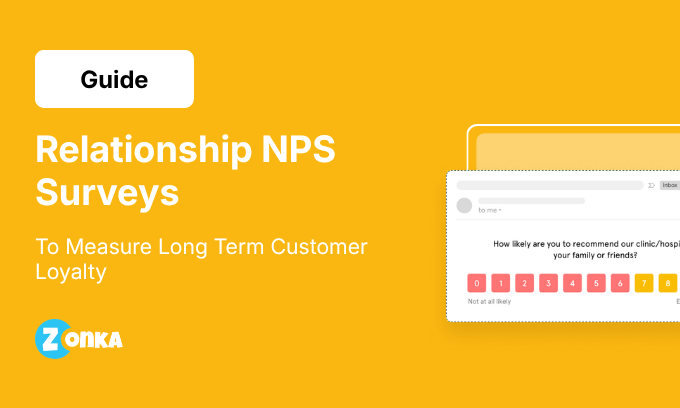
| The question | "How likely are you to recommend us to a colleague or friend?" (0-10 scale) |
| Scoring | Promoters (9-10) minus Detractors (0-6) = NPS. Passives (7-8) excluded. Range: -100 to +100. |
| What Salesforce adds | Response data attaches to CRM records so CS teams see loyalty signals next to renewal dates, contract value, and usage data, not in a separate dashboard |
NPS was developed by Fred Reichheld at Bain & Company in 2003 as a way to measure loyalty that correlates with revenue growth. In simple terms: the question isn't about satisfaction with a single experience. It's about whether the overall relationship is strong enough that a customer would put their own reputation on the line by recommending you. Our NPS program guide covers the full methodology, calculation, and program design.
The score is a headline. The open-text follow-up ("What's the main reason for your score?") is where the signal actually lives. A Promoter who writes "your onboarding team kept us from cancelling in month two" is telling you something you can replicate across other accounts. A Detractor who writes "we've had three account managers in two years" is telling you something you need to fix before renewal. The number tells you direction. The comment tells you what to do about it.
The Salesforce-specific part is where the response lands. NPS doesn't belong on a Case record: Cases track individual interactions, and NPS is relational. Put it on the Contact record for individual sentiment trending, and roll it up to the Account for health monitoring. That's the structure that makes it useful rather than decorative. For more on the Net Promoter Score metric itself, the dedicated guide goes deeper.
Transactional vs Relationship NPS: Getting the Timing Right
This is where most Salesforce NPS programs go sideways, usually before anyone has written a single Flow rule.
Relationship NPS has nothing to do with a specific ticket or interaction. It's a periodic read on how customers feel about the overall relationship. Send it quarterly, post-onboarding, at renewal windows, or at lifecycle anniversaries. Map responses to Contact and Account records. This is the data CSMs and account managers need to manage accounts proactively, not just react when something breaks.
Transactional NPS ties to a specific event: a deal closing, an implementation completing, a training session ending. A closed deal is one of the better NPS trigger moments: customers have been through your entire sales process and their impression is fresh. Map this to the Opportunity record. Over time, you can correlate deal size, rep, product line, and sales cycle length with post-close satisfaction. That correlation ends up being more useful for sales leadership than the NPS score in isolation: it shows which deal types set CS up for success and which create churn risk from day one.
The mistake most Salesforce teams make is sending NPS when a Case closes. That's a CSAT moment. Customers who've just had a difficult support experience will pull scores down in ways that don't reflect the actual account relationship. Use CSAT on cases. Save NPS for when there's a relationship to measure.
For how to run both types side by side without over-surveying the same contacts, see our relationship vs transactional NPS guide.
How to Set Up NPS Surveys in Salesforce
Five steps. The first three move quickly. Step four, field mapping, is where teams cut corners and spend the following year wondering why their NPS reports can't answer the questions leadership is asking.
Step 1: Connect Your Survey Platform to Salesforce
Salesforce's native Feedback Management (available with Service Cloud or Experience Cloud licenses) handles basic NPS distribution via Salesforce email and maps responses to standard objects. For simple quarterly NPS programs running entirely within Salesforce, this works and there's no reason to add a third-party tool.
If you need omnichannel distribution (SMS, in-app, WhatsApp), AI analysis on open-text responses, or more flexible workflow automation, you'll need a dedicated feedback platform. With Zonka Feedback, the Salesforce integration is native: go to Integrations, select Salesforce, and log in with your Salesforce credentials via OAuth. One-time authentication, no package installation. Once connected, your Salesforce records (Contacts, Accounts, Cases, Opportunities, custom objects) become available as trigger sources and mapping targets in both directions.
Step 2: Build the NPS Survey
The survey is one question. The open-text follow-up is what gives you enough context to act on the score: without it, you're left with a number and no idea what's behind it.
Customize the follow-up by score segment, and go beyond just "detractors vs. promoters":
- For Detractors (0-6): "What would need to change for you to score us higher?"
- For Passives (7-8): "What's one thing that would make your experience better?"
- For Promoters (9-10): "What do you value most about working with us?"
A Detractor who just finished onboarding is frustrated about something different than a Detractor at month 18. And Promoter feedback is consistently the most underused data in NPS programs: customers telling you what they value is product positioning data. Don't waste it on "Any other comments?"
Keep it short. One follow-up, open-text, optional. Programs that add three or four questions after the score see meaningful drops in completion rate, which reduces the open-text volume needed for reliable analysis at scale.
Step 3: Configure NPS Triggers in Salesforce Flow
Salesforce Flow handles trigger logic without code. Here's the decision architecture before you build, because the structure you choose determines what you can report on later.
Start with the trigger event. Flow fires when a record is created or updated. For NPS, that typically means: a Contact field changes (Onboarding_Complete__c = True), a scheduled time window relative to an Account field (Renewal_Date__c is 60 days out), or an Opportunity stage changes to "Closed Won."
Then add the time delay. Flow's Scheduled Paths let you wait before sending. Post-close NPS should wait 14 days: customers who just signed are in an optimistic state but haven't experienced the product yet, so the score reflects the sales process rather than the relationship. Two weeks gets them through initial onboarding steps and produces a more grounded read. Post-implementation NPS should wait even longer: 30 days minimum after go-live, not after contract signature.
Then check the suppression condition. Before sending, Flow checks Last_NPS_Date__c on the Contact. If the date is within the last 90 days, the record is excluded and the Flow path ends. Most initial configurations skip this step. It's the step that creates the survey fatigue problem three months later.
Then send and update. Flow sends the survey via the configured channel, then immediately writes today's date to Last_NPS_Date__c on the Contact record. That write is what makes suppression work for subsequent runs.
Four nodes: trigger, delay, suppression check, send and update. That's the minimum viable NPS Flow. Salesforce's Flow Builder documentation covers the mechanics of each node type. For guidance on how often to send NPS surveys across different business types, the dedicated guide has cadence recommendations.
Step 4: Map NPS Data to the Right Salesforce Objects
This is where programs get built wrong, and it's not obvious until 6-12 months in when someone tries to build a longitudinal report and discovers the data structure won't support it.
We worked with an enterprise SaaS team (about 400 employees, mid-market Salesforce deployment) that had two years of NPS responses mapped to Case records because their initial integration defaulted to it and nobody questioned the configuration. When their VP of Customer Success asked "which CSMs have the most at-risk accounts?", the data couldn't answer it. Each NPS response was isolated to its Case with no thread back to the Contact or Account. They had to rebuild the field structure and re-survey to establish a clean baseline. Six months of remediation work that a correct initial setup would have avoided.
The principle: land the survey response on the object closest to what triggered it AND on the object that owns the long-term relationship. For relationship NPS, that means two simultaneous mappings.
On the Contact record (fields that support trending over time):
NPS_Score__c(Number, 0 decimal places): the raw 0-10 score from the most recent surveyNPS_Category__c(Picklist: Promoter / Passive / Detractor): auto-classified from the score, lets you filter reports without formula logic on every runLast_NPS_Date__c(Date): critical for suppression logic in Flow. Without this field, you can't reliably prevent over-surveyingNPS_Response_Count__c(Number): how many surveys this Contact has completed. Useful for identifying chronic non-responders vs. engaged customersNPS_Open_Text__c(Long Text Area, 32,768): verbatim comment. The field most teams forget and regret not having when they want to do keyword analysis six months later
On the Account record (fields that represent account-level health, not individual response data):
Account_NPS_Score__c(Roll-Up Summary or Formula): average NPS across all Contacts on the Account who've responded in the past 12 monthsAccount_NPS_Category__c(Formula Text): derives Promoter/Passive/Detractor from the aggregate score. This is what CS leadership wants on the Account page layout alongside ARR and renewal dateNPS_Response_Date__c(Date): most recent response from any Contact on the Account. Shows which accounts haven't been surveyed recently at a glance
A common setup error: storing NPS only on the Contact and trying to surface it at the Account level through report grouping. This works until you have multiple contacts per account with different scores, at which point report aggregation produces inconsistent results depending on how the report is built. Setting up a dedicated Account-level field from the start gives you a cleaner data model.
For Opportunity-triggered NPS, also add NPS_Score__c and NPS_Response_Date__c directly to the Opportunity record. Over time, you can report on Opportunity NPS by rep, deal size, and product line in a single standard Salesforce report, no custom joins needed. For the technical setup of Custom vs Managed mapping, see our Salesforce survey mapping types guide.
Step 5: Set Survey Cadence and Suppression Rules
Set these before you go live. Adding suppression logic after a program is running, especially with multiple NPS triggers active, is significantly more complex than building it in from the start.
- Relationship NPS: 90-day minimum between surveys to the same Contact. Enforced in Flow by checking
Last_NPS_Date__cbefore each send. - Transactional NPS: Same 90-day suppression after any NPS send, regardless of trigger type. A customer who just received a post-close NPS shouldn't receive a quarterly relationship NPS six weeks later.
- Global suppression: A separate
Last_Survey_Response_Date__cfield, updated on any survey response (not just NPS), lets Flow check whether a Contact responded to any survey in the last 30 days and hold the next send accordingly.
Closed-Loop NPS Automation in Salesforce
The collection side of NPS is what everyone builds. The closed-loop process is what most teams say they'll figure out after launch. "After launch" becomes "never" in most organizations, and that's where programs stop being useful.
Build the loop before you send your first survey.
Detect: Categorize Responses Automatically
When a response lands, Salesforce categorizes by segment and triggers the right downstream actions:
- Detractors (0-6): Flag for immediate follow-up. Human response within 48 hours, not an automated acknowledgment email.
- Passives (7-8): Route for engagement nurture. A proactive check-in, a QBR invite, or a relevant feature spotlight moves a meaningful share of 7s and 8s to 9s over time. Most programs ignore this segment entirely, which is a missed opportunity given that passives are one good conversation away from becoming promoters.
- Promoters (9-10): Trigger a referral or review request. Customers who've just told you they're happy are the best possible moment to ask for a G2 review or a peer introduction.
If you're running AI analysis on open-text, detection extends beyond score buckets. A 7 with a comment that reads "I like the product but our CSM goes quiet for days at a time" isn't really neutral: it's a service quality signal that should route to a manager, not sit in a passive queue until the next quarterly review.
Route: Auto-Assign Follow-Up in Salesforce
Flow creates a Task or Case for each Detractor and assigns it based on account characteristics:
- Strategic account (Contract_Value__c > $50K): assign to CSM, notify CSM manager
- Mid-market account: assign to CSM
- No CSM assigned: route to CS queue
Set an SLA on the Task and measure whether the team is hitting it. We've seen situations where 60% of Detractor responses sat unacknowledged for two or more weeks, and those customers were contacted six months later by a renewal rep who had no visibility into what they'd submitted. The renewal conversation started from a deficit that didn't need to exist.
Recover: Close the Loop with the Customer
Personal outreach, not a template. The CSM reads the comment, references the specific issue ("You mentioned the transition between support tiers has been slow, I want to understand what that's looked like for you"), and documents the outcome on the Contact record. That documentation is what makes the next survey cycle meaningful: you can see whether the intervention actually changed the trajectory, or whether the same issues are still driving Detractor scores six months later.
If your team can't follow up with every Detractor at current scale, run the program at 30% of your contact base with guaranteed follow-up rather than at full scale with no loop. The smaller program produces more useful data.
Measure: Track Recovery Over Time
Most programs track response rate and aggregate score. The metric that tells you whether the program is working is loop closure rate: what percentage of Detractors received a follow-up, and of those, how many improved their score in the next cycle?
Track loop closure in Salesforce by reporting on Task completion rates tied to NPS response records, then join subsequent Contact scores back to the original Detractor record. That report is the one that demonstrates program value to leadership: not the score itself, but evidence that the program is moving sentiment in accounts that matter.
For how NPS data connects to executive reporting and product feedback loops, see the Salesforce CX program guide.
NPS Benchmarks for Salesforce Teams
Most published benchmarks aren't particularly useful for evaluating your own program. They aggregate companies at different relationship stages, different survey timing, and different customer bases. A company surveying at month 3 of onboarding scores differently from the same company running quarterly relationship NPS at 18 months: comparing either number to an industry average doesn't tell you whether your program is working.
That said, some orientation is useful. Bain & Company's Net Promoter System research (Bain developed the methodology and has tracked scores across industries since 2003) shows typical ranges roughly as:
- B2B SaaS: 25-45 for healthy programs. Above 50 is genuinely strong. Below 20 usually indicates a loop problem, not a product problem.
- Enterprise support operations: 20-35 is common. Post-implementation NPS tends to run 10-15 points higher than ongoing support NPS for the same customer base.
- Financial services / professional services: 25-50, with meaningful variance depending on whether the relationship is transactional or advisory.
- Post-close / post-onboarding NPS: Usually higher than relationship NPS. The honeymoon period effect is real and tends to flatten by month 6.
In simple terms: trend matters more than the absolute number. A program moving from 22 to 38 over four cycles, with a documented closed-loop process, is in better shape than one sitting at 50 with declining scores quarter over quarter. For sector-specific benchmarks, what's a good Net Promoter Score has more detail.
In Salesforce, segment before you report. An aggregate NPS of 32 could mean enterprise accounts at 50 and SMB accounts at 12: two completely different business problems requiring different responses. The segment breakdown is where actionable information lives.
Common NPS Mistakes in Salesforce
These tend to compound quietly. Bad data leads to decisions made on the wrong signal, which leads to a leadership team that stops trusting the numbers. By then, rebuilding credibility for the program is a harder sell than starting over.
Sending NPS after support cases. The SaaS company described in the intro is a good example of how far this can propagate without anyone noticing. Case-close NPS produces scores that look like account health data but are actually interaction data. Anyone who pulls the report without knowing the trigger logic will draw the wrong conclusions. Use CSAT surveys in Salesforce for post-case feedback. Save NPS for relationship moments.
Mapping NPS to the Case record. Related to the above, but it also happens independently, usually because the initial integration defaulted to it. An NPS response on a Case record has no thread connecting it to how that customer's sentiment has shifted over time. The Contact record is the right object, and it's significantly harder to migrate historical data than to start with the right structure.
No closed-loop process at launch. A bad score with no follow-up accelerates churn faster than if you'd never sent the survey. Build the loop before you send. If capacity is a constraint, a smaller program with guaranteed follow-up outperforms a full-scale program with no loop.
Over-surveying without suppression rules. Running multiple NPS triggers without a global suppression window creates fatigue. The contacts who keep responding despite fatigue tend to be your most engaged customers, which skews aggregate scores upward in a way that looks like improvement but reflects self-selection, not real sentiment change. For tactical guidance on cadence, see NPS follow-up email sequences.
Treating NPS as the only metric. NPS tells you where the relationship stands. It doesn't tell you why. Pair it with CSAT for interaction-level satisfaction and CES for identifying where your workflows create unnecessary friction. The three metrics together give you a feedback picture that NPS alone can't deliver.
NPS is the metric that tells you whether your customer relationships are heading toward loyalty or toward churn. But the score alone changes nothing. What makes it work is the system around it: the right trigger moments, the right object mapping, a closed-loop process that turns every low score into a recovery action and every high score into an advocacy opportunity. The companies that get NPS right in Salesforce aren't the ones with the highest scores. They're the ones who act on every score they collect.