

.svg)
 Healthcare
 Finance
 Retail
 SaaS & Digital
 eCommerce
 Education
 Salesforce
  HubSpot
 Pipedrive
 Mailchimp
 Zendesk
  Intercom
 Freshdesk
 HelpScout
  Front
Front Jira
Jira Slack
Slack  MS Teams
 Zoom
Zoom Google Sheets
  Zapier
  Integrately
 Make
Make  Webhooks




 MS Teams


TL;DR
-
B2B SaaS customer surveys fail when they're sent at the wrong stage, or not sent at all between onboarding and renewal.
-
The B2B SaaS customer journey has 8 distinct feedback moments: Website Research, Demo, Purchase, Implementation, Onboarding, Adoption, Support, and Renewal.
-
Each stage needs a different survey type: CES for effort-heavy stages, NPS for loyalty checkpoints, CSAT for interaction-specific moments.
-
Survey questions should carry a trigger, a format, and a follow-up. Not just "How was your experience?"
-
Bain & Company research shows that increasing customer retention by 5% can grow profits by 25–95%.
-
Acquiring a new customer is anywhere from 5 to 25 times more expensive than retaining an existing one. The survey program you build across these 8 stages is what makes retention happen.
Your NPS score looks fine. Churn goes up anyway.
This is the story of most B2B SaaS companies that survey. They run a quarterly NPS. They close support tickets and forget to ask how it went. They hand off new customers to onboarding without a single CES checkpoint. And then, three months before renewal, they're surprised.
The problem isn't that they don't survey. It's that they survey in isolation — one metric, one moment, no map.
The B2B SaaS customer journey doesn't start at onboarding and end at renewal. It starts the moment a prospect lands on your website trying to understand if your product is worth a demo. And it ends, or restarts, when they decide whether to stay. In between, there are eight distinct stages where survey data can either prevent a problem or confirm you missed one.
This guide maps each stage to the right survey type, the questions that actually surface signal, and the timing that gets responses. Whether you're building your first feedback program or overhauling a scattered one, this is the sequence that works.
B2B SaaS Customer Journey: Surveys at a Glance
Before going deep on each stage, here's the full map.
| Stage | Survey Type | Trigger | Channel |
| Website Research | CSAT / CES | Exit intent or 30-second page dwell | Website popup / slide-up |
| Product Demo | CSAT | 1 hour post-demo | |
| Product Purchase | NPS + CSAT | Immediately post-purchase | |
| Product Implementation | CES + CSAT | Go-live milestone | Email / In-app |
| Customer Onboarding | CES then CSAT | End of each onboarding step, then Day 7 | In-app slide-up |
| Product Adoption | NPS + Feature CSAT | Day 30, 60, 90 + post-feature use | In-app popup |
| Customer Support | CES + CSAT | Ticket closed | Email / In-app |
| Renewal | NPS + CSAT | 30–45 days before renewal date |
NPS, CSAT, and CES: What Each Actually Measures
Three metrics show up repeatedly across the B2B SaaS customer journey. Here's what each one is built for, and where it breaks down when misapplied.
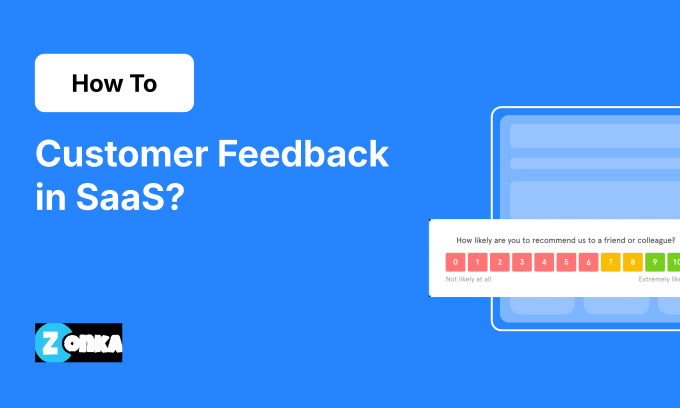
Net Promoter Score (NPS) measures loyalty over time. It asks customers how likely they are to recommend you on a 0–10 scale and splits them into Promoters (9–10), Passives (7–8), and Detractors (0–6). NPS works best at relationship moments, not immediately after a support ticket. The frequency and timing decisions matter as much as the question itself.
Customer Satisfaction Score (CSAT) measures satisfaction with a specific interaction. It's transactional and immediate: "How was your onboarding call?" rather than "How do you feel about us overall?" Use it right after discrete events.
Customer Effort Score (CES) measures friction. "How easy was it to complete this task?" It's the most actionable metric for process-heavy stages like implementation and support, because effort is something you can fix.
None of these work in isolation. The best B2B SaaS feedback programs stack them deliberately across the journey.
Stage 1: Website Research Surveys
What's happening
A prospect lands on your website, probably from a search, a G2 listing, or a referral. They're reading your homepage, checking your pricing page, watching a product video. They haven't talked to anyone yet. This is their first impression of you, shaped entirely by what they find, or don't find, on their own.
Why survey here
Website friction is invisible without feedback. You can see bounce rates in analytics, but you can't see why someone left the pricing page without booking a demo. A one-question website survey catches that gap before it costs you a qualified lead.
Surveys at this stage collect digital feedback from anonymous visitors, so you're not capturing personal data, just intent signals. G2 does this well: they place slide-up widgets on specific high-intent pages (their review submission page, pricing page, and research pages) rather than running the same survey sitewide. Over 33,700 responses collected from targeted website surveys alone. The lesson is page-level targeting, not site-wide coverage.
Survey type
CSAT for overall experience. CES for navigation and findability.
Questions that work
- "Did you find what you were looking for today?" (CSAT, 5-point scale)
- "How easy was it to understand what [product] does from this page?" (CES, 7-point agreement scale)
- "What almost stopped you from booking a demo?" (open-ended, exit intent popup)
Timing and channel
Trigger the popup after 30 seconds on high-intent pages (pricing, features, comparison pages) or on exit intent. Keep it to one question. A slide-up works better than a centered popup here; it doesn't interrupt reading.
Stage 2: Post-Demo Surveys
What's happening
Your prospect just sat through a 30–45 minute product demo. They have opinions. About the fit. About the presenter. About whether the use case resonated. Most sales teams never ask.
Why survey here
Post-demo CSAT tells your sales team what objections are forming before the prospect says them out loud. A low "fit" score after a demo is infinitely more useful than a no-show on a follow-up call. It also gives Customer Success early signal about how the deal was positioned, which affects onboarding expectations downstream.
This is the stage most B2B SaaS companies completely skip. That's the gap.
Survey type
CSAT: two to three questions, sent via email within one hour of the demo ending.
Questions that work
- "How well did the demo address your specific use case?" (CSAT, 5-point scale)
- "How clearly did you understand how [product] would work for your team?" (CES)
- "What would you need to see before moving forward?" (open-ended)
Timing and channel
Email, immediately post-demo. Keep it to two questions maximum. They're still in evaluation mode and a long survey feels like friction. If the CSAT score is low, route an alert to the Account Executive automatically.
Stage 3: Post-Purchase Surveys
What's happening
The contract is signed. The customer just made a financial commitment based on what they were promised. This is one of the highest-intent moments in the entire relationship, and also the moment most CS teams are heads-down setting up the next call rather than asking how the buying experience felt.
Why survey here
Post-purchase NPS is a leading indicator. A detractor score immediately after purchase, before a single onboarding session, tells you something in the sales process misaligned expectations. That's fixable if you catch it here.
For teams building a broader measurement program, how to measure NPS in SaaS covers how to connect these early purchase signals to long-term loyalty trends. The open-ended attribution question at this stage is underrated: it tells marketing what actually moved the needle, not what the pitch deck claimed.
Survey type
NPS (relationship) + one CSAT question.
Questions that work
- "On a scale of 0–10, how likely are you to recommend us to a colleague?" (NPS)
- "How was your buying experience with us?" (CSAT)
- "What was the main reason you chose us over alternatives?" (open-ended, attribution signal)
Timing and channel
Email, triggered automatically from your CRM the same day the deal closes. If your team uses HubSpot or Salesforce, this is a workflow trigger, not a manual send.
Stage 4: Product Implementation Surveys
What's happening
For many B2B SaaS products, there's a gap between signing and using. Data migration. API setup. Team provisioning. Configuration. This is the implementation phase, and it's often run by a technical team rather than the buyer who signed the contract.
Why survey here
Does your CS team know if implementation went well, or are they waiting to find out at the first QBR? Implementation friction is one of the most underreported drivers of early churn in B2B SaaS. Problems here rarely show up as support tickets. They show up as slow go-lives, stalled adoption, and a sponsor who's lost enthusiasm by the time the product launches. A CES survey at the go-live milestone catches this while there's still time to act.
Survey type
CES at go-live + CSAT with the implementation team.
Questions that work
- "How easy was the implementation process overall?" (CES, 7-point agreement scale)
- "How well did our team support you during setup?" (CSAT)
- "What was the most frustrating part of getting started?" (open-ended)
Timing and channel
Trigger at the confirmed go-live event, not on a set date. If your implementation team marks a milestone in Jira or your CRM, that's the trigger. Email works well here; the buyer is already receiving project-related communication from the team.
Stage 5: Customer Onboarding Surveys
What's happening
Onboarding is where B2B SaaS companies win or lose the long game. A customer who reaches their first value milestone in week one has a fundamentally different retention profile than one who's still confused about configuration in week three. You want to know about friction on Day 3. Not Day 60.
Why survey here
CES after each onboarding step surfaces where the process breaks while there's still time to fix it. The Day 7 CSAT captures the overall first impression. Together, they give CS a real-time view of onboarding health instead of a retroactive one.
Survey type
CES per onboarding step, then CSAT on Day 7.
Questions that work
- "How easy was it to complete [step name]?" (CES, triggered per step, in-app)
- "How confident do you feel using [product] on your own?" (CSAT, Day 7 slide-up)
- "What would have made the onboarding process easier?" (open-ended, Day 7)
- "Did you achieve what you set out to do during onboarding?" (Yes/No, clean binary signal)
Timing and channel
In-app slide-up after each onboarding step completion. Day 7 in-app popup for the broader satisfaction check. Pass the onboarding step name as a variable so you can filter responses by step and identify the specific drop-off point. If you're building this program from scratch, start with the SaaS onboarding survey template: it covers the key questions across all onboarding steps.
Stage 6: Product Adoption Surveys
What's happening
Your customer is in the product daily. They've formed opinions about what works, what doesn't, which features save them time, and which ones they still haven't figured out. This is the stage where loyalty is built or eroded, quietly, without any visible warning signal.
Why survey here
Which features are quietly frustrating your users right now? An NPS survey at Day 30 tells you whether the product delivered on the onboarding promise. Feature-level CSAT tells you which specific parts of the product are driving satisfaction and which are dragging it down. Without this data, your product team is prioritizing the roadmap based on the loudest voice in Slack, not the broadest signal.
SmartBuyGlasses is a useful reference point here. They run NPS and CSAT surveys across 30+ countries through website popups and side tabs. Since moving to a systematic survey cadence, they've increased their NPS score by 30% and collected over 84,000 responses, with a single multilingual survey that automatically adapts across languages rather than maintaining separate versions per market. The volume of adoption-stage data compounds fast when the program is set up right.
For a full picture of how these metrics connect to business performance, see SaaS customer success metrics. NPS, CES, and CSAT all factor into the health scores CS teams use to forecast renewals.
A structured SaaS feedback management program makes adoption surveys part of a systematic cadence, not a one-off campaign.
Survey type
NPS at Day 30/60/90 + Feature CSAT triggered post-use.
Questions that work
- "On a scale of 0–10, how likely are you to recommend [product] to a colleague?" (NPS)
- "What do you like most about [product]?" (NPS promoter follow-up)
- "What's the one thing you'd change about [product]?" (NPS detractor follow-up, open-ended)
- "How useful was [Feature X] for your workflow?" (Feature CSAT, triggered after 3 uses)
Timing and channel
In-app popup for Day 30/60/90 NPS, triggered for active users only. Suppress for users who haven't logged in in the past 14 days. Feature CSAT fires as a slide-up after the user has engaged with a specific feature three times; by then they have a real opinion worth capturing.
Pass subscription_plan and days_since_signup as survey variables so your team can segment NPS by plan tier. If Starter users score 35 and Enterprise users score 72, that's a product and pricing story, not just a CX one.
Stage 7: Customer Support Surveys
What's happening
A customer raised a ticket. Something broke, something was confusing, or they needed help doing something the product doesn't make obvious. The ticket got resolved. Now what?
Why survey here
Support interactions are make-or-break moments for retention. A customer who had a bad support experience but never told you is a renewal risk you won't see coming. A customer who had a frustrating issue but was delighted by how it was handled can become a promoter. The difference between those two outcomes is almost entirely about whether you asked and what you did with the answer.
CES here is more predictive than CSAT alone. Research from CEB, now part of Gartner, consistently shows that reducing customer effort in service interactions is more strongly tied to loyalty than delight. Making it easy to get help matters more than making the help feel extraordinary.
For a comparison of SaaS customer feedback tools that integrate with support platforms like Zendesk and Freshdesk, the trigger mechanics and CRM sync capabilities are worth evaluating before you commit to a platform.
Survey type
CES + CSAT post-ticket close.
Questions that work
- "How easy was it to get your issue resolved?" (CES, 7-point agreement scale)
- "How satisfied are you with the support you received?" (CSAT)
- "Is there anything we could have handled differently?" (open-ended)
Timing and channel
Email triggered when the ticket status moves to "Resolved" in Zendesk, Freshdesk, or Intercom. Pass the ticket ID and agent name as variables. That lets the support manager filter CSAT by individual agent and identify coaching opportunities before issues become patterns. Set an automatic Slack alert when CES drops below 3. That's the threshold where you want a human following up, not just a templated autoresponder.
Stage 8: Renewal Surveys
What's happening
This is the conversation that determines whether everything that came before was worth it. Most B2B SaaS teams start thinking about renewal 30 days out. The ones who don't lose deals tell you they should've started 90 days out, when they still had time to fix something.
Why survey here
A renewal survey sent 30–45 days before contract end isn't a satisfaction check. It's early-warning infrastructure. A low NPS score here gives CS 30 days to intervene: resolve the issue, demonstrate value, have a real conversation. A low NPS score on the actual renewal call gives CS zero days.
According to Bain & Company, increasing customer retention by just 5% can increase profits by 25–95%. And acquiring a new customer to replace one you lost costs anywhere from 5 to 25 times more than keeping them. The math on sending a renewal survey 45 days early is not complicated. What matters is to close the feedback loop before the contract decision is made, not after.
Survey type
NPS (renewal variant) + CSAT (relationship health).
Questions that work
- "On a scale of 0–10, how likely are you to renew your subscription with us?" (NPS, renewal framing)
- "How well has [product] helped you achieve the goals you set at the start?" (CSAT)
- "What almost stopped you from continuing with us?" (open-ended, surfaces hidden hesitation)
- "Is there anything we could improve before your renewal date?" (open-ended, gives CS an action item)
Timing and channel
Email, 30–45 days before the renewal date. Pull the renewal date from your CRM and automate the send. A detractor response here triggers a CS alert immediately — not a task, an alert. The CSM should have that account on the phone or in an async thread within 48 hours.
Don't send this at the actual renewal date. By then, the decision is already made.
Building the Program: What Makes It Actually Work
The survey cadence above works in theory. Here's what separates programs that compound from ones that stall after stage two.
Variables make everything filterable. Every survey you send should pass user attributes: subscription plan, signup date, account size, onboarding step, CSM name. Without variables, you have a pile of responses. With them, you have segmented data that tells you whether enterprise accounts onboard differently from SMB ones, or whether a specific CSM has a consistent pattern of low Day 30 NPS scores.
One stage at a time. Don't launch all eight stages simultaneously. Start with onboarding and renewal, the two stages with the highest return on your retention investment. Get those working, get the alerts routing correctly, get the CS team in the habit of responding. Then add support CSAT. Then adoption NPS. The program compounds; the data gets richer as you add stages.
Suppression rules prevent survey fatigue. A customer shouldn't receive a Day 30 NPS and a post-support CES in the same week. Set suppression windows: if a customer has received any survey in the past 14 days, skip the next automated trigger. The signal quality goes up; the response rate holds.
The loop has to close. A survey program where feedback goes into a dashboard and stops there is worse than not surveying at all. Customers who gave feedback and saw nothing change are more cynical than customers who were never asked. Every detractor response needs a human follow-up. Every recurring theme needs a product or process owner. That's what the program is actually for.
Conclusion
Eight stages. Eight survey moments. One coherent view of whether your customers are getting the value they signed up for.
Most B2B SaaS churn doesn't announce itself. It accumulates — in an onboarding step that was harder than expected, a support ticket that took too long, a renewal call where the CSM was hearing the real concern for the first time. The survey program above doesn't prevent all churn. But it removes "we didn't know" from the equation.
Set it up stage by stage. Keep it running. And you'll catch problems when they're still fixable.