

.svg)
 Healthcare
 Finance
 Retail
 SaaS & Digital
 eCommerce
 Education
 Salesforce
  HubSpot
 Pipedrive
 Mailchimp
 Klaviyo
 Zendesk
  Intercom
 Freshdesk
 HelpScout
  Front
Front Jira
Jira Slack
Slack  MS Teams
 Zoom
Zoom Google Sheets
  Zapier
  Integrately
 Make
Make  Webhooks




 MS Teams



The best experience management software for insurance helps carriers, brokers, and agencies measure how policyholders feel at claims, renewals, and every touchpoint in between, then route the fix to the right team. The strongest options in 2026 include Zonka Feedback, Qualtrics, Medallia, and InMoment. This guide compares 11 platforms so you can match one to your book of business, your lines, and your team.
TL;DR
- Experience management software for insurance sits above your core systems and measures the policyholder experience, then turns feedback into action.
- The 11 platforms compared here: Zonka Feedback, Qualtrics, Medallia, InMoment, Verint, SurveySensum, Survicate, QuestionPro, SurveyMonkey, CustomerGauge, and AskNicely.
- Enterprise suites bring governance and scale. Unified feedback platforms bring faster setup and AI analysis. Focused tools do one job well.
- Delighted (closing June 2026) and GetFeedback Direct (retiring December 2026) are left off, since both are winding down.
- The guide covers what to look for, how to choose by carrier size and line of business, and what these tools do not replace.
Ask an insurer how the experience is going and you get numbers. Claims close in nine days. Support answers in ninety seconds. Policies bind the same day. Renewals hold steady. Every number is true. Not one of them tells you the policyholder spent day four of that claim convinced no one was coming.
That is the blind spot. Your systems record what happened. They cannot record how it felt. And in insurance the feeling is the business, because a policyholder who felt ignored rarely says so out loud. Experience management software is what makes that feeling visible. It captures how each moment landed and sends the fix to the team that can change it. The 11 platforms below do that job for insurance. Here is how they compare, and how to choose the one that fits your book.
Why Insurance Experience Management Is Its Own Problem
Most industries get dozens of chances to make a good impression. Insurance gets a handful. A policyholder buys once, renews quietly, and then goes silent until the worst day of their year. A crash. A flood. A hospital bill. That is the moment the relationship is decided.
So the stakes per interaction run higher than almost anywhere else. A slow claim does not just lower a score. It ends a fifteen-year policy and takes the referrals with it. Renewals turn on a single billing email that read as cold. Broker loyalty shifts on how a submission was handled last quarter.
Regulation raises the floor further. Communications have to be accurate, accessible, and auditable across every line and state. A tone-deaf message is a compliance exposure before it is a CX problem.
Measuring all of this is the hard part. Feedback lands in a claims system, a call center, a broker portal, and a renewal email, and none of them talk to each other. That gap is what experience management software exists to close.
What Experience Management Software for Insurance Actually Is (and Isn't)
Experience management software for insurance is the measure-and-act layer that captures policyholder and broker feedback across the lifecycle, analyzes it, and drives the fix. It is where you learn that claims satisfaction dropped in one region, why it dropped, and who needs to know. Think of it as experience management applied to the specific moments that define an insurance relationship.
Here is the line most buyers miss. This software does not run your business. It reads it.
Your policy administration system, your claims platform, your agency management system, and your contact center do the work of insurance. They quote, bind, service, and pay. Experience management tools do something different. They sit on top of those systems and answer one question the systems cannot: how did that feel to the person on the other end?
That distinction matters because the search results for this category are crowded with tools that are not experience management at all. Guidewire and Duck Creek are core systems. EZLynx is agency management. NiCE, Genesys, and Glia are contact-center platforms. Cincom handles communications. All of them shape the experience. None of them measure it and turn it into a prioritized action for the right team. That is the job of the platforms below.
What to Look for in Insurance Experience Management Software
The feature list for insurance runs longer than for most industries, because the journey spans channels, regulations, and relationships. A few capabilities matter more than the rest.
- Lifecycle triggers: surveys that fire automatically at first notice of loss, claim closure, renewal, and onboarding, not just an annual blast.
- Omnichannel collection: email, SMS, WhatsApp, web, in-app, and offline, so you meet policyholders and agents where they already are.
- Text and sentiment analysis: AI that reads open-ended claims feedback at volume and tells you the theme, not just the score.
- Closed-loop workflows: automatic routing of a detractor to the adjuster, branch, or broker manager who can actually resolve it.
- Compliance and security: data handling that meets HIPAA, PCI-DSS, and regional rules, with audit trails and access controls.
- Channel and relationship reporting: views that separate the direct policyholder from the broker or agent who sells to them.
Score every platform against how your own book actually behaves. A digital-first insurtech and a broker network with fifty offices need different things from the same category.
How to Choose the Right Platform for Your Insurance Team
Buying by feature list is how teams end up with a six-figure contract that three people use. Buy by fit instead. Start with three questions, then map them to a tool type.
Who owns this day to day? A lean CX team wants a platform they can configure themselves. A large carrier with in-house analysts can run a heavier suite.
What are you measuring first? Relationship metrics like nps software tracking suit renewal and loyalty programs. Transactional metrics like a csat platform reading fit claims and service moments. Effort scoring through customer effort score surveys exposes friction in quoting and first notice of loss.
How fast do you need value? Some platforms take a quarter to stand up. Others send their first signals in days.
Use this quick read:
| If you are... | Look for... |
| A digital insurtech with a lean team | A unified platform with fast setup and AI analysis |
| A mid-market carrier scaling a CX program | Omnichannel collection plus closed-loop routing |
| A national carrier with governance needs | An enterprise suite with compliance and role controls |
| A broker or agency network | Account-level tracking across offices and books |
How We Evaluated These Tools
We picked platforms that do the actual work of experience management for insurance: collect feedback across the journey, analyze it, and drive action. We weighed lifecycle coverage, AI analysis, compliance posture, insurance and financial-services fit, setup time, and current G2 standing. Pricing and ratings were pulled from vendor pages and G2 at the time of writing, so confirm both before you buy.
Two well-known names were left out on purpose. Delighted shuts down on June 30, 2026, and GetFeedback Direct retires on December 31, 2026, so neither is a safe long-term choice. A note on transparency: Zonka Feedback publishes this guide. We have kept every description to the same length and the same honest treatment, and we say plainly where other tools fit better.
Compare the 11 Platforms at a Glance
| Tool | Best for | Standout capability | Pricing | G2 rating |
| Zonka Feedback | Collection and AI analysis in one platform | AI agents surface role-based signals | Custom | 4.7/5 |
| Qualtrics | Large carriers running formal research | P&C insurance CX solution plus iQ analytics | Custom | 4.3/5 |
| Medallia | Real-time frontline action | Live alerting across claims and service | Custom, six figures | 4.5/5 |
| InMoment | AI text analytics across messy sources | Unified analytics on unstructured feedback | Custom | 4.1/5 |
| Verint | Contact-center-led insurers | VoC plus speech and interaction analytics | Custom | 4.2/5 |
| SurveySensum | Guided CX with light internal lift | AI analysis plus CX consulting | From ~$300/mo, annual | 4.7/5 |
| Survicate | Digital and in-product feedback | Behavioral in-app and web surveys | Free, $89 to $569/mo | 4.6/5 |
| QuestionPro | Research depth and branch surveys | 80+ question types, offline capture | Free, $99/user/mo | 4.5/5 |
| SurveyMonkey | Fast, broad survey deployment | Speed plus 200+ integrations | From $25/user/mo, annual | 4.4/5 |
| CustomerGauge | Account-level NPS across broker books | NPS tied to account revenue | Custom | 4.6/5 |
| AskNicely | Frontline NPS and agent coaching | Per-agent scores and follow-up | Custom | 4.7/5 |
The 11 Best Experience Management Software Platforms for Insurance
The best experience management software for insurance is the platform that captures how each moment lands for a policyholder or broker, then actually helps you fix what it surfaces. In practice, that comes down to lifecycle coverage, analysis depth, compliance posture, and how cleanly the tool fits the way your team already works.
1. Zonka Feedback: Best for Insurers That Want Collection and AI Analysis in One Platform
G2 Rating: 4.7/5 on G2
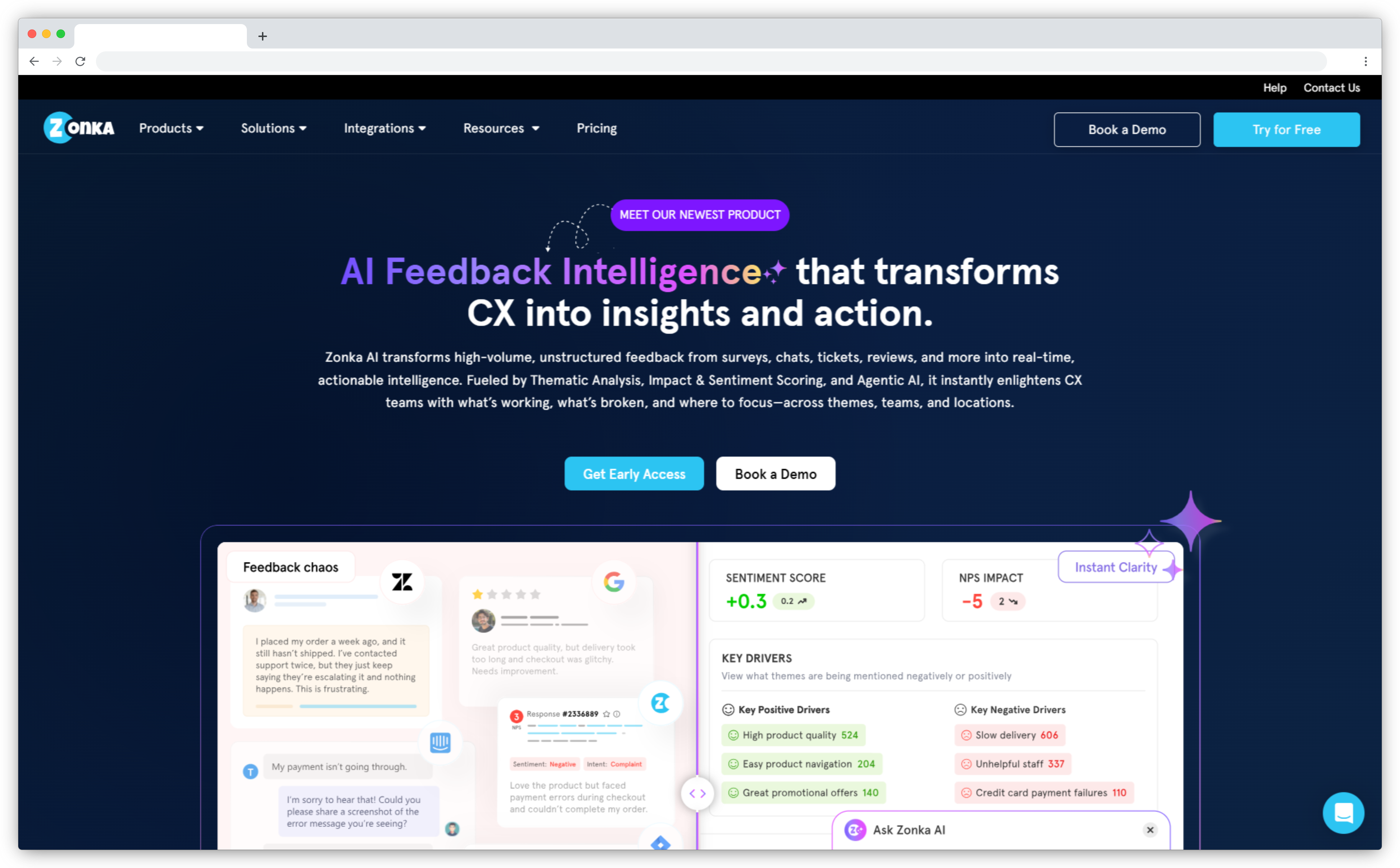
Zonka Feedback is an AI Customer Feedback and Intelligence Platform that collects policyholder and broker feedback on every channel, unifies it with tickets, reviews, and calls, and then reads it with AI. For insurers, that means a claims survey, a renewal email, and a branch kiosk all feed one system instead of four disconnected ones.
The difference shows up after the response lands. Survey tools hand you a number. Zonka's AI agents surface signals: which region's claims satisfaction is slipping, which broker book is at churn risk, which policy change moved the score. Every team gets its own view, so an adjuster, a branch manager, and the CCO each see what they own. It runs for a lean insurtech and a multi-office carrier on the same platform, and most teams go live in under a week.
Key Features:
- Omnichannel surveys across email, SMS, WhatsApp, web, in-app, kiosk, and offline
- AI Feedback Intelligence with thematic, sentiment, and impact analysis
- Entity recognition that maps feedback to branches, agents, and lines
- Closed-loop case management with intelligent routing and alerts
- NPS, CSAT, and CES programs for relationship and transactional moments
- Native integrations with Salesforce, HubSpot, Zendesk, and Intercom
Zonka Feedback Pros
- Collection and AI analysis in one platform, no data pipeline to build
- Fast setup, with first signals in days rather than months
- Role-based signals that reach the person who can act
- Scales from a first survey to a full program without switching tools
Zonka Feedback Cons
- The AI Intelligence tier is a step up in cost for very small teams
- Advanced taxonomies take some configuration to tune
Zonka Feedback Pricing
- Custom, quote-based.
2. Qualtrics: Best for Large Carriers Running Formal Experience Research
G2 Rating: 4.3/5 on G2
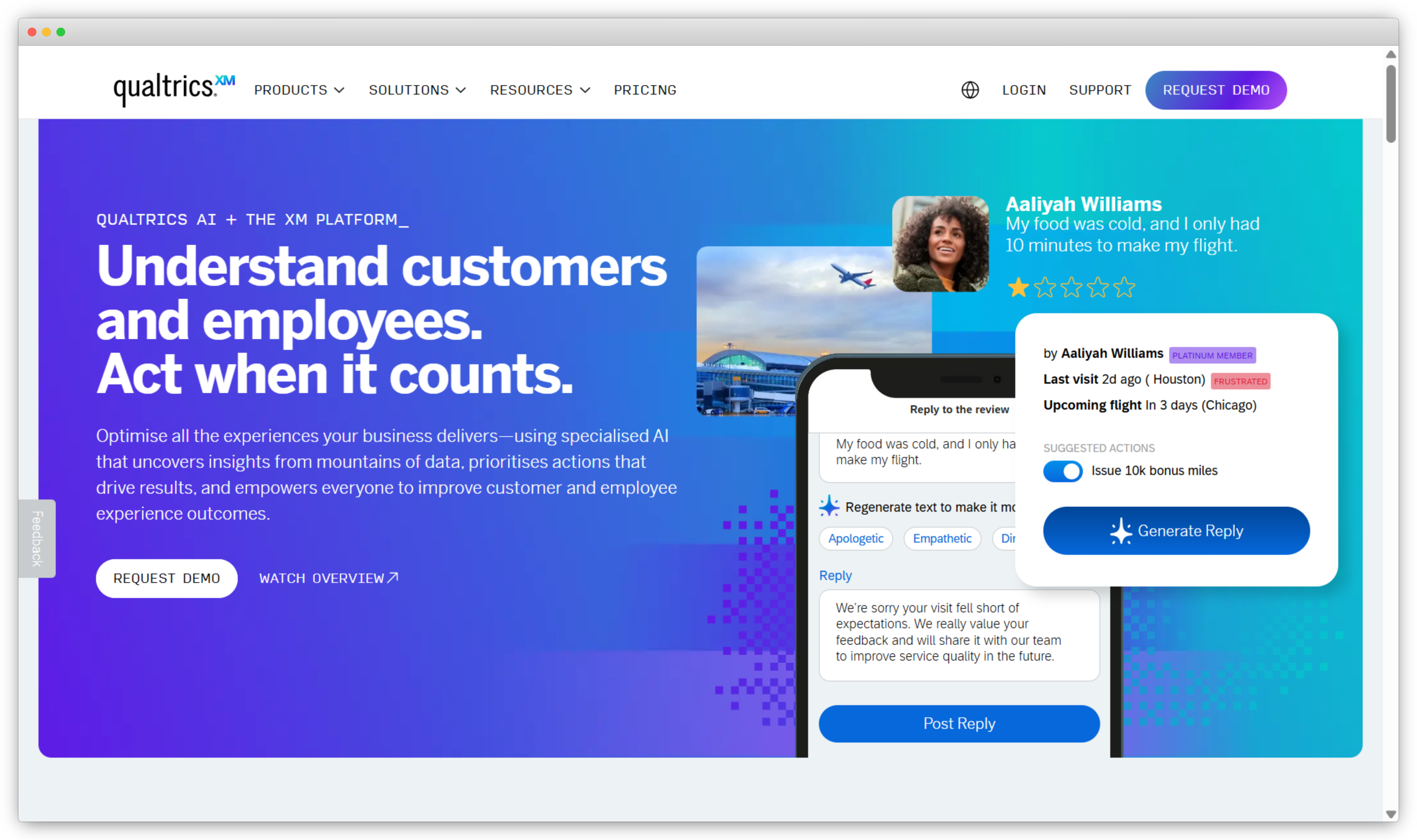
Qualtrics is the enterprise standard for experience management, and it is one of the few vendors with a purpose-built property and casualty insurance CX solution that ships with expert-designed surveys and industry benchmarks. For a national carrier that treats CX as a research discipline, the depth is hard to match.
Its strength is breadth. Text iQ reads open-ended feedback across languages, Predict iQ forecasts churn, and Stats iQ runs statistical analysis most mid-market tools do not offer. The tradeoff is weight. Implementations often run a quarter or longer, pricing scales into six figures for full deployments, and the platform rewards teams with the resources to self-serve. Note the market shift too: Qualtrics closed its acquisition of Press Ganey Forsta in May 2026, pulling InMoment and Forsta into its orbit. For an insurer that needs research-grade analysis and governance in one place, it remains the benchmark.
Key Features:
- Property and casualty insurance CX solution with prebuilt surveys
- Text iQ, Predict iQ, and Stats iQ for advanced analysis
- Omnichannel distribution with industry benchmarking
- X-data and O-data linkage to CRM and operational systems
- Role-based dashboards and enterprise governance controls
- Multi-language support for large, distributed programs
Qualtrics Pros
- Research-grade analytics and flexible survey logic
- Insurance-specific content and benchmarks out of the box
- Deep integration library for enterprise stacks
- Strong governance for regulated programs
Qualtrics Cons
- Cost scales quickly into six figures for full deployments
- Setup and administration demand dedicated resources
Qualtrics Pricing
- Custom, quote-based. Qualtrics does not publish public pricing, and cost scales with modules and volume.
3. Medallia: Best for Real-Time Frontline Action Across Claims and Service
G2 Rating: 4.5/5 on G2
Medallia is built around signal capture and frontline response at scale, which suits insurers whose experience is made or broken in the call center and the claims queue. Where some platforms center the survey, Medallia centers the action that follows it.
It pulls feedback from surveys, digital behavior, and interaction data, then routes alerts to the person closest to the customer in near real time. For a carrier fielding thousands of claims interactions a day, that speed is the point. The catch is familiar for this tier. Medallia prices on Experience Data Records, contracts start in the six figures, and cost prediction gets harder as volume grows. It also carries genuine depth in financial services, with journey analytics and role-based alerting that map well to policyholder and agent workflows. Teams that want frontline coaching tied to live feedback tend to shortlist it first.
Key Features:
- Real-time signal capture across surveys, digital, and interactions
- Frontline alerting and role-based action workflows
- Journey analytics across the policyholder lifecycle
- Text and speech analytics for contact-center feedback
- Financial-services experience expertise and benchmarks
- Enterprise governance, security, and integrations
Medallia Pros
- Fast, granular alerting that drives frontline response
- Deep journey segmentation for complex programs
- Proven at very large interaction volumes
- Strong financial-services track record
Medallia Cons
- Six-figure entry point puts it out of mid-market reach
- Usage-based pricing makes budgeting less predictable
Medallia Pricing
- Custom, quote-based. Enterprise contracts typically start in the six figures.
4. InMoment: Best for AI Text Analytics Across Messy Feedback Sources
G2 Rating: 4.1/5 on G2
InMoment combines surveys with social reviews, support tickets, and call-center data into one analytics layer, which fits insurers sitting on unstructured feedback they cannot read by hand. Its heritage is voice, text, and video analytics, and that shows in how it surfaces root causes rather than just scores.
For financial-services and insurance teams, the pull is AI that turns scattered verbatim feedback into themes and intent quickly, with a reputation for being more accessible to mid-market buyers than Medallia. There is a real caveat to weigh in 2026. Press Ganey Forsta acquired InMoment in 2025, and Qualtrics then acquired Press Ganey Forsta in May 2026, so InMoment now sits under Qualtrics. Forrester has said publicly it expects the product to be absorbed or sunset within about two years. If roadmap certainty is a top criterion, factor that in. If AI analysis across sources is the priority today, it still delivers.
Key Features:
- Unified analytics across surveys, reviews, tickets, and calls
- AI-driven text, speech, and sentiment analysis
- Customer journey mapping and case management
- Self-serve NPS, CSAT, CES, and micro-surveys
- Omnichannel collection across web, mobile, SMS, and email
- Industry-specific text models for financial services
InMoment Pros
- Strong AI analysis across unstructured sources
- More mid-market accessible than peer enterprise suites
- Action planning tools that connect insight to teams
- Broad data-source coverage in one layer
InMoment Cons
- Roadmap uncertainty after the Qualtrics acquisition
- Consulting-heavy model can slow self-serve changes
InMoment Pricing
- Custom, quote-based.
5. Verint: Best for Insurers Running Feedback Through the Contact Center
G2 Rating: 4.2/5 on G2
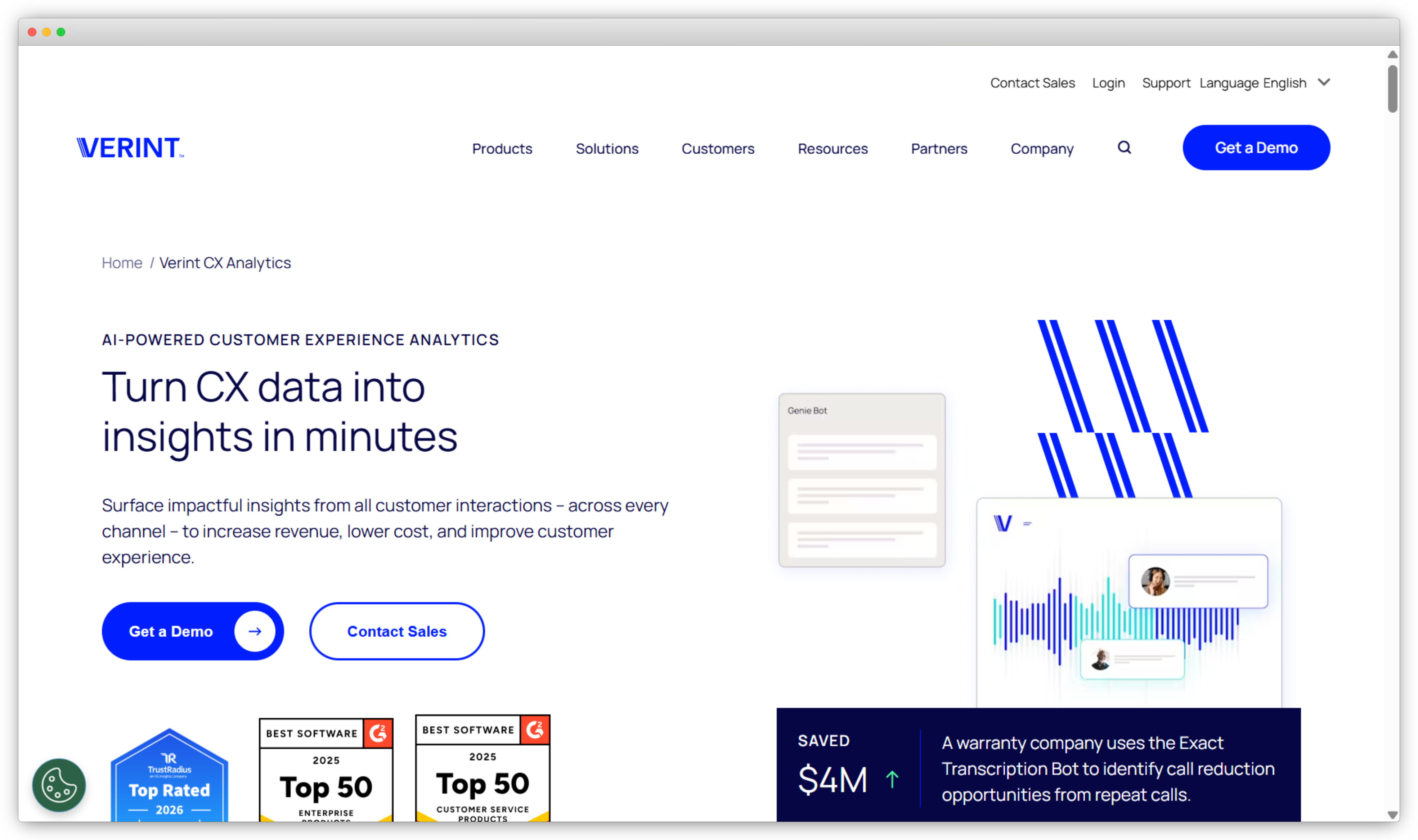
Verint ties voice-of-the-customer feedback to contact-center operations, which makes it a natural fit for carriers whose policyholder experience lives mostly on the phone. Its VoC platform absorbed OpinionLab and ForeSee, and it pairs survey feedback with interaction and speech analytics in one view.
For an insurer, that combination means you can connect what a policyholder says in a survey to what actually happened on the call about their claim. The result is a fuller picture of service quality than surveys alone provide. Verint is enterprise software, so expect a considered implementation and quote-based pricing rather than a quick self-serve start. Reviewers value the analytical depth and the customer-success support, while noting the back-office reporting can feel slow at times. Teams that already run a Verint contact-center stack get the most from adding its experience layer on top.
Key Features:
- Voice-of-the-customer surveys across digital and assisted channels
- Speech and interaction analytics tied to contact-center data
- Journey-based feedback across the service lifecycle
- AI-assisted theme and driver analysis
- Enterprise security and compliance controls
- Integration with the broader Verint platform
Verint Pros
- Connects survey feedback to real interaction data
- Deep analytical tooling for service-heavy programs
- Experienced customer-success and research support
- Strong fit for existing Verint contact-center users
Verint Cons
- Enterprise setup rather than a fast self-serve start
- Back-office reporting can respond slowly
Verint Pricing
- Custom, quote-based.
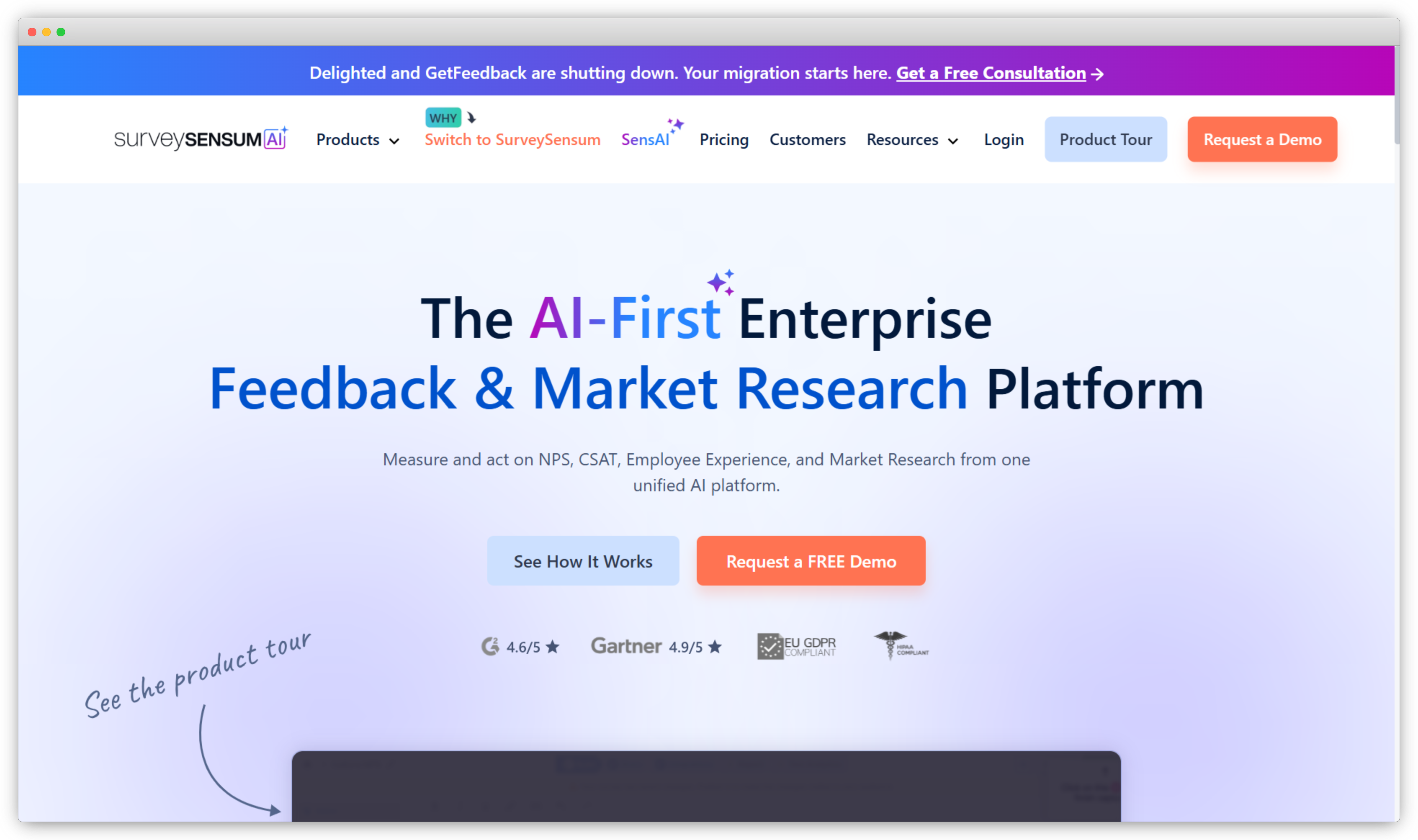
6. SurveySensum: Best for Guided CX Programs With Light Internal Lift
G2 Rating: 4.7/5 on G2
SurveySensum pairs an AI-driven feedback platform with hands-on CX consulting, which suits insurance teams that want expert guidance without hiring a full analytics function. Its consultants help build surveys, read the results, and decide what to act on, so a small team can run a credible program.
For insurers, the draw is affordable AI text and sentiment analysis across channels, with strong support baked in. It has partnerships across banking and other regulated sectors, so the templates and workflows are not starting from zero. The platform handles NPS, CSAT, and CES for both relationship and transactional moments, and users highlight fast setup and responsive help. The honest limits show at the top end. Survey logic and branching are lighter than the enterprise suites, and complex conditional flows can feel constrained. For a mid-market carrier or broker that values guidance over raw configurability, it is a strong, cost-conscious pick.
Key Features:
- AI-powered text and sentiment analysis
- Hands-on CX consulting alongside the software
- Omnichannel surveys including WhatsApp
- NPS, CSAT, and CES program support
- Real-time dashboards and alerting
- Templates tuned for regulated sectors
SurveySensum Pros
- Expert guidance lowers the internal skill requirement
- Affordable relative to enterprise suites
- Quick to launch a first program
- Responsive, well-reviewed support
SurveySensum Cons
- Survey logic and branching are limited for complex flows
- Reporting depth trails the enterprise tier
SurveySensum Pricing
- Free trial available. Paid CX plans start around $300/month, billed annually.
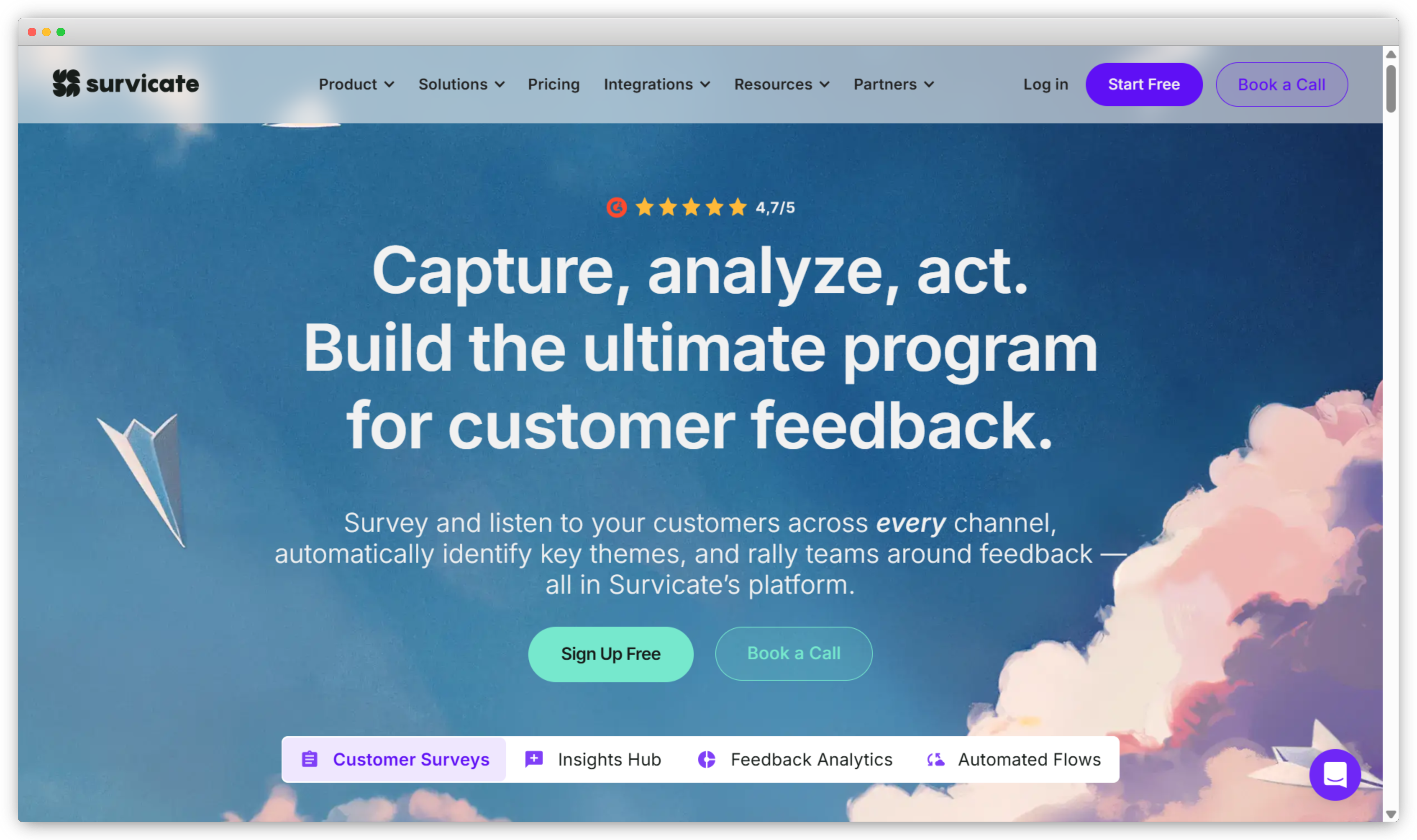
7. Survicate: Best for Digital and In-Product Policyholder Feedback
G2 Rating: 4.6/5 on G2
Say your experience program lives on the website and in the mobile app. Survicate is built for exactly that, running targeted surveys across web, in-product, email, and mobile, with behavioral targeting that asks the right policyholder at the right moment.
For digital-first insurers and insurtechs, that in-context capture is the strength. A quoting drop-off survey, a post-claim micro-survey in the app, an onboarding check after a policy purchase, all fire based on behavior rather than a scheduled send. Its Insights Hub categorizes feedback automatically and surfaces trends, and a research assistant answers questions with actual customer quotes attached. More than forty native integrations push responses into HubSpot, Salesforce, Zendesk, and Jira so feedback reaches working tools. The main constraint is scope. Survicate is a focused digital feedback platform, not a full enterprise experience suite, and reviewers note pricing can tighten as response volume climbs. For digital journeys, it is a clean fit.
Key Features:
- Web, in-product, email, and mobile surveys
- Behavioral targeting and advanced logic
- AI categorization and trend detection in Insights Hub
- Research assistant with quote-backed answers
- 40+ native integrations including Salesforce and Jira
- Free plan for getting started
Survicate Pros
- Strong in-context digital and in-app capture
- Fast to launch with a clean interface
- Broad integration coverage for a focused tool
- AI insights tied to real customer quotes
Survicate Cons
- Focused on digital rather than full-lifecycle programs
- Pricing can rise with response volume
Survicate Pricing
- Free plan available. Paid plans run from about $89/month up to $569/month for Enterprise.
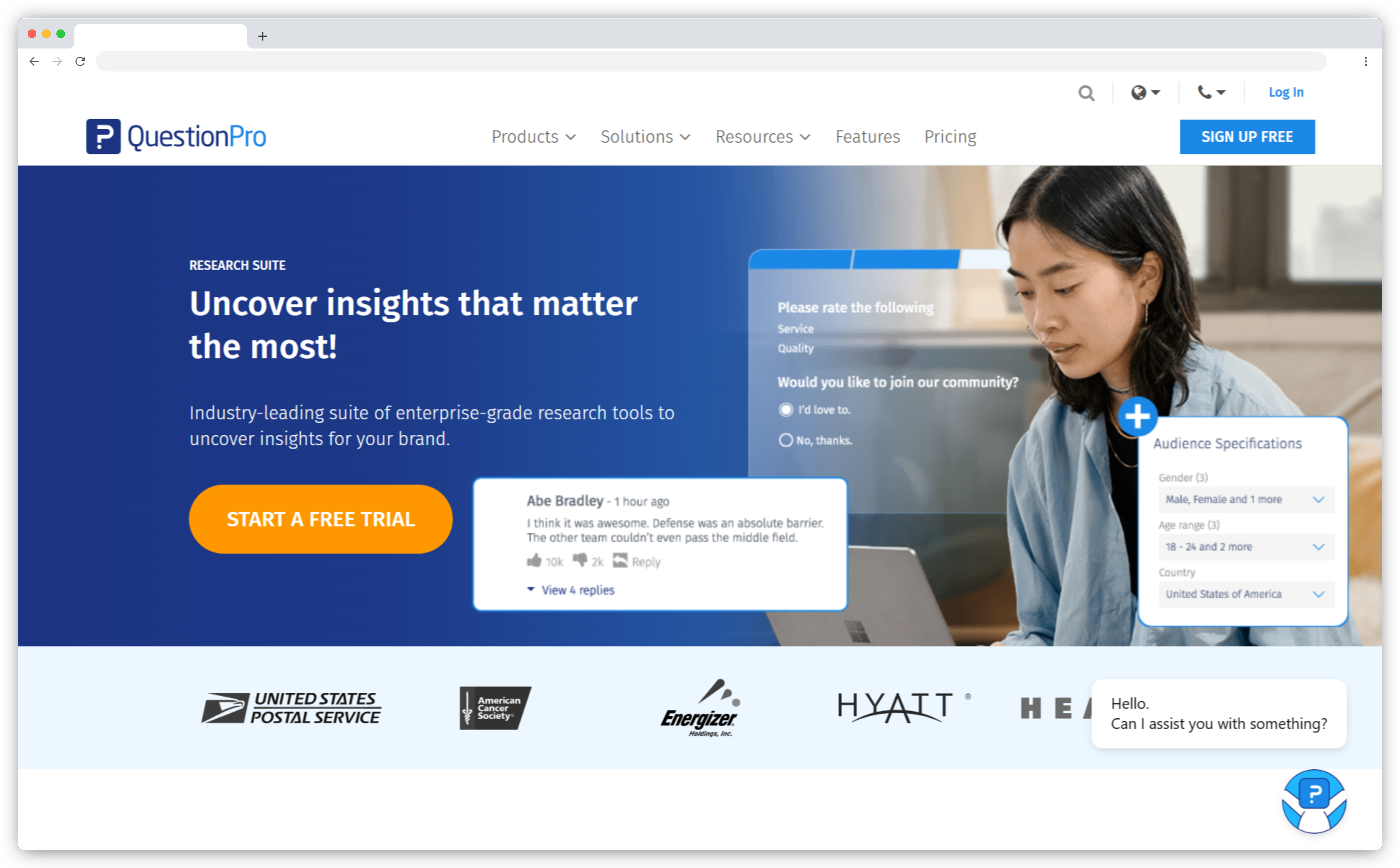
8. QuestionPro: Best for Research Depth and Multi-Channel Branch Surveys
G2 Rating: 4.5/5 on G2
QuestionPro brings research-grade survey capability without full enterprise pricing, which fits insurers that need sophisticated logic for branch, agent, and policyholder studies. It carries 80-plus question types, advanced skip logic, and data-integrity features that prevent duplicate responses.
For insurance and financial-services teams, the versatility is the appeal. You can run a rigorous relationship study, an offline survey in a branch, and a claims transactional survey from the same platform, in more than twenty languages. Its CX module adds NPS, CSAT, and CES tracking with closed-loop workflows on top of the research core. Reviewers rate its support highly and single out the branching and validation logic as reasons they chose it over lighter tools. The learning curve is the tradeoff, since the depth that makes it capable also takes time to master. For teams that blend market research with CX measurement, it covers both without an enterprise contract.
Key Features:
- 80+ question types with advanced skip and branching logic
- Offline and multi-channel survey collection
- CX module for NPS, CSAT, and CES with closed loops
- Text and sentiment analysis on open-ended responses
- Multi-language support across 26+ languages
- Data-validation and duplicate-prevention controls
QuestionPro Pros
- Research-grade logic without enterprise pricing
- Offline capture for branch and field surveys
- Highly rated, responsive support
- Blends market research and CX in one tool
QuestionPro Cons
- Depth brings a steeper learning curve
- Dashboards can feel rigid for custom reporting
QuestionPro Pricing
- Free Essentials plan. Advanced starts at $99/user/month, with Team and Enterprise tiers.
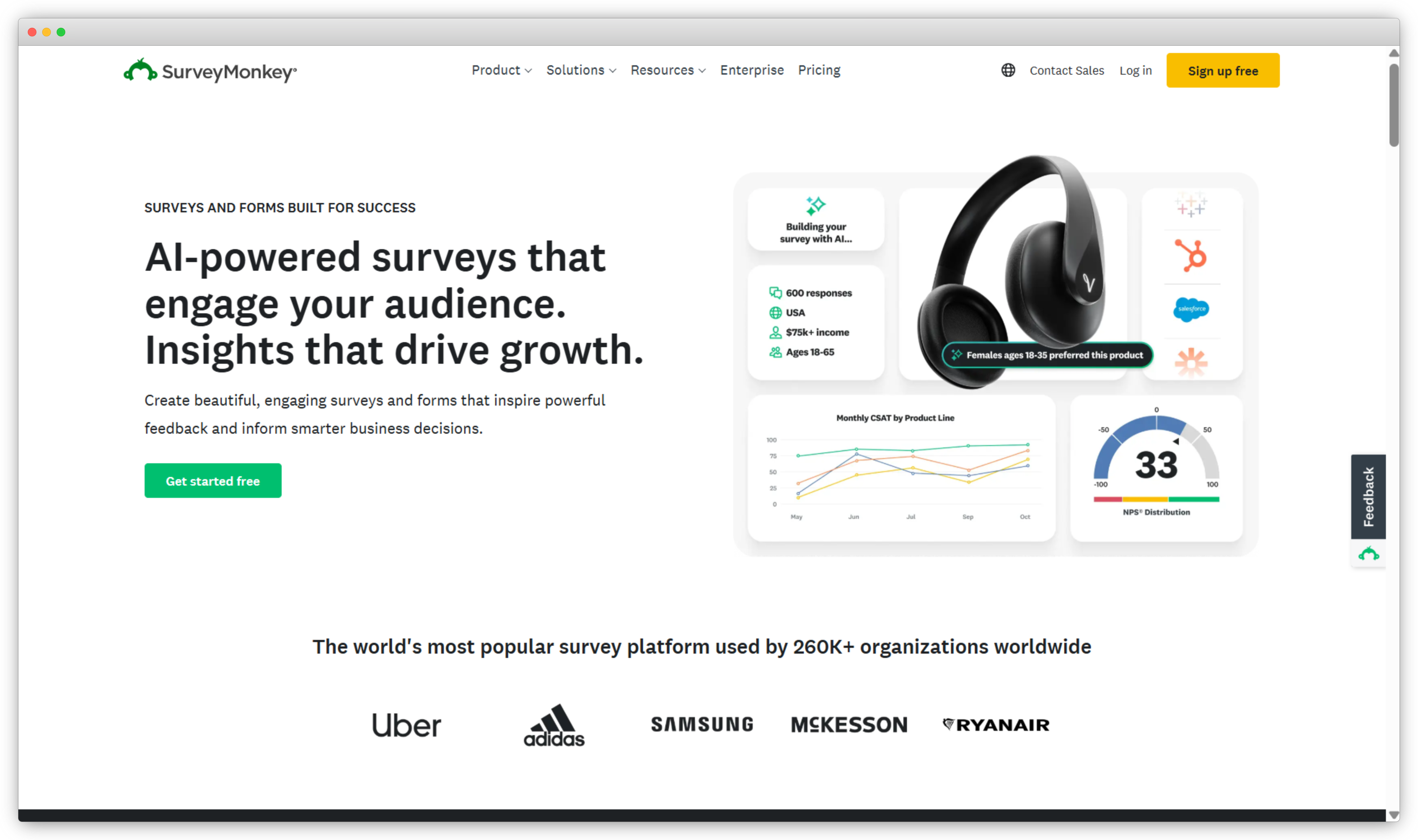
9. SurveyMonkey: Best for Fast, Broad Survey Deployment
G2 Rating: 4.4/5 on G2
SurveyMonkey is the most widely recognized survey platform in the world, and its value for insurance is speed and reach rather than depth. When you need to stand up a policyholder or agent survey quickly and get responses fast, few tools are simpler.
For teams whose primary need is structured feedback collection, it does that job reliably, with a large template library, 200-plus integrations, and research features that go beyond a basic form. It is worth being clear about what it is not. SurveyMonkey is a survey tool, not a full experience management platform, so the analysis and closed-loop action that define this category are lighter here. One ownership note matters for planning: SurveyMonkey owns GetFeedback, and it is retiring GetFeedback Direct at the end of 2026, steering those users toward SurveyMonkey Enterprise. For an insurer that wants quick, dependable collection and will handle analysis elsewhere, it is a practical, low-friction choice.
Key Features:
- Fast survey creation with a large template library
- 200+ third-party integrations
- NPS, CSAT, and CES question types
- Research-grade analysis add-ons and a respondent panel
- HIPAA-compliant option for regulated data
- Enterprise tier for larger programs
SurveyMonkey Pros
- Very fast to launch and easy to run
- Broad recognition and integration coverage
- Reliable for structured feedback at scale
- Enterprise and compliance options available
SurveyMonkey Cons
- Lighter analysis and closed-loop action than full XM tools
- Best value needs the higher enterprise tiers
SurveyMonkey Pricing
- Team plans from about $25/user/month, billed annually. Individual and Enterprise plans also available.
10. CustomerGauge: Best for Account-Level NPS Across Broker Books
G2 Rating: 4.6/5 on G2
Insurance is often a business of accounts, not just individuals. CustomerGauge is built for exactly that, measuring Net Promoter Score at the account level and tying feedback to revenue, which fits carriers and brokers managing books of business rather than one-off policyholders.
For a broker network or a commercial carrier, the account-based model is the differentiator. It aggregates feedback across everyone at a client organization, links satisfaction to retention and revenue, and flags accounts at risk before renewal. That B2B focus is something general CX platforms handle awkwardly. It also keeps a Salesforce integration, which makes it a common landing spot for teams leaving GetFeedback Direct. The tradeoff is scope. CustomerGauge is purpose-built for account-level NPS and revenue linkage, so a carrier focused on high-volume individual policyholder sentiment may find it narrower than a full suite. For account-based insurance relationships, few tools fit better.
Key Features:
- Account-level NPS aggregation across contacts
- Revenue linkage and retention forecasting
- At-risk account flagging ahead of renewal
- Salesforce integration for B2B workflows
- Closed-loop follow-up on account feedback
- Benchmarking for B2B programs
CustomerGauge Pros
- Purpose-built for account-based insurance relationships
- Ties feedback directly to revenue and retention
- Strong Salesforce-native fit
- Highly rated for ease of use and support
CustomerGauge Cons
- Narrower than a full suite for individual sentiment
- Best value only for account-based programs
CustomerGauge Pricing
- Custom, quote-based.
11. AskNicely: Best for Frontline NPS and Agent Coaching
G2 Rating: 4.7/5 on G2
AskNicely turns real-time feedback into daily actions for frontline teams, which suits insurers whose experience depends on agents, adjusters, and service staff. Where enterprise suites center the analyst, AskNicely centers the frontline person who talks to policyholders every day.
For an agency network or a service team, the model is simple and effective. Collect NPS and CSAT after key interactions, then push each frontline worker their own scores, trends, and follow-ups so they can improve in the moment. That coaching loop is the product's core, and it lands well for teams that want feedback to change behavior rather than sit in a dashboard. The limits match the focus. AskNicely is strongest at real-time frontline NPS, so a carrier needing deep research, multi-source analytics, or heavy governance will outgrow it. For frontline-driven insurance service, it does one job well and keeps teams accountable to it.

Key Features:
- Real-time NPS and CSAT after key interactions
- Frontline dashboards with individual scores and trends
- Coaching and recognition workflows for agents
- Automated follow-up on detractor feedback
- Integrations with CRM and communication tools
- Mobile-first experience for field teams
AskNicely Pros
- Turns feedback into frontline daily action
- Simple to run and quick to adopt
- Strong coaching and accountability loop
- Highly rated for support and usability
AskNicely Cons
- Narrow beyond frontline NPS programs
- Limited depth for research or heavy analytics
AskNicely Pricing
- Custom, quote-based.
Experience Management vs. the Systems Insurers Already Own
Here is the mistake that costs insurers the most in this category. They buy an experience tool expecting it to fix the experience, then wonder why the claims process is still slow.
Experience management software does not process a claim. It does not bind a policy or send a renewal notice. Those jobs belong to systems you already run. Guidewire and Duck Creek administer policies and claims. Your agency management system handles servicing. Salesforce holds the relationship. NiCE, Genesys, or Glia run the contact center. Every one of those systems creates the experience.
What experience management software adds is the missing sense: the ability to hear how each of those moments landed, read the pattern across thousands of them, and tell the right person what to fix. It is the measurement-and-action layer that sits on top of the stack, not a replacement for any part of it.
The layers map cleanly to the journey. A quoting friction signal points back to the rating engine. A claims detractor points to the adjuster and the claims platform. A renewal drop points to billing and the account team. The experience tool does not do those jobs. It tells you where they broke, and it makes sure the fix reaches the team that owns the system underneath. Buy it for that, and it earns its place. Buy it to replace a core system, and it will disappoint every time.
Which Insurance Experience Management Tool Is Right for You?
The right platform is the one that matches how your book actually behaves, not the one with the longest feature list. A digital insurtech with a lean team and a national carrier with in-house analysts are shopping for different tools, and both are on this list.
Start where the experience is decided for your business. If it lives in claims and service at scale, weigh the real-time suites. If it lives on the website and in the app, weigh the digital-first platforms. If it lives across broker books, weigh account-level measurement. And if you want collection and AI analysis in one place without a six-figure build, start your evaluation with the platform that opens this list.
Then test before you commit. Run a real survey, on real policyholders, through two or three tools. The one that shows you the fix, not just the score, is the one worth keeping.
Ready to see what that looks like in practice? Explore Zonka Feedback and start turning policyholder feedback into signals your teams can act on.
Displaying experience-management-software-for-insurance.html.

.svg)
.png)