

.svg)
 Healthcare
 Finance
 Retail
 SaaS & Digital
 eCommerce
 Education
 Salesforce
  HubSpot
 Pipedrive
 Mailchimp
 Klaviyo
 Zendesk
  Intercom
 Freshdesk
 HelpScout
  Front
Front Jira
Jira Slack
Slack  MS Teams
 Zoom
Zoom Google Sheets
  Zapier
  Integrately
 Make
Make  Webhooks



 Sign In
 MS Teams



TL;DR
- A voice of customer (VoC) framework is a clear process that turns raw customer feedback into decisions, actions, and results you can measure.
- Most VoC programs stall because teams have no plan for what to do with feedback once it arrives. Collecting feedback is not the same as running a program.
- The six main VoC framework types are the Five-Stage VoC Model, Customer Journey Mapping, the Kano Model, the Net Promoter System, Jobs to Be Done, and the Closed-Loop Feedback Framework.
- The right framework depends on how mature your program is, which outcome you care about most (insight, loyalty, or retention), and how your team is set up.
- The best VoC programs use more than one framework: one to listen, one to prioritize, one to act, and one to check whether any of it worked.
Most teams treat a VoC framework like a survey template. They pick one, launch it, and call it a program. Six months later the dashboards are full and nothing has changed.
The problem is usually not which framework you picked. It is that you used only one.
A voice of customer framework (also called a voice of the customer framework) is a clear process for collecting, organizing, and acting on customer feedback. A framework is not the same as a methodology. A methodology is the way you collect feedback. A framework is the wider model that decides what happens to that customer input after it arrives, who acts on it, and how you measure whether those actions worked. Without a framework, VoC is just research. With one, it becomes a system your team can run.
This guide covers the six most common VoC frameworks, how to choose between them, and why the best teams almost always use more than one.
Why VoC Programs Fail Before They Really Start
Most VoC programs stall at the action stage, which is the part teams rarely plan for. They spend weeks picking a feedback channel and writing survey questions, then assume the VoC feedback will reach the people who can act on it. It usually does not. That gap between collecting feedback and acting on customer pain points is what a framework is built to close.
The right VoC framework defines the full loop: how you collect feedback, how you analyze it, who gets which signal, and what happens next. Each framework below handles one part of that loop, and no single one handles all of it.
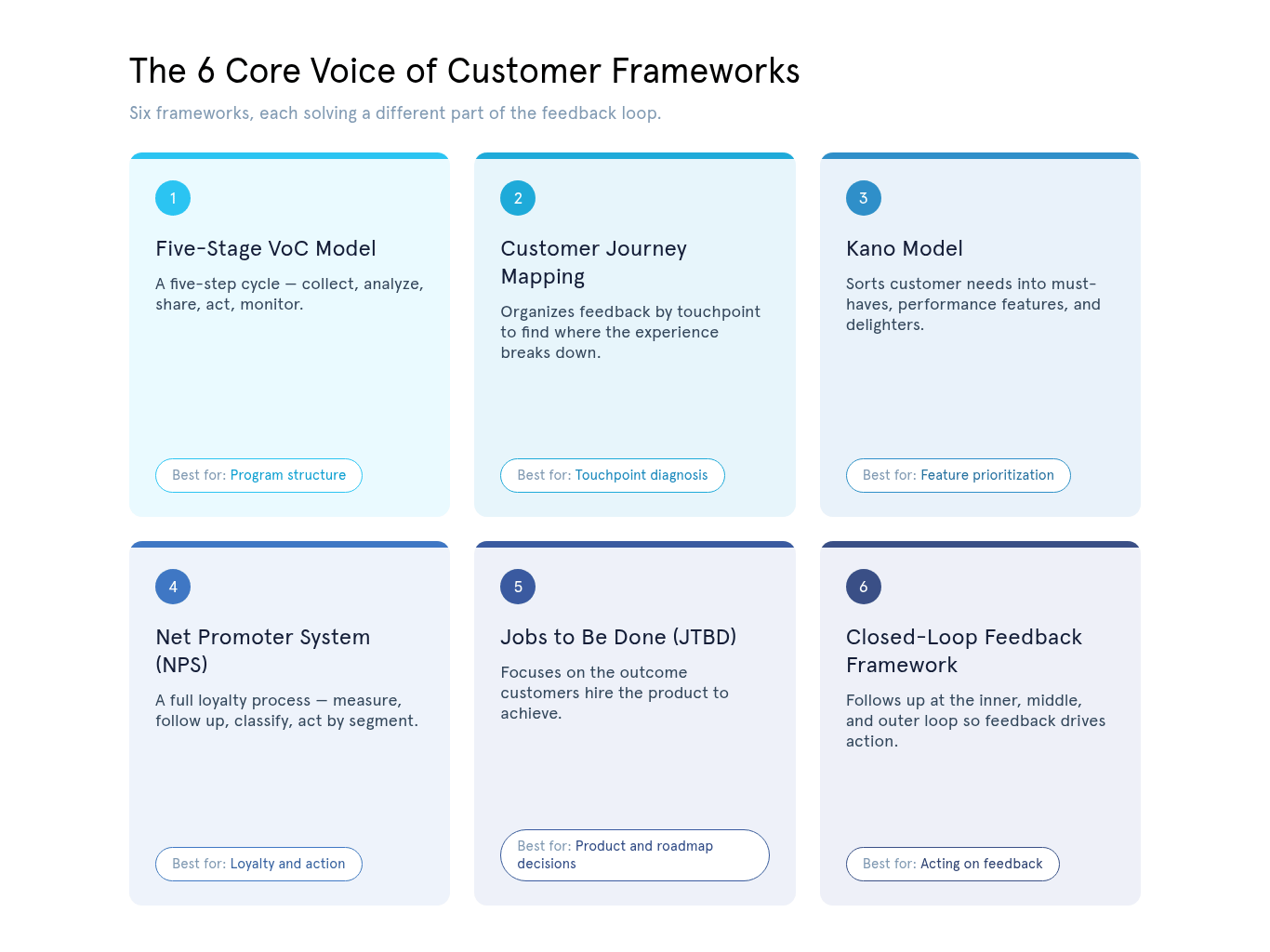
The 6 Core Voice of Customer Framework Types
Here are the frameworks that show up in mature VoC programs, what each one does, where it fits, and what it leaves out.
1. The Five-Stage VoC Model
This is the most general framework and the best place to start when you are building your first structured VoC program. It breaks the work into five steps:
- Collect: gather feedback across multiple channels (surveys, customer interviews, support interactions, online customer reviews)
- Analyze: find patterns in the raw data
- Share: send the findings to the teams who need to act
- Act: make changes based on what you found
- Monitor: track whether those changes led to real improvements in the customer experience
The strength of the five-stage model is that it is clear. It gives everyone a shared language and a set order to follow. Its weakness is that it says nothing about priorities. When you collect from multiple channels and feedback volume is high, being told to "analyze" does not tell you which themes matter most or which issues to fix first.
Use this framework to set the rhythm of a new VoC program. Add a prioritization framework once you have steady feedback volume.
2. Customer Journey Mapping Framework
Journey mapping sorts feedback by touchpoint instead of by channel. Rather than asking "what are customers saying about us?" it asks "what are customers going through at each stage, and where does it break down?"
You map the customer journey (awareness, onboarding, first value, regular use, renewal, support) and collect direct feedback at each stage. The better versions also track how customers feel at each point, not only the score they give.
This customer journey mapping framework finds friction you would not have thought to ask about. A post-purchase survey might show a CSAT score of 4.2. A journey map might show that the delivery confirmation email confuses 40% of first-time buyers, and that the confusion follows them into their first support interaction. The score looked fine, but the problem was real.
Journey mapping works best for finding where problems in the customer experience actually happen. It pairs well with the Closed-Loop Framework once you know which moments need fixing.
3. The Kano Model
Kano is a prioritization framework for teams that have already gathered feedback. It sorts customer needs into three groups:
- Must-haves (basic needs): Things customers expect by default. Missing them causes frustration, but having them does not create delight. Examples are uptime, correct billing, and search that works.
- Performance features: The more you improve these, the higher customer satisfaction goes. Examples are speed, response time, and ease of use. The payoff rises in step with the investment.
- Delighters (excitement factors): Things customers did not expect but enjoy. A proactive check-in from your CS team, or a feature that anticipates the next step. Delighters have a big effect at first, but it fades once competitors copy them.
The value of the Kano Model is what it stops you from doing. It keeps you from spending months improving a must-have that is already good enough while you ignore a performance feature where a small improvement would lift satisfaction a lot. It also shows you where to focus when you have more feedback than time to act on it.
What Kano does not do is tell you how to collect customer data or what to do after you prioritize. It helps you decide, but it does not close the loop.
4. Net Promoter System (NPS Framework)
Most teams use NPS as a single metric. One score, tracked each quarter, reported upward. That is fine, but it is not the framework.
The Net Promoter System, created by Bain & Company and Fred Reichheld, is a full process built around the loyalty question. It runs in four steps: measure, follow up, classify, and act by segment.
- Measure: Send the survey at the right time. Relationship NPS works quarterly. Transactional NPS should go out after key moments like onboarding, support resolution, or renewal. Some teams also add a customer effort score (CES) at high-friction points to separate loyalty from ease of use.
- Follow up: Contact detractors within 24 to 48 hours. Contact promoters to learn what they liked and to start referral conversations.
- Classify: Group responses by theme, team, location, product area, or customer tier, not only by promoter, passive, and detractor.
- Act by segment: A detractor who scored 3 over a billing issue needs a different response than one who scored 4 over a missing integration. Generic replies hurt customer sentiment instead of repairing it.
The difference between NPS as a metric and NPS as a system is where most loyalty programs fall apart. The score tells you something is wrong. The system tells you what to do about it. The right NPS tools help you run the follow-up, classification, and segment-level action instead of only tracking the score.
For context on what is voice of customer beyond the NPS metric, the pillar piece covers the full picture.
5. Jobs to Be Done (JTBD)
JTBD changes the main question you ask about customer feedback. Instead of "what do customers want?" it asks "what is the customer trying to get done, and what job are they hiring this product for?"
The difference matters. Survey responses and feature requests might tell you customers want a faster export. JTBD analysis might show they are really trying to cut the time between collecting data and a weekly leadership review. A scheduled delivery feature solves that job better than a faster export does.
JTBD is most useful for product teams that use VoC data to plan the roadmap. It filters out noise in qualitative feedback and focuses on the goal behind the request. Customers often know what they want, but they are less reliable about what they actually need.
This framework uses structured customer interviews, not surveys alone. You ask customers to walk through a task or a decision instead of rating a feature. The result is a map of customer jobs, ranked by how often they come up and how much they frustrate people, and that map guides priorities far better than a flat list of feature requests.
6. Closed-Loop Feedback Framework
This is the framework most VoC programs skip, and it decides whether the program builds customer engagement or quietly damages it.
Closing the loop means following up on feedback instead of only analyzing it inside your team. It means telling the customer who left a 3 out of 5 on a support interaction that you looked into it. It means letting detractors know when the issue they raised is fixed. It means customers feel heard instead of ignored.
The Closed-Loop Framework works on three levels:
- Inner loop: The quick, one-to-one response. A customer flags a problem, and a team member follows up within 48 hours. This is the loop that stops one bad experience from turning into a lost account.
- Middle loop: The process-level response. Repeated themes from the inner loop go to the team that owns the underlying process. Support patterns go to support leadership. Product friction goes to the product team.
- Outer loop: The strategy-level response. Bigger issues found across the middle loop shape leadership decisions, product roadmaps, and how the company operates.
Most teams run only the inner loop, and even that is often inconsistent. The middle and outer loops are where negative feedback actually changes how a company works.
The why your voice of customer program is failing blog explains why loop closure is the most common breakdown point and what fixing it looks like.
How the Frameworks Compare
| Framework | Best For | Prioritization | Feedback Collection | Loop Closure |
| Five-Stage Model | Program structure | No | Yes | Partial |
| Journey Mapping | Touchpoint diagnosis | No | Yes | No |
| Kano Model | Feature prioritization | Yes | No | No |
| NPS System | Loyalty + action | Partial | Yes | Yes |
| Jobs to Be Done | Product decisions | Yes | No | No |
| Closed-Loop | Acting on feedback | No | No | Yes |
How to Choose the Right VoC Framework
No single framework fits every team. The right choice depends on three things: where your program is today, which outcome you own, and how your team is organized.
Filter 1: Program maturity
If you are building a VoC program for the first time, start with the Five-Stage Model or Customer Journey Mapping. Both give you a way to collect feedback and a place to put what you learn. Neither needs an existing data set or feedback setup.
If you already run a program but feel buried in survey feedback with no clear priorities, add the Kano Model or JTBD. Both help you decide what to work on first.
If you run a mature program with steady data, the gap is usually action and measurement. The Closed-Loop Framework and NPS System are where the program gets real teeth.
Filter 2: Your primary outcome
Which number are you most responsible for? Customer retention, satisfaction, product adoption, or customer loyalty? Your answer points to a framework.
To understand the "why" behind scores, use JTBD or Journey Mapping. For loyalty, use the NPS System. For retention, use the Closed-Loop Framework. For roadmap decisions, use Kano with JTBD.
Filter 3: Team structure
CX-owned programs tend to run the NPS System well because it fits their workflow. Product teams lean toward Kano and JTBD because both connect to the roadmap. Cross-functional teams often do best starting with the Five-Stage Model, because it gives everyone a shared process before they specialize.
Use this table to make the call:
| If your biggest problem is... | Start with... |
| "We don't know what customers think" | Five-Stage Model |
| "We know what they think but can't prioritize" | Kano Model |
| "We know but don't understand why" | JTBD |
| "We understand but don't act fast enough" | Closed-Loop Framework |
| "We act but scores aren't improving" | NPS System (the full system, beyond the score) |
For more on VoC strategy and best practices before you commit to a framework, that guide covers the planning stage in detail. Once you have chosen your framework, voice of customer analytics covers how to measure it.
Why One Framework Is Never Enough
Here is what many articles on VoC frameworks get wrong. They treat these six as options: pick the one that fits and move on.
That is not how strong VoC programs are built.
Look at the comparison table again. No single framework covers all four needs: collection, prioritization, action, and measurement. The Five-Stage Model handles collection and gives you a rhythm, but it does not tell you what to prioritize or how to close the loop. JTBD gives you deep insight but says nothing about what to do after you map the jobs. Kano prioritizes well but assumes you already have feedback coming in.
Teams that actually move the numbers treat frameworks as layers.
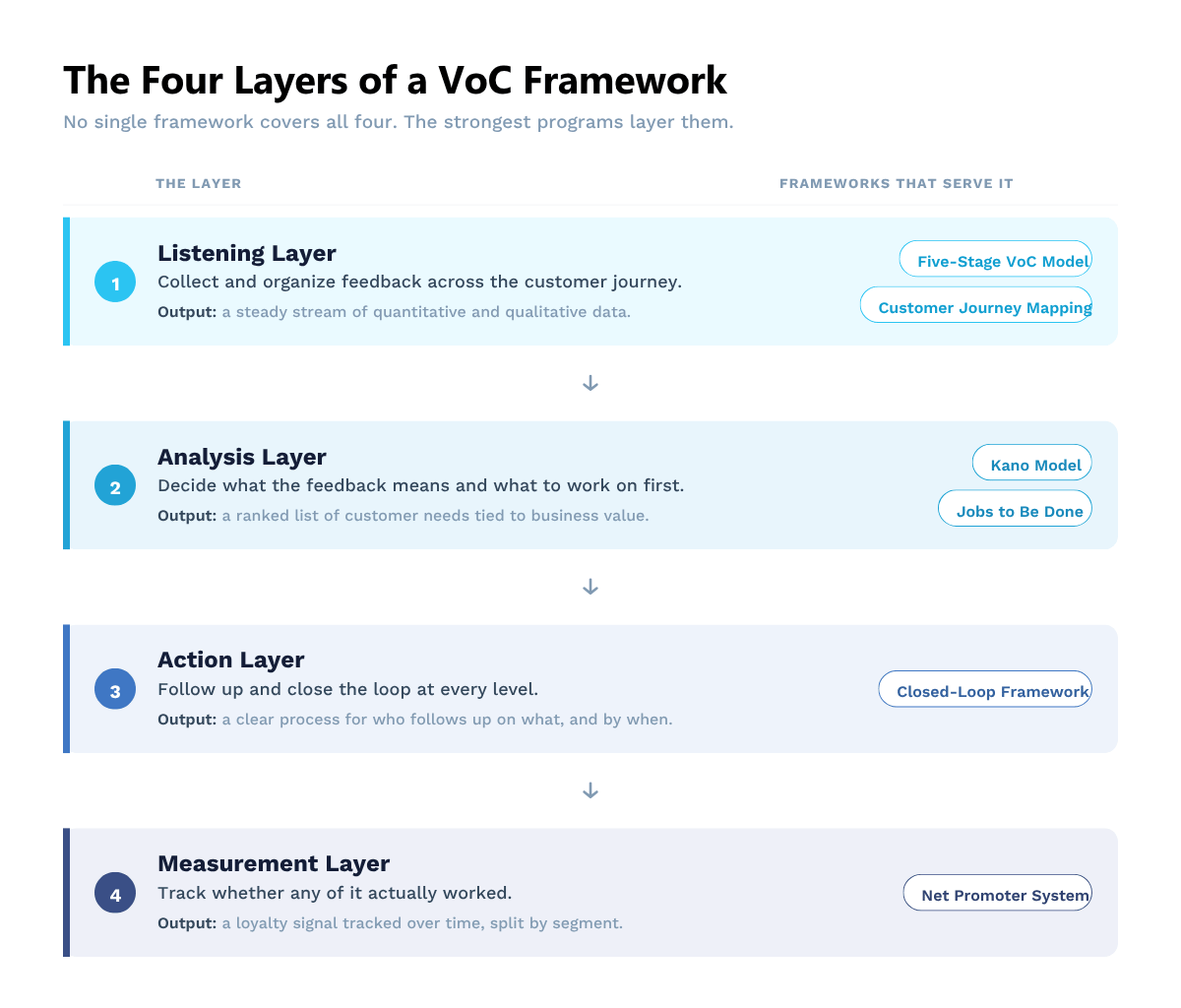
Listening layer (how you collect and organize feedback across the customer journey). The Five-Stage Model or Customer Journey Mapping sits here. The output is a steady stream of quantitative and qualitative data from multiple channels.
Analysis layer (what the feedback means and what to work on first). Kano or JTBD sits here. The output is a ranked list of customer needs tied to business value. This is where you identify opportunities that matter and find deeper insights, instead of a flat backlog of everything customers mentioned.
Action layer (what happens after analysis). The Closed-Loop Framework sits here. The output is a clear process for who follows up on what, at which loop level, and by when.
Measurement layer (whether any of this worked). The NPS System sits here. The output is a loyalty signal tracked over time and split by customer tier, product area, and team, instead of one score reported each quarter that nobody links to real actions.
Enterprise CX teams often split VoC ownership by layer without noticing that is the structure. CX runs the NPS System. Product owns Kano and JTBD. Customer success owns loop closure. Everyone uses journey mapping to diagnose problems. The part that usually breaks is the handoff: the analysis layer produces customer insights that never reach the action layer, or the measurement layer tracks a customer sentiment score that nobody connects to real changes.
That handoff failure is what most VoC programs are really trying to solve. No single framework fixes it alone.
How this plays out changes by industry. The sections below cover the layered approach in each sector.
How to Build a VoC Framework: 6 Steps
Once you have chosen your framework combination, here is how to turn it into a working program.
Step 1: Decide what you want to learn
Before you pick a channel or write a survey, answer one question: what decision will this data inform? Are you trying to learn why churn is up in one customer segment? Find which onboarding steps cause friction? Check whether a recent product change improved customer satisfaction? Starting with a question instead of a method makes it clear what good data looks like for your program.
Step 2: Map your feedback touchpoints
List every moment in the customer journey where feedback is worth collecting: onboarding, first value, regular use, support, renewal, and exit. For each one, decide whether direct feedback (a survey or customer interview) or indirect feedback (CRM data, support ticket patterns, user behavior) fits better. The voice of customer methodologies guide covers the active and passive methods that fit each touchpoint. Some touchpoints tell you more by watching what customers do than by asking them.
Step 3: Choose your framework combination
Use the decision table above. Most programs need at least two frameworks: one for listening and one for analysis or action. If your program is ready to run all four layers, match a framework to each one before you build anything.
Step 4: Set up collection and analysis
This is where the program becomes real. You need a feedback collection method that works across every touchpoint you listed: surveys, kiosk forms, in-app prompts, review monitoring, and whatever else the channel needs. If you are still deciding what to use, the voice of customer tools guide covers the main types and what each is built for. You also need a way to analyze feedback that does not force someone to read every response by hand or piece raw feedback together from separate tools. A feedback platform like Zonka Feedback does both. It collects across channels and uses AI agents with natural language processing to surface signals from the incoming data, so high feedback volume does not create a backlog that stalls the whole program.
Step 5: Build your action and escalation workflow
Define the inner, middle, and outer loop before you launch. Who gets a signal when a detractor comes in? What is the response time target? Which team owns middle-loop escalation when a theme shows up three times in a week? What happens with outer-loop items that need a leadership decision? Write these answers down before the first survey response arrives.
Step 6: Set your measurement baseline
Decide what "working" looks like in 90 days before you start. Pick a net promoter score baseline, a customer retention rate, a customer lifetime value trend, a loop closure rate (the share of detractors your team actually follows up with), and a response rate target. Without a baseline, every review of the data is a guess. With one, it is a clear comparison that supports revenue growth over time.
For a ready-made starting point, the voice of customer survey template covers survey design. And voice of customer surveys covers channels and question structure in detail.
VoC Framework by Industry
Framework choice does not change much by industry, but the emphasis does.
SaaS: Product-led VoC programs put Kano and JTBD at the center. Feedback is high-volume, mostly in-product, and the main audience is the product team. Journey Mapping matters most at onboarding and churn, where customer expectations are highest and raw feedback is hardest to get. For the tools that fit a product-led SaaS program, see VoC tools for SaaS.
Healthcare: Journey Mapping is a must. Patient experience runs on a journey by nature. Admission, diagnosis, treatment, and discharge are separate touchpoints that each need their own feedback mechanisms. CAHPS alignment adds a compliance layer that shapes which metrics matter most. For the patient-experience practices that make this work across a hospital or clinic, see VoC best practices in healthcare.
Retail: Omnichannel touchpoints mean journey mapping across physical and digital channels at once. The Closed-Loop Framework matters more here than in most sectors, because one bad in-store experience creates both direct feedback and public reviews that add up fast. For the practices that keep feedback moving across stores and online, see VoC best practices in retail.
Insurance: The claims journey drives framework choice. FNOL (first notice of loss), claim resolution, and renewal are the three key moments, and each needs a different approach. The NPS System works well for renewal and the ongoing relationship. The Closed-Loop Framework matters most at FNOL, where a slow follow-up is the most common driver of customers churning. For the practices that keep claims-stage feedback on track, see VoC best practices in insurance.
Closing
A VoC program is not a survey. It is a system for how your company responds to what customers go through.
Teams that build programs that work stop treating framework choice as a one-time call. They build the listening layer, then analysis, then action, then measurement, in that order, one at a time, with clear owners and set workflows at each stage. Customer data stops piling up in dashboards and starts reaching the people who can act on it. Customers feel heard, and the product starts to meet customer expectations instead of guessing at them. The gap between what customers expect and what they get starts to close.
Start with the framework combination that fits where you are now. Add layers as the program matures, and tie each one back to customer retention and business growth so it earns its place. Make loop closure non-negotiable from day one.
That is the difference between a program and a research exercise.
If you're building or rebuilding a VoC program, see how Zonka Feedback handles multi-channel feedback collection, AI-driven analysis, and real-time loop closure, all in one platform.

.png)
.svg)
.png)