


.svg)
 Healthcare
 Finance
 Retail
 SaaS & Digital
 eCommerce
 Education
 Salesforce
  HubSpot
 Pipedrive
 Mailchimp
 Klaviyo
 Zendesk
  Intercom
 Freshdesk
 HelpScout
  Front
Front Jira
Jira Slack
Slack  MS Teams
 Zoom
Zoom Google Sheets
  Zapier
  Integrately
 Make
Make  Webhooks



 Sign In
 MS Teams



TL;DR
- Voice of Customer best practices in healthcare go beyond survey design. They cover who you listen to, when, how feedback is stored compliantly, and what happens after a signal comes in.
- Most VoC programs in healthcare fail at the same point: collecting customer feedback without a system to act on it.
- The "customer" in healthcare VoC isn't just the patient. Caregivers, physicians, and frontline staff carry signals most programs never capture.
- HCAHPS scores directly affect CMS reimbursement through the Value-Based Purchasing program, which means poor feedback has a measurable cost beyond patient experience.
- A successful VoC program in healthcare collects customer feedback across multiple channels: email, SMS, WhatsApp, kiosks, and in-app. Signals route to the right team in real time, with HIPAA compliance built in.
A patient leaves your hospital after a 4-day inpatient stay. On the way out, they fill in a discharge survey. They rate their experience a 6 out of 10. In the open-text box, they write: "Nobody explained what my medication was for. I was scared the entire time."
That response goes into a dashboard. It gets counted toward the monthly NPS. It might show up in a quarterly review as part of a "communication" theme.
Nobody calls the patient. Nobody updates the discharge protocol. Three months later, the same theme surfaces again.
This is the gap most healthcare VoC programs live in. Not a lack of feedback. A lack of everything that has to happen after it arrives.
Patient experience in healthcare isn't just a satisfaction metric. HCAHPS scores affect CMS reimbursement. Poor feedback drives patient churn. And when care instructions aren't communicated clearly, patients don't just leave bad reviews. They stop following through on treatment.
The stakes are too high for a VoC program that only collects.
These 8 best practices are for the teams building programs that actually do something with what patients say.
What "VoC Best Practices" Actually Means in a Healthcare Context
Voice of Customer in healthcare, also called voice of the customer, is the structured process of capturing, analyzing, and acting on customer feedback from everyone who interacts with your care delivery: patients, caregivers, physicians, and staff. The goal is to improve customer experience, care quality, and operational performance.
That definition sounds clean. The reality is messier.
Healthcare VoC operates under constraints no other industry shares at this scale: HIPAA compliance limits how you collect and store patient data. HCAHPS scores tie directly to CMS reimbursement through the Value-Based Purchasing program, meaning patient experience isn't just a metric. It affects hospital revenue. And care quality is literally at stake, not just customer satisfaction.
That's why best practices in healthcare VoC aren't just "send better surveys." They're the principles that determine whether your feedback strategy actually changes how care gets delivered. Whether a negative signal from a patient in the Dialysis ward reaches the right person in time to matter.
The 8 practices below are built for the people running (or trying to build) a VoC program in a hospital, multi-location clinic, or healthcare network. Not for market researchers. For operators.
1. Define Who Your "Customer" Is: Before You Build Anything
Here's the assumption most programs start with: the customer is the patient.
It's not wrong. But it's incomplete. And that gap, right at the starting line, shapes everything downstream.
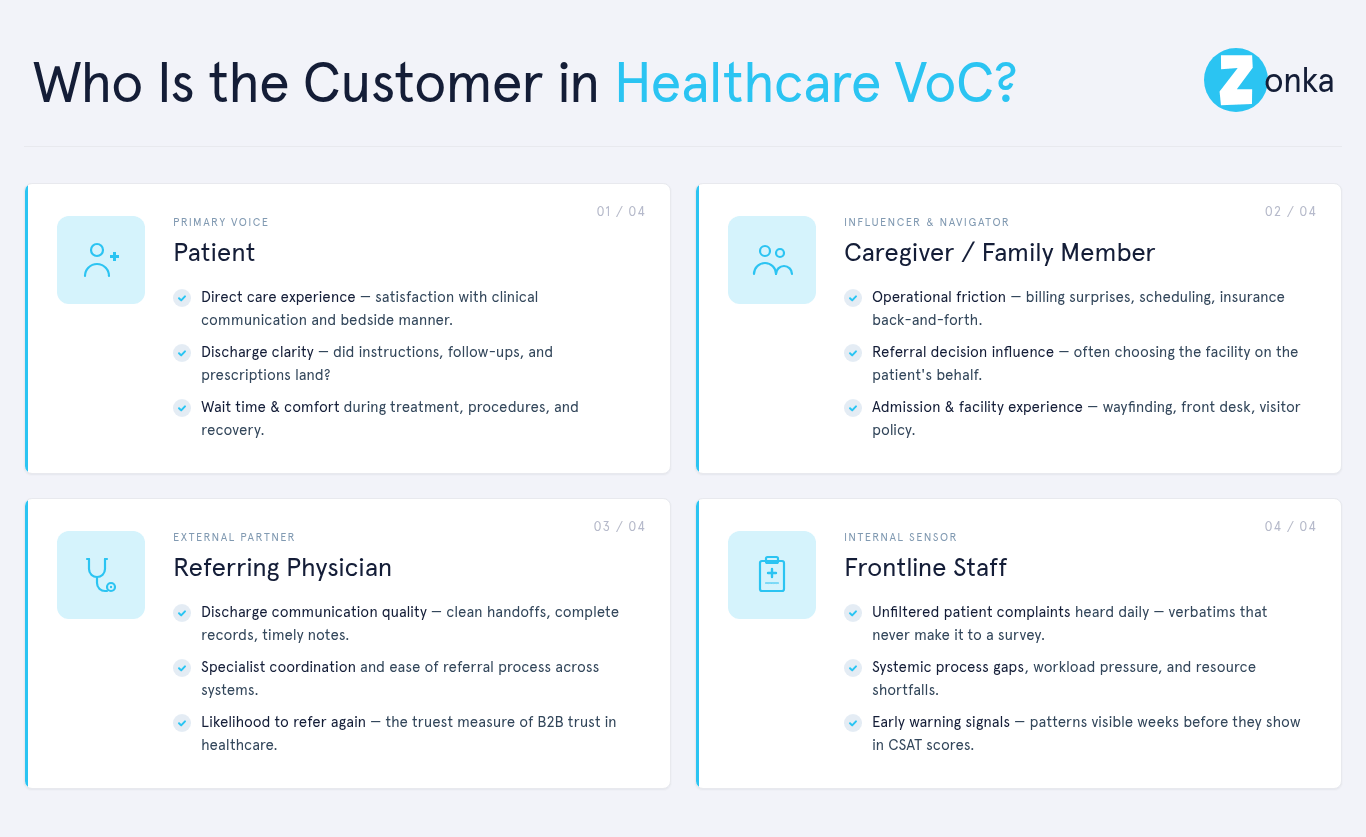
A complete VoC program in healthcare captures signals from at least four groups:
Patients: The obvious one. Their direct experience of care, communication, environment, and discharge.
Caregivers and family members: Especially critical in IPD settings, pediatric care, and elderly patients. In many cases, it's the caregiver who managed the appointment, navigated billing, and drove the patient home. They have a sharper read on operational friction than the patient does. Most programs survey neither of them.
Referring physicians: For multi-specialty hospitals, referrals are a revenue stream. A referring physician who has a bad experience with your discharge communication or scheduling team will stop sending patients. That signal doesn't show up in a patient satisfaction survey.
Frontline staff: Not as a recipient of feedback, but as a source of it. A nurse who handles 30 customer interactions a day hears customer concerns you'll never see in a survey. Building a channel for that, even informally, is VoC. Some of the best early-warning signals about systemic problems come from staff, not patients.
Each group needs different questions, different channels, different timing.
Getting this wrong at step one means your data is incomplete by design. We've seen organizations run 6-month VoC programs and then discover they had zero structured data from caregivers, the people who actually made the care decision and influenced the referral. The surveys were well-designed. The audience was just too narrow.
Start by mapping who you need to hear from and what customer needs each group carries. Then design the program around that map. Not the other way around.
For a deeper look at the patient-specific layer, see our guide to voice of the patient, which covers VoP as a distinct practice within the broader VoC framework.
2. Map Feedback to the Patient Journey, Not Just Discharge
The most common structural mistake in healthcare VoC: running feedback collection only at discharge.
It's understandable. Discharge is the clearest exit point. The patient's episode of care is ending. Seems like the right moment. But there are two real problems with it.
First: recall bias. A patient being discharged has just been through something physically and emotionally demanding. They're relieved to be going home. They may be confused about their medications. They're not in the best cognitive state to give accurate retrospective feedback about an admission that happened 3 days ago.
Second: you can't act fast enough. If a patient tells you on discharge that their night nurse wasn't responsive, that issue happened 48 hours ago. The nurse has already been on two other shifts. The moment has passed.
Better VoC programs gather customer feedback at multiple points across the entire customer journey, each with a different question, a different channel, and a different owner.
| Touchpoint | Signal to capture | Best channel |
| Appointment scheduling | Access friction, wait time, ease of booking | SMS, email |
| Admission/registration | First impression, staff responsiveness | Kiosk, tablet |
| Consultation | Doctor communication, clarity of diagnosis | Post-visit SMS |
| In-stay/treatment | Care quality, comfort, responsiveness | Bedside kiosk, tablet |
| Discharge | Instruction clarity, process ease | Email, WhatsApp |
| Post-discharge follow-up | Outcome satisfaction, care continuity | Email, SMS |
| Billing | Transparency, ease, accuracy |
Not every touchpoint needs the same depth. A 2-question kiosk tap at registration ("How was your wait?") is fine. Discharge warrants a proper CSAT with an open-text follow-up. Post-discharge NPS at 24–72 hours gives you a more reflective, higher-quality signal than anything collected at the door. If you need a starting point, the voice of customer survey template covers the core questions across journey stages.
The goal isn't more surveys. It's the right question at the right moment, when the patient can actually answer it accurately.
For a broader look at how this maps to patient experience, we've covered the full care journey and what feedback looks like at each stage.
3. Choose the Right Method for Each Touchpoint
VoC in healthcare isn't one method. It's a portfolio, and matching the right method to the right context is itself a best practice.
NPS (Net Promoter Score): Best for measuring loyalty over time. Send post-discharge or at a 30-day follow-up. "How likely are you to recommend this hospital?" is a meaningful question once the dust has settled, not at the door.
CSAT (Customer Satisfaction Score): Best for measuring immediate satisfaction with a specific interaction. Right after a consultation. Right after a billing call. Targeted, contextual, fast.
CES (Customer Effort Score): Best for measuring process friction. How hard was it to get an appointment? How easy was the discharge process? CES is underused in healthcare and often reveals operational problems that NPS and CSAT miss.
HCAHPS: Mandatory for US inpatient hospitals. The Hospital Consumer Assessment of Healthcare Providers and Systems survey covers nurse communication, doctor communication, staff responsiveness, environment, and discharge readiness. Press Ganey reports that over 7,000 patients respond to HCAHPS surveys every day. These scores are publicly reported on Medicare's Care Compare site and directly affect CMS reimbursement through the Value-Based Purchasing program. You don't get to choose whether to run HCAHPS, but you do get to choose how well you use the data it generates.
In-person kiosk: High-volume, low-friction, in-the-moment. Best for OPD reception areas, waiting rooms, and post-appointment check-out. Patients tap a smiley face and move on. The completion rate is far higher than any email survey.
Post-discharge email/SMS/WhatsApp: Higher completion, richer open-text responses. The 24–72 hour window after discharge consistently produces more reflective, detailed feedback than anything collected at the point of discharge.
Online review monitoring: Patients say things publicly they won't say in a survey. Online reviews and negative reviews on Google, Practo, and Healthgrades give you a real-time window into customer sentiment that your structured customer surveys might be missing. They also reflect customer loyalty and customer preferences in ways that structured surveys rarely surface.
For a deeper look at the methods side, our guides to VoC surveys and VoC methodologies cover setup and implementation in more detail. And if you're evaluating platforms, our roundup of VoC tools covers the leading options by use case.
For qualitative feedback (where structured surveys aren't enough), focus groups and in-depth patient interviews can surface customer expectations that no rating scale captures. These work especially well for service redesign and journey mapping projects.
4. Get Compliance Right from the Start, Not as an Afterthought
Most best practices posts skip this entirely. Which is how teams end up discovering, midway through a program, that their survey tool can't legally handle patient data.
HIPAA isn't a checkbox you manage at the end. It actively shapes which tools you can use, how you can collect feedback, how data is stored, who can access it, and what you can do with it downstream.
What this means practically:
Your VoC tool must sign a BAA. A Business Associate Agreement is a legal requirement when a vendor handles Protected Health Information on your behalf. Most consumer-grade survey tools like Typeform, Google Forms, and some versions of SurveyMonkey don't offer BAAs, or charge enterprise-tier pricing for them. If a vendor can't answer "yes" to "do you sign BAAs?", the conversation is over.
PHI can't flow through non-compliant channels. Patient names, dates of service, medical record numbers. These are PHI. If your survey responses include any of them and they're flowing through a non-HIPAA-compliant pipeline, you have a compliance problem, not just a tool problem.
Encrypted storage and role-based access aren't optional features. They're requirements. Your VoC platform needs to store patient feedback in encrypted form, with access controls that ensure a billing team member isn't reading clinical feedback from the ICU.
Survey timing has an ethical dimension, not just a data-quality one. Sending a satisfaction survey to a patient while they're still in acute care, or within hours of a difficult procedure, raises real ethical flags. Timing rules aren't just about response quality. They're about treating patients as people, not data sources.
Offer anonymity for sensitive topics. Patients are less likely to give honest feedback about a specific nurse, a physician's bedside manner, or hospital cleanliness if they think responses are traceable. Building an anonymous submission option into your VoC program, especially for in-facility feedback, increases honesty and improves data quality on the topics that matter most.
The teams that build this compliance layer upfront don't have to rebuild their programs later. The ones that treat it as an afterthought do.
5. Time Your Surveys for Maximum Signal, Not Maximum Convenience
Survey timing is one of the most underrated variables in VoC quality. And in healthcare, it's harder to get right than in any other industry.
Too early: A patient being discharged after a 5-day hospital stay is tired, relieved, and not in a reflective headspace. A patient in the ICU shouldn't be receiving a satisfaction survey. Feedback collected too soon is reactive, not considered, and it skews negative for reasons that have nothing to do with the care quality you're trying to measure.
Too late: Recall fades fast. A discharge survey sent 3 weeks later is measuring memory, not experience. The patient probably can't remember which nurse was responsive and which wasn't. The feedback becomes generic.
The sweet spots by context:
- OPD/outpatient visit: Same day or within 24 hours. Experience is fresh, no clinical recovery period needed.
- Inpatient discharge: 24–72 hours post-discharge. Patient is home, physically stable, and can reflect accurately.
- Post-procedure follow-up: 7–14 days. Enough recovery time; close enough to remember the details.
- Long-term NPS / loyalty signal: 30–90 days post-episode. Asking "would you recommend us" on discharge day isn't measuring loyalty. It's measuring relief.
One more thing: don't over-survey. A patient who receives 4 separate feedback requests during one episode of care will stop engaging with all of them. Response rates drop fast when patients feel over-surveyed, and low response rates make your VoC data statistically unreliable. Throttling logic (suppressing surveys if a patient has already responded in the last X days) isn't just a nice-to-have. It's the difference between a feedback program that generates signal and one that generates fatigue.
6. Segment Feedback by Department, Location, and Care Type
Aggregate VoC scores hide more than they reveal in healthcare. And when you can't see the real picture, you can't increase customer satisfaction where it actually matters.
A hospital network reporting an NPS of 45 might have Cardiology running at 72 and the Emergency Department at 18. The network average is technically accurate. It's also operationally useless, because the actions needed in Cardiology and the ED are completely different, and nobody responsible for either one can act on a blended number.
Segmentation dimensions that actually matter:
By department: Dialysis, Radiation Oncology, OPD, IPD, Emergency, Billing, Physiotherapy. Each has its own experience drivers, its own staff dynamics, its own patient population. A score that mixes these together tells you nothing about any of them.
By location: For multi-location hospital networks, location-level scores are where the real insight lives. A branch manager can't act on company-wide data. They need to see their branch, ranked against others, with enough detail to know what's driving the gap.
By care type: Inpatient and outpatient experiences are fundamentally different. An IPD patient spent multiple nights in your facility. An OPD patient came for a 30-minute consultation. Mixing them in the same report produces data too noisy to act on.
By patient segment: First-time vs. returning patients often have very different satisfaction drivers. Age cohort, referral source, and care pathway all matter when you're trying to understand why a score is what it is.
Jupiter Hospital in India runs department-wise patient feedback across Dialysis, Radiation Oncology, and Physiotherapy, not a single hospital-wide survey, precisely because the experience factors in each department are completely distinct. That segmentation is what makes the data usable at the care-delivery level.
This is also where role-based dashboards matter: the ward manager needs their ward's data, not the CMO's view of the whole network. Getting segmentation right is what turns VoC data into customer insights that teams can actually act on. It's also how you analyze feedback meaningfully rather than just gathering it.
7. Close the Loop: Every Negative Signal Needs an Owner
This is where most healthcare VoC programs actually fail.
Not at collection. Not at analysis. At action.
Feedback comes in. Reports are generated. Dashboards are reviewed quarterly. Nothing changes. Six months later, the same themes are coming up in the data: wait times, discharge clarity, billing confusion, because nobody was assigned to fix them.
Closing the loop means something specific: every piece of negative feedback and every customer complaint has a named owner, a response timeline, and a resolution path. Not a general awareness that "patients are unhappy with discharge instructions." An actual ticket, assigned to an actual person, due in 48 hours.
What this looks like when it works:
- A low NPS score at a specific ward triggers an automatic alert to the ward manager, not just the CX team. The ward manager sees it, calls the patient, documents the resolution.
- A discharge complaint about unclear medication instructions creates a task assigned to the discharge nurse lead, flagged for review at the next team huddle.
- Repeated billing complaints surfacing across three branches get escalated to finance operations, not buried in a monthly PDF that nobody reads until month-end.
The clinical stakes here are real. Research published in BMJ Open found that organizations delivering better patient experience consistently deliver better clinical outcomes and stronger safety results. The AHRQ has recognized patient experience as a core quality metric, not a supplementary one. And HCAHPS scores feeding into CMS Value-Based Purchasing mean a poor patient experience has a direct, calculable cost in reimbursed payments.
The customer retention stakes are just as concrete. Unresolved issues drive customer churn in healthcare just as they do in any other industry. Patients switch providers, stop returning for follow-up care, and share their experience publicly on Google, Practo, and Healthgrades. One unresolved complaint influences far more than one future patient's decision.
What closing the feedback loop requires technically:
- Real-time alerts, not weekly digests or monthly reports
- Role-based routing so the right signal reaches the right person (a ward nurse needs their ward's data, not the CMO's view)
- Ticketing integration with whatever your team already uses, like Zendesk, Freshdesk, or an internal system
- Resolution tracking so leadership can see what got fixed, not just what came in
One thing that's easy to miss: closing the loop only works if the people receiving signals have the capacity and authority to act. A ward nurse flagged for 12 complaints in a week can't resolve them if they're managing a full patient load with no support. Before rolling out loop-closure workflows, make sure frontline teams have the workload headroom and the cross-functional backing (nursing management, operations, and facility teams) to actually respond. Otherwise the loop closes on paper and stays open in practice.
A VoC program that generates 10,000 responses with no closed loop is expensive market research. A program that generates 200 responses and closes every negative signal in 48 hours is actually improving care.
That's the difference. And it's not about the survey. It's about the system behind it.
For teams where the program exists but isn't working, our analysis of why VoC programs fail covers the most common structural gaps. And for the analytics layer that turns signal into action, VoC analytics is worth reading before you build the reporting layer.
8. Use AI to Analyze at Scale: Not Just to Automate Surveys
Most teams use AI to send surveys faster. That's the wrong use case.
The real value of AI in healthcare VoC isn't automation. It's comprehension. Specifically: the ability to analyze customer feedback, including both structured and unstructured data, at a scale no human team can match, without spending a month on it.
At scale, that's not a nice-to-have. It's the only way the data stays usable.
Consider what happens without it. A hospital network collecting post-visit feedback across 700+ centers generates tens of thousands of responses a month. Aggregate NPS scores tell you the number. They don't tell you whether the drop in Q3 was driven by billing complaints, doctor communication issues, or discharge delays, or whether that pattern is concentrated in one region or spread across the network.
Here's what AI actually does in a mature healthcare VoC program:
Thematic analysis clusters open-text feedback into recurring themes automatically: "wait time," "nurse responsiveness," "billing confusion," "discharge instructions", without manual tagging. What used to take an analyst two weeks now happens in minutes.
Sentiment analysis flags customer sentiment at the response, department, and location level. Not just the star rating. The actual tone of what a patient wrote about their interaction.
Anomaly detection surfaces when a theme is spiking and helps you identify trends before they become crises. "Discharge instruction complaints are up 340% at Branch X this week" is the kind of signal that used to get buried in monthly reports until it became a formal complaint or a readmission.
Role-based signals mean the ward nurse sees their ward's themes; the branch manager sees their branch's picture; the CMO sees the network view. Same underlying data. Different lenses. So the right person gets the signal that's relevant to what they can actually fix.
Akumin, one of the largest radiology networks in the US with 700+ centers, uses Zonka Feedback to run CSAT and NPS across all locations via email and SMS. AI analysis surfaces branch-level and region-level patterns that would be invisible if the team were reading aggregate dashboards. That's the difference between knowing your network score and knowing which centers need attention this week.
The question isn't whether to use AI in your VoC program. It's whether you're using it at the right stage. Not just to send surveys faster, but to actually understand what the responses mean.
Where VoC Programs Go From Here
Most healthcare organizations have some version of VoC running. The question worth asking is whether it's changing anything, whether a negative signal from a patient in your Oncology ward this week will reach the person who can act on it before it becomes a pattern.
The 8 practices above aren't about adding more surveys. They're about building the customer program and feedback strategy that makes existing feedback worth collecting.
Define the right audience. Map the right moments. Comply with the right rules. Time your outreach for signal, not convenience. Gather feedback at the right touchpoints. Segment deep enough for the data to be usable. And close every loop that opens.
Is your VoC program doing all of that? Or just the first step?
If you're building or rebuilding a healthcare feedback program, see how Zonka works as a hospital feedback software built for HIPAA-compliant collection, AI-driven analysis, and real-time loop closure.

.png)
.svg)
.png)