

.svg)
 Healthcare
 Finance
 Retail
 SaaS & Digital
 eCommerce
 Education
 Salesforce
  HubSpot
 Pipedrive
 Mailchimp
 Klaviyo
 Zendesk
  Intercom
 Freshdesk
 HelpScout
  Front
Front Jira
Jira Slack
Slack  MS Teams
 Zoom
Zoom Google Sheets
  Zapier
  Integrately
 Make
Make  Webhooks



 Sign In
 MS Teams
.png?width=400&height=240&name=Best%20Voice%20of%20Customer%20Tools%20for%20Ecommerce%20(3).png)

.png)


The best voice of customer tools for ecommerce in 2026 include Zonka Feedback, Chattermill, Qualtrics, Qualaroo, Hotjar, Fairing, Zigpoll, Yotpo, Bazaarvoice, Gorgias, and Survicate. The right choice depends on where you need to capture feedback: on-site behavior before purchase, post-purchase and delivery surveys, product reviews, support conversations, or unified analysis across all of them.
TL;DR
- Voice of customer tools for ecommerce capture customer feedback across the online shopping journey, from on-site behavior to post-purchase surveys to support tickets and reviews.
- Different tools specialize in different feedback surfaces, so most ecommerce teams run two or three together rather than relying on one.
- On-site tools like Hotjar and Qualaroo explain why shoppers abandon carts or drop out of checkout.
- Post-purchase apps like Fairing and Zigpoll trigger surveys after an order and tie each response to order data.
- Review platforms like Yotpo and Bazaarvoice turn online customer reviews into both direct feedback and conversion content.
- Unified platforms add AI analysis and signals across every channel, which is what turns scattered feedback into a real voc program.
Ecommerce teams measure almost everything. You can see the cart abandonment rate, the conversion rate by traffic source, and the return rate by product, often down to the hour. What the behavioral data rarely tells you is why any of it happened. A shopper left during checkout. A product page converted at half the rate of the one next to it. A best-selling item came back at triple the return rate last month. The numbers count the events, but they don't explain them.
Voice of customer data holds those answers, and this is where most ecommerce brands struggle. Product reviews sit in one system, support tickets in another, survey responses in a third, and social mentions scatter across platforms no one checks. Post-purchase feedback flags a delivery problem, but nobody connects it to the carrier. Several customers mention a confusing size chart, but the note never reaches merchandising. The voice of the customer exists. It's just fragmented across so many touchpoints that the patterns stay invisible until they turn into a revenue problem.
This guide reviews eleven voice of customer tools for ecommerce, grouped by the feedback surface each one covers best. For every tool you'll find what it does, key features, honest pros and cons, current pricing, a rating, and a clear best use case, so you can match the right platform to your store.
Voice of Customer Tools for Ecommerce at a Glance
| Tool | Best For | Feedback Surface | Pricing | G2 Rating |
| Zonka Feedback | Multi-channel VoC with AI analysis and signals | Post-purchase, on-site, in-app, support | Custom, quote-based | 4.7/5 |
| Chattermill | AI feedback analytics across channels | Reviews, tickets, surveys, social | Custom, quote-based | 4.5/5 |
| Qualtrics | Enterprise experience management | Surveys, multi-channel research | Custom, enterprise | 4.3/5 |
| Qualaroo | Targeted on-site nudge surveys | On-site | Free tier, from $19.99/mo | 4.3/5 |
| Hotjar | On-site behavior and contextual surveys | On-site behavioral | Free tier, from ~$39/mo | 4.3/5 |
| Fairing | Post-purchase attribution surveys | Post-purchase | Free ≤100 orders, $15 to $199/mo | 5.0/5 (Shopify App Store) |
| Zigpoll | Budget-friendly post-purchase and on-site surveys | Post-purchase, on-site | Free Lite, from ~$10/mo | 5.0/5 (Shopify App Store) |
| Yotpo | Reviews that drive conversion | Product reviews, UGC | Free (50 orders), from $79/mo | 4.3/5 |
| Bazaarvoice | Enterprise review syndication | Product reviews at scale | Custom, enterprise | 4.2/5 |
| Gorgias | Support-conversation VoC | Support tickets | From $10/mo | 4.6/5 |
| Survicate | Multi-channel feedback collection | Web, in-product, email, mobile | Free tier, from ~$56/mo | 4.6/5 |
What Are Voice of Customer Tools for Ecommerce?
Voice of customer tools for ecommerce are software platforms that collect, analyze, and help teams act on customer feedback across the online shopping journey. They gather both direct feedback (surveys, reviews, interviews) and indirect feedback (support tickets, chat logs, social mentions), then help teams find patterns in that customer data and route each issue to the team that owns it. Voice of customer software for ecommerce ranges from single-channel survey apps to full intelligence platforms that unify every source.
A general survey builder captures one channel and gives you a score. A voice of customer tool built for ecommerce goes further. It ties feedback to order data, fires surveys at moments like delivery or return, and connects a complaint in a review to the same complaint in a support ticket. That connection is what separates a stack of disconnected tools from a working voc program.
Why Ecommerce VoC Is Different From General VoC
Retail voice of customer programs have to bridge in-store and online. Pure-play ecommerce doesn't. Every interaction happens on a screen, which changes both the feedback surfaces that matter and the tools that fit them. An ecommerce program lives and dies on a handful of digital moments: the product page, the cart, the checkout, the delivery, the unboxing, and the return.
That shifts what you measure at each stage. On-site behavior explains why a shopper hesitates before adding to cart. A survey triggered at the abandoned checkout step says what a funnel chart never can. Post-purchase feedback catches delivery and packaging issues while they're fresh. Reviews do double duty as product feedback and as social proof that lifts conversion for the next shopper. Support tickets carry the raw customer complaints that reveal what's actually breaking.
The other difference is the stack. Ecommerce feedback tools have to sit inside the Shopify, Klaviyo, and helpdesk ecosystem that DTC brands already run. A tool that can't read an order event or enrich a response with basket value and SKU is working blind. For a broader view of how these moments add up, see our guide to the customer experience for ecommerce. If you want the foundational definition first, start with what voice of customer means across the full customer relationship.
What to Look For in an Ecommerce VoC Tool
The strongest ecommerce voice of customer tools share a few traits. Weigh these against where your feedback actually comes from before you shortlist anything.
- Ecommerce-native integrations. Native Shopify, BigCommerce, and Adobe Commerce connections, plus Klaviyo and your helpdesk, so surveys fire on order events and responses flow back into the tools you already use.
- Order-level enrichment. Each response should carry SKU, basket value, coupon, and channel, so you see who said what and what they bought, rather than an anonymous score.
- Coverage across the journey. On-site plus post-purchase plus support, either in one platform or across a deliberate stack, so no stage of the customer journey goes unheard.
- AI text analysis. Sentiment analysis and theme detection on open-text responses, so you can read thousands of customer comments without reading them one by one.
- The full feedback loop. Routing, alerts, and case management that move a customer complaint to the team that owns the fix, then track whether the fix worked.
If surveys are your priority, our library of ecommerce survey questions covers what to ask at each stage. To launch quickly, start from a ready-made ecommerce website feedback survey template.
How to Choose the Right Ecommerce VoC Tool
Start with your feedback surface, then filter by store size and budget. The mistake most teams make is buying a platform first and figuring out the use case later. Work in the other direction.
| If Your Priority is | Look For | Tools that Fit |
| Understanding on-site drop-off | Heatmaps, session recordings, on-site surveys | Hotjar, Qualaroo |
| Post-purchase and attribution | Shopify-native survey triggers, order enrichment | Fairing, Zigpoll |
| Reviews that also convert | Review collection, UGC display, syndication | Yotpo, Bazaarvoice |
| Support-driven feedback | Helpdesk with order context | Gorgias |
| One connected program with AI | Multi-channel collection plus AI analysis | Zonka Feedback, Chattermill |
Match the metric to the moment too. Net promoter score belongs at the relationship level, customer effort score fits friction points like checkout and returns, and customer satisfaction fits discrete interactions like a support reply. Our guide to voice of customer metrics breaks down which score to use where. If you specifically want to track loyalty across the buying cycle, compare dedicated NPS survey platforms compared for retail and ecommerce.
Budget sets the last filter. Small stores can start on free tiers from Zigpoll, Fairing, or Survicate. Mid-market brands usually run a survey tool plus a review platform. Enterprise retailers with a dedicated insights team are the buyers for Qualtrics, Bazaarvoice, or a full intelligence platform. If your brand also sells in physical stores, start with our guide to voice of customer tools for retail, which covers the in-store and omnichannel side this list leaves out.
How We Evaluated These Tools
We assessed each platform on five criteria: the feedback surfaces it covers, depth of ecommerce integration, order-level enrichment, AI text analysis, and how well it helps teams close the loop. Ratings were checked against each tool's G2 or Shopify App Store profile and pricing against each vendor's official pricing page, current at the time of writing, so confirm live figures before you buy.
A note on fairness. Zonka Feedback publishes this guide and is one of the tools listed. We've given it the same treatment as every other platform here, including honest limitations. For a broader, industry-agnostic list, see our roundup of best VoC platforms in 2026. We also left Delighted off the list on purpose. Qualtrics is winding it down, with customer access ending June 30, 2026, so it isn't a sound choice for a new program.
Unified VoC and AI Analytics Platforms
These platforms collect feedback across channels and run AI analysis on top, which is what turns raw customer feedback into signals a team can act on. They're the anchor of an ecommerce voc program.
1. Zonka Feedback: Best for Multi-Channel Ecommerce VoC with AI Analysis and Signals
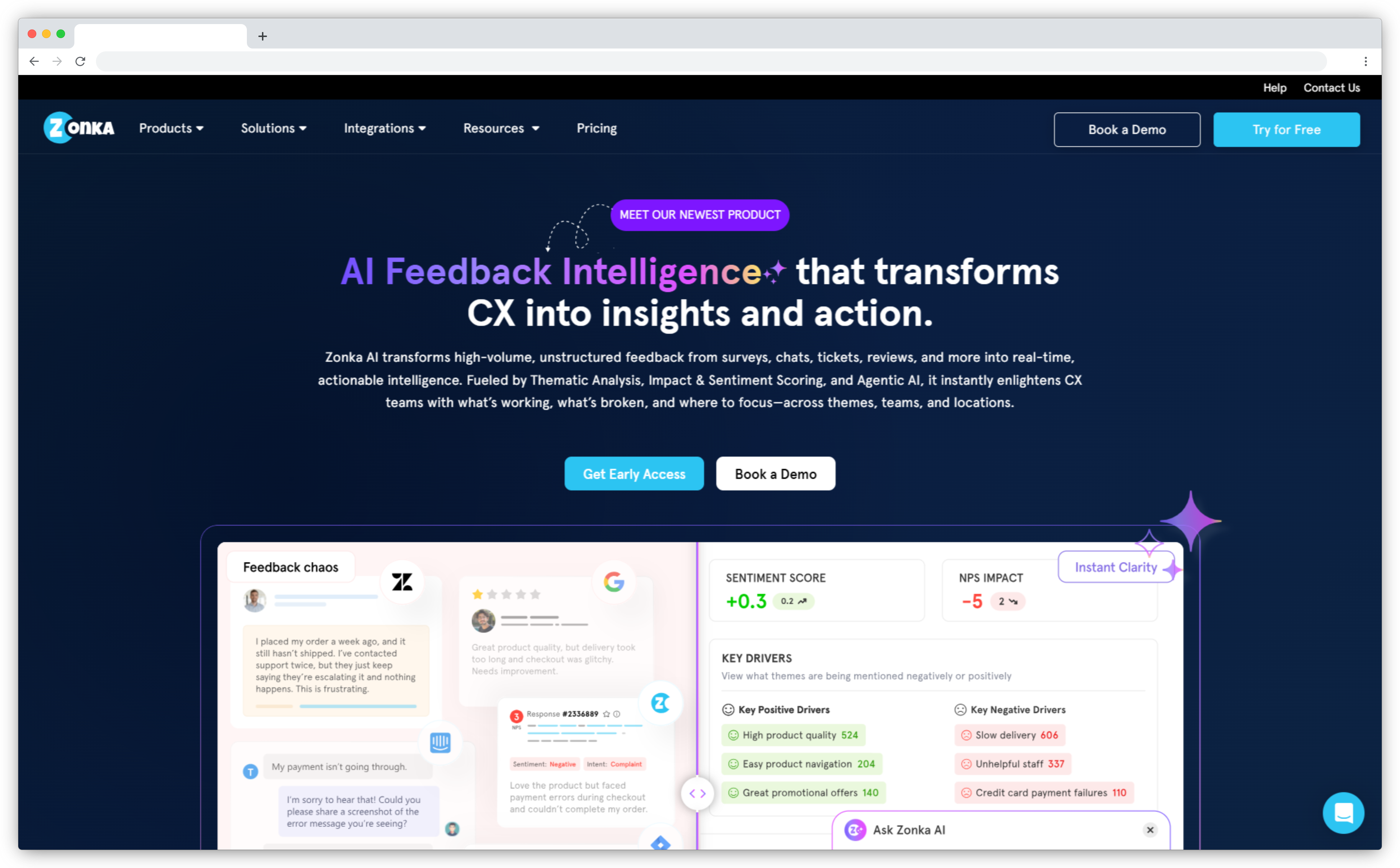
Zonka Feedback is an AI customer feedback and intelligence platform that combines omnichannel survey collection with a unified feedback analytics layer. For an ecommerce brand, that means the post-purchase survey and the AI that reads the answers live in the same place, rather than in two tools someone has to reconcile.
Where it earns its spot for ecommerce is the mix of reach and analysis. The native Shopify app can trigger a survey when an order is placed or fulfilled, and the same survey can follow up by email, SMS, WhatsApp, on-site, or in-app, which matters because WhatsApp post-purchase drives far higher response rates in many markets than email alone. Eyewa collected more than 86,000 responses that way, and SmartBuyGlasses lifted its net promoter score by 30 percent running multilingual surveys across more than 30 countries. The AI layer then clusters open-text responses into themes, scores sentiment, and surfaces signals such as a rise in delivery complaints before it shows up in returns.
Key features
- Native Shopify trigger for post-purchase surveys, plus email, SMS, WhatsApp, on-site, and in-app collection
- AI Feedback Intelligence for theme detection, sentiment analysis, and entity mapping
- Role-based signals and case management to close the feedback loop
- Integrations with Shopify, Klaviyo, HubSpot, Salesforce, and Zendesk
Pros
- Collection and AI analysis in one platform, so most brands skip a separate analysis tool
- Multi-channel reach that fits how ecommerce customers respond, including WhatsApp
- ISO 27001 certified, GDPR and HIPAA compliant
Cons
- The deepest AI analysis sits in higher plans
- The breadth of channels is more than a single-channel store needs on day one
Pricing: Custom, quote-based.
Rating: 4.7/5 from 81 reviews on G2.
Best use case: Ecommerce brands that want post-purchase and multi-channel feedback plus AI analysis in one connected program.
Bottom line: The strongest fit when you want one platform to both collect and make sense of ecommerce feedback, especially if WhatsApp and post-purchase matter.
2. Chattermill: Best for AI Feedback Analytics Across Channels
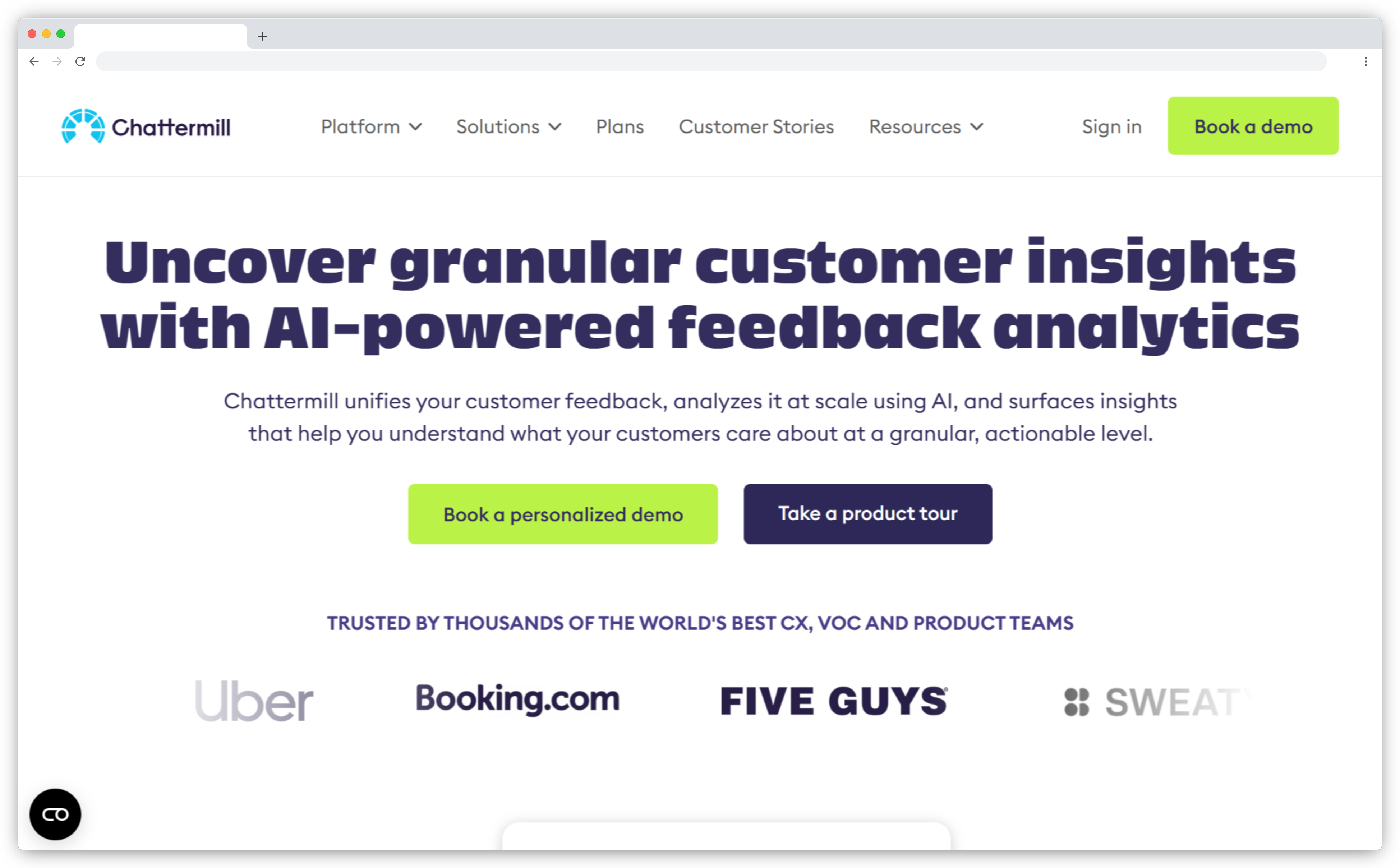
Chattermill is built for the point where feedback volume outgrows what a team can read by hand. It's an analysis layer, not a collection tool, so a brand points its existing reviews, tickets, surveys, and social feeds at it and lets AI find the patterns.
The value is in scale and journey mapping. Chattermill unifies sources through 50-plus integrations and ties themes to metrics like net promoter score, which is how brands including Amazon, Uber, and H&M read sentiment across a high volume of customer data. It works best above a real volume threshold. A store running one quarterly survey will find it heavier than the job needs.
Key features
- Unifies reviews, tickets, surveys, and social into one analytics layer
- Deep-learning theme and sentiment analysis built for CX
- Journey-stage mapping and impact analysis
- 50-plus integrations across helpdesk, survey, and review sources
Pros
- Strong at finding patterns across high-volume, multi-source feedback
- Maps sentiment to specific journey touchpoints, which suits ecommerce funnels
- Trusted by large consumer brands
Cons
- Enterprise-weighted, with no free plan and custom pricing
- Analysis only, so you still need collection tools feeding it
- Some reporting views feel dated
Pricing: Custom, quote-based.
Rating: 4.5/5 from 218 reviews on G2.
Best use case: Mid-market and enterprise ecommerce teams that already collect feedback and need AI to analyze it at scale.
Bottom line: A powerful analysis brain for brands drowning in feedback, but only once volume justifies it.
3. Qualtrics: Best for Enterprise Experience Management
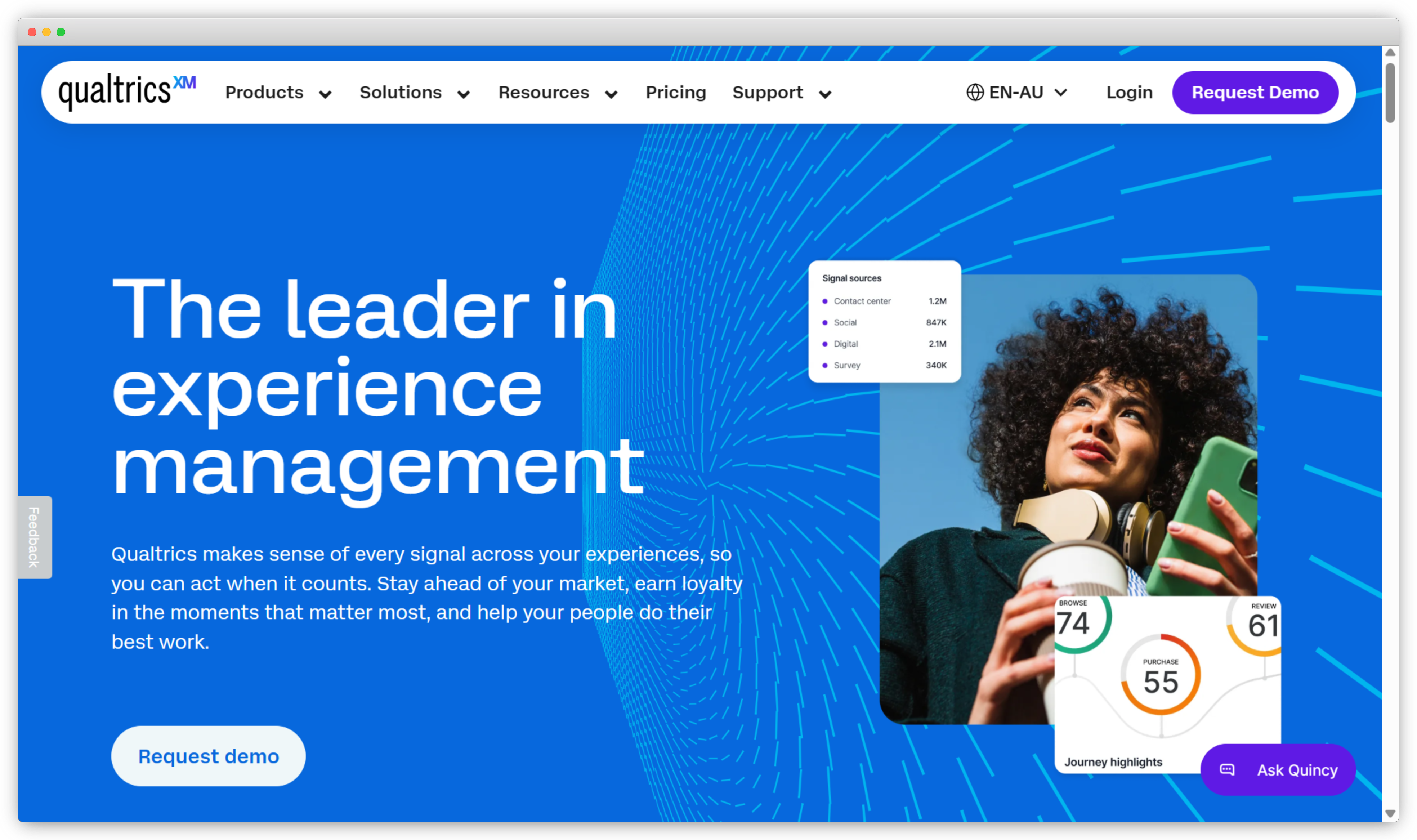
Qualtrics is the heavyweight of experience management, built for large-scale research and cross-department reporting rather than quick post-purchase surveys. For ecommerce, it fits large retailers running structured voice of customer research alongside brand and product studies.
Its depth is real, and so is its overhead. Qualtrics handles everything from basic customer satisfaction surveys to conjoint analysis and longitudinal studies, with text and statistical engines on top, but setup takes expertise and the pricing is enterprise-only. A team that mainly needs a post-purchase survey tied to Shopify orders will spend most of its budget on capability it won't use.
Key features
- Advanced survey logic, branching, and research methodology
- Text and statistical analysis engines
- Multi-channel distribution and journey feedback
- Enterprise governance and integrations
Pros
- Deepest research and analysis capability in the category
- Scales across departments and large response volumes
- Established, well-documented platform
Cons
- Custom enterprise pricing, typically well into five figures a year
- Steep learning curve and slower to deploy
- Overkill for small and mid-market stores running standard surveys
Pricing: Custom, enterprise.
Rating: 4.3/5 from 739 reviews on G2.
Best use case: Large online retailers with a dedicated insights team running research-grade VoC.
Bottom line: The right call for enterprise research programs, the wrong call for a store that just needs post-purchase surveys.
On-Site and Behavioral Feedback Tools
These tools capture the voice of the customer while shoppers are still on the site, which is where you learn why they hesitate, abandon, or convert.
4. Hotjar: Best for On-Site Behavior and Contextual Surveys
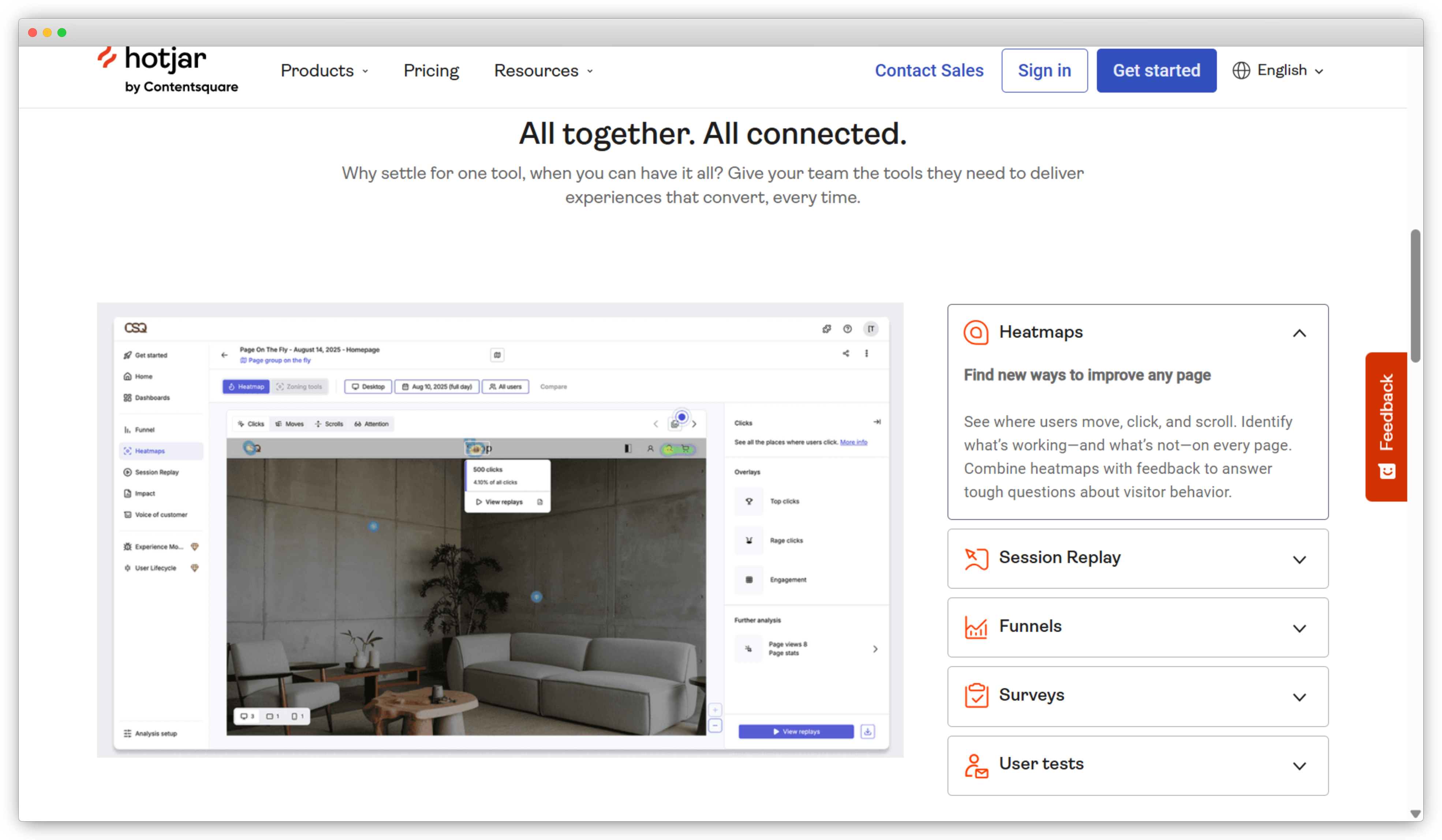
Hotjar answers a question surveys can't, which is what shoppers actually do before they buy. Heatmaps and session recordings show where they click, scroll, and stall, and feedback polls layer the why on top of the what.
For ecommerce, the combination is the point. Seeing that customers abandon checkout at a specific step is useful, and a poll triggered at that step tells you the reason. It's behavioral-first, so the feedback capture is lighter than a dedicated survey platform, and it won't touch post-purchase or support, but behavior plus a well-timed question is hard to beat for conversion work.
Key features
- Heatmaps and session recordings across product, cart, and checkout pages
- On-site feedback polls and surveys triggered by behavior
- Funnel and page performance views
- Free tier for smaller stores
Pros
- Combines behavioral data with contextual feedback in one tool
- Fast to install and easy for non-technical teams
- Generous free tier
Cons
- Behavioral-first, so feedback capture is secondary to analytics
- Data retention limits on lower tiers require planning
- Doesn't cover post-purchase or support feedback
Pricing: Free tier. Paid plans from around $39 per month.
Rating: 4.3/5 from 342 reviews on G2.
Best use case: Ecommerce teams optimizing on-site experience and checkout who want behavior and voice together.
Bottom line: The default for understanding on-site drop-off, best paired with a post-purchase tool for full coverage.
5. Qualaroo: Best for Targeted On-Site Nudge Surveys
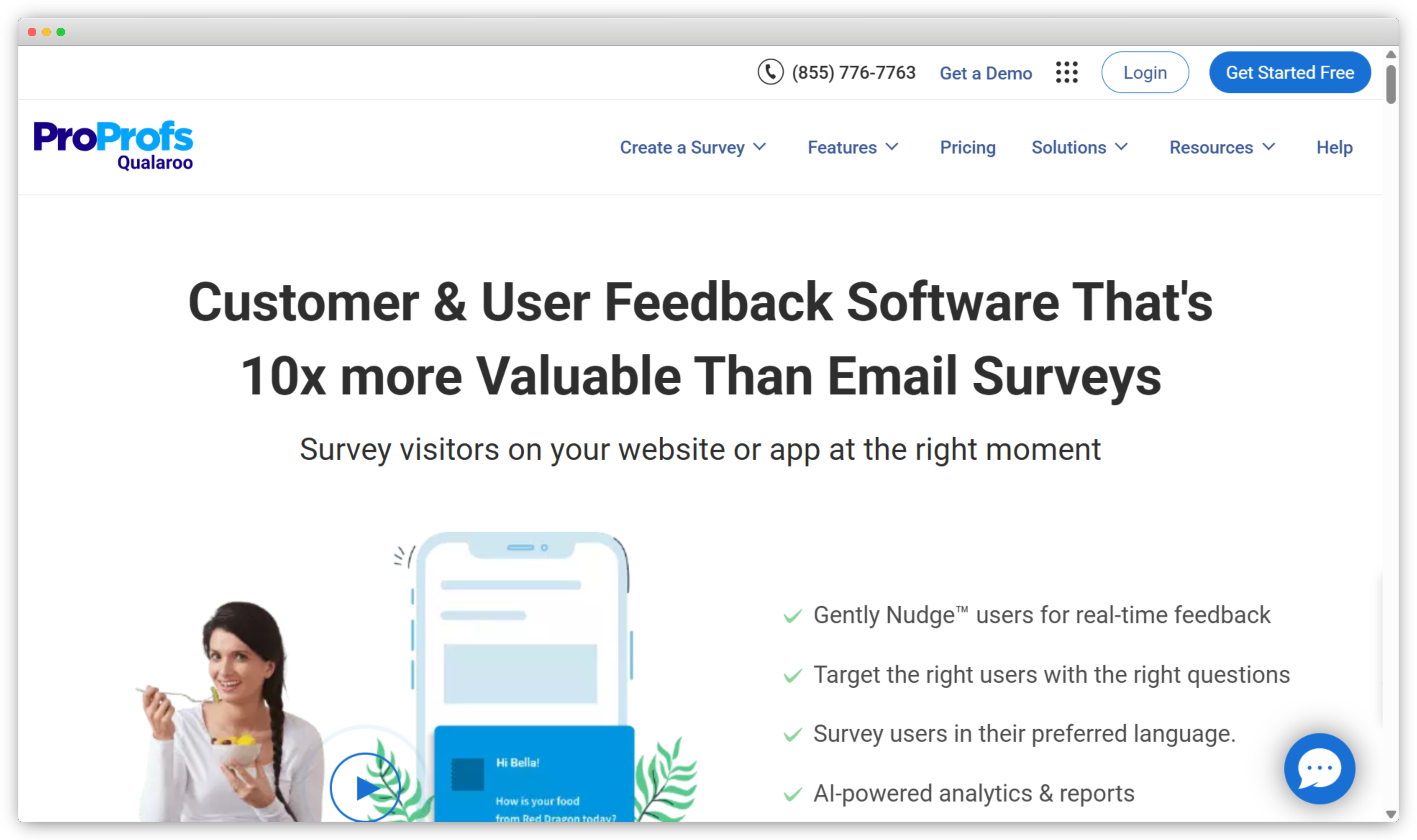
Qualaroo is built around a simple idea: ask the question while the behavior is still happening. Its Nudge format fires a short, contextual survey when a shopper views a product, lingers on a page, or moves to abandon a cart.
That timing is what makes the feedback useful. Asking why someone is leaving during checkout, in the moment, beats asking days later by email, and AI sentiment analysis on the answers surfaces the recurring reasons. Like every on-site tool, its reach ends at the site, so it earns its place as one layer of a broader stack rather than the whole program.
Key features
- Nudge on-site micro-surveys with behavioral triggers
- Advanced audience and page targeting
- AI sentiment analysis on responses
- Templates and branching logic
Pros
- Captures intent and friction at decision points on-site
- Strong targeting for relevant, timely questions
- Free tier to start
Cons
- Charges scale by responses, and white-labeling costs extra
- Limited customization and logic compared with full survey platforms
- On-site only, so no post-purchase or support coverage
Pricing: Free tier. Paid plans from $19.99 per month.
Rating: 4.3/5 on G2.
Best use case: Ecommerce teams that want precise, in-the-moment on-site feedback at specific journey points.
Bottom line: A sharp tool for reading intent at decision points, as long as you pair it with off-site collection.
Post-Purchase and Multi-Channel Survey Tools
These tools collect structured feedback after the sale and across channels, and the Shopify-native ones tie each response to the order behind it.
6. Fairing: Best for Post-Purchase Attribution Surveys
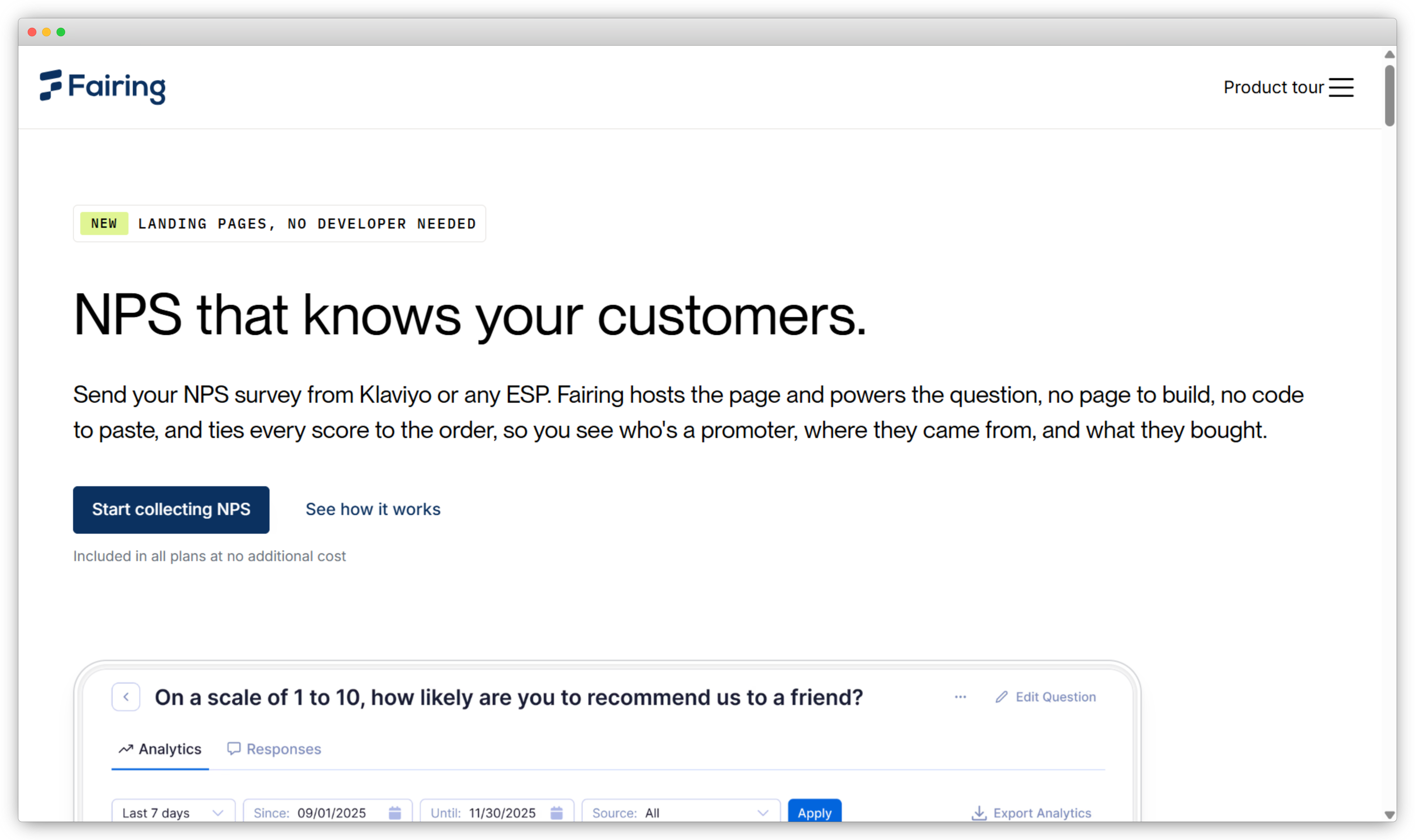
Fairing turns the post-purchase thank-you page into an attribution engine. Formerly EnquireLabs, it runs a programmable sequence of questions through its Question Stream and appends every answer to the customer's order record.
The reason DTC brands reach for it is response quality. In-the-moment post-purchase questions capture high response rates, and tying answers to order data lets a brand see which channels actually drive conversions instead of guessing from indirect metrics. It's attribution-first, though, so it works as a zero-party data source rather than a full customer experience suite.
Key features
- Question Stream programmable post-purchase surveys
- One-click Shopify integration with order-level enrichment
- Question Bank of pre-built questions including NPS
- Routing of responses to the marketing stack
Pros
- Very high post-purchase response rates
- Order-level enrichment out of the box
- Fast to set up on Shopify
Cons
- Attribution focus, not a broad VoC or reviews suite
- Some users have reported steep pricing changes over time
- Depth of open-text analysis is limited
Pricing: Free up to 100 orders per month, then roughly $15 to $199 per month by volume.
Rating: 5.0/5 from 193 reviews on the Shopify App Store.
Best use case: DTC brands that want post-purchase attribution and zero-party data tied to order records.
Bottom line: The pick when marketing attribution is the goal, less so when you need broad experience feedback.
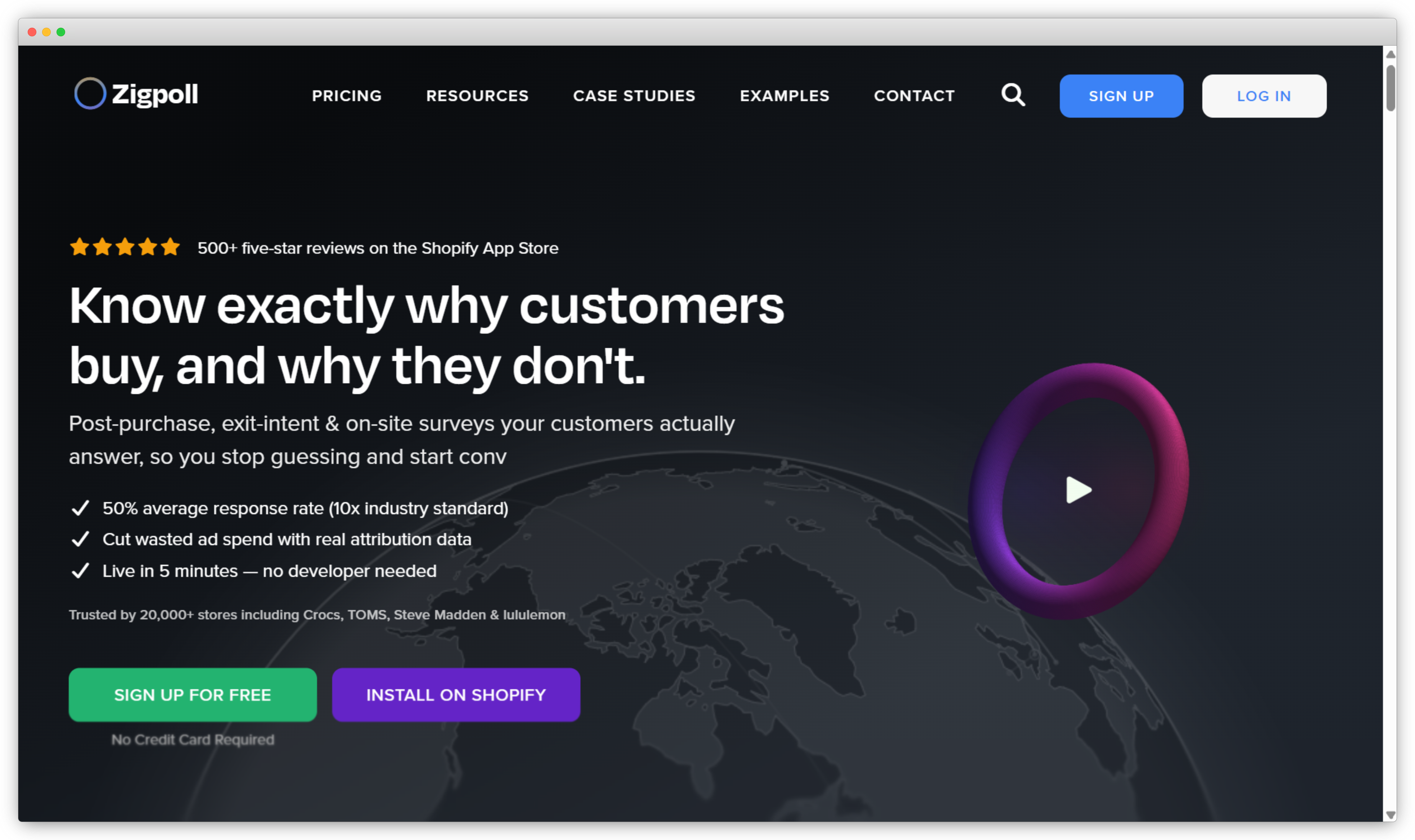
7. Zigpoll: Best for Budget-Friendly Post-Purchase and On-Site Surveys
Zigpoll is the value pick for stores that want post-purchase and on-site surveys without a big bill. It runs post-purchase, on-site, and exit-intent surveys covering attribution, net promoter score, and general feedback, with AI analysis on open-text responses.
It punches above its price. A free Lite plan covers small stores, paid tiers stay low as volume grows, and multilingual delivery across on-site, email, and SMS suits cross-border brands. Deep Shopify-attribute segmentation is lighter than a dedicated attribution specialist, but for most small and mid-size stores it covers the job at a fraction of the cost.
Key features
- Post-purchase, on-site, and exit-intent surveys
- Multilingual delivery across on-site, email, and SMS
- AI analysis of open-text responses
- Zero-party data collection with Shopify-native setup
Pros
- Free-forever Lite plan and low-cost paid tiers
- Multilingual, which suits cross-border stores
- Easy Shopify-native setup
Cons
- Lighter deep segmentation than attribution specialists
- Reporting is simpler than enterprise platforms
- Best suited to small and mid-size stores
Pricing: Free Lite plan. Paid plans from around $10 per month by volume.
Rating: 5.0/5 from 509 reviews on the Shopify App Store.
Best use case: Small to mid-size DTC brands that want affordable post-purchase and on-site surveys.
Bottom line: The best low-cost entry point for Shopify feedback, with room to grow before you need something heavier.
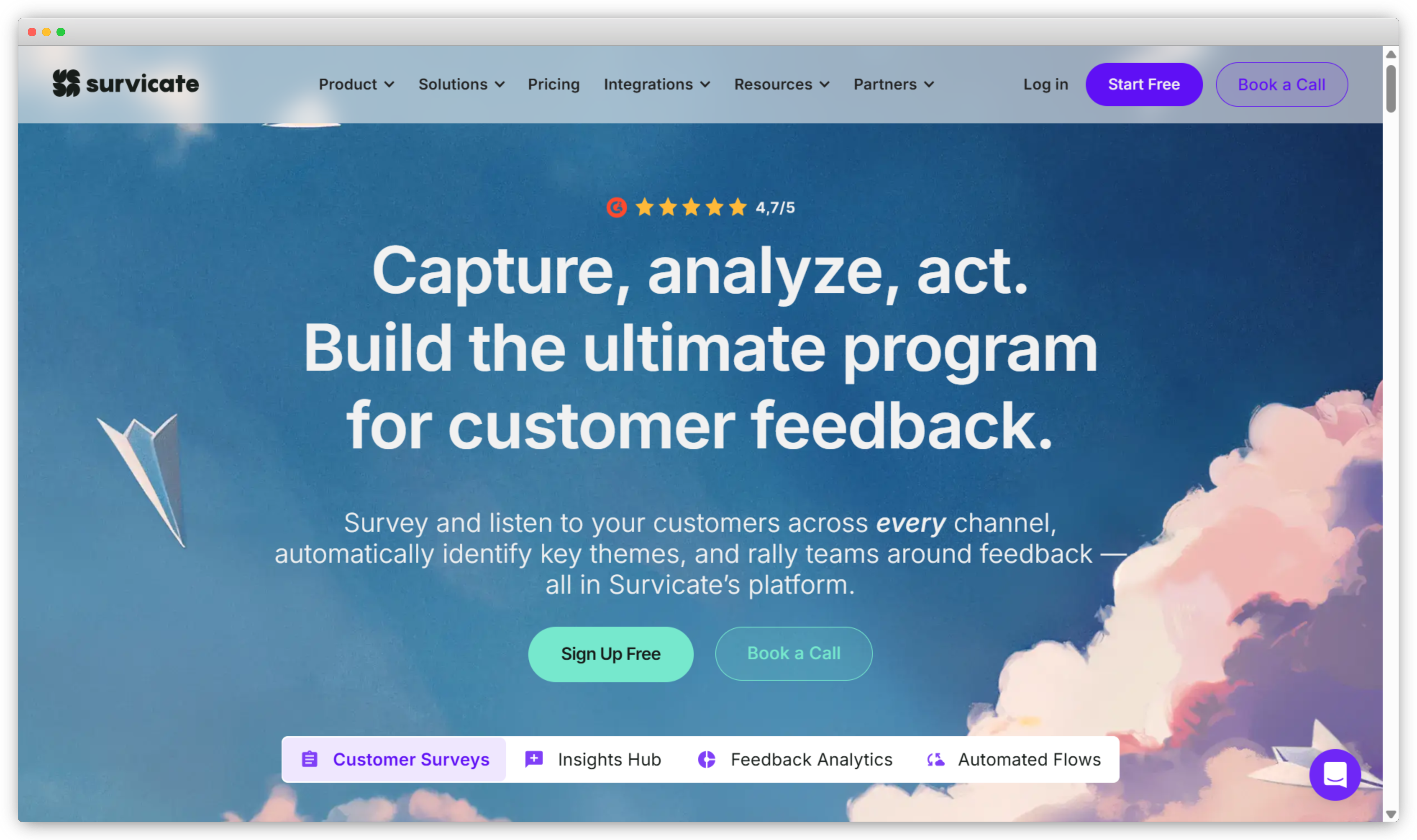
8. Survicate: Best for Multi-Channel Feedback Collection
Survicate spreads survey collection across the channels a store already runs, from web and in-product to email and mobile. That breadth lets an ecommerce team gather feedback at several points in the journey rather than from one place.
Collection is the strength, not deep analysis. Survicate supports net promoter score, customer satisfaction, and customer effort score with behavioral triggers and feedback tagging, but the analysis layer is lighter than a dedicated platform and manual tagging strains at high volume, so heavy free-text programs usually pair it with an analysis tool.
Key features
- Surveys across web, in-product, email, mobile, and link
- NPS, CSAT, CES, and open-text question types
- Behavioral and event-based triggers
- Feedback tagging and journey insights
Pros
- Flexible multi-channel collection at a reasonable price
- Fast deployment and strong templates
- Free tier to start
Cons
- Analysis layer is basic for CX-heavy teams
- Manual tagging doesn't scale for high volumes
- Not ecommerce-specific out of the box
Pricing: Free tier. Paid plans from around $56 per month.
Rating: 4.6/5 from 199 reviews on G2.
Best use case: Ecommerce teams that want flexible survey collection across several channels without heavy setup.
Bottom line: A solid multi-channel collector when reach matters more than deep analysis.
Product Review and UGC Tools
Reviews are a distinct feedback surface for ecommerce. They capture product-level feedback and, displayed on product pages, they lift conversion for the next shopper.
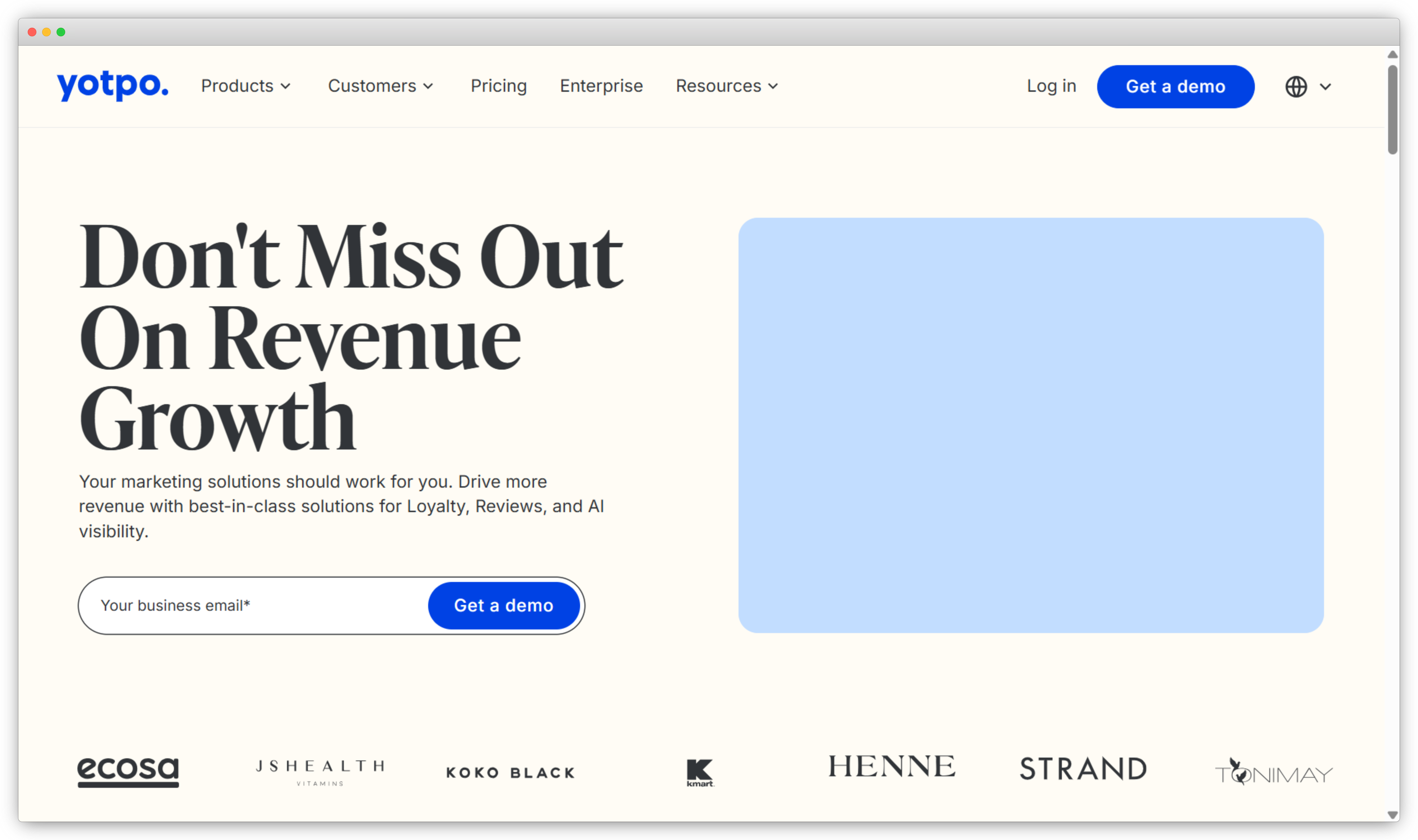
9. Yotpo: Best for Reviews That Drive Conversion
Yotpo treats reviews as two things at once: product feedback and conversion content. It collects reviews, ratings, photos, and Q&A through post-purchase flows, then displays that content on product pages to influence the next purchase.
For a DTC brand, that dual role is the appeal. Smart Sentiment analysis flags what customers praise or criticize and auto-detects recurring topics like fit and fabric, while the widgets turn that content into social proof. The lens stays mostly at the product level, so checkout, shipping, and service feedback need other sources, and the pricing climbs as you stack modules.
Key features
- Review, rating, photo, and Q&A collection via post-purchase flows
- On-page display widgets and rich snippets
- Smart Sentiment analysis and topic detection
- Deep Shopify, Klaviyo, and Gorgias integrations
Pros
- Reviews double as feedback and conversion content
- Tight DTC and Shopify integration
- Free plan and self-serve start
Cons
- Pricing escalates as you add features and modules
- Product-level focus, so it isn't a full VoC program
- Email and SMS products were sunset at the end of 2025
Pricing: Free plan for up to 50 orders. Reviews plans from $79 per month.
Rating: 4.3/5 from 258 reviews on G2.
Best use case: DTC and Shopify brands that want product reviews that also lift conversion.
Bottom line: The default review engine for Shopify brands that value conversion content, if the budget can absorb module stacking.
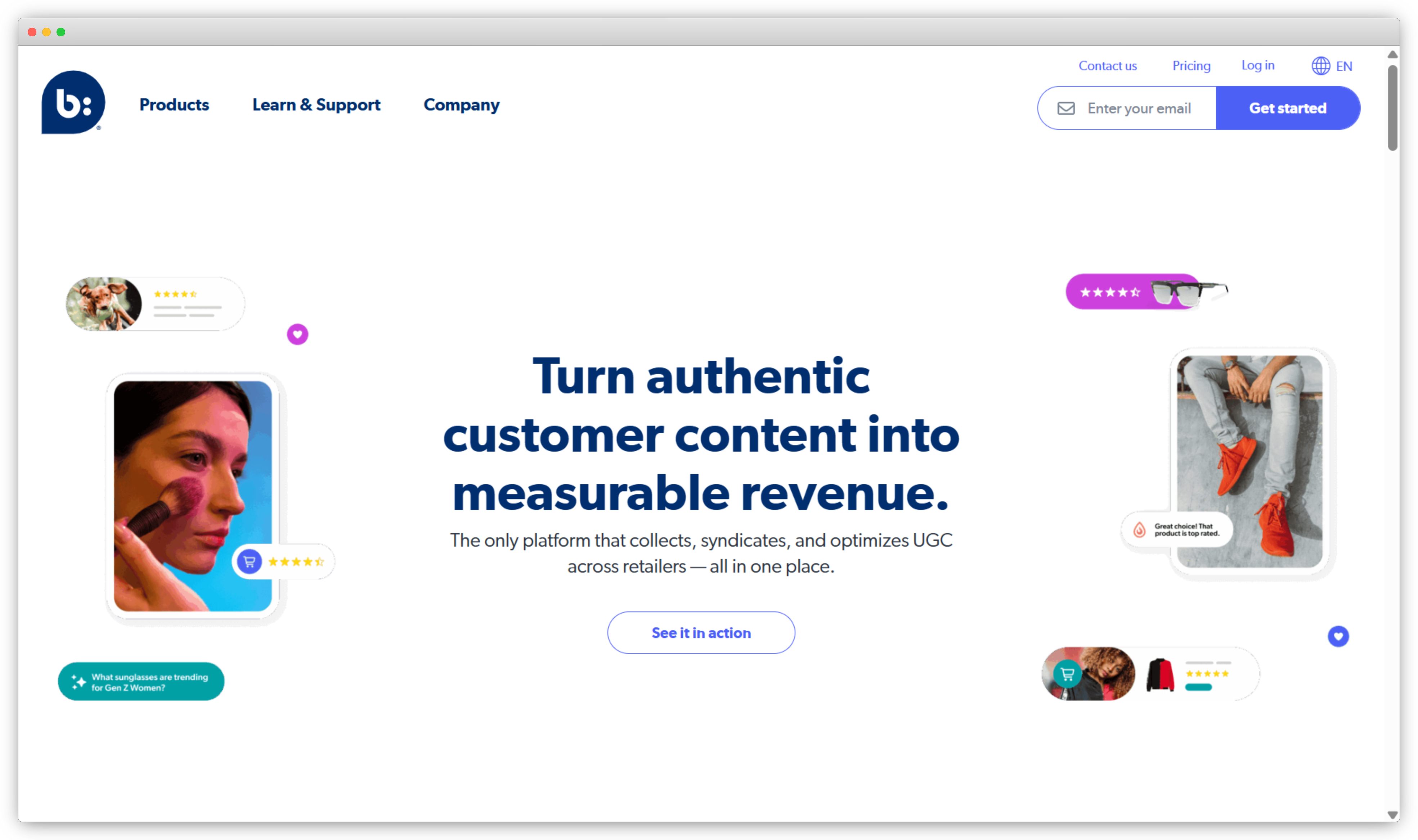
10. Bazaarvoice: Best for Enterprise Review Syndication
Bazaarvoice sits at the enterprise end of reviews, where scale and syndication matter more than setup speed. It collects, moderates, and displays product reviews at high volume for brands with large catalogs.
Its real differentiator is the syndication network. Bazaarvoice pushes a brand's reviews across thousands of retail partners, which is something no Shopify-native tool matches, and it handles moderation across thousands of SKUs. That scale carries enterprise cost, lengthy implementation, and rigid contracts, so smaller stores usually find a more focused tool more practical.
Key features
- Review collection and moderation at scale
- Syndication across a large retail partner network
- Enterprise analytics and compliance
- Display optimization across product pages
Pros
- Industry-leading review syndication reach
- Built for high volumes and complex catalogs
- Strong moderation and fraud detection
Cons
- Enterprise pricing and lengthy implementation
- Rigid, auto-renewing contracts noted by many users
- Older admin interface and steeper setup
Pricing: Custom, enterprise.
Rating: 4.2/5 from 803 reviews on G2.
Best use case: Large brands that sell across many retailers and need review syndication at scale. Brands that mainly need brand-reputation reviews rather than product reviews may prefer Trustpilot.
Bottom line: Worth the enterprise cost only when retail syndication is a priority, otherwise overkill for a DTC store.
Support-Conversation VoC Tools
Support conversations are one of the richest sources of customer complaints and product feedback in ecommerce, because customers reach out in their own words when something goes wrong.
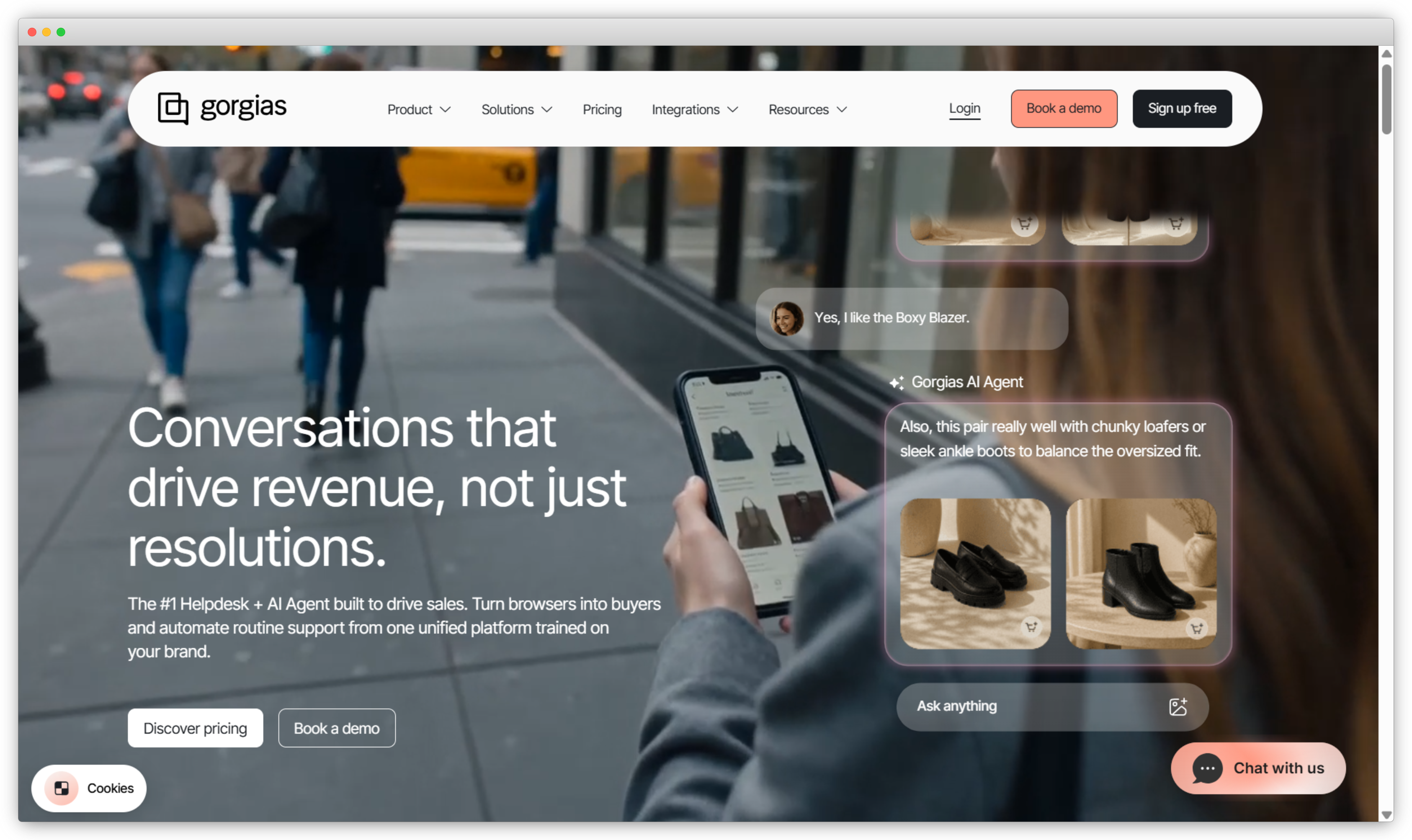
11. Gorgias: Best for Support-Conversation VoC
Gorgias captures the rawest voice of the customer there is, the support ticket, with the order sitting right beside it. Built for ecommerce, it integrates deeply with Shopify, BigCommerce, and Adobe Commerce so every conversation carries order and customer context.
That context is what makes the feedback rich, since tickets reveal product issues, shipping problems, and return reasons in the customer's own words. Gorgias reporting surfaces common support topics and intents, though it reports on tags and detected intents rather than mining the full content of conversations, so teams that want deep theme extraction add an analysis layer on top. Zendesk's retail solution is a comparable option for brands that need broader omnichannel support.
Key features
- Ecommerce-native helpdesk with Shopify order context
- Ticket tagging and intent detection
- AI Agent for common inquiries
- Multi-channel support across email, chat, and social
Pros
- Support conversations carry order context automatically
- Deep Shopify integration
- Affordable entry pricing
Cons
- Reports on tags and intents, not deep conversation analysis
- Costs climb quickly once AI and overage tickets are added
- Integration depth is strongest on Shopify
Pricing: From $10 per month (Starter), with the popular Pro tier at $360 per month.
Rating: 4.6/5 from 547 reviews on G2.
Best use case: Ecommerce brands that want support infrastructure that captures VoC with full purchase context.
Bottom line: The best way to turn support into a feedback source, provided you add analysis for the deeper themes.
How to Build a VoC Tool Stack for a Shopify Store
Most ecommerce brands don't need one tool. They need two or three that cover the journey without overlapping. The trick is matching each tool to the moment it captures, then giving one platform the job of analysis so the signals don't stay siloed.
Here's a practical way to map the stack to the online journey:
| Journey Stage | What You Want to Learn | Metric | Tool Type |
| Browsing and product pages | Why shoppers hesitate | Behavioral plus on-site poll | On-site tool |
| Cart and checkout | Why shoppers abandon | Customer effort score | On-site survey |
| Post-purchase and delivery | Whether the order met expectations | CSAT, NPS | Post-purchase survey |
| Product use | Whether the product delivered | Reviews, NPS | Review platform |
| Support and returns | What's breaking and why | CSAT, ticket themes | Helpdesk plus analysis |
A lean DTC store might run Zigpoll for post-purchase, Hotjar for on-site, and Yotpo for reviews. A scaling brand adds a helpdesk like Gorgias and points everything at one analysis layer so themes connect across channels. The goal is a single view, not five dashboards no one reconciles. For the full framework, see how to build a voice of customer program step by step.
The point where a stack becomes a program is analysis. Collecting feedback in five tools still leaves you reading five inboxes. A platform that unifies those sources and runs AI analysis across them is what turns collection into signals your team can act on.
Which Ecommerce VoC Tool Is Right for Your Store?
The right tool comes down to where your feedback lives and how much of the journey you need to hear. On-site tools explain drop-off, post-purchase apps catch delivery and product issues, review platforms turn feedback into conversion content, and helpdesks surface what's breaking. Most brands combine a few, then add a platform that unifies and analyzes across them.
If you want post-purchase and multi-channel collection plus AI analysis in one connected program, schedule a demo and start capturing customer feedback that turns into signals your team can act on.

.svg)