

.svg)
 Healthcare
 Finance
 Retail
 SaaS & Digital
 eCommerce
 Education
 Salesforce
  HubSpot
 Pipedrive
 Mailchimp
 Zendesk
  Intercom
 Freshdesk
 HelpScout
  Front
Front Jira
Jira Slack
Slack  MS Teams
 Zoom
Zoom Google Sheets
  Zapier
  Integrately
 Make
Make  Webhooks




 MS Teams


The best VoC tools for retail in 2026 are Zonka Feedback, Qualtrics, Medallia, InMoment, Retently, Zenloop, SurveySensum, AskNicely, Birdeye, and Formbricks. Each platform addresses a different retail need, from in-store kiosk feedback and post-purchase automation to enterprise analytics and multi-location management. The right tool depends on your store type, channel mix, and which stage of the retail customer journey you need to instrument first.
TL;DR
- The 10 best VoC tools for retail in 2026 span five use cases: full-stack omnichannel collection, enterprise analytics, ecommerce post-purchase automation, in-store multi-location management, and review reputation management.
- Retail VoC is harder than most industries because in-store and ecommerce feedback sit in separate tools. A platform that covers both channels prevents fragmented customer data from the start.
- For mid-market retail, Zonka Feedback handles physical store and ecommerce channels from one account. For enterprise chains, Qualtrics, Medallia, and InMoment are the established choices.
- NPS alone is not a complete retail VoC program. CES at checkout and returns, and CSAT after support interactions, are required to identify where customers actually experience friction.
- Returns experience and loyalty program integration are the two stages most retail VoC programs are missing. Instrumenting them separates programs that drive repeat purchases from those that only measure satisfaction.
Retail brands gather customer feedback across more touchpoints than most industries. The problem is not volume. It is that in-store feedback and ecommerce feedback typically sit in separate tools, which means most retail teams do not have a complete picture of customer experience across both channels. Most VoC tools for retail are built for one channel, not both.
This guide reviews 10 voice of customer tools for retail, organized by use case. It covers full-stack platforms, ecommerce-native tools, in-store and multi-location solutions, reputation management, and a privacy-first option. Each review includes key features, honest pros and cons, pricing, and a clear best-use case so you can match the right platform to your retail operation.
What Are VoC Tools for Retail?Voice of Customer (VoC) tools for retail are platforms that collect, analyze, and help teams act on customer feedback across retail touchpoints. They differ from general survey software in that they support retail-specific channels such as in-store kiosks, QR codes on receipts, post-purchase email triggers, and WhatsApp surveys.
A complete retail VoC program covers five customer feedback moments that reflect different customer needs: pre-purchase (product discovery), checkout (in-store and online), post-purchase (delivery and product quality), returns (resolution speed and effort), and loyalty re-engagement (repeat purchase intent and NPS at the relationship level).
According to PwC’s 2025 Customer Experience Survey, 52% of consumers stopped using or buying from a brand because of a bad experience with its products or services. Retail brands that collect structured feedback across these five stages can identify where experiences are falling short and act before customers stop returning.
Customer surveys are the primary collection method at each stage. Capturing the full voice of the customer requires covering all five moments, not just post-purchase.
What Makes Retail VoC Different from Other Industries?
Retail has five characteristics that determine which VoC tools actually work for the category. Generic platforms miss at least two of them.
1. The in-store data gap
Ecommerce platforms log every click, scroll, and abandoned cart. Physical stores log almost nothing about customer experience unless you deliberately instrument them. Kiosks, QR codes on receipts, and SMS surveys triggered at POS are the primary collection methods. Without them, your in-store program has no data to work with. Digital commerce has raised customer expectations for consistent service, and physical stores are increasingly judged against those standards.
2. High transaction volume with seasonal spikes
A retailer processing thousands of daily orders during peak season cannot manually analyze open-text customer feedback. VoC platforms need AI-based thematic analysis to handle that volume. Platforms without this capability will surface large amounts of raw survey data that no one has capacity to read.
3. Multi-location comparison
A single aggregate NPS score for a retail chain tells you nothing about which locations are underperforming. Store-level benchmarking is the only way to identify where the customer experience breaks down. Tools that do not support location-level tagging from initial setup create data architecture problems that are expensive to fix later.
4. Returns as a high-signal touchpoint
Returns reveal customer behavior patterns that other feedback channels rarely surface. A customer who returns a product and has a smooth resolution experience can still become a loyal buyer. Most VoC programs do not capture feedback at this stage, leaving a gap in understanding what drives repeat purchase decisions.
5. Loyalty program integration
Feedback from customers with 10 or more purchases should be weighted differently from feedback from first-time buyers. VoC platforms that connect to loyalty program data let you filter and compare responses by customer lifetime value, which changes how you prioritize improvements.
To understand the full depth of these stages, see what is voice of customer for grounding in the discipline. For a detailed breakdown of which metrics map to each stage, see which voice of customer metrics matter most for retail.
What Features Should You Look for in a Retail VoC Tool?
These seven capabilities determine whether a VoC platform can support a real retail feedback program.
- Omnichannel collection: The platform should support email, SMS, WhatsApp, web widgets, in-store kiosks, QR codes, and in-app surveys, covering multiple channels from one account. Running these channels in separate tools creates feedback data that cannot be compared.
- Offline and kiosk mode: The platform must collect responses in locations without internet access and sync data when connectivity is restored. This is a non-negotiable requirement for physical store operations.
- Post-purchase automation: Surveys should trigger automatically based on order events such as delivery confirmation or return completion. Manual campaign setup does not scale for high-transaction retailers.
- Multi-location management: Store-level reporting must be available out of the box. Managers need to compare location performance in a single dashboard.
- AI thematic analysis: High response volumes from seasonal periods require automated theme detection to identify trends across feedback without manual analysis. This is what separates platforms built for retail scale from general survey tools.
- Ecommerce and CRM integrations: Shopify, WooCommerce, Gorgias, Klaviyo, and Salesforce are the integrations retailers most commonly need. Confirm whether these are native or Zapier-dependent.
- Closed-loop workflows: Real time customer feedback should trigger automatic alerts to the right team. A low NPS response at a specific store should reach that store’s manager directly.
For a full comparison of what these capabilities look like across platforms, see the general Voice of Customer tools guide. For a data-focused perspective on what these capabilities produce, see how retailers use voice of customer analytics to track store-level trends.
How Do You Choose the Right VoC Tool for Your Retail Business?
The decision depends on four factors: store type, scale, primary use case, and integration stack.
| If you are... | Primary need | Good fits from this list |
| Ecommerce or DTC on Shopify | Post-purchase automation, Shopify-native integration | Retently, Zenloop |
| Multi-location chain | Store-level benchmarking, kiosk and QR support | Zonka Feedback, SurveySensum |
| Enterprise retailer | Predictive analytics, governance, global scale | Qualtrics, Medallia, InMoment |
| Frontline-heavy, large store staff | Coaching signals for store associates | AskNicely |
| Privacy-first or EU-based | Self-hosted, GDPR-native | Formbricks |
| Multi-location with reputation focus | Review tracking unified with internal VoC | Birdeye |
Full-stack platforms cover multiple rows in this table. Zonka Feedback handles both the multi-location chain and ecommerce scenarios from a single account. Specialized tools are a stronger fit when your use case is narrow and your budget is tighter.
For a detailed look at how these decisions play out in practice, see voice of customer best practices for retail brands.
How We Evaluated These Tools
We built Zonka Feedback, so we have a stake in this guide. Zonka is reviewed here on the same criteria applied to every other platform, and we have noted the cases where other tools do specific things better.
We evaluated each tool against six criteria: retail-specific channel support (in-store kiosk, offline mode, WhatsApp, post-purchase triggers), AI analysis capability, multi-location management, integration ecosystem, pricing transparency, and G2 ratings from verified user reviews.
Tool Comparison: At a Glance
| Tool | Best For | Key Retail Feature | G2 Rating | Starting Price |
| Zonka Feedback | Omnichannel retail, AI intelligence | In-store kiosk + WhatsApp + AI signals | 4.7/5 | Custom pricing |
| InMoment | Enterprise retail intelligence | Multi-source data unification | 4.7/5 | Contact for pricing |
| Qualtrics | Enterprise research programs | Complex survey logic + Salesforce | 4.3/5 | Contact for pricing |
| Medallia | Multi-country retail operations | Role-based governance at scale | 4.5/5 | Contact for pricing |
| Retently | Shopify and DTC brands | SKU-enriched post-purchase surveys | 4.7/5 | From $25/month |
| Zenloop | B2C churn prevention | Automated detractor recovery workflows | 4.7/5 | Contact for pricing |
| SurveySensum | Asia/ME multi-store chains | Fast deployment, dedicated CX manager | 4.6/5 | From $3,600/year |
| AskNicely | Frontline staff activation | Store associate coaching signals | 4.7/5 | Contact for pricing |
| Birdeye | Multi-location reputation management | Review monitoring + internal VoC | 4.7/5 | Contact for pricing |
| Formbricks | Privacy-first, GDPR-strict brands | Self-hosted, QR and kiosk support | 4.8/5 | Free (self-hosted) |
The 10 Best VoC Tools for Retail in 2026
These 10 platforms cover the range of retail feedback needs, from single-store ecommerce brands to multi-country enterprise chains. They are grouped by use case.
Full-Stack Retail VoC Platforms
Full-stack platforms handle collection, AI analysis, and closed-loop action from a single account. They suit retailers who need multiple feedback channels without connecting several point tools.
1. Zonka Feedback: Best for Omnichannel Retail with AI Feedback Intelligence
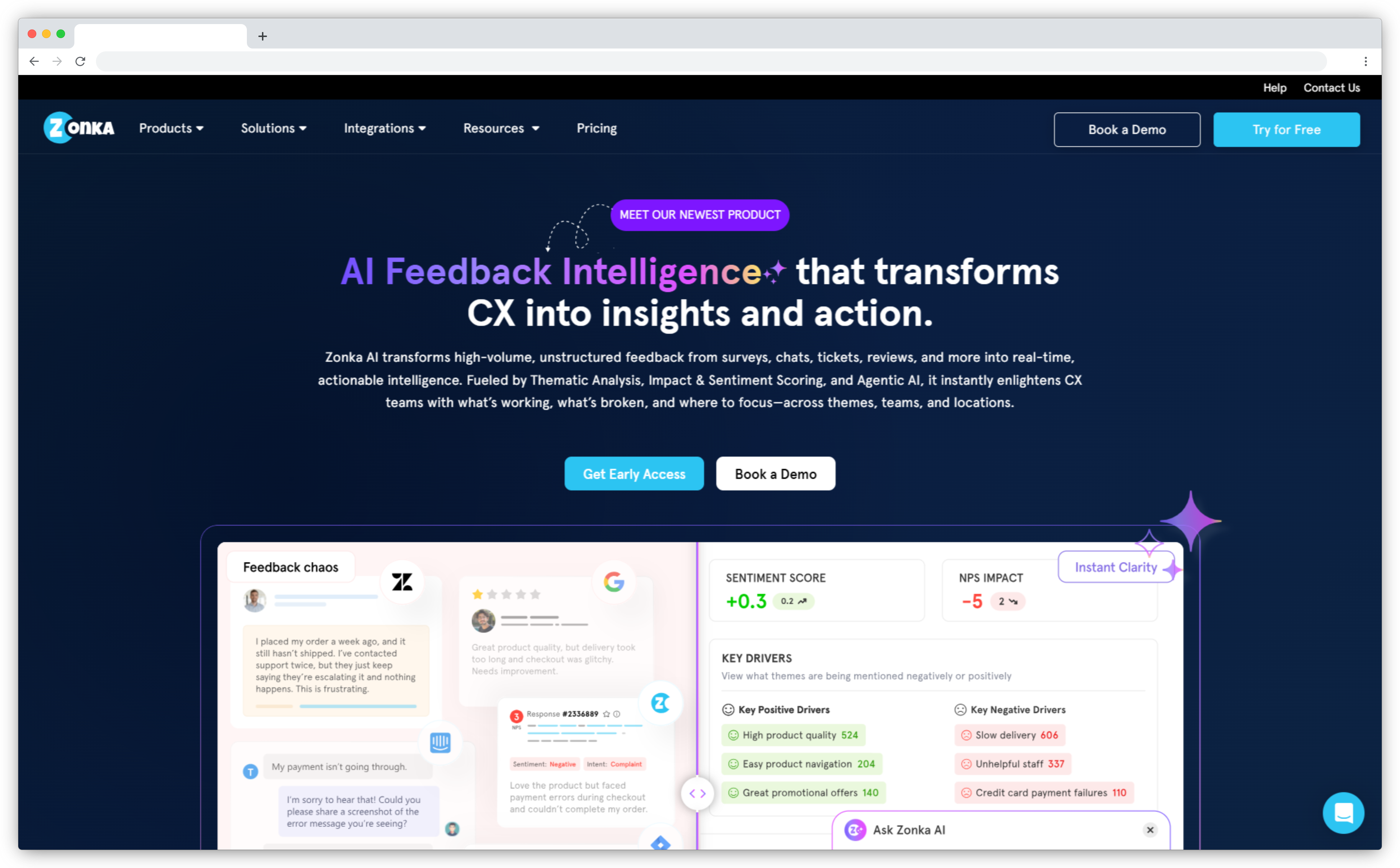
Zonka Feedback covers the full retail feedback journey from one platform. It supports in-store kiosks, email, SMS, WhatsApp post-purchase surveys, website widgets, offline mode, and QR codes. All feedback flows into a single dashboard where the AI Feedback Intelligence layer processes it.
The AI layer clusters open-text responses into themes, maps feedback to specific store locations and staff members, and delivers signals by role. A store manager sees their location’s signals. A regional director sees their region’s comparison. The central CX team sees the full picture.
Retail customers include SmartBuyGlasses, which increased its NPS by 30% with 84,000+ responses across 30+ countries. Damas Jewellery uses store-level NPS across its multi-store network, reaching an NPS of 85+. Eyewa collects post-purchase CSAT and NPS via WhatsApp webhook automation with 86,000+ responses.
Key Features of Zonka Feedback
- In-store kiosk and offline survey mode with automatic sync on reconnect
- WhatsApp post-purchase survey automation via webhook
- AI thematic analysis with store-level and agent-level entity mapping
- Multi-location dashboards with role-based signal delivery
- Shopify, Salesforce, HubSpot, Zendesk, and Freshdesk integrations
- Closed-loop case management with auto-alerts on score drops
Zonka Feedback Pros
- Covers physical retail and ecommerce channels from a single account
- AI signals reach the right person without manual report distribution
- ISO 27001 certified, GDPR and HIPAA compliant
Zonka Feedback Cons
- Setting up multi-location reporting and role-based dashboards for large retail chains requires initial configuration time
- The AI Feedback Intelligence layer is a premium add-on. Smaller retail programs may need to upgrade to access full AI analysis
Zonka Feedback Pricing
- Custom pricing. Contact Zonka Feedback for a quote.
G2 Rating: 4.7/5 on G2
Best Use Case: Mid-market to enterprise retailers running both physical and ecommerce channels who need collection, AI analysis, and closed-loop workflows in one platform.
2. InMoment: Best for Enterprise Retail Intelligence with Multi-Source Data
InMoment unifies feedback from surveys, online reviews, social mentions, support tickets, and call transcripts in one analysis layer. It covers customer journey mapping and operational data integration alongside survey collection, making it one of the broader enterprise platforms in this list.
For large retail programs, InMoment connects VoC data to business data sources such as sales transactions, identifying which feedback patterns correlate with revenue outcomes. The platform’s predictive analytics flag emerging issues before they appear in score declines.
Key Features of InMoment
- Multi-source feedback unification across surveys, reviews, calls, and tickets
- Predictive analytics with early-warning trend detection
- Customer journey visualization and orchestration
- Qualitative feedback analysis from call transcripts and unstructured data sources
- Operational data integration for revenue correlation
InMoment Pros
- Processes unstructured data from multiple sources without manual tagging
- Strong enterprise governance and role-based access controls
- Predictive capability is more advanced than most full-stack survey platforms
InMoment Cons
- Pricing and implementation complexity are suited to enterprise programs, not mid-market
- Setup typically requires a dedicated implementation engagement
InMoment Pricing
- Contact for pricing
G2 Rating: 4.7/5 on G2
Best Use Case: Large multi-channel retailers needing CX intelligence across surveys, reviews, calls, and tickets in one system.
Enterprise Retail Chains
Enterprise platforms are designed for large retail organizations with complex reporting structures, global operations, and dedicated research teams.
For reference on what enterprise VoC programs look like in practice, see real-world voice of customer examples from brands across industries.
3. Qualtrics: Best for Enterprise Retail Programs and Cross-Functional Research
Qualtrics works with over 450 retailers globally. Its strength is in complex survey design, advanced statistical analysis, and integration with enterprise systems such as Salesforce. Research teams use it for cross-functional studies that combine VoC data with employee feedback and market research in a single platform.
Qualtrics moved to an interaction-based pricing model in 2025, billing by survey response volume rather than by seat count. For high-transaction retailers with seasonal volume peaks, annual costs scale with survey activity. Modeling expected response volumes against the pricing structure before signing a contract is worth doing at the evaluation stage.
Key Features of Qualtrics
- Complex survey logic with branching, randomization, and conjoint analysis
- Cross-functional XM platform covering customer, employee, and brand programs
- Advanced statistical analysis and predictive modeling
- Native Salesforce integration with bidirectional data sync
- Role-based access and enterprise governance controls
Qualtrics Pros
- Industry-leading for research-grade survey design and statistical analysis
- Extensive integration ecosystem across enterprise tools and CRM platforms
- Strong analyst and academic credibility across retail use cases
Qualtrics Cons
- High cost and implementation complexity for most mid-market retailers
- Interaction-based pricing makes annual cost difficult to predict for retailers with high seasonal survey volumes
Qualtrics Pricing
- Enterprise. Starts in the low five figures annually. Large programs commonly run $200,000 or more per year.
G2 Rating: 4.3/5 on G2
Best Use Case: Large enterprise retailers with dedicated research teams needing multi-functional measurement across customer, employee, and brand programs.
4. Medallia: Best for Very Large Multi-Country Retail Operations
Medallia is built for global retail programs where governance, multi-country deployment, and operational data integration are baseline requirements. It supports real-time digital signals alongside transactional survey data, so retailers can act on feedback as interactions happen rather than in weekly reporting cycles.
Medallia’s pricing is based on Experience Data Records (EDR), meaning the platform bills by total feedback volume ingested across all sources. For high-transaction retailers, cost scales directly with program scope. Modeling expected annual response volumes before committing to a contract is an important step in the evaluation process.
Key Features of Medallia
- Real-time digital signals alongside transactional survey data
- Multi-country role-based governance and access controls
- Operational data integration for connecting feedback to business metrics
- AI-powered text analytics at enterprise scale
Medallia Pros
- Industry standard for large, multi-country retail CX programs
- Real-time signal delivery rather than batch reporting cycles
- Strong role-based architecture for complex organizational structures
Medallia Cons
- Requires significant onboarding time and dedicated CX infrastructure. Not suited for teams without an established enterprise program
- EDR-based pricing scales with feedback volume and can be difficult to forecast for high-transaction retail operations
Medallia Pricing
- Custom. EDR-based pricing model.
G2 Rating: 4.5/5 on G2
Best Use Case: Multi-country retail chains that need governance at scale, role-based regional access, and VoC connected to operational data.
Ecommerce-Native Tools
Ecommerce-native tools are built around order events, ecommerce platform integrations, and post-purchase survey triggers. They outperform general VoC platforms for DTC and Shopify-based brands. For a deeper comparison of tools focused specifically on the NPS metric in ecommerce, see NPS tools built for retail and ecommerce brands.
5. Retently: Best for Shopify and DTC Ecommerce Brands
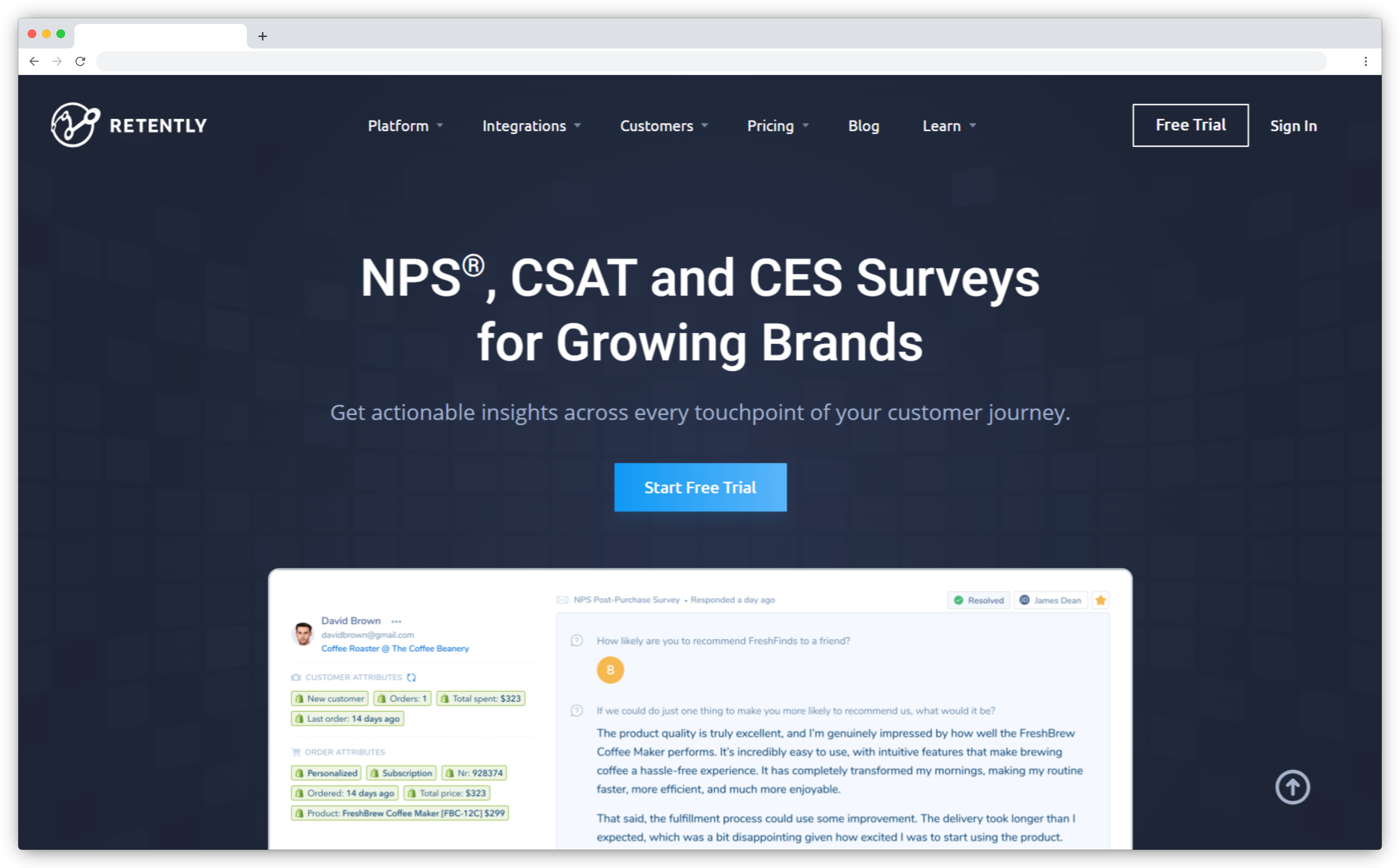
Retently is built around the ecommerce feedback lifecycle. It triggers NPS surveys after delivery, CSAT after support ticket closure, and CES after order completion. Every survey response is enriched with the customer’s SKU, basket value, coupon usage, agent name, and channel. Teams see scores alongside context: who bought what, through which channel, and what drove the result.
Retently’s integrations with Shopify, Gorgias, Klaviyo, and Yotpo are native. Survey triggers fire based on real order and ticket events. The agent leaderboard feature connects CSAT scores to individual support staff for targeted coaching.
Retently has no kiosk mode, QR support, or offline collection. Retailers with physical store operations need a separate tool for in-store feedback.
Key Features of Retently
- Post-purchase NPS, CSAT, and CES with order-level response enrichment
- Native integrations with Shopify, Gorgias, Klaviyo, and Yotpo
- Agent leaderboards linking CSAT scores to individual staff performance
- Customer sentiment analysis and topic clustering for open-text responses
Retently Pros
- Response enrichment with SKU, basket value, and coupon data is a genuine differentiator
- Native ecommerce integrations reduce program setup time significantly
- Purpose-built for the specific feedback moments ecommerce retailers care about most
Retently Cons
- No in-store, kiosk, or QR feedback support
- Not suited for enterprise programs that require research-grade analytics
Retently Pricing
- Starts at $25/month (G2). Volume-based tiers. Verify current plans at retently.com.
G2 Rating: 4.7/5 on G2
Best Use Case: DTC and Shopify-based ecommerce brands that want post-purchase surveys enriched with order-level customer data.
6. Zenloop: Best for B2C Churn Prevention with Automated Retention Workflows
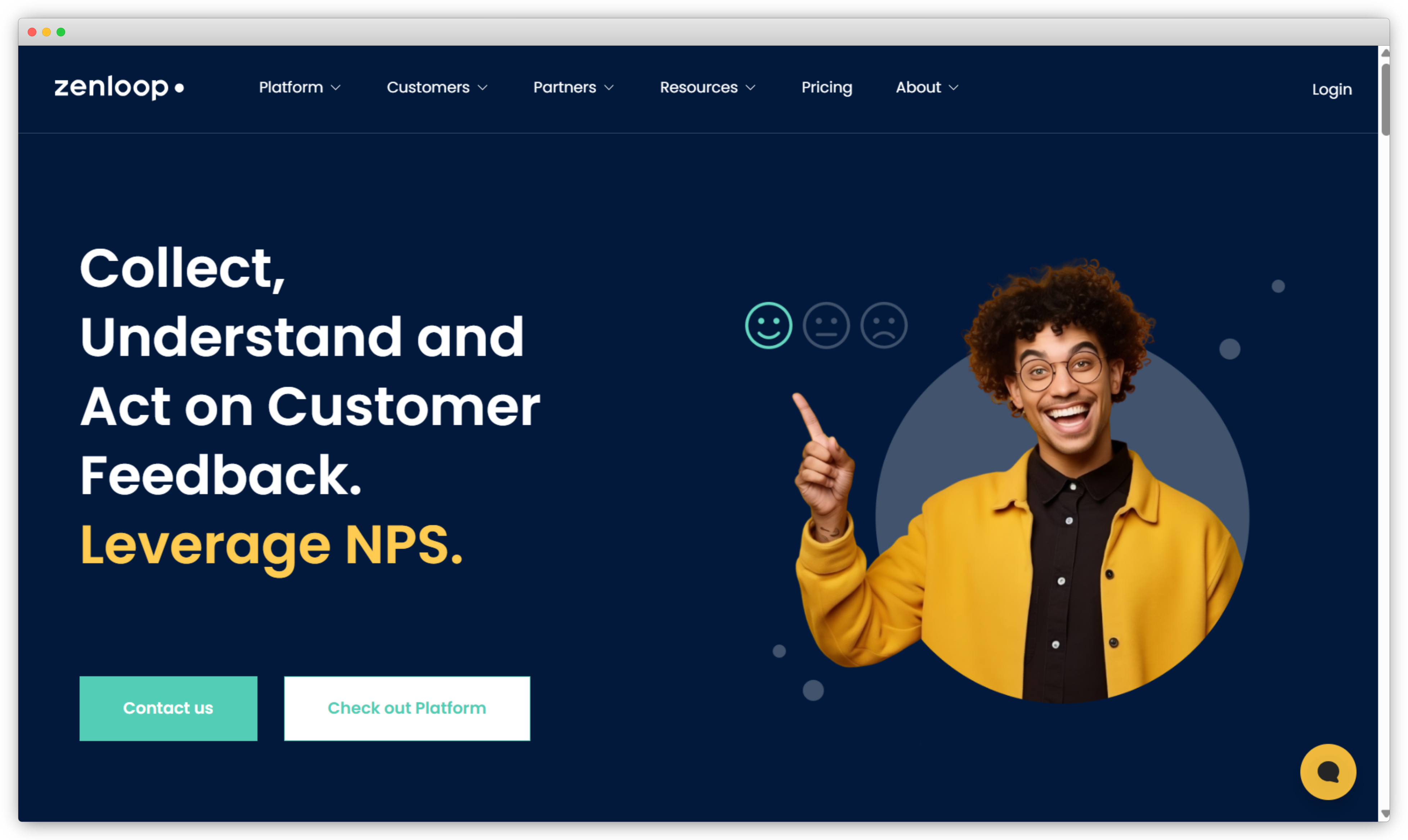
Zenloop connects VoC data to customer retention workflows that trigger automatically based on survey responses. A detractor response triggers a recovery campaign. A promoter response triggers a review request. The loop closes automatically without manual follow-up tasks.
Zenloop is suited to fashion, beauty, food, and ecommerce brands with high purchase frequency. The platform clusters feedback using AI to identify which themes drive detractor responses. Server infrastructure is in Germany, making it GDPR compliant for European retailers by design. Kiosk and offline feedback are not supported.
Key Features of Zenloop
- Automated detractor recovery and promoter review request workflows
- NPS and CSAT distribution via email and web
- AI theme clustering to identify drivers of negative customer responses
- GDPR compliant with Germany-based server infrastructure
- Salesforce, Klaviyo, and Zendesk integrations
Zenloop Pros
- Automated retention workflows close the feedback loop without manual intervention
- Strong for high-frequency B2C purchase scenarios and seasonal retail
- GDPR-native for European retail operations
Zenloop Cons
- No kiosk or offline in-store feedback collection
- Analytics depth is lighter than full-stack enterprise platforms
Zenloop Pricing
- Contact for pricing. Individual pricing available at zenloop.com.
G2 Rating: 4.7/5 on G2
Best Use Case: Ecommerce and DTC brands focused on automated detractor recovery and promoter activation across high-frequency B2C customer relationships.
Multi-Location and In-Store Tools
In-store and multi-location tools prioritize physical store feedback, QR and kiosk deployment, and support for distributed retail networks.
7. SurveySensum: Best for Multi-Store Chains in Asia, the Middle East, and Emerging Markets
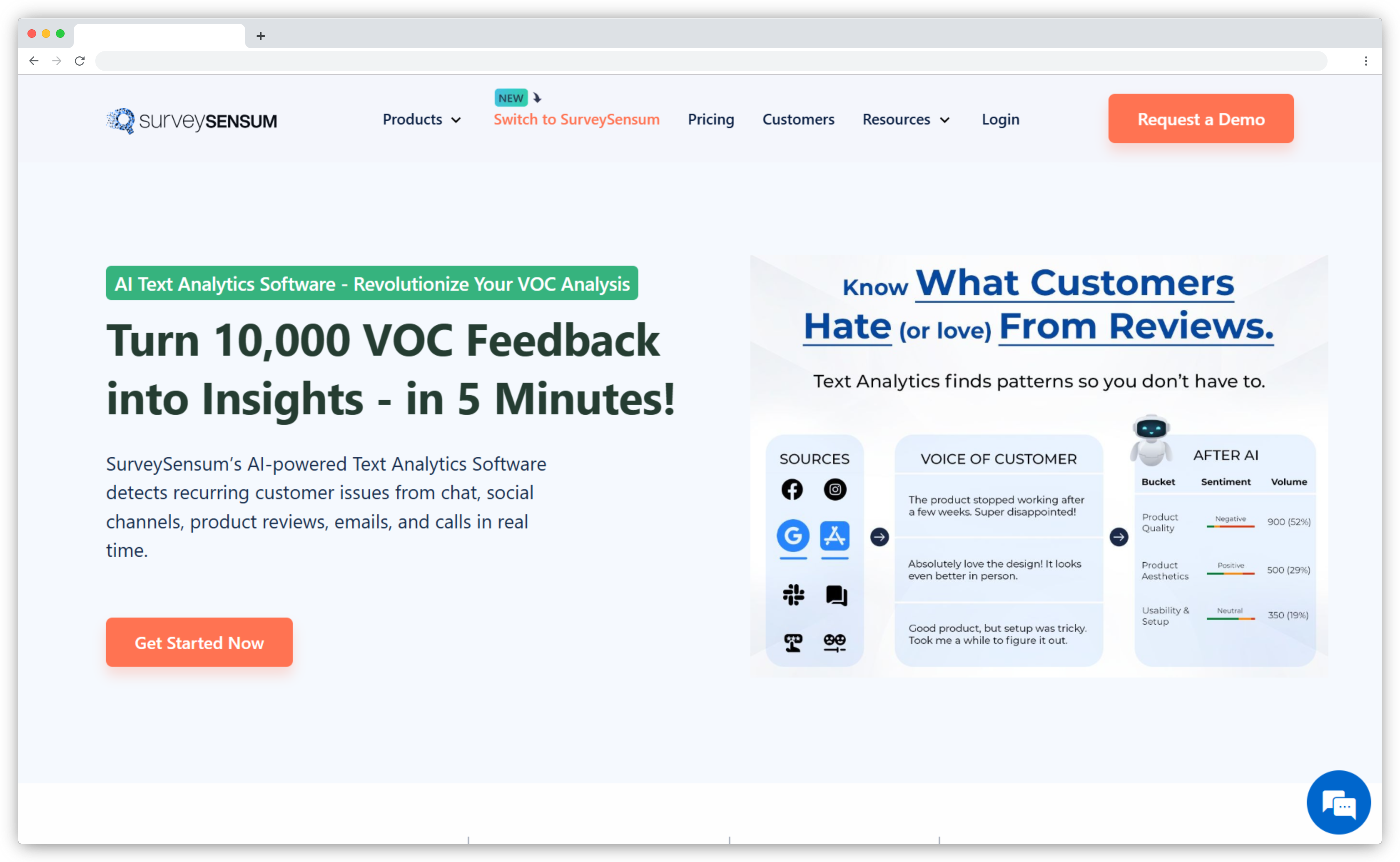
SurveySensum works with 80+ retail and lifestyle brands across 750+ stores. Its primary differentiator is implementation speed: the platform deploys in two to three weeks and includes a dedicated CX manager who supports program design and ongoing optimization.
For retail chains in Asia, the Middle East, and emerging markets, SurveySensum addresses a gap that US-based platforms often leave open: regional language support, local data handling, and hands-on implementation in those markets. QR and kiosk deployment are supported for in-store collection. AI tools help analyze customer feedback across locations, though the platform is less ecommerce-native than Retently.
Key Features of SurveySensum
- Dedicated CX manager included with every subscription tier
- QR code and kiosk support for in-store feedback collection
- NPS, CSAT, and CES templates with industry-specific question libraries
- Multi-location comparison dashboards with store-level performance data
SurveySensum Pros
- Two-to-three week deployment timeline with hands-on support included
- Strong regional fit for retail in Asia and the Middle East
- Transparent pricing without enterprise-only gating
SurveySensum Cons
- Ecommerce integration depth is more limited than Retently
- AI analysis capability is less advanced than full-stack platforms
SurveySensum Pricing
- Starts at $3,600/year (per G2). Verify current plans at surveysensum.com.
G2 Rating: 4.6/5 on G2
Best Use Case: Regional retail chains in Asia or the Middle East needing fast deployment and dedicated implementation support across physical store locations.
8. AskNicely: Best for Frontline Staff Activation

AskNicely converts NPS and CSAT data into coaching signals for frontline store staff. Its focus is on delivering feedback to the people who can act on it: store associates and their managers, rather than centralizing all insights in a CX team dashboard.
Every store associate sees a personal signal tied to the customer interactions they own. Store managers see who needs coaching and on which dimensions. AskNicely works best paired with a broader VoC platform for enterprise reporting.
Key Features of AskNicely
- Personal feedback signals for individual store associates
- Manager coaching dashboards with team-level comparison views
- NPS and CSAT survey distribution via email and SMS
- Workflow integrations for routing feedback to frontline managers
- Recognition and performance tracking tied to customer satisfaction scores
AskNicely Pros
- Frontline activation model is genuinely different from dashboard-first analytics tools
- Builds a feedback culture at the store level, across store associates and central CX teams
- Easy for non-technical store managers to use without training
AskNicely Cons
- AI analytics depth is limited compared to enterprise platforms
- Not designed for ecommerce post-purchase survey programs
AskNicely Pricing
- Contact for pricing. Verify current plans at asknicely.com.
G2 Rating: 4.7/5 on G2
Best Use Case: Service-intensive retail brands that need NPS and CSAT scores to reach individual store associates and frontline managers, beyond the central CX team.
Reputation Management with VoC Integration
9. Birdeye: Best for Multi-Location Retailers Managing Review Reputation Alongside VoC
Birdeye combines external review monitoring with internal VoC feedback collection. For a multi-location retailer, the platform tracks ratings and reviews on Google, Trustpilot, Yelp, and G2, and connects them to internal NPS and CSAT scores. A reputation alert fires when a negative review appears on a critical platform.
Birdeye’s review generation feature identifies promoters from NPS responses and sends automated requests for public reviews, linking the internal feedback program to external review volume for local search impact.
Key Features of Birdeye
- Review monitoring across Google, Trustpilot, Yelp, and G2
- Review response management from within the Birdeye dashboard
- Automated review generation from NPS promoter responses
- Reputation alerts for negative public reviews on critical platforms
- NPS, CSAT, and survey distribution via email and SMS
Birdeye Pros
- Connects internal VoC data to external review reputation in one dashboard
- Review generation from promoters drives local search ranking improvement
- Multi-location management with location-level review comparison
Birdeye Cons
- Survey depth and analytics are lighter than dedicated VoC platforms
- AI analysis for high-volume open-text feedback is less advanced
Birdeye Pricing
- Contact for pricing. Verify current plans at birdeye.com.
G2 Rating: 4.7/5 on G2
Best Use Case: Multi-location retailers where managing public review reputation is as important as internal feedback collection, particularly local brick-and-mortar chains.
Privacy-First and Open-Source Option
10. Formbricks: Best for Privacy-First Retailers and GDPR-Strict Brands
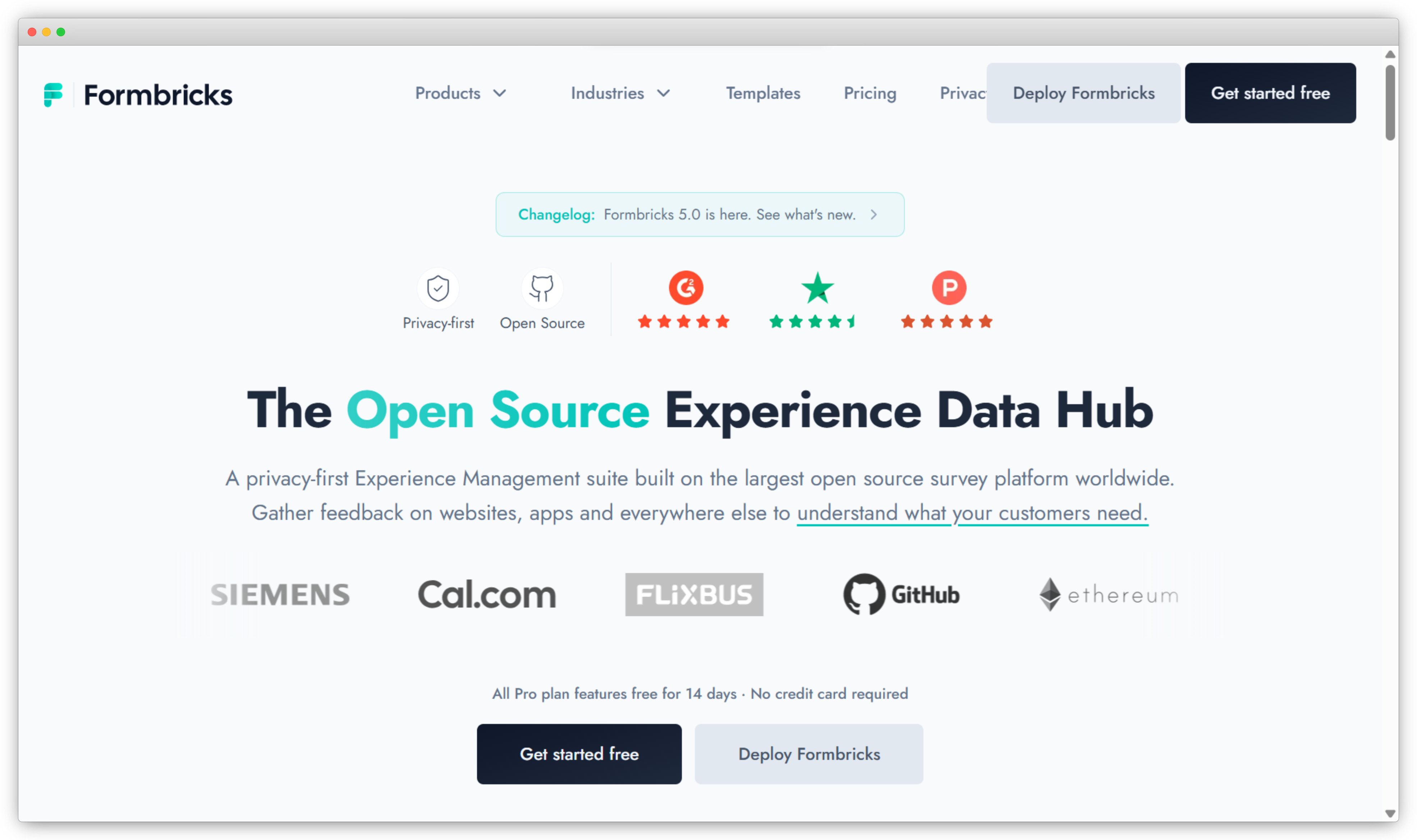
Formbricks is an open-source feedback platform with a self-hosted option. For retailers that cannot send customer data to US-based third-party servers, self-hosting means loyalty data, purchase history, and customer identifiers stay on your own infrastructure.
The platform supports QR and kiosk feedback for in-store use. An EU-hosted cloud version is available for retailers who want GDPR compliance without managing their own servers. Developer setup is required for self-hosted deployment.
Key Features of Formbricks
- Self-hosted open-source deployment with full data ownership
- QR code and kiosk support for in-store feedback collection
- EU-hosted cloud version for managed GDPR compliance
- Website and in-app survey collection
- Link and email survey distribution for post-purchase programs
Formbricks Pros
- Self-hosted option keeps all customer data on your own infrastructure
- Free self-hosted tier reduces cost for smaller retail operations
- EU data residency available without enterprise pricing
Formbricks Cons
- Developer setup required for self-hosted deployments
- AI analytics depth is limited compared to full-stack VoC platforms
Formbricks Pricing
- Free (self-hosted). Cloud pricing available. Verify current tiers from the Formbricks site.
G2 Rating: 4.8/5 on G2
Best Use Case: EU-based or privacy-first retailers that need in-store and ecommerce feedback collection with full control over where customer data is stored.
What Retail Brands Get Wrong When Choosing a VoC Tool
Most retail VoC buying decisions focus on the wrong criteria. These are the five mistakes that most often lead to platform changes within the first year.
Buying an ecommerce-native tool and ignoring physical store channels
The tools with the best Shopify integration typically have no kiosk or offline support. Retailers who run physical stores alongside an ecommerce operation end up with two disconnected feedback programs. Check physical store channel support before shortlisting any platform.
Treating NPS as the only retail feedback metric
NPS measures customer loyalty at the relationship level. It does not identify customer pain points at checkout, returns, or specific service interactions. Customer effort score belongs at friction points like checkout and returns. CSAT belongs after discrete customer service interactions. A retail program built on NPS alone misses the moments where customers decide whether to come back.
Choosing enterprise tools before any feedback loops are closed
Qualtrics and Medallia produce excellent data. If your team has no defined owner for each feedback signal and no workflow to act on the data, the platform value is theoretical. Sort out the loop-closing process before committing to an enterprise contract. See why most voice of customer programs fail to produce results for a detailed breakdown of where programs typically break down.
Running VoC programs during peak season only
Holiday and sale periods produce score inflation. Customers in a high-purchase-intent mindset are more forgiving of friction. If your only major data collection happens in Q4, your baseline is skewed. A year-round program gives you a reliable benchmark to measure against.
Not mapping feedback to location level from initial setup
Aggregate scores hide performance gaps. A retailer with an overall NPS of 45 might have one region at 62 and another at 28. Location-level tagging must be configured during initial setup, not retrofitted months later.
Building a solid voice of customer framework before selecting a tool prevents all five of these mistakes.
Which VoC Tool Is Right for Your Retail Brand?
Physical retail chains should prioritize platforms with kiosk support, offline mode, and store-level analytics. Ecommerce brands on Shopify get the most from tools with native order-event integrations and response enrichment. Retailers running both physical and digital channels need a full-stack platform that covers both without requiring separate accounts.
To set up the right program structure before selecting a tool, see how to build a voice of customer program from scratch. For a broader look at program strategy, see VoC strategy and best practices.
If you want to see how Zonka Feedback covers the retail journey, from in-store kiosk to AI-powered signal delivery, book a demo here.



.png)