

.svg)
 Healthcare
 Finance
 Retail
 SaaS & Digital
 eCommerce
 Education
 Salesforce
  HubSpot
 Pipedrive
 Mailchimp
 Klaviyo
 Zendesk
  Intercom
 Freshdesk
 HelpScout
  Front
Front Jira
Jira Slack
Slack  MS Teams
 Zoom
Zoom Google Sheets
  Zapier
  Integrately
 Make
Make  Webhooks



 Sign In
 MS Teams



The best voice of customer tools for banking in 2026 are Qualtrics, Medallia, Sprinklr, Chattermill, Zonka Feedback, SurveySensum, CustomerGauge, and Verint. The right choice depends on your institution: enterprise and multi-national banks need governance and scale, regional banks and credit unions need faster setup and lower cost, commercial banking teams need account-level feedback tied to revenue, and phone-heavy institutions need contact-center analytics.
TL;DR
- This guide compares eight voice of customer tools for banking in 2026, grouped by the type of institution each one fits best, from global banks to credit unions.
- Enterprise and multi-national banks tend to shortlist Qualtrics, Medallia, and Sprinklr, which are the survey-and-analytics Leaders in Gartner's 2026 Voice of the Customer Magic Quadrant.
- Regional banks and credit unions with lean teams usually get more value from mid-market platforms that pair collection with AI analysis and deploy in weeks rather than months.
- A banking voice of customer tool is not the same as a voicebot or contact-center analytics suite, and confusing the three is the most common buying mistake in this category.
- Compliance posture matters more in banking than in any other vertical, so verify SOC 2 Type II, PCI DSS, data residency, and audit trails before shortlisting.
- The category is consolidating fast through acquisitions, which makes vendor stability a real decision factor for any bank signing a multi-year contract.
Choosing a voice of customer tool for a bank isn't the same as choosing one for a retailer or a software company. The channels are different, the feedback carries compliance weight, and the cost of missing a signal is higher. This guide reviews eight platforms worth considering in 2026, grouped by the type of institution each one serves best. Every listing covers key features, honest pros and cons, current pricing, and G2 standing, so you can match a tool to your bank's size, channel mix, and regulatory profile. It also covers what these tools are not, because two product categories keep getting mislabeled as voice of customer software.
Why Banking Customer Feedback Needs Its Own Tooling
A bank can report that support answers in ninety seconds, that a card dispute closes in five days, and that a mortgage binds on schedule. Every one of those numbers can be accurate. None of them tells you the customer spent day three of that dispute convinced no one was working on it. That gap between operational metrics and how the experience actually felt is what voice of customer tools exist to close.
Banking makes that gap harder to close than most industries do. Customers interact across branches, mobile apps, call centers, ATMs, and digital portals, so customer feedback lands in separate systems that rarely talk to each other. Feedback about a fee, a failed transfer, or a loan decision carries compliance weight that a retail complaint does not. And a single unresolved complaint can escalate from a low satisfaction score into a regulatory filing. That combination of fragmented channels, regulated feedback, and high stakes is why generic survey software falls short for financial institutions.
The stakes are loyalty and revenue. Customer expectations in banking now track the smoothest digital experiences customers see anywhere, so a clunky mobile flow costs a bank more than an occasional complaint. Poor experiences drive customers to switch, which is why customer retention and customer loyalty sit at the center of any serious banking program. The banks that pull ahead treat customer feedback as a product input, not a compliance output, and they connect customer sentiment to the specific fixes that move the score. Financial services firms that unify feedback across multiple channels get there faster than those still reading survey exports one at a time.
What Are Voice of Customer Tools for Banking?
Voice of customer tools for banking are platforms that collect customer feedback across banking channels, analyze it with AI, and route it to the teams that can act on it. They differ from general survey software because they support banking-specific channels and moments: post-transaction surveys, in-app surveys inside mobile banking, on-site feedback widgets and feedback forms, branch and ATM feedback, call-center follow-ups, support tickets, and complaint portals. A complete program captures customer sentiment at the moments that shape loyalty in banking, including account opening, a card or payment issue, a loan or mortgage decision, a dispute, and renewal.
The useful ones do more than collect. They applyvoice of customer analytics to open-text responses, connect customer sentiment to specific branches, products, and agents, and flag the accounts most likely to leave. That connection between raw feedback and a named owner is what separates a program that changes something from one that only measures.
Voice of customer is broader than any single metric. It draws on both quantitative and qualitative feedback, blends structured and unstructured feedback, and pulls from survey responses, online reviews, support interactions, and customer service interactions across the bank. Some programs add customer interviews and focus groups alongside surveys. All of it feeds a broader customer experience management practice, where the goal is to identify trends in customer behavior and customer needs before they show up in churn.
The strongest feedback tools don't just gather customer feedback. They analyze customer feedback to surface customer insights, rank the customer pain points that matter most, and point a team toward the changes that improve customer satisfaction. Because they pull from multiple touchpoints, they weigh customer preferences and customer input against each other rather than reacting to whichever channel shouted loudest. Turning VoC data into VoC insights that reach the right person is the real test.
Voice of Customer Tools Are Not Voicebots
Search results for banking voice tools mix two unrelated things.
- Voice-activated banking and voicebots let customers check a balance or move money by speaking to an assistant. That is a service channel.
- Voice of customer tools capture and analyze what customers think about the bank. That is a feedback and intelligence function.
- A voicebot answers the customer. A voice of customer platform tells you what the customer is telling you.
This guide covers the second category.
Voice of Customer Platforms Are Not Contact-Center Analytics Suites
The second point of confusion is subtler.
- Speech and text analytics suites like the ones built into contact-center platforms analyze the customer's voice inside recorded calls. That is real customer feedback, and it matters for phone-heavy banks.
- But those suites are built to run a contact center, not to run a feedback program across branch, app, email, and portal.
- A survey-first voice of customer platform and a contact-center analytics suite solve different problems. Some banks need both.
Knowing which one you are buying prevents an expensive mismatch.
What to Look for in a Banking Voice of Customer Tool
Banking narrows the feature list that actually matters. These are the capabilities worth weighting heavily.
- Omnichannel collection across banking touchpoints. The tool should capture feedback from email, SMS, in-app surveys, web, call center, and offline or branch settings, and unify it in one place. Multi-channel feedback collection is the baseline, because banking customers move across channels within a single customer journey.
- AI text and sentiment analysis. A bank running post-branch or post-support surveys generates thousands of open-text responses. Natural language processing that clusters them into themes, scores customer sentiment, and separates a fee complaint from a wait-time complaint turns raw feedback into something a team can prioritize. Strong voice of customer analytics also surface customer satisfaction trends over time, not just a snapshot.
- Entity mapping. The platform should tie feedback to the specific branch, product, or agent it concerns, so a regional manager sees their locations and a product lead sees their product.
- Compliance and data security. SOC 2 Type II, PCI DSS readiness, data residency options, audit trails, and role-based access are not nice-to-haves in banking. They decide which tools clear procurement.
- Closed-loop action. Detractor alerts, case creation, and routing to the right team are what connect a low score to a resolution. A dashboard without a path to action is a silo.
- Integration with existing systems. The tool should connect to the CRM, helpdesk, and core systems a bank already runs, so feedback data reaches the systems where work happens.
For the metrics side of this, our guide to voice of customer metrics covers how net promoter score, CSAT, and customer effort score fit together in a banking program. A bank focused narrowly on loyalty measurement should also look at dedicated NPS tools for banking and financial services, which go deeper on relationship and transactional NPS than a general feedback platform does. For the questions that feed those metrics, our guide to voice of customer survey questions for banking covers what to ask at each banking moment.
How to Choose the Right Tool for Your Institution
The best voice of customer tool for a global bank is rarely the best one for a credit union. Match the platform to your institution before you compare feature lists.
- If you are an enterprise or multi-national bank, look for governance, role-based dashboards, multi-country support, and predictive analytics. Qualtrics, Medallia, and Sprinklr are built for this scale.
- If you are a regional bank or credit union with a lean CX team, prioritize fast setup, guided onboarding, and a platform that pairs collection with AI analysis so you are not stitching tools together. SurveySensum and Zonka Feedback fit here.
- If you run commercial or corporate banking, where relationships are accounts rather than individuals, look for account-level feedback tied to revenue. CustomerGauge is purpose-built for this.
- If your customer experience lives mostly on the phone, a contact-center voice of customer suite like Verint may fit better than a survey-first platform.
One factor specific to 2026 deserves its own line: vendor stability. This category is consolidating through acquisitions, which can reshape a product roadmap mid-contract. For a bank signing a three-year deal, ask each vendor directly about ownership and roadmap before committing. Banks that want pre-built financial-services taxonomies out of the box should also look at Concentrix, though its managed-services model is a different kind of purchase than a self-serve platform.
If your program is still being designed rather than re-tooled, start with our guide on how to build a Voice of Customer program before you shortlist software.
How We Evaluated These Tools
We weighed six things: banking and financial-services fit, omnichannel collection, AI text and sentiment analysis depth, compliance posture, closed-loop action, and current G2 standing. We compared these VoC tools on how well each one fits a specific type of institution, not on a single ranked score. Pricing and ratings were pulled from vendor pages and G2 at the time of writing, so confirm both before you buy. We left NICE Satmetrix off because its standalone product status is now ambiguous, and Calabrio because it has merged into Verint.
A note on transparency: Zonka Feedback publishes this guide. We kept every description to the same length and the same honest treatment, and we say plainly where other tools fit a bank better than we do. For the full category beyond banking-specific platforms, see our guide to Voice of Customer tools.
Comparison of the Best Voice of Customer Tools for Banking
| Tool | Best for | Key banking capability | Pricing |
| Qualtrics | Enterprise and multi-national banks | Predictive CX analytics and research depth | Custom, quote-based |
| Medallia | Large banks needing CX orchestration | Enterprise-wide signal orchestration | Custom, quote-based |
| Sprinklr | Banks unifying social, service, and VoC | Unified listening across social and digital | Custom, quote-based |
| Chattermill | Larger banks with fragmented feedback | Multi-source feedback unification and AI themes | Custom, quote-based |
| Zonka Feedback | Multi-channel banking programs at any scale | Collection plus AI Feedback Intelligence in one platform | Free trial; custom pricing |
| SurveySensum | Regional banks and credit unions | BFSI-calibrated NLP with guided setup | From $3,600/year (~$300/mo) |
| CustomerGauge | Commercial and corporate banking | Account-level NPS tied to revenue | Custom, quote-based |
| Verint | Phone-heavy institutions | Speech and text analytics on call data | Custom, quote-based |
The 8 Best Voice of Customer Tools for Banking
1. Qualtrics: Best for Enterprise Banks Running Formal Research Programs
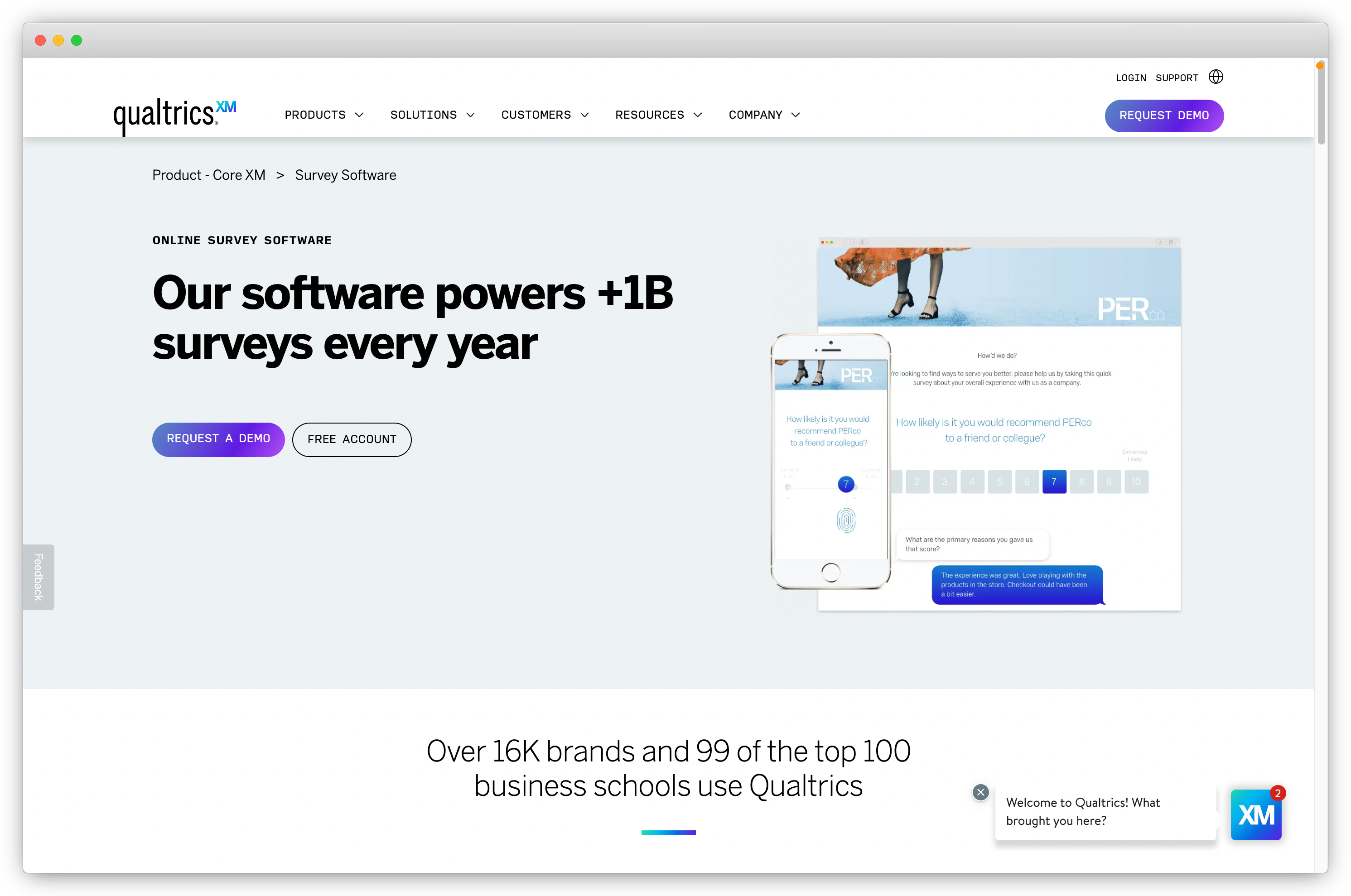
Qualtrics is the benchmark for banks that need complex survey design, large-scale customer research, and analytical depth beyond what standard platforms offer. It handles everything from transaction-level CSAT to longitudinal studies and journey feedback in one system, and it connects customer sentiment to operational data across digital banking, branches, cards, and loans. It is a Leader in Gartner's 2026 Magic Quadrant for Voice of the Customer Platforms, and more than 85 percent of the Fortune 500 use it.
For large BFSI institutions, the pull is governance: audit trails, role-based access, and predictive intelligence across products and regions. The tradeoff is complexity. Qualtrics rewards teams with dedicated analysts and punishes those without them.
Key Features of Qualtrics
- Predictive CX analytics
- Text and sentiment analysis
- Closed-loop case management
- Journey mapping
- 20-plus question types
- Enterprise integrations
Qualtrics Pros
- Deepest research and analytics in the category
- Strong compliance and governance
- Scales across multi-country programs
Qualtrics Cons
- Steep learning curve
- Among the most expensive options
- Underused without trained administrators
Qualtrics Pricing
- Custom, quote-based, on an interaction model.
- First-year cost commonly exceeds $30,000, and large enterprise deployments run into six figures.
G2 Rating: 4.3/5 on G2, based on 724 reviews for the Customer Experience product.
Best use case: Large banks with a dedicated CX or insights team running research-grade programs across regions and product lines.
2. Medallia: Best for Large Banks Needing Enterprise CX Orchestration
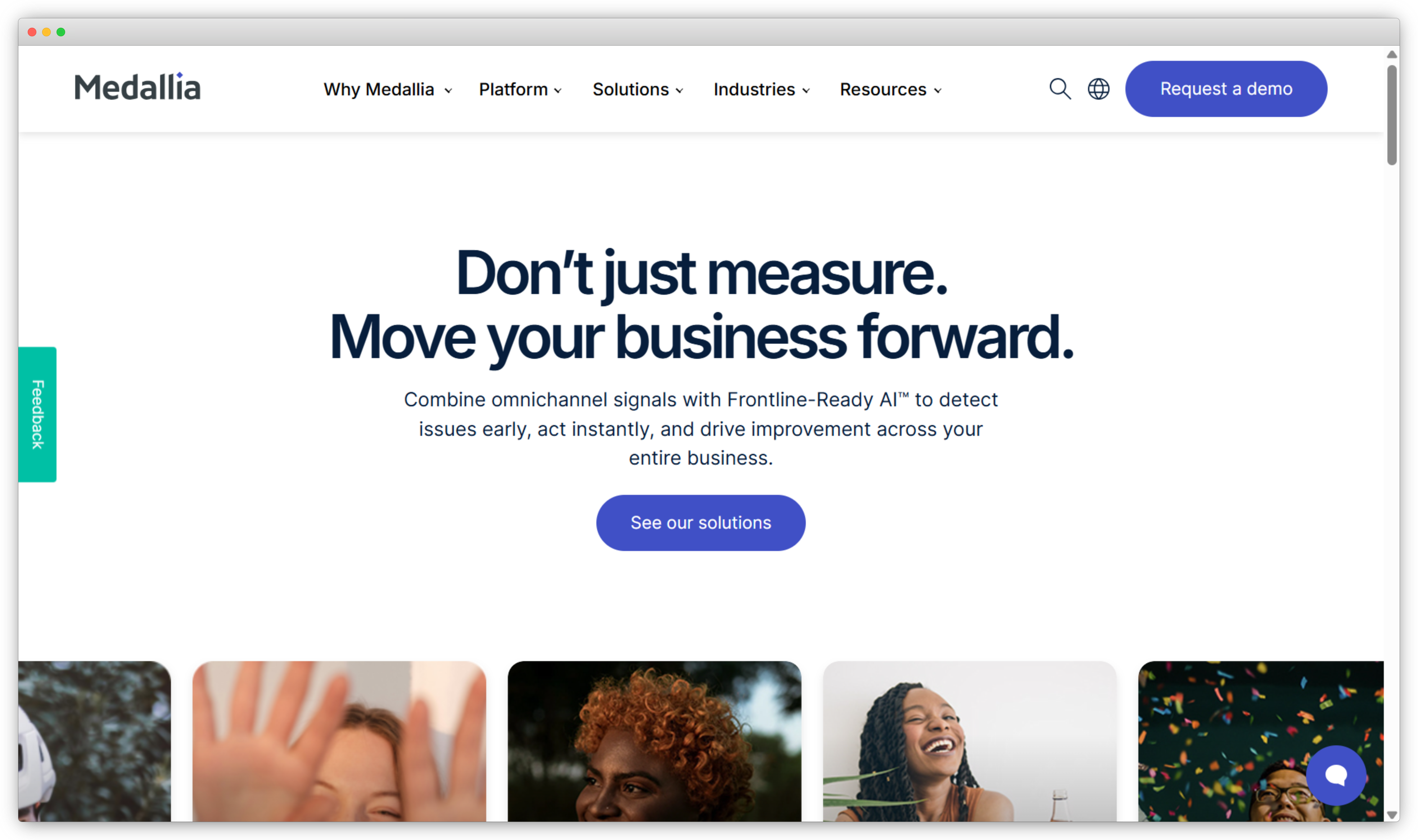
Medallia is built for large, multi-department banks where role-based access, operational data integration, and enterprise-wide orchestration are requirements. It captures feedback across many touchpoints and routes signals to the right people, from a branch manager to the chief customer officer. Like Qualtrics, it is a Leader in the 2026 Gartner Voice of the Customer Magic Quadrant.
Implementation is lengthy and the cost is high, but for institutions at that scale, Medallia is one of the most capable enterprise systems available. One 2026 development belongs in the evaluation: a creditor consortium took ownership of Medallia from Thoma Bravo in an April 2026 debt-for-equity swap, so factor roadmap stability into a multi-year decision.
Key Features of Medallia
- Omnichannel feedback collection
- Text analytics
- Predictive churn scoring
- Role-based dashboards
- Journey mapping
- Enterprise integrations
Medallia Pros
- Enterprise-grade orchestration
- Strong analytics
- Capable at very high response volumes
Medallia Cons
- Long implementation
- High cost
- Recent ownership change adds roadmap uncertainty
Medallia Pricing
- Custom, quote-based, aimed at enterprise budgets.
G2 Rating: 4.5/5 on G2, based on 210 reviews.
Best use case: Large multi-national banks that need enterprise-wide CX orchestration across complex, multi-department journeys.
3. Sprinklr: Best for Banks Unifying Social, Service, and Voice of Customer
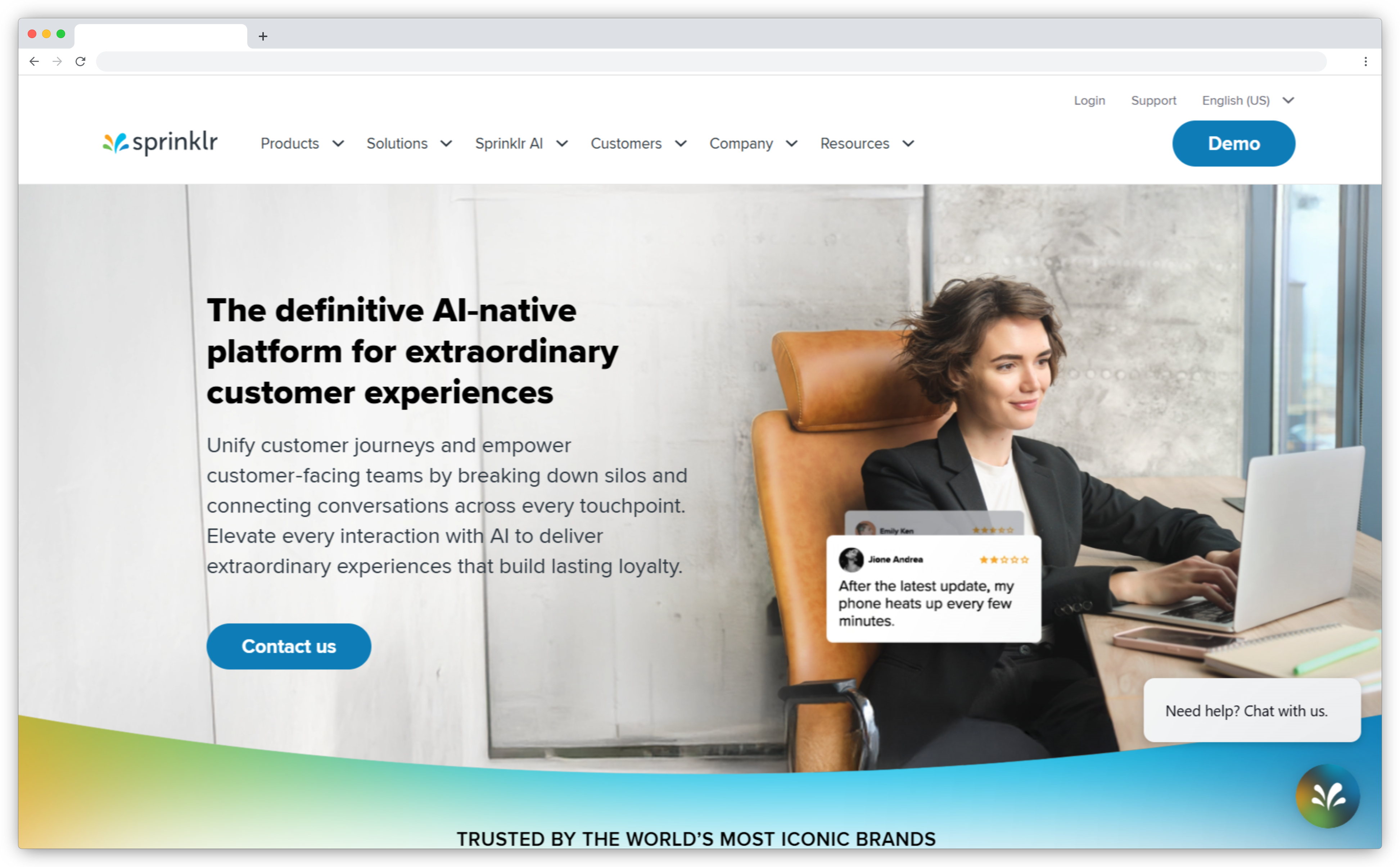
Sprinklr is the only 2026 Gartner Voice of the Customer Leader that pulls social listening, marketing, customer service, and voice of customer data into a single unified platform. Its Insights product applies sentiment analysis, topic detection, and intent classification across feedback from contact centers, social channels, messaging, and digital touchpoints. For a bank running a large social-care operation alongside a formal feedback program, the appeal is consolidation: one dataset, one workflow.
The tradeoff Gartner flags is that Sprinklr's text analytics is built on a more established natural language approach than some newer AI-native tools, so teams spend time tuning categories and rules. The platform is also complex and priced for the enterprise.
Key Features of Sprinklr
- Unified voice of customer and social listening
- Sentiment and intent classification
- 30-plus channel coverage
- AI-powered dashboards
- Contact-center insights
Sprinklr Pros
- Unmatched breadth across social and digital channels
- Strong for brand and reputation monitoring
- Genuine consolidation of siloed tools
Sprinklr Cons
- Steep learning curve
- Category tuning takes effort
- Expensive for mid-market banks
Sprinklr Pricing
- Custom, quote-based for the unified platform; individual suites priced per user per year.
G2 Rating: 4.2/5 on G2 across Sprinklr products, from more than 2,150 reviews.
Best use case: Banks managing high volumes of social and digital conversation that want voice of customer unified with broader service and reputation operations.
4. Chattermill: Best for Larger Banks With Feedback Scattered Across Tools
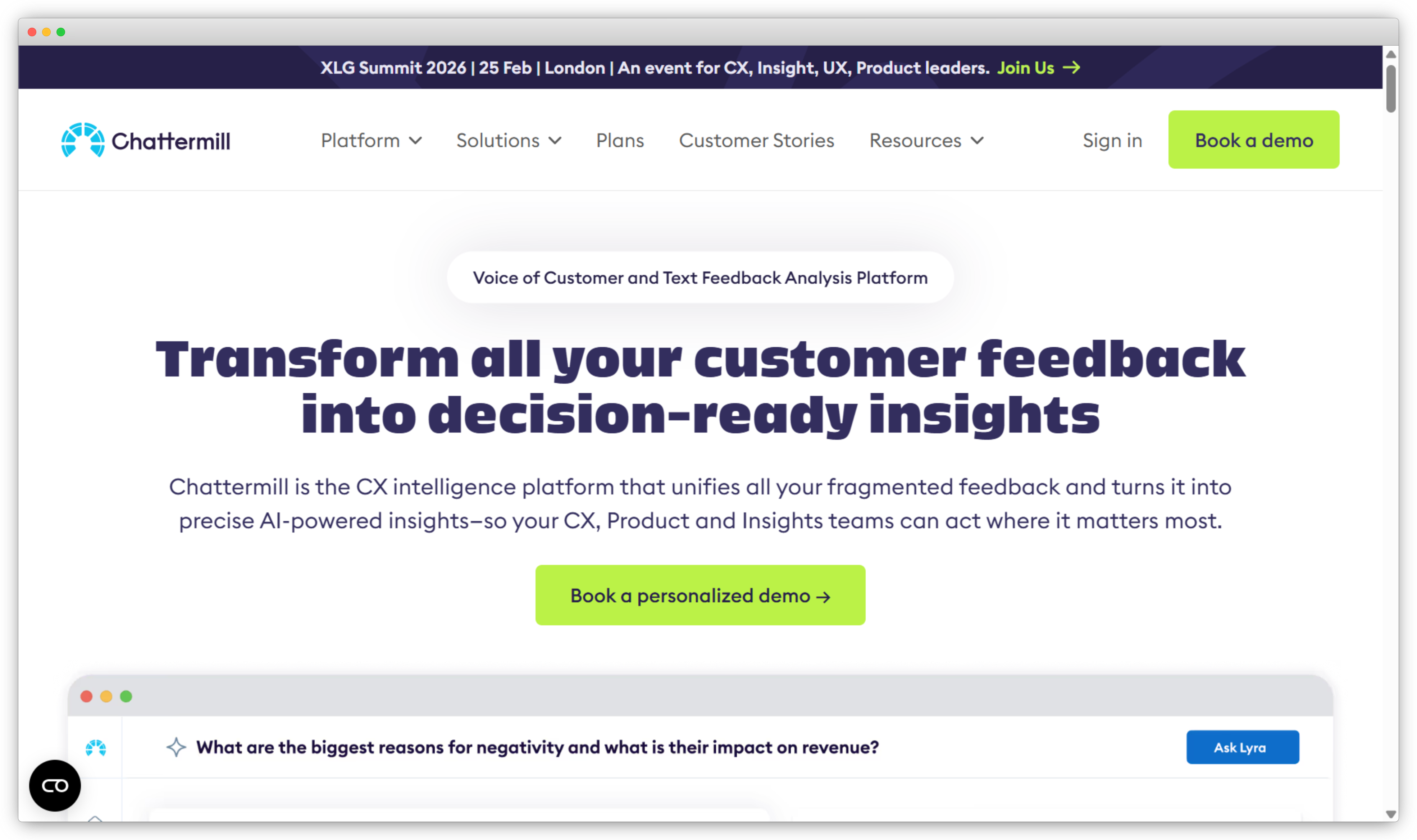
Chattermill is a customer experience intelligence platform built to unify and analyze feedback across every channel. If a bank's customer feedback sits fragmented across a survey tool, a helpdesk, review sites, and call transcripts, Chattermill's proposition is consolidation: one AI model reads all of it. Its deep-learning model is trained on CX-specific language, which helps with the messy middle of customer text, including sarcasm and mixed sentiment in a single response.
Chattermill is a Leader in G2's Feedback Analytics grid and is used by large consumer brands. It analyzes feedback well but is not a survey-first collection tool, so banks that need heavy front-end survey design often pair it with a collection platform.
Key Features of Chattermill
- Multi-source feedback unification
- AI theme detection
- Sentiment scoring
- Anomaly alerts
- Impact analysis
- Segmentation
Chattermill Pros
- Strong AI text analysis at scale
- Handles unstructured feedback from many sources
- Anomaly alerts surface emerging issues early
Chattermill Cons
- Lighter on native survey collection
- Enterprise pricing
- Better as an analysis layer than an all-in-one
Chattermill Pricing
- Custom, quote-based, scaled to feedback volume.
G2 Rating: A Leader in G2's Feedback Analytics category, based on more than 200 reviews.
Best use case: Larger banks that already collect feedback across many systems and need one AI layer to unify and analyze it.
5. Zonka Feedback: Best for Multi-Channel Banking Programs at Any Scale
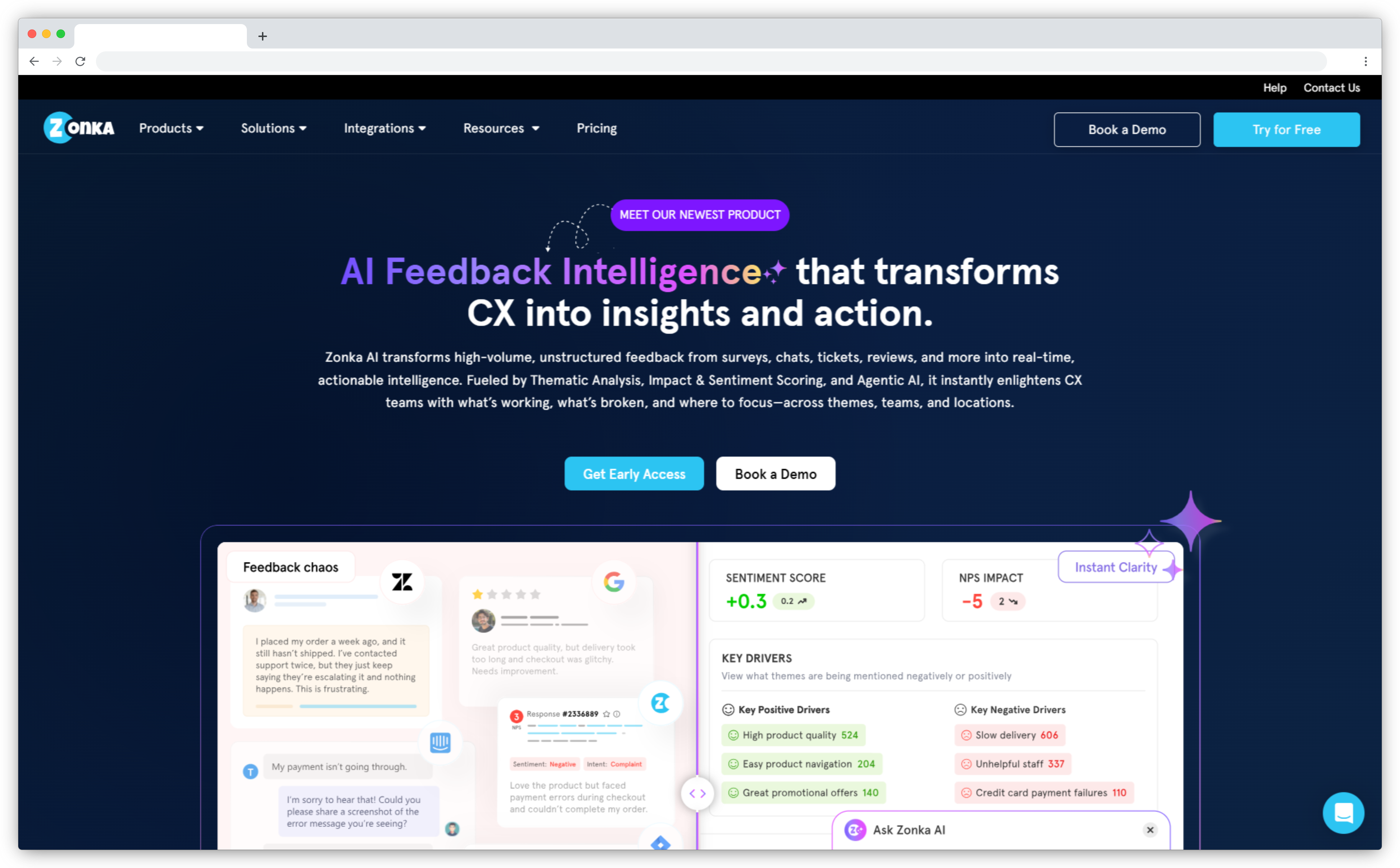
Zonka Feedback pairs multi-channel collection with AI Feedback Intelligence in one platform, which suits banks and fintechs at any scale, from regional and mid-market institutions to enterprise, multi-location networks, that want to collect feedback and understand it without stitching two tools together. It captures feedback across email, SMS, WhatsApp, web, in-app, kiosks, and offline branch settings, then uses AI to cluster themes, score sentiment, and map feedback to specific branches, products, and agents. Detractor alerts and case creation close the loop back to the responsible team.
Banking customers include Bank of Maldives, which runs API-integrated CSAT across support, social, and its contact center at more than 21,000 responses, and Ecobank across its pan-African branch network. Fintech users include Dhan, which collects in-app user feedback from trading-platform users. The honest limit is scale: the largest multi-country enterprise programs may need the governance depth of the enterprise suites.
Key Features of Zonka Feedback
- Omnichannel surveys
- AI theme and sentiment analysis
- Entity mapping to branches and agents
- Closed-loop workflows
- Role-based signals
- Banking survey templates
Zonka Feedback Pros
- Collection and AI analysis in one system
- Fast to deploy
- Strong fit for multi-location and multi-channel banking
Zonka Feedback Cons
- Less governance depth than the largest enterprise suites
- Smaller brand footprint than Qualtrics or Medallia
Zonka Feedback Pricing
- Free trial; custom, quote-based pricing.
G2 Rating: 4.7/5 on G2, based on 81 reviews.
Best use case: Banks and fintechs of any size, from regional and mid-market institutions to enterprise, multi-location networks, that want multi-channel collection and AI analysis in a single platform.
6. SurveySensum: Best for Regional Banks and Credit Unions
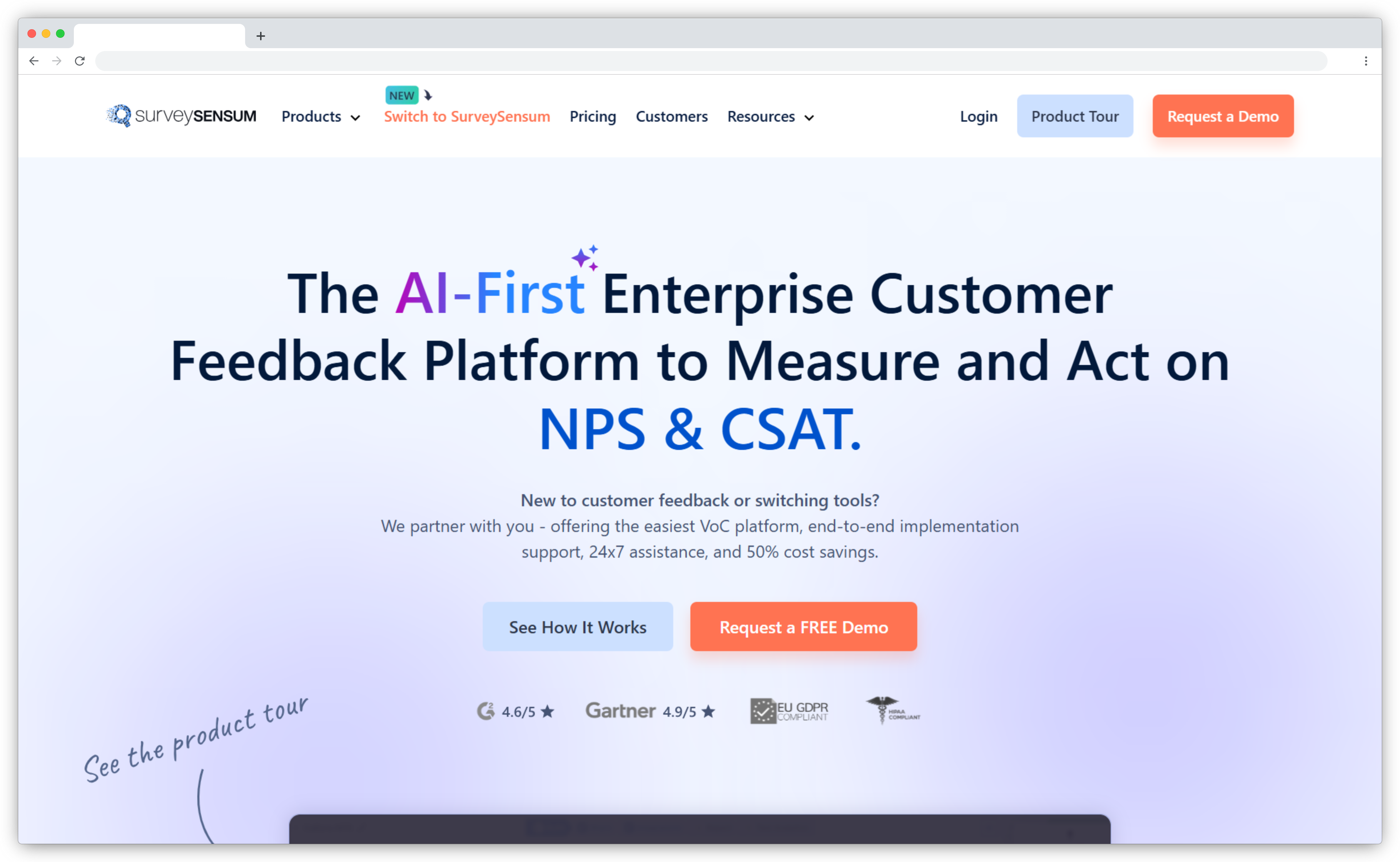
SurveySensum pairs an affordable, easy-to-use feedback platform with a CX consulting layer, which suits regional banks and credit unions that want guidance rather than raw configurability. Its NLP models are calibrated for specific verticals, so a bank running post-branch CSAT finds the platform already recognizes that "long wait," "the queue was terrible," and "40 minutes before anyone helped me" describe the same complaint. That calibration reduces the setup work most platforms require.
It handles NPS, CSAT, and customer effort score for both relationship and transactional moments, and users highlight fast setup and responsive support. The honest limit shows at the top end, where survey logic and complex conditional flows are lighter than the enterprise suites.
Key Features of SurveySensum
- BFSI-calibrated NLP
- AI text and sentiment analysis
- NPS, CSAT and CES surveys
- Closed-loop workflows
- Guided CX consulting
SurveySensum Pros
- Cost-conscious
- Fast to deploy
- Strong support and industry-tuned analysis
SurveySensum Cons
- Lighter advanced survey logic
- Smaller ecosystem than the enterprise suites
- Less suited to very large multi-country programs
SurveySensum Pricing
- One-month free trial (no free-forever plan currently advertised); paid plans start at $3,600/year, about $300/month, billed annually.
G2 Rating: 4.6/5 on G2, based on 38 reviews.
Best use case: Regional banks, credit unions, and community banks that want industry-tuned AI analysis and guided setup without enterprise cost.
7. CustomerGauge: Best for Commercial and Corporate Banking
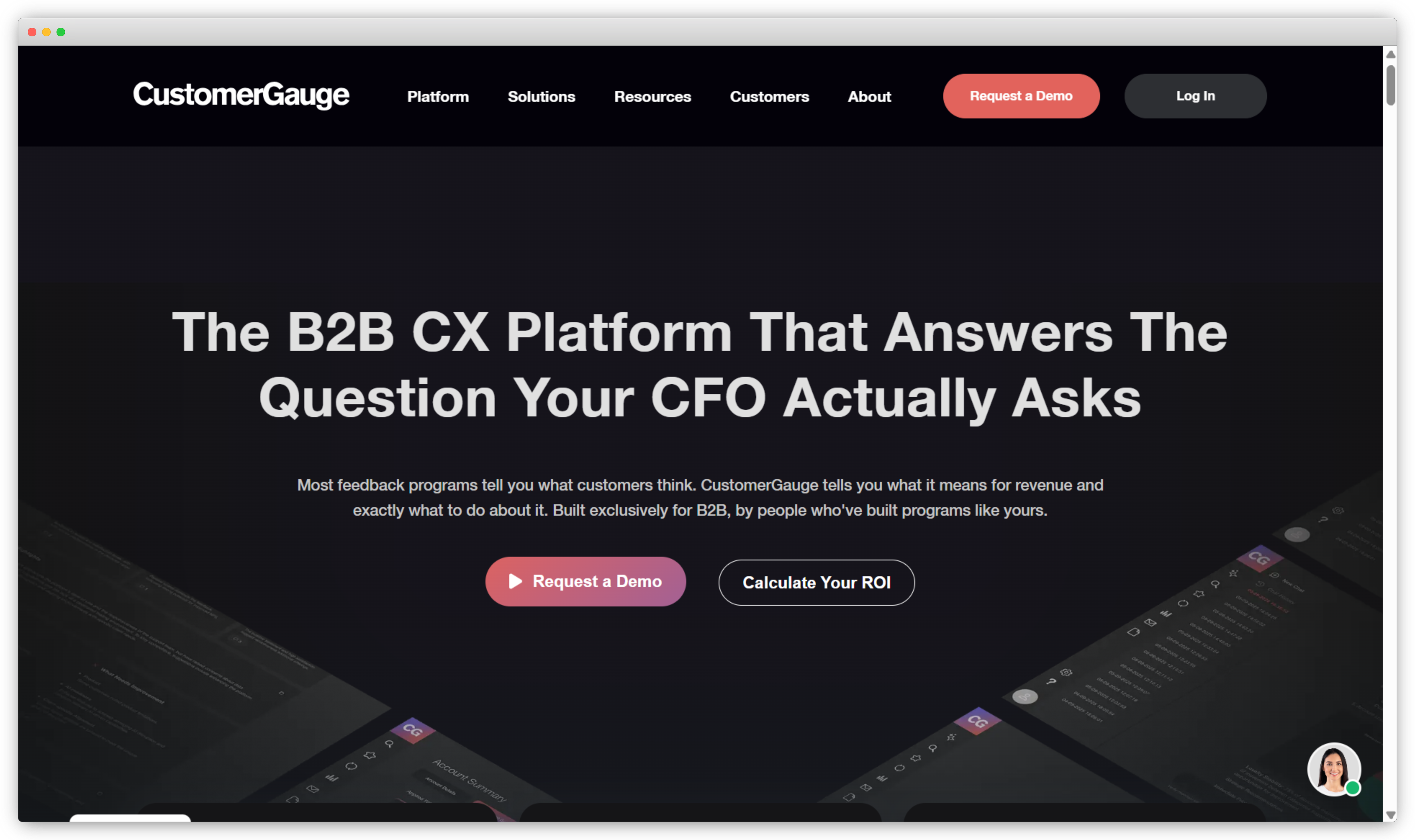
Banking is often a business of accounts, not just individuals, and CustomerGauge is built for exactly that. It measures Net Promoter Score at the account level and ties feedback to revenue, which fits commercial banks and corporate banking teams managing books of business rather than one-off retail customers. It aggregates feedback across everyone at a client organization, links satisfaction to retention, and flags accounts at risk before renewal.
That B2B focus is something general CX platforms handle awkwardly. The tradeoff is scope. CustomerGauge is purpose-built for account-level NPS and revenue linkage, so a retail bank focused on high-volume individual customer sentiment may find it narrower than a full suite.
Key Features of CustomerGauge
- Revenue-linked NPS
- Account-level feedback aggregation
- Churn and retention flags
- Salesforce integration
- Closed-loop follow-up
CustomerGauge Pros
- Best-in-class for account-based feedback
- Ties customer sentiment to revenue
- Strong ease of setup and support
CustomerGauge Cons
- Narrow beyond account-level NPS
- Less suited to high-volume retail feedback
- Fewer collection channels than full suites
CustomerGauge Pricing
- Custom, quote-based; more transparent and focused than the enterprise suites.
G2 Rating: 4.6/5 on G2, based on 50 reviews.
Best use case: Commercial, corporate, and B2B banking teams that manage client accounts and need feedback tied directly to revenue.
8. Verint: Best for Phone-Heavy Institutions
Verint fits banks whose customer experience lives mostly on the phone. Its strength is speech and text analytics that transcribe and analyze call interactions, surfacing sentiment, themes, and compliance signals from conversations that would otherwise go unread. It also runs a dedicated voice of customer product that absorbed the former OpinionLab and ForeSee, and it was named a Leader in Frost & Sullivan's 2025 Voice of Customer Analytics report.
One structural change matters for evaluation: Verint was acquired by Thoma Bravo and merged with Calabrio in November 2025, so the two now operate as one company. Verint is contact-center-rooted rather than survey-first, which is a fit or a mismatch depending on where your feedback lives.
Key Features of Verint
- Speech and text analytics
- Dedicated voice of customer surveys
- Digital behavior analytics
- Compliance detection
- Contact-center integration
Verint Pros
- Deep call-analytics capability
- Strong for compliance-sensitive phone channels
- Capable across large volumes
Verint Cons
- Contact-center-rooted, not survey-first
- Setup can be complex
- Recent merger adds integration questions
Verint Pricing
- Custom, quote-based.
G2 Rating: 4.4/5 on G2 across Verint products, from more than 950 reviews.
Best use case: Banks whose primary customer channel is the contact center and that need analytics on call and interaction data.
The Banking Voice of Customer Compliance Checklist
Compliance is where banking voice of customer programs quietly fail. A platform can collect feedback well and still be unusable if it cannot clear a bank's procurement and risk review. Before you shortlist, verify each of these directly with the vendor, because most tools describe compliance in general terms and the details vary.
- SOC 2 Type II. The baseline security attestation. Ask for the current report, not a claim.
- PCI DSS readiness. Any platform touching payment-adjacent feedback or call recordings in a card context needs this. Not every voice of customer tool has it.
- Data residency options. Many banks are required to keep customer data in a specific region. Confirm the vendor can host where you need.
- Audit trails and access logs. Regulators and internal risk teams expect a record of who saw and changed what. Confirm the platform logs it.
- Role-based access control. A branch manager should see their branch, not the whole book. Granular permissions protect both privacy and focus.
- Complaint-handling alignment. In regulated markets, complaints carry legal obligations. Check whether detractor and complaint workflows can capture, route, and document responses in a way your compliance team accepts.
- Retention and deletion controls. Confirm you can set retention periods and honor deletion requests to meet privacy rules.
A tool that clears this list is not automatically the best fit, but a tool that fails it is disqualified regardless of its features. Run the checklist before the feature comparison, not after.
Which Voice of Customer Tool Is Right for Your Bank?
The eight platforms here do not compete for a single crown, because a global bank and a credit union are not solving the same problem. An enterprise or multi-national bank running research-grade programs across regions will land on Qualtrics, Medallia, or Sprinklr. A regional bank or credit union with a lean team will get further, faster, with a mid-market platform like SurveySensum that pairs collection with AI analysis. A commercial banking team managing accounts will find CustomerGauge fits the account-level model that general suites handle awkwardly. A larger bank with feedback scattered across systems will want Chattermill's unification layer, and a phone-heavy institution will look at Verint.
Start from where your customer signal actually lives and which regulatory bars you have to clear, then match the platform to that. The best voice of customer tool for banking is the one that captures how each moment lands for a customer, clears your compliance review, and helps the right team fix what it surfaces. For real programs behind the scores, our roundup of voice of customer examples includes banks that turned feedback into measurable loyalty gains.
Want to see multi-channel collection and AI analysis in one platform, built for how banks actually collect feedback? Book a Zonka Feedback demo.

.svg)
.png)