

.svg)
 Healthcare
 Finance
 Retail
 SaaS & Digital
 eCommerce
 Education
 Salesforce
  HubSpot
 Pipedrive
 Mailchimp
 Klaviyo
 Zendesk
  Intercom
 Freshdesk
 HelpScout
  Front
Front Jira
Jira Slack
Slack  MS Teams
 Zoom
Zoom Google Sheets
  Zapier
  Integrately
 Make
Make  Webhooks



 Sign In
 MS Teams
.svg)


TL;DR
- Feature feedback measures how users feel about specific features, not the product overall.
- Track three dimensions:
- Adoption (do they use it?)
- Satisfaction (do they like it?)
- Effort (is it easy?)
- The five core metrics: feature adoption rate, feature-level CSAT, feature CES, time to first value, and correlation between feature usage and retention.
- Trigger in-app surveys 2-3 minutes after feature use for 40% response rates (vs. 12% for next-day email).
- AI analysis maps feedback to specific features automatically. No manual tagging required.
The average feature adoption rate for SaaS products is 24.5%. Three out of four features you ship will be used by less than a quarter of your users. Some of those features took months to build. How do you know which ones are worth the investment? Which ones need to be fixed, promoted, or killed?
Product teams track NPS at the company level and assume they understand how users feel. But NPS doesn't tell you which feature is driving detractors. It doesn't tell you if that new dashboard everyone requested sits untouched after launch. And it definitely doesn't tell you whether the feature that took six months to build actually solved the problem it was supposed to solve.
That's what feature feedback is for. Not product feedback. Feature feedback. Specific, granular, tied to something you actually shipped.
This guide covers how to measure product feature feedback with a framework that connects adoption, satisfaction, and effort. We'll cover the questions that surface real insights, the timing that gets responses, and the AI layer that turns thousands of comments into signals your product team can act on.
If you're looking to get started measuring feature feedback within your product, here's a quick product feature feedback template you can implement in-app and in-product.
Why Product-Level Feedback Isn't Enough
Most product teams measure NPS quarterly and call it feedback. They get a score (42, maybe 35, maybe 58) and they know whether it went up or down. They don't know why.
Product-level metrics are averages. They smooth out the signal. A user who loves your core workflow but hates your new reporting feature shows up as a passive. A user who churned specifically because of a single broken experience shows up as a detractor, indistinguishable from someone who left for budget reasons.
We've seen teams track NPS at the product level for years without realizing one specific feature was driving all their detractors. The score would dip after release, recover a bit, dip again. Nobody connected the dots because nobody was measuring at the feature level.
Here's the problem with that approach: by the time the aggregate signal is clear, you've already lost the users you could have saved.
Collecting product feature requests catches problems when they're still fixable. It identifies which features to double down on and which to sunset. And it gives your product team something they can actually act on: a signal tied to something specific, not a score that could mean anything.
The distinction matters: product feedback tells you how users feel about your company. Feature feedback tells you what's driving that feeling.
The Feature Feedback Measurement Framework
Feature feedback lives in three dimensions: adoption, satisfaction, and effort. Measuring any one alone gives you a distorted picture. Measuring all three gives you a framework for action.
Pillar 1: Feature Adoption Metrics
Adoption tells you whether users find the feature in the first place and choose to use it.
Feature adoption rate is the core metric: (users who used the feature / eligible users) x 100. Userpilot's Product Metrics Benchmark Report 2024, which analyzed 181 SaaS companies, found the average to be 24.5%; specific features range from under 5% to over 80% depending on visibility, onboarding, and use case fit.
Activation rate goes a step deeper: it measures whether users completed the key action that defines "real" usage. For a reporting feature, that might be generating a report. For a survey builder, that might be publishing a survey. Just opening the feature doesn't count.
Time to first value tracks how long users take to reach that activation moment. If your feature takes 47 minutes of setup before delivering any value, adoption rates will reflect that. The best SaaS features deliver value in under 5 minutes.
One caveat: high adoption doesn't mean high satisfaction. Users might adopt a feature because they have to, not because they want to. That's where the second pillar comes in.
Pillar 2: Feature Satisfaction Metrics
Satisfaction tells you whether users who adopted the feature are actually happy with it.
Feature-level CSAT is the simplest version: "How satisfied are you with [specific feature]?" on a 1-5 scale. Run it in-app, triggered 2-3 minutes after the user completes a core action in that feature. We've seen response rates hit 40% with this timing, compared to 12% for email surveys sent the next day. For context on what good scores look like across verticals, see our product feedback benchmarks.
Feature-level NPS is appropriate for larger features that define a significant chunk of the user experience. "How likely are you to recommend [feature] to a colleague?" For smaller features, CSAT is usually enough.
Open-ended feature feedback fills the gap between the score and the reason. "What would make this feature more useful for you?" gets more actionable responses than "Any feedback?" Every quantitative signal needs a qualitative complement.
Pillar 3: Feature Effort Metrics
Effort tells you whether users are fighting the feature to get value from it.
Customer Effort Score (CES) for features works exactly like CES for support interactions: "How easy was it to [accomplish the goal this feature serves]?" Research from CEB (now Gartner) published in the Harvard Business Review found that reducing customer effort is a stronger predictor of loyalty than delighting customers. That applies to product features just as much as support interactions.
Task completion rate tracks whether users finish what they start. A feature where 60% of users abandon mid-workflow has an effort problem, even if the 40% who finish give it high marks.
Error and frustration signals include support tickets mentioning the feature, in-app rage clicks, and repeat attempts at the same action. These catch effort problems that users don't bother reporting.
Connecting Adoption + Satisfaction
This is where the framework becomes a feature prioritization framework. Plot your features on a 2x2:
| Low Adoption | High Adoption | |
| High Satisfaction | Discovery problem: users who find it love it. Promote it. | Star feature: protect it, build on it. |
| Low Satisfaction | Cut or rebuild: users aren't finding it, and those who do don't like it. | Urgent fix: users need it but it's failing them. |
The features in the top-left quadrant are your opportunity. The features in the bottom-right are your fire.
Feature Feedback Questions That Actually Work
The questions you ask determine the quality of the signal you get. Here's what works at the feature level.
Adoption Questions
- "How did you first discover [feature]?"
- "What were you trying to accomplish when you started using [feature]?"
- "Is there anything that almost stopped you from trying [feature]?"
These questions surface discovery friction. If users only find features through support tickets, you have a visibility problem.
Satisfaction Questions (Feature-Level CSAT/NPS)
- "How satisfied are you with [feature]?" (1-5)
- "Would you recommend [feature] to a colleague?" (0-10)
- "Does [feature] meet your expectations?" (Yes / Partially / No)
For feature CSAT, scale simplicity matters. A 1-5 scale gets higher response rates than a 1-10 scale, and the data is just as useful for feature-level decisions.
Effort Questions
- "How easy was it to [accomplish the goal this feature serves]?" (Very easy to Very difficult)
- "How much time did it take to get value from [feature]?"
- "Did you run into any problems using [feature]?"
The effort question framed around the GOAL, not the feature, gets more honest responses. Users don't evaluate features in isolation. They evaluate whether the feature helped them do what they needed to do. For agree/disagree scales (the Likert scale format used in CES), keep the options to 5 or 7 points to avoid decision fatigue.
Open-Ended Feature Questions
- "What would make [feature] more useful for you?"
- "What's the most frustrating part of using [feature]?"
- "If [feature] disappeared tomorrow, what would you do instead?"
That last question is underrated. It surfaces competitive alternatives and measures how much the feature actually matters to the user's workflow.
For a complete bank of product feedback questions and structured product survey questions, see our dedicated guides.
When and Where to Collect Feature Feedback
Timing is the difference between a 12% response rate and a 40% response rate. Get this wrong, and the best questions in the world won't save you.
The 2-Minute Rule
Trigger in-app feature surveys 2-3 minutes after the user completes a meaningful action in the feature. Not before. Not the next day. During the session, after they've done something real.
Why it works: the user is still in context. They know what the feature did and didn't do for them. Their opinion is fresh. And because they're already engaged, the survey doesn't feel like an interruption. For the technical and strategic details of deploying these surveys inside your product, our in-app surveys guide covers the setup layer.
Channel-Feature Fit
| Feature Type | Best Channel | Why |
| Core workflow feature | In-app (triggered) | User is already in the product |
| Mobile-first feature | In-app feedback with React Native SDK | Catch users on the device where they use the feature |
| Onboarding feature | In-app + email follow-up | First interaction needs context, then allow reflection |
| Rarely used feature | Email (triggered by usage) | Don't wait for the next session; it might not happen |
Survey Length for Feature Feedback
One question is better than five. Seriously.
A single CSAT question with an optional open-text follow-up gets 3x the completion rate of a 5-question survey. For feature feedback specifically, you need frequency over depth. Run a quick survey every time the feature is used, not a long survey annually. Frequency over depth also reduces survey fatigue because each interaction takes seconds rather than minutes.
If you need deeper feedback, use the template above as a starting point, but trim ruthlessly.
Using AI to Track Feature Feedback at Scale
The collection layer gets you responses. The AI layer turns responses into something your product team can use.
A product org handling 10,000 survey responses a month can't manually read every comment. So they don't, and the insights sit unread in a dashboard nobody opens.
What AI Analysis Does for Feature Feedback
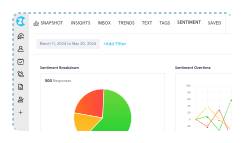
Entity mapping connects feedback to specific features automatically. Instead of keyword filtering ("mentioned 'dashboard'"), AI maps responses to your feature taxonomy and surfaces which features appear in negative sentiment clusters.
Thematic analysis clusters similar feedback. Instead of 500 individual comments, you see: "34% mention load time, 22% mention export limitations, 18% mention missing chart types." That's a prioritization framework your team can actually use.
Sentiment scoring catches what numbers miss. A 4/5 CSAT with a comment that says "it works, but I dread using it" isn't really a 4. The sentiment analysis layer catches the frustration the number doesn't.
Impact analysis correlates feedback themes with business outcomes. If users who mention "setup confusion" churn at 2x the rate of users who don't, that's your highest-priority fix. And once you've identified it, closing the product feedback loop on those users is what turns the insight into retention.
Zonka Feedback's Product Feedback Analytics handles this automatically. It maps responses to features, scores sentiment, and surfaces the signals that matter without manual tagging or dashboard building.
Conclusion
Measuring product feature feedback comes down to three things: knowing what to track, knowing when to ask, and knowing how to act on what you learn.
The framework is straightforward. Track adoption to see if users find and use the feature. Track satisfaction to see if they like it. Track effort to see if it's worth the trouble. Plot those dimensions against each other using the feature prioritization framework, and you'll know which features to promote, which to fix, and which to cut.
The mechanics matter too. In-app surveys triggered within minutes of feature use get 3-4x the response rates of email surveys sent the next day. One question beats five. Frequency beats depth.
And at scale, AI analysis becomes non-negotiable. No product team can manually read thousands of open-text responses. The teams that get value from feature feedback are the ones who let AI surface the patterns and route the signals to the right people.
Feature feedback isn't just about whether users like what you built. It's about whether you built the right thing in the first place. If you're building a system around this rather than treating it as a one-off measurement, the product feedback strategy guide covers how to design cadence, ownership, and escalation paths. And for the broader picture of how feature measurement connects to your overall product feedback loop, see the product feedback guide.