

.svg)
 Healthcare
 Finance
 Retail
 SaaS & Digital
 eCommerce
 Education
 Salesforce
  HubSpot
 Pipedrive
 Mailchimp
 Klaviyo
 Zendesk
  Intercom
 Freshdesk
 HelpScout
  Front
Front Jira
Jira Slack
Slack  MS Teams
 Zoom
Zoom Google Sheets
  Zapier
  Integrately
 Make
Make  Webhooks




 MS Teams


TL;DR
- The Feedback Intelligence Framework is a 3-pillar system: thematic analysis, experience signals, and entity recognition. It analyzes every piece of customer feedback simultaneously, not sequentially.
- Zonka Feedback developed this framework over 1.5 years of building its AI Feedback Intelligence engine and speaking with 100+ CX leaders across industries.
- 87% of CX teams still manually review verbatims to extract insights, and 57% say their feedback data lacks business context: the framework closes both gaps.
- Experience signals go beyond sentiment: effort, urgency, churn risk, emotion, and customer intent are all detected at both the response level and the individual theme level.
- The Impact × Trend prioritization matrix converts signals into four action categories (Fix Now, Monitor, Watch, Celebrate), replacing gut-feel prioritization with data-scored decisions.
- The framework works with ChatGPT and Claude for small-scale analysis, but hits walls at ~50 responses per session with no memory, no trends, and no auto-routing.
When we started building our Feedback Intelligence engine 1.5 years ago, we assumed the hard part would be the AI. It wasn't. The hard part was figuring out what the AI should look for.
We'd talk to CX leaders running programs across finance, retail, SaaS, and healthcare. They all had the same data. Surveys, tickets, reviews, Slack threads, in-app comments. And they all had the same gap: no structured way to extract intelligence from what they were already collecting. The answer wasn't a better tool. It was a better framework. Because when the framework is right, the tools fall into place. And AI starts to fall into place too.
We tested this. We ran framework-structured prompts through ChatGPT, Claude, and our own engine. The results converged. Different tools, same structure, similar output. That's when we knew the framework was the real IP, not the model underneath it.
This article is that framework. Not a concept explainer. Not a product walkthrough. The actual 3-pillar system we built, every signal it extracts, and the prioritization model that turns analysis into decisions.
What Is the Feedback Intelligence Framework?
The Feedback Intelligence Framework is a 3-pillar analytical system that processes every piece of customer feedback through thematic analysis, experience signals, and entity recognition simultaneously. Not one after the other. All three at once, on every response.
That distinction matters because customer feedback isn't just surveys anymore. It spans four channel types, each with different levels of structure:
| Channel | Sources | Data Type |
| Direct | NPS, CSAT, CES surveys, in-app feedback, forms | Scores + open-text |
| Support | Zendesk, Intercom, Freshdesk tickets, live chat | Mostly unstructured |
| Public | Google Reviews, G2, App Store, Trustpilot, social | Fully unstructured |
| Product | Jira tickets, sales calls, feature requests, email threads | Scattered across tools |
Structured data tells you "what": a score dropped. Unstructured data reveals the "why": the language patterns, the frustration, the competitor mention buried in a support ticket nobody opened.
Gartner estimates that 93% of customer feedback data is never analyzed. And Zonka Feedback's own AI in Feedback Analytics 2025 report, based on conversations with 100+ CX leaders, found the same pattern playing out operationally: 93% of organizations struggle with feedback scattered across tools and touchpoints, blocking clear action.
In simple terms: the data exists. The analysis doesn't. That's the gap a framework fills before any tool enters the picture.
Most teams approach feedback analysis by picking a tool and hoping the tool does the thinking. But a tool without a framework is just processing. It can count themes or label sentiment, but it doesn't know what signals matter for your business, who should see them, or what action should follow. The framework is the layer that tells the AI (whether it's ChatGPT, Claude, or a purpose-built platform) what to look for, how to classify it, and where to send it. For teams new to this space, our guide on what feedback intelligence is covers the category-level context. This article goes deeper: into the actual system.
The three pillars work together because each answers a different question about the same response:
- Thematic Analysis asks: what is this about?
- Experience Signals ask: how was the experience, and what does the customer want next?
- Entity Recognition asks: who or what specifically is involved?
Run them sequentially and you get three separate reports. Run them simultaneously and you get one structured view where themes carry sentiment, entities carry context, and intent drives routing. That simultaneous processing is what makes the framework different from traditional feedback analytics.
How much intelligence is actually hiding in unstructured feedback? We ran the framework across 1,000,000+ responses spanning multiple industries and 8 languages. The numbers were striking: the average response (over 100 characters) contained 4.2 distinct topics. Nearly one-third mentioned specific entities like staff names, competitor brands, or product features. 29% carried mixed sentiments that a simple positive/negative classifier would misread. And 23% contained clear intent signals: requests, complaints, advocacy, or escalation cues that could drive automatic routing if anyone were extracting them. Most teams weren't.
Pillar 1: Thematic Analysis — What Are Customers Talking About?
Thematic analysis is the first pillar because it answers the most fundamental question: what topics are showing up in your feedback?
AI reads every response and discovers themes and sub-themes, organizing them into a consistent hierarchy that evolves as new patterns emerge. You might call these topics, categories, or tags. The terminology doesn't matter. What matters is that the taxonomy is consistent across every response and every channel, and that it updates itself as your customers start talking about something new.
That self-evolving taxonomy is worth pausing on. In manual tagging systems, categories are fixed: someone defines 15-20 tags at the start and analysts assign each response to one. When a new issue emerges (say, customers start complaining about a feature that didn't exist when the tags were created), it either gets shoehorned into an existing category or labeled "Other." Over time, "Other" becomes the largest bucket, and nobody knows what's in it.
AI-driven thematic analysis doesn't have this problem. When a new pattern emerges in feedback, the system recognizes it as a distinct theme and adds it to the taxonomy. If "mobile app crashes during checkout" appears across 40 responses in a week, it surfaces as its own sub-theme under a broader parent category. Without anyone manually creating the tag. And because the taxonomy is persistent, that sub-theme is tracked consistently from the moment it appears, with trend data building from day one.
Here's what the shift looks like in practice:
| Manual Tagging | AI Thematic Analysis | |
| Who does it | Analysts reading every response | AI processes all responses in real time |
| Time | 40+ hours per quarter | Instant |
| Consistency | Categories drift across analysts | Consistent, auto-evolving taxonomy |
| Freshness | Results stale before anyone acts | Themes surface as they arrive |
| Scale ceiling | Can't realistically go beyond 500 responses | Scales to 100,000+ without degradation |
That scale ceiling is the part most teams underestimate. Zonka Feedback's research report found that 87% of CX leaders still rely on manual, time-consuming text review to extract insights. One CX leader in finance put it bluntly: "We're going through hundreds of comments every day, but turning them into insights still takes days — and sometimes weeks."
And it's not just speed. Manual tagging introduces inconsistency that compounds over time. When two analysts tag the same complaint differently (one calls it "slow service," the other calls it "wait time"), the data fragments. You can't see the real volume of an issue because it's split across three categories that mean the same thing. AI-driven thematic analysis eliminates this by applying the same taxonomy to every response, every time, across every channel. Consistency isn't a nice-to-have when you're making decisions based on theme volume. It's the foundation.
To see how thematic analysis works on a real comment, consider this piece of hotel feedback:
"Sarah at the front desk was amazing, but the WiFi was terrible and checkout took forever. If it happens again, we'll just book the Marriott next time."
Thematic analysis extracts three themes, each with a sub-theme:
- Staff Experience → Excellent front desk service
- Amenities Feedback → WiFi not working
- Checkout Experience → Slow checkout process
Three topics from one sentence. And that's just Pillar 1. The next two pillars tell you how the customer felt about each topic and who specifically was involved. For a broader view of how feedback intelligence connects these pillars to business outcomes, see our category overview.
Pillar 2: Experience Signals — How Was the Experience and Why Are They Communicating?
This is the framework's deepest pillar, and the one most teams skip entirely. Themes tell you what customers are talking about. Experience signals tell you how they experienced it and what they expect you to do next.
Two sub-pillars sit here: Experience Quality and Customer Intent. Both are detected at the response level AND the individual theme level. That dual-level detection is critical. A response might be mixed overall but strongly negative on one specific theme. If you only read the overall signal, you miss the theme that's actually driving the score.
Wondering what these five dimensions actually look like in practice? Here's each one with the language patterns AI detects.
Experience Quality: 5 Dimensions in Every Response
Zonka Feedback's research report found that 46% of CX leaders admit frontline teams don't get insights in time to intervene. Experience quality signals are what close that gap: they surface effort, urgency, and churn risk in real time so the people closest to the customer can act before it's too late. Teams using AI-powered feedback analytics can detect all five dimensions automatically, across every channel.
Here are the five dimensions:
1. Sentiment: per topic, not just overall.
A response can be positive about staff and negative about WiFi in the same sentence. Overall sentiment averaging would call it "mixed" and move on. Per-topic sentiment analysis tells you exactly which experience needs attention. And which doesn't. Without topic-level granularity, a support team could spend hours investigating a "negative" response where the negativity was actually about parking, not about the service interaction they own. Per-topic sentiment eliminates that wasted effort.
2. Effort: high-friction language flagged automatically.
Phrases like "took forever," "had to call three times," and "couldn't figure out how to" are effort signals. They're distinct from satisfaction signals because a customer can be satisfied with the outcome and still exhausted by the process. Research published in the Harvard Business Review by CEB (now Gartner) found that reducing customer effort is a stronger predictor of loyalty than delighting customers. Your feedback already contains these signals. Most teams just aren't extracting them. Effort detection turns those buried language patterns into a structured flag that operations teams can act on immediately, rather than discovering friction six weeks later in a quarterly report.
3. Urgency: time-sensitive situations that can't wait for a weekly report.
"Need this resolved today." "Deadline is tomorrow." "This has been going on for three weeks." Urgency signals flag responses where timing matters as much as the content. A complaint about slow service has a different priority when the customer adds "my event is this Saturday" versus "for future reference." Both are negative sentiment. Only one is time-sensitive. Urgency detection catches the difference so routing logic can prioritize accordingly.
4. Churn: the language of leaving.
"If it happens again, we'll switch." "Considering alternatives." "This is the last time." Churn signals detect conditional and explicit switching intent in customer language. They don't replace a churn detection model built on behavioral data (usage drops, support ticket frequency, contract dates). But they catch something behavioral models miss: the customers who are telling you they're about to leave, in their own words, before the behavioral signals show up. A customer who mentions a competitor by name while expressing frustration is giving you a signal that no usage dashboard will surface.
5. Emotion: what the tone carries that the score doesn't.
Frustration, delight, confusion, anger. These aren't the same as sentiment. Sentiment classifies positive/negative. Emotion classifies the specific feeling. A 4/5 CSAT with a comment that says "I guess it was fine but I still don't understand why it broke in the first place" isn't really a 4. The customer is confused and mildly frustrated. But the score says "satisfied." The emotion layer catches what the number misses, and it gives teams the language to act with: you don't respond to confusion the same way you respond to anger.
Customer Intent: 5 Types with Routing Logic
Now for the question most feedback programs never ask: why is this person communicating?
Zonka Feedback's research found that 66% of CX leaders report slow or missing feedback-action loops due to disconnected systems. Intent classification is what fixes this. When AI knows whether a response is advocacy, a feature request, or an escalation, the routing logic writes itself.
Five intent types, each with a natural destination:
| Intent Type | Language Pattern | Routes To |
| Advocacy | "I've told all my friends about you" | Marketing |
| Feature Request | "I wish you had..." / "It would be great if..." | Product |
| Question | "How do I...?" / "Can you explain...?" | Support / Knowledge Base |
| Complaint | "This is unacceptable" / "Very disappointed" | Support / Operations |
| Escalation | "I want to speak to a manager" / "If this isn't resolved..." | Management |
Most feedback programs treat every response the same way: it lands in a queue, someone reads it, someone decides where it goes. Intent classification flips that. The AI reads the response, classifies why the customer is communicating, and routes it to the team that can actually act on it.
Advocacy is the most underutilized. When a customer writes "I've already recommended you to three colleagues," that's a marketing asset sitting in a support inbox. Without intent classification, nobody in marketing ever sees it. With it, advocacy signals get amplified: sent to marketing for case studies, testimonials, or referral campaigns.
Feature requests follow a similar pattern. Product teams often rely on a separate feedback channel (Canny, Productboard, a shared spreadsheet) while a stream of feature signals flows through NPS comments and support tickets unnoticed. Intent detection catches "I wish you had..." and "it would be great if..." patterns across every source and routes them to the product roadmap without anyone manually triaging.
When intent is classified automatically, feedback stops sitting in an inbox waiting for someone to read it. Complaints hit the right team before they become public reviews. Escalations reach management in minutes instead of days.
Pillar 3: Entity Recognition — Who and What Specifically?
The third pillar answers a question that thematic analysis and experience signals don't: who or what specifically is the customer talking about?
This is where feedback stops being anonymous and starts becoming operational. Themes tell you "checkout experience is a problem." Signals tell you "it's high-effort and driving churn risk." But entity recognition tells you "it's happening at the airport location, Agent B is mentioned in most negative responses, and customers are naming Competitor X as the alternative." That level of specificity is what turns a theme into a task with a clear owner.
Zonka Feedback's research report found that 57% of CX leaders say their insights lack business context, making it hard to link customer experience to NPS, CSAT, revenue, or ROI. In simple terms: teams know their score dropped, but they can't tell you which location, which agent, or which competitor is involved. Entity recognition is what connects feedback to business context. It maps complaints to a specific location, ties positive signals to a specific staff member, and flags competitor mentions as switching triggers.
Four standard entity types appear across industries:
Staff members. "Sarah at the front desk was amazing." Now you can recognize Sarah. Or coach an agent whose name keeps appearing in negative feedback. Entity recognition turns anonymous sentiment into named performance data. For support operations handling thousands of tickets a month, this is the difference between knowing "agent satisfaction is 3.8" and knowing "Agent A averages 4.6, Agent B averages 3.1, and Agent B's low scores cluster around one specific issue type." The coaching conversation changes entirely when you can point to theme-level data tied to a name.
Competitors. "We'll just book the Marriott next time." That's a switching trigger, not just a theme. Competitor mentions get flagged and tracked over time so you can see which competitors surface most, in which contexts, and whether their mention frequency is increasing or decreasing. For a product team, seeing "Competitor X" mentioned in 12% of feature request responses is a signal that your roadmap needs to account for competitive gaps you might not have known existed.
Products and features. "The mobile app crashes every time I try to check out." Product teams can filter all feedback by specific feature, plan tier, or integration. No more digging through spreadsheets to find what customers think about a particular release. When a new version ships, you can track theme and sentiment shifts tied to that feature within days, not weeks.
Locations. "The downtown branch is great but the airport location is terrible." Multi-location businesses can view all analysis through the lens of a specific branch. Themes, sentiments, signals, all filtered by location. A regional manager seeing that "checkout speed" is a Fix Now theme at three of their ten locations, but a Celebrate theme at four others, has immediately useful information. The entity layer makes that comparison possible without anyone building a custom report.
Beyond these four, entities are customizable by industry. An airline tracks flight numbers, routes, and cabin classes. So when a customer mentions "BA 283 to Heathrow, business class," the system maps that to a specific route and product tier. A SaaS company tracks feature names, plan tiers, and integrations. "The Slack integration keeps disconnecting on the Pro plan" becomes a structured data point that product and engineering can filter by. A healthcare provider tracks departments, treatment types, and physicians. A hospitality brand tracks room types, amenities, and booking channels.
The power of custom entities is that they connect feedback to your specific operational structure. Generic thematic analysis might tell you "customers are unhappy with billing." Entity recognition tells you "customers on the Enterprise plan are unhappy with billing, specifically the invoice format, and it's concentrated among accounts managed by the EMEA team." That level of specificity changes who acts on the insight and how quickly they can act.
From Signals to Decisions: The Impact × Trend Prioritization Matrix
Analysis without prioritization is a dashboard nobody acts on. The framework includes a decision layer that converts signals into four action categories using a simple formula: Impact × Trend = Priority.
Zonka Feedback's research found that 43% of CX leaders lack automated triggers for negative feedback or volume spikes. Only 8% have real-time alerting. The rest find out about problems days after customers have already escalated them.
The prioritization matrix changes that:
| Quadrant | What It Means | Example | Action |
| Fix Now | High impact, negative trend | Checkout friction: 340 mentions, trending down | Auto-assigned to Product/Ops |
| Monitor | High impact, improving trend | Wait times: 280 mentions, trending up | Dashboard alert set |
| Watch | Lower impact, trending negative | Parking complaints: 45 mentions, trending down | Queued for next sprint review |
| Celebrate | Positive, high mentions | Staff friendliness: 200 mentions, consistently positive | Shared to HR/recognition |
One CX leader in finance framed it well: "It's not enough to know what the customer said. You need to track what action was taken."
That's the matrix's job. It takes the themes from Pillar 1, the signals from Pillar 2, the entities from Pillar 3, and scores them against frequency and trend direction. The result isn't a report. It's a prioritized action list where every item has a clear owner.
Consider how this plays out in practice. A retail chain with 40 locations might have 15 active themes across all of them. Without the matrix, leadership reviews a dashboard showing all 15 themes ranked by volume. The loudest theme gets attention. But volume alone doesn't tell you what's getting worse. A theme with 45 mentions that's tripled in two weeks is more urgent than a theme with 300 mentions that's been stable for six months. The matrix catches that distinction because it weighs trend alongside impact.
The "Celebrate" quadrant deserves specific attention because most feedback programs ignore it entirely. When staff friendliness consistently drives positive signals across locations, that's not just a nice pattern. It's evidence of what's working that HR and training teams can replicate. Positive signals have business value too. They just don't show up in systems that only trigger on problems.
The gut-feel alternative, where a team lead scans comments and decides what "feels" important, doesn't scale past a few hundred responses. And it consistently overweights recent, loud complaints while missing slow-building patterns that matter more. Data-scored prioritization catches both. If your current process feels like this, you're not alone: most feedback analytics programs are broken in exactly this way.
Why Framework-First Beats Tool-First
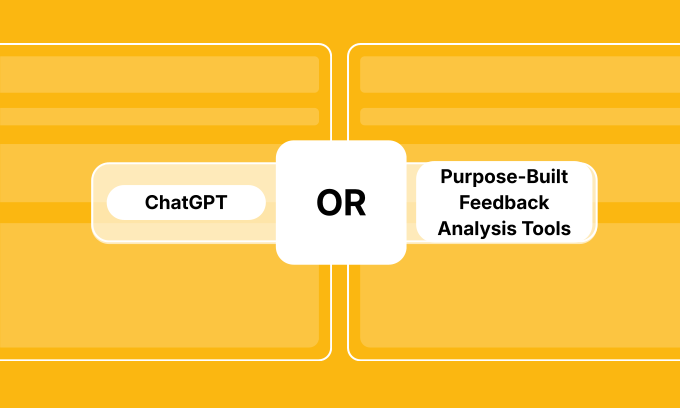
Here's something we demonstrated in our March 2026 webinar: when you give ChatGPT or Claude the Feedback Intelligence Framework as a structured prompt, the results improve dramatically. Two different AI tools, same framework prompt, similar structured output.
That's the point. The framework is what matters, not the tool.
With a general prompt ("analyze this feedback"), you get decent but inconsistent results. Run the same prompt twice and the output is structured differently each time: different categories, different ordering, different depth. With a framework prompt that specifies thematic analysis, experience quality signals, customer intent, and entity extraction, both ChatGPT and Claude converge on consistent, structured analysis.
The difference is stark. A general prompt might return a vague summary: "The customer had a mixed experience. They liked the staff but were frustrated with the WiFi and checkout." A framework prompt returns structured themes with sub-themes, per-topic sentiment scores, effort and churn flags, classified intent, and named entities, all in a consistent format you can compare across responses.
In our webinar, we ran the same 20 hospitality feedback comments through both ChatGPT and Claude with framework prompting. The themes that emerged (housekeeping and room maintenance, staff and service quality, billing and financial accuracy, food and beverage experience) were consistent across both tools. The structure converged because the framework, not the AI model, determines how the analysis is organized.
But walls remain. In our webinar, 46% of the audience reported using ChatGPT, Claude, or Gemini for feedback analysis. And for 20-50 responses at a time, framework prompting genuinely works. The limitation isn't quality. It's everything around quality:
| Capability | ChatGPT + Framework | Purpose-Built Tool |
| Sentiment accuracy | Better per-topic, but drifts across sessions | Consistent, real-time, zero drift |
| Taxonomy | Re-paste every session | Persistent, auto-evolving |
| Trend tracking | Impossible — no memory between sessions | Time-series with alerts |
| Entity linking | Per-session only | Persistent across all data, all time |
| Intent routing | Manual — copy output, assign yourself | Auto-routed tasks with context |
| Closed-loop action | Text output you act on manually | Auto-routed to the right person |
| Scale | ~50 responses per session | Unlimited, continuous |
The framework makes ChatGPT better. A purpose-built platform removes the walls. For teams experimenting with AI feedback analysis, the framework is the bridge from "I'm pasting comments into ChatGPT" to "I need this running continuously across every channel."
We'll be sharing structured prompt templates that align with the framework's three pillars: thematic analysis, experience quality signals, customer intent, and entity extraction. So you can apply the framework yourself with any LLM. The prompts are good. The results are genuinely useful for small batches. But the moment you need to compare this week's themes to last week's, or route an escalation to a manager without copying and pasting output into Slack, you've hit the wall that only persistence and automation can solve.
Where Most Organizations Stand Today
Knowing the framework is one thing. Knowing where you fall on the maturity curve is what determines your next step. And for most teams, the honest answer is: earlier than you'd think.
Don't believe us? Zonka Feedback's research report mapped four stages based on conversations with 100+ CX leaders. The progression isn't about technology adoption. It's about how structurally connected your feedback and VoC program is: how well data flows from collection to analysis to action to measurement.
Stage 1: Reactive Listening. Feedback lives in silos. Analysis is manual. Insights arrive too late to act on. Most teams are here. 83% of the organizations we spoke with fall into early or moderate stages. In a typical Stage 1 organization, the CX team runs NPS surveys, the support team has CSAT on closed tickets, and a product manager occasionally reads through app store reviews. Nobody connects the three.
Stage 2: Organized Reporting. Feedback is centralized in one or two tools. Limited tagging exists. Reports are static, generated monthly or quarterly, reviewed in a meeting, filed away. The data is better organized, but the analysis is still backward-looking. You're describing what happened last quarter, not what's happening right now.
Stage 3: Connected Insights. Feedback is linked to NPS, CSAT, and operational data. Trends surface across channels. But triage is still manual. Someone has to read the themes and decide what matters. This is where most "advanced" programs plateau. They can see patterns, but turning those patterns into team-level actions still requires a person in the loop.
Stage 4: AI-Driven Intelligence. Auto-tagging, experience quality signals, churn detection, intent-based routing, role-based dashboards, and ROI attribution. The system tells each team what's happening in their domain without anyone having to go looking. A support lead sees agent-level CSAT with effort signals. A product manager sees feature-level themes with intent classification. A regional manager sees location-level entity dashboards with trend alerts. Same data, different views, zero manual triage.
Only 17% of the leaders we spoke with have reached high maturity. Just 7% have adopted AI-driven analytics with predictive triggers and automated workflows. The gap between Stage 1 and Stage 4 isn't technology. It's framework. Teams that define what they're looking for before they pick a tool move through the curve faster than teams that buy a platform and figure out the rest later.
Applying the Framework: A Single Response, Decoded
The best way to understand how the three pillars work together is to watch them process a single comment. Here's the hotel feedback we've been using throughout:
"Sarah at the front desk was amazing, but the WiFi was terrible and checkout took forever. If it happens again, we'll just book the Marriott next time."
One sentence. Here's what the framework extracts:
Pillar 1: Themes
- Staff Experience → Excellent front desk service
- Amenities → WiFi not working
- Checkout Experience → Slow checkout process
Pillar 2: Experience Signals
| Signal | Level | Value |
| Sentiment (overall) | Response | Mixed |
| Sentiment (staff) | Theme | Positive |
| Sentiment (WiFi) | Theme | Negative |
| Sentiment (checkout) | Theme | Negative |
| Effort | Response | High — "took forever" |
| Urgency | Response | Medium — conditional, already delivered |
| Churn Risk | Response | High — conditional switching intent |
| Emotion | Response | Frustration (WiFi, checkout) + Appreciation (staff) |
| Intent | Response | Complaint + Conditional churn |
Pillar 3: Entities
- Sarah: staff member (positive context → recognition opportunity)
- Marriott: competitor (switching trigger → competitive intelligence)
Eight signals from one comment. Three themes. Two named entities. One clear action priority: the checkout friction and WiFi issue are driving a churn risk that needs to reach Operations before this guest books somewhere else.
Now scale that. A hotel chain receiving 500 reviews a week gets this analysis on every single one, automatically. Themes aggregate across all responses. Entity dashboards show which locations have the most WiFi complaints. Trend views reveal whether checkout friction is getting worse or improving after a recent process change. Staff entities surface which team members consistently drive positive experiences. And which ones don't.
That's the framework working as designed. Not three separate analyses stitched together after the fact. Three pillars running simultaneously on every response, producing structured intelligence that routes to the right team automatically.
The Feedback Intelligence Framework isn't a model that exists only in slides or webinars. It's the operating system behind how leading CX teams are starting to analyze customer feedback: structured, signal-rich, and built to route the right insight to the right person at the right time. The teams that adopt a framework-first approach don't just collect more data. They build programs where every piece of feedback drives a decision.
That's what we built Zonka Feedback to do. See the framework in action. Schedule a Demo.