

.svg)
 Healthcare
 Finance
 Retail
 SaaS & Digital
 eCommerce
 Education
 Salesforce
  HubSpot
 Pipedrive
 Mailchimp
 Zendesk
  Intercom
 Freshdesk
 HelpScout
  Front
Front Jira
Jira Slack
Slack  MS Teams
 Zoom
Zoom Google Sheets
  Zapier
  Integrately
 Make
Make  Webhooks




 MS Teams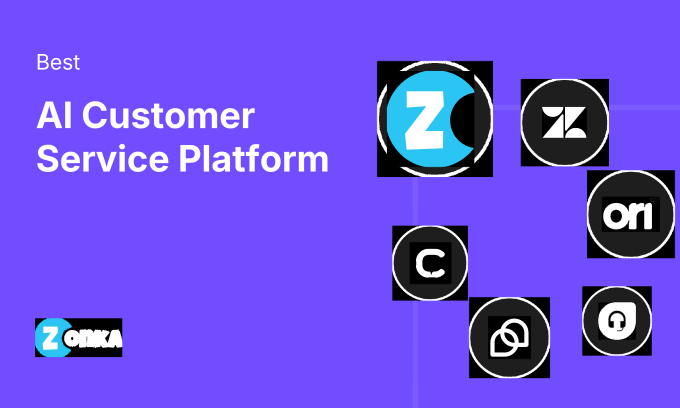


The best AI customer service platforms for 2026 include Zendesk, QuantumDesk, Freshdesk, Tidio, Intercom, CloudTalk, Creatio, Kapture CX, Oriserve, Replify, and ReachifyAI. These tools help teams automate responses, route conversations, analyze customer sentiment, and close the loop between feedback and action.
TL;DR
- This guide covers 11 AI customer service platforms: Zendesk, QuantumDesk, Freshdesk, Tidio, Intercom, CloudTalk, Creatio, Kapture CX, Oriserve, Replify, and ReachifyAI.
- Use cases range from enterprise support and SMB chat automation to outbound calling, no-code AI agents, and industry-specific solutions (BFSI, fitness franchises, restaurants).
- Each tool is evaluated on AI capability depth, channel coverage, integration ecosystem, pricing transparency, and feedback loop closure.
- Includes a comparison table, decision framework, and common implementation mistakes to avoid.
Most teams shopping for AI customer service tools are still thinking in 2023 terms. Chatbot deflects ticket. Customer gets faster reply. Support team breathes easier.
That's one version of the category. But the tools have split. Some still focus on response automation. Others go further: they analyze what customers are actually saying, surface patterns before they become problems, and route signals to the people who can act. Not just faster replies. Actual understanding.
This guide covers 10 platforms across enterprise helpdesks, SMB chat automation, outbound calling, no-code AI configuration, and industry-specific solutions. Each one evaluated on AI depth, channel coverage, integrations, pricing transparency, and whether it closes the loop between feedback and action.
At a Glance: Top AI Customer Service Platforms Compared
| Tool | Best For | Key AI Capability | Starting Price |
| Zendesk | Enterprise-grade AI at scale | Answer Bot, Content Cues, ecosystem | $19/user/mo+ |
| QuantumDesk | D2C and Shopify brands wanting AI-native support | Quantum AI, native Shopify sync, resolution based pricing | $0.79/credit (plans from $100/month) |
| Freshdesk | Growing teams wanting AI + affordability | Predictive analytics, automation | Free tier available |
| Tidio | SMBs needing chatbot + live chat | Lyro AI agent, 67% automated resolution | Free / $24/mo |
| CloudTalk | Outbound sales & support calls | Power dialer, IVR, skill-based routing | $25/user/mo |
| Intercom | AI-first customer messaging at scale | Fin AI agent, unified inbox, workflows | $29/seat/mo + $0.99/resolution |
| Kapture CX | Mid-market AI + human balance | Smart routing, SLA management | Contact sales |
| Creatio | No-code AI agent configuration | Pre-built agents, case classification | $40/user/mo |
| Oriserve | BFSI collections & renewals | Voice AI for financial services | Contact sales |
| Replify | Multi-location franchise businesses | Omnichannel AI employee | $300/mo/location |
| ReachifyAI | Restaurant phone automation | 24/7 AI call answering, order handling | $149/mo/location |
The short version: If you need AI that automates ticket responses, most tools on this list will work. If you need AI that connects customer feedback to business outcomes and tells your team what to fix, the field narrows considerably.
How We Evaluated These Platforms
Zonka Feedback integrates natively with several customer service platforms, including Zendesk, Freshdesk, and Intercom. We've worked with customers across these tools for years, helping them connect feedback data to their support workflows. That hands-on experience shaped how we approached this guide.
Five criteria shaped this list:
1. AI capability depth. Does the tool just route tickets, or does it actually analyze what customers are saying? There's a big gap between "auto-reply with a help article" and "surface that three enterprise accounts mentioned billing issues this week."
2. Channel coverage. Chat-only tools are fine for some teams. Others need email, voice, SMS, in-app, WhatsApp, and web. We noted what each platform covers.
3. Integration ecosystem. A customer service tool that doesn't talk to your CRM, helpdesk, or marketing stack creates more work than it saves. Native integrations matter.
4. Pricing transparency. Some vendors publish pricing. Some require a sales call. We noted which is which because hidden pricing often means hidden complexity.
5. Feedback loop closure. This is where most tools fall short. Can the AI help your team act on what customers are saying, or does it stop at analysis?
G2 ratings are included where available. Pricing comes from official sources as of March 2026.
The 11 Best AI Customer Service Platforms for 2026
1. Zendesk – Best for Enterprise-Grade AI at Scale
Zendesk is a cloud-based customer service platform that offers support tools for businesses of all scales and types. The platform includes AI-powered features: Answer Bot automatically responds to customer queries with relevant articles, Content Cues identifies gaps and opportunities in the knowledge base, and Satisfaction Prediction predicts customer satisfaction scores based on conversation signals.
With 130,000+ customers globally and omnichannel support across chat, email, voice, and social, Zendesk serves as the industry standard for enterprise support operations. The marketplace includes 1,800+ integrations, and workforce management and quality assurance are available on higher tiers. The platform offers strong security and compliance certifications for regulated industries. The trade-off is complexity: configuration takes 4+ weeks, and pricing requires a sales conversation for enterprise features.
Key Features
- Answer Bot for automatic responses from knowledge base
- Content Cues to identify gaps in help center content
- Satisfaction Prediction from conversation signals
- Omnichannel support (chat, email, voice, social)
- 1,800+ marketplace integrations
- Workforce management and quality assurance on higher tiers
Zendesk Pros
- Proven at enterprise scale
- Native AI integration
- Comprehensive ecosystem and marketplace
- Strong security and compliance
Zendesk Cons
- Complex pricing; requires sales conversation
- Configuration takes 4+ weeks
- AI features solid but not cutting-edge
Zendesk Pricing
- Starts at $19/user/month for basic Support. Suite plans require custom pricing.
G2 Rating: 4.3/5 (7,000+ reviews)
2. QuantumDesk – Best for D2C and Shopify Brands Wanting AI-Native Customer Support
QuantumDesk is an AI-native customer service platform built for small and mid-sized D2C and Shopify brands. Rather than adding AI as a layer on top of ticketing software, the platform is built with AI at its foundation. Quantum AI resolves repetitive queries such as order status and refund requests automatically; the AI-Curated Inbox prioritizes incoming conversations by urgency, sentiment, and intent, and Quantum AI Copilot drafts responses and summarizes long threads so agents can resolve faster.
QuantumDesk's native Shopify integration surfaces live order and purchase history directly inside every conversation, so agents never need to open a second tab to check an order status. This closes a gap left by tools that treat AI as a bolted-on add-on rather than the platform's foundation. The trade-off is that QuantumDesk is purpose-built for D2C and Shopify support teams, making it a narrower fit for large enterprises running complex, multi-department ticketing outside e-commerce.
Key Features
- Quantum AI resolves repetitive support queries automatically
- Unified Inbox for WhatsApp, email, and live chat
- Native Shopify integration surfaces live order data
- Quantum AI Copilot drafts and summarizes agent responses
- Real-time dashboard for AI resolution and CSAT trends
- Resolution-based, uncapped credit pricing tied to outcomes
QuantumDesk Pros
- AI-native from day one, not a bolted-on module
- Native Shopify sync eliminates manual order lookups
- Usage-based pricing scales with outcomes, not headcount
- Copilot keeps agents fast without losing conversation context
QuantumDesk Cons
- Purpose-built for D2C/Shopify support, a narrower fit for non-ecommerce enterprises
- Newer platform with a smaller integration ecosystem than legacy players
- Credit-based pricing needs monitoring for high-volume teams to avoid overage costs
QuantumDesk Pricing
- Limited early bird pricing available. $0.79/credit, uncapped (Micro plan starts at $100/month - 1 AI agent, 3 seats).
G2 Rating: 4/5
3. Freshdesk – Best for Growing Teams Wanting AI + Affordability
Freshdesk is an AI-powered helpdesk solution with omnichannel support, predictive analytics, and automation to streamline customer service and improve response efficiency. The platform offers ticket categorization and routing, automation workflows, and a self-service portal with AI-powered suggestions. Omnichannel ticketing covers email, chat, phone, social, and web in one interface.
Freshdesk positions itself between basic tools and enterprise platforms, offering solid capabilities at mid-market pricing with a free tier for small teams. Predictive analytics identify support trends before they escalate, and automation workflows streamline repetitive tasks. The integration ecosystem works with major CRMs and business tools. The trade-off is that some features require higher tiers, and costs scale with agents and channels as teams grow.
Key Features
- Omnichannel ticketing (email, chat, phone, social, web)
- AI-powered ticket categorization and routing
- Predictive analytics for identifying support trends
- Automation workflows for repetitive tasks
- Self-service portal with AI suggestions
- Integration ecosystem with major CRMs and business tools
Freshdesk Pros
- Competitive pricing for mid-market
- Solid AI capabilities without enterprise complexity
- Good integration ecosystem
- Free tier available
Freshdesk Cons
- AI less advanced than AI-native platforms
- Some features require higher tiers
- Costs scale with agents and channels
Freshdesk Pricing
- Free tier available. Paid plans from $15/agent/month.
G2 Rating: 4.4/5 (3,500+ reviews)
4. Tidio – Best for SMBs Needing Chatbot + Live Chat in One
Tidio is an AI-powered customer service platform that integrates live chat, help desk, and chatbot tools to help businesses deliver faster and more personal support. The platform features Lyro, a reliable AI agent that provides grounded responses based on a company's own data. Lyro handles routine inquiries automatically while ensuring a smooth handoff to human operators for complex or sensitive issues.
This combination allows teams to maintain high-quality service and transparency while automating up to 67% of support tasks. The platform works well with Shopify, WordPress, and WooCommerce, making it popular with e-commerce businesses. The help desk module centralizes multichannel communications, and the mobile app lets teams manage conversations on the go. Tidio offers a free tier, making it accessible for small teams testing AI-powered support.
Key Features
- Lyro AI agent for automated, grounded responses
- Live chat for real-time customer communication
- No-code chatbot flows for proactive service and lead capture
- Help desk with multichannel ticketing
- E-commerce integrations (Shopify, WordPress, WooCommerce)
- Mobile app for managing conversations on the go
Tidio Pros
- Lyro provides grounded responses; avoids hallucination
- Free version available
- Easy setup for non-technical teams
- Strong e-commerce integrations
Tidio Cons
- AI capabilities limited compared to enterprise platforms
- Conversation limits on lower-tier plans
- Help desk is basic compared to dedicated tools
Tidio Pricing
- Free version available. Starter ($24.17/mo), Growth (starts at $49.17/mo), Plus (starts at $749/mo), Premium (custom pricing).
G2 Rating: 4.7/5 (1,800+ reviews)
5. Intercom – Best for AI-First Customer Messaging at Scale
Intercom is a customer service platform that combines live chat, help desk, and AI automation into one system. The platform's AI agent, Fin, resolves customer queries automatically by pulling answers from help center content and learning from past conversations. Fin handles routine questions 24/7 and hands off complex issues to human agents with full context.
Intercom unifies messaging across live chat, email, SMS, WhatsApp, and in-app channels in a single inbox. The platform serves 30,000+ businesses including companies like Anthropic and Atlassian. Product Tours, automated workflows, and proactive messaging let teams engage customers before they reach out. The trade-off is pricing complexity: per-resolution fees for Fin ($0.99/resolution) plus seat costs can add up quickly at scale.
Key Features
- Fin AI agent with 67% average resolution rate
- Unified inbox for chat, email, SMS, WhatsApp, and in-app messaging
- Automated workflows and conversation routing
- Product Tours for in-app onboarding and engagement
- Knowledge base integration with AI-powered suggestions
- Works with any helpdesk (Zendesk, Salesforce, HubSpot)
Intercom Pros
- Fin AI agent ranked #1 on G2 for resolution quality
- Seamless omnichannel messaging in one inbox
- Strong automation and proactive engagement tools
- Integrates with existing helpdesks without migration
Intercom Cons
- Per-resolution pricing makes costs unpredictable at scale
- Full feature set requires expensive add-ons
- Complex pricing tiers and seat requirements
Intercom Pricing
- Essential $29/seat/mo, Advanced $85/seat/mo, Expert $132/seat/mo. Fin AI: $0.99/resolution.
G2 Rating: 4.5/5 (3,700+ reviews)
6. CloudTalk – Best for AI-Powered Outbound Sales and Support Calls
CloudTalk is an AI-powered cloud-based call center solution built for sales and customer support teams in small to midsize businesses. It delivers advanced dialing features and powerful outbound calling capabilities optimized for high-volume scenarios, including insurance and collections use cases. With support for multiple dialer types (Power, Preview, Progressive, and Parallel), the platform helps teams streamline outbound workflows and improve efficiency.
Deep integrations with leading CRM systems like HubSpot, Salesforce, Zendesk, and Pipedrive enable centralized management of calls, contacts, and customer data. The platform offers 160+ international numbers for global coverage, skill-based routing for intelligent call distribution, and comprehensive analytics to track performance across teams. CloudTalk handles the voice channel well but isn't designed for chat, email, or feedback intelligence.
Key Features
- Power, Preview, Progressive, and Parallel dialing options
- Deep CRM integrations with HubSpot, Salesforce, Zendesk, and 80+ tools
- IVR and skill-based routing for intelligent call distribution
- Advanced call analytics and performance tracking
- 160+ international numbers for global coverage
- Call recording, tagging, and notes for quality assurance
CloudTalk Pros
- Multiple dialer options for different workflows
- Strong call quality and reliability
- Deep CRM integration reduces manual work
- International number coverage
CloudTalk Cons
- Voice-focused; not a full omnichannel platform
- Advanced dialing features cost extra
- Longer setup for complex routing rules
CloudTalk Pricing
- From ~$25/user/month, with add-ons for advanced dialing features.
G2 Rating: 4.4/5 (1,700+ reviews)
7. Kapture CX – Best for Mid-Market Teams Needing AI + Human Agent Balance
Kapture CX is a customer experience platform that combines automation with human oversight. The platform handles chat, email, messaging, and bots together through a unified interface. AI manages repetitive questions and early sorting, while agents get full context visibility for complex issues. Smart ticket routing based on SLA and priority rules ensures complex issues don't sit in queue.
Kapture serves industries including retail, BFSI, travel, and consumer durables across 16+ countries. The platform offers self-service portals, knowledge base management, and analytics for tracking resolution quality and CX performance. Auto QA analyzes omnichannel customer interactions and scores them against custom success metrics. This balance of automation and human oversight works well for mid-market teams that need efficiency without sacrificing service quality.
Key Features
- Unified interface for chat, email, messaging, and bots
- AI support for self-service and guided conversations
- Smart ticket routing with SLA and priority rules
- Auto QA for omnichannel interaction scoring
- Self-service portals and knowledge base management
- Analytics for resolution quality and CX performance
Kapture CX Pros
- Balance of AI automation and human oversight
- SLA management built in
- Multi-channel in one interface
- Industry-specific solutions for BFSI, retail, and travel
Kapture CX Cons
- Pricing not publicly available
- May be more than small teams need
- AI capabilities less advanced than pure-play platforms
Kapture CX Pricing
- Contact sales for pricing.
G2 Rating: 4.5/5 (280+ reviews)
8. Creatio – Best for No-Code AI Agent Configuration
Creatio is an AI-native customer service and workflow automation platform designed to support end-to-end service operations. The Creatio Agentic Platform enables teams to collaborate with autonomous, role-based AI agents that support daily operations, automate routine tasks, and assist human agents throughout the service lifecycle. Pre-built AI agents handle case classification, customer support, knowledge management, and customer success scenarios.
Organizations can define clear rules and levels of autonomy for AI-driven actions using no-code tools. The platform offers automated response generation, sentiment analysis, and knowledge base generation with real-time content recommendations. Human-in-the-loop controls and governance provide real-time monitoring of AI actions for compliance and security. Creatio works well for teams in complex and regulated environments that need both autonomous execution and oversight.
Key Features
- Pre-built AI agents for case classification and customer support
- Autonomous case classification and intelligent routing
- AI-driven next-best-action recommendations
- Automated response generation and sentiment analysis
- No-code tools for configuring workflows and AI agent behavior
- Human-in-the-loop controls and governance for compliance
Creatio Pros
- Comprehensive AI agents across the service lifecycle
- Strong governance and human-in-the-loop controls
- No-code customization for service processes
- AI agents included in base pricing
Creatio Cons
- Initial onboarding required for teams new to no-code platforms
- May be more than needed for simple support use cases
- Enterprise-focused
Creatio Pricing
- Starts at $40/user/month. AI agents included.
G2 Rating: 4.7/5 (340+ reviews)
9. Oriserve – Best for BFSI Collections and Renewals
Oriserve is a Voice AI platform built specifically for BFSI (banking, financial services, insurance) companies. The platform handles collections and renewals, lead qualification, and customer support through multimodal voice and chat agents. AI-driven disposition tagging (PTP, RTP, renewal intent) provides accurate categorization, and automated follow-ups boost recovery and renewal rates.
The platform understands financial services compliance and the specific conversation patterns unique to this industry. Speech and conversation analytics turn every interaction into coaching opportunities for agents while flagging compliance risks. Oriserve deploys on voice, WhatsApp, web, and app channels with integrations into CRMs, dialers, and ticketing systems. The narrow BFSI focus makes it strong for that vertical but unsuitable for general customer service use cases.
Key Features
- Voice AI for collections and renewals automation
- Lead qualification workflows with AI-powered scoring
- AI-driven disposition tagging (PTP, RTP, renewal intent)
- Speech analytics for agent coaching and compliance monitoring
- BFSI compliance awareness and regulatory alignment
- Integrations with CRMs, dialers, and ticketing systems
Oriserve Pros
- Purpose-built for financial services
- Collections and renewals automation
- Voice-first approach with compliance built in
- Speech analytics for coaching and risk flagging
Oriserve Cons
- Very narrow focus; not useful outside BFSI
- Limited public information on pricing and features
- Not a general customer service platform
Oriserve Pricing
- Contact sales for pricing.
G2 Rating: 4.6/5 (18 reviews)
10. Replify – Best for Multi-Location Franchise Businesses
Replify is an AI employee platform designed for multi-location businesses. It acts as an omnichannel (phone, text, email, and live chat) customer service and sales employee, capturing leads, selling services, booking appointments, and handling billing collections. The platform serves over 1,000 fitness businesses and integrates with major membership management platforms.
Replify is used by Gold's Gym, UFC Gym, Anytime Fitness, and hundreds of franchise and independent locations. Primary users include health clubs, gyms, fitness studios, recreation centers, and YMCAs. The AI handles after-hours coverage, daytime overflow, and billing communications without requiring additional staff. The narrow focus on fitness and multi-location operations makes it strong for that vertical but less suitable for other industries.
Key Features
- AI Receptionist for incoming inquiries across channels
- AI Sales for lead capture and service selling
- AI Billing & Collections for payment reminders
- AI lead qualification before human handoff
- Omnichannel support (phone, SMS, email, live chat)
- Integrations with membership management platforms
Replify Pros
- Built for franchise and multi-location complexity
- Combines service and sales in one AI
- Used by recognizable fitness brands
- Handles billing and collections automatically
Replify Cons
- Very specific use case; not for single-location businesses
- Less focus on feedback intelligence
Replify Pricing
- Pricing starts at $300/mo/location
G2 Rating: Not yet rated
11. ReachifyAI – Best for Restaurant Phone Automation
ReachifyAI is an AI-powered phone system built specifically for restaurants. It answers calls 24/7, responds to guest questions, sends actionable text links, and transfers calls to staff based on custom rules. The AI handles multiple calls simultaneously during rush hours without any issues, letting staff focus on in-house service instead of juggling phones.
The platform integrates with Square and Olo for seamless order flow directly into POS systems. ReachifyAI supports 50+ languages for diverse customer bases and blocks robocalls automatically. SMS ordering lets customers text their orders naturally, with AI processing requests and sending secure checkout links. The restaurant-specific focus makes it strong for food service but unsuitable for general customer service scenarios.
Key Features
- 24/7 AI call answering for restaurants
- AI ordering and order handling with high accuracy
- Actionable SMS messages with ordering and reservation links
- Call transfers based on custom rules
- POS integrations with Square and Olo
- 50+ language support for diverse customer bases
ReachifyAI Pros
- Purpose-built for restaurants
- No setup fees, no long-term contracts
- Frees staff during rush periods
- Multi-language support
ReachifyAI Cons
- Only for restaurants
- Phone-focused; not a full customer service platform
- Depends on phone infrastructure
ReachifyAI Pricing
- Plans start at $149/month per location, with no setup fees and no long-term contracts.
G2 Rating: Not yet listed on G2
What's the Difference Between an AI Chatbot and an AI Customer Service Platform?
An AI chatbot answers questions. An AI customer service platform understands what customers are saying and connects that understanding to business outcomes.
The chatbot asks "how can I help you?" The platform asks "what's actually going wrong here?"
Chatbots follow scripted rules or use natural language processing to handle incoming inquiries. They're good at deflecting tickets, answering FAQs, and providing 24/7 availability. But they stop at the interaction level.
A full AI customer service platform does more: it analyzes patterns across conversations, surfaces themes and sentiment shifts, routes signals to the right people, and helps teams act on what customers are saying. The best platforms close the loop between feedback and action.
If you need fast replies to common questions, a chatbot works. If you need to understand why customers are frustrated and what to fix, you need a platform.
How to Choose the Right AI Customer Service Platform
Match the tool to the job. Here's a decision framework:
| If You Need... | Look For... | Consider... |
| Chat automation for SMB | Free tier, easy setup, e-commerce integrations | Tidio, Freshdesk |
| AI-native support connected to Shopify data | Native Shopify sync, resolution-based pricing | QuantumDesk |
| Enterprise scale + ecosystem | Proven platform, compliance | Zendesk |
| Outbound call automation | Power dialer, CRM integration | CloudTalk |
| No-code AI agent configuration | Pre-built agents, workflow automation | Creatio |
| Multi-location franchise ops | Omnichannel AI employee | Replify |
| Industry-specific (BFSI, restaurants) | Vertical expertise | Oriserve, ReachifyAI |
Common Mistakes When Implementing AI Customer Service
1. Automating without understanding.
The most common mistake: deploying AI that responds to customers but doesn't analyze what they're saying. You end up with faster replies and zero insight into why customers are frustrated.
The fix: pair response automation with a feedback intelligence layer.
2. Ignoring the human handoff.
AI can't resolve everything. When it gets stuck, what happens? If there's no clear escalation path, the customer repeats their problem and your team looks incompetent.
The fix: define handoff triggers and ensure agents see full conversation history.
3. Treating all channels the same.
Chat needs speed. Email can be detailed. Phone needs natural language. Using the same AI script across all channels creates friction.
The fix: configure AI behavior per channel.
4. Not measuring AI-specific metrics.
CSAT and resolution time are important. But they don't tell you whether the AI is actually working. You need containment rate, escalation rate, AI accuracy, and time-to-handoff.
The fix: add AI-specific KPIs to your reporting.
5. Deploying before the knowledge base is ready.
AI that answers from your help center is only as good as your help center. If articles are outdated, the AI will confidently give wrong answers.
The fix: audit your knowledge base before AI launch.
The Real Question
The AI customer service category isn't about whether to use AI. That decision is already made. Your competitors are using it, and customers expect the speed and availability AI provides.
The real question is whether your AI is just responding to customers or actually helping you understand them.
Faster replies are table stakes. The differentiation is in what happens after the reply: Does your team know what's actually frustrating customers? Can they connect feedback to specific locations, agents, products, or services? Are they acting on patterns before small issues become churn drivers?
Tools that automate responses are everywhere. Tools that close the loop between what customers say and what your team does about it are rarer. The platforms on this list represent the best options across different use cases, team sizes, and budgets.