

.svg)
 Healthcare
 Finance
 Retail
 SaaS & Digital
 eCommerce
 Education
 Salesforce
  HubSpot
 Pipedrive
 Mailchimp
 Klaviyo
 Zendesk
  Intercom
 Freshdesk
 HelpScout
  Front
Front Jira
Jira Slack
Slack  MS Teams
 Zoom
Zoom Google Sheets
  Zapier
  Integrately
 Make
Make  Webhooks



 Sign In
 MS Teams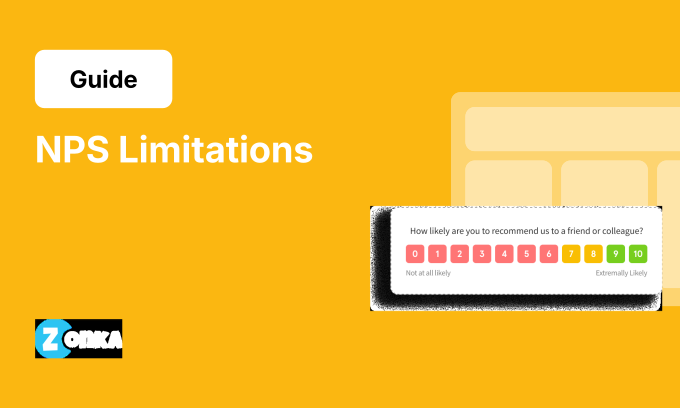


TL;DR
- NPS was designed as a directional loyalty signal, not a complete diagnostic system. Most teams treat it like both.
- The NPS score has 9 distinct limitations organized in three layers: what it misses, what it can't see structurally, and where it quietly misleads.
- Survivorship bias is the most underestimated problem: your NPS only measures customers who stuck around long enough to be surveyed, not those who churned before the invite.
- The flat democracy problem means a $500/month customer and a free-trial user contribute equal weight to your score. NPS can improve while your most valuable customers leave.
- Pair NPS with CSAT, CES, behavioral data, and churn models. None of these replace NPS, but they complete it. Learn more about how to improve your NPS score.
Every CX leader I know can recite their NPS score. Almost none of them can tell you what's actually driving it.
That gap (between knowing the number and understanding what it means) is where most NPS programs quietly fail. You're tracking a score that's going up or down, but you can't explain why. Or worse, you can explain it, but the explanation doesn't match what the number says.
Fred Reichheld built NPS as a conversation starter. One question. A directional signal. Most teams turned it into the conversation ender. The proof that CX is handled. The metric that shows up in board decks without context, without segmentation, without anyone asking what happens next.
Here's what Reichheld himself said later: NPS became a "tragedy of the commons." Teams gamed it. Coached customers. Tied it to performance reviews. The simplicity that made it spread also made it easy to misuse.
The companies that actually get value from NPS? They know exactly where it stops being useful.
Is NPS Really "The One Number You Need to Grow"?
That line came from Reichheld's 2003 article. It became the tagline that sold a million CX programs.
Twenty years later, NPS is used by two-thirds of Fortune 1000 companies. Also the most criticized.
The gap between what NPS was built to do and what teams ask it to do keeps widening. Reichheld built it as a proxy for loyalty. One question to identify which customers would recommend you. Not a diagnostic tool. Not a complete picture of customer health. Not proof your product works.
The problem isn't the metric. It's that we stopped asking what comes after the number.
What NPS Was Built to Do (& Why the Gap Matters)
Reichheld's thesis was simple: one question could predict loyalty better than complex satisfaction surveys. The score correlated with growth. Companies with higher NPS grew faster.
His original research surveyed 4,000 customers across 14 case studies in six industries. The "recommend" question was the best or second-best predictor of repeat purchases and referrals in 11 of 14 cases. Later research from London School of Economics found that businesses increased sales by £8.82 million for every 1-point NPS increase. A 7-point rise correlated with 1% revenue growth.
Bain's own research tracked 11 public NPS leaders over a decade. Their median total shareholder return was five times the US median for comparably-sized companies.
That part still holds. NPS does what it was designed to do: gives you a directional signal about customer loyalty at a population level.
What it wasn't designed for: telling you why customers feel that way. What's driving the score. Which customers are about to churn. Whether the number represents your actual customer base.
Teams that treat NPS as the complete answer end up staring at a declining score with no idea what broke. That gap between what you expect and what the metric can actually tell you is where most programs fail.
Layer 1: What the Score Actually Misses
The most fundamental gaps. What NPS actively ignores. Let us look at them.
1. It Tells You What, Not Why
A 3 and a 6 are both Detractors. One hates your product. The other had a bad support call. The score treats them identically.
This is the most common trap. The score points you toward a problem. It doesn't tell you what the problem is.
A customer gives you a 4. You know they're unhappy. You don't know if it's onboarding, pricing, a missing feature, or a support interaction from three weeks ago. The number is the symptom. The follow-up is the diagnosis.
Every NPS survey needs an open-ended "why" question. Not optional. The score gives direction. The comment gives the story. Skip it and you've collected noise.
For guidance on structuring better NPS survey questions that actually surface root causes, the question design matters as much as the score itself.
2. The Passive Black Box
Passives (customers who score 7 or 8) are mathematically invisible. They don't count in the NPS formula at all. Promoters (9-10) minus Detractors (0-6) equals your score. Passives get excluded.
But they're often the largest segment. Think of them as the swing voters of your customer base. Satisfied enough not to complain. Not loyal enough to advocate.
Most NPS programs ignore Passives entirely. That's a mistake. They represent both your biggest conversion opportunity and your biggest silent churn risk. A Passive customer is one competitor offer away from leaving. Or one great experience away from becoming a Promoter.
The fix: analyze Passives as a separate cohort. Build specific re-engagement strategies. Track Passive to Promoter and Passive to Detractor conversion rates over time. The movements in this middle band often predict what your score will look like three months from now.
3. Binning Destroys Information
Grouping 0 through 6 as "Detractors" treats a 6 and a 0 as identical. The Nielsen Norman Group's research showed this collapsing of scores results in significant information loss.
A team of all-6 Detractors and a team of all-0 Detractors face entirely different problems. But NPS presents the same number. The binning system that makes NPS simple to calculate also makes it blind to severity.
A 6 is a disappointed customer. A 0 is actively hostile. The interventions you'd use for each are completely different. But the score doesn't tell you which one you have.
The compensation: analyze raw score distributions alongside NPS. Track the shape of your distribution, not just the headline number. If your Detractors are clustering at 5-6, that's a different problem than if they're clustering at 0-2. The shape tells the story the number hides.
Layer 2: What NPS Can't See
Structural blind spots. Things the architecture can't capture.
4. It's a Snapshot, Not a Film
NPS is collected at a single moment in time. A customer can be a Promoter at onboarding and a Detractor by month three. A single annual survey would never catch that shift.
The gap between survey moments is where churn actually brews. Friction accumulates in quiet months. Problems compound. By the time the next survey arrives, the customer has already made the decision to leave.
This is why both relational and transactional NPS matter. Relational NPS gives you periodic health checks. Transactional NPS captures moments. Together, they give you the film, not just the snapshot.
5. The Flat Democracy Problem
NPS treats every response equally. A Promoter spending $500 a month and a Promoter on a free trial contribute identical weight.
A Detractor representing 30% of your revenue counts the same as someone who signed up yesterday.
Your NPS can improve while your most valuable customers leave. The score looks healthy. The revenue doesn't.
This is one of the most dangerous assumptions: that the score represents business health. It represents the sentiment of whoever responded. Not the same thing.
Segment by revenue tier, plan type, customer lifetime value. Never report company-wide NPS without value weighting. Your exec team needs to know if enterprise is at +50 and SMB is at -10, even if the blended number looks fine.
Without segmentation, you're flying blind. You might be winning with customers who don't pay much and losing the ones who do.
6. Cultural & Regional Scoring Bias
Japanese respondents tend to score lower across the board. American respondents skew higher. A "7" in the Netherlands means contentment. A "7" in the US is a polite expression of dissatisfaction.
If you're benchmarking across regions without cultural calibration, you might over-invest in markets performing fine and under-invest where loyalty is genuinely eroding.
Qualtrics XM Institute research shows scoring patterns vary by as much as 15-20 points between regions for identical customer experiences. That variance isn't loyalty. It's culture.
The compensation: segment by region. Apply cultural context before comparing. A -5 in Japan might represent healthier loyalty than a +15 in the US. The number alone won't tell you.
Layer 3: What NPS Gets Quietly Wrong
The dangerous ones. Where NPS actively misleads. Here's what constitutes them.
7. Sentiment Doesn't Equal Timing
A Detractor might stay for years. Switching costs are high. Contracts lock them in. Meanwhile, a Passive might churn tomorrow because a competitor made a better offer last week.
NPS tells you who's unhappy. It does not tell you who's about to leave.
This is one of the most dangerous assumptions teams make: treating Detractors as imminent churn risks and Promoters as safe. The score measures sentiment, not departure timing.
The compensation: pair NPS with behavioral data. Login frequency. Support ticket trends. Feature usage patterns. Renewal signals. Move from knowing who's unhappy to knowing who's walking out the door.
Someone who scores you a 6 but logs in daily and uses your product deeply is a different risk profile than someone who scores you an 8 but hasn't logged in for three weeks. The behavior tells you more than the number.
8. Survivorship Bias: The Silent Killer of NPS Accuracy
This is the most underestimated limitation.
Think about who actually receives your NPS survey. Customers who completed onboarding. Reached a milestone. Are still active. The survivors.
Customers who churned before the survey? Dropped off during onboarding? Never engaged deeply enough to trigger the feedback loop? They're invisible.
Your NPS isn't measuring your full customer base. It's measuring the customers who stuck around long enough to be asked.
That's a fundamentally different group. And it means most NPS scores are structurally inflated. Not because teams are gaming them. Because the customers most likely to give low scores never receive the survey.
The problem compounds when response rates are low. Research shows the average NPS response rate is just 12.4%, ranging from 4.5% to 39.3% depending on industry and channel. If only 15% of your surveyed customers respond, your score represents 15% of an already-filtered base. The silent majority — including many at-risk accounts — never participate.
Most NPS inflation isn't intentional. It's architectural.
The fix: survey at earlier touchpoints. Day 1. Day 7. Before the silent churn happens. Include churned customer exit surveys in your NPS program. Track NPS response rate as a metric itself. Low response rate means higher survivorship risk.
9. NPS Is Easily Gamed
When employee performance reviews, bonuses, or job security hinge on NPS scores, the metric stops measuring customer sentiment. It starts measuring employee desperation.
Some teams coach customers: "Anything less than a 9 is a failing grade for me." Others time surveys strategically, sending them only after positive interactions. Fred Reichheld himself criticized this over-gamification. The metric becomes the target, and the target distorts the behavior.
The compensation: separate NPS from individual employee performance reviews. Use NPS as a team or program metric, not a personnel weapon. Anonymous survey design. And never, ever tell a customer what number you need them to give you.
When Should You NOT Use NPS?
Most vendors skip this section. That's why it matters.
NPS doesn't work for:
- Very small customer bases (fewer than 50 respondents per cycle). Statistical noise dominates. You can't trust the trends.
- One-time transactional businesses with no repeat relationship. "Would you recommend this car wash?" has no retention value. There's no relationship to measure.
- When you can't commit to acting on the data. Surveys without follow-up erode trust faster than no survey at all. If you're not ready to build the closed-loop process, don't send the survey.
- As the sole CX metric. NPS was designed to open conversations, not close them. If it's your only source of customer insight, you're missing most of the story.
For a full comparison of when to use NPS vs CSAT vs CES, the choice depends on what you're actually trying to measure.
The Feedback Stack: What to Pair NPS With
Think of customer feedback as layers. Each one answers a different question.
-
NPS is the headline. The directional signal about loyalty and growth potential.
-
CSAT is the caption. Transactional, moment-specific satisfaction. Did this interaction work?
-
CES is the subtext. The friction and effort customers shouldn't have to spend. How easy was it?
-
Behavioral and product analytics are the fine print. What customers do, not just what they say.
-
Churn prediction models are the deadline. Who's about to leave, and when.
None of these metrics replace NPS. They complete it.
The companies that get value from NPS don't use it alone. They build it into a broader system where the score opens the question and the other metrics help answer it.
Using NPS Despite Its Limitations: A Recalibrated Approach
Here's how teams that actually get value from NPS use it:
- Always pair NPS with an open-ended follow-up. Every single time. The score is the alarm. The comment is the address.
- Segment by customer cohort, journey stage, and revenue tier. Aggregate NPS hides the signal. Break it down. Enterprise vs SMB. New vs tenured. High-touch vs self-serve.
- Track trends over time, not individual snapshots. A trend line is a story. A single number is noise. What matters is the direction and the speed of change.
- Use NPS to open conversations, not close them. Every Detractor response is an invitation to dig deeper. Don't just log the score. Follow up.
- Build closed-loop processes. Every Detractor triggers action, not just a report. Route it to the right person. Set SLAs. Track recovery rates.
- Track NPS alongside leading indicators. Support ticket trends. Feature adoption. Renewal signals. Social sentiment. If NPS is green but these signals are yellow, something is shifting underneath the score.
For a full guide on closing the feedback loop with NPS surveys, the process matters more than the score itself.
NPS Score Is Where Understanding Begins
NPS's simplicity is both its strength and its trap. One question. Easy to explain to executives. Easy to track.
Also easy to misread.
The companies that get value from NPS don't treat it as the answer. They treat it as the question that opens the real work. They pair it with richer data. Read the comments. Segment the results. Build systems that turn scores into conversations.
The metric isn't the problem. Treating it as complete is!

.png)
.svg)
.png)