

.svg)
 Healthcare
 Finance
 Retail
 SaaS & Digital
 eCommerce
 Education
 Salesforce
  HubSpot
 Pipedrive
 Mailchimp
 Klaviyo
 Zendesk
  Intercom
 Freshdesk
 HelpScout
  Front
Front Jira
Jira Slack
Slack  MS Teams
 Zoom
Zoom Google Sheets
  Zapier
  Integrately
 Make
Make  Webhooks




 MS Teams



TL;DR
- Teams across your company are asking AI assistants about customer sentiment, complaint patterns, and churn risk. Without a structured data connection, every answer is fabricated. Not approximated. Fabricated.
- Deloitte found that 47% of executives made major business decisions based on AI-generated content they never verified. In CX, where the questions are specific and the answers sound grounded, the risk is higher.
- The second wave is just as dangerous: when a real data connection exists without governance, every score, every verbatim, every complaint theme becomes equally accessible to everyone, without the context that makes it meaningful.
- The CX team's role isn't disappearing. It's shifting. From the people who pull reports and control access, to the people who define what AI can reach, what it means, and who sees what. Governance architect is the new job description.
- Most teams connect first and govern later. That sequence is where the damage happens. The fix isn't more caution. It's a different order of operations.
There's something happening in your company right now that your CX team probably doesn't know about.
Someone in product, or CS, or on the leadership team, is asking an AI assistant a question about your customers. "What are our enterprise accounts frustrated about?" or "What's driving churn this quarter?" or "How does onboarding sentiment compare to last year?"
The AI responds immediately. Specific themes. Plausible percentages. Structured analysis. It reads exactly like something pulled from your AI customer feedback analysis platform.
None of it was. The model has no connection to your data. It doesn't know your NPS score, your churn themes, or your escalation patterns. But it was trained to sound like it does.
That distinction, between sounding right and being right, is where the damage starts. And it's also where the CX team's role is about to fundamentally change.
The CX Data Nobody Collected
A poorly designed survey gives you flawed data, but at least that data has a trail. You can check the sample size, review the questions, challenge the methodology. There's something to audit.
Fabricated AI output has no trail. No sample to check. No methodology to challenge. No source to verify. The output arrives complete, formatted, and confident. It looks identical whether the answer came from your actual customer responses or from patterns the model learned during training on someone else's data entirely.
Deloitte's 2026 AI survey found that 47% of executives made major business decisions based on AI-generated content they never verified. Nearly half. That's across all functions. In CX, where the questions are more specific and the answers sound more grounded, the risk is worse. "Top complaint themes in Q3" sounds like it came from a report. It didn't.
MIT research makes this harder to catch: AI models use 34% more confident language when generating incorrect information. The output doesn't get vague when it's wrong. It gets sharper. More specific. More structured. Exactly the qualities that make it feel trustworthy in a meeting.
Three Rooms Where This Is Already Playing Out
This isn't a risk assessment. It's a description of what's happening right now in specific, recurring conversations.
1. Product planning
A PM preparing for a roadmap review asks an AI assistant what customers are frustrated about. The answer comes back with themes, sub-themes, and severity indicators. It becomes a slide. It shapes a priority. Nobody checks whether those themes match what customers actually said this quarter, because the output was detailed enough to feel like real feedback intelligence. The decision was made on data that was never collected.
2. Executive preparation
Someone preparing a board update asks for a CX sentiment summary. The AI provides one. Trend language, segment comparisons, improvement areas. It mirrors what a quarterly review slide would contain. The executive presents it. If the real data tells a different story, nobody in the room would know. Because the real data wasn't in the conversation.
3. CS escalation reviews
A team lead asks the AI to surface patterns in recent complaints. The response identifies themes, suggests root causes, even prioritizes by urgency. It reads like an intelligence report. But it was generated from the model's training data, not from a single customer response in your platform. The patterns may be plausible. They're not yours.
In each of these rooms, the AI didn't refuse to answer. It didn't say "I don't have access to your feedback data." It gave a complete, confident response. And the person asking had no way to tell the difference.
The Connection Fixes One Problem. It Creates Another.
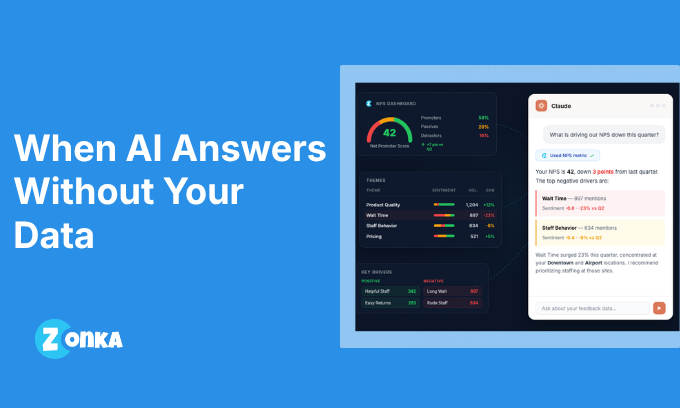
The obvious solution is to give AI a real connection to your feedback data. When the model can query your actual NPS scores, your classified themes, your verbatim responses, every answer becomes grounded. Real data. Real trends. Real customer language.
That's genuinely valuable. It solves the fabrication problem entirely. But it introduces a different one.
When AI connects to your feedback data without governance, everything becomes equally accessible. Every score, every verbatim, every complaint theme is now queryable by anyone with access to the AI tool. A regional manager pulls feedback from a market they don't manage. An analyst surfaces data they wouldn't normally see in the dashboard. Someone outside the CX team shares sensitive customer comments in a meeting without context, without knowing the account history, without understanding what that feedback already triggered.
The data is real this time. The access is uncontrolled.
Gartner's May 2026 research calls out the exact failure pattern. Enterprises treat AI governance as binary: either locked down or fully trusted. That binary approach is the root cause of most AI deployment failures. Lock everything down and teams build workarounds, shadow AI spreads, adoption dies. Trust everything and sensitive data reaches conversations it was never meant to enter.
Gartner predicts 40% of enterprises will demote or decommission autonomous AI agents by 2027 because governance gaps were discovered after production incidents. Not during the planning stage. After the damage.
Your CX Team's Role Is About to Change
For most CX teams, the last five years looked something like this: build the survey program, configure the dashboards, run the analysis, present the findings. The team's value sat at the intersection of access and interpretation. They could get to the data. And they knew what it meant.
Both of those advantages are about to erode.
When AI connects to your feedback data and anyone in the company can query it in plain language, the access advantage disappears. Product doesn't need CX to pull the data. CS doesn't need to request a report. Leadership doesn't need to wait for the quarterly review. The data goes wherever the question is asked.
The interpretation advantage is more durable, but also under pressure. AI doesn't just surface raw data. It structures it. Themes, trends, comparisons, summaries. It provides enough context that the person asking feels confident acting on the answer. Whether they should feel that confident is a different question, but confidence drives decisions, and the AI delivers it in abundance.
This doesn't make the CX team less important. It makes their old role less relevant. Pulling reports, building dashboards, controlling who sees what through platform access. That model was built for a world where the data was hard to reach. In a world where AI makes it easy to reach, the CX team's value has to come from somewhere else.
From Gatekeeper to Governance Architect
The teams that will thrive in this shift aren't the ones fighting to keep AI out of the feedback data. They're the ones defining the rules for how it gets in.
That means deciding which roles see which data when AI queries it. Not as a one-time setup, but as an ongoing governance structure that evolves as agentic AI in customer experience capabilities grow.
It means setting the compliance boundaries. Customer feedback is full of PII. Names, account numbers, health details buried in open-ended responses. When AI can access that data mid-conversation, the PII and compliance rules that apply when AI analyzes customer feedback aren't theoretical. They're operational. GDPR, the EU AI Act, and CCPA all have specific expectations for how AI processes personal data. Most teams haven't translated those expectations into their AI access layer.
It means owning the context layer. A churn signal on a $200K enterprise account renewing in 45 days is a different business problem than the same signal on a $5K starter plan. AI without context treats both identically. The CX team is the one that knows the difference. That interpretive layer, the ability to add context that changes the meaning of a data point, is the most valuable thing the CX team has. And it's the thing that needs to be built into the governance model, not left to chance.
This is the new job description. Not data gatekeeper. Governance architect. The person who defines what AI can access, how it interprets what it finds, and who sees the result.
The Order of Operations Is Everything
Most teams approach this in the wrong sequence. They connect first. They govern later. Sometimes weeks later. Sometimes after someone surfaces data in a meeting that nobody should have seen. Sometimes never.
The right sequence is the opposite. Set the governance before the connection goes live. Define role-based access before the first query runs. Build the AI open ended feedback analysis pipeline with PII protections in place from day one, not retrofitted after an incident.
That's not overcaution. It's the only sequence that doesn't create a cleanup problem.
Because the thing most teams underestimate is how fast this moves once the connection exists. One person runs a query in a meeting. They share the output. A teammate asks "how did you get that?" and within a week, the entire team is pulling feedback data through AI assistants that were never configured with access controls.
The window between "we connected it" and "everyone's using it" is days. Not months. The governance has to be in place before that window opens.
What This Means Going Forward
AI connecting to feedback data is not optional. It's already happening in organizations that have the infrastructure, and it's happening informally (through fabricated answers) in organizations that don't.
The question isn't whether to allow it. It's whether you'll govern the connection before it goes live, or after something goes wrong.
The CX teams that are going to get the most out of this shift aren't the ones that connect the fastest. They're the ones that define the rules first. That treat governance not as a constraint on AI, but as the infrastructure that makes AI trustworthy enough to use at scale.
That's the shift. From running the feedback program to governing how the entire organization interacts with it.
Zonka Feedback's MCP Server connects AI assistants to your live CX data with governance built in from the start. Your existing roles carry over, admin control is explicit, and PII protections are enforced before any data reaches the AI. Schedule a demo to see how the connection and the governance work together.