


.svg)
 Healthcare
 Finance
 Retail
 SaaS & Digital
 eCommerce
 Education
 Salesforce
  HubSpot
 Pipedrive
 Mailchimp
 Klaviyo
 Zendesk
  Intercom
 Freshdesk
 HelpScout
  Front
Front Jira
Jira Slack
Slack  MS Teams
 Zoom
Zoom Google Sheets
  Zapier
  Integrately
 Make
Make  Webhooks




 MS Teams


TL;DR
- An experience management framework is a structured approach for using experience data and operational data together to measure and improve every experience a business delivers: customer, employee, and product.
- Maturity moves through five stages, from ad hoc to embedded. Knowing your stage tells you what to build next instead of copying a program built for a company further along.
- The framework only works if it closes the loop. A program that collects feedback but never converts it to action is a dashboard, not a framework.
- Five building blocks matter: experience data, the experiences you're measuring, a listen-analyze-act loop, the people and governance running it, and the technology underneath.
- Most frameworks fail for the same reasons: siloed data, no executive owner, and chasing a score instead of its drivers. The fix is designing the action path before the first survey goes out.
Most teams think experience management is just a bigger word for customer experience. Same surveys. Same NPS chart. Same quarterly review, now with a fancier title on the slide.
It isn't.
Customer experience is one experience your business delivers. Your employees have one, and their engagement rides on it. Your product has one. Your brand has one, and it drives brand loyalty. And here's what the dashboard never shows you: those experiences feed each other. A burned-out support team produces frustrated customers. A confusing onboarding flow produces churn that no NPS question will ever explain on its own. Treat them as separate problems and you'll keep fixing symptoms.
Experience management treats them as one system. This is how to build it, and why most attempts collapse before they ever change a number.
What Is an Experience Management Framework?
An experience management framework is a structured approach for using experience data and operational data together to measure and improve the core experiences a business delivers: customer, employee, product, and brand. It gives an organization one method for listening across every touchpoint, analyzing what the feedback means, and acting on it, instead of running disconnected survey programs in separate departments.
The discipline rests on a split between two kinds of data. Experience data (X-data) captures how people feel: what they say in an open-ended response, how they rate an interaction, where they hesitate. Operational data (O-data) captures what happened: purchase history, churn, ticket volume, response times. A framework's job is to put those two streams side by side so a drop in customer satisfaction can be traced to the operational event that caused it. That's the structured approach the word "framework" actually promises, and it's what separates experience management from a stack of survey tools.
How Is an Experience Management Framework Different From a CX Framework?
A CX framework manages one experience, the customer's. Experience management manages all of them and connects the data between them. This is the distinction most articles blur, and getting it wrong is why so many "experience" programs never move past customer surveys.
A customer experience management program maps the customer journey, measures satisfaction at each touchpoint, and works to improve it. That work is essential. But it stops at the customer. It rarely sees that a product experience problem is driving the support tickets, or that an employee experience gap is producing the churn. The framework holds CX, EX, and PX in the same system so those connections become visible.
| CX Framework | Experience Management Framework | |
| Scope | Customer experience only | Customer, employee, product (and brand) experience |
| Data | Mostly CX data and feedback | Experience data + operational data across functions |
| Owner | CX or support team | Cross-functional, with C-suite sponsorship |
| Goal | Improve customer satisfaction and retention | Improve every experience and connect their drivers |
| Blind spot it fixes | None; it is the customer view | The links between experiences a single-team view misses |
The short version: a CXM framework answers "how do our customers feel?" An experience management program answers "how does every experience we deliver affect the others, and the business?"
The Five Core Building Blocks of the Framework
Every working experience management framework has five building blocks: the data, the experiences, the loop, the people, and the technology. Skip any one and the framework tilts. Most teams build three and wonder why nothing changes.
The first block is the data, both kinds. Experience data tells you how people feel; operational data tells you what they did. A framework needs both, mapped to each other, or you get sentiment with no cause and metrics with no meaning.
The second block is the set of experiences you're actually managing. For most organizations that's customer, employee, and product experience, with brand experience as the fourth. Each has its own listening posts and its own metrics, and the customer ones are where most teams already have signal. Customer satisfaction tends to run on csat platform data, loyalty on nps software gathered through recurring NPS surveys, and friction on customer effort score. The framework's job is to stop treating those as three isolated charts and start reading them as one picture of the customer, measured against customer expectations.
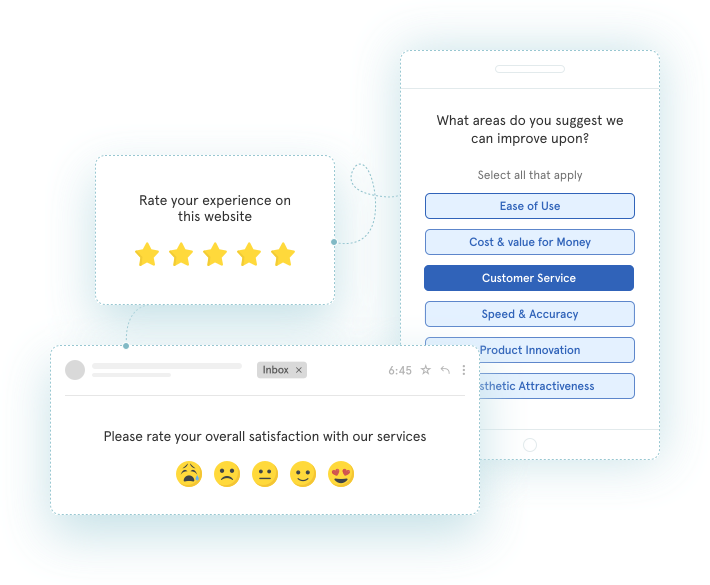
The third block is the loop: listen, analyze, act. The fourth is the people: who owns the framework, who handles experience design, which stakeholders act on the signals, and the governance that decides what gets prioritized. The fifth is the technology that runs all of it. The third block is where frameworks live or die, so it gets its own section next.
Before any of that, you need to know where experiences actually happen. That's what customer journey mapping is for. It turns "the customer experience" into specific moments you can instrument, measure, and fix.
The Signal-to-Action Loop: The Engine of the Framework
Here's the part most framework articles skip entirely, because it's the hard part. A framework isn't a list of components. It's a loop. And the loop is only as good as the speed at which a signal becomes an action.
Think about what usually happens. Feedback comes in. It sits in a dashboard. Someone exports it to a slide. The slide goes to a monthly review. By the time anyone decides to act, the customer who left the feedback has already churned, and the pattern they were part of has grown. The data was perfect. The loop was broken.
A real experience management framework runs five moves on repeat: design the moments worth listening to, listen across every channel, analyze what the feedback means, act on it, and measure whether the action moved the experience. The middle move, analyze, is where modern frameworks pull ahead. Manually reading thousands of open-ended responses doesn't scale, so this is where feedback intelligence earns its place: AI agents read the verbatim feedback, surface the themes, score sentiment, and flag the signal that needs a human: the location slipping, the feature driving complaints, the account at risk. The team stops hunting for patterns and starts acting on the customer insights that matter.
Then you close the feedback loop. Not eventually. Inside the window where it still matters. That single discipline, acting before the signal goes stale, is the difference between a framework that changes the business and one that just describes it.
How to Build an Experience Management Framework
Building one happens in six phases, and the order matters: scope before you instrument, and design the action path before the first survey goes out. Teams that start by sending surveys end up with data they can't act on. Teams that start with the action path end up with a framework.
- Align on scope and ownership. Decide which experiences you're managing first, set the business goals each one ties to, and name an owner with C-suite sponsorship. A framework without an executive owner becomes a survey program.
- Map the moments that matter. Identify the touchpoints across each experience where perception actually forms. You can't instrument everything, so prioritize the moments that move customer retention and revenue growth.
- Instrument listening across channels. Put the right metric at each moment (relationship and transactional surveys, in-product prompts, support feedback), and meet people where they already are.
- Unify experience and operational data. Bring feedback together with the operational context behind it. This is where AI customer feedback analytics does the heavy lifting, connecting what people said to what happened, across every channel, in one place.
- Analyze for drivers, not just scores. A score tells you the temperature. The driver tells you what to fix. Get to the "why" behind every movement.
- Close the loop and measure impact. Act on the signal, then check whether the action moved the experience. If it didn't, the loop tells you, and you adjust.
The first three phases set up the listening. The last three turn listening into change. Most failed frameworks have the first three and skip the rest.
Experience Management Maturity: From Ad Hoc to Embedded
Experience management maturity progresses through roughly five stages (ad hoc, reactive, managed, optimized, and embedded), and most organizations are earlier on that curve than they think. Knowing your stage tells you what to build next instead of copying a framework built for a company three stages ahead.
At the ad hoc stage, feedback is collected occasionally with no owner. Reactive programs run surveys but only respond to fires. Managed programs have a defined owner, consistent metrics, and a working loop on at least one experience. Optimized programs connect experience and operational data and act on drivers, not scores. Embedded programs run experience management as a company-wide discipline with governance, executive sponsorship, and signals reaching every relevant team. That's the stage where experience management is woven into how the organization operates rather than run as a project.
The gap this exposes is bigger than most leaders expect. Bain & Company famously found that while 80% of companies believed they delivered a superior experience, only 8% of their customers agreed. That delivery gap doesn't close by maturing one experience. It closes by maturing the system that connects them, which is the whole point of the framework.
Why Most Experience Management Frameworks Fail
Most experience management frameworks don't fail because the framework was wrong. They fail because of how it was run. After enough programs, the failure patterns rhyme.
They collect more than they act on. Survey sprawl is the most common one. More questions, more channels, more dashboards, and no faster path from a response to a decision. The program gets busier and the customer experience stays exactly where it was.
Their data sits in silos. The CX team has its feedback, support has its tickets, product has its requests, and none of them talk. Feedback silos are the quiet killer of experience management, because the whole premise, connecting experiences, is impossible when the data lives in four systems owned by four teams.
Nobody owns it. A framework with no executive sponsor becomes a side project. It gets deprioritized the first quarter the numbers get hard.
They chase the score, not the driver. A team obsessed with moving NPS from 31 to 35 will optimize the number and miss the reason. The score is the smoke. The driver is the fire.
They manage one experience and call it the whole system. This is the subtle one. A great CX program is not an experience management framework. If employee and product experience are invisible to you, you've built a better customer survey, not a framework. The blind spots are exactly the connections you can't see.
Fix these before adding a single new survey. A leaner framework that closes the loop beats a sprawling one that doesn't, every time.
Choosing Technology to Run Your Framework
The right technology to run the framework is judged on five capabilities, not on feature counts: omnichannel listening, unified experience and operational data, AI analysis, closed-loop workflows, and signals routed to each team. Evaluate against those, and most of the market sorts itself out quickly.
Omnichannel listening matters because experiences happen everywhere: email, in-product, support, offline. Unified data matters because a framework that can't connect feedback to operational context is just a prettier survey tool. AI analysis matters because manual reading doesn't scale past a few hundred responses. Closed-loop workflows matter because, as covered above, the loop is the framework. And role-based signal routing matters because the support lead and the product manager need different views of the same truth.
The market generally splits into tools that collect well but don't analyze, and platforms that analyze well but carry an enterprise price tag. The decision usually comes down to where your team sits between those two, and how much of the loop you need one system to run end to end.
Where to Start
You don't build an experience management framework by buying software or running more surveys. You build it by closing one loop, on one experience, faster than you do today, then connecting the next.
That last part, turning feedback into action fast enough to matter, is where most frameworks stall. It's the problem Zonka Feedback was built to solve: one platform where feedback comes together, AI agents surface the signals that need attention, and every team knows what to fix. See how Zonka turns feedback into signals your team can act on →



.svg)
.png)