

.svg)
 Healthcare
 Finance
 Retail
 SaaS & Digital
 eCommerce
 Education
 Salesforce
  HubSpot
 Pipedrive
 Mailchimp
 Klaviyo
 Zendesk
  Intercom
 Freshdesk
 HelpScout
  Front
Front Jira
Jira Slack
Slack  MS Teams
 Zoom
Zoom Google Sheets
  Zapier
  Integrately
 Make
Make  Webhooks




 MS Teams
%20Best%20Practices%20That%20Drive%20Results.svg)


TL;DR
- Most NPS programs fail because of poor execution, not bad survey design. The difference is operational discipline.
- Build your response management framework before you launch surveys. Who gets notified, what's the SLA, how do issues escalate?
- Loop in your entire organization. NPS siloed in the CX team creates vanity metrics, not business outcomes.
- Measure loop closure rate, not response rate. A 10% response with 100% follow-through beats 50% response with zero action.
- Automate the mechanics (triggers, responses, routing). Keep humans involved for relationships (detractor recovery, high-value accounts).
Most NPS programs fail quietly. The survey goes out, scores come back, and then nothing. No follow-up, no routing, no loop closure.
It's not that companies don't measure NPS. They do. They send the surveys, they calculate the score, they put it in a slide deck for the quarterly review. But that's where it ends. The metric becomes decorative. A number in a dashboard that nobody actually uses to make decisions.
The difference between NPS programs that work and ones that don't isn't survey design. It's operational discipline. How you respond to detractors, how you activate promoters, how you loop in your teams, how you automate the mechanics so responses don't pile up unanswered. That's what separates signal from noise.
This guide is built around execution, not theory. If you're looking for foundational concepts like what is net promoter score or how the calculation works, start there. This is for people who already know what NPS is and want to know how to run it well.
Best Practices to Implement NPS
Let us look at some of the best practices to implement Net Promoter Score in your organization:
1. Build Your Response Management Framework Before Launch
Hope for the best and prepare for the worst. That applies to every part of business, but it especially applies to feedback programs. Most teams launch surveys, then scramble to handle responses. Detractors pile up, no one knows who owns follow-up, and response times slip from hours to days to weeks. You cannot fix this problem after it starts. You have to solve it before the first survey goes out.
a. Decide Notification Routing
When a detractor responds, who gets the alert? The support lead, the account manager, or the CS team? Your answer depends on what triggered the survey and who owns the relationship. Define this before launch, not after the first angry customer sits waiting.
Set up routing logic in your survey tool:
- Detractor on a high-value account? Route to the account manager immediately.
- Detractor on a support interaction? Route to the support team lead.
- Detractor on a product experience? Route to the product team.
Don't make this a manual process. If someone has to check a dashboard to find new detractors, they won't.
b. Set Response SLAs
Detractors need immediate attention. Passives need engagement. Promoters deserve gratitude. Commit to a TAT (Turn Around Time) for each segment and share it with your team. Make sure everyone knows these numbers and can hit them consistently.
-
Detractors: Response within 2 hours. Not the next day. Not when someone gets around to it. Two hours. If you can't commit to that, don't ask the question.
-
Passives: Response within 24 hours. They're not urgent, but they're vulnerable. Competitors are one better offer away from taking them.
-
Promoters: Response within 48 hours. Thank them, activate them, reward their loyalty. Don't let gratitude sit in a queue for a week.
c. Create Escalation Paths
If the first responder can't resolve the issue, what happens? Most programs don't answer this question until it's too late. Define the escalation chain in advance so issues don't get stuck at the first level with no clear next step.
Here's how it should work:
- First-line CS can't solve it? Goes to the account manager.
- Account manager can't solve it? Goes to the product team or the CS lead.
- Product team can't solve it fast enough? Escalates to leadership for resource priority.
Make the path explicit. Document it. Share it with your team.
d. Template Common Responses
You will see the same issues repeatedly. Delayed delivery, product bugs, billing confusion, onboarding friction. Don't make your team write these responses from scratch every time. Pre-drafted templates speed up response time and maintain quality.
Pre-draft templates for the most common issues:
- Not robotic scripts
- Natural, empathetic responses that your team can personalize with specifics
- This speeds up response time and maintains consistency
e. Assign Clear Ownership
Someone has to own this. Not everyone. Someone. Keep a dedicated team or assign specific employees to take action on customer feedback. Make it their job, not an add-on task they get to when they have time.
Assign tasks to team members with clear deadlines:
- Every detractor gets a response within the TAT
- Every issue gets tracked to resolution
- Every feedback gets closed
When customers see you trying your best to serve them better, it makes an impact. Not just on that customer. On every customer who sees how you handle problems.
For help setting up NPS automation workflows, look at how leading teams structure their routing and response logic.
2. Loop In Your Entire Organization, Not Just CX
NPS gets siloed. The CX team owns it, runs it, reports on it. Product doesn't see the feature complaints. Support doesn't see the recurring issues. Leadership doesn't see the account-level risk signals. When NPS stays in CX, it becomes a vanity metric. The goal is to make NPS visible and actionable across every team that touches the customer experience.
a. Share Scores Org-Wide
Send monthly NPS summaries to the entire company. Not just leadership. Everyone. When support agents see their CSAT scores correlating with NPS trends, they respond faster. When product sees feature gaps driving detractor scores, they prioritize differently.
Include the score, the trend, and the top three themes from open-ended feedback:
- Make it visible in company-wide channels
- Keep the summary short and scannable
- Tie NPS movement to team actions where possible
NPS becomes operational, not theoretical.
b. Map Feedback to Teams
Product gets feature requests. Support gets service issues. CS gets account health signals. Don't make teams dig through raw survey responses to find what matters to them. Route feedback automatically based on the theme so each team sees only what's relevant to their domain.
Route feedback automatically based on the theme:
- Product bugs go to the product team
- Billing issues go to finance
- Delivery delays go to operations
If you're using AI-powered feedback analysis, this becomes straightforward. Thematic clustering shows you which complaints map to which department. You can route without manual triage.
For a deeper look at how using sentiment analysis to improve NPS works in practice, see what teams are learning from tone analysis layered on top of scores.
c. Create Feedback Digests
Weekly summaries work better than real-time firehoses. Send each team a digest of what customers said about their domain. Product gets a summary of feature requests and product complaints. Support gets service friction themes. CS gets account health signals. Keep these digestible rather than overwhelming.
Keep these digests short:
- Five bullet points max
- What changed this week
- What's getting worse
- What's improving
Make it scannable.
d. Train Teams Using Real Customer Examples
Use actual promoter and detractor responses to train your team. Show them what customers love and what customers hate. Make it real. This works better than generic training materials because your team sees the exact words customers use.
Pick three promoter responses from last month. Share them in your team meeting:
- What did these customers call out?
- What language did they use?
- What specific moments made the difference?
Then pick three detractor responses:
- What went wrong?
- Where did the experience break?
- What could have been prevented?
Your team understands what good looks like and what bad looks like. And they learn what to do right the first time to avoid detractors entirely.
e. Celebrate Wins Publicly
When a detractor converts, share it. When a promoter refers a customer, share it. When an account renews after a near-churn, share it. Make feedback loop success visible across the organization so teams see the impact of their work in customer language.
This reinforces that NPS isn't a CX metric. It's a company metric. And everyone's work shows up in it.
3. Automate Segment-Specific Responses
Every response gets the same generic "thanks for your feedback" email. Promoters feel underappreciated. Detractors feel ignored. Passives get no engagement. You need different responses for different segments. Not just different tone. Different actions. Each segment has different needs and different business value, and your response strategy should reflect that.
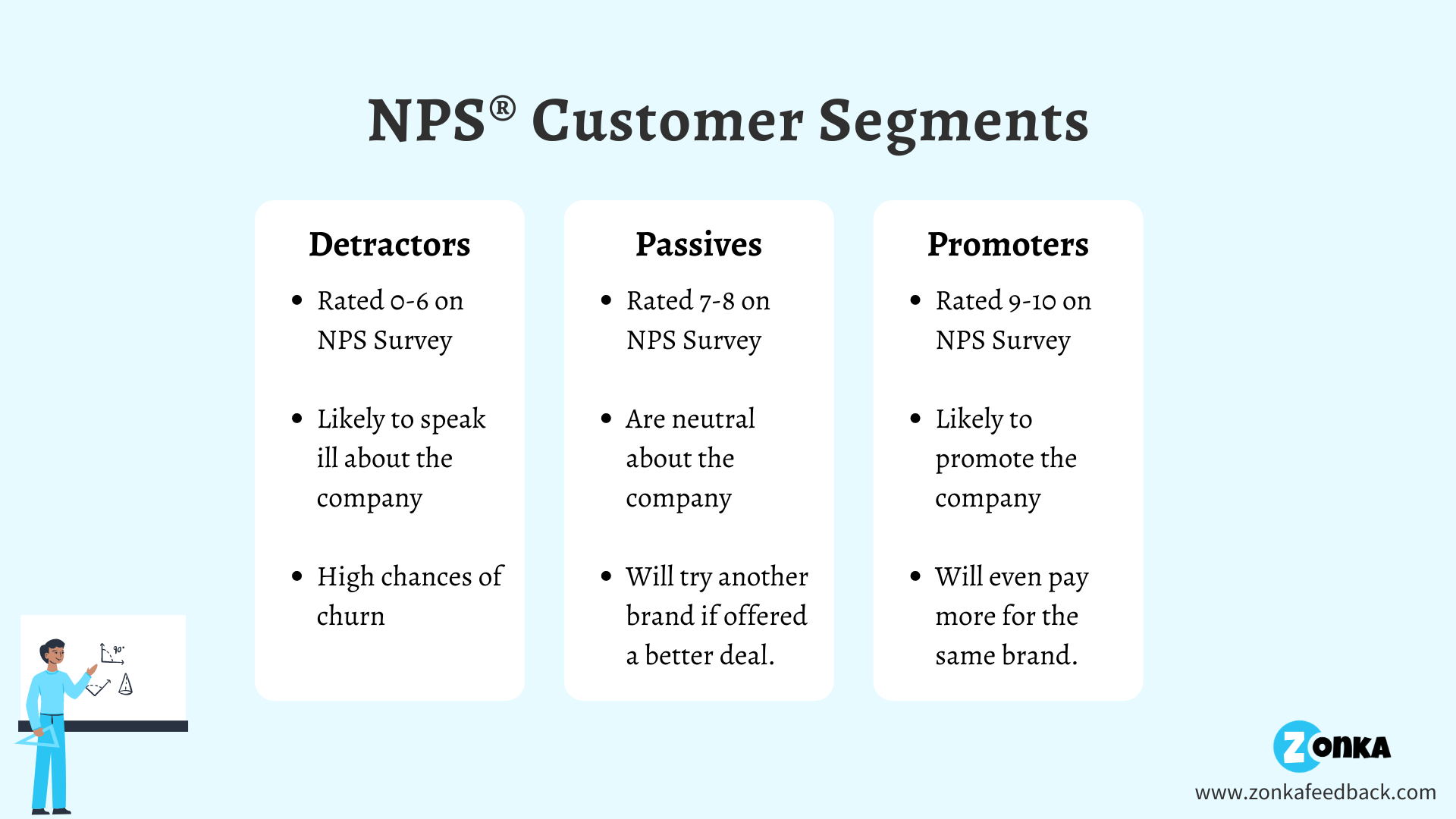 a. For Promoters (9-10)
Thank them immediately. Then ask for something. Promoters have agreed to recommend you. But agreeing isn't the same as doing. You need to activate them while their positive experience is still fresh in their mind.
Ask for a referral. Ask for a review. Ask for a testimonial. Do it in the same email. Don't wait for a second touch.
Offer loyalty perks:
- Early access to new features
- A discount on the next purchase
- Exclusive content
Whatever signals that their loyalty is noticed and valued.
For more on how to convert promoter sentiment into business outcomes, read NPS promoters for activation strategies that actually work.
b. For Passives (7-8)
Acknowledge their feedback. Then ask what would turn them into a promoter. Passives are the most vulnerable segment. They're satisfied but not loyal. If your competitor offers a better deal, they'll switch. You need to engage them before that happens.
Offer a personalized follow-up within 24 hours:
- Not automated. A real person.
- Ask what would make the experience better.
- Then deliver on it.
See NPS passives for engagement tactics that prevent drift into the detractor zone.
c. For Detractors (0-6)
Apologize. Acknowledge the issue. Commit to a resolution timeline. Assign a human owner. Not a ticket number. A person. Someone the customer can reach if the issue isn't resolved. Speed and accountability are what turn bad experiences around.
Make that person's name visible in the response:
- Don't just say "we're looking into it."
- Give a timeline. "We'll have an update by end of day tomorrow."
- Then hit the timeline. Missed commitments on top of a bad experience compound the problem.
For detractor recovery frameworks, the guide on NPS detractors covers what actually turns a 3 into a 9.
| Segment | Response Type | Example |
| Promoter | Thank + Activate | We're glad you're happy with the product. Would you mind writing a quick review? It helps other teams discover us. [Link to review page] |
| Passive | Acknowledge + Engage | Thanks for the feedback. We'd love to know what would make this a 9 or 10 for you. Can we schedule a quick call this week? |
| Detractor | Apologize + Resolve | We're sorry your experience didn't meet expectations. [Name] from our team will reach out within 2 hours with a resolution plan. You can contact them directly at [email]. |
For email-specific best practices, check the breakdown in NPS survey email templates and subject lines.
4. Follow Up Differently for Each Segment
Automated responses go out. But there's no second touch. Detractors don't get resolution. Passives don't get re-engaged. Promoters don't actually refer. You need a multi-touch strategy. Not the same follow-up for everyone. Different sequences for different segments. The first response opens the loop. The follow-up sequence is what actually closes it.
a. Detractors: Three-Touch Resolution Sequence
Detractors need immediate acknowledgment, a clear resolution plan, and proof that something changed. This three-touch sequence converts angry customers into advocates when executed well. The key is speed on the first touch and specificity on the second.
First touch: Automated apology + human assignment. Goes out immediately after the response.
Second touch (within 48 hours): Account manager or CS lead with a resolution plan. Not "we're working on it." A specific plan:
- What we're doing
- When you'll see results
- Who owns it
Get in touch with them. Ask what happened. Where did things go wrong. Listen with empathy. Understand what they went through. Don't just apologize for the problem. Empathize with the situation they were in because of it.
If the issue was your fault, own it. If it wasn't entirely on you, explain calmly what happened and what you tried to do. Customers respect honesty more than deflection.
Do whatever it takes to make their experience better:
- Inform them what you're doing
- Show them the steps, not just the promise
Third touch (7 days later): "Here's what we fixed" update. Show the customer what changed because of their feedback. This is what converts detractors back into promoters.
b. Passives: Engagement + Re-Survey Sequence
Passives are one interaction away from becoming promoters or detractors. This sequence nudges them toward loyalty by identifying what's missing and delivering it. The goal is to understand what "good enough" is missing to become "great."
First touch: Automated "what would make this a 9 or 10" question. Include an open text field or a link to schedule a call.
Second touch (if they reply): Personalized offer or product demo. Show them the feature they didn't know existed or the workflow improvement that addresses their concern.
Don't just satisfy passives. Delight them:
- Give them something extra they didn't expect
- A free service upgrade
- Early access to a new feature
- A surprise discount
Anything that moves them from satisfied to impressed.
Third touch (30 days later): Check-in survey. Did the experience improve? Simple yes/no + optional comment. Track whether passives move up or down over time.
c. Promoters: Activation + Loyalty Sequence
Promoters already love you. This sequence turns that sentiment into business outcomes: referrals, reviews, testimonials, case studies. The window for activation is short. Ask while they're still excited, not months later when the moment has passed.
First touch: Automated thank you + referral ask. Include a direct link to leave a review or submit a referral.
Reward their loyalty:
- Discount on the next purchase
- Free gift coupon
- Exclusive early access
Make it tangible.
If you're sending a physical thank you gift, include a small product they haven't tried yet. It's a gesture of appreciation and a way to introduce them to another part of your offering. Two goals, one action.
Second touch (if they don't refer): Testimonial request or case study invite. Different activation path for the same loyalty signal.
Third touch (90 days later): Loyalty reward or VIP program invite. Early access, exclusive features, beta programs. Keep promoters engaged long-term.
If you want to convert promoters into genuine referrals and reviews, read NPS surveys for customer reviews recommendations for the exact workflows that work.
5. Measure Loop Closure, Not Just Response Rates
Teams celebrate 40% response rates. But they don't track how many detractors actually got follow-up. How many issues got resolved. How many promoters actually referred. Response rate is a vanity metric. Loop closure rate is the real one. A 10% response rate with 100% loop closure beats a 50% response rate with zero follow-through. The goal isn't collecting more feedback. It's acting on the feedback you get.
Track These Metrics Instead
These metrics measure whether your NPS program is operational or decorative. Track them weekly for detractors, monthly for the full picture. If these numbers are low, your program exists in name only.
-
Detractor resolution rate: Percentage of detractors who received follow-up within SLA. If your SLA is 2 hours, how many detractors got a response in 2 hours? This is your operational health metric.
-
Issue closure rate: Percentage of detractor issues actually resolved. Not just acknowledged. Resolved. The customer confirmed the problem is fixed. This separates process compliance from real outcomes.
-
Promoter activation rate: Percentage of promoters who submitted a review, referral, or testimonial. If you ask for activation and nobody acts, your promoters aren't really promoting.
-
Passive conversion rate: Percentage of passives who became promoters in the next survey cycle. If passives don't move up over time, your engagement strategy isn't working.
For dashboard setup and metric tracking, see NPS dashboards reports for what to measure and how to visualize it.
6. Run Ongoing Feedback Collection, Not One-Off Campaigns
NPS gets run quarterly or annually as a "project." CX sends the survey, collects responses, creates a report, then waits six months to do it again. That's not a program. That's a campaign. And campaigns don't build systems. Real NPS programs run continuously with automated triggers tied to customer journey moments.
a. Relationship NPS: Quarterly or Semi-Annual
These measure overall loyalty. They're not tied to a specific interaction. They go to your entire customer base on a schedule. The cadence depends on your business model and how frequently customers interact with you.
Send these every 90 to 180 days:
- B2B SaaS with long sales cycles? Semi-annual works.
- Retail or hospitality with frequent interactions? Quarterly makes sense.
For the difference between survey types, read relationship transactional NPS to understand when to use each.
b. Transactional NPS: Triggered After Key Moments
These measure specific interactions. Onboarding complete. Support ticket closed. Renewal processed. Purchase delivered. Trigger these automatically based on system events so you capture feedback while the experience is still fresh.
Trigger these automatically based on system events:
- Customer closes a support ticket? Send NPS within 2 hours.
- Customer completes onboarding? Send NPS the next day.
- Don't wait for a campaign cadence. Send when the experience is fresh.
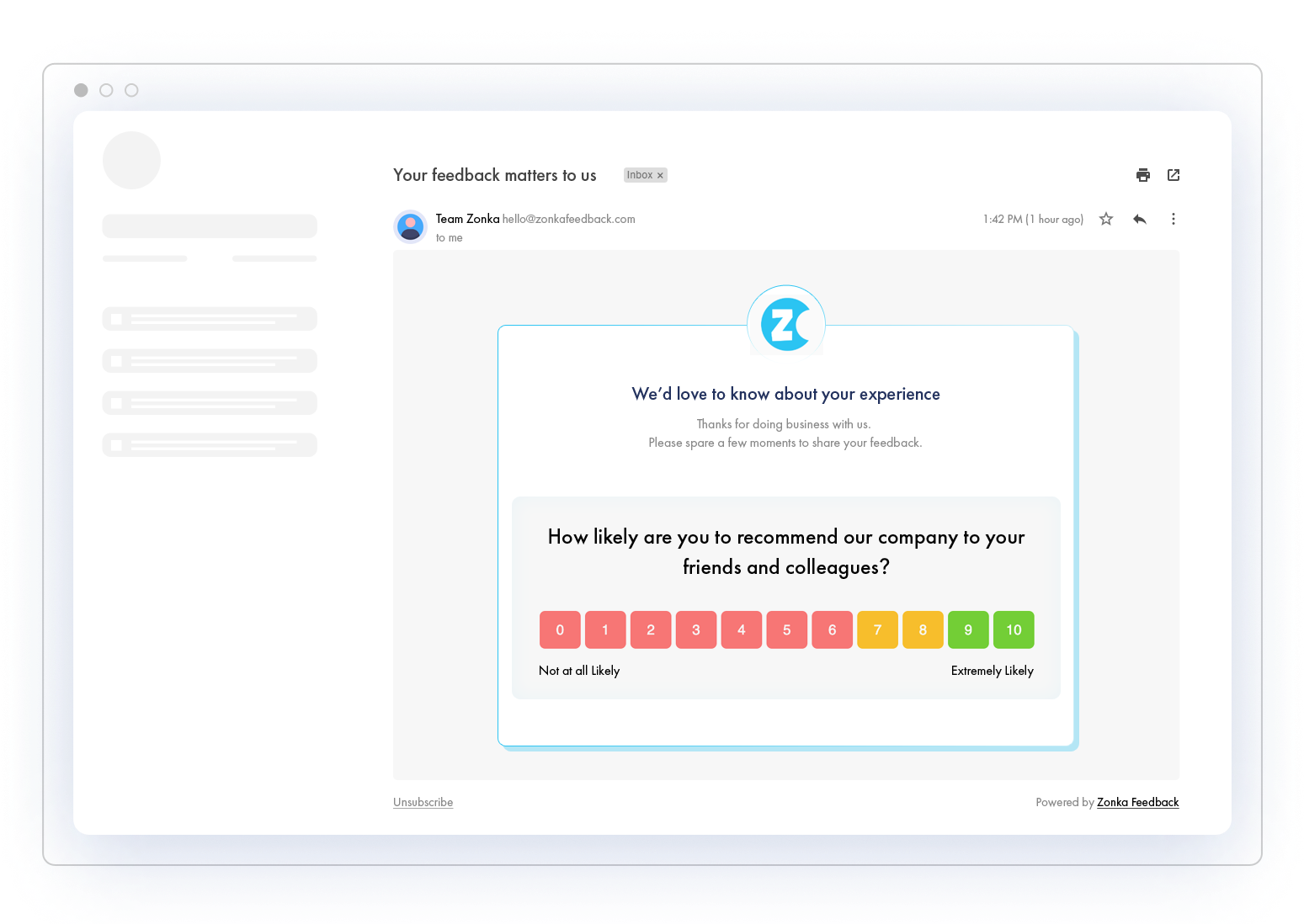
c. Channel Mix Matters
Email works for relationship NPS. It's less intrusive, customers can respond when convenient, and you can include context in the message. SMS or in-app works better for transactional NPS because the interaction just happened and the customer is still engaged.
SMS or in-app works better for transactional NPS:
- The interaction just happened
- The customer is still engaged
- A quick SMS or in-app prompt gets higher response rates than an email they'll see hours later
For channel-specific guidance, NPS surveys on WhatsApp SMS in app covers when to use each and what response rates to expect.
7. Tie NPS to Business Outcomes, Not Vanity Metrics
NPS gets reported in isolation. Leadership sees "NPS is 45" but doesn't know if that's good, bad, or what it means for revenue. You need context. NPS by itself is just a number. NPS correlated to retention, revenue, and referrals is a business metric. The value of your program is measured in customer behavior changes, not score movements.
a. Segment NPS by Revenue Tier
Your enterprise accounts and your SMB accounts don't have the same value. Don't treat them the same in reporting. If enterprise NPS is dropping while overall NPS is rising, you have a problem standard reporting won't catch.
Break NPS down by account size:
- What's your NPS among high-value accounts versus low-value accounts?
- Track trends separately for each tier
- Alert on movements in high-value segments even if overall NPS is stable
b. Correlate NPS to Retention
Track churn rate by NPS segment. What percentage of detractors churned in the last 90 days? What percentage of promoters renewed? If your detractor churn rate is 60% and your promoter churn rate is 5%, NPS is a leading indicator of retention. If those numbers are close, NPS isn't predictive for your business.
For how NPS connects to long-term value, NPS and customer lifetime value breaks down the revenue correlation data.
c. Map Promoter Referrals to Pipeline
How many deals came from promoter referrals? If you're asking promoters to refer and nobody's tracking whether those referrals convert, you're missing the loop. This turns NPS from a satisfaction metric into a growth metric.
Tag referral-source deals in your CRM:
- Track how many came from NPS promoters
- Calculate the revenue value
- Compare conversion rates for NPS referrals vs other channels
d. Benchmark Against Industry
Don't just report "NPS is 45." Report "NPS is 45, industry average is 30." Or "NPS dropped 5 points but we're still 10 points above industry average." Context matters. A 40 NPS in SaaS is different from a 40 NPS in healthcare.
For benchmarks by vertical, check what is a good net promoter score for the comparison data.
e. Reporting Cadence
Different stakeholders need different frequencies. Weekly reports keep operations running. Monthly reports track program health. Quarterly reports connect NPS to business outcomes that leadership cares about.
-
Weekly: Detractor alerts and resolution tracking. Who responded this week, who got follow-up, who's still waiting.
-
Monthly: NPS trends by segment plus loop closure metrics. Are we hitting our response SLAs? Are passives converting? Are promoters activating?
-
Quarterly: Executive summary with retention and revenue correlation. What's NPS doing to churn? What's NPS doing to referrals? What's the business impact?
8. Common Mistakes to Avoid
Most of these don't surface immediately. They compound over months until you're looking at survey data that isn't telling you anything useful. Here's what breaks NPS programs and how to avoid it. Each of these mistakes is recoverable if you catch it early. By the time leadership notices, you've usually been running a broken program for six months.
-
Sending NPS without a follow-up plan. If you don't know who responds to detractors before the survey goes out, you're not ready to send it.
-
Treating all segments the same. Promoters, passives, and detractors need different responses. Generic thank-you emails don't work for anyone.
-
Siloing NPS in the CX team. When product doesn't see feature complaints and support doesn't see service issues, NPS becomes a vanity metric.
-
Measuring response rates instead of loop closure. A 50% response rate with zero action is worse than a 10% response rate with full follow-through.
-
Running NPS as a campaign instead of a system. One-off quarterly surveys don't build feedback loops. Ongoing collection with automated routing does.
For a structured walkthrough of closing the feedback loop with NPS surveys, see how teams at scale handle thousands of responses without manual triage.
Using NPS Effectively
Here's how you know if your NPS program is working. Open your CRM. Find a detractor from last week. Check whether anyone followed up. Check whether the issue got resolved. Check whether that customer's score changed in the next survey cycle.
If the answer to any of those is no, you don't have an NPS program. You have an NPS survey. And there's a difference.
The mechanics outlined here aren't complicated. Response frameworks, team enablement, segment-specific automation, loop closure tracking. None of this requires advanced technology or massive budget. It requires operational discipline. It requires treating feedback as a system, not a campaign.
Most NPS programs fail because companies optimize for collecting scores instead of acting on them. They measure response rates instead of resolution rates. They celebrate high survey volume instead of high loop closure. They build dashboards instead of building processes.
The teams that get value from NPS do the opposite. They build the response framework before they send the first survey. They loop in the entire organization, not just CX. They measure what matters: did the detractor get follow-up, did the issue get fixed, did the promoter actually refer someone.
That's the program. Everything else is just setup.
Customer experience drives loyalty. Loyalty drives your score. Use these best practices to implement NPS surveys effectively and you'll see the difference in every survey cycle.


.png)
.png)