

.svg)
 Healthcare
 Finance
 Retail
 SaaS & Digital
 eCommerce
 Education
 Salesforce
  HubSpot
 Pipedrive
 Mailchimp
 Klaviyo
 Zendesk
  Intercom
 Freshdesk
 HelpScout
  Front
Front Jira
Jira Slack
Slack  MS Teams
 Zoom
Zoom Google Sheets
  Zapier
  Integrately
 Make
Make  Webhooks



 Sign In
 MS Teams



TL;DR
- A voice of customer program helps businesses reduce churn, improve products, and make decisions based on what customers actually say instead of internal guesswork.
- The biggest early benefit is detection. VoC surfaces pain points and customer complaints before they turn into cancellations.
- Product teams use qualitative feedback and direct customer input to decide what to build next, which lowers the risk of shipping features no one uses.
- When VoC insights are shared across teams, they improve cross functional collaboration and cut down on conflicting priorities.
- The benefits are strongest when feedback leads to action. Programs that collect VoC data but never act on it see limited results.
Most businesses already collect customer feedback. Surveys go out after purchases, support tickets pile up, and online reviews arrive whether you ask for them or not. The feedback exists. The problem is what happens after it lands.
The benefits of a voice of customer program show up only when that feedback turns into decisions. A voice of customer program collects customer feedback across multiple channels, analyzes it, and routes it to the people who can act on it. Done well, it reduces customer churn, improves products and services, grows revenue, and gets your teams working from the same customer data. This guide covers the key benefits of running a VoC program and how each one creates real business results.
What Are the Benefits of a Voice of Customer Program?
A voice of customer program helps businesses collect and act on customer feedback to improve retention, product quality, revenue, and customer satisfaction.
Running an effective VoC program delivers seven core benefits:
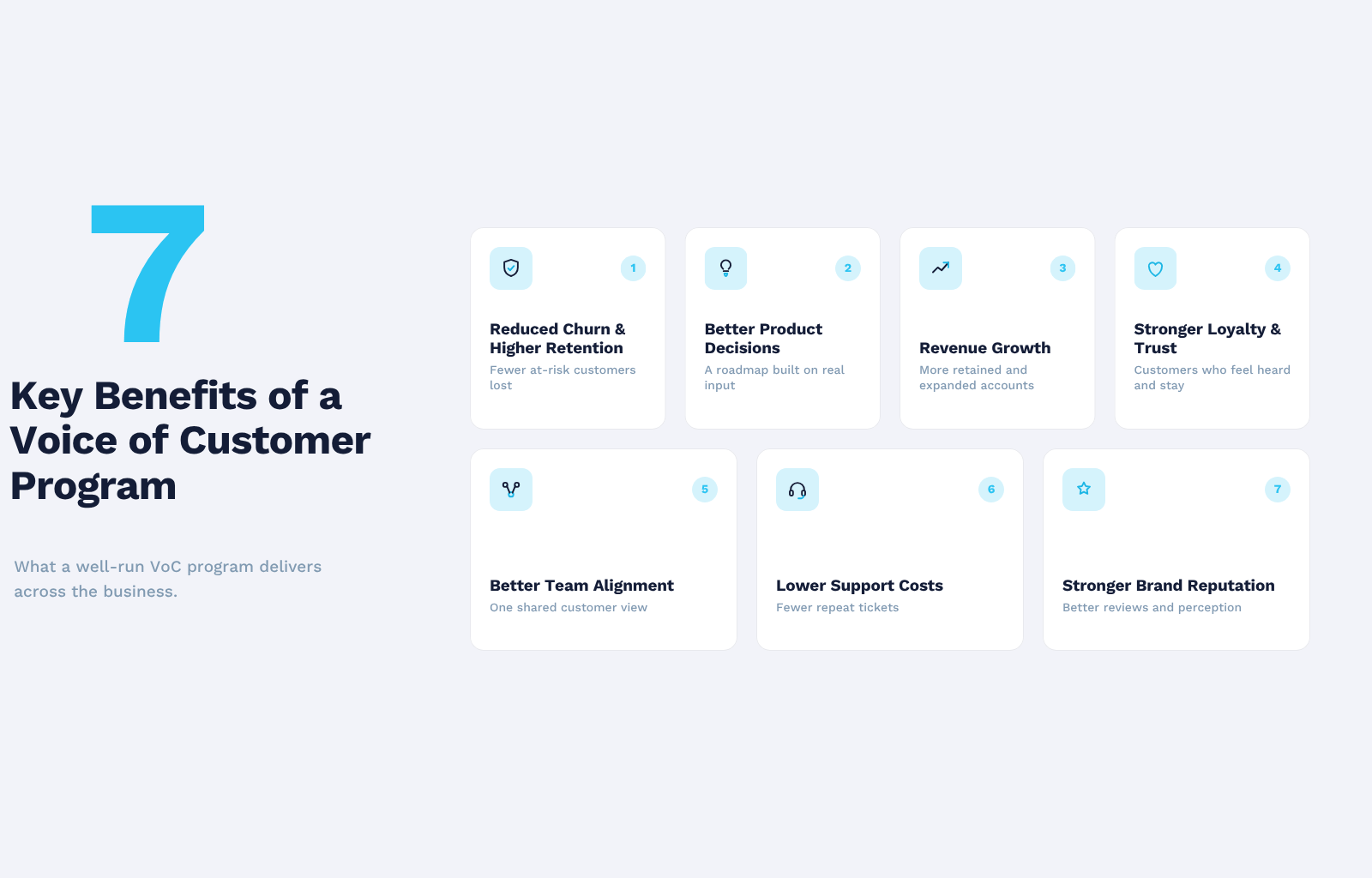
Each of these depends on a program that moves past data collection into analysis and action. A VoC program that gathers responses but doesn't route them to the right teams or use them to make decisions won't return much. Every benefit below includes the metric you'd watch to prove it's working.
Benefits of a Voice of Customer Program at a Glance
| Benefit | What It Drive | Metrics to Track |
| Reduced churn and higher retention | At-risk customers kept before they cancel | Churn rate, retention rate |
| Better product and service decisions | A roadmap built on customer input, not assumptions | Feature adoption, CSAT on new releases |
| Revenue growth | More retained and expanded accounts | Customer lifetime value, NPS, expansion revenue |
| Stronger loyalty and trust | Customers who feel heard stay and refer | NPS, repeat purchase rate |
| Better team alignment | One shared view of customer data | Time to resolve cross team issues |
| Lower support costs | Root causes fixed, fewer repeat tickets | Support ticket volume, CES |
| Stronger brand reputation | Better public reviews and perception | Online review rating, social sentiment |
Reduced Customer Churn and Higher Retention
The clearest early payoff of a voice of customer program is detection. It uses sentiment analysis to track customer sentiment on a continuous basis, rather than only at quarterly check ins, so problems surface while you can still act on them.
Most customers don't announce that they're leaving. Satisfaction scores start dropping. The same complaint type shows up across multiple responses. A specific touchpoint gets consistently low ratings. These are early warning signals, and watching them is a core part of tracking voice of customer metrics.
When those signals appear, a structured VoC program routes them to the right team fast, whether that's customer success, product, or support, so the issue gets addressed before it leads to cancellation.
Specific ways VoC reduces customer churn:
- Tracks shifts in customer sentiment and identifies recurring pain points across touchpoints
- Routes at-risk VoC feedback to the right team for follow up
- Closes the feedback loop so customers feel heard
- Identifies which parts of the product or service are driving dissatisfaction
The faster feedback leads to action, the greater the impact on retention. Collecting VoC data without a clear action process cuts this benefit sharply.
Metric to track: churn rate and retention rate, segmented by the touchpoints your feedback flags most often.
Better Product and Service Decisions
Without customer feedback, product decisions rest on what internal teams assume customers need. VoC replaces that with direct evidence from the customer's voice.
VoC programs collect customer input through voice of customer surveys, feedback forms, focus groups, interviews, and support interactions. When that raw feedback is analyzed with text analytics and machine learning, it reveals patterns that quantitative scores alone can't show.
Open text responses can pinpoint a single friction point in the onboarding process. Machine learning helps identify trends across thousands of responses at once. This kind of qualitative feedback moves a team from "customers are unhappy with onboarding" to "customers can't find the integration setup in step four."
What changes when product decisions are driven by customer data:
- Roadmap priorities reflect customer needs and customer preferences, not internal assumptions
- Feature development is based on real customer input, which reduces the risk of building something customers don't use
- Post launch feedback confirms whether a change actually solved the original problem
For teams that want to gather feedback systematically, a voice of customer survey template is a practical starting point. You can also study voice of customer examples to see how other businesses structure their collection process.
Metric to track: feature adoption and CSAT on new releases, compared against the feedback that prompted them.
Revenue Growth
Customer retention has a direct effect on revenue. Satisfied customers spend more, refer others, and are more open to upgrades. A VoC program supports revenue by helping you keep existing customers longer and spot opportunities to grow their spend.
Bain & Company, the firm that created the Net Promoter Score, found that loyalty leaders, the companies that top their industries on NPS for three or more years, grow revenue more than twice as fast as their industry peers.
How a VoC program contributes to revenue:
- Identifies customers with high customer lifetime value who are likely to expand
- Surfaces churn risk early, which reduces revenue lost to cancellations
- Gives sales teams and customer success the data on which accounts need attention
VoC doesn't generate revenue directly. It improves business performance by keeping customers longer, and that compounds. For a longer view of how this fits a wider plan, see this guide to VoC strategy. If you need to make the financial case internally, the voice of customer ROI breakdown walks through the math.
Metric to track: customer lifetime value, NPS, and expansion revenue among engaged accounts.
Stronger Customer Loyalty and Trust
Customers who feel heard are more likely to stay loyal. Customers who raise a concern and hear nothing back tend to leave, and they share that experience in online reviews or with people in their network.
PwC research shows 1 in 3 customers will stop doing business with a brand after a single bad experience. A VoC program lowers the odds of those experiences going unnoticed.
How VoC builds customer loyalty:
- Customers can see their feedback is being collected and used to make improvements
- Closing the feedback loop, meaning you follow up after input is received, directly increases trust and customer engagement
- Consistent service improvements give customers a reason to stay and to recommend the brand
The loyalty benefit becomes measurable through NPS. Teams that run consistent closed loop programs tend to see NPS climb over time as detractors move to passive or satisfied through follow up. Customers who get direct engagement after submitting feedback retain at higher rates than those who don't.
Metric to track: NPS and repeat purchase rate, watched over consecutive quarters.
Better Alignment Across Teams
When customer feedback is scattered across support tickets, survey tools, and CRM data, different teams draw different conclusions about what customers need. Product prioritizes one way. Support sees another set of problems. Sales hears something different again.
A VoC program fixes this by centralizing feedback so every team, including product, sales, support, and customer success, works from the same customer data. That makes it far easier to agree on what to fix and in what order.
Benefits of stronger cross functional collaboration through VoC:
- Product and support can trace customer complaints back to the same root cause
- Reporting stays consistent across multiple channels, which removes conflicting numbers
- Priority alignment happens faster when everyone reads the same customer interactions
For teams that need to turn shared data into structured analysis, voice of customer analytics covers how to move from raw feedback to usable output.
Metric to track: time to resolve issues that touch more than one team.
Lower Support Costs
Support teams often handle the same customer complaints again and again. VoC identifies the patterns behind those complaints so they can be fixed at the source, whether that source is the product, a process, or the way something is communicated.
When a complaint type shows up often in VoC feedback, it points to a systemic issue. A confusing step in the product flow. An unclear policy. A gap in the customer journey. Fix the underlying cause and the volume of future tickets drops.
How VoC reduces support costs:
- Recurring themes in customer support interactions highlight gaps worth fixing at the product or process level
- Proactive service improvements through continuous improvement cycles lower contact volume over time
- Teams spend less time on repeat issues and more on complex cases that need a human
Fewer repeat tickets means lower cost and faster resolution for the requests that do come in.
Metric to track: support ticket volume and Customer Effort Score on high frequency issues.
Stronger Brand Reputation
Customers who have a good experience are more likely to leave online reviews and recommend a brand. The link between an internal VoC program and external brand perception is direct.
When CSAT and NPS improve internally, public review scores tend to follow. The same issues moving your internal satisfaction scores are often the ones that surface in online reviews and social media listening, including what people see in Google AI results when they research your brand.
How VoC supports brand reputation:
- Promoters identified through NPS surveys can be invited to review you on the platforms that matter
- Monitoring social media listening and online reviews alongside internal feedback gives a fuller picture of brand perception
- Addressing customer complaints before they escalate lowers the chance of a negative review
Leading brands treat VoC as an early signal for reputation risk. A pattern in internal feedback usually appears before it becomes visible in public reviews.
Metric to track: average online review rating and social sentiment trend.
Voice of Customer Benefits by Team
The benefits aren't spread evenly. Each team pulls something different from the same VoC data.
- Product gets direct customer input on what to build, which features to drop, and where the onboarding process breaks.
- Support sees recurring complaint themes early and can push fixes upstream instead of answering the same ticket forever.
- CX and insights get one unified read on customer sentiment across every channel rather than fragments in separate tools.
- Sales learns the objections, pain points, and buying triggers customers actually voice, which sharpens the pitch.
- Marketing hears the customer's own language and can turn it into messaging that lands, plus a steady supply of promoters for reviews and referrals.
This is also why VoC drives cross functional collaboration. Once teams share the same customer data, they stop arguing about whose numbers are right.
Benefits for B2B vs B2C Companies
The core process is the same for both: collect VoC feedback, analyze it, and act. What changes is the focus.
B2B programs lean toward account level feedback and renewal risk. A single detractor at a key account can put real revenue in play, so B2B teams weight who said something as heavily as what was said, and they tie feedback to CRM data and expansion opportunities.
B2C programs work with high volume patterns across large customer bases. Individual responses matter less than the trend, so B2C teams rely on sentiment analysis and text analytics to identify trends across thousands of responses and catch shifts in customer behavior fast.
How to Capture the Benefits of a VoC Program
None of these benefits arrive from data collection alone. They come from a closed loop that runs across the whole voice of customer program. If you're setting one up, this is the short version, and how to build a voice of customer program covers the full process.
- Collect across multiple channels. Meet customers where they are, from email and in-app surveys to reviews and support interactions, so you're working from the customer's voice, not a slice of it.
- Route feedback to an owner. Every signal needs a person accountable for acting on it. Feedback with no owner dies in a dashboard.
- Close the loop. Follow up with customers after their input. This single habit is what turns feedback into loyalty.
- Set a review cadence, then act and re-measure. Pick the right tools to unify and analyze feedback, share findings on a schedule, and check whether the change moved the metric. A shortlist of Voice of Customer tools is a good place to compare options.
The programs that build a deeper understanding of their customers are the ones that finish the loop every time: collect, analyze, act.
Conclusion
The benefits of a voice of customer program come down to one thing: whether the feedback you collect actually leads to change. A program that gathers customer input but never routes it, analyzes it, or uses it to improve won't deliver the results above. If yours isn't returning much yet, the common reasons VoC programs fail are worth a read.
Zonka Feedback helps you collect, analyze, and act on customer feedback across every channel, with AI that surfaces the signals your teams should act on first. It's how customers like SmartBuyGlasses lifted their NPS by 30%. Start a free trial or book a demo to see it on your own feedback.

.png)
.svg)
.png)