

.svg)
 Healthcare
 Finance
 Retail
 SaaS & Digital
 eCommerce
 Education
 Salesforce
  HubSpot
 Pipedrive
 Mailchimp
 Klaviyo
 Zendesk
  Intercom
 Freshdesk
 HelpScout
  Front
Front Jira
Jira Slack
Slack  MS Teams
 Zoom
Zoom Google Sheets
  Zapier
  Integrately
 Make
Make  Webhooks



 Sign In
 MS Teams


The best Qualtrics alternatives in 2026 are Zonka Feedback for enterprise-grade, AI-powered CX, QuestionPro and Alchemer for research, Medallia and InMoment for enterprise XM, and Formbricks or Google Forms for open-source and free needs. The right pick depends on your use case, budget, and whether you need Gen AI analysis built in rather than sold as an add-on.
TL;DR
- Most teams leave Qualtrics for one of three reasons: cost that climbs with every add-on, setup that needs an analyst, or legacy NLP that reads keywords instead of context.
- This guide compares 14 Qualtrics alternatives and competitors across four jobs: CX and omnichannel feedback, research and market insights, enterprise XM, and simple or free tools.
- Every tool is scored on the same five criteria, with a verified G2 link and official pricing. Zonka Feedback is ours, and it's held to the same bar.
- Quick picks: Zonka Feedback for enterprise-grade AI CX, QuestionPro for research on a budget, Medallia for enterprise scale, Formbricks for open-source control, Google Forms when you just need a form.
- Stay on Qualtrics if you run genuine research methodology (conjoint, MaxDiff, panel sampling) or need customer, employee, and brand programs in one system.
Qualtrics is one of the most recognized experience management platforms in the market. Recognition and fit aren't the same thing, though. The teams shopping for Qualtrics alternatives in 2026 aren't leaving because it's bad. They're leaving because it's built for a budget, a team size, and a level of complexity many organizations don't have. This guide covers the top Qualtrics competitors by the job you're actually trying to do, so you can shortlist in minutes instead of days.
Should You Actually Leave Qualtrics?
Sometimes the honest answer is no. Before you shortlist an alternative, check whether the constraint is really the platform.
Stay with Qualtrics if you run genuine research: conjoint analysis, MaxDiff, panel sampling, or academic methodology. Very little else covers that ground, and a lighter survey tool will leave gaps. Stay if you need customer, employee, and brand experience management in one system. Consolidation has real value, and few alternatives span all three. And stay if someone owns the platform and it's producing. The most common reason a replacement disappoints is that the original tool was fine and the constraint lived somewhere else.
Consider an alternative if you're paying enterprise pricing for a fraction of the capability, nobody has capacity to run the platform day to day, or your recurring complaint is that findings never turn into changes. If one of those describes you, the rest of this guide is where to look.
What is a Qualtrics Alternative?
A Qualtrics alternative is a customer experience or survey management platform that replaces Qualtrics CustomerXM. Teams pick one based on use case (B2B vs. B2C), company size, budget, or a specific capability Qualtrics doesn't offer natively, such as account-level B2B feedback, in-app microsurveys, or Gen AI analysis included in the base price.
A Qualtrics competitor is any survey or experience management platform that overlaps with a Qualtrics buying decision. Some compete head-on at the enterprise level, like Medallia and InMoment. Others win on a narrower job: research, in-app feedback, or simple survey creation at a fraction of the cost.
Why Do Teams Look for Qualtrics Competitors?
Three pain points drive almost every Qualtrics evaluation. Cost is the first. Qualtrics pricing starts around $1,500 per user annually, and add-ons stack fast. Because pricing is quote-only, actual spend varies widely: independent contract data from Vendr puts the median Qualtrics deal near $30,000 a year, with enterprise contracts reaching into six figures, and analytics add-ons like Text iQ, Stats iQ, and Discover priced separately on top.
Complexity is the second. Teams need weeks to deploy programs that other platforms launch in days, and the configuration burden doesn't stop at setup. Non-technical owners frequently need dedicated admin support just to keep things running. Response rates suffer when nobody can adjust a survey without a ticket.
Legacy AI is the third. Qualtrics' NLP-based text analysis matches keywords more than context. As one former user put it: "The sentiment is not always accurate. The matching is more keyword-based rather than completely contextual." As feedback volume grows, that gap widens.
How We Evaluated These Alternatives
We scored each tool on five things that decide real purchases, not feature counts: pricing transparency, ease of setup and daily use, support quality, AI and analytics depth, and deployment speed. Ratings and prices link to official sources. Where a vendor hides pricing behind a quote, we say so instead of guessing.
Disclosure: Zonka Feedback is our platform and appears in this list. It was evaluated on the same five criteria as every other tool.
What 18 teams told us when they left Qualtrics
This isn't a feature roundup pulled from vendor sites. The pain points and switcher patterns below come from 18 recorded migration calls with organizations actively evaluating or leaving Qualtrics in 2025 and 2026. Three switcher profiles showed up again and again:
- 1. The Delighted refugee. Long-time Delighted users didn't choose to switch. Qualtrics sunset Delighted and forced the move. They loved the simplicity and found Qualtrics core "too grandiose" for their needs.
- 2. The cost-aware escapee. Teams that made an active decision to leave over cost, thin support, or feature overkill. One VP of CX left after response rates fell from 22% to 12% with no guidance from the Qualtrics team.
- 3. The renewal-window evaluator. Current customers benchmarking as a contract comes up. Not ready to leave, but listening. The AI story and pricing transparency are the two hooks.
Best Qualtrics alternatives at a glance
| Tool | Best for | Category | Pricing |
| Zonka Feedback | AI-powered CX + closed loop | CX | Custom pricing |
| Survicate | Multi-channel feedback without the weight | CX | Free plan; paid from $89/mo |
| Perspective AI | AI interviews that explain the score | Research | Free; $99/mo |
| piHappiness | Real-time kiosk & frontline feedback | CX | Quote-based (~$50/mo) |
| Affiniv | Affordable e-commerce & CX surveys | CX | Free tier; paid from $25/mo |
| Sopact | AI native data collection | Research | Custom pricing |
| QuestionPro | Research on a budget | Research | Free plan; Advanced from $99/mo |
| Alchemer | Research-grade survey logic | Research | Custom (no free plan) |
| Sprig | AI research for product teams | Research | Free plan; paid quote-based |
| Medallia | Enterprise CX at scale | Enterprise | Custom (enterprise) |
| InMoment | Experience improvement + ROI | Enterprise | Custom (enterprise) |
| SurveyMonkey | Fast, simple surveys | Simple/Free | Free plan; individual from $39/mo |
| Formbricks | Open-source, self-hosted | Simple/Free | Free (self-hosted); cloud from $89/mo |
| Google Forms | Quick, free data collection | Simple/Free | Free |
The 14 best Qualtrics Alternatives and Competitors, Reviewed
Here are the twelve tools, scored on the same five criteria. They span the full range of Qualtrics use cases, from AI-powered CX and research to enterprise XM and simple, free surveys. Each entry covers who it's best for, how it compares to Qualtrics, pros and cons, verified pricing, and its G2 rating.
Zonka Feedback: Best for AI Feedback Analysis and closed-loop CX
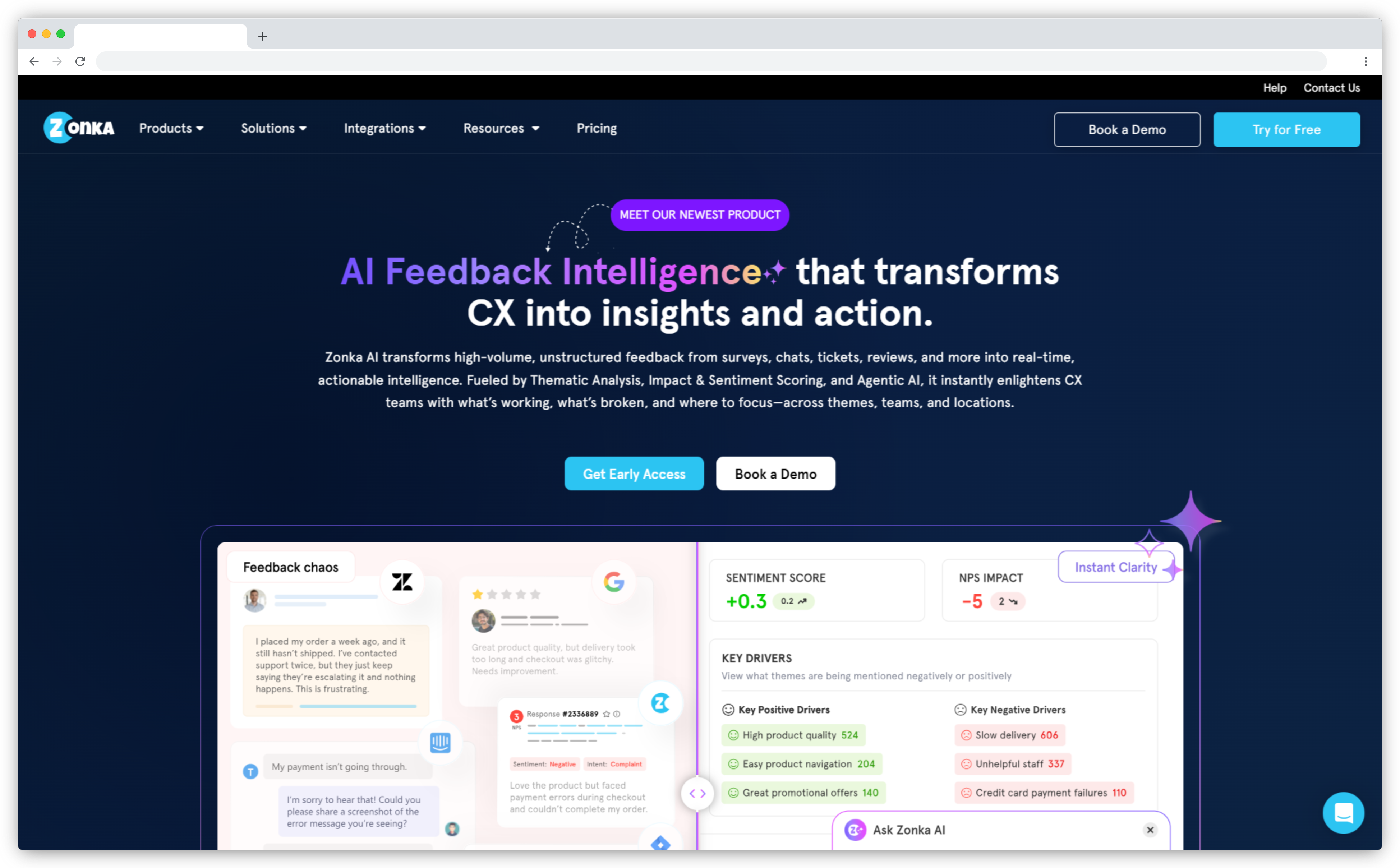
Zonka Feedback is the only tool in this list that handles both feedback collection and AI intelligence natively. No integrations, no exports, no separate data pipeline. You capture Voice of the Customer across web, in-app, email, SMS, WhatsApp, kiosks, and offline, and unify it with the reviews, tickets, and conversations you already have. Every response is tagged to the location, agent, or touchpoint it came from, so Gen AI surfaces the themes driving your NPS, CSAT, and CES scores by location and by agent, not just an overall number. Case routing, alerts, and follow-up automation are built in, not sold as a module, and it runs at enterprise scale with SOC 2 Type II security, SSO, and role-based access.
Why choose it over Qualtrics?
Qualtrics splits CX into separate modules and prices Gen AI (Discover XM) as a six-figure add-on. Zonka bundles collection, AI analysis, and closed-loop action in one workspace, with deployment in hours rather than weeks. Its Salesforce integration is bidirectional, with custom object mapping and merge fields inside surveys.
Zonka Feedback Pros
- AI analysis built in, no add-on needed
- Widest range of feedback channels
- Automated case routing and follow-ups
- No per-user pricing
Zonka Feedback Cons
- Custom dashboards are still improving
- Lighter on employee-experience features
- Voice analytics not yet available
Zonka Feedback Pricing
- Custom pricing based on usage and needs. You pay for what you use, not locked tiers.
G2: 4.7/5 on G2
Survicate: Best for multi-channel product and CX feedback
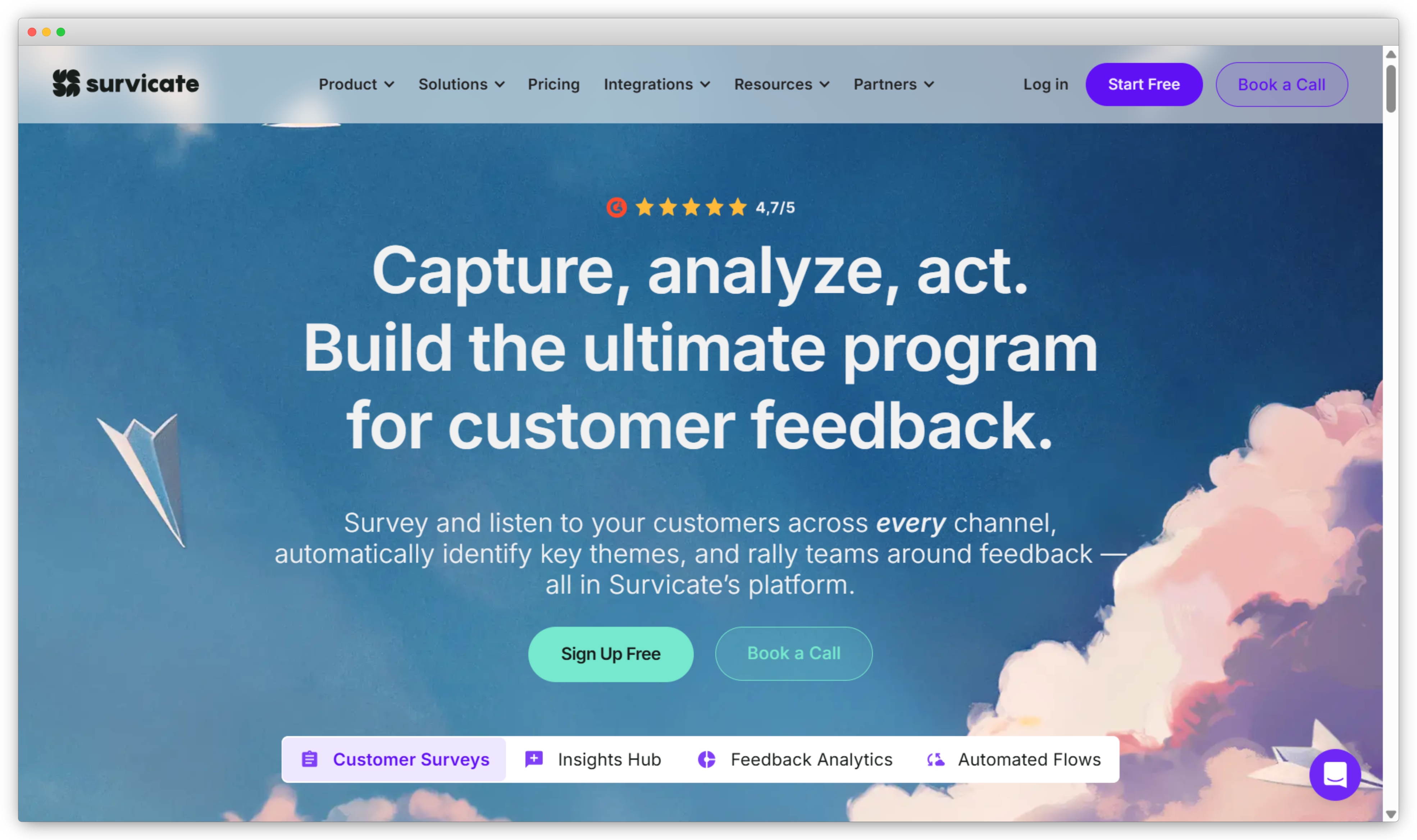
Survicate runs surveys across web, in-product, email, and shareable links, with native SDKs for iOS, Android, React Native, and Flutter. Its Research Hub pulls every feedback source into one place and lets you query it in plain language, so you ask a question and get an answer instead of building a report. For teams leaving Qualtrics over deployment complexity, the buying experience is the opposite: self-service signup, published pricing, and AI analysis included from the mid tier up. Templates and behavioral targeting cover most common CX and product-feedback jobs without custom work.
Why choose it over Qualtrics?
No-code setup and pre-built templates get teams live in under an hour, versus weeks and an integration partner. In-app surveys and behavioral targeting run without IT after the initial SDK install, and pricing is transparent instead of quote-only.
Survicate Pros
- Native mobile app SDKs
- AI repository you can query in plain language
- 40+ integrations, including Intercom
- Public, self-serve pricing
Survicate Cons
- No built-in case routing (needs Zapier)
- AI and targeting only on higher plans
- Not built for call-center or multi-location feedback
Survicate Pricing
- Free plan; paid plans from $89/mo (Starter); Growth from $56/mo billed annually.
G2: 4.6/5 on G2 (200+ reviews)
Perspective AI: Best for AI Customer Interviews
Why choose it over Qualtrics?
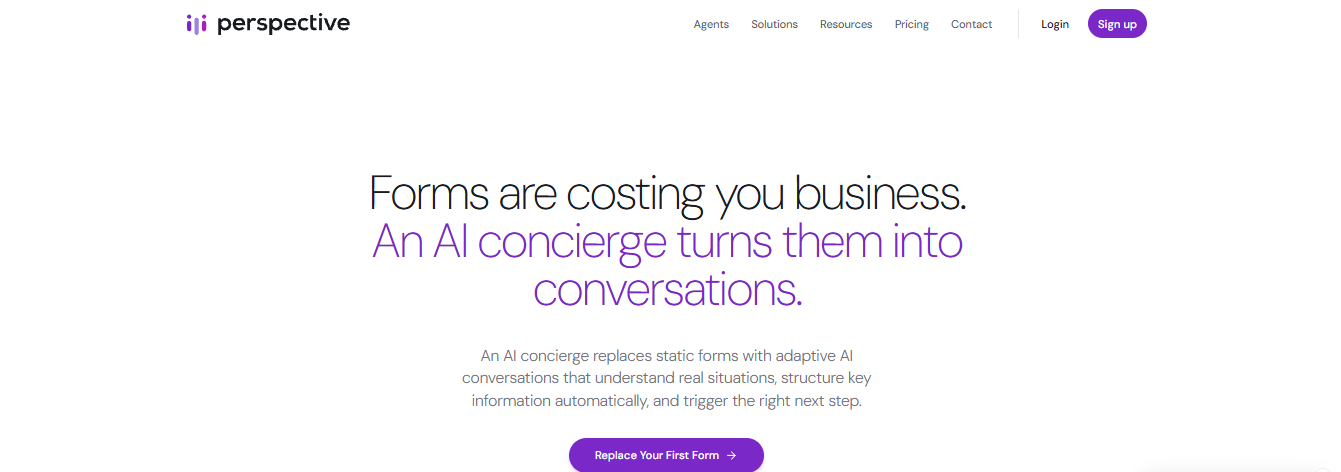
Qualtrics is built for running large measurement programs, and Text iQ does a capable job of analysing open-text once it arrives. The structural limit is that the analysis happens after the fact: Text iQ can read a vague answer but cannot ask what was meant by it. Perspective AI inverts that. Its AI interviewer asks the follow-up during the response — hearing "the rollout was rough" and immediately asking what went wrong — so the depth is captured rather than inferred. It also lands in days rather than the quarter a Qualtrics implementation typically takes, starts at $99/month against an enterprise contract, and needs no XM administrator to run. Teams that keep Qualtrics for program measurement often add Perspective AI as the diagnostic layer underneath it.
Perspective AI Pros
- Adaptive follow-up questions generated in real time, in voice or text
- Voice interviews in 57 languages with automatic language detection and accent-native voices — a global VoC program runs without local setup per market
- Sub-second opening, mid-sentence interruption and noise filtering, so spoken interviews feel like conversations rather than IVR
- Automatic themes, sentiment, key quotes and risk signals — no coding or taxonomy work
Perspective AI Cons
- No enterprise XM program management, quotas or governance tooling
- No recurring NPS, CSAT or CES dashboards or long-run trend tracking
- No statistical testing or crosstabs
Perspective AI Pricing
-
Free plan with 100 credits; Pro from $99/month for 1,000 credits; pay-as-you-go Flex credits; custom Enterprise pricing.
piHappiness: Best for real-time kiosk and frontline feedback
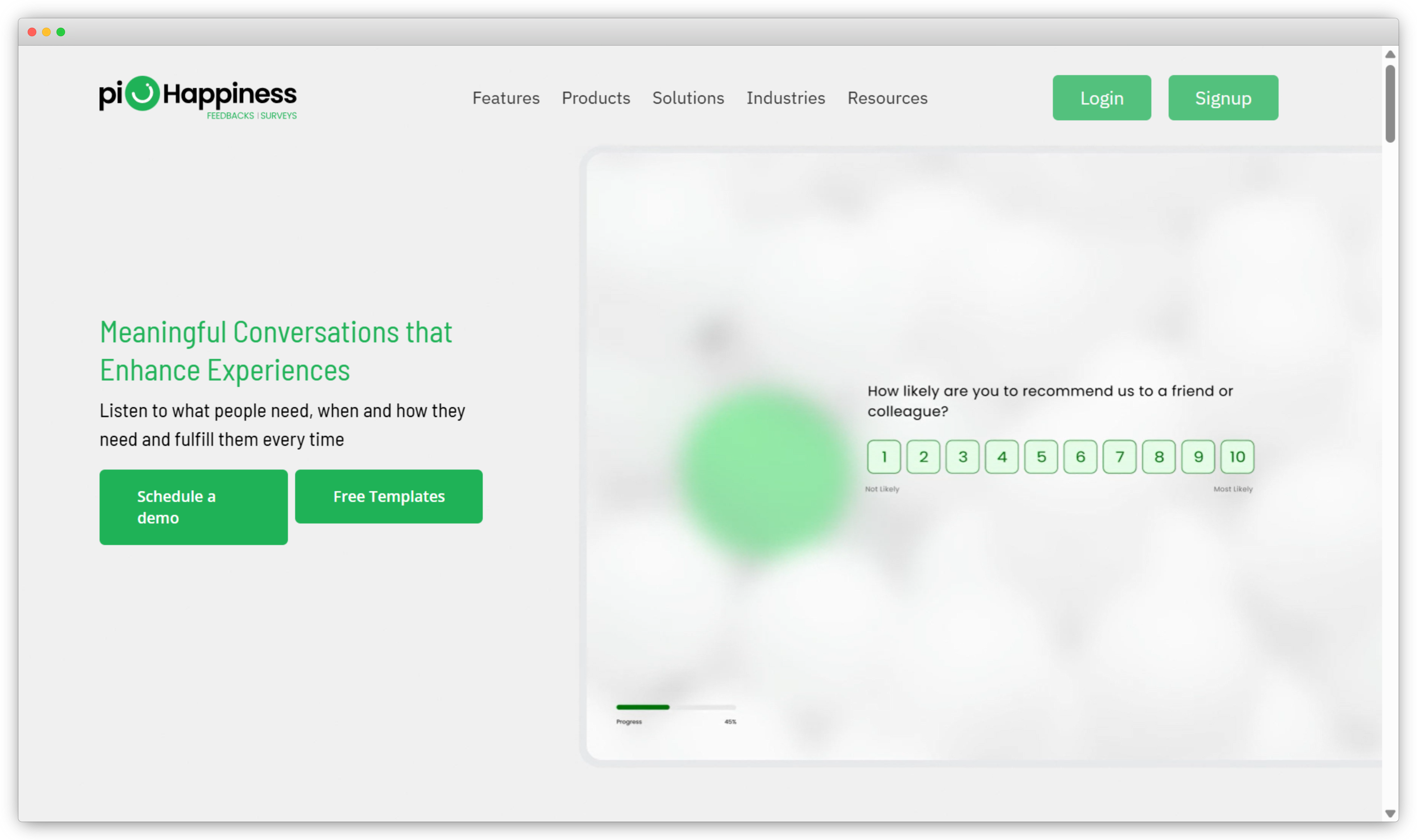
Picture a retail counter, a clinic waiting room, or a hotel checkout. That's where piHappiness earns its place. It's a real-time customer feedback platform built for physical touchpoints, capturing responses through tablets, kiosks, iPads, SMS, and QR codes, with strong offline collection that syncs once a connection returns. Emoticon, NPS, CSAT, and short dynamic questionnaires keep surveys quick at the point of service, and multilingual support suits high-traffic, mixed-language locations. Real-time dashboards and alerts route issues to the right person, so problems get resolved while the customer is still on site. Integrations with Slack, Salesforce, HubSpot, and Google Analytics push feedback into the tools your team already uses, and customizable reports track satisfaction by location or period.
Why choose it over Qualtrics?
Qualtrics needs technical setup and starts around $1,500 per user per year. piHappiness is priced for smaller teams and goes live in a fraction of the time, with loop management tuned for immediate, on-location issue resolution rather than long-cycle research.
piHappiness Pros
- Easy kiosk and tablet setup
- Strong multilingual support
- Responsive phone, chat, and email support
- Affordable for small teams
piHappiness Cons
- Limited customization for complex needs
- Learning curve on advanced features
- Small user-review base
piHappiness Pricing
- Quote-based; entry plans around $50/mo.
G2: 3.6/5 on G2 (limited reviews)
Affiniv: Best for affordable e-commerce and CX surveys
Affiniv is an AI-powered feedback platform aimed at e-commerce and retail teams that want NPS, CSAT, CES, and post-purchase surveys without enterprise overhead. It runs email and web-embedded surveys with automated triggers, say seven days after purchase, then tags every response by keyword and sentiment on a real-time dashboard. You can segment by product, location, or cohort, and act directly from the dashboard by emailing customers or escalating issues. A native Shopify app sets up action-based surveys in minutes, and integrations with Salesforce and Slack keep data flowing into your existing systems.
Why choose it over Qualtrics?
It's bootstrapped and priced for lean teams, with premium features on every plan and no enterprise complexity. For a Shopify store running post-purchase feedback, it's live in an afternoon, where a Qualtrics rollout would take weeks and a far larger budget.
Affiniv Pros
- Affordable, pay-per-response pricing
- AI sentiment and tagging on every plan
- Native Shopify and Salesforce integrations
- Act on feedback from the dashboard
Affiniv Cons
- Very small review base so far
- Narrower than full XM platforms
- Best for surveys, not large-scale research
Affiniv Pricing
- Free up to 25 responses/mo; paid plans from $25/mo.
G2: 4.8/5 on G2 (early reviews — small sample)
Sopact: Best for AI-Native Data Collection
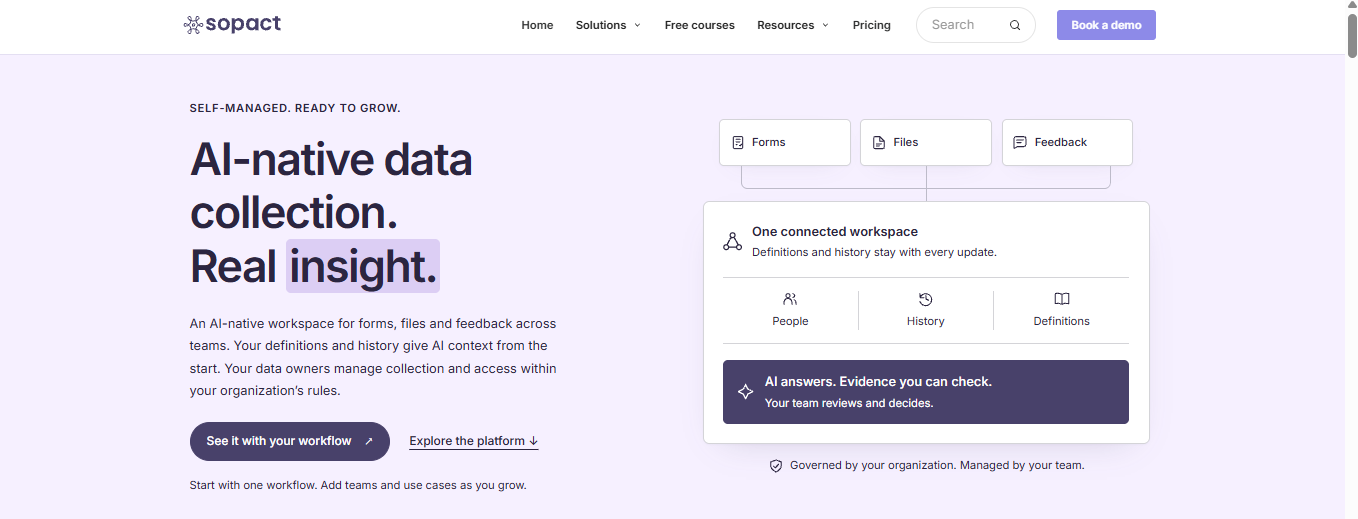
Sopact is an AI-native data collection and real-insight platform built around a “connected” model — rather than treating each survey as a standalone project like Qualtrics does, it keeps every survey, file, and interview tied to one persistent record per person, member, or customer, so historical context carries forward automatically and AI analysis runs on that context from the moment data is collected, not after the fact.
Why choose it over Qualtrics?
Qualtrics is built around the survey as the unit of work — each project stands on its own. Sopact is AI-native from the ground up: every survey, file, and interview is tied to shared definitions and a shared history, so AI-driven analysis has context from the moment data is collected rather than being stitched together afterward.
Sopact Pros
- Positioned against Qualtrics and Medallia for membership/CX use cases
- Purpose-built, AI-native structure
- Clear guidance on data ownership and integrations upfront
Sopact Cons
- Newer platform, fewer reviews (3 on G2)
- Integration scope needs case-by-case confirmation
- Smaller enterprise reference base than incumbents
Sopact Pricing
- Custom Pricing
QuestionPro: Best budget-friendly research platform
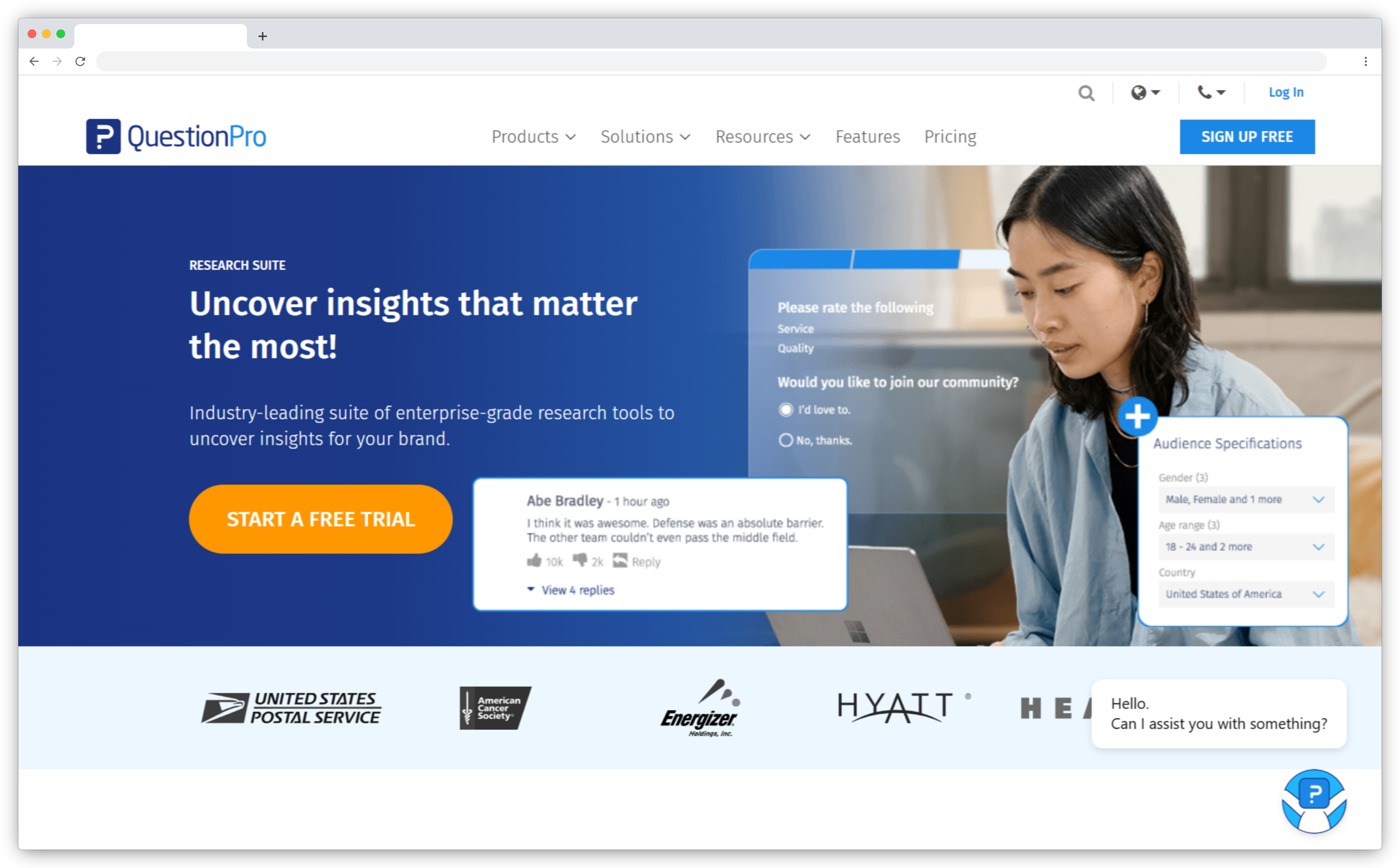
QuestionPro is an insights platform trusted by millions of users, offering research-grade surveying at a fraction of enterprise pricing. It handles multilingual surveys, price-sensitivity and conjoint-style questions, and 50-plus question types, plus a Community Management feature most CX tools lack that's useful for running long-term research panels. Its Research Suite adds an integrated audience panel, an AI-powered insights repository, and compliance across GDPR, HIPAA, ISO 27001, and SOC 2. Marketing, product, and academic teams use it for everything from quick pulse surveys to complex market research, and 24/7 support is included in the plan rather than sold as a premium tier.
Why choose it over Qualtrics?
It delivers much of what mature CXM platforms do at a fraction of the cost, with research features Qualtrics reserves for higher tiers. For mid-market and academic teams, it's a rare mix of depth and affordability.
QuestionPro Pros
- Very affordable for mid-market
- Panel and community features for research
- 24/7 support included
- Multilingual surveys
QuestionPro Cons
- Analytics trail enterprise tools
- Weaker fit for large B2B programs
- Interface can feel dated
QuestionPro Pricing
- Essentials free; Advanced $99/user/mo, billed annually.
G2: 4.5/5 on G2
Alchemer: Best research-grade survey logic
Need Qualtrics-level branching, piping, and quotas without the per-seat model? Alchemer, formerly SurveyGizmo, is one of the most flexible research platforms around. It suits market research, UX studies, and brand tracking, with more than 40 question types, advanced logic and validation, and API-level integration into your CRM, BI, and analytics stack. Teams in technology, healthcare, financial services, and education use it across the full feedback lifecycle, from quick pulse surveys to sophisticated Voice of the Customer programs. It's built for researchers who want control over every detail of a study without wrestling a rigid, module-based enterprise suite. Reporting is exportable and API-accessible, so results feed dashboards and downstream systems rather than sitting in a silo.
Why choose it over Qualtrics?
You get logic and validation that rival Qualtrics' Research Core, but with a more intuitive setup and no forced module structure. Similar analytical depth, lower cost, and fewer hoops to build the study you actually want.
Alchemer Pros
- Research-grade survey logic
- Intuitive to set up
- Strong CRM and BI integrations
- Flexible, with no rigid modules
Alchemer Cons
- Less built-in benchmarking than Qualtrics
- Reporting visuals trail dedicated BI tools
- Newer, lighter AI features
Alchemer Pricing
- Custom pricing; no free plan.
G2: 4.4/5 on G2
Sprig: Best AI research for product teams
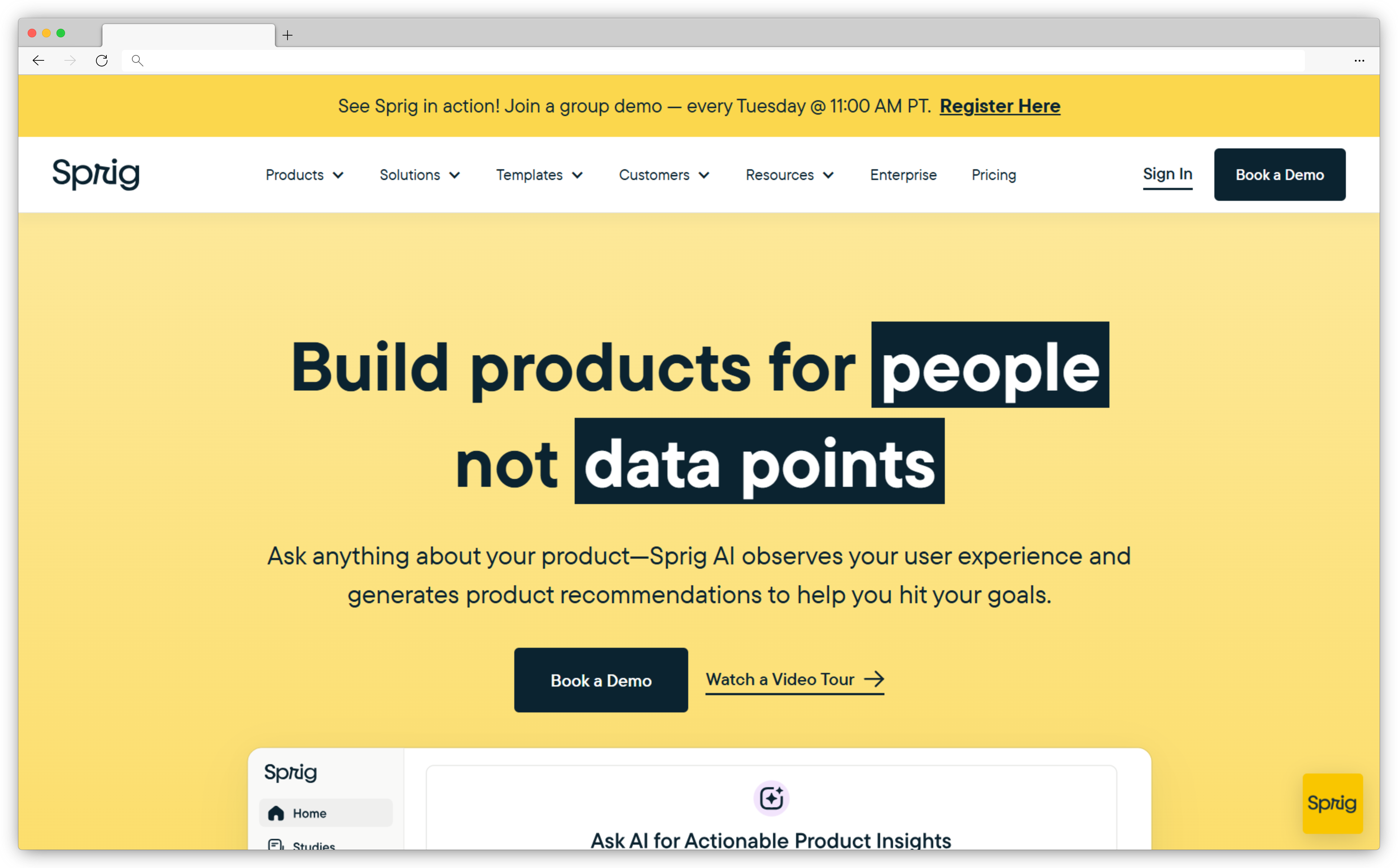
Sprig is a product experience platform built around AI agents that design studies, field adaptive surveys, and synthesize open-text into themes. It's aimed at product and research teams that want to move from question to evidence without manual survey programming. In-product surveys, feedback buttons, session replays, and heatmaps capture behavior and opinion together, and a GPT-powered analysis tool turns responses into quick, actionable summaries. Companies like Figma, Notion, and DoorDash use it to learn from users continuously and feed findings straight into the product roadmap, all without sacrificing launch deadlines or waiting on a research backlog. Because studies are targeted in-product and analyzed automatically, a single researcher can keep a live pulse on the product across many user segments at once.
Why choose it over Qualtrics?
Where Qualtrics is a broad, services-heavy suite, Sprig trades breadth for speed to insight, with AI handling setup, targeting, and tagging. For product teams that need contextual answers fast, that focus is the whole point.
Sprig Pros
- Fast, low-effort setup
- Clean interface with flexible logic
- Strong AI theme summaries
- Easy SSO onboarding
Sprig Cons
- Cross-study filtering still maturing
- Survey triggers can be tricky to test
- Support slower in some time zones
Sprig Pricing
- Free plan available; paid plans quote-based.
G2: 4.5/5 on G2
Medallia: Best enterprise CX with predictive analytics
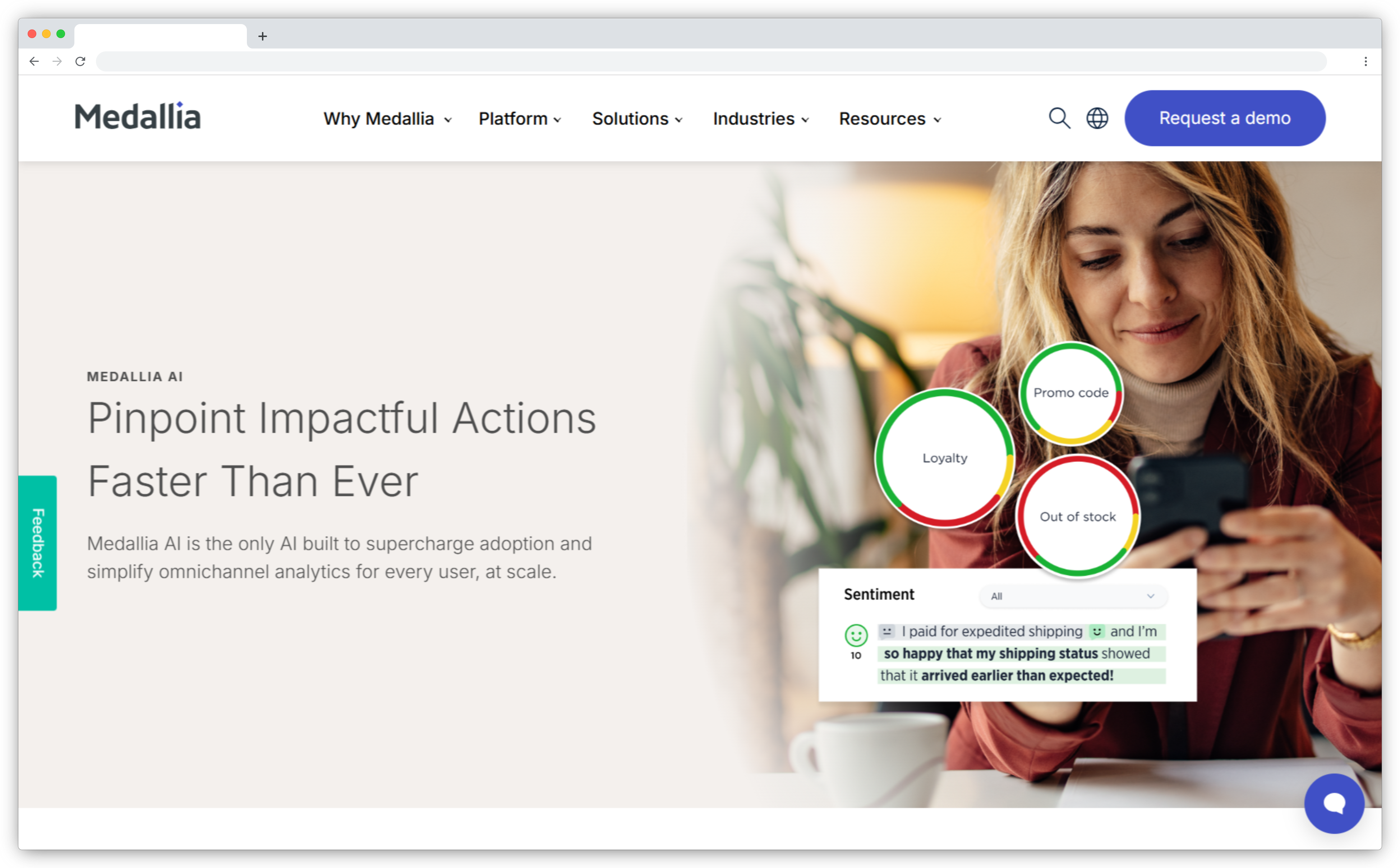
Medallia Experience Cloud captures passive and proactive signals from web, mobile, connected devices, apps, social, and conversational messaging in one unified stream. Its Athena AI surfaces risk signals, themes, and next actions without heavy manual setup, and its action-management workflows auto-route cases and flag at-risk customers in real time. Built for multi-department programs across contact center, digital, and physical channels, it handles complex organizational hierarchies that trip up lighter tools. Large enterprises in hospitality, financial services, and retail use it to embed the voice of the customer into daily operations across thousands of frontline staff and every touchpoint along the journey. Speech and text analytics extend the same insight to call recordings and open text, not just structured surveys.
Why choose it over Qualtrics?
For organization-wide CX transformation, Medallia is relatively more experienced with complex structures, and its real-time action management is a genuine strength. Where Qualtrics leans on measurement, Medallia leans on acting on signals as they arrive.
Medallia Pros
- Predictive, real-time analytics
- Deep survey logic
- Broad omnichannel capture
- Strong workflow routing
Medallia Cons
- Complex to implement
- Overkill for simple surveys
- Enterprise pricing, like Qualtrics
Medallia Pricing
- Custom pricing (enterprise only).
G2: 4.5/5 on G2
InMoment: Best for experience improvement and ROI
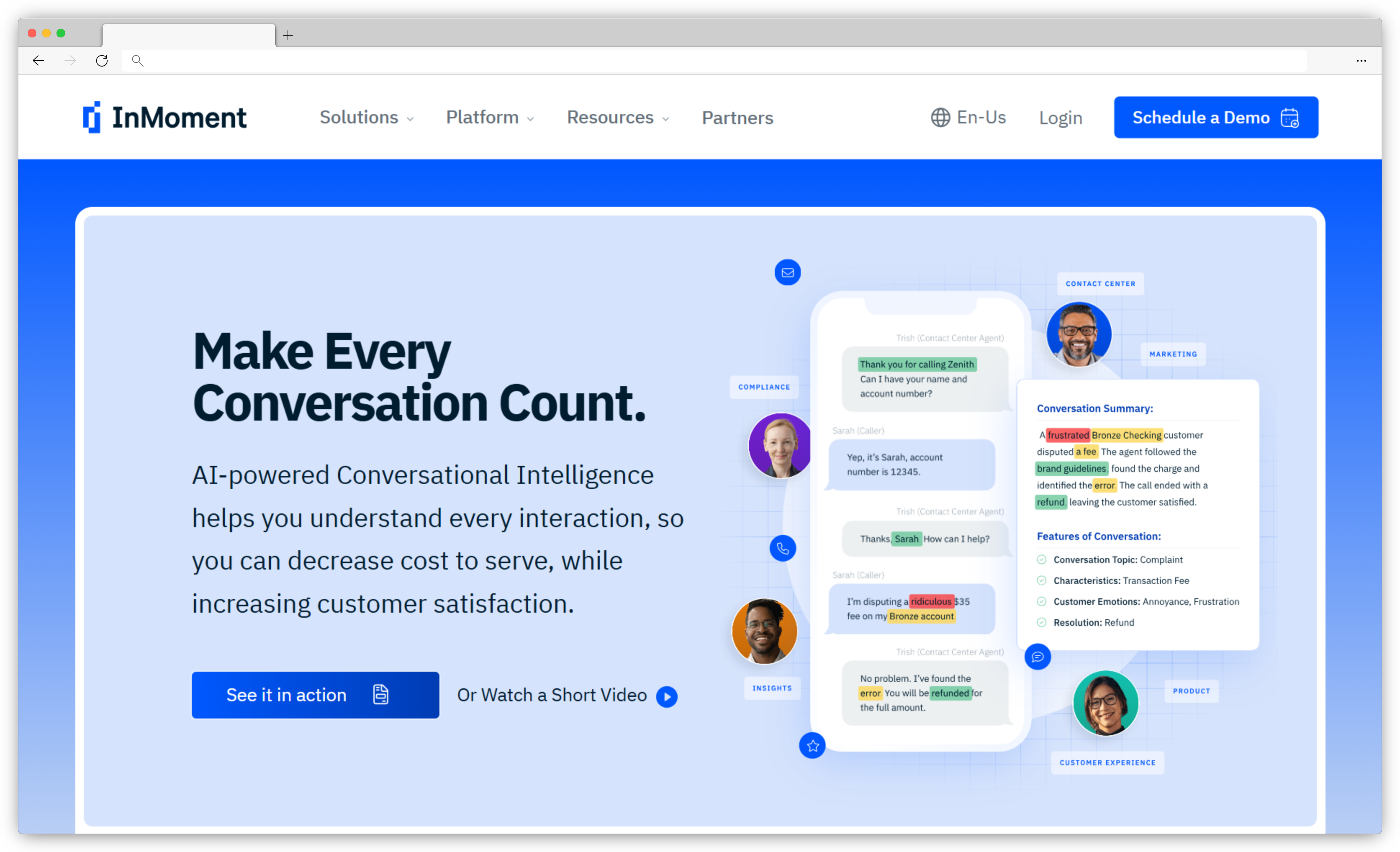
InMoment, now part of Press Ganey Forsta, is built around an Experience Improvement framework that ties customer, employee, and market insight to business outcomes. What sets it apart is the focus on ROI: built-in tools quantify the financial impact of CX initiatives, and strategic consultants are part of the engagement rather than a separate contract. Its AI reads structured surveys and unstructured sources alike, from call logs and support tickets to social reviews and chat transcripts, breaking down data silos. Enterprise teams use it for closed-loop case management and reputation monitoring, with strong support and setup scores despite the platform's overall complexity. It serves large B2B and B2C organizations that want measurable outcomes from their program, not just dashboards, with text and speech analytics covering feedback wherever it lives.
Why choose it over Qualtrics?
Where Qualtrics focuses on measurement, InMoment leans into action and ROI, with strong case management and native social and review monitoring. The included consulting means you're buying a partner, not just a platform.
InMoment Pros
- Strong ROI and business-case tools
- Excellent case management
- Built-in social and review monitoring
- Consulting included
InMoment Cons
- Enterprise-level pricing
- Complex to implement
- Too much for simple survey needs
InMoment Pricing
- Custom pricing (enterprise only).
G2: 4.7/5 on G2
SurveyMonkey: Best for fast, simple surveys
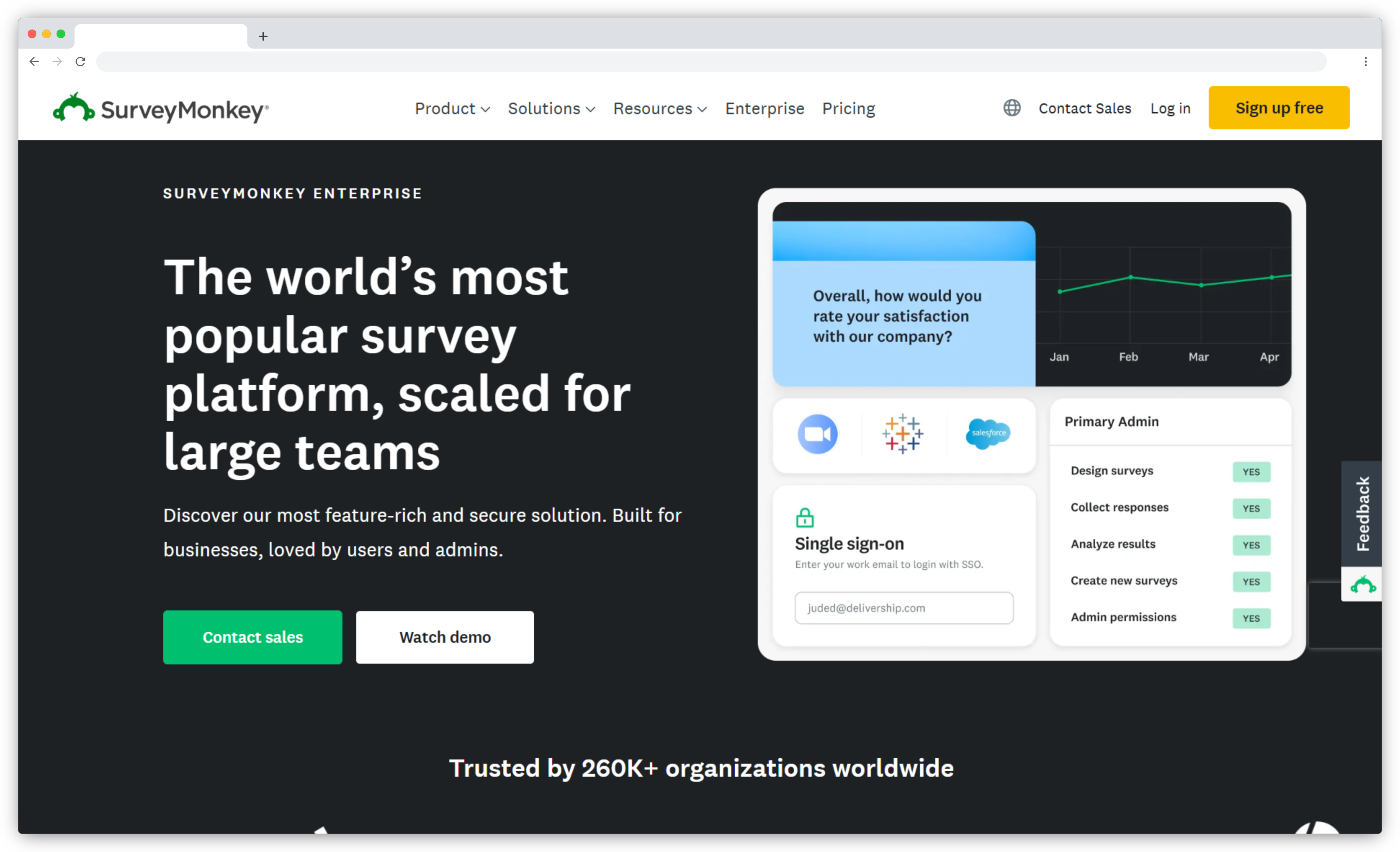
SurveyMonkey Enterprise extends the survey builder millions already know into a secure, organization-wide tool. It's the near-zero-learning-curve option: drag-and-drop design, a deep question bank, 350-plus templates, and instant analytics, with no implementation partner required. New AI features help draft surveys and speed up analysis, and broad integrations connect it to Salesforce, Power BI, Slack, and hundreds of other apps. It covers customer satisfaction, market research, and employee feedback for teams that want to launch fast and share results widely, without the configuration burden or cost of a full experience management suite they may never fully use. Security and admin controls in the Enterprise tier support HIPAA, SOC 2, and GDPR compliance for larger organizations.
Why choose it over Qualtrics?
Qualtrics' research suite can take weeks to configure. SurveyMonkey delivers a large share of that value at a fraction of the cost, and non-technical teams go live in days rather than waiting on an analyst or a rollout project. If SurveyMonkey itself is on your shortlist, our guide to SurveyMonkey alternatives compares it against the field.
SurveyMonkey Pros
- Fast to deploy
- Deep question and template library
- New AI features speed up analysis
- Broad integrations
SurveyMonkey Cons
- Analytics trail Qualtrics
- No built-in journey analytics
- Some workflows need the API
SurveyMonkey Pricing
- Free Basic plan; individual plans from $39/mo (billed annually); Enterprise custom.
G2: 4.4/5 on G2
Formbricks: Best open-source Qualtrics alternative
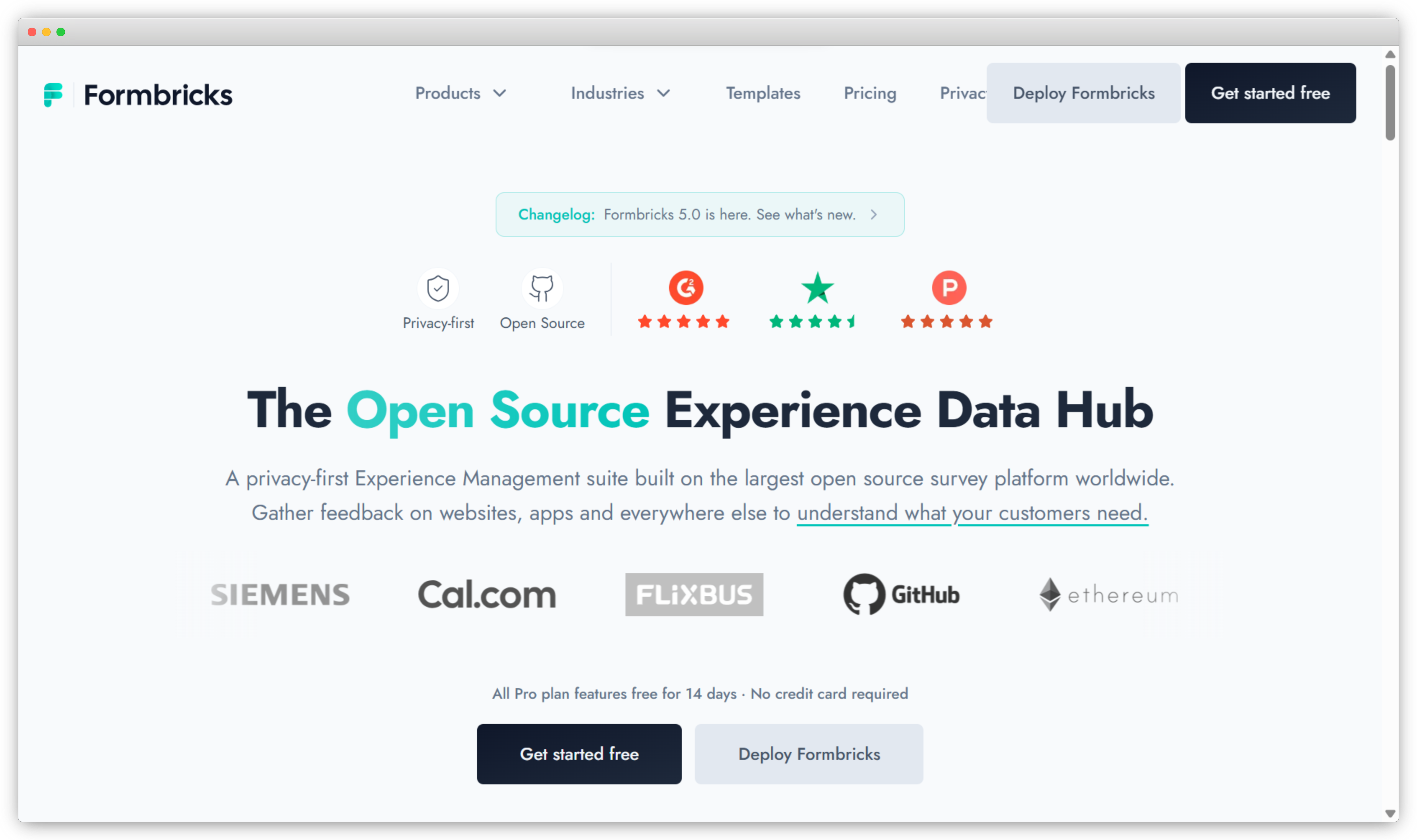
When data sovereignty is non-negotiable, Formbricks is the answer. It's an open-source experience platform you can fully self-host, audit, and own end to end, which matters in financial services, healthcare, and government. Headless and API-first, it's GDPR- and HIPAA-friendly by design, with a lightweight JavaScript SDK that triggers in-app and website surveys based on user actions, page visits, or custom events. The visual editor supports NPS, rating scales, open text, and logic jumps, and a fast-growing community keeps shipping new question types and integrations. Self-host it with Docker in minutes, or use the GDPR-compliant cloud operated from Germany. With thousands of GitHub stars and frequent releases, it's actively maintained rather than a stalled side project.
Why choose it over Qualtrics?
You get full data ownership and code auditability without a closed enterprise stack. It's simple enough that privacy-focused teams don't need long onboarding, and every response lives in a database you control rather than a vendor's.
Formbricks Pros
- Open-source and self-hostable
- Strong API and webhooks
- Broad integrations
- Advanced logic and quotas
Formbricks Cons
- Limited AI out of the box
- May need a separate analytics tool
- Small user-review base
Formbricks Pricing
- Free self-hosted Community Edition; cloud Pro from $89/mo ($74/mo billed annually).
G2: 4.9/5 on G2 (small review base)
Google Forms: Best free tool for quick data collection
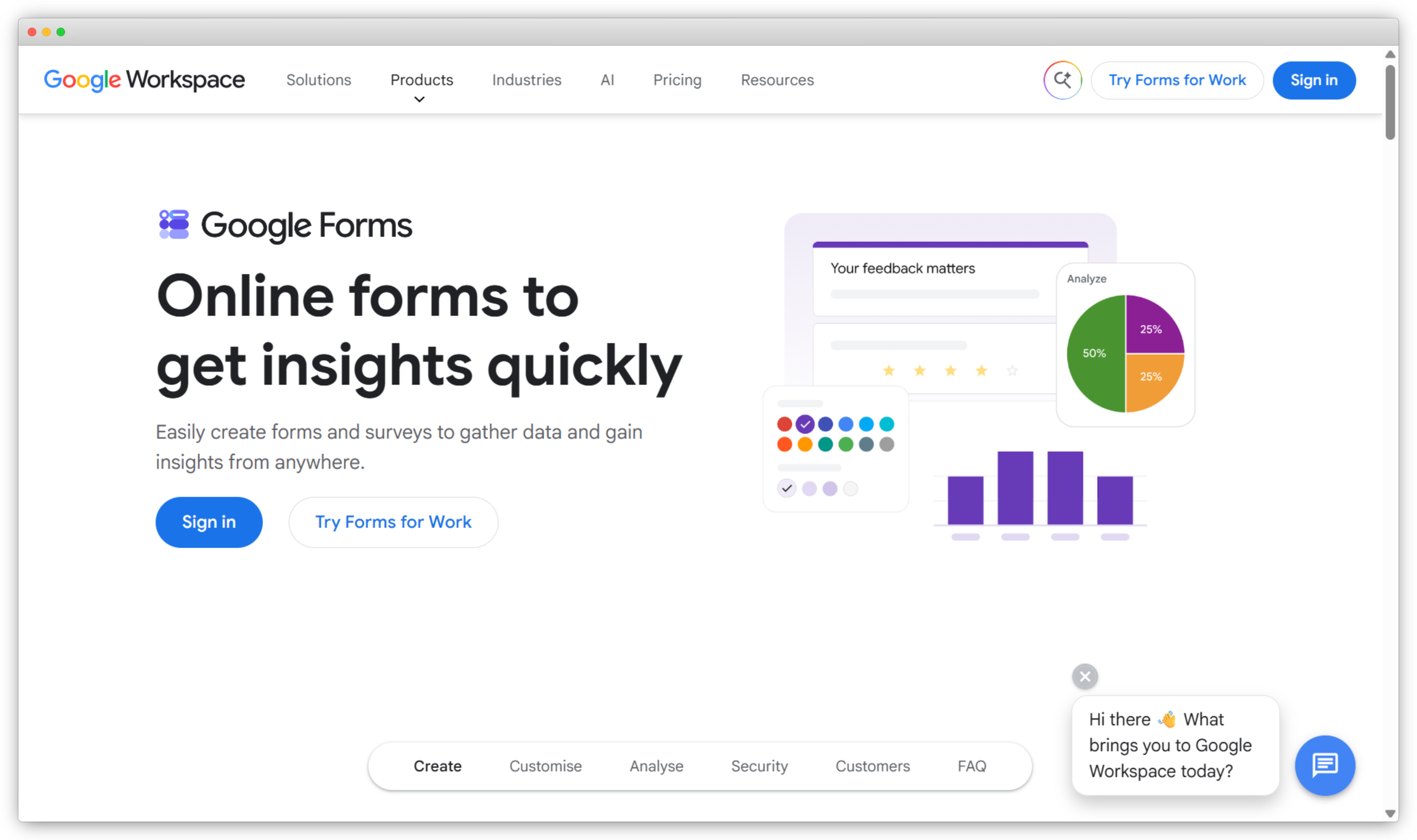
Google Forms is the honest answer to "I just need a form." It's free inside Google Workspace, intuitive for anyone who's used a Google product, and connects straight to Google Sheets so responses land where you can analyze them. It handles common question types, star and scale ratings, basic validation, and simple branching, and it's live the moment you open it, with no setup, contracts, or training. For one-off surveys, event RSVPs, quizzes, polls, or quick internal data capture, it covers the essentials without asking anyone to learn a new platform or budget for a tool. And because it's part of Google Workspace, permissions, sharing, and collaboration work exactly the way your team already expects.
Why choose it over Qualtrics?
For simple, occasional needs, an enterprise XM platform is overkill. If the sophisticated Qualtrics capability was never actually being used, Google Forms does the core job for nothing, and everyone on the team already knows how to use it.
Google Forms Pros
- Free to use
- Easy for anyone
- Unlimited forms
- Native Google Sheets integration
Google Forms Cons
- Very limited branding and customization
- No central analytics across sources
- Not built for large or complex programs
Google Forms Pricing
- Free with a Google account.
G2: No standalone G2 listing; rated within Google Workspace, 4.6/5 on G2
Which Qualtrics Alternative Should You Choose?
Match the tool to the actual complaint. After all 12, three questions narrow the shortlist faster than any feature grid.
| If your blocker is... | Start with |
| Cost | Zonka Feedback, QuestionPro, Google Forms |
| Text IQ tells you what customers said but not why | Perspective AI |
| Complexity and time-to-value | Survicate, Affiniv, SurveyMonkey |
| Research methodology | QuestionPro, Alchemer, Sprig |
| Data control or residency | Formbricks |
| Enterprise scale | Medallia, InMoment |
| Physical and frontline touchpoints | piHappiness, Zonka Feedback |
| Insights never turn into action | Zonka Feedback |
If your feedback program lives inside a product, in-app tools win. If it spans physical locations, look at multi-location CX. If you're a large enterprise that needs unified customer, employee, and brand programs across many complex units, Medallia or InMoment fit. And if you want enterprise-grade CX with Gen AI analysis and closed-loop action in one platform, without the implementation overhead, Zonka Feedback serves teams from mid-market to enterprise.
How to Migrate off Qualtrics Without Losing Data
Migrating off Qualtrics is manageable with a plan. The snags are usually complex skip logic, piped text, embedded data, and historical IDs used in automations. A three-step approach keeps it clean.
First, export and map. Pull survey structures and responses to CSV, and map question types, piping, and logic before you rebuild. Second, rebuild and QA. Recreate skip and branching logic one to one in the new platform, test on staging, and check embedded data. Third, reconnect and cut over. Re-map CRM and help-desk integrations, then run a parallel pilot for one or two cycles before switching fully. Keep legal archives, and hold old survey links with redirects so nothing breaks mid-program.
If you're a Delighted user forced off by the sunset, the migration path is shorter, and mid-market tools sit comfortably between basic survey apps and full enterprise XM. Some vendors, Zonka Feedback among them, run the move for you as white-glove onboarding, rebuilding your surveys, logic, and integrations instead of leaving it as a self-serve project.

.png)
.svg)
.png)