What Questions Are in This Hospital Patient Satisfaction Survey Template?
Seven questions across eight screens, each targeting a specific HCAHPS-adjacent domain. This isn't a general feedback form — it's structured to give hospital quality teams data they can act on. Here's the question-by-question breakdown:
- "Please rate your satisfaction with the care provided during your visit" (1-5 scale: Very Poor to Excellent) — Your headline metric. This single question correlates most strongly with overall HCAHPS composite scores. Track it weekly — not monthly — because hospital patient satisfaction shifts fast. A bad week in the ER can drag down scores for the entire facility if you don't catch it early.
- "How well did the healthcare providers communicate with you?" (1-5 scale: Very Poor to Excellent) — Communication is the #1 driver of patient satisfaction in hospitals — and the #1 predictor of malpractice claims. Providers who score below 3 here need immediate coaching intervention, not a note in their quarterly review. Use AI service analytics to spot communication score patterns by department, shift, or provider.
- "Rate your satisfaction with: Wait Time, Staff Friendliness, Cleanliness, Clarity of Communication" (matrix rating, 1-5 each) — The parameter-level question. This is where hospital administrators find the real signal. A hospital scoring 4.5 on cleanliness but 2.8 on wait time doesn't have a "patient satisfaction problem" — it has a throughput problem. Specific parameters produce specific actions.
- "Are you satisfied with the follow-up care after your visit?" (yes/no) — Post-discharge follow-up is the most neglected domain in hospital patient satisfaction. Patients who feel abandoned after leaving the hospital are 40% more likely to rate their entire experience negatively — even if the in-hospital care was excellent. This question catches that gap.
- "It was easy for me to schedule the appointment" (7-point Likert: Strongly Disagree to Strongly Agree) — Scheduling difficulty is a satisfaction anchor. A patient who struggled to get an appointment enters the hospital already frustrated — and that frustration colors every subsequent rating. Track this alongside your actual scheduling metrics to see if the problem is capacity, process, or perception.
- "How likely are you to recommend us to a friend or colleague?" (0-10 NPS scale) — The Net Promoter Score applied to healthcare. Hospital NPS benchmarks vary by type — academic medical centers average 50-60, community hospitals 30-45, rural hospitals 20-35. Know your benchmark before setting improvement targets.
- "Is there anything we can do to improve your satisfaction as a patient?" (open-ended) — The qualitative safety valve. This question catches everything the rating scales miss — specific incidents, staff names (good and bad), facility issues, and systemic complaints. Run responses through sentiment analysis and thematic analysis to convert hundreds of comments into categorized action items.
HCAHPS Scores and Why They Matter Beyond Compliance
Patient satisfaction scores don't measure care quality — and that's the point. They measure the patient's experience of care, which is a different thing entirely. A hospital can deliver clinically excellent outcomes and still score poorly on HCAHPS if patients felt unheard, confused, or neglected during the process.
Here's why that matters beyond just "patients should feel good":
- Reimbursement impact — CMS ties a portion of Medicare reimbursement to HCAHPS scores through the Hospital Value-Based Purchasing Program. Low scores directly reduce your revenue. This isn't theoretical — hospitals in the bottom quartile lose 1-2% of their Medicare payments.
- Public reporting — HCAHPS scores are published on Hospital Compare. Patients, insurers, and referring physicians use these scores. A hospital with a 2-star overall rating on communication loses referral volume to the 4-star hospital across town.
- Clinical correlation — Research consistently shows that higher patient satisfaction correlates with lower readmission rates, better medication adherence, and fewer patient safety incidents. Satisfied patients follow discharge instructions. Dissatisfied patients don't.
The HCAHPS survey itself covers specific domains: nurse communication, doctor communication, responsiveness of hospital staff, communication about medications, discharge information, care transition, hospital environment (cleanliness and quiet), and overall rating. This hospital patient satisfaction survey template covers the same domains in a shorter format you can deploy internally between official HCAHPS survey cycles.
This Hospital Survey vs. HCAHPS — When to Use Which
HCAHPS is mandated, standardized, and administered by CMS-approved vendors. You can't replace it. But you can supplement it — and you should, because HCAHPS has structural limitations that a custom hospital patient satisfaction survey fills:
- HCAHPS is retrospective and slow — Patients receive the HCAHPS survey 48 hours to 6 weeks after discharge. By the time results are compiled, the experience is months old. This template gives you real-time data you can act on this week.
- HCAHPS is inpatient-only — It doesn't cover outpatient visits, ER experiences, or ambulatory surgery. This template works across all hospital settings — deploy it post-discharge for inpatients and post-visit for outpatients.
- HCAHPS can't be customized — You can't add questions about your new patient portal, your recently renovated waiting area, or the nurse mentorship program you just launched. This template lets you measure what matters to your improvement priorities right now.
- Use both, but differently — HCAHPS for regulatory compliance and benchmarking against national data. This hospital patient satisfaction survey template for operational improvement and real-time intervention. The HCAHPS score tells you where you stand. This survey tells you what to fix this week.
How to Analyze Hospital Patient Satisfaction Data at Scale
A single hospital generates thousands of patient satisfaction responses monthly. Reading them one at a time is impossible. Here's how to turn volume into signal:
- Department-level dashboards — Break satisfaction data by department: ER, ICU, maternity, orthopedics, general medicine. Each department has different satisfaction drivers. ER patients care about wait time and pain management. Maternity patients care about nurse communication and room comfort. Department-level views via survey reports let each department head see their own data.
- Shift and time analysis — Satisfaction scores often vary by shift. Night shift scores are consistently 10-15% lower than day shift in most hospitals — partly staffing, partly patient acuity. Track by time to identify whether low scores are a people problem or a structural problem.
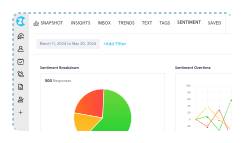
- Open-ended text mining — The open-ended question generates the richest data but is hardest to analyze. Use AI feedback analytics to auto-categorize themes, extract sentiment, and surface urgent issues (mentions of specific staff, safety concerns, or billing disputes).
- Trend over threshold alerts — Set automated alerts when any parameter score drops below your threshold for two consecutive weeks. A single bad day is noise. Two weeks is a signal. Feedback alerts catch the signal before it becomes a HCAHPS problem.
Where to Deploy a Hospital Patient Satisfaction Survey
Hospitals have more deployment touchpoints than any other healthcare setting — and each one captures a different moment in the patient's experience. The channel you choose determines what kind of feedback you get.
- Bedside tablet (inpatient) — Deploy on a tablet kiosk at the bedside during the last 24 hours of the stay. The patient is still in the experience, not remembering it. Response rates are 60-70% for bedside tablets — higher than any post-discharge method.
- Post-discharge SMS — Send a text message survey within 4 hours of discharge. The patient is home, settled, and still has the experience fresh. Include the NPS question first (one tap) with a link to the full 7-question survey. Expect 25-35% completion rates.
- Post-visit email (outpatient) — For outpatient clinics within the hospital system, trigger an automated email survey the same day. Include the hospital and department name in the subject line — generic "How was your visit?" emails from hospital systems get buried.
- ER exit survey — The ER is the hardest environment for feedback collection. A short 3-question version on a WhatsApp survey sent at discharge captures ER-specific data (wait time, triage communication, pain management) without adding burden to an already stressful experience.
Pro tip: Don't deploy the same survey through all channels simultaneously. A patient who gets a bedside tablet survey, a discharge SMS, and a follow-up email feels surveyed to death. Use survey throttling to limit each patient to one survey per encounter.
Closing the Loop on Hospital Patient Feedback at Scale
Hospitals that collect patient satisfaction data and file it away for the quarterly board presentation are doing feedback theater. Closing the feedback loop at hospital scale requires systems, not heroics.
- Service recovery for detractors — Any patient scoring below 3 on overall care quality should trigger an automated alert to the patient experience team. The recovery call should happen within 48 hours of discharge — not because it fixes the past, but because it prevents the negative online review and gives you information about what broke.
- Department-level action plans — Route department-specific feedback to department heads weekly. Orthopedics gets orthopedics data. ER gets ER data. The Chief Experience Officer sees the rollup, but each department owns their improvement actions. Connect through Salesforce or your hospital CRM to track follow-up actions per patient.
- Staff recognition for promoters — When patients name specific nurses or doctors in positive feedback, share it publicly. Recognition programs tied to patient feedback improve staff morale and reduce turnover — and in hospitals, staff satisfaction and patient satisfaction are correlated.
- Trend reporting to leadership — Monthly scorecards showing satisfaction trends, HCAHPS projections, and top complaint themes. Use patient experience analytics to build these automatically instead of manually assembling slide decks.
Related Healthcare Survey Templates
Hospital patient satisfaction is one measurement layer. Depending on your hospital's structure and improvement priorities, pair this with more targeted surveys:
- Dental Patient Satisfaction Survey Template — For hospital-affiliated dental clinics where the visit dynamics differ from inpatient and general outpatient care.
- Healthcare Assessment Survey Template — Captures baseline health data at intake. Use the assessment to set context, and the satisfaction survey to measure how well the hospital delivered on the resulting care plan.
- Post-Discharge Inpatient Feedback Form — A more detailed post-discharge survey that digs deeper into care transitions, discharge instructions, and medication communication.
- Outpatient Feedback Form — For hospital outpatient departments where the visit is shorter and the feedback focus shifts from inpatient care to clinic-level experience.


.svg)
 Healthcare
 Finance
 Retail
 SaaS & Digital
 eCommerce
 Education
 Salesforce
  HubSpot
 Pipedrive
 Mailchimp
 Klaviyo
 Zendesk
  Intercom
 Freshdesk
 HelpScout
  Front
Front Jira
Jira Slack
Slack  MS Teams
 Zoom
Zoom Google Sheets
  Zapier
  Integrately
 Make
Make  Webhooks



 Sign In
 MS Teams