

.svg)
 Healthcare
 Finance
 Retail
 SaaS & Digital
 eCommerce
 Education
 Salesforce
  HubSpot
 Pipedrive
 Mailchimp
 Zendesk
  Intercom
 Freshdesk
 HelpScout
  Front
Front Jira
Jira Slack
Slack  MS Teams
 Zoom
Zoom Google Sheets
  Zapier
  Integrately
 Make
Make  Webhooks




 MS Teams


The best VoC tools for healthcare in 2026 are Zonka Feedback, Qualtrics, Medallia, Sogolytics, QuestionPro, SurveySparrow, NexHealth, AskNicely, Birdeye, and Alchemer. Each platform serves a distinct use case: Qualtrics leads for CAHPS compliance and regulatory programs, Zonka Feedback for omnichannel collection with AI intelligence, and Sogolytics for HIPAA-secure programs on a defined budget.
TL;DR
- This guide covers 10 VoC tools for healthcare, organized by use case: full-stack VoC platforms, survey platforms, digital patient engagement tools, and reputation management tools.
- A complete healthcare VoC program captures feedback from five groups: patients, caregivers, clinical staff, administrative teams, and payers.
- Every VoC tool handling patient data needs both HIPAA compliance and a signed Business Associate Agreement, which are two separate requirements.
- CAHPS and HCAHPS compliance is a separate requirement from HIPAA, and only a few tools here support the CAHPS-approved survey methodology tied to CMS reimbursement.
- Qualtrics is the only platform here that natively combines HCAHPS-approved survey methodology with enterprise VoC analytics after its 2026 Press Ganey Forsta acquisition.
- For most mid-market healthcare organizations, Zonka Feedback and Sogolytics offer more accessible entry points with strong HIPAA compliance.
Healthcare organizations collect a lot of patient feedback. Most of it sits in a dashboard nobody reads on a schedule nobody keeps.
Real VoC programs in healthcare work differently. They capture feedback from key stakeholders across the care journey: patients, caregivers, clinical staff, administrative teams, and payers. They connect that data to HCAHPS scores, CMS reimbursement outcomes, and department-level performance. They don't require someone to log in and check a report.
The best voice of customer tools for healthcare are built for that scope. This guide evaluates 10 of them, organized by what they're actually best at.
What Makes VoC Different in Healthcare?Healthcare VoC isn't a more complicated version of customer feedback. It's a structurally different problem.
Most industries collect feedback from one stakeholder group: the customer. Healthcare has five. Patients rate the experience at the point of care. Caregivers have their own observations, especially in pediatric and elder care settings. Clinical staff feed into the service-profit chain in ways that directly affect patient satisfaction scores. Administrative teams own registration, billing, and discharge workflows that generate friction data. Payers and members have their own experience layer on top of all of it.
Collecting from one group and calling it VoC leaves most of the signal on the table.
The regulatory dimension adds another layer that doesn't exist in other industries. HCAHPS scores directly affect CMS Value-Based Purchasing reimbursements. According to the CMS Value-Based Purchasing Program, hospitals can see meaningful adjustments to their base operating DRG payments based on patient experience domain scores. A VoC tool that collects patient feedback but doesn't produce CAHPS-compliant survey data doesn't solve that problem.
And then there's the care journey itself. Pre-admission, registration, in-care, discharge, post-discharge, and telehealth follow-up all require different feedback approaches, triggered at different moments, with different compliance requirements per touchpoint.
For a deeper look at how VoC strategy applies to healthcare specifically, the voice of customer best practices in healthcare guide covers program design principles across care settings.
What to Look for in a Healthcare VoC Tool
Before evaluating specific platforms, these six criteria separate tools built for healthcare from general survey software marketed to healthcare:
HIPAA compliance and a signed BAA. Every tool in your VoC stack must be HIPAA-compliant and willing to sign a Business Associate Agreement. Compliance documentation should be available on request, not buried in an enterprise contract. Don't proceed without a signed BAA.
CAHPS and HCAHPS alignment. If your organization is subject to CMS reporting requirements, you need a CMS-approved CAHPS vendor rather than only a HIPAA-compliant survey tool. These are different standards. More on this in the compliance section below.
Multi-channel feedback collection. Healthcare organizations need to gather feedback at every touchpoint: email, SMS, tablet kiosks, in-app, QR codes at point of care, and offline collection in areas with limited connectivity. A tool that only sends email surveys misses most of those moments.
EHR integration capability. The most reliable feedback trigger in healthcare is a completed encounter in the EHR. Tools that connect to Epic, Cerner, or Allscripts can automate survey delivery based on actual care events rather than scheduled campaigns.
Role-based access control. A ward manager needs their department's data. A CMO needs system-wide trends. A frontline nurse needs their own scores. Role-based views make VoC data usable across the org, giving each team visibility into the customer pain points relevant to their function.
Closed-loop case management. Low HCAHPS scores, negative patient comments, and unresolved complaints need to trigger action rather than only appear in a report. Support tickets, alert routing, and resolution tracking are table stakes for healthcare VoC programs that close loops.
These criteria connect directly to the VoC metrics that healthcare organizations track at the program level, including patient satisfaction scores, HCAHPS domain performance, response rates by touchpoint, and service recovery rates.
Healthcare VoC Tools at a Glance
| Tool | Best For | HIPAA | CAHPS Support | EHR Integration | Pricing | G2 Rating |
| Zonka Feedback | Omnichannel collection + AI intelligence | Yes | No | Via API | Custom pricing | 4.7/5 |
| Medallia | Enterprise multi-source intelligence | Yes | Limited | Yes | Contact sales | 4.5/5 |
| Qualtrics | CAHPS compliance + regulatory programs | Yes (HITRUST) | Yes | Yes | Contact sales | 4.3/5 |
| Sogolytics | Secure analytics for regulated industries | Yes | No | Partial | From $39/month | 4.6/5 |
| QuestionPro | Flexible healthcare research + survey programs | Yes | No | Partial | From $83/month | 4.5/5 |
| SurveySparrow | Department-level survey distribution | Yes | No | No | From $19/month | 4.4/5 |
| NexHealth | Digital-first patient engagement | Yes | No | Yes | From $299/month | 4.8/5 |
| AskNicely | Frontline teams + service recovery | Yes | No | No | From $399/month | 4.7/5 |
| Birdeye | Healthcare reputation + online reviews | Yes | No | No | Contact for pricing | 4.7/5 |
| Alchemer | Direct + indirect feedback combined | Yes | No | No | From $55/month | 4.4/5 |
How We Evaluated These VoC Tools for Healthcare
We're the team behind Zonka Feedback, so we want to be transparent about that. This guide is based on hands-on research, official product documentation, recent G2 reviews (verified from the official G2 product pages for each tool), and real feature comparisons across healthcare use cases.
Tools are not ranked within their categories. HIPAA compliance status was verified against vendor documentation and official certification pages. CAHPS alignment was assessed against CMS-approved vendor lists. Pricing was sourced from official pricing pages and verified third-party aggregators. G2 ratings reflect data pulled from the official G2 product pages in June 2026. For a broader overview of VoC platforms across all industries, the Voice of Customer tools guide covers the general category.
One market development worth noting: Qualtrics completed its acquisition of Press Ganey Forsta (which had already acquired InMoment) in May 2026. That consolidation has changed the competitive landscape for large hospital systems evaluating CAHPS-compliant platforms.
Best VoC Tools for Healthcare in 2026
Full-Stack VoC Platforms
For healthcare organizations that need feedback collection, multi-source unification, and AI analysis in one system.
1. Zonka Feedback: Best for Omnichannel Patient Feedback with AI Intelligence
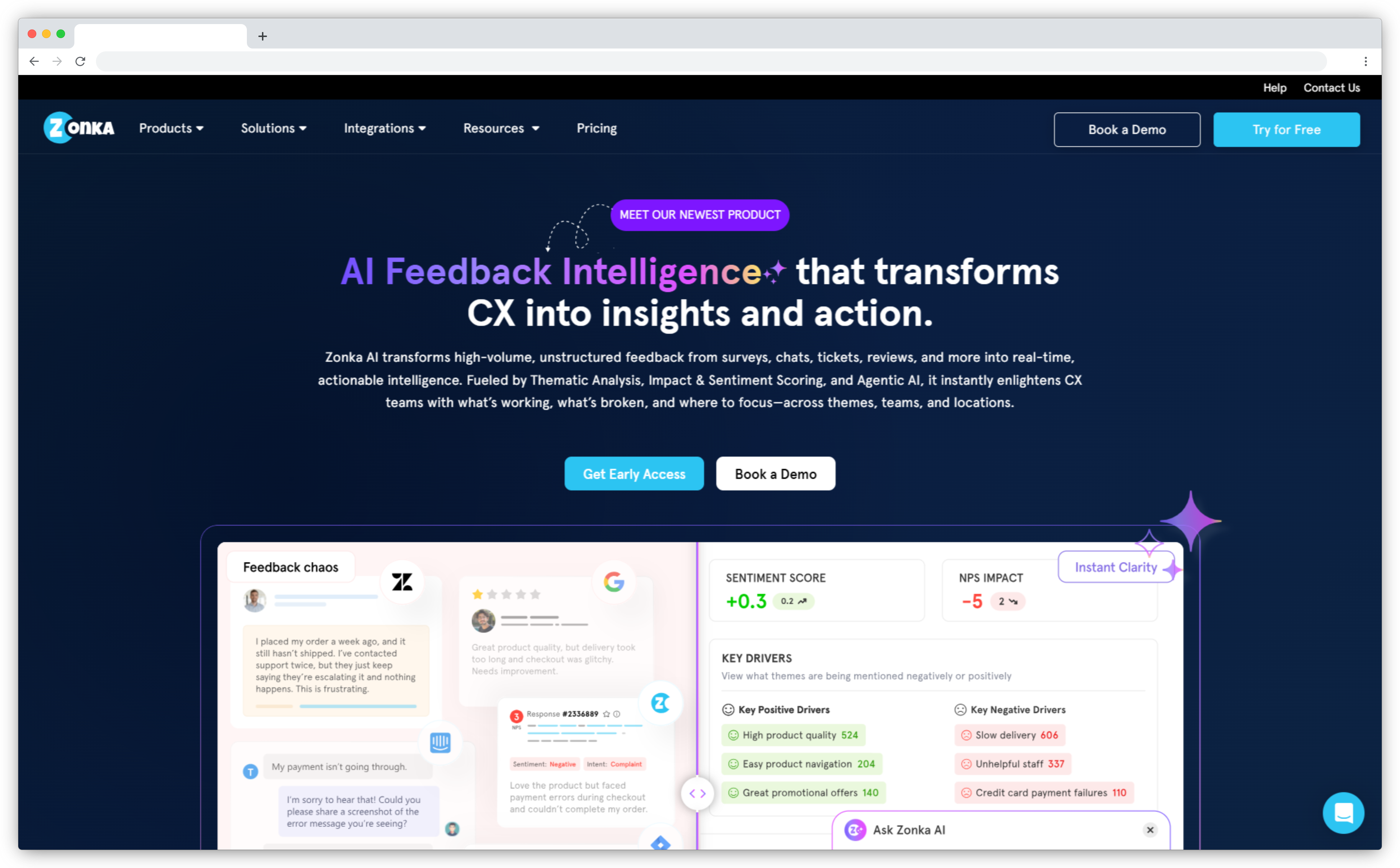
Zonka Feedback is an AI customer feedback and intelligence platform that combines omnichannel survey collection with a unified feedback analytics layer. It's HIPAA-compliant and ISO 27001 certified, with a BAA available for healthcare organizations.
The platform collects feedback across email, SMS, WhatsApp, tablet kiosks, in-app, web, offline, and QR codes, all managed from one dashboard. For healthcare, this matters because different care settings need different collection channels. Inpatient feedback works well via bedside tablet. Post-discharge follow-up works via SMS. Digital health touchpoints work via in-app surveys with the mobile SDK.
Zonka's AI Feedback Intelligence layer runs thematic analysis, sentiment scoring, entity mapping, and impact analysis across open-ended patient responses at scale. Instead of reading 2,000 discharge survey comments, the system surfaces that "wait times in radiology" appears in 34% of negative responses this month, mapped to the specific department and linked to the team responsible. Role-based signals mean the radiology department head sees their department's themes. The CMO sees system-wide patterns.
Healthcare customers include Akumin (700+ imaging centers, 10,000+ responses per month via email and SMS), Jupiter Hospital (department-wise patient feedback across dialysis, radiation, and physiotherapy via WhatsApp NPS), and Sankara Eye Care (patient experience feedback across an eye care network).
Key Features of Zonka Feedback
- Omnichannel feedback: email, SMS, WhatsApp, tablet kiosk, in-app, offline, QR code
- AI thematic analysis, sentiment scoring, entity mapping, and impact scoring
- Role-based signals: department-level through C-suite views
- Closed-loop case management with ticket creation and alert routing
- EHR integration via API (Salesforce, HubSpot, Zendesk, and custom webhook triggers)
- HIPAA-compliant, ISO 27001 certified, GDPR-compliant
Zonka Feedback Pros
- Omnichannel collection that covers every healthcare touchpoint in one platform
- AI intelligence layer eliminates manual analysis of open-text responses at scale
- Role-based signal architecture supports multi-location hospital and clinic networks
- Healthcare-specific customer references with documented deployment scale
Zonka Feedback Cons
- Does not support CAHPS/HCAHPS-compliant survey methodology natively
- EHR integration requires API configuration rather than native connector
- AI Feedback Intelligence tier carries significant pricing premium over the base feedback management plan
Zonka Feedback Pricing
- Custom pricing
G2 Rating: 4.7/5 on G2
Best Use Case: Mid-market to enterprise healthcare organizations that need omnichannel feedback collection and AI analysis without managing separate tools for collection and intelligence.
2. Medallia: Best for Enterprise Health Systems Needing Multi-Source Intelligence
Medallia is an enterprise customer experience platform that unifies feedback from surveys, contact center interactions, online reviews, social media, and call transcripts into one analytics layer. It's HIPAA-compliant and widely deployed across large health systems and hospital networks.
What separates Medallia from most tools on this list is its multi-source architecture. Patient feedback doesn't only come from surveys. It comes from multiple feedback sources: call center recordings, complaint letters, online reviews, and social mentions. Medallia ingests all of those and runs text analytics and speech analytics across them to surface patterns that survey-only tools miss entirely. A drop in discharge satisfaction scores that also appears in call center transcripts two weeks earlier shows up as a signal before it becomes a headline metric problem.
Role-based dashboards scale from ward level to C-suite. A nursing director sees their unit's scores. The Chief Experience Officer sees the full system view, segmented by location, department, and care setting. G2 reviewers consistently call out feedback management, insights generation, and closed-loop workflows as Medallia's strongest dimensions, though a steep learning curve and complex configuration appear frequently in the same reviews.
Key Features of Medallia
- Multi-source feedback: surveys, call center, reviews, social media, and chat
- Speech analytics for contact center interactions
- Text analytics with sentiment scoring across unstructured feedback data
- Role-based dashboards from department level to enterprise-wide
- EHR integration with enterprise deployment support
- HIPAA-compliant with enterprise security controls
Medallia Pros
- Strongest multi-source feedback unification capability in the market
- Speech analytics is a genuine differentiator for health systems with large contact center operations
- Enterprise-grade role hierarchy handles complex organizational structures
- Listed as a Gartner Magic Quadrant Leader for VoC platforms
Medallia Cons
- Pricing starts around $20,000/year, out of range for independent clinics and community hospitals
- Complex configuration requires dedicated admin resources and professional services
- Implementation timelines can run into months for large deployments
Medallia Pricing
- Contact sales. Custom enterprise pricing based on Experience Data Records (EDRs).
G2 Rating: 4.5/5 on G2
Best Use Case: Large health systems (500+ beds) or multi-hospital networks that need to unify patient survey data with contact center transcripts and online reviews under one analytics platform.
3. Qualtrics: Best for CAHPS Compliance and Regulatory Programs
Qualtrics is a customer experience platform and, following its May 2026 acquisition of Press Ganey Forsta (which had already acquired InMoment), the dominant vendor for CAHPS-compliant healthcare VoC in the enterprise market.
That acquisition context matters for buyers evaluating this space in 2026. Qualtrics now combines its own enterprise voice of customer analytics capabilities with Press Ganey Forsta's HCAHPS-approved survey methodology and the world's largest healthcare experience benchmark dataset. For large hospital systems that need to satisfy CMS regulatory requirements and run internal VoC programs in the same platform, there is no other vendor that brings those three things together natively.
Qualtrics is certified under HITRUST and FedRAMP in addition to HIPAA. It supports 13+ CAHPS regulatory programs, including HCAHPS, OAS CAHPS, Home Health CAHPS, CAHPS for MIPS, and ACO REACH. The platform's text analytics engine (Text iQ) handles open-ended responses at enterprise scale, and its Frontline Care product surfaces real-time signals to frontline teams rather than waiting for quarterly reports.
G2 reviewers rate Qualtrics at 4.3/5 with 747 reviews, which is lower than many tools on this list with fewer reviews. The consistent themes in reviews: powerful for complex research programs and enterprise analytics, but challenging to navigate without training, and slower to set up than mid-market alternatives.
Key Features of Qualtrics
- HCAHPS-approved CAHPS survey methodology for CMS regulatory compliance
- Supports HCAHPS, Home Health CAHPS, OAS CAHPS, CAHPS for MIPS, and ACO REACH
- HITRUST, FedRAMP, and HIPAA certifications
- Text iQ for enterprise text analytics across open-ended responses
- EHR integration with enterprise implementation support
- Role-based access and dashboards at health system scale
Qualtrics Pros
- Only platform with native CAHPS-compliant methodology AND enterprise VoC analytics after the Press Ganey Forsta acquisition
- Strongest regulatory program coverage in the market
- HITRUST and FedRAMP certifications go beyond standard HIPAA for organizations with federal program requirements
- Benchmark data from the Press Ganey Forsta dataset provides national comparison context
Qualtrics Cons
- Custom enterprise pricing with no public tiers, so a sales process is required before any cost visibility
- Complex implementation, since most large deployments require professional services engagement
- G2 reviewers cite lower ease of use and setup scores compared to mid-market alternatives
- Significant overkill for organizations that don't have CAHPS reporting requirements
Qualtrics Pricing
- Contact sales. No public pricing.
G2 Rating: 4.3/5 on G2
Best Use Case: Hospital systems with mandatory HCAHPS reporting obligations, organizations participating in CMS value-based care programs, or health systems running multiple CAHPS regulatory programs simultaneously.
Survey and Feedback Platforms for Healthcare Teams
For organizations that need HIPAA-compliant survey infrastructure without full enterprise overhead.
4. Sogolytics: Best for HIPAA-Secure Feedback in Regulated Healthcare Settings
Sogolytics (formerly SoGoSurvey) is an experience management platform built for regulated industries: healthcare, government, finance, and education. It's HIPAA-certified with BAA availability, and its pricing structure makes it accessible to healthcare organizations that don't have enterprise VoC budgets.
The platform's strongest argument for healthcare teams is its price-to-capability ratio. Pro at $39/month covers ground that SurveySparrow's business tier and SurveyMonkey's premier plans occupy at significantly higher price points. Advanced survey logic, multilingual support, real-time reporting, and a full data export stack are all available in the base paid tiers. Teams at community hospitals, independent clinics, and non-profit health organizations get professional-grade survey tooling without justifying an enterprise contract.
G2 reviewers specifically call out Sogolytics's quality of support (9.5 out of 10 on G2 support rating) and deployment speed as strengths. One verified reviewer from a hospital billing and marketing role noted using it for community health needs assessments and internal staff surveys simultaneously.
Key Features of Sogolytics
- HIPAA-certified with BAA availability for healthcare deployments
- Advanced survey logic, skip logic, and branching for complex patient journey surveys
- Multilingual surveys covering 30+ languages for diverse patient populations
- Real-time dashboards with sentiment analysis and trend reporting
- SogoCX module for structured customer experience programs
- SogoEX module for employee and clinical staff engagement programs
Sogolytics Pros
- Best price-to-capability ratio for HIPAA-compliant survey software in this list
- Full feature set available across plans, with no key feature gating behind enterprise tiers
- Documented healthcare customer references (hospitals, healthcare nonprofits)
- Strong support ratings consistently cited in G2 and TrustRadius reviews
Sogolytics Cons
- Lower brand recognition than Medallia or Qualtrics creates internal justification challenges in large procurement processes
- UI shows signs of the SoGoSurvey heritage in places and isn't as polished as newer platforms
- No native EHR integration, so survey triggers require manual setup or third-party automation
Sogolytics Pricing
- Free plan available.
- Pro: $39/month.
- Pro Max: $49/month.
- Enterprise: contact sales.
G2 Rating: 4.6/5 on G2 (86 reviews)
Best Use Case: Community hospitals, independent clinics, and health nonprofits that need HIPAA-compliant surveys with strong analytics capabilities and don't need enterprise-scale deployment.
5. QuestionPro: Best for Flexible Healthcare Research and Survey Programs
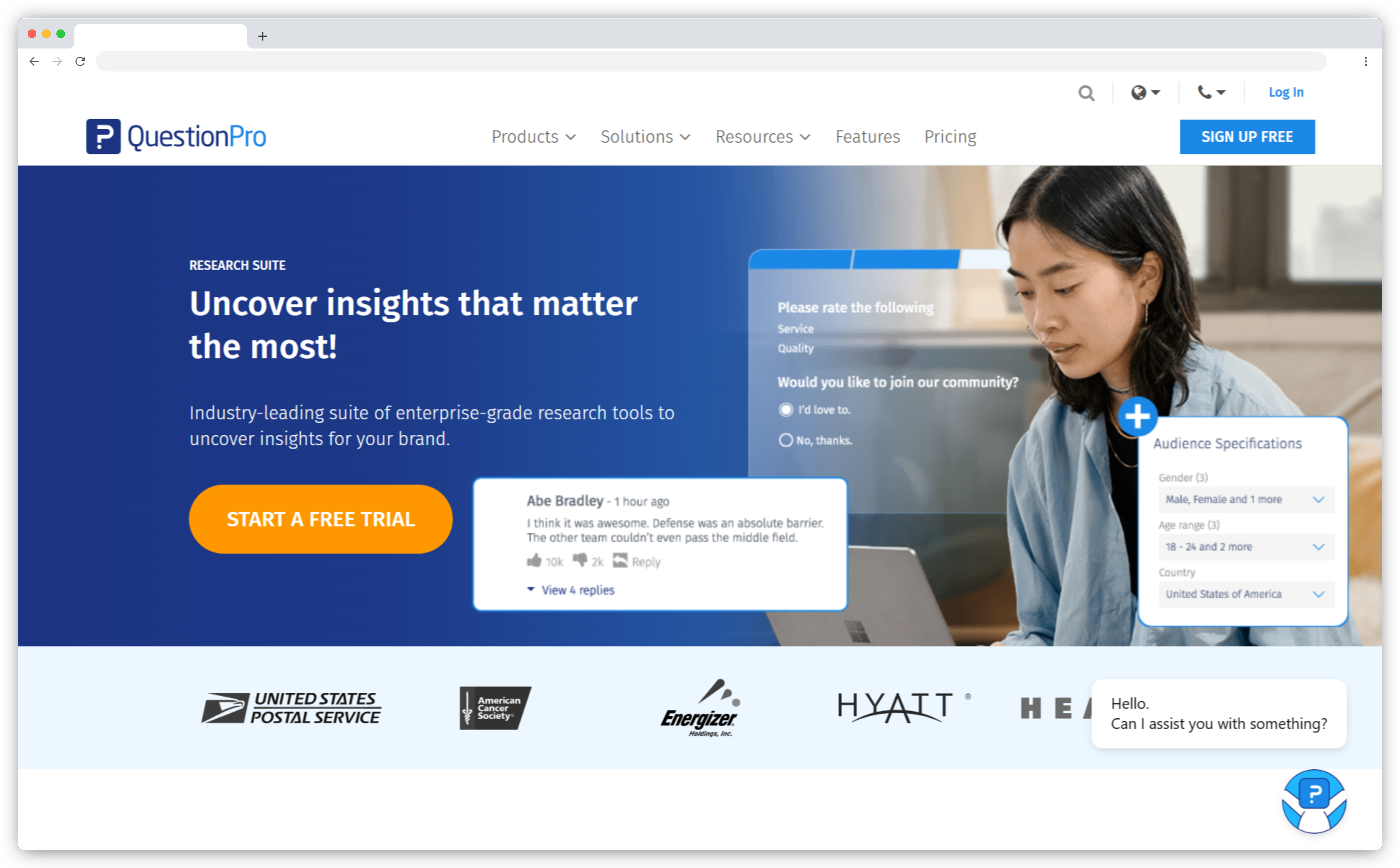
QuestionPro is a survey and research platform with a strong track record in healthcare market research, patient satisfaction programs, and multi-method feedback design. It's HIPAA-compliant with BAA availability and offers one of the more generous free research tiers in the category.
QuestionPro's differentiation is research sophistication. It supports conjoint analysis, MaxDiff, and cross-tab reporting natively, capabilities that matter for health systems running clinical quality research alongside patient satisfaction programs, or for healthcare organizations that want to go deeper than NPS and CSAT into structured patient journey research. Its recent acquisition of Fathom (text analytics, April 2026) and merger with Trymata (UX research, February 2026) have expanded its analytical depth considerably.
The platform's CX and EX suites (contact sales for pricing) sit on top of the core research tier. For teams specifically evaluating healthcare CX programs with automated workflows and real-time signal routing, Zonka Feedback or AskNicely are typically stronger fits. QuestionPro's strength is research depth and question-type breadth rather than CX automation.
Key Features of QuestionPro
- HIPAA-compliant with BAA availability
- 350+ question types including conjoint, MaxDiff, and ranking questions for structured research
- Native text analytics following the Fathom acquisition
- UX research capabilities following the Trymata merger
- Communities platform for longitudinal patient panel studies
- Role-based access with regional data center options
QuestionPro Pros
- Most flexible question design capabilities in the mid-market tier
- Generous free plan for testing and small-scale research projects
- Strong value for health systems running mixed research and CX programs
- Text analytics capability now native rather than requiring export to a separate tool
QuestionPro Cons
- CX automation and real-time alert routing are less developed than dedicated CX platforms
- Interface can feel complex for teams that only need standard NPS/CSAT survey distribution
- CX and EX module pricing requires sales contact, with no public tiers
QuestionPro Pricing
- Free Essentials plan. Advanced: $99/user/month.
- Team Edition: $83/user/month (5+ users, billed annually).
- CX/EX: contact sales.
G2 Rating: 4.5/5 on G2 (1,108 reviews)
Best Use Case: Health systems and research-oriented healthcare organizations that run both patient satisfaction programs and structured clinical or market research, and need a platform that handles both without switching tools.
6. SurveySparrow: Best for Department-Level HIPAA-Compliant Survey Distribution
SurveySparrow is a HIPAA-compliant survey platform known for its conversational survey format and multi-channel distribution. At $19/month for its entry tier, it's the most accessible HIPAA-compliant survey option in this list.
SurveySparrow's conversational survey format is worth highlighting for healthcare specifically. Completion rates on traditional form-based digital surveys in healthcare tend to lag behind conversational formats. SurveySparrow's chat-like format, which presents one question at a time in a conversation-style interface, has been cited by users as improving completion rates meaningfully in patient-facing survey programs. For outpatient clinics and specialty practices where response rate is a real operational challenge, that format difference matters.
The platform handles NPS, CSAT, CES, 360 assessments, and multi-channel distribution including SMS, email, web, and QR codes. It doesn't have native EHR integration, but its API supports custom trigger configurations. SurveySparrow isn't the right tool for CAHPS compliance or enterprise-scale health system analytics. But for department managers who need to deploy HIPAA-compliant patient feedback surveys across multiple care settings without a dedicated IT implementation, it deploys faster than anything else on this list.
Key Features of SurveySparrow
- HIPAA-compliant with BAA availability
- Conversational survey format for higher patient response rates
- Multi-channel distribution: email, SMS, web, QR, and in-app
- NPS, CSAT, CES, and custom survey types
- 70+ languages for multilingual patient populations
- Real-time reporting and response tracking
SurveySparrow Pros
- Fastest deployment of any HIPAA-compliant tool in this list, with minimal setup required
- Conversational format drives better completion rates in patient-facing surveys
- Affordable entry pricing accessible to department-level budgets
- Strong multi-language support for diverse patient populations
SurveySparrow Cons
- No native EHR integration, so encounter-triggered surveys require custom API work
- Analytics depth is more limited than Qualtrics, Medallia, or Zonka's AI Intelligence tier
- Business and enterprise tiers require sales contact for pricing and isn't fully transparent
SurveySparrow Pricing
- Starts at $19/month. Higher business and enterprise tiers available.
G2 Rating: 4.4/5 on G2 (2,038 reviews)
Best Use Case: Outpatient clinics, specialty practices, and department managers at hospital systems who need HIPAA-compliant patient satisfaction surveys deployed quickly across multiple touchpoints with minimal IT involvement.
Digital Patient Engagement and Frontline Feedback
For organizations where feedback connects directly to patient workflows or frontline team performance.
7. NexHealth: Best for Digital-First Patient Engagement
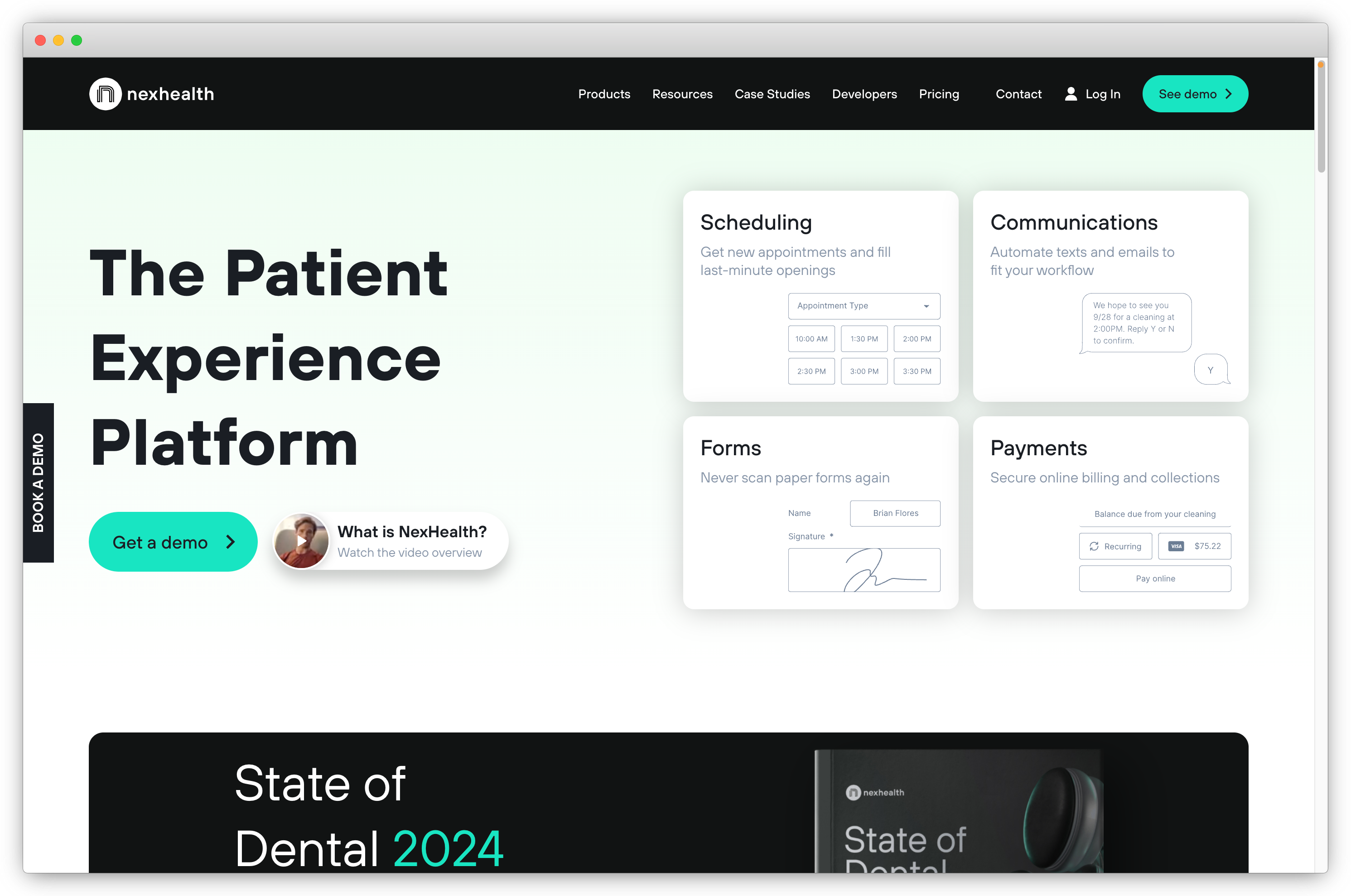
NexHealth is a patient experience platform built for digital health workflows: online appointment scheduling, digital intake forms, automated reminders, and post-visit feedback collection. It's HIPAA-compliant with native EHR integration covering Dentrix, Eaglesoft, Athena, eClinicalWorks, and others.
The distinction worth understanding here is that NexHealth isn't a general VoC tool applied to healthcare. It's a patient engagement platform that closes the feedback loop at the moment patients are already engaged in a digital workflow. When a patient books an appointment online, gets a reminder via text, and completes digital intake forms before their visit, NexHealth can trigger a feedback request immediately after the visit through the same channel the patient already used. The response rate on that kind of contextual, channel-consistent outreach is higher than a generic survey email sent three days later.
That workflow integration is what differentiates NexHealth from the other tools in this category. It works best for dental practices, medical groups, and outpatient clinics that have already digitized their patient front-office workflows and want to close the feedback loop natively within that system. It's not the right tool for inpatient hospital settings or organizations looking for enterprise-scale VoC analytics.
Key Features of NexHealth
- HIPAA-compliant with BAA availability
- Native EHR integration: Dentrix, Eaglesoft, Athena, eClinicalWorks, and others
- Automated post-visit feedback triggered by completed encounters in the EHR
- Online scheduling, digital intake, and reminders on the same platform
- NPS and CSAT survey collection with real-time dashboard
- SMS and email feedback distribution with mobile-first design
NexHealth Pros
- Native EHR integration covers the broadest range of EHR systems on this list
- Feedback collection embedded in digital patient workflows rather than isolated in a separate tool
- Strong fit for dental and medical groups already using a digital front-office stack
- Month-to-month billing available for non-enterprise plans
NexHealth Cons
- Limited analytics depth compared to Zonka Feedback, Medallia, or Qualtrics
- Not designed for inpatient or complex multi-department hospital environments
- Focused on dental and outpatient medical, with limited documented deployment in specialty or acute care settings
NexHealth Pricing
- Starts at $299/month. 4 pricing tiers available.
G2 Rating: 4.8/5 on G2
Best Use Case: Dental practices, outpatient medical groups, and specialty clinics that have digitized their patient front-office workflows and want feedback collection integrated natively with scheduling and communication.
8. AskNicely: Best for Frontline Healthcare Teams and Service Recovery
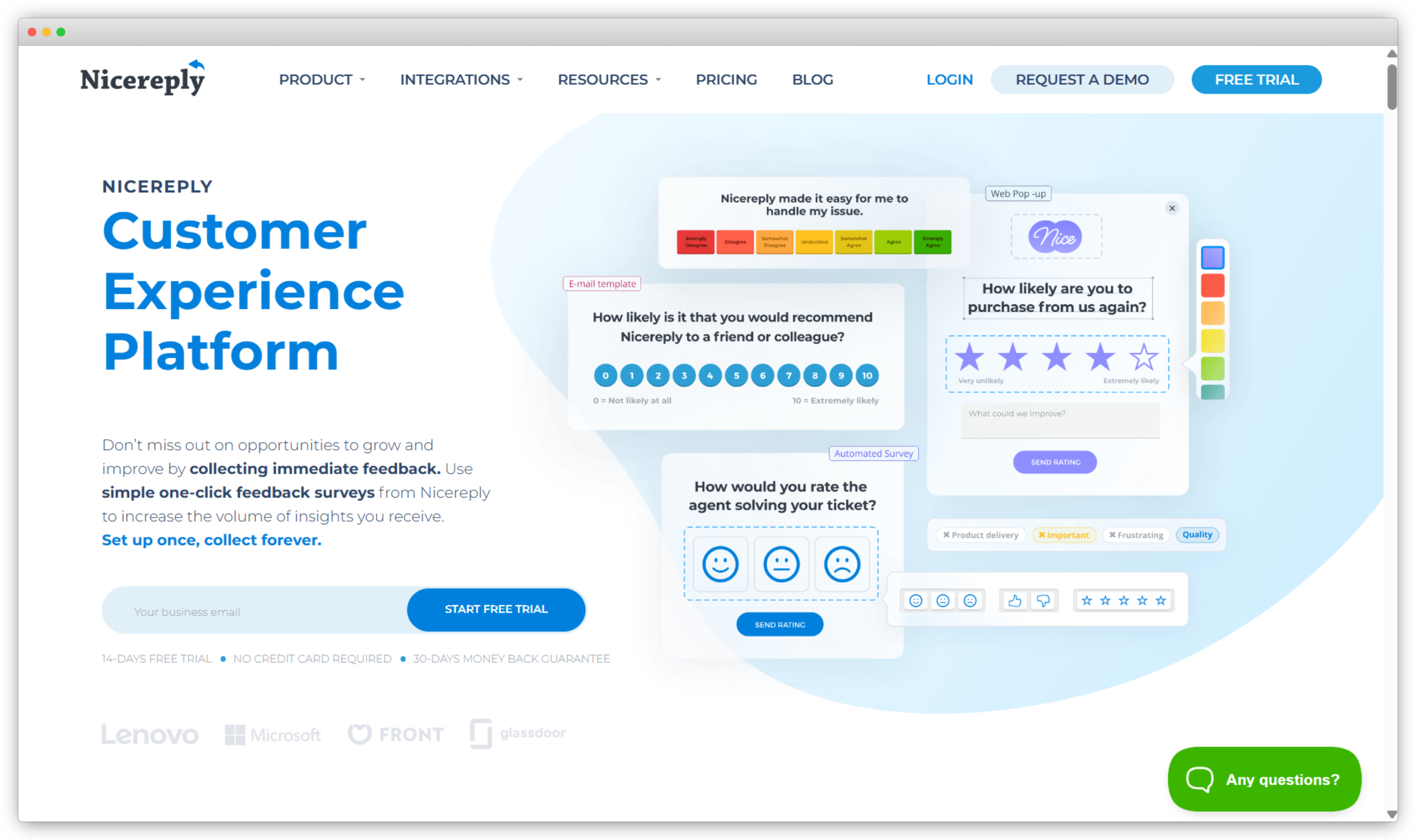
AskNicely is a customer experience platform built specifically for frontline, people-powered service businesses. In healthcare, that maps directly to clinic chains, home health agencies, hospice providers, and outpatient networks where the individual care experience delivered by frontline staff is the primary driver of patient satisfaction.
With 1,046 reviews and a 4.7/5 rating on G2, AskNicely has strong review volume for a platform in this category. The consistent themes across those reviews are simplicity, frontline coaching workflows, and the ability to see performance at the individual employee or team level. For a clinic network where one location consistently scores lower than others, AskNicely's location-level and employee-level feedback data makes that visible in real time rather than buried in a quarterly report.
The platform's coaching and recognition workflows deserve specific mention. AskNicely goes beyond collecting feedback and reporting it. It routes high scores back to the individual staff member as recognition, and routes low scores to the manager as a coaching alert. In healthcare settings where frontline burnout is a real operational problem, that kind of real-time positive reinforcement from patient feedback is a differentiator that general VoC tools don't match.
Key Features of AskNicely
- NPS, CSAT, and 5-star surveys with real-time frontline dashboards
- Employee and team-level feedback visibility with coaching workflow integration
- Automated service recovery alerts for low scores
- Review generation workflows for satisfied patients
- Multi-location performance benchmarking
- Integration with CRM, helpdesk, and communication platforms
AskNicely Pros
- Strongest frontline coaching and employee-level feedback architecture in this list
- Real-time alert routing supports same-day service recovery, not quarterly reporting
- Multi-location benchmarking shows which sites consistently underperform
- High review volume on G2 (1,046 reviews) with strong ease-of-use scores
AskNicely Cons
- No native EHR integration, so encounter-triggered surveys require third-party automation
- Less suited for complex inpatient or multi-department analytics needs
- Pricing starts at $399/month, higher than SurveySparrow or Sogolytics for comparable survey functionality
AskNicely Pricing
- Starts at $399/month. Contact for full pricing.
G2 Rating: 4.7/5 on G2
Best Use Case: Clinic chains, home health agencies, hospice providers, and any healthcare organization where individual frontline staff performance is the primary driver of patient satisfaction scores.
Reputation Management and Multi-Source Feedback
For healthcare organizations that want to capture what patients say when they're not being surveyed.
9. Birdeye: Best for Healthcare Reputation Management and Online Reviews
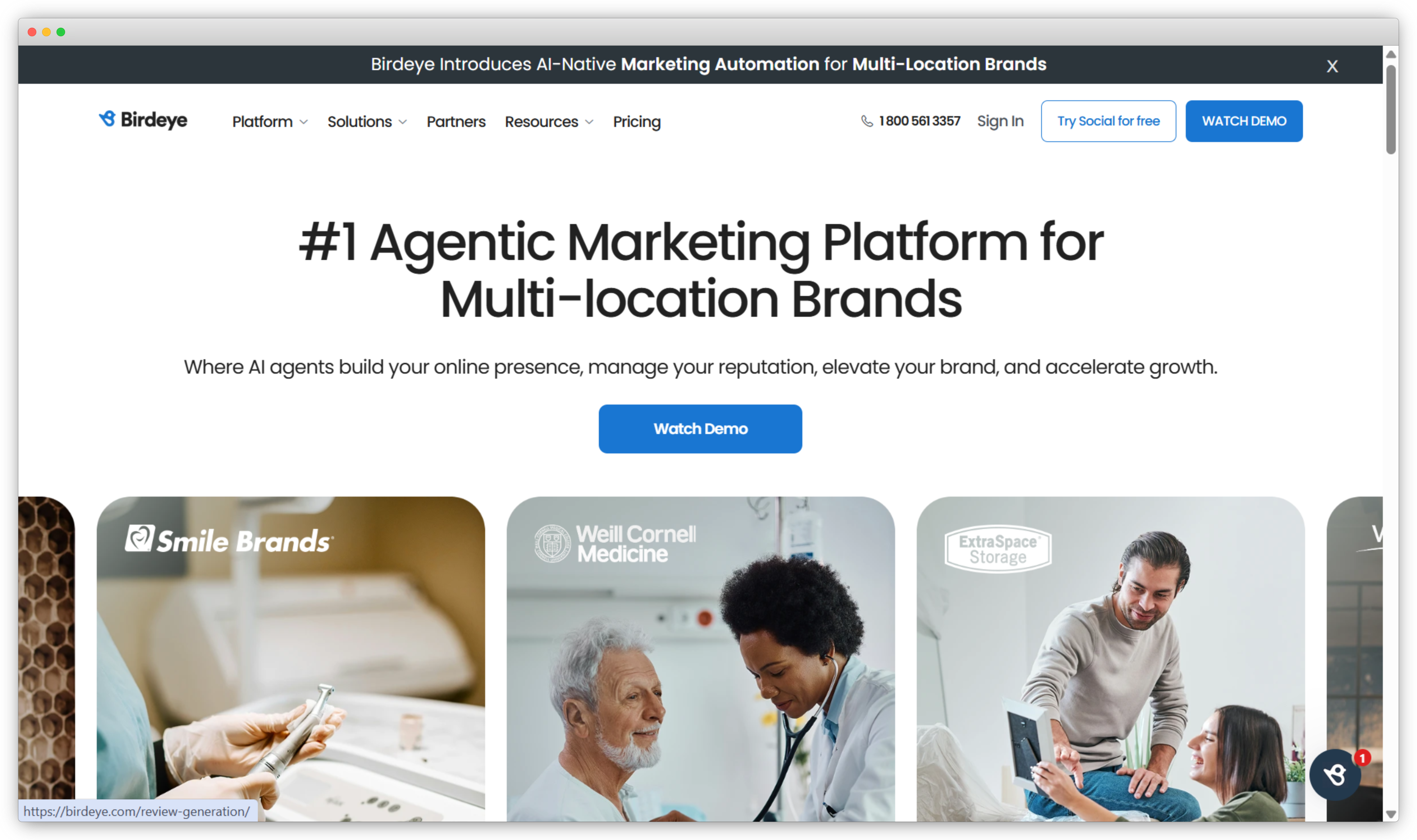
Birdeye is an AI-powered marketing and reputation management platform trusted by more than 200,000 businesses. For healthcare organizations, it aggregates patient reviews across Google, Healthgrades, Zocdoc, Yelp, and other platforms in one dashboard, with tools to monitor, respond to, and generate reviews at scale.
The VoC angle on Birdeye is worth stating directly: online patient reviews are the largest corpus of unsolicited patient feedback most healthcare organizations will ever access. They're more candid than survey responses, they're public, and they directly affect new patient acquisition through Google search visibility. A hospital that generates 500 post-visit survey responses per month may generate 3,000+ public review touchpoints in the same period. Birdeye treats those reviews as structured VoC data rather than reputation noise.
For multi-location healthcare brands, including hospital networks, dental chains, urgent care groups, and specialty practices across multiple sites, Birdeye's per-location management architecture handles review monitoring and response at scale. Location-level ratings, response workflows, and competitive benchmarking across the network are all native to the platform. Birdeye holds a 4.7/5 rating on G2 from 3,502 reviews, making it the most reviewed platform in this list by a significant margin.
Key Features of Birdeye
- Multi-platform review aggregation: Google, Healthgrades, Zocdoc, Yelp, and 200+ review sites
- AI-powered review response generation
- Review request automation triggered by care events or survey scores
- Multi-location performance dashboards and competitive benchmarking
- Patient messaging and chat capabilities
- Social media management integrated with reputation monitoring
Birdeye Pros
- Strongest review aggregation coverage in the healthcare category
- Multi-location architecture handles networks of dozens to hundreds of locations
- Highest G2 review volume in this list (3,502 reviews) with consistent 4.7 rating
- AI review response reduces time-to-response for high-volume review environments
Birdeye Cons
- Per-location pricing model compounds quickly for large networks, and 10+ locations require custom enterprise pricing
- Not a substitute for a structured patient satisfaction survey program, and works best alongside one
- No native support for HCAHPS or CAHPS reporting requirements
Birdeye Pricing
- Contact for pricing. Per-location model with Starter, Growth, and Dominate tiers.
G2 Rating: 4.7/5 on G2 (3,502 reviews)
Best Use Case: Multi-location healthcare organizations, including hospital networks, dental chains, urgent care brands, and specialty practice groups, that need to manage patient reviews at scale and turn online review data into structured VoC signals.
10. Alchemer: Best for Healthcare Teams Combining Survey Data with Indirect Feedback
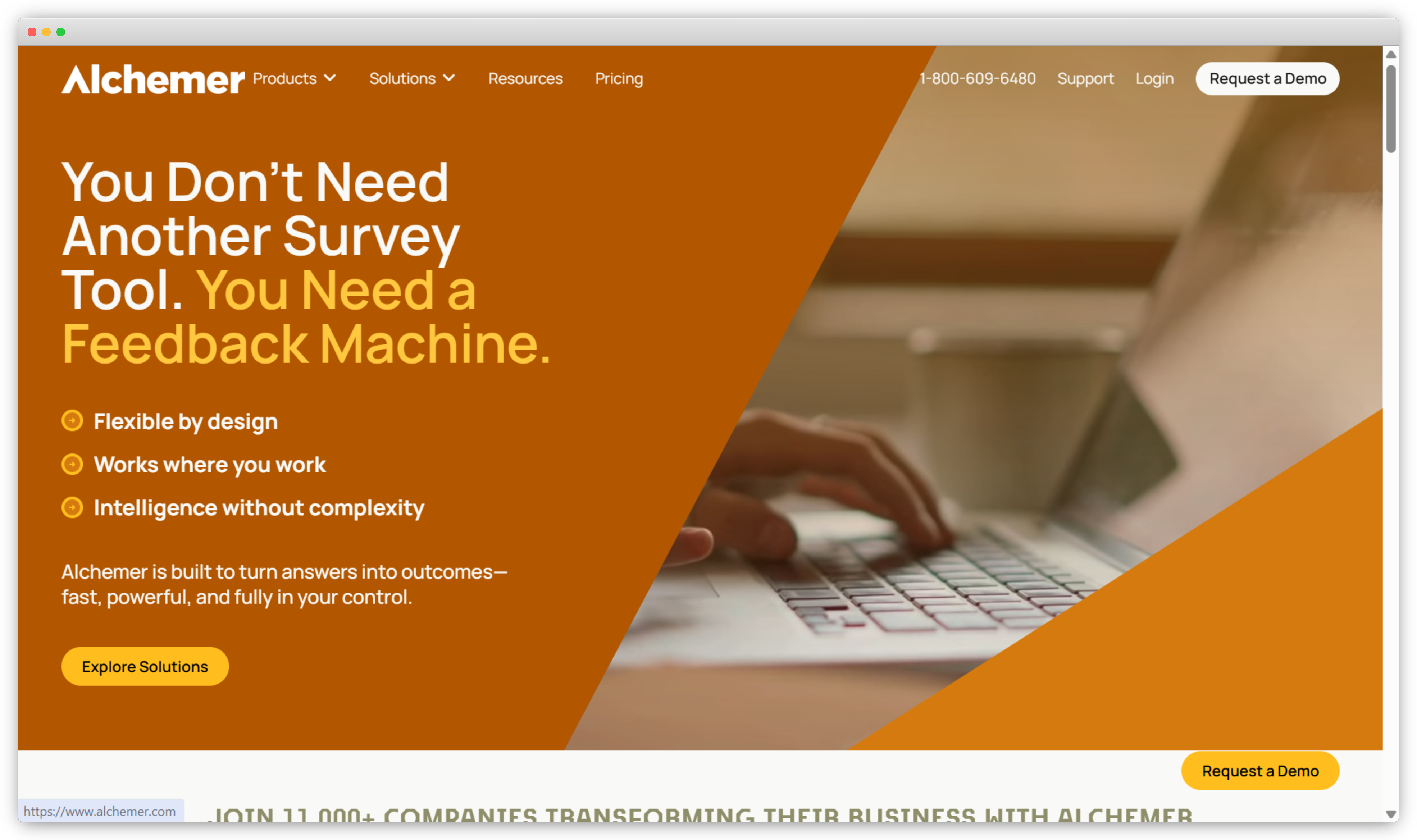
Alchemer (formerly SurveyGizmo) is a challenger-positioned VoC platform that earns its fifth consecutive inclusion in the Gartner Magic Quadrant for VoC Platforms in 2026. Its September 2025 acquisition of Chatmeter, a multi-location AI-powered customer intelligence platform, significantly changed its capability profile.
Before the Chatmeter acquisition, Alchemer was primarily a flexible, HIPAA-compliant survey platform with strong logic capabilities and SOC 2 / GDPR compliance. That description still applies. But Chatmeter adds direct feedback from patient reviews, social media, and community mentions alongside the survey data layer. For healthcare organizations that want to move beyond survey-only VoC without buying a full enterprise suite, Alchemer now offers a more complete picture than most tools in this price range.
The platform reaches 500 million people monthly through its Alchemer Digital in-app feedback product, and its Alchemer Workflow module handles automated feedback routing across 10,000+ unique workflows. G2 reviewers highlight the advanced survey logic as a consistent differentiator, as the question types and conditional logic cover scenarios that SurveySparrow and SoGoSurvey's survey builders don't handle cleanly.
Key Features of Alchemer
- HIPAA-compliant, SOC 2 certified, GDPR-ready
- Direct feedback: advanced surveys, in-app prompts, website intercepts
- Indirect feedback: reviews and social media monitoring via Chatmeter integration
- Advanced survey logic: skip logic, branching, piping, and conditional display
- Alchemer Workflow for automated feedback routing and case management
- API and integration support with Salesforce, HubSpot, and 400+ connectors
Alchemer Pros
- Combined direct and indirect feedback in one platform after the Chatmeter acquisition
- Advanced survey logic handles complex multi-branch patient journey surveys
- HIPAA, SOC 2, and GDPR compliance in one platform
- More affordable entry point than Medallia or Qualtrics for organizations that don't need CAHPS compliance
Alchemer Cons
- Reputation management integration is newer and less mature than Birdeye's native reputation platform
- Enterprise packages require an annual commitment, with no month-to-month billing at the enterprise tier
- Lower brand recognition in healthcare-specific procurement contexts
Alchemer Pricing
- Starts at $55/month. Enterprise packages: contact sales.
G2 Rating: 4.4/5 on G2
Best Use Case: Healthcare organizations that want to combine patient survey data with unsolicited feedback from online reviews and social channels, without managing separate platforms for each.
The VoC Compliance Trap in Healthcare
Most healthcare procurement teams check one compliance box: HIPAA. They confirm the vendor is HIPAA-compliant, get a BAA signed, and move forward. That's the right first step.
But it's only the first step.
HIPAA governs how PHI is handled, stored, and transmitted. It's a data security and privacy standard. A vendor that signs a BAA and encrypts data at rest is HIPAA-compliant. That says nothing about whether their survey methodology meets CMS requirements for patient experience data submission.
CAHPS reporting standards govern something different: how patient experience surveys are designed, administered, sampled, and submitted to CMS for regulatory programs. For hospitals participating in the HCAHPS program, survey design must follow specific question wording, sampling methodology, and administration protocols approved by CMS. A hospital can run HIPAA-compliant patient satisfaction surveys for five years and still have its HCAHPS results penalized in CMS Value-Based Purchasing reimbursements, because the tool they used wasn't a CMS-approved CAHPS vendor and the methodology didn't meet CMS submission standards.
The practical implication is straightforward. If your organization has mandatory HCAHPS reporting obligations, which applies to virtually all acute care hospitals participating in Medicare, your shortlist for that component of your VoC stack must start with CMS-approved CAHPS vendors. In 2026, that category is dominated by Qualtrics following the Press Ganey Forsta acquisition.
For organizations without CAHPS reporting requirements, including outpatient clinics, dental practices, home health agencies, and specialty practices, HIPAA compliance plus a BAA is the correct floor. CAHPS alignment isn't relevant to your stack.
The second compliance gap worth naming: patient survey data is only one layer of a real healthcare voice of customer program. Clinical staff voice feeds the service-profit chain and correlates with patient satisfaction outcomes. Caregiver feedback captures experience dimensions that patients themselves can't always articulate. Payer and member experience data affects retention in ways that don't show up in HCAHPS scores. Most VoC tools are built to solve the patient survey layer. Thinking that layer is the full program is how organizations end up with data they can't fully act on.
For a detailed breakdown of HIPAA-compliant survey tools specifically, the HIPAA-compliant survey tools guide covers compliance verification and BAA procurement in detail. For healthcare-specific question design, VoC survey questions for healthcare covers what to ask at each touchpoint.
How to Choose the Right VoC Tool for Your Healthcare Organization
The right tool depends on what you need to accomplish, not on which platform has the most features.
| Organization Type | Primary Need | Start Here |
| Large hospital system (500+ beds) with HCAHPS obligations | CAHPS compliance + enterprise analytics | Qualtrics |
| Multi-location clinic or hospital network | Omnichannel collection + location-level view + AI analysis | Zonka Feedback |
| Digital health or telehealth provider | In-app + EHR-triggered feedback | NexHealth, Zonka Feedback |
| Community or independent hospital on a defined budget | HIPAA compliance + strong analytics without enterprise pricing | Sogolytics, QuestionPro |
| Clinic chain with frontline service recovery goals | Frontline team performance + location benchmarking | AskNicely |
| Research-oriented health system | Advanced survey methodology + text analytics | QuestionPro, Alchemer |
| Multi-location brand managing online reviews | Review aggregation + survey data in one view | Birdeye, Alchemer |
The VoC metrics your organization tracks will also shape the tool decision. A few decisions worth calling out:
If HCAHPS compliance is non-negotiable, start with Qualtrics and work backward from there. No other tool in this list has the CAHPS-approved methodology natively in 2026.
If you need omnichannel collection and AI intelligence in one platform without the Qualtrics price point, Zonka Feedback is the strongest mid-market option and the only tool in this list with documented deployment at Akumin's scale (700+ centers).
If your primary challenge is frontline coaching and location-level service recovery, AskNicely solves that specific problem better than any other platform here, including enterprise tools built for different use cases.
Building a program around more than one tool is reasonable for larger organizations. A hospital system might run Qualtrics for CAHPS compliance, Zonka Feedback for multi-channel patient experience programs, and Birdeye for reputation management. These functions don't overlap. They serve different layers of the VoC stack.
For a full framework on structuring the program itself, the voice of customer framework covers program architecture in detail. The guide on building a voice of customer program walks through setup step by step.
Which VoC Tool Is Right for Your Healthcare Organization?
Picking the right VoC solution is a function of what you need to accomplish, not what the feature matrix says. A community hospital that needs HIPAA-compliant patient surveys at $39/month and a 500-bed acute care hospital with HCAHPS reporting obligations are not in the same buying situation, even if they're searching the same keyword.
The tools in this guide cover the full range of that spectrum. Qualtrics for organizations where CAHPS compliance is non-negotiable. Zonka Feedback for organizations that need omnichannel collection and AI intelligence without enterprise complexity. Sogolytics and SurveySparrow for teams that need to move fast on a defined budget. NexHealth for practices that have digitized their patient front office. AskNicely for frontline-driven care environments. Birdeye and Alchemer for organizations that want to hear patients beyond the survey.
The next step after picking a tool is building the program. A platform without a defined listening architecture, feedback cadence, and closed-loop accountability structure won't improve patient experience scores regardless of how much it costs. For guidance on that structure, the VoC best practices for healthcare guide covers program design. The benefits of a voice of customer program article covers the organizational outcomes that a well-run program actually produces.



.png)