

.svg)
 Healthcare
 Finance
 Retail
 SaaS & Digital
 eCommerce
 Education
 Salesforce
  HubSpot
 Pipedrive
 Mailchimp
 Klaviyo
 Zendesk
  Intercom
 Freshdesk
 HelpScout
  Front
Front Jira
Jira Slack
Slack  MS Teams
 Zoom
Zoom Google Sheets
  Zapier
  Integrately
 Make
Make  Webhooks




 MS Teams
%20Tools%20in%202026_%20Reviews%2c%20Pricing%2c%20Comparison-1.svg)


Voice of Customer (VoC) tools are software platforms that help businesses capture, analyze, and act on customer feedback from multiple sources, surveys, support tickets, online reviews, contact center interactions, and more. They help teams understand customer pain points, track customer sentiment, and make decisions that improve customer experience, retention, and loyalty across the entire customer journey.
TL;DR
- Best overall VoC platform: Zonka Feedback: AI-driven, omnichannel, full feedback lifecycle in one place
- Best for AI Customer Feedback Analytics: Chattermill: enterprise CX, product and insights team
- Best for enterprise CX intelligence: InMoment: predictive analytics, speech analytics, multi-source data
- Best for global enterprise programs: Medallia: multi-country CX orchestration with operational data fusion
- Best for research-grade surveying: Qualtrics: complex survey logic and advanced analytics at scale
- Best for B2B and CPG: CustomerGauge: account-based NPS tied directly to revenue
- Best for SaaS in-app feedback: Refiner: behavioral targeting and contextual in-product surveys
- Best for support-driven VoC: Crescendo.ai: AI analysis of 100% customer conversations, no surveys needed
- Best for churn prevention: Zenloop: automated retention workflows triggered by feedback signals
- Best for SMBs starting out: SurveyMonkey: fast, low-friction survey collection at an accessible price
- Best for visual product feedback: Usersnap: annotated screenshot feedback from inside your product
- Best for guided implementation: CustomerHero: AI VoC platform with expert program support included
- Best for growing mid-market teams: Sogolytics: action-driven VoC with strong closed-loop infrastructure
- Best for research-heavy programs: Forsta: advanced text analytics, emotion detection, multi-audience scope
- Best for CX and HR survey programs: Startquestion: flexible survey platform for European mid-market teams
We evaluated all 17 tools on: feedback source coverage, AI and analytics depth, omnichannel collection capabilities, integration ecosystem, and closed-loop action support.
Most teams already have some form of VoC tool. A survey platform. A support ticket system. Maybe a review monitoring dashboard someone set up two years ago and hasn't touched since.
And yet the question CX and product leaders keep asking stays the same: "Why can't we figure out what our customers actually want?"
The tools aren't always the problem. Fragmentation is. When your customer data lives in five different platforms and no one's connecting the dots, you don't have a VoC program, you have a data storage problem. Feedback flows in, sits in silos, and never becomes the kind of actionable insights teams can move on.
The right VoC tool doesn't just collect feedback. It unifies it, analyzes it, and gets the right insight to the right person before it's too late to act.
This guide covers 17 Voice of Customer tools we evaluated on real criteria, feedback coverage, analytics depth, AI capabilities, ease of deployment, and how well they actually help teams close the loop. Whether you're building your first program or replacing a platform that's stopped delivering, here's what's worth your time in 2026.
What Are Voice of Customer Tools?
Voice of Customer tools help businesses collect customer feedback, analyze it, and act on what customers think, feel, and expect at every stage of their journey. In practice, they're the infrastructure behind any serious voice of the customer program.
They pull from multiple data sources: customer surveys, online reviews, contact center interactions, support tickets, in-app behavior, and direct feedback. Some tools focus on collection. Others specialize in analysis. The best ones do both, and connect insights to action across multiple departments.
VoC tools let teams track customer sentiment over time, surface recurring customer pain points before they escalate, understand customer behavior and unmet customer expectations across touchpoints, and identify issues before they drive churn.
They're not just survey platforms. A good VoC tool is how you turn scattered feedback data into clear decisions your whole organization can act on. Teams that analyze customer feedback regularly make faster, more confident decisions than those relying on gut feel.
Types of Voice of Customer Tools
The VoC landscape is broad. Before picking a platform, it's worth knowing which category you actually need, because these tools do very different jobs.
Survey-based platforms are built for collecting feedback at specific moments through feedback forms. NPS after a renewal. CSAT after a support interaction. CES after onboarding. They're strong for gathering quantitative and qualitative data on a defined question at a defined moment, but they only capture what you think to ask, and only from customers who respond. sentiment analysis tools built on top of survey data are useful, but the input is limited by your survey design and your response rate. For most teams, survey-based VoC is where programs start, not necessarily where they should end.
In-app and contextual feedback tools capture feedback inside the product, triggered by behavior or user actions. The feedback is specific and timely. As one category of product feedback tools, they're best for product and SaaS teams that need real-time signals from active users at the moments that actually matter, onboarding, feature adoption, trial expiry, task completion.
AI conversation analysis tools don't rely on surveys at all. They analyze 100% of customer conversations, calls, chats, emails, SMS, automatically. No response rate problem. No selection bias. Every interaction becomes a data point, including unstructured data from calls and chats that surveys never capture. The tradeoff is that they're built for support-heavy environments and work best alongside, not instead of, broader VoC programs.
Full-lifecycle VoC platforms combine collection, unification, and analysis in one system. They pull from multiple channels, apply machine learning and NLP to unstructured feedback with platforms that use AI to analyse customer feedback, and give teams a single view of customer experience. These are the platforms you need when VoC isn't a single team's job, it's an organization-wide feedback management program that spans product, CX, support, and operations simultaneously.
Specialized VoC tools serve specific verticals or use cases, B2B account management, research-heavy programs, visual feedback for product teams. Powerful within their niche, but narrow outside it. If your primary use case is clearly defined, a specialized tool often beats a general-purpose platform on depth and fit.
Knowing which category fits your program narrows the decision significantly. Most of the tools in this list span more than one category, which is where the real comparison gets interesting.
How We Evaluated These Tools
We assessed 17 VoC platforms across five criteria:
- Feedback source coverage: how many channels and data sources the tool captures from
- AI and analytics depth: quality of sentiment analysis, theme detection, and insight generation
- Omnichannel collection: ability to gather feedback across digital, physical, and conversational touchpoints
- Integration ecosystem: connectivity with CRM, helpdesk, and workflow tools
- Closed-loop capability: whether the tool helps teams act on feedback, not just store it
Zonka Feedback is our product. We've noted that wherever relevant. All other tools were evaluated independently on the same five criteria.
Comparison Table: Best Voice of Customer Platforms in 2026
| VoC Tool | Top VoC Capability | Best For | Free Trial | Price | G2 Rating |
| Zonka Feedback | AI-driven multi-channel VoC + full lifecycle management | All-size enterprises needing end-to-end VoC | Yes | Custom | 4.7 |
| Chattermill | AI-powered customer feedback analytics | Mid-market and enterprise CX, product, and insights team | No | Custom | 4.4 |
| Refiner | In-app microsurveys with behavioral targeting | SaaS and product-led growth teams | Yes | From $99/mo | 4.6 |
| Qualaroo | AI-powered on-site and in-app nudges | In-context feedback capture | Yes | From $49.99/mo | 4.3 |
| Sogolytics | Action-driven feedback across touchpoints | Mid-market and enterprise CX teams | Yes | Custom | 4.6 |
| Crescendo.ai | AI analysis of 100% support conversations | Enterprises with high support volume | Yes (with AI agent) | Free with package | N/A |
| Enterpret | AI feedback analytics unifying signals | Product and CX teams needing deep analysis without building collection | No | Custom | 4.6 |
| InMoment | Deep experience intelligence and predictive analytics | Large enterprises with complex CX programs | No | Custom | 4.7 |
| Medallia | Enterprise CX orchestration at global scale | Multi-national enterprises, multi-department programs | No | Custom | 4.5 |
| Qualtrics | Research-grade surveys and advanced analytics | Research-heavy enterprises and institutions | No | Custom | 4.4 |
| SurveyMonkey | Fast, easy multichannel feedback collection | SMBs and teams starting their VoC journey | Yes | From $39/mo | 4.4 |
| Forsta | Advanced text analytics and emotion detection | Research agencies and regulated industries | No | Custom | 4.2 |
| CustomerGauge | Account-based NPS tied to revenue | B2B and CPG organizations | No | Custom | 4.6 |
| CustomerHero | AI VoC with expert-guided program setup | Teams that need strategic implementation support | No | Custom | 4.8 |
| Zenloop | 360° feedback collection + automated retention | B2C retail, e-commerce, and D2C brands | No | Custom | 4.7 |
| Usersnap | Visual, annotated in-product feedback | Product teams and developers | Yes | From $69/mo | 4.5 |
| Startquestion | Survey-based VoC for CX and HR | Mid-market teams needing flexible survey programs | Yes | Custom | 4.6 |
The 17 Best Voice of Customer Tools in 2026
1. Zonka Feedback: Best for AI-Driven, Multi-Channel VoC Programs
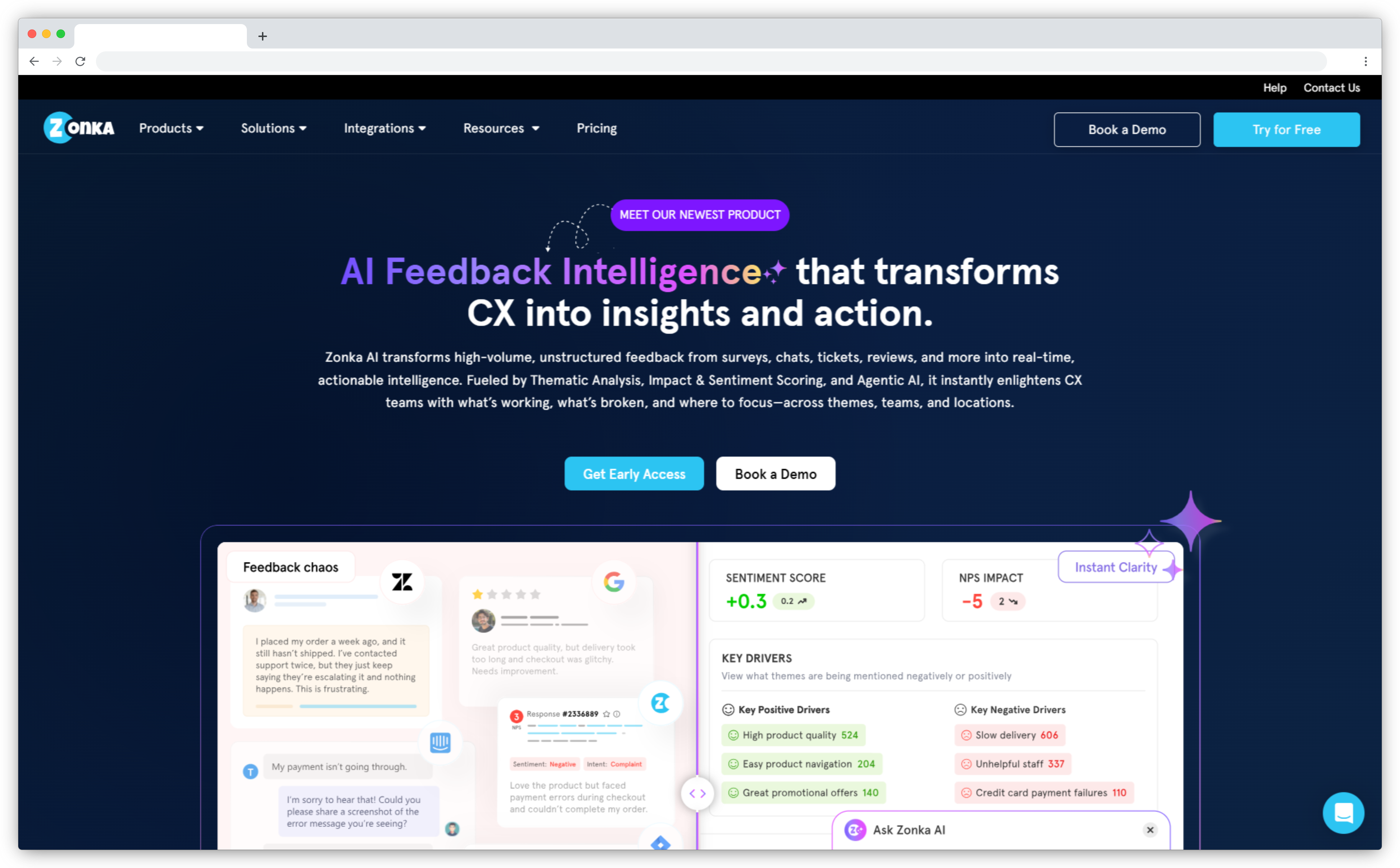
Zonka Feedback is a customer experience management platform and the strongest choice when you need feedback from every channel unified into one intelligence layer, with AI that does the analysis automatically. It collects across email, SMS, WhatsApp, web, in-app, kiosks, offline, and QR codes, then runs sentiment analysis, thematic clustering, and text intelligence across every response to turn scattered comments into clear, prioritized CX insights. Instead of reading hundreds of open-text responses, your team gets automated summaries and impact-ranked themes that show what needs attention first.
What separates it for VoC programs is how that intelligence gets distributed. An agent sees feedback about their own interactions. A branch manager sees location-level signals. The CCO sees the full picture. Brands like Damas and Simpl use Zonka to run VoC programs that connect feedback directly to action, without the manual analysis overhead. For teams working with scattered tools to collect and analyse customer feedback, Zonka replaces the patchwork with one connected program.
Best for: Retail, healthcare, SaaS, hospitality, and multi-location enterprises needing a centralized, AI-first VoC system that scales from 100 to 100,000+ responses per month.
Key Features:
- Impact scoring that ranks themes by business impact, not just how often they appear
- Entity mapping that connects feedback to specific locations, agents, services, and departments
- Reputation management: monitor and respond to Google, G2, and Capterra reviews within Zonka
- Closed-loop case management with direct integrations into Zendesk, Jira, Salesforce, and HubSpot
Pros
- Full feedback lifecycle in one platform: no separate tools to connect
- Scales from 100 to 100,000+ responses per month without switching platforms
- ISO 27001, GDPR, and HIPAA compliant: live in under a week
Cons
- Custom pricing means no self-serve entry point for very small teams
- 14 day free trial(available on request)
G2 Rating: 4.7/5 (81 reviews)
2. Chattermill: Best VoC Tool for AI Powered Customer Feedback Analytics
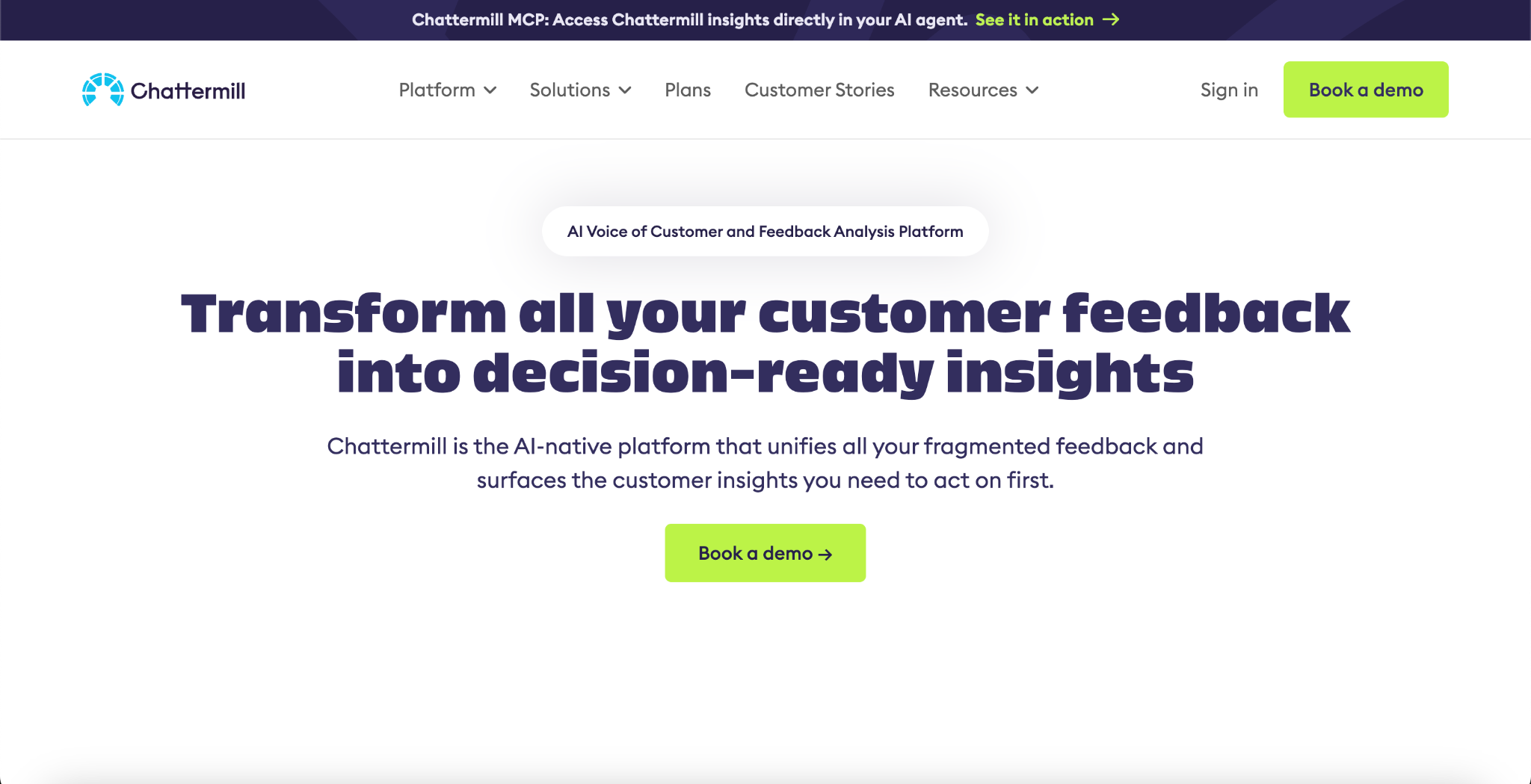
Chattermill is an AI-native Voice of the Customer (VoC) platform that helps organizations centralize and analyze customer feedback from surveys, reviews, support tickets, social media, call transcripts, and other customer touchpoints. Rather than focusing on collecting feedback, it specializes in transforming large volumes of unstructured customer data into actionable insights using AI-powered theme detection, sentiment analysis, and natural language querying.
Chattermill helps CX, Product, and Operations teams understand why customers feel the way they do by automatically identifying recurring issues, emerging trends, and the business impact behind customer feedback. Its proprietary Lyra AI engine, Ask Lyra conversational analytics, automated alerts, and integrations with tools like Zendesk, Salesforce, Slack, Jira, Intercom, and Qualtrics make it well-suited for organizations that want to connect customer insights directly to product improvements and operational decisions.
Chattermill AI-powered VoC analytics platform
 Best for: Enterprise CX, Product, Customer Insights, and Operations teams that need to unify customer feedback from multiple channels and prioritize improvements using AI.
Key Features:
- AI-powered theme detection and sentiment analysis across customer feedback
- Unified feedback hub for surveys, reviews, support tickets, calls, and social channels
- Ask Lyra conversational AI for natural language customer insight queries
- Automated alerts, dashboards, and trend monitoring
Pros
- Excellent at consolidating customer feedback from multiple sources
- AI automatically categorizes feedback and surfaces actionable trends
- Strong integrations with CX, CRM, and product management ecosystems
Cons
- Not designed for collecting surveys or running feedback campaigns
- Pricing is available only through custom quotes
- Better suited for organizations with high feedback volumes than small businesses
G2 Rating: 4.4/5 (238 reviews)
3. Refiner: Best VoC Tool for In-App and SaaS Product Feedback
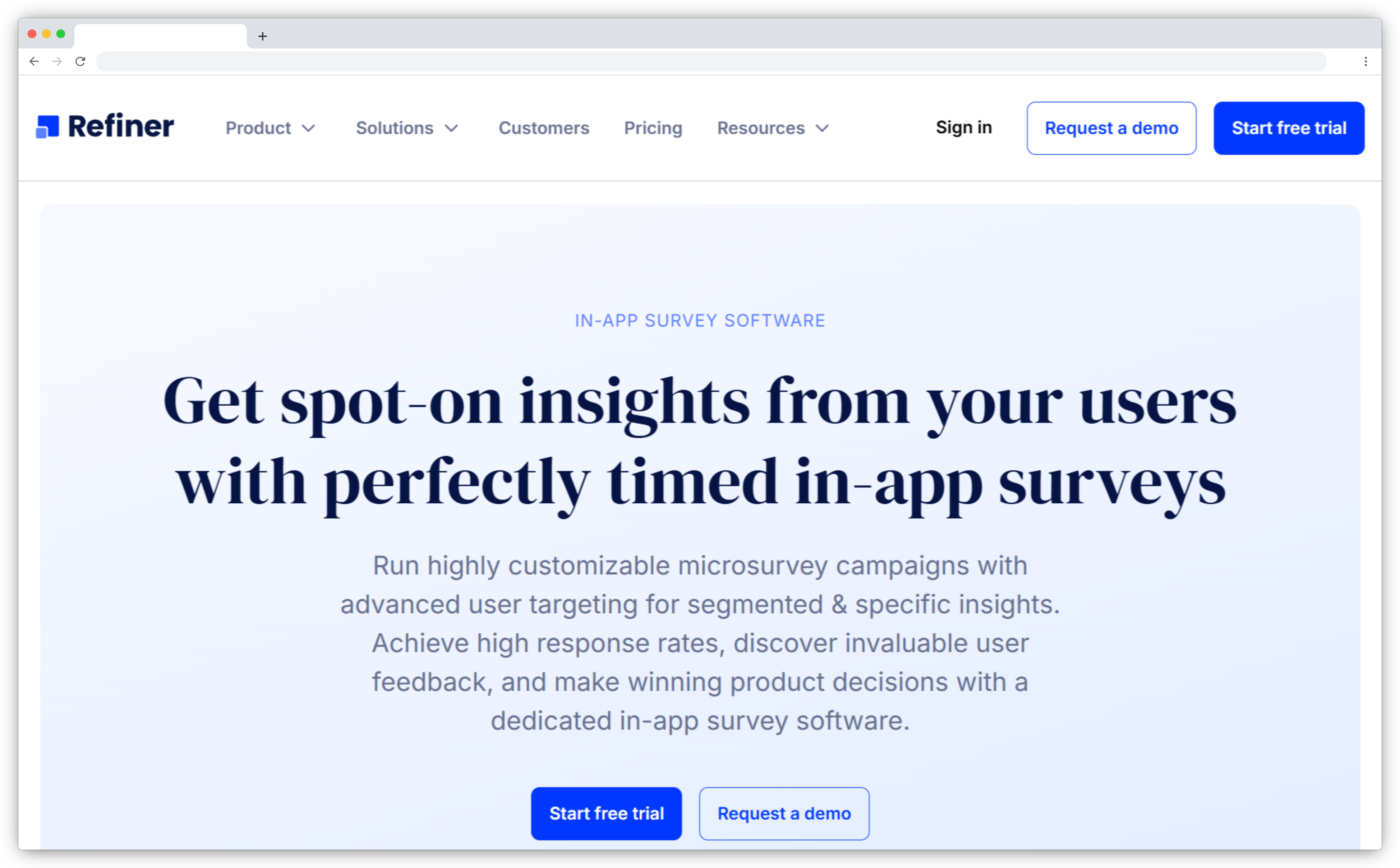
Refiner is an in-app survey platform built for SaaS and product teams. It triggers surveys based on what users do inside your product, such as completing onboarding, using a specific feature, or reaching the end of a trial, so feedback is collected at the relevant moment rather than days later through a scheduled email blast.
Unlike general survey tools like SurveyMonkey or Typeform, Refiner lets you limit surveys to specific user segments based on customer demographics, lifecycle stage, subscription plan, or usage behavior. Product managers, UX researchers, and customer success teams use this to get responses about customer preferences from the exact users who have experienced what they're asking about. You can survey users who have used a feature three times instead of your whole user base, which makes the responses more useful. For tools to collect feedback directly inside your app, it's one of the more targeted options available.
Best for: SaaS startups, product managers, and UX researchers who need real-time in-product VoC signals at specific moments in the user journey.
Key Features:
- Behavioral event triggers: surveys fire based on what users do, not when you schedule them
- NPS, CSAT, CES, PMF, and fully custom survey types
- Advanced targeting by lifecycle stage, subscription tier, or custom user attribute
- Native integrations with Segment, Intercom, HubSpot, and Slack
Pros
- Best-in-class targeting precision for in-product surveys
- Minimal engineering lift to get live
- Strong fit for modern SaaS and product-led growth stacks
Cons
- Limited offline feedback capability
- Not designed for multi-channel or enterprise-wide VoC programs
- Advanced event-based triggers may need developer support
G2 Rating: 4.6/5 (25 reviews)
4. Qualaroo: Best for AI-Powered On-Site & In-App Feedback Capture
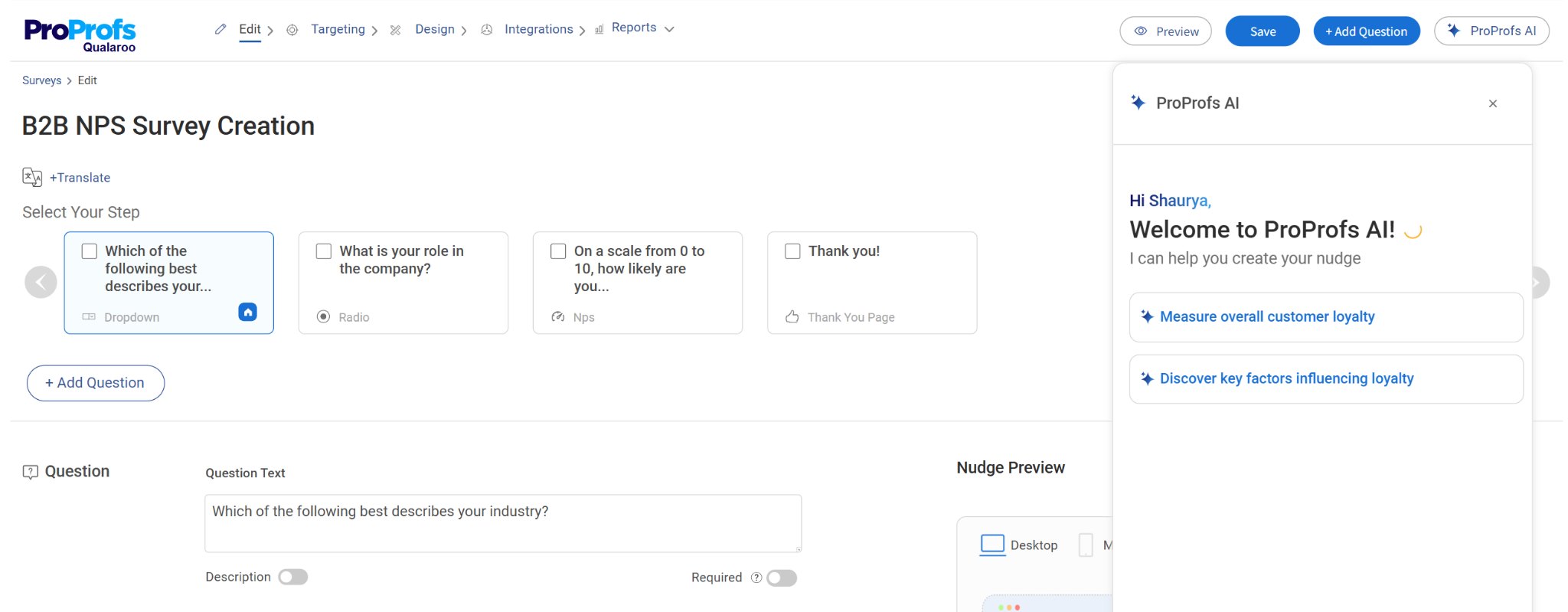
Qualaroo is an AI-powered Voice of the Customer platform built around capturing feedback at the exact moment it matters, through targeted on-site, in-app, mobile, and prototype surveys called Nudges™. Rather than pulling feedback together after the fact, it focuses on reaching users while they are actively engaged, then using its Customer Feedback Analysis AI to score sentiment and surface themes from open-text responses in real time.
Qualaroo helps Product, CX, and UX teams pinpoint exactly where users are struggling and why, using advanced targeting based on behavior, identity, and custom properties to reach the right visitor at the right moment. Its Identify API ties responses back to known users, and native integrations with tools like Salesforce, HubSpot, Slack, Mailchimp, and Zapier make it easy to route feedback into existing CX and product workflows.
Best for: Product, UX, and CX teams that need real-time, in-context feedback from website visitors, app users, and prototype testers, not just after-the-fact analysis of feedback collected elsewhere.
Key Features:
- On-site, in-app, mobile, and prototype Nudges™ for contextual feedback collection
- Customer Feedback Analysis AI with native sentiment scoring and word cloud generation
- Advanced user targeting based on behavior, identity, and custom properties
- Identify API and native integrations with CRM, support, and analytics tools
Pros
- Reaches users in the moment, producing higher response rates than post-visit or email surveys
- Native AI sentiment analysis turns open-text responses into themes without manual review
- Precise targeting means surveys reach the right segment instead of every visitor
Cons
- No native email, SMS, or WhatsApp distribution if you need feedback beyond the web or product experience
- Sentiment analysis is basic keyword-level tagging, not full thematic clustering
- Pricing scales with the number of active Nudges, which can add up quickly for teams running several concurrent surveys
G2 Rating: 4.3/5 (48 reviews)
5. Sogolytics: Best Action-Driven VoC Platform for Growing Teams
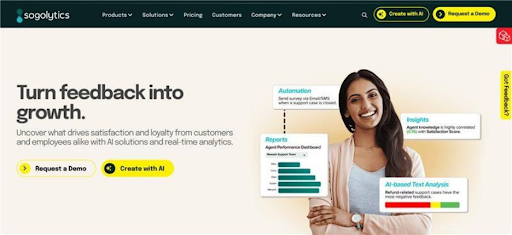
Sogolytics is a VoC platform that covers survey collection, real-time analytics, and closed-loop action in one system. You can run NPS, CSAT, CES, and custom surveys across email, web, and mobile, with automated alerts and workflows that route feedback to the right teams without manual triage.
The main difference from basic survey tools like SurveyMonkey is the built-in closed-loop layer. Instead of showing you data and leaving follow-up to you, Sogolytics automatically creates tasks and alerts from low scores, turning feedback data into valuable insights your team can act on. For growing teams that have outgrown entry-level tools but aren't ready for the complexity or cost of enterprise platforms like InMoment or Medallia, it's a practical middle ground.
Best for: Mid-sized businesses and fast-growing companies that need end-to-end VoC with strong closed-loop infrastructure and without enterprise-level complexity.
Key Features:
- CSAT, NPS, CES, and custom VoC surveys across email, web, link, and QR
- Automated alerts and closed-loop workflows that route feedback to the right teams
- Real-time dashboards with trend analysis and sentiment scoring
- CRM integrations for feedback-triggered follow-up actions
Pros
- Feedback leads to action, not just reports
- Scales well from mid-market to growing enterprise programs
- Analytics accessible without heavy technical setup
Cons
- Advanced features have a learning curve for new users
- Pricing is higher than basic survey-only tools
G2 Rating: 4.6/5 (85 reviews)
6. Crescendo.ai: Best AI-Backed VoC Tool for Customer Support Teams
Crescendo.ai takes a survey-free approach to VoC. It automatically transcribes, analyzes, and categorizes 100% of customer support conversations, calls, chats, emails, and SMS, turning each interaction into structured CX intelligence without asking customers to fill anything out. Every conversation is a data point. No response rate problem. No selection bias.
Most VoC tools only capture what customers choose to report. Crescendo captures what customers actually experience in every support interaction, including the majority who never fill out a survey. That's a materially different picture of customer sentiment, and it feeds directly into agent coaching, knowledge base updates, and product improvement loops.
-1.png?width=3896&height=2416&name=Untitled%20design%20(13)-1.png)
Best for: Enterprises, SaaS companies, and e-commerce brands with high support volume that need AI-driven VoC insights from 100% of customer interactions.
Key Features:
- Automatic transcription and AI analysis of 100% of support conversations across chat, call, email, and SMS
- AI-based CSAT scoring derived from sentiment signals, not manual survey responses
- Sentiment detection for frustration, urgency, satisfaction, and churn risk in real time
- Agent performance insights and coaching signals tied to individual interactions
Pros
- Captures VoC data from interactions that never trigger a survey
- Eliminates selection and response bias entirely
- Insights continuously feed back into AI training and knowledge base optimization
Cons
- VoC platform is free but only available to Crescendo's AI agent customers
- No social media listening or review monitoring
G2 Rating: Not listed on G2
7. Enterpret: Best AI Feedback Analytics Layer for Unifying Scattered Customer Signals
Enterpret is a customer feedback intelligence platform built for teams that already have feedback flowing in from everywhere like support tickets, NPS surveys, app store reviews, sales calls, social media, and community forums, but no single system stitching it together. It connects to feedback sources and uses AI to automatically tag, cluster, and organize that feedback into a structured taxonomy, so product and CX teams can spot recurring themes without manually coding open-text responses.
Enterpret doesn't collect feedback itself, there's no native survey builder or in-app widget. It's purpose-built as an analysis layer that sits on top of tools you already use. Its Wisdom AI Agent lets teams ask plain-language questions ("why are signups stalling in Europe?") and get answers pulled straight from the underlying feedback data.
.png?width=1366&height=623&name=Screenshot%20(68).png) Best for: Product and CX teams already collecting feedback across multiple tools who need a dedicated AI layer to unify, tag, and surface themes from that data, without adding another survey platform.
Best for: Product and CX teams already collecting feedback across multiple tools who need a dedicated AI layer to unify, tag, and surface themes from that data, without adding another survey platform.
Key Features:
- Connects to 50+ feedback sources (support tickets, reviews, surveys, sales calls, social, community forums)
- Adaptive Taxonomy that evolves with customer language instead of relying on fixed tags
- Wisdom AI Agent for natural-language querying inside Slack, Jira, or ChatGPT
- Action Agents that flag emerging issues or at-risk accounts in real time
Pros
- Strong at unifying and organizing feedback that's already scattered across many tools
- Adaptive taxonomy reduces manual tagging work as feedback volume grows
- Natural-language querying makes insights accessible to non-analysts
Cons
- No native feedback collection — needs to be paired with a survey or in-app tool
- No free trial; evaluating it requires a sales-led demo
- Enterprise-only pricing (typically $30K–$100K+/year) puts it out of reach for smaller teams
G2 Rating: 4.6/5 (110 reviews)
8. InMoment: Best Enterprise VoC Platform for Deep CX Intelligence
InMoment is an enterprise VoC platform that analyzes feedback from multiple sources at the same time. It ingests data from surveys, social mentions, online reviews, and contact center interactions, then applies text analytics, predictive modeling, and speech analytics to understand customer sentiment and identify what's driving satisfaction scores across the customer journey.
Compared to Medallia, InMoment's main differentiator is the depth of the predictive layer. It can model which accounts are at churn risk and which touchpoints are likely to degrade before those issues show up in satisfaction scores. The trade-off is a longer implementation timeline and higher cost than most platforms on this list.
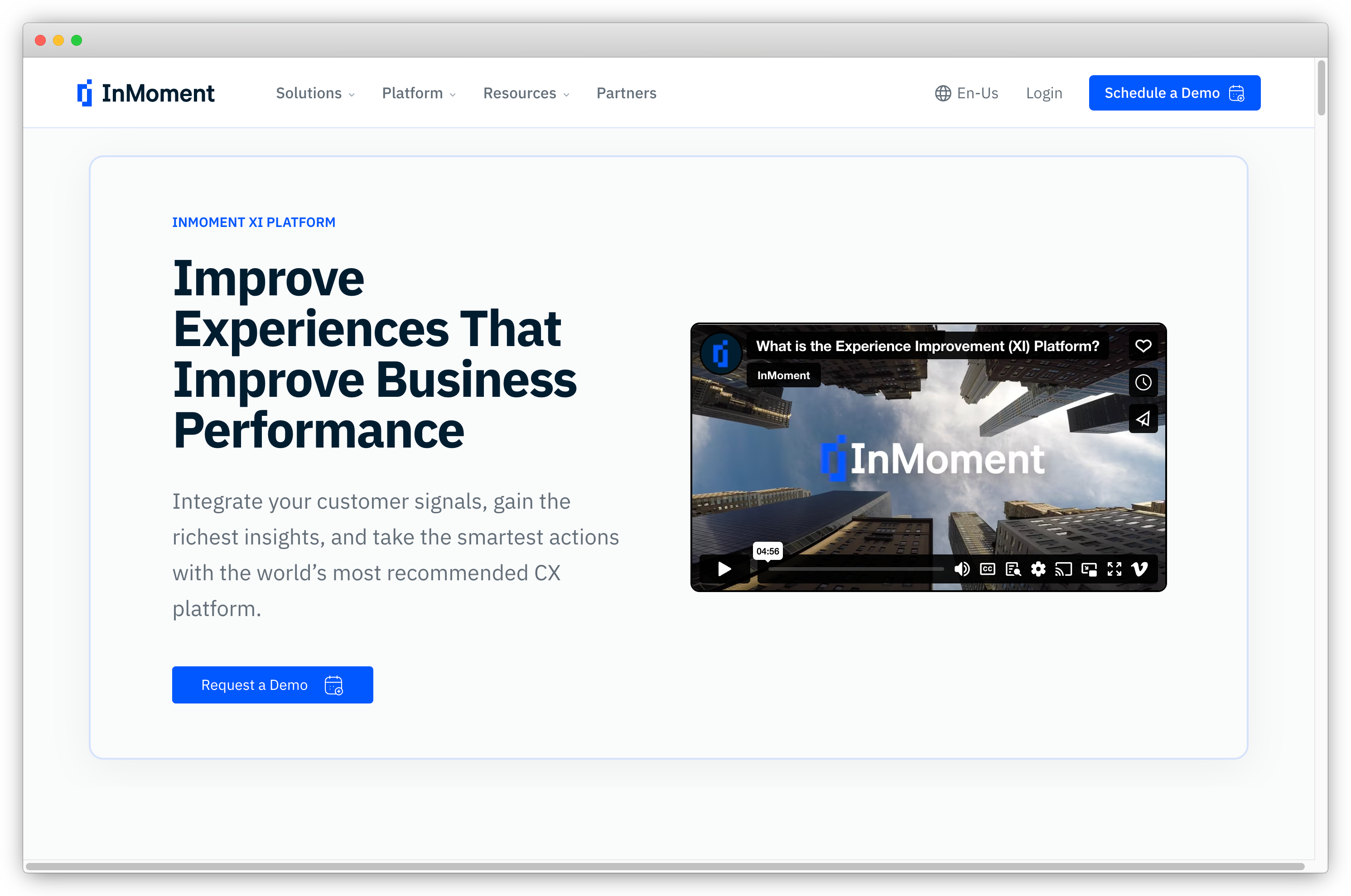
Best for: Large enterprises, contact centers, financial institutions, healthcare networks, and global brands managing high feedback volumes across multiple departments.
Key Features:
- Multi-source feedback ingestion (direct surveys, indirect social/review signals, inferred behavioral data)
- Real-time text and speech analytics with emotion detection for contact center interactions
- Predictive analytics for customer behavior modeling and churn risk identification
- Experience Improvement Score (EIS) to track the ROI of CX initiatives
Pros
- Captures direct, indirect, and inferred feedback signals in one system
- Predictive modeling for proactive CX decision-making at enterprise scale
- Strong connectivity with operational data sources (CRM, ERP, contact center)
Cons
- Complex implementation requiring significant time and resource investment
- Enterprise-level pricing puts it out of reach for most mid-market teams
- Platform depth requires a dedicated CX operations team to manage effectively
G2 Rating: 4.7/5 (319+ reviews)
9. Medallia: Best Voice of Customer Platform for Global Enterprise CX Programs
Medallia is built for global enterprises that need a governed, multi-country VoC program with full visibility across every customer touchpoint. Its core strength is fusing experience data, what customers say and feel, with operational data from CRM, HRIS, POS, and ERP systems. That fusion gives leadership a view of how customer experience connects to business performance, not just satisfaction scores in isolation.
It's a different type of platform from InMoment or Qualtrics. Medallia is designed for large, multi-country programs where governance, role-based access, and operational data integration are requirements. The implementation is lengthy and the cost is high, but for organizations with those requirements and that level of scale, it's one of the most capable enterprise VoC systems available.
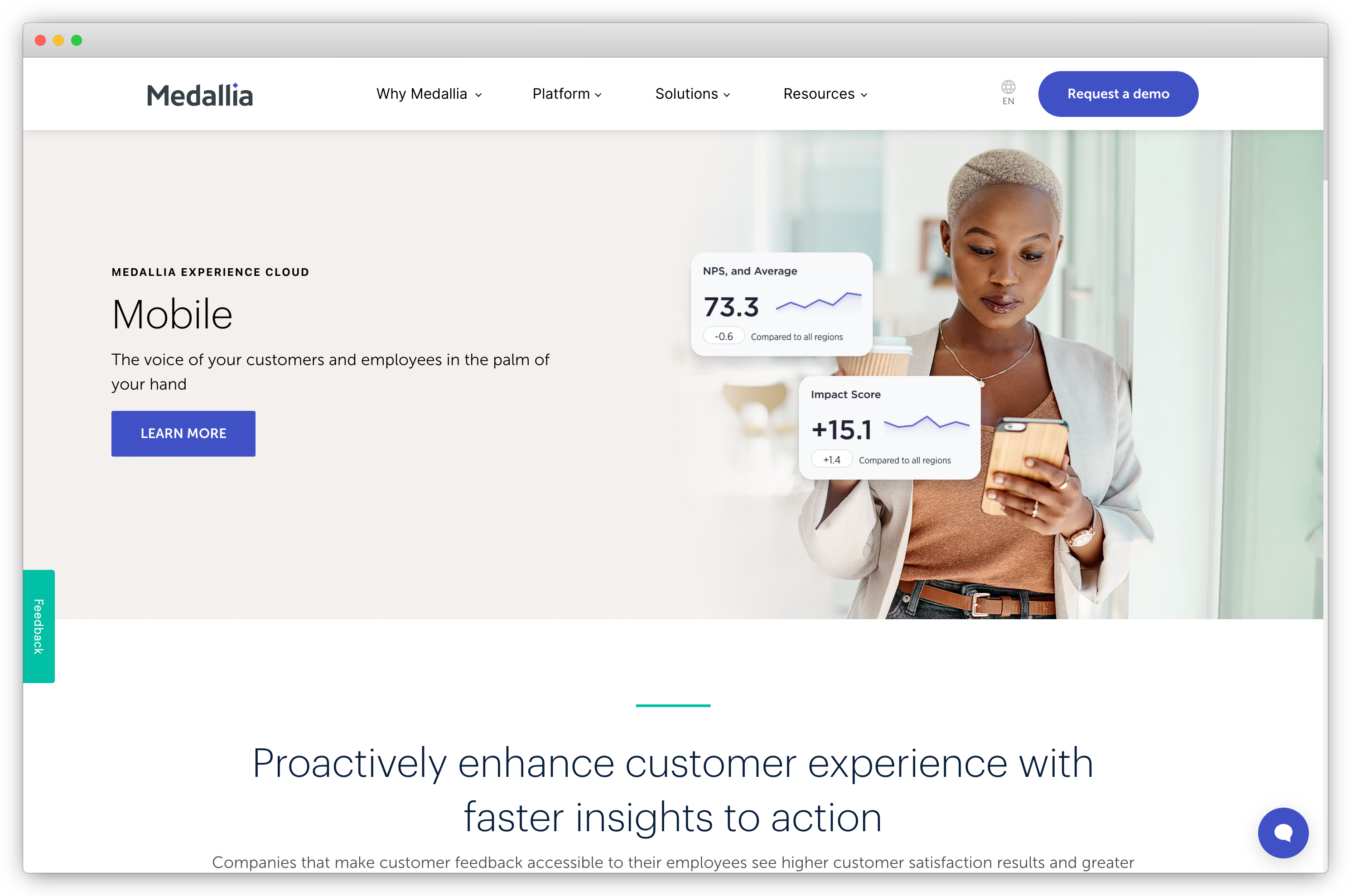
Best for: Large multi-national enterprises in telecom, banking, hospitality, retail, and transportation needing enterprise-wide CX orchestration across complex, multi-department journeys.
Key Features:
- Solicited and unsolicited feedback capture (surveys, reviews, social mentions, operational data)
- Athena AI for real-time insight generation and customer behavior prediction
- Operational data fusion connecting experience signals to CRM, HRIS, POS, and ERP data
- Role-based reporting and alerts from frontline teams to C-suite leadership
Pros
- Connects experience data directly to operational and financial performance data
- Identifies positive and negative experience drivers across the full customer journey
- Proven at scale across regulated industries including healthcare and financial services
Cons
- Significant implementation investment requiring technical expertise and dedicated resources
- Too complex and expensive for most non-enterprise organizations
- Advanced customization typically requires dedicated consulting support
G2 Rating: 4.5/5 (199 reviews)
10. Qualtrics: Best VoC Solution for Research-Grade Surveys and Advanced Analytics
Qualtrics is the benchmark for VoC programs that require complex survey design, large-scale research methodology, and analytical frameworks beyond what standard platforms offer. It handles everything from basic CSAT surveys to conjoint analysis, longitudinal studies, and multi-channel journey feedback programs in one system.
It's a better choice for organizations that need research depth and custom analytical frameworks than teams that need fast deployment and straightforward insights. Unlike SurveyMonkey at the entry level or InMoment at the enterprise analytics end, Qualtrics occupies its own category for organizations where survey methodology precision matters as much as feedback volume.
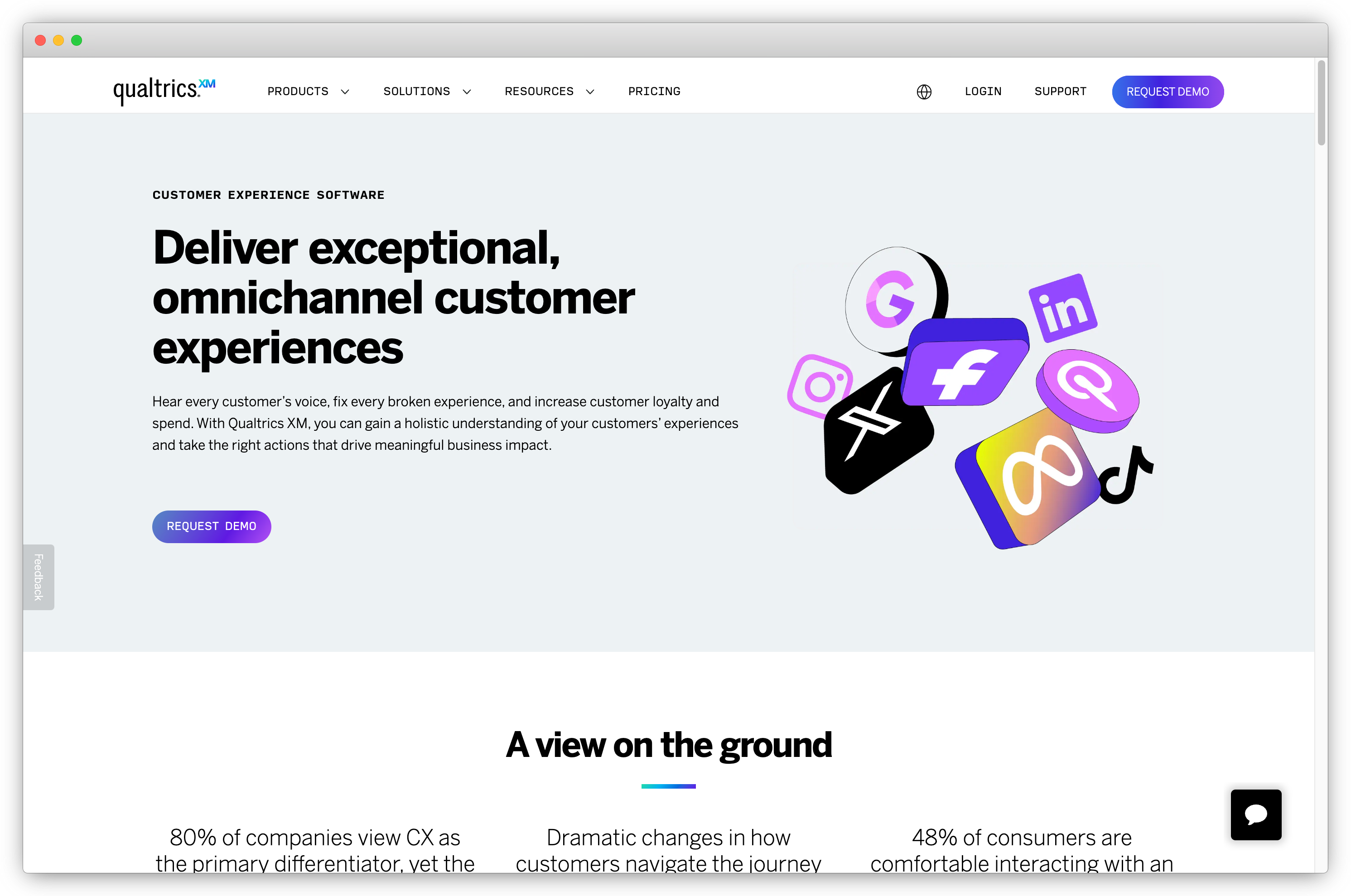
Best for: Large enterprises, academic institutions, government bodies, and healthcare systems that need sophisticated survey logic, cross-channel programs, and highly customizable reporting.
Key Features:
- Advanced survey logic with complex branching, piping, and randomization
- Predictive intelligence engine for customer trend and behavior identification
- Text and voice analytics across open-ended and spoken feedback
- Pre-configured and fully customizable role-based dashboards
Pros
- Unmatched research-grade survey capabilities
- Scales from departmental to organization-wide VoC programs
- Strong reporting and analytics customization options
Cons
- High cost: particularly prohibitive for mid-market teams
- Steeper learning curve than most feedback platforms
- Implementation complexity increases significantly with program scope
G2 Rating: 4.4/5 (2,964 reviews)
Zonka Feedback vs. Medallia vs. Qualtrics: Which VoC Tool Is Right for You?
| Use Case | Best Choice |
| Flexible, AI-first VoC with fast deployment and strong ROI | Zonka Feedback |
| Enterprise-scale CX orchestration with operational data fusion | Medallia |
| Advanced research-grade surveying and complex analytics | Qualtrics |
If you need enterprise-grade VoC without the enterprise complexity → Zonka Feedback
Zonka delivers the analytics depth of Medallia and the survey flexibility of Qualtrics, with faster deployment, lower operational overhead, and better value. It's the right choice for teams that need intelligence at scale but can't absorb a six-month implementation or a dedicated CX operations team to run it.
If you're a global enterprise with multi-department CX needs → Medallia
Medallia is built for organizations managing customer experience across many countries, channels, and business units simultaneously. Its strength is combining X-data (experience) with O-data (operations) for a leadership-level view. The trade-off is complexity, long implementation timelines, and cost.
If your VoC program requires research-grade precision → Qualtrics
Qualtrics is the right call when the quality of survey methodology, data structure, and analytical rigor matters more than speed to insight. It's widely used in enterprises where VoC intersects with formal market research initiatives and academic-style research programs.
11. SurveyMonkey: Best Entry-Level VoC Tool for Small and Mid-Sized Businesses
SurveyMonkey is where most VoC programs start. It's widely recognized, fast to set up, and gives teams a low-friction way to begin collecting structured customer feedback, CSAT, NPS, post-purchase surveys, market research, without a long procurement process or technical implementation. For teams that need online survey tools for customer feedback quickly and without complexity, it's a practical first step.
The ceiling is real though. As your VoC program matures and you need theme detection, survey analysis software, closed-loop automation, or feedback unification from multiple channels, SurveyMonkey will show its limits. Teams that start here often find themselves looking for an upgrade within 12–18 months. It's a starting point, not a destination.
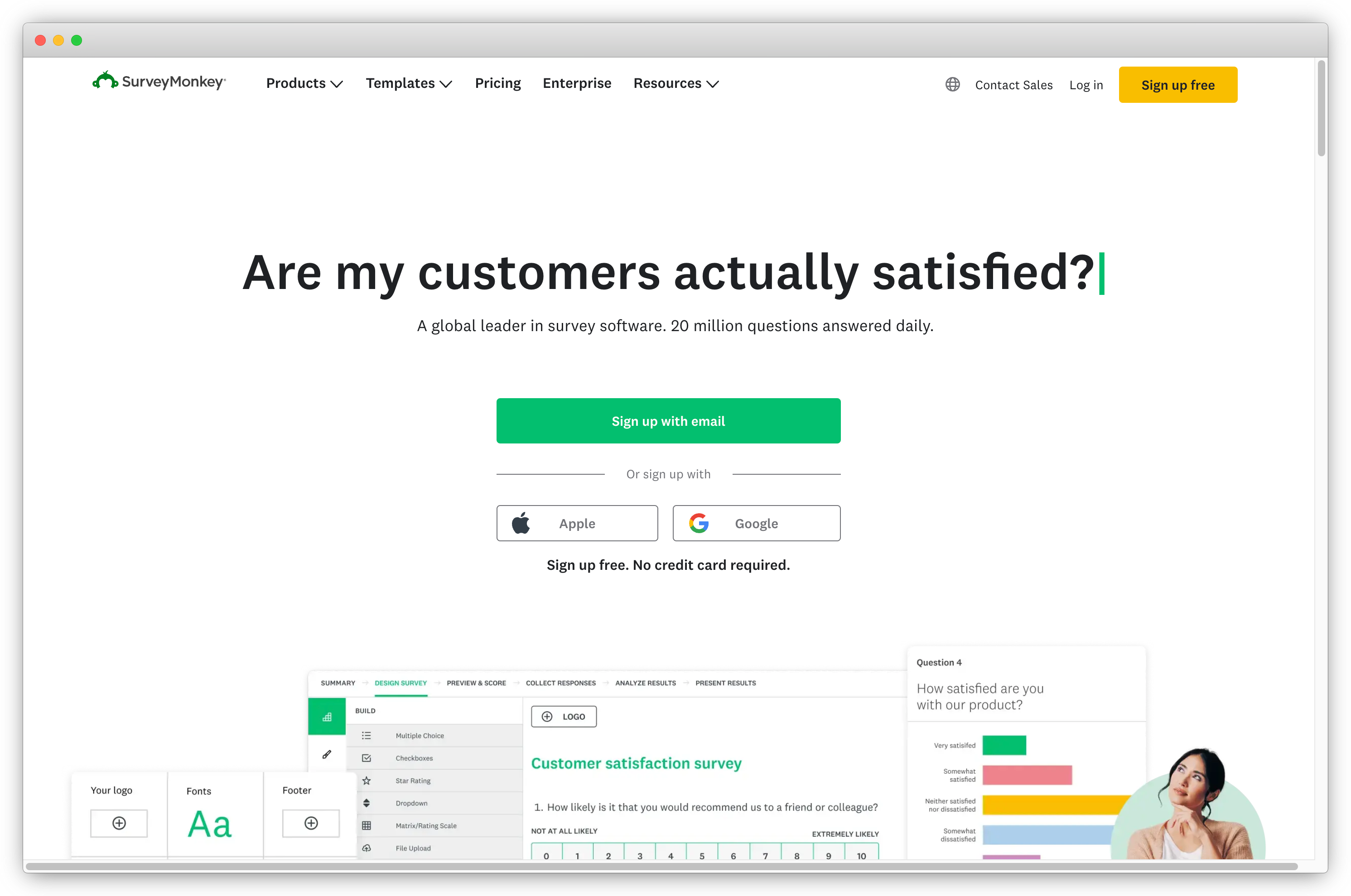
Best for: Small and mid-sized businesses, startups, and teams beginning their VoC journey who need fast, accessible feedback collection at a low price point.
Key Features:
- Wide pre-built template library covering NPS, CSAT, post-purchase, and market research surveys
- Multi-channel distribution across web, email, and mobile
- Real-time response monitoring with basic analytics and filtering
- CRM integrations for automated follow-up actions
Pros
- Fast to learn and deploy with very low technical barrier
- Broad use case coverage with ready-to-use templates
- Brand recognition that can positively impact survey response rates
Cons
- No AI analysis, entity mapping, or contact center integration
- Higher-tier plans get expensive relative to the analytics depth you receive
- Not designed to scale into enterprise-level VoC programs
G2 Rating: 4.4/5 (23,811 reviews)
12. Forsta: Best VoC Platform for Advanced Text, Emotion, and Journey Analytics
Forsta is a VoC and market research platform that supports multiple audience types in a single system, including customers, employees, and market research panels. It includes advanced text analysis tools, emotion detection, and survey design capabilities not available in most standard platforms. Market research agencies and regulated industries like financial services and healthcare are the primary users.
Compared to platforms like Sogolytics or SurveyMonkey, Forsta handles more complex program structures but requires more setup time and technical knowledge to configure properly. It's a stronger option for teams running longitudinal studies, multi-wave research, or programs that span both qualitative and quantitative feedback collection.
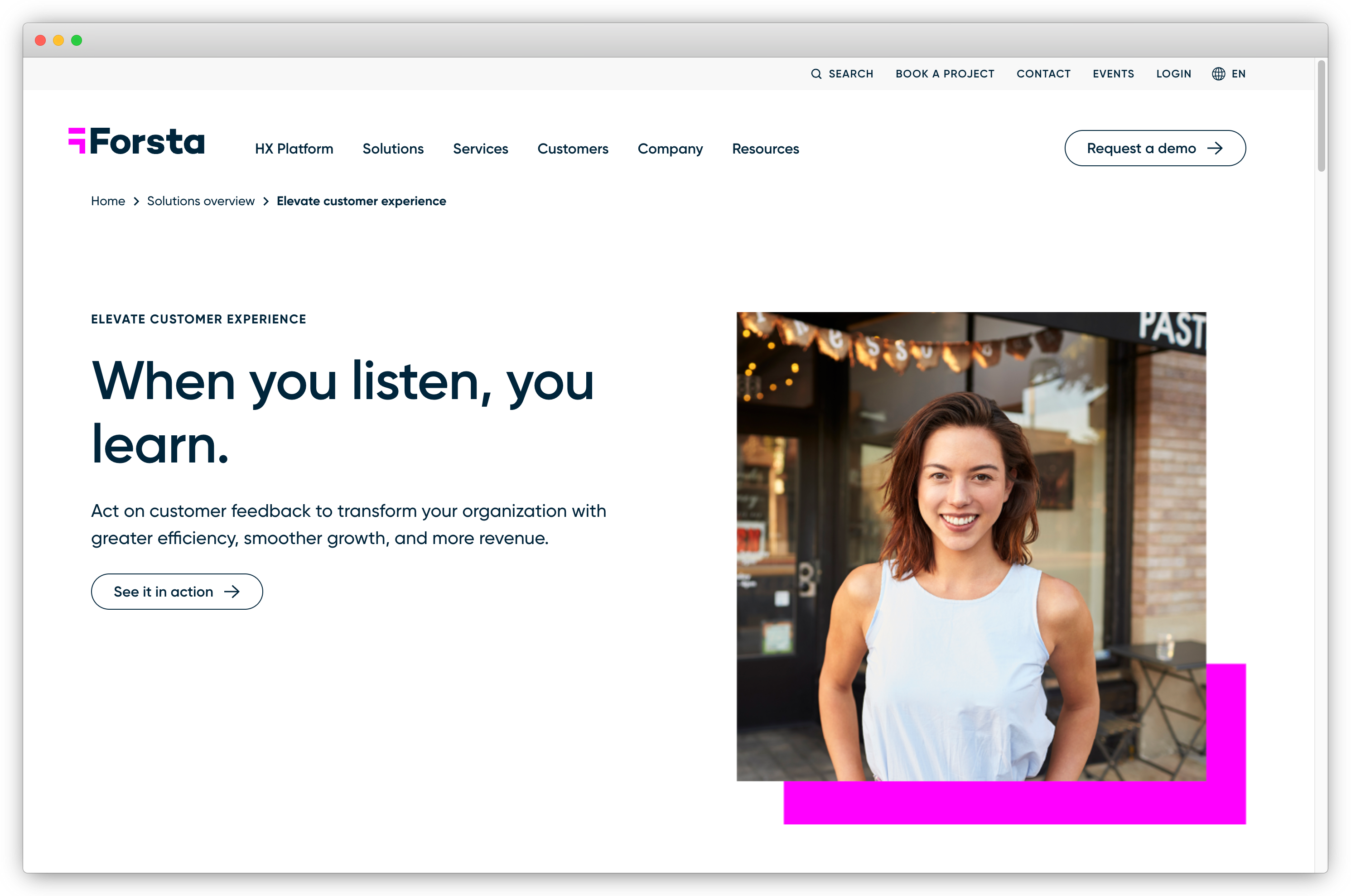
Best for: Enterprises, market research agencies, and regulated industries (financial services, healthcare) that need flexible survey design, advanced text analytics, and consolidated data across customer, employee, and market audiences.
Key Features:
- Multi-channel data collection across web, phone, CATI, CAPI, and paper surveys
- Advanced text analytics with emotion detection for open-text feedback
- Voice sentiment analysis for spoken and recorded customer interactions
- Automated feedback routing to relevant teams with case resolution management
Pros
- Strong for complex research programs spanning multiple audience types
- Eliminates data silos across customer, employee, and market research
- Effective data visualization and insight storytelling tools
Cons
- Some users report outdated reporting dashboard design
- Automated workflow setup can be complex for smaller teams
G2 Rating: 4.2/5 (335 reviews)
13. CustomerGauge: Best B2B and CPG VoC Platform for Revenue-Linked Feedback
CustomerGauge connects VoC data directly to revenue outcomes, which accounts are at risk, which relationships need attention, and where churn impact is highest. It's one of the few platforms built specifically for B2B organizations and CPG brands where account-level health matters as much as individual satisfaction scores. Think of it as one of the stronger NPS tools for account-based VoC programs.
The benchmarking capability is a genuine differentiator for CPG teams. Access to 6M+ global benchmarks lets you compare NPS against industry standards, not just your own history. That changes the leadership conversation from "our score went up" to "we're in the top quartile for our category."
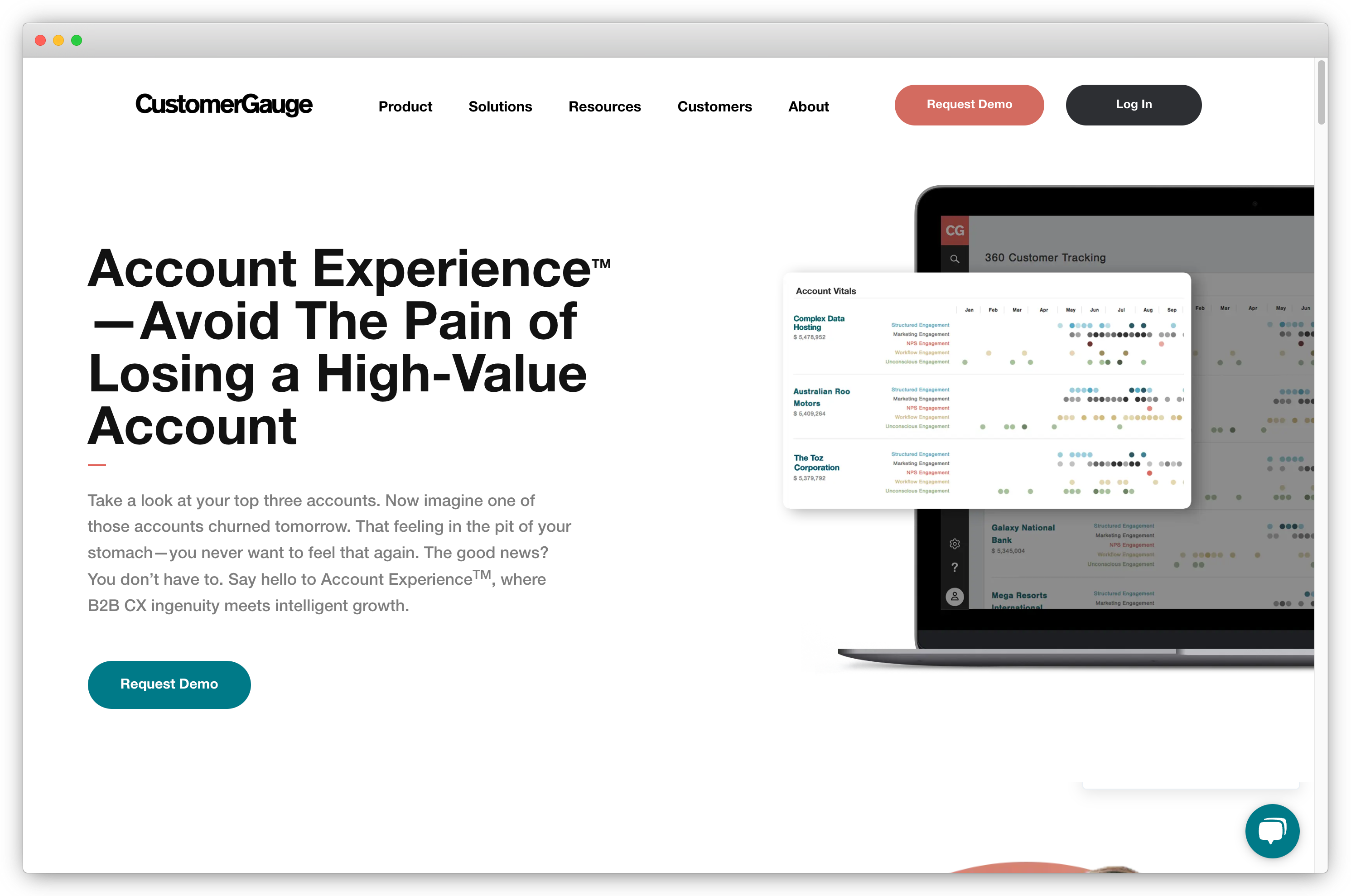
Best for: B2B companies, manufacturers, distributors, and CPG brands that need account-based NPS, revenue-linked VoC insights, and customer health scoring tied to financial outcomes.
Key Features:
- Account-based NPS with revenue and health scoring tied to individual accounts
- 360-degree account views identifying at-risk and high-value customers
- Internal and external CPG benchmarking across 6M+ global data points
- Automated follow-up workflows triggered by survey responses and score changes
Pros
- Directly connects NPS and account feedback to revenue and churn risk data
- Identifies upsell and expansion opportunities from customer VoC signals
- Strong CPG-specific benchmarking for competitive positioning
Cons
- Primarily suited for B2B and CPG: limited fit for B2C or SaaS-focused VoC programs
- Advanced analytics features require onboarding investment to use effectively
G2 Rating: 4.6/5 (50 reviews)
14. CustomerHero: Best AI-Led VoC Solution with Expert-Guided Implementation
CustomerHero pairs an AI-powered VoC platform with hands-on expert implementation support. Built by the creators of Webankieta and drawing on over two decades of feedback program experience, it's designed for organizations that want a complete VoC program, not just software licenses and documentation. The SwaS (Software with a Service) model means you get program design guidance, implementation support, and ongoing optimization alongside the product.
It's the right choice for teams that have tried deploying enterprise platforms and stalled because nobody owned the program design. The software handles multi-channel feedback collection, AI sentiment analysis, and closed-loop workflows. The service layer handles everything that software alone can't. For organizations in retail, banking, insurance, or hospitality that need results from a VoC program but don't have a dedicated CX operations team, that distinction is meaningful.
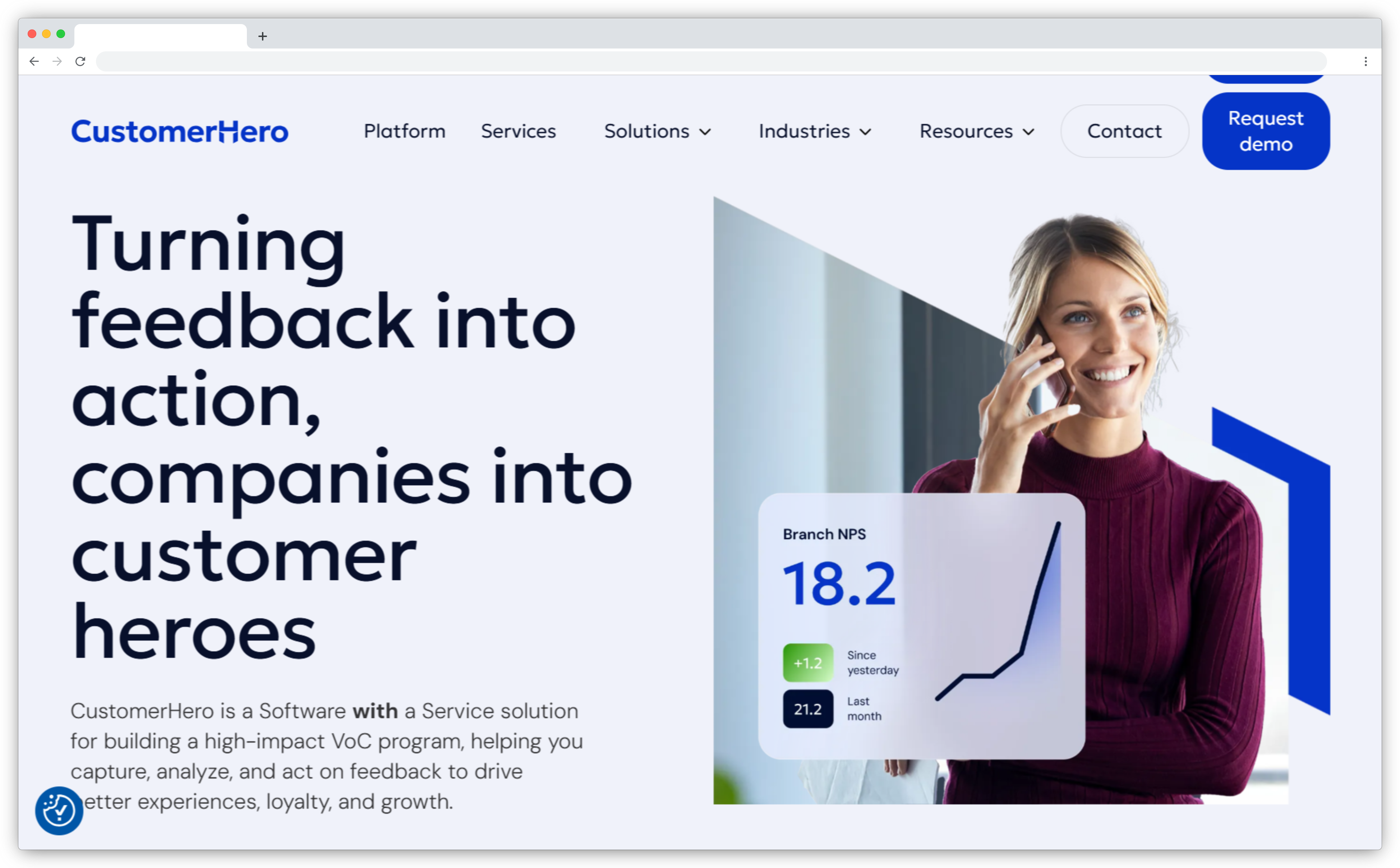
Best for: Organizations across retail, restaurants, insurance, and banking that need an AI-capable VoC platform with expert support for program design and ongoing optimization.
Key Features:
- Omnichannel feedback collection across web, email, in-store, mobile, and QR
- AI sentiment analysis and topic categorization for open-text VoC responses
- Real-time role-based dashboards for teams, regions, and departments
- GDPR-compliant with local European data storage options
Pros
- Software combined with expert implementation and ongoing program support
- Strong for organizations without dedicated in-house CX program management
- Good AI analysis for unstructured qualitative feedback at scale
Cons
- No free plan available
- May require customization for simpler or smaller-scale setups
G2 Rating: 4.8/5 (19 reviews)
15. Zenloop: Best VoC Platform for 360° Feedback Collection and Automated Retention
Zenloop is built for B2C brands that want to use VoC data to prevent churn, not just measure it. It combines NPS and CSAT surveys with AI analysis and automated retention workflows, a detractor triggers a recovery campaign, a promoter triggers a review request, and the loop closes automatically without anyone checking a dashboard. For brands managing thousands of customer interactions daily, that automation layer is what makes the program operationally sustainable.
The 360° approach covers both survey-based feedback and public review monitoring across review sites like Google and Trustpilot, unified in one place. That means you're capturing what customers say when you ask and what they say publicly including customer complaints, two very different signals, and both relevant to improving customer retention.
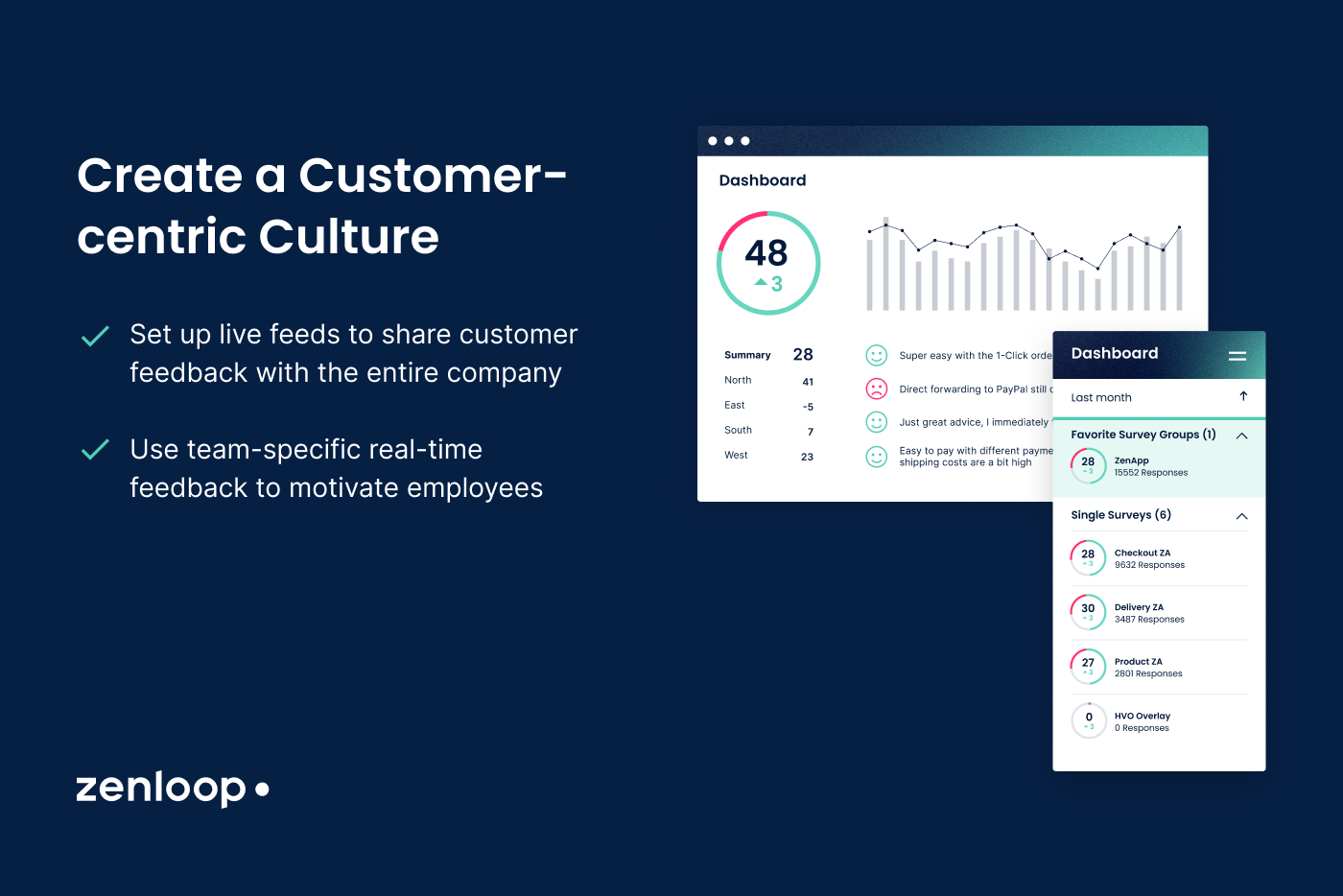
Best for: Retail, e-commerce, D2C, hospitality, and telco brands managing high-volume B2C customer relationships where churn prevention and promoter activation are primary VoC goals.
Key Features:
- Post-purchase NPS and CSAT survey automation triggered by transaction events
- AI-powered sentiment analysis and churn risk detection across survey responses
- Automated win-back campaigns and promoter review activation workflows
- 360° feedback collection combining surveys with public review monitoring
Pros
- Retention automation: feedback triggers real action without manual intervention
- Well-suited for high-volume B2C programs where manual follow-up doesn't scale
- Clean UI with strong e-commerce platform and CRM integrations
Cons
- Less suited for complex enterprise VoC programs spanning multiple departments
- Limited pricing transparency for smaller teams
G2 Rating: 4.7/5 (13 reviews)
16. Usersnap: Best VoC Tool for Visual and Contextual Product Feedback
Usersnap captures VoC data through annotated screenshots rather than post-interaction surveys. Users click to highlight exactly what's broken, confusing, or unclear directly in the browser, in the moment they experience it. The annotation is attached to the page URL, browser metadata, and console logs automatically, giving the receiving team everything they need to act without a follow-up conversation.
This makes it particularly effective as a complement to broader VoC programs. As a website feedback tools solution for specific, actionable product and UX feedback, where a text description of a bug would take longer to write than it does to screenshot and annotate, Usersnap fills a genuine gap without replacing what's already working.
Best for: Product teams, developers, QA teams, and UX researchers who need visual, contextual feedback from users inside their product or website.
Key Features:
- In-browser screenshot capture with annotation, drawing, and highlighting tools
- Automatic metadata capture including browser, OS, page URL, and console logs
- Direct integrations with Jira, GitHub, Slack, Zendesk, Trello, and Asana
- NPS, CSAT, and custom micro-survey widgets for structured feedback alongside visual input
Pros
- Visual, pinpointed feedback eliminates back-and-forth between users and dev teams
- Integrates directly into existing development and project management workflows
- Fast to deploy via JavaScript snippet or browser extension
Cons
- Narrower scope than full VoC platforms: primarily website and in-product feedback
- Analytics layer less deep than dedicated feedback intelligence platforms
- Not suitable as the sole VoC solution for multi-channel CX programs
G2 Rating: 4.5/5 (93 reviews)
17. Startquestion: Best Survey-Based VoC Platform for CX and HR Teams
Startquestion is a survey platform used by CX and HR teams, primarily in European markets. It supports NPS, CSAT, CES, and custom questionnaire types with advanced branching logic, automated email feedback tools with CRM triggers capability, and GDPR-compliant data storage. It's designed for mid-market teams that need structured survey programs without the complexity or cost of enterprise platforms.
Unlike Qualtrics or Sogolytics, Startquestion doesn't include AI analytics capabilities, but it's also considerably easier to set up and doesn't require a lengthy onboarding process. It covers both customer and employee feedback from the same platform, which is useful for organizations that want to run CX and HR programs without managing two separate survey tools.
Best for: Mid-market CX and HR teams, particularly in European markets, that need a reliable, flexible survey platform for both customer and employee feedback programs.
Key Features:
- NPS, CSAT, CES, and custom survey builder with advanced branching logic
- Multi-channel distribution across email, web embed, mobile, QR code, and link
- White-label survey design with full custom branding options
- GDPR-compliant with European data storage for privacy-sensitive programs
Pros
- Clean, intuitive survey builder requiring no coding
- Strong customer support and guided onboarding process
- Good value for mid-market teams building structured VoC programs
Cons
- Less AI and analytics depth than full VoC intelligence platforms
- Survey-based only: doesn't unify feedback from non-survey data sources
G2 Rating: 4.8/5 (19 reviews)
How to Choose the Right Voice of Customer Tool
With 17 tools on this list, the decision can feel harder than it needs to be. Five questions cut through the noise.
1. What feedback sources do you actually need?
If you're running NPS and CSAT surveys and that covers your program, almost any tool here works. If you need to gather customer feedback from surveys alongside support tickets, call transcripts, online reviews, and behavioral data, you need a platform with multi-source unification, not just a survey builder with an analytics tab. Know your data sources and whether you need to capture customer preferences and open-ended opinions or just quantitative scores before you shortlist anything. Teams that skip this step spend six months evaluating the wrong platforms.
2. Who owns the VoC program?
A single CX team running quarterly surveys needs a different platform than an organization where product, support, operations, and leadership all need different views of the same customer data. The latter needs role-based dashboards and an intelligence layer that surfaces what's relevant to each team, which is what running enterprise surveys at scale usually demands. The former can start simpler and scale later. The best CSAT survey platforms with AI analysis and closed-loop workflows for enterprise use aren't necessarily the right fit for a five-person CX team doing its first structured feedback program.
3. How much AI do you actually need right now?
Sentiment scoring is table stakes in 2026. Almost every tool on this list does it at some level. The more useful question is whether you need AI that proactively surfaces signals, emerging themes, churn risk, score drops, or whether you're comfortable querying a dashboard manually. Those are fundamentally different products at fundamentally different price points. Don't pay for proactive intelligence if your team isn't ready to act on it.
4. What's your implementation tolerance?
Enterprise platforms like Medallia and InMoment are powerful, but they require months to implement properly. Trying to rush them creates a half-configured system nobody trusts. If you need to be live quickly and start generating customer insights within days, that narrows your shortlist significantly. Most mid-market platforms deploy in under a week. Most enterprise platforms don't, and shouldn't be expected to.
5. Do you need to close the loop, or just collect?
Some platforms are excellent at gathering feedback and mediocre at helping you act on it. If customer retention and tools to measure and improve customer satisfaction are your actual goals, not just measuring satisfaction but improving it, verify that the platform has automated alerting, task routing, and CRM workflow integration built in. Not as a paid add-on. Not as a Zapier workaround. Built in. That capability varies enormously across even the best tools on this list.
Answer these five questions and the right tool becomes significantly clearer. Most teams that struggle with VoC tool selection are actually struggling with program clarity, the tool decision is the easy part once you know what you actually need.
What Makes a VoC Program Actually Work?
Tools are the infrastructure. They're not the program. A VoC program works when three things happen consistently, and most organizations get one or two right.
Feedback reaches the right people fast enough to act. The half-life of customer feedback is short. A complaint about checkout friction that reaches your product team six weeks after the customer churned is historical data, not intelligence. VoC programs that work have automated routing built in, low NPS scores alert the right team automatically, not after someone runs a monthly report.
Insights are specific enough to be actionable. "Customers are unhappy with onboarding" is not an insight. Neither are generic reports about customer concerns. "Users who don't complete the integration step in week one have a 3x higher churn rate, and their main friction point is API documentation clarity" is an insight. The difference is analytical depth. Tools with thematic analysis software and entity mapping get you to the second level, surfacing deeper insights and customer trends that generic dashboards miss. Tools that just show you average scores leave you at the first.
The feedback loop actually closes. Customers notice when nothing changes. The fastest way to kill survey response rates is to ask for feedback repeatedly and visibly do nothing about it. Closing the loop on actionable feedback, acknowledging it, communicating what changed, following up with detractors, is what separates VoC programs that build customer trust from ones that erode it. Most tools support this in theory. The organizations that do it consistently make it part of their operating model, not an afterthought.
The right tool makes all three of these easier. But the tool doesn't do them for you.

.png)
.png)