

.svg)
 Healthcare
 Finance
 Retail
 SaaS & Digital
 eCommerce
 Education
 Salesforce
  HubSpot
 Pipedrive
 Mailchimp
 Klaviyo
 Zendesk
  Intercom
 Freshdesk
 HelpScout
  Front
Front Jira
Jira Slack
Slack  MS Teams
 Zoom
Zoom Google Sheets
  Zapier
  Integrately
 Make
Make  Webhooks




 MS Teams


The best enterprise survey tools in 2026 depend on what you need them to do after a response lands. For research depth, Qualtrics leads. For AI analysis of open-ended feedback, Zonka Feedback stands out. For omnichannel CX at scale, Medallia is the reference platform. Most large teams shortlist two or three of these, then decide on channel mix, compliance needs, and budget.
TL;DR
- The best enterprise survey software does more than collect responses at enterprise scale. It connects survey data to your CRM, applies AI to open-ended responses, and routes issues to the team that owns the fix.
- The real dividing line is what a tool does after a response lands. Some stop at a dashboard. Others read the open-ended text and route a fix to the right team, and that gap should shape your shortlist more than feature counts.
- Budget splits the field. Qualtrics, Medallia, and InMoment run on custom enterprise contracts. Survicate, Sogolytics, Typeform, and Jotform publish public pricing you can start on today.
- Two long-standing tools left the market this year. Delighted shut down and GetFeedback Direct is closing, so a chunk of this guide is really about where those teams should go next.
- Pick on fit, not feature count. The right platform matches your channels, your compliance needs, and how your teams actually act on feedback.
Why The Enterprise Survey Software You Pick In 2026 Matters More Than It Used To
Here's the real cost of slow feedback at scale: by the time a quarterly report surfaces a churn signal, the customers who sent it have already left. Large organizations don't struggle to collect data anymore. They struggle to act on it before it goes stale.
That's the job the best enterprise survey software is now expected to do. Not prettier forms. Feedback that reaches the right person while there's still time to fix something. The category has shifted fast over the past year, and the platforms that win enterprise deals in 2026 look different from the ones that won them in 2023. This guide compares 11 of them on the things that decide real deployments: analysis depth, security, integrations, and how quickly insight turns into action.
What Enterprise Survey Software Is, And Where It's Heading In 2026
Enterprise survey software is a platform built to collect, secure, and analyze feedback across a large organization, with the administration, compliance, and integration depth that a basic form tool can't offer. It handles enterprise volume, segments survey data by team and region, and connects responses to the systems where work already happens.
The practical difference from a standard survey tool shows up in four places: data governance (SSO, role-based access, GDPR and HIPAA controls, regional data residency), advanced survey logic and design, real-time analytics that different teams can each read their own way, and integrations that push survey responses into a CRM instead of trapping them in a spreadsheet.
What's changed in 2026 is where the value sits. For two decades, vendors competed on question types and reporting. Now the gap between platforms is what happens after the response lands. Some tools still stop at a dashboard. Others read the open-ended comments automatically, score sentiment, and tell a specific team what to do next. That split, collection versus understanding, is the single most useful lens for the shortlist below.
The 11 Best Enterprise Survey Software, At A Glance
The table ranks all 11 tools and gives you the fast read. The reviews after it explain why each earned its spot.
| S.No | Tool | Best For | Standout Capability | G2 Rating | Pricing |
| 1 | Qualtrics | Research-grade programs | Advanced methodology and statistics | 4.4/5 | Custom |
| 2 | Zonka Feedback | AI feedback analysis and signals | AI Impact Analysis links themes to score movement | 4.7/5 | Custom pricing based on usage and needs |
| 3 | Medallia | Omnichannel CX | Signal capture across every touchpoint | 4.5/5 | Custom, quote-based |
| 4 | Survicate | In-product and journey feedback | Identified-response CRM loop | 4.6/5 | Free plan, paid from ~$49/mo |
| 5 | Sogolytics | Value-focused CX and EX | CX and EX in one platform | 4.6/5 | Free plan, paid from ~$25/mo |
| 6 | InMoment | Text analytics at scale | Conversation and open-text analysis | 4.7/5 | Custom, quote-based |
| 7 | AskNicely | Frontline and service teams | Team-level scoring and coaching | 4.7/5 | Custom, quote-based |
| 8 | SurveyMonkey Enterprise | Cross-department rollout | Familiar UI, broad admin controls | 4.4/5 | Custom (Enterprise) |
| 9 | Sprig | AI-native product research | Agent-run study design and synthesis | 4.5/5 | Free plan, Starter ~$175/mo |
| 10 | Typeform | Branded, conversational surveys | One-question-at-a-time design | 4.5/5 | Free plan, paid from ~$25/mo |
| 11 | Jotform | Form-heavy data collection | 10,000+ templates, no-code logic | 4.7/5 | Free plan, paid from ~$34/mo |
The pattern worth noticing: the highest-rated tools aren't the biggest ones. Review scores cluster tightly between 4.4 and 4.7, so the real decision isn't "which is best," it's "which fits how your teams work."
How We Evaluated These Tools
We're the team behind Zonka Feedback, so we'll be upfront about that. This is a ranked list, and yes, our product is on it. What follows is based on hands-on use, product documentation, recent G2 reviews, and official pricing pages, and we've tried to be as honest about our own limitations as everyone else's.
Every tool here had to clear the same bar before it made the list. We looked for:
- Multi-channel distribution that holds up at enterprise volume (email, SMS, web, in-app, offline)
- Native NPS, CSAT, and CES with scoring already built in
- Advanced survey logic, branching, and multilingual design
- Real-time analytics with role-based access, so a regional lead and a VP see different views of the same data
- Closed-loop workflow automation that assigns and routes issues, not just charts them
- Enterprise integrations and security, including SSO, encryption, and GDPR or HIPAA support
Ratings come straight from each tool's G2 profile. Pricing comes from each vendor's own pricing page. Where a tool uses custom quotes, we say so rather than guessing at a number.
The 11 Best Enterprise Survey Tools, Reviewed
Here's the detailed look at all 11, in ranked order. Every entry follows the same shape, what it does well, where it falls short, pricing, and its live G2 rating, so you're comparing like for like instead of taking any vendor's word for it.
1. Qualtrics: Best For Large-Scale Research Programs
Qualtrics is the platform most enterprises benchmark everyone else against, and for good reason. It's less a survey tool than a research system, built for teams running complex, methodology-heavy programs across regions and business units. If you need conjoint analysis, MaxDiff, or statistical rigor that holds up in a boardroom, this is the reference standard.
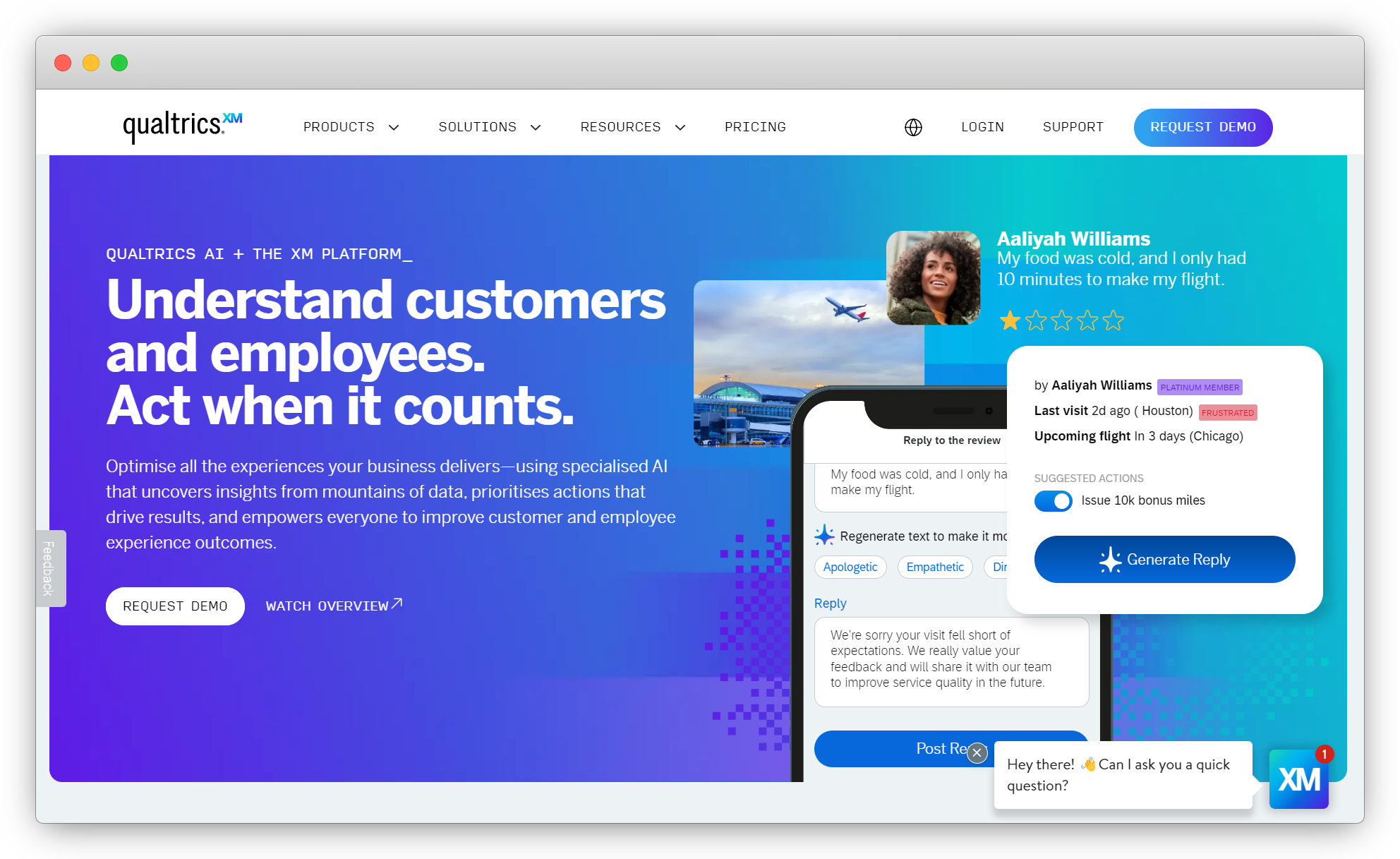
The trade-off is weight. Qualtrics rewards organizations that can staff it. Most teams that get full value from it have an internal specialist or a dedicated success manager, and the learning curve is real for anyone who just wants to ship a survey this week.
Key Features
- Advanced methodology (conjoint, MaxDiff, statistical testing)
- AI-driven text and sentiment analysis on open-ended responses
- Deep integrations across Salesforce, SAP, and Slack
- Strong data governance and compliance controls
- Journey mapping and experience orchestration
Pros
- Unmatched analytical depth
- Broad integration ecosystem
- Strong governance for regulated enterprises
Cons
- Steep learning curve for non-specialists
- Custom pricing runs high, and licensing gets complex at renewal
Pricing: Custom enterprise pricing (no public tiers).
G2 rating: 4.4/5
Best for: Research and insights teams that treat feedback as formal, statistically rigorous research.
2. Zonka Feedback: Best For AI Feedback Analysis And Signals
Here's the gap Zonka Feedback fills. For mid-market to enterprise Voice of the Customer (VoC) programs, the choice usually comes down to tools that collect feedback well but don't analyze it (Typeform, SurveyMonkey) and tools that analyze deeply but cost six figures and take months to deploy (Qualtrics, Medallia). Zonka sits in that gap: omnichannel collection and native AI analysis in one platform, without the enterprise price tag or the long onboarding.
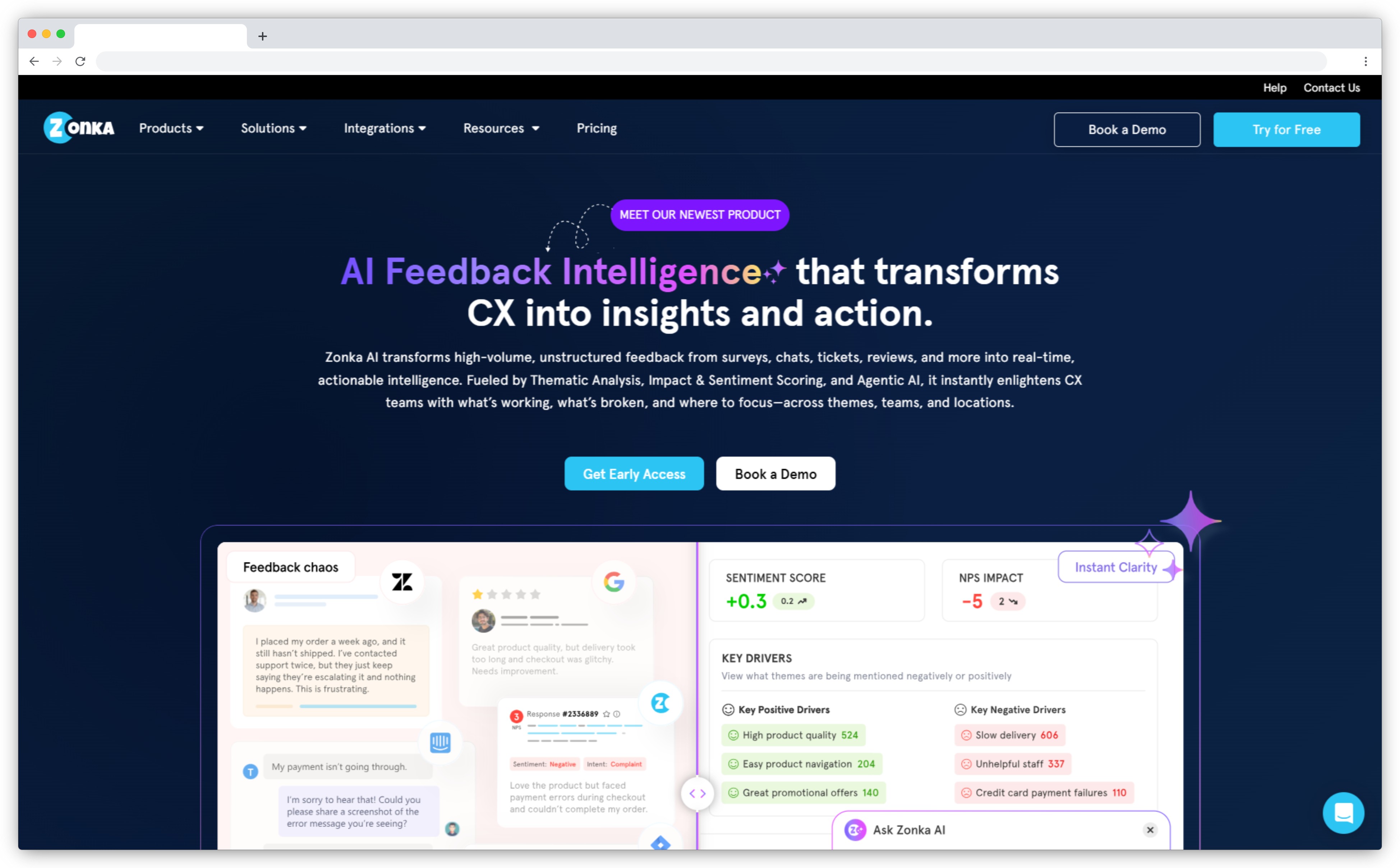
The capability that earns it the number-two spot is how it handles open-ended feedback. Its AI Impact Analysis ties recurring themes in free-text responses to NPS, CSAT, and CES movement, so you can see which issues are actually pulling scores down. An AI co-pilot lets a team question feedback data across surveys, tickets, and reviews without building a report by hand. And role-based AI feedback analytics mean a frontline agent, a branch manager, and the CCO each see the signals that belong to them.
Key Features
- Omnichannel collection across kiosk, QR codes, offline, email, SMS, WhatsApp, web, and in-app, plus unified support tickets and reviews
- AI Impact Analysis connecting open-text themes to score changes
- Role-based dashboards and signals per team
- Closed-loop case management with routing and alerts
- Regional data residency (US, EU, Australia, India), SSO, and ISO 27001, GDPR, and HIPAA support
Pros
- Collection and AI analysis in one system, so there's nothing to stitch together
- Goes live in days, not months
- Strong Salesforce and helpdesk integrations
Cons
- Lower tiers cap response volume, so very high-volume programs need a custom quote
- The full AI intelligence layer sits on higher plans
Pricing: Custom pricing based on usage and needs.
G2 rating: 4.7/5 from 81 reviews
Best for: CX and VoC teams that want signals, not just survey scores, across physical and digital touchpoints.
3. Medallia: Best For Omnichannel Enterprise CX
Medallia's strength isn't survey design. It's signal capture. The platform pulls feedback from surveys, chat, contact centers, in-app, and in-person interactions into one analytics layer, then acts on it in real time. For service-heavy organizations where speed of insight matters more than questionnaire aesthetics, that's the whole ballgame.
It's built for scale and priced for it. Medallia is a heavy-duty platform that usually needs dedicated specialists to run well, and reviewers consistently place it firmly in large-organization territory. If your CX program lives and dies by real-time action across thousands of touchpoints, that investment makes sense. If it doesn't, this is more than you need.
Key Features
- Omnichannel feedback capture across web, mobile, contact center, and in-person
- Real-time analytics and predictive scoring
- Case management for tracking and resolving issues
- Deep integrations with enterprise systems like Salesforce, ServiceNow, and Workday
Pros
- Best-in-category omnichannel depth
- Strong text and sentiment analytics
- Proven at global scale
Cons
- Expensive and resource-intensive to implement
- Advanced workflows often require Medallia specialists
Pricing: Custom and quote-based. Medallia does not publish public pricing, so contact sales for a quote.
G2 rating: 4.5/5
Best for: Large enterprises running real-time, omnichannel voice-of-customer programs.
4. Survicate: Best For In-Product And Journey Feedback
If your feedback needs to happen inside the product and the customer journey rather than in a standalone survey link, Survicate is a strong fit. It runs surveys across website, in-app, email, and link, then funnels everything into one place with NPS, CSAT, and CES ready out of the box. The survey builder is fast, and a large template library covers most starting points.
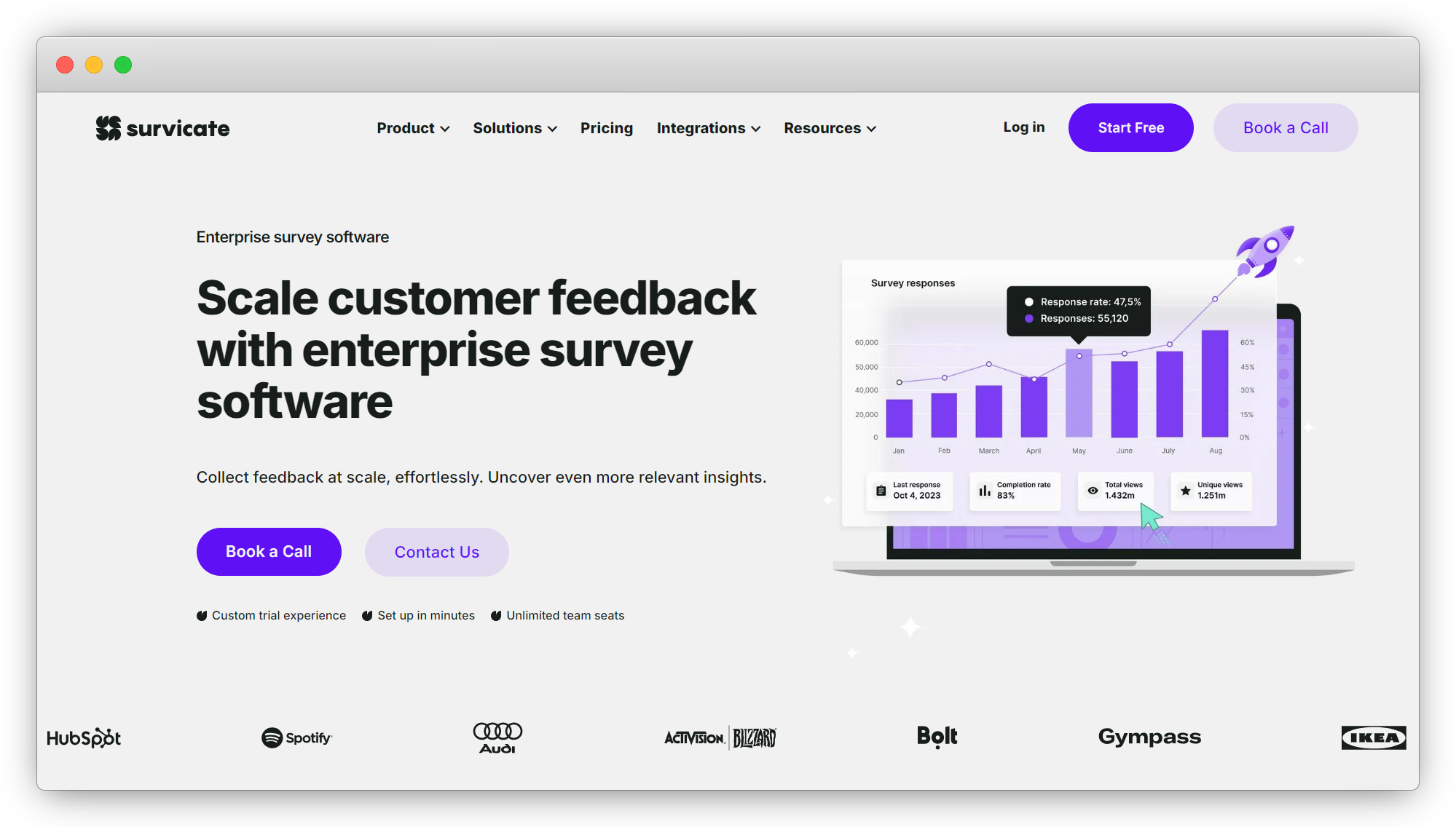
The differentiator worth shortlisting for is the identified-response loop. When a respondent is known, an answer can update a CRM record and trigger follow-up, which is where feedback stops being a report and becomes an operational signal. Reviewers do flag the ceiling: analysis stays fairly basic for deeper research, and higher tiers move to custom pricing that climbs with response volume.
Key Features
- Multi-channel surveys (web, in-app, email, link)
- Identified responses that sync to CRM records
- Ready-made survey templates and an AI question assistant
- Integrations with Intercom, Salesforce, HubSpot, and Mailchimp
Pros
- Fast setup
- Genuine in-product targeting
- The CRM feedback loop is well executed
Cons
- Analytics depth is limited for complex research
- Costs scale with response volume
Pricing: Free plan, paid plans start around $49/mo, with a custom Scale tier.
G2 rating: 4.6/5
Best for: Product, marketing, and CX teams collecting feedback in-context across the journey.
5. Sogolytics: Best For Value-Focused Experience Management
Sogolytics is the value pick on this list. It's a full experience management platform that runs both customer (SogoCX) and employee (SogoEX) programs from one place, positioned as the sophisticated but approachable alternative to premium suites. Teams that want enterprise-grade surveys, analytics, and security without an enterprise-grade contract tend to land here.
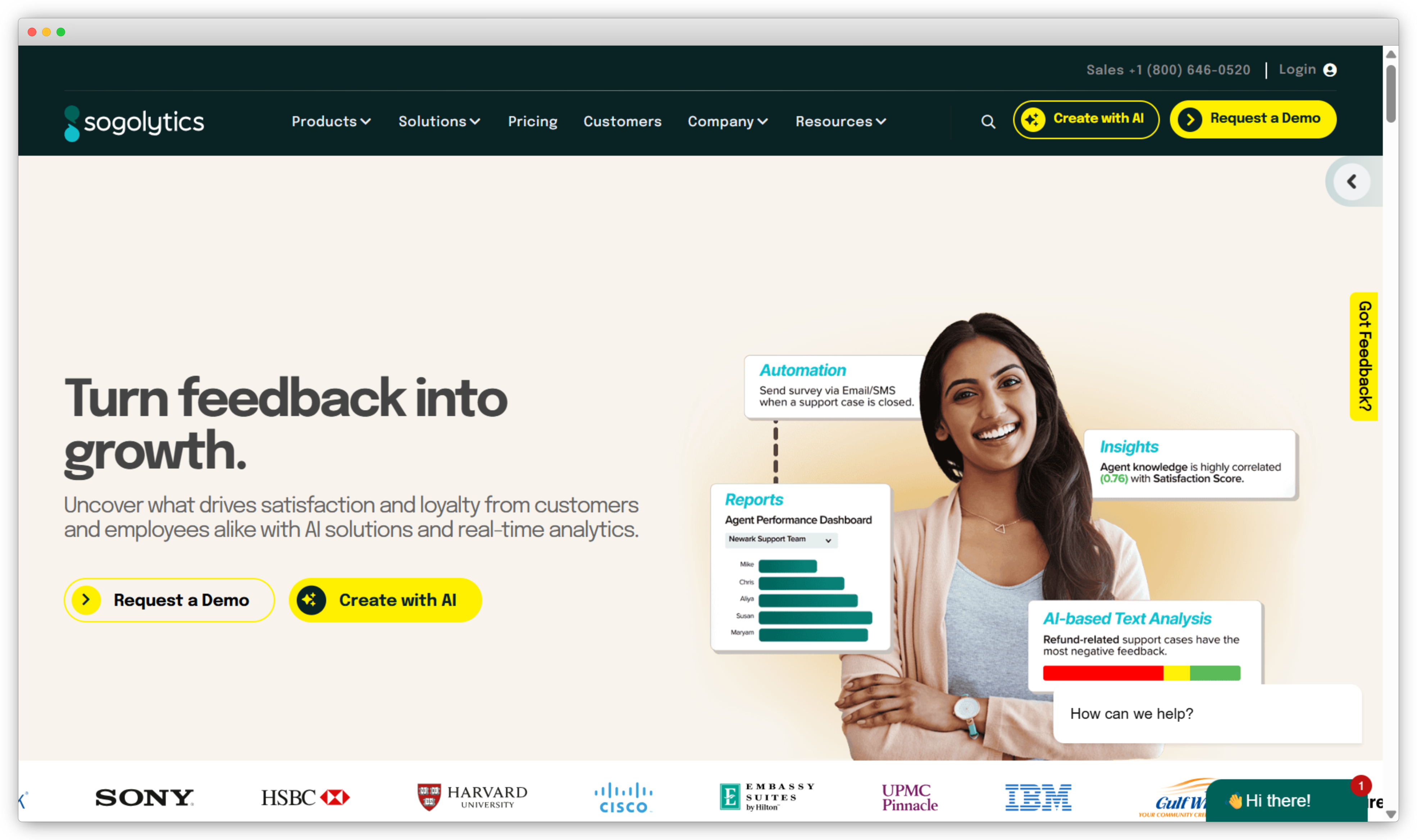
It pairs a capable survey builder with strong customization, handles thousands of responses without the reporting falling apart, and distributes across email, SMS, social, and embedded links. Its security posture (SOC 2, HIPAA support, and granular permissions, backed by real security and compliance for enterprise surveys controls) also makes it a common pick in healthcare and education. The interface has modernized with recent AI additions, though power users note the advanced features take some time to learn.
Key Features
- Advanced survey design with branching, skip logic, and piping
- Customer (SogoCX) and employee (SogoEX) experience in one platform
- Real-time analytics and customizable dashboards
- Enterprise security: SOC 2, HIPAA support, SSO, and granular permissions
- Integrations with Salesforce, Microsoft Dynamics, ServiceNow, Slack, and Zendesk
Pros
- Strong value for the feature set
- Covers both CX and EX in one tool
- Genuinely useful reporting at scale
Cons
- Advanced capabilities have a learning curve
- Brand recognition trails the enterprise incumbents
Pricing: Free plan, paid plans start around $25/mo.
G2 rating: 4.6/5
Best for: Organizations that want versatile CX and EX surveys with enterprise features at a mid-market price.
6. InMoment: Best For CX With Deep Text Analytics
InMoment earns its place on the strength of what it does with unstructured feedback. Its text and conversation analytics pull signal out of surveys, reviews, call logs, and chat transcripts, and reviewers rate its AI text generation and summarization among the platform's best features. For enterprises drowning in open-ended responses, that's the draw.
It sits alongside Medallia and Qualtrics in the enterprise CX tier, and it carries similar expectations: usage-based pricing, a proper implementation, and the most value going to teams with a real CX program behind it. Onboarding gets consistent praise, which softens the usual enterprise learning curve.
Key Features
- Text and conversation analytics across structured and unstructured sources
- AI-driven summarization and theme detection
- Case management and workflow automation
- Broad integrations across CX and data systems
Pros
- Excellent open-text and conversation analysis
- Quick, well-rated onboarding
- Strong at connecting data silos
Cons
- Usage-based pricing means costs scale with scope
- Best value assumes a mature CX program
Pricing: Custom and usage-based. InMoment does not publish public pricing, so contact sales for a quote.
G2 rating: 4.7/5 from 319 reviews
Best for: Enterprises whose biggest challenge is making sense of large volumes of open-ended feedback.
7. AskNicely: Best For Frontline And Service Teams
AskNicely takes a narrower, sharper angle than the enterprise suites: it's built to motivate frontline and service teams with feedback they can see and act on. Automated NPS and CSAT programs, team-level scoring, and coaching workflows keep customer sentiment visible to the people who actually shape it, day to day, across locations.
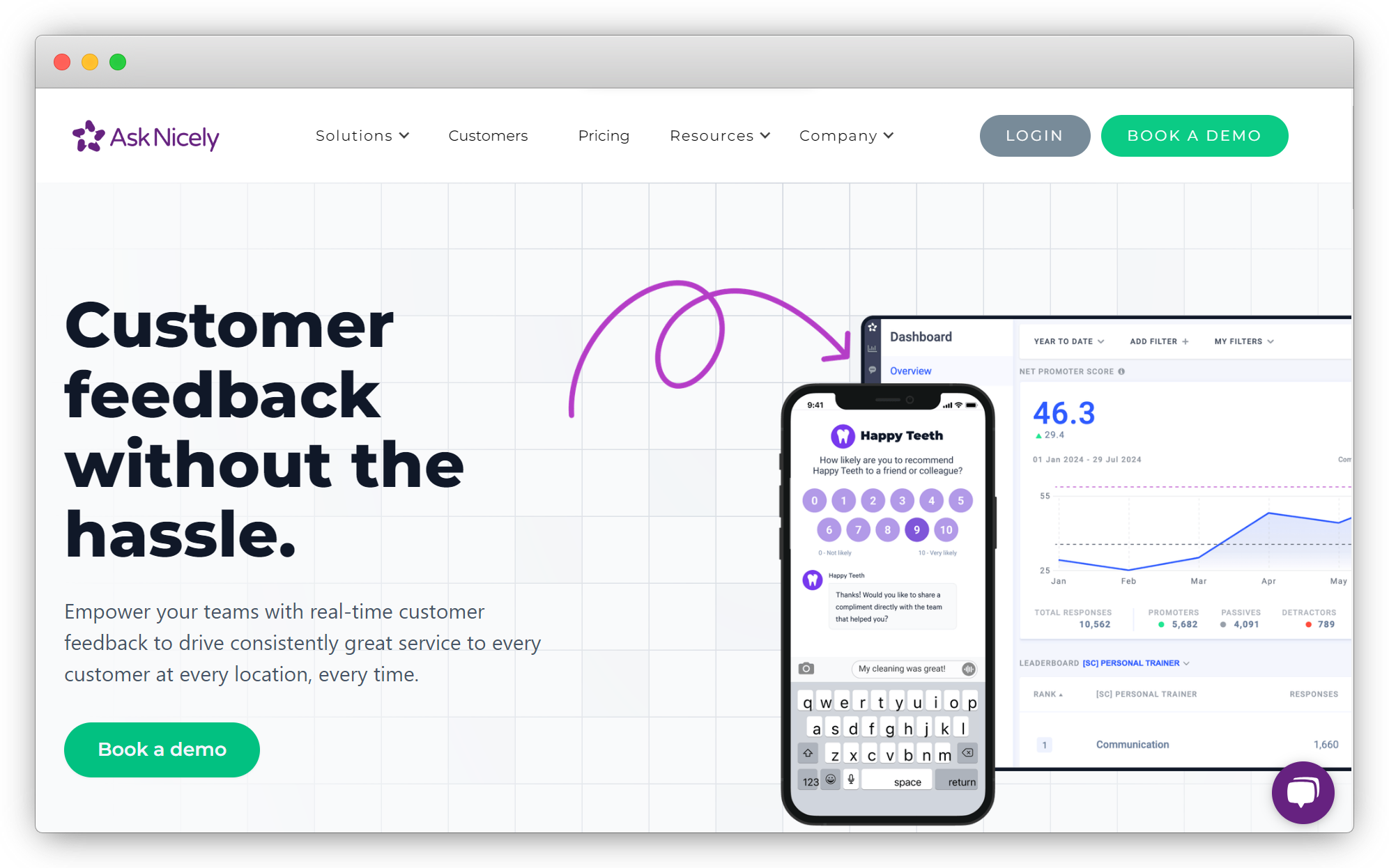
That focus is its strength and its limit. If you're running distributed service teams and want feedback to drive performance on the floor, few tools do it better. If you need heavy analytics or complex research, you'll feel the ceiling. Reviewers occasionally note that some integration steps could be clearer.
Key Features
- Automated NPS and CSAT programs
- Team and location-level performance scoring
- Coaching and recognition workflows
- Real-time alerts and feedback routing
Pros
- Excellent for frontline motivation and accountability
- Simple to run at the team level
- High adoption
Cons
- Analytics depth is limited versus enterprise XM tools
- Some integration steps lack clarity
Pricing: Custom and quote-based. AskNicely does not publish public pricing, so contact sales for a quote.
G2 rating: 4.7/5 from 1,050 reviews
Best for: Multi-location service and frontline teams that want feedback to drive daily performance.
8. SurveyMonkey Enterprise: Best For Broad, Cross-Department Rollout
SurveyMonkey's advantage is the one thing you can't buy: familiarity. Roll it out across departments and most people already know how to use it, which cuts onboarding to near zero. For enterprises that need a reliable, broadly accessible survey tool with proper admin controls, that reach matters more than any single feature.
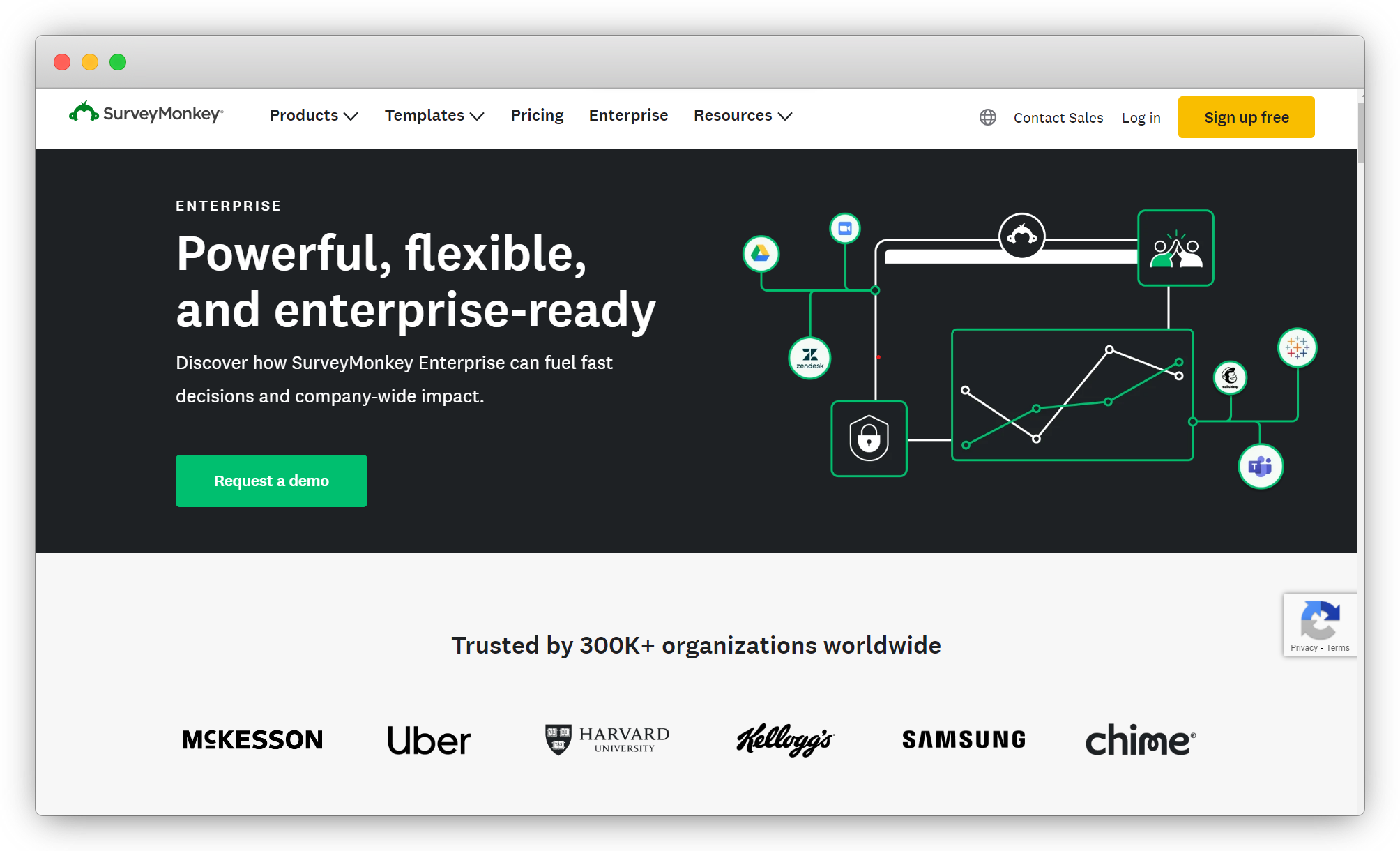
The enterprise tier adds SSO, HIPAA support, advanced admin, and a large integration catalog of 200+ apps, including Salesforce. Where teams outgrow it is depth. Complex analytics and multi-layered branching are where reviewers say they eventually graduate to a heavier platform.
Key Features
- Familiar, low-training survey creation across teams
- Enterprise admin, SSO, and HIPAA support
- Large template library and integration catalog
- Multi-survey dashboards and cross-survey comparison
Pros
- Almost no learning curve
- Broad adoption across departments
- Wide integrations
Cons
- Limited advanced analytics for enterprise research
- Costs rise quickly with users and responses
Pricing: Enterprise pricing is custom (contact sales), SurveyMonkey's team plans are publicly listed.
G2 rating: 4.4/5
Best for: Organizations that need a dependable survey tool everyone can use with no training.
9. Sprig: Best For AI-Native Product Research
Sprig is the clearest example of where the category is heading. It's built AI-first, with agents that help design studies, field them in-product, and synthesize the results into reports. Product and UX teams use it to run in-app surveys, concept tests, and continuous discovery without leaning on engineering or a dedicated research team for every study.
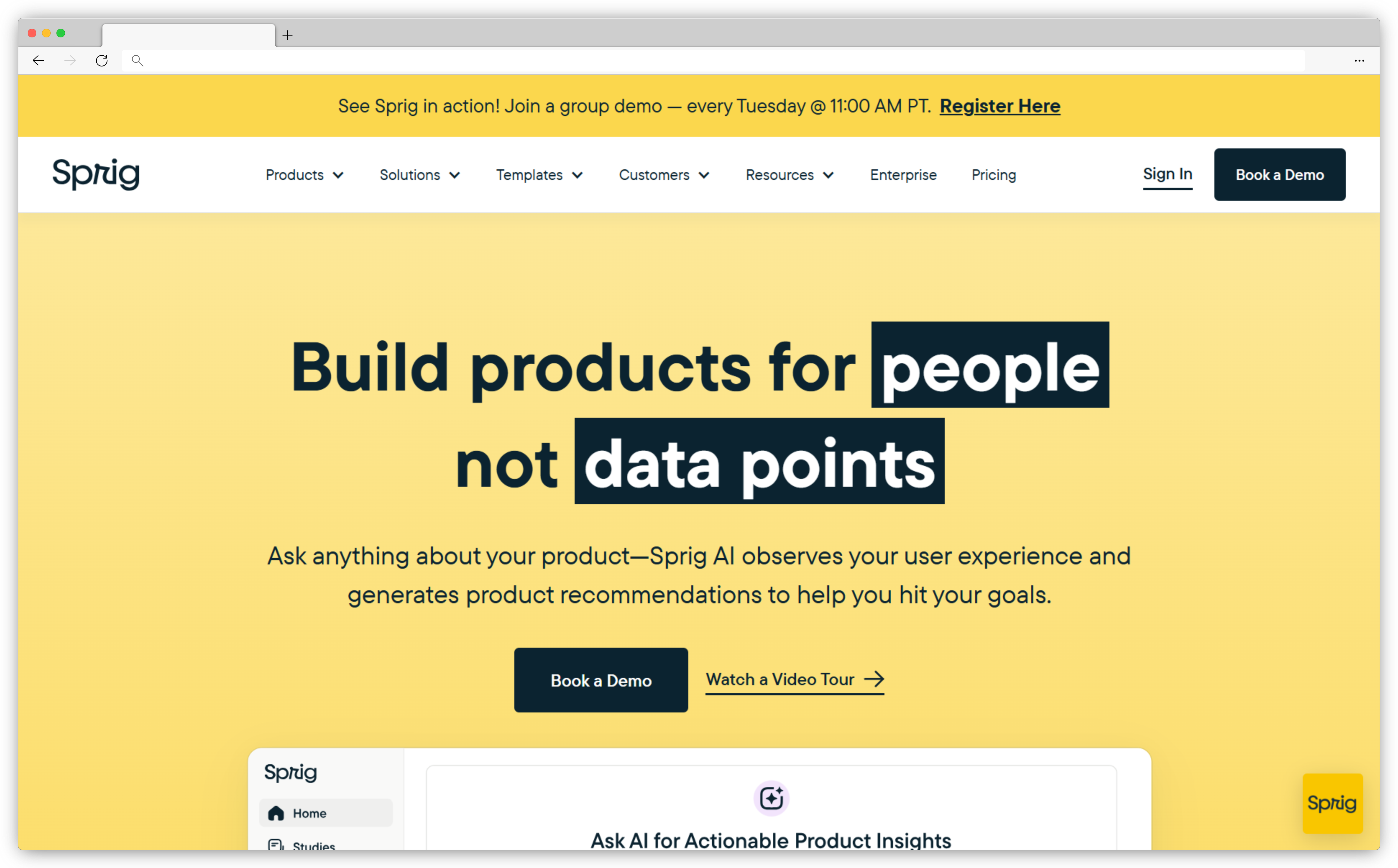
It's narrower than the enterprise suites by design. Sprig is strongest for in-the-moment, in-product research, and reviewers love how fast it is to launch. Two consistent caveats: survey logic isn't as advanced as Qualtrics, and the pricing model (based on monthly tracked users) draws repeated complaints for being hard to predict at scale.
Key Features
- AI agents for study design, fielding, and synthesis
- In-product, web, mobile, email, and link surveys
- Session replay alongside survey responses
- Integrations with Segment, Figma, Slack, and analytics tools
Pros
- Genuinely AI-native workflow
- Very fast to deploy in-product
- Strong AI summaries of open text
Cons
- Survey logic is lighter than research-grade tools
- Usage-based pricing gets unpredictable at scale
Pricing: Free plan, Starter around $175/mo (billed annually), Enterprise is custom.
G2 rating: 4.5/5 from 104 reviews
Best for: Product and UX teams running continuous, in-product research.
10. Typeform: Best For Branded, Conversational Surveys
Typeform made its name on a simple idea: ask one question at a time and forms feel human. That design lifts completion rates and makes surveys feel native to your brand, which is why marketing, product, and CX teams reach for it when respondent experience is the priority. You can embed it on landing pages, run it in email, or trigger it through automations.
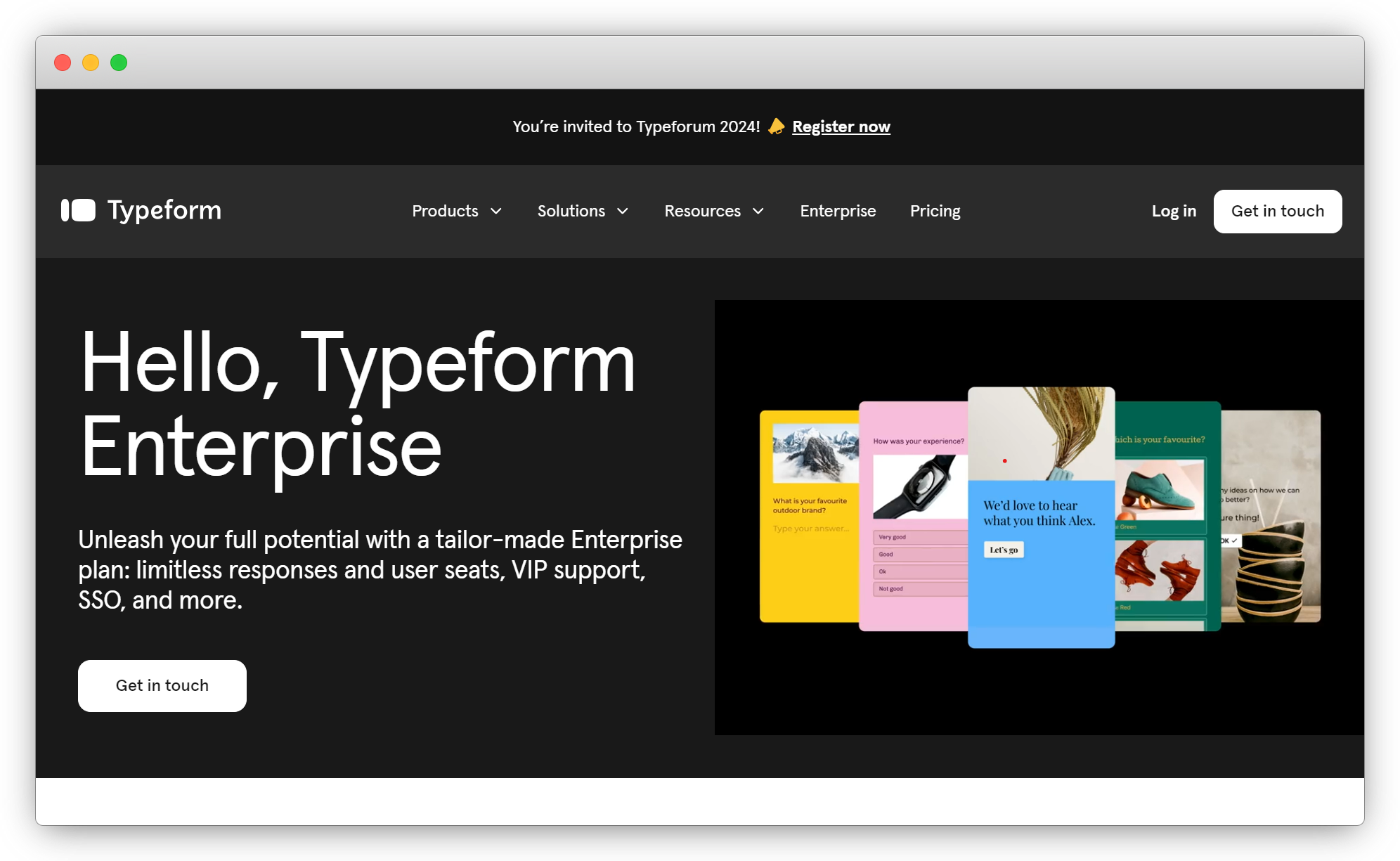
It's an engagement tool more than an analysis engine. Segmentation and analytics stay light, and pricing climbs quickly at high response volumes. But for branded, high-converting feedback where the experience carries the weight, few tools match the polish.
Key Features
- One-question-at-a-time conversational design
- Strong branding and embed options
- Logic that adapts to responses
- Integrations with HubSpot, Slack, Notion, and Zapier
Pros
- Best-in-class respondent experience
- High completion rates
- Genuinely on-brand surveys
Cons
- Limited analytics and segmentation
- Pricing scales fast with volume
Pricing: Free plan, paid plans start around $25/mo.
G2 rating: 4.5/5
Best for: Teams that want branded, conversational surveys with high completion rates.
11. Jotform: Best For Form-Heavy Data Collection At Scale
Jotform is the workhorse of the list. It's a no-code platform with more than 10,000 templates and an enterprise tier that adds SSO, HIPAA support, and admin controls. If your organization runs on forms as much as surveys, from intake to registration to feedback, its breadth and automation are hard to beat, and it does it all without code.
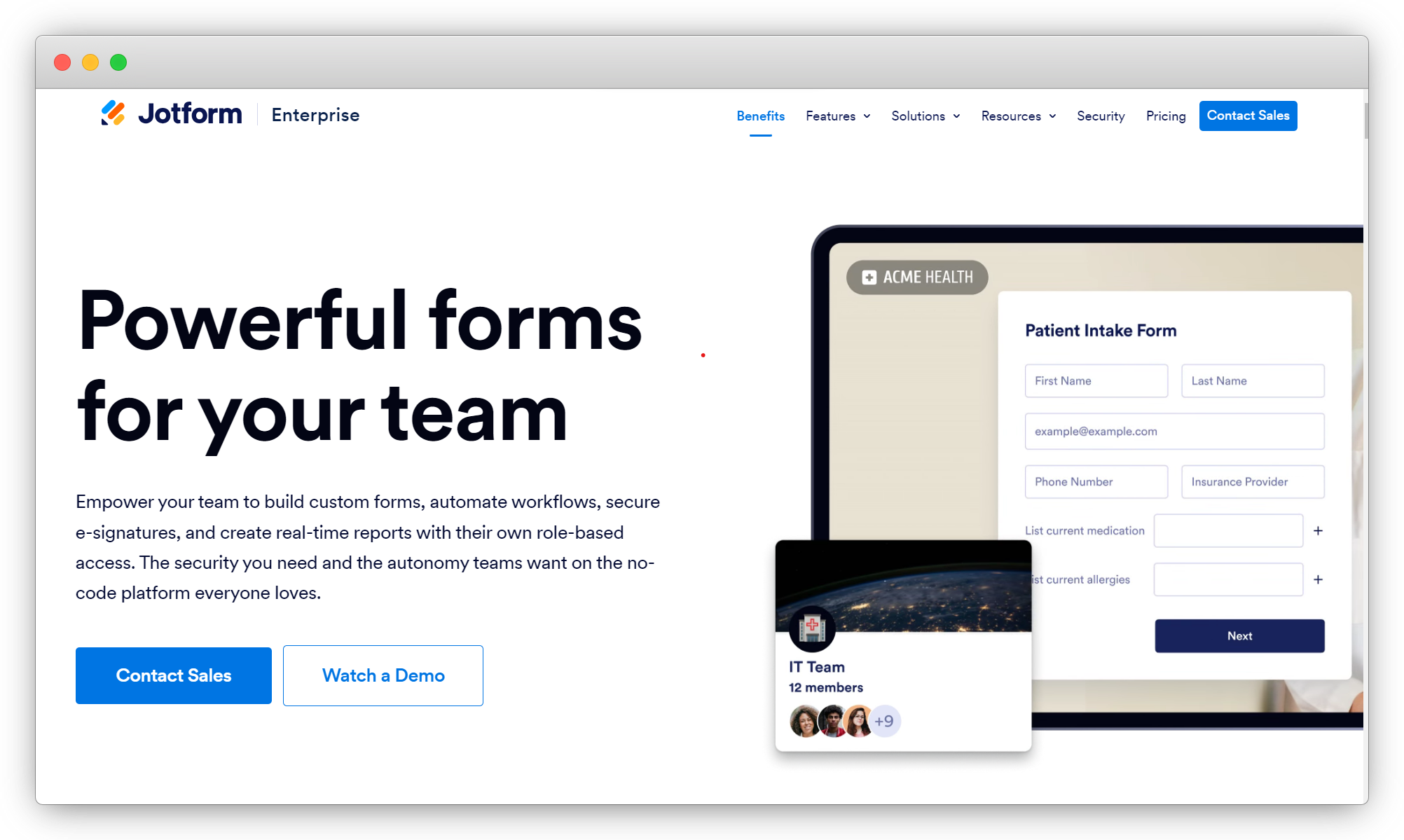
It's less a dedicated CX platform than a flexible data-collection engine, which is exactly why so many teams keep it around. Analytics are functional rather than deep, but for logic-based workflows, payments, and field data collection, it covers an enormous amount of ground.
Key Features
- 10,000+ templates and drag-and-drop, no-code building
- Logic-based workflows and approvals
- Enterprise security (encryption, GDPR, HIPAA, SSO, PCI)
- Offline and kiosk-mode mobile forms
Pros
- Huge template library
- Strong automation and payments
- Genuine no-code flexibility
Cons
- Not a purpose-built CX or analytics platform
- Reporting is functional, not deep
Pricing: Free plan, paid plans start around $34/mo.
G2 rating: 4.7/5
Best for: Teams that need flexible, high-volume form and data collection alongside surveys.
If You Need X, Look For Y: A Fast Way To Choose
Feature lists don't decide this. Fit does. Match your primary constraint to what to prioritize, then shortlist two or three tools and run them against a real workflow before you commit.
| If You Need | Look for.... | Start With |
| Research-grade methodology | Statistical analysis, conjoint, MaxDiff | Qualtrics |
| AI analysis of open-ended feedback | Theme-to-score linking, sentiment scoring | Zonka Feedback, InMoment |
| Omnichannel CX at scale | Signal capture across every touchpoint | Medallia |
| In-product feedback | In-app targeting, CRM sync | Survicate, Sprig |
| Regulated data handling | Data residency, granular permissions | Sogolytics |
| Cross-department rollout | Familiar UI, admin controls | SurveyMonkey Enterprise |
| Public pricing you can start on | Transparent tiers, free plan | Typeform, Jotform |
Two factors deserve extra weight. If Salesforce is your system of record, prioritize native two-way sync over a generic connector, and compare options in our roundup of Salesforce survey tools. And if analysis is the bottleneck, weight AI text analysis heavily, because that's where most of these tools genuinely differ. When sentiment is the core need, it's worth comparing dedicated sentiment analysis tools alongside the platforms here.
For a deeper decision framework with scoring criteria and a vendor questionnaire, see our guide on how to choose enterprise survey tools.
What Changed In Enterprise Survey Software This Year
The biggest story in this category in 2026 isn't a new feature. It's two tools leaving.
Delighted, the go-to for simple NPS and CSAT surveys, shut down on June 30, 2026, and GetFeedback Direct is set to close on December 31, 2026, with both vendors steering customers toward their larger parent platforms (Salesforce Ben). That's not a coincidence. It's consolidation. Qualtrics acquired Delighted and is focusing on its AI suites. SurveyMonkey acquired GetFeedback and is pushing users to SurveyMonkey Enterprise. Two simple, affordable, well-loved tools are gone, and thousands of teams are migrating right now.
If you're one of them, don't just look for a like-for-like replacement. Look for the thing the old tools couldn't do. Both Delighted and GetFeedback were collection tools. They asked the question and gave you a score. What they never did was tell you why the score moved. That's the capability worth buying into now: platforms that read the open-ended answers, not just count the numbers.
Which points at the deeper shift. The category has quietly split in two. On one side, legacy platforms that collect responses into a dashboard and treat open text as an afterthought. On the other, tools that analyze feedback the moment it lands and route a signal to whoever owns the fix. The AI-native entrants (Sprig is the clearest example) were built for the second world from day one, and the established suites are racing to catch up. When you evaluate, ask each vendor what happens in the ten minutes after a detractor hits submit. The answer separates the two camps fast.
One honest note, because it belongs here: not every team needs an enterprise platform. If you're collecting a few hundred responses a month with no compliance requirements and no CRM to sync, a simpler tool will serve you better and cost less. Enterprise survey software earns its price when volume, governance, and cross-team action are real problems. If they aren't yet, buy for where you are, not where a sales deck says you'll be. For the wider picture of how these programs fit together, see our pillar on enterprise surveys.
When Enterprises Actually Run Surveys
Enterprise feedback programs tend to fall into two buckets, and the best platforms handle both without forcing you into separate tools. Understanding which surveys you'll actually run helps size the platform you need. The types of enterprise surveys break down like this:
External surveys point outward at the market and the customer:
- Customer feedback to track satisfaction, loyalty, and product fit
- Product feedback to guide the roadmap and validate features, usually gathered with dedicated product feedback tools
- Vendor and partner feedback to strengthen supply relationships
- Market and brand research before a launch or a new-market entry
- Post-launch surveys to catch problems early
Internal surveys point inward at the organization:
- Employee feedback and engagement across the lifecycle
- Operations feedback to find and fix process friction
- Pre-change pulse checks before a reorg or a rollout
The teams that get the most from enterprise survey software connect the two. When employee experience data sits next to customer experience data, you can trace a drop in customer scores back to a frontline issue, which is exactly the kind of link a single, unified platform makes possible and a patchwork of point tools doesn't.
Which Enterprise Survey Tool Fits Your Team
The honest answer is that there's no single best enterprise survey software, only the one that fits your channels, your compliance requirements, and how your teams turn feedback into action. Qualtrics owns research depth. Medallia owns omnichannel scale. The mid-market tools win on speed and price. And the tools worth the most in 2026 are the ones that don't just collect feedback but tell you what to do about it.
If that last part is where your current setup falls short, if you're collecting plenty of feedback but still can't see which issues are moving your scores, that's the gap to close first. Take two or three tools from this list, run them against a real workflow, and see which one gets you from a response to a decision fastest. To see how omnichannel collection and AI analysis work in one platform, explore Zonka's enterprise survey software.